10 Best Highspot Alternatives for Revenue Teams (2026)
Compare the 10 best Highspot alternatives for enterprise sales teams. Evaluate AI-native revenue execution, content management, pricing, and key tradeoffs.
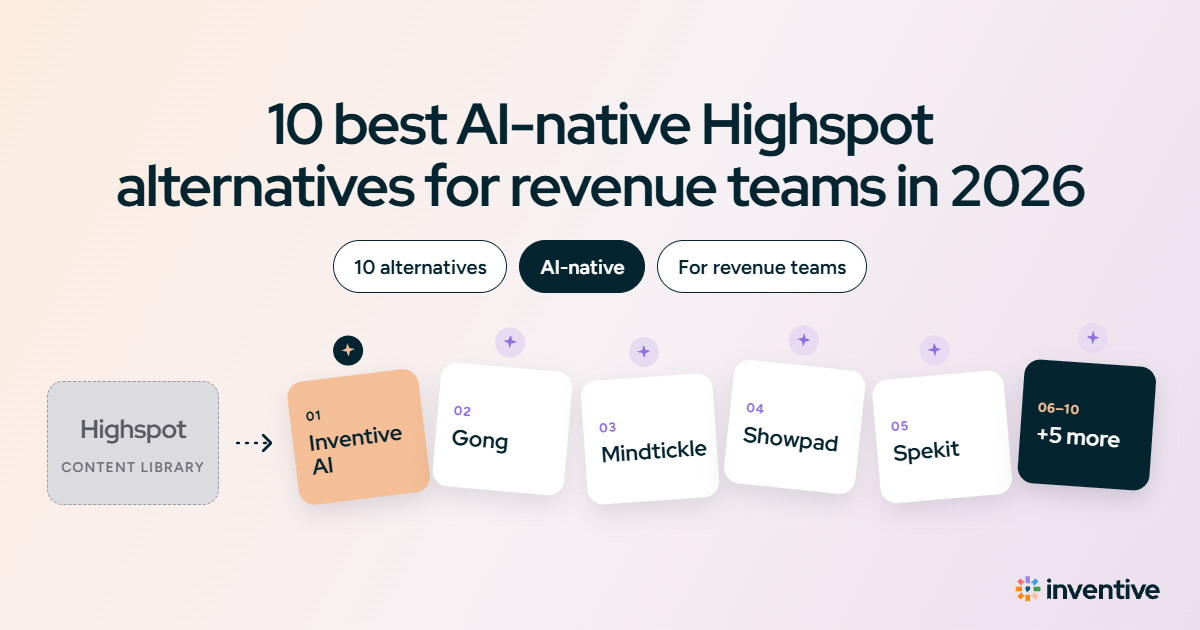
The best Highspot alternatives in 2026 are Inventive AI, Gong, Mindtickle, Showpad, and Spekit. Inventive AI is the top AI-native Highspot alternative because its AI agents do deal work for reps: they draft sales documents, flag what's holding a deal up, and update the CRM.
Highspot is good at storing sales content. But reps still find the file, edit it, send it, and log it in the CRM by hand, and that manual work slows deals down. The August 2026 Seismic merger has also pushed many teams to re-check their contract.
This guide compares 10 Highspot alternatives by what each tool does best, its price, G2 rating, and limits. It also covers what to ask vendors and how to switch.
TL;DR: 10 best alternatives to Highspot at a glance
- Inventive AI: Best for reducing deal slippage, with AI agents that surface what each deal is waiting on, build deal-specific sales assets, and update Salesforce and HubSpot.
- Gong: Best for call recording, deal risk alerts, and coaching built from real sales calls.
- Mindtickle: Best for onboarding new reps and AI role-play practice.
- Showpad: Best for field sales teams that present on tablets, including offline.
- Spekit: Best for quick answers and guidance inside Salesforce, Gmail, and Slack.
- GTM Buddy: Best for AI that suggests the right content inside email, CRM, and calendar.
- Allego: Best for video pitch practice and peer coaching.
- Mediafly: Best for ROI calculators that reps build with buyers.
- SalesHood: Best for step-by-step sales playbooks and team coaching.
- Zoomforth: Best for branded, trackable proposal websites for big deals.
Why are revenue leaders replacing Highspot in 2026?
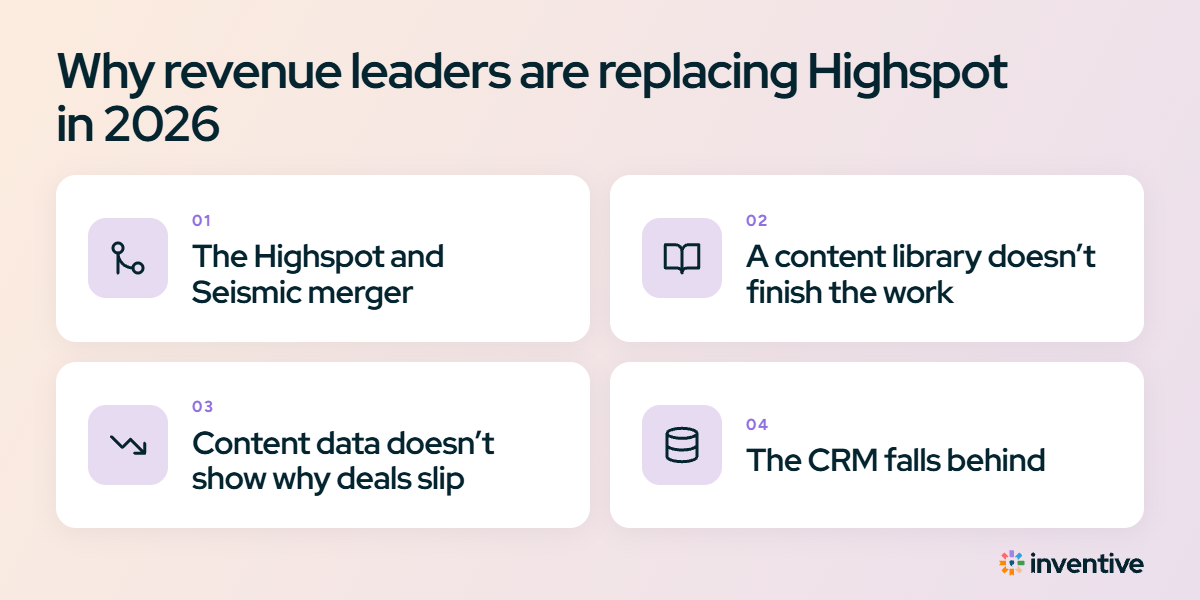
Revenue leaders replace Highspot when keeping a content library up to date takes more work than it saves on live deals. The 2026 Seismic merger added a second reason: renewals now involve a new parent company with a roadmap still being decided.
To be fair, Highspot is still a strong product. It has a 4.7/5 rating on G2 from about 1,200 reviews, and Gartner named Highspot by Seismic a Leader in its 2026 Magic Quadrant for Revenue Enablement Platforms. Teams that mainly need to organize thousands of files across many business units have good reasons to stay. Here are the four reasons others are moving.
The Highspot and Seismic merger
Seismic, Highspot's biggest competitor, completed its merger with Highspot on August 18, 2026. The product is now called Highspot by Seismic. Seismic says Highspot customers won't be forced to move, and it plans to spend more than $100 million a year on product development.
In plain terms, one company now owns both of the largest content platforms. So at renewal, buyers are asking three things: which product gets more investment, whether prices change, and how long both products stay supported.
A content library doesn't finish the work
A content library helps reps find approved files, but the work after that stays manual. Reps still edit the file for each buyer, send it, log it in the CRM, and follow up.
This matters because more tools don’t mean less work. A Gartner survey of 1,026 B2B sellers found that 50% feel overwhelmed by the amount of technology their job requires, and sellers who feel overwhelmed are 45% less likely to hit quota. Tools that complete these steps for reps reduce that load and give reps more time to sell.
Content data doesn’t show why deals slip
RevOps teams need to know which deals will close on time and what’s holding the rest back. Library-based sales content and proposal tools mainly report on content: which files reps shared, and which ones buyers opened.
That data doesn’t explain a deal that slips into next quarter. The cause is usually inside the company: a pricing approval waiting in finance, a contract redline sitting with legal, or a security review nobody picked up. RevOps leaders find out late, often in the forecast call, when it’s too late to pull the deal back.
The CRM falls behind
Most content tools don’t update the CRM. Reps still type next steps, deal stages, and call notes into Salesforce or HubSpot after every call, and when they skip it, RevOps leaders forecast from outdated records.
Poor CRM data affects revenue. In Validity’s State of CRM Data Management in 2025 report, a survey of 602 CRM users, 37% said their company lost revenue because of poor CRM data.
Highspot alternatives that update the CRM after each call keep deal records current without relying on reps to type them in.
Highspot alternatives compared: features and pricing
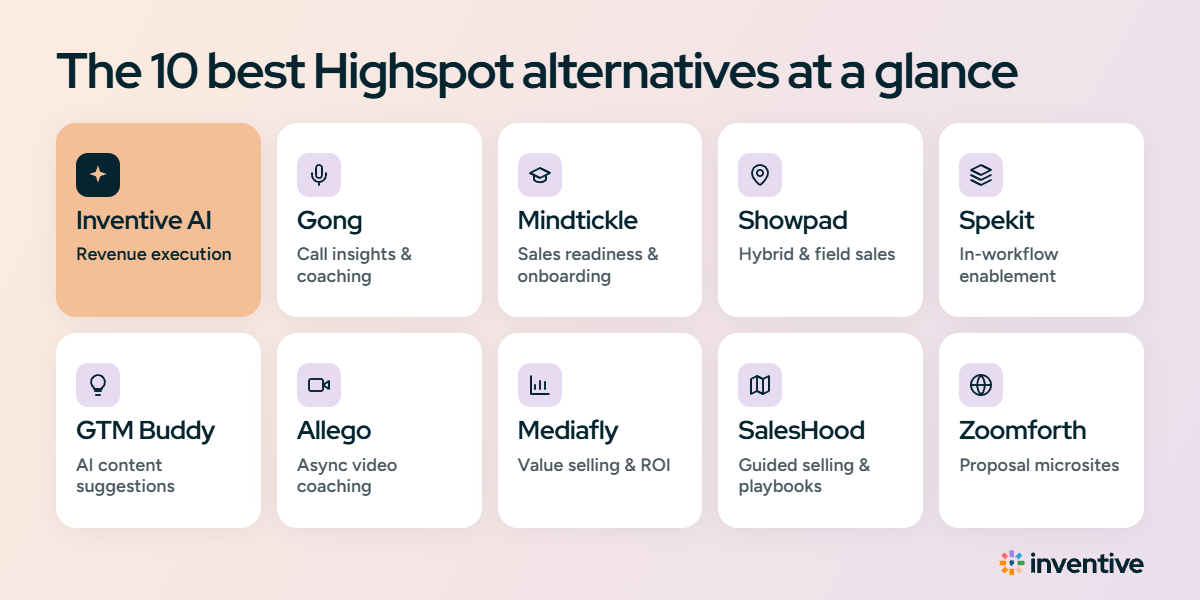
Highspot alternatives fall into three groups. AI-native platforms do deal work, such as drafting documents and updating the CRM. Content platforms store and share approved files. Coaching platforms train reps. The table compares the 10 best alternatives to Highspot side by side.
Inventive AI: best AI-native Highspot alternative for revenue execution
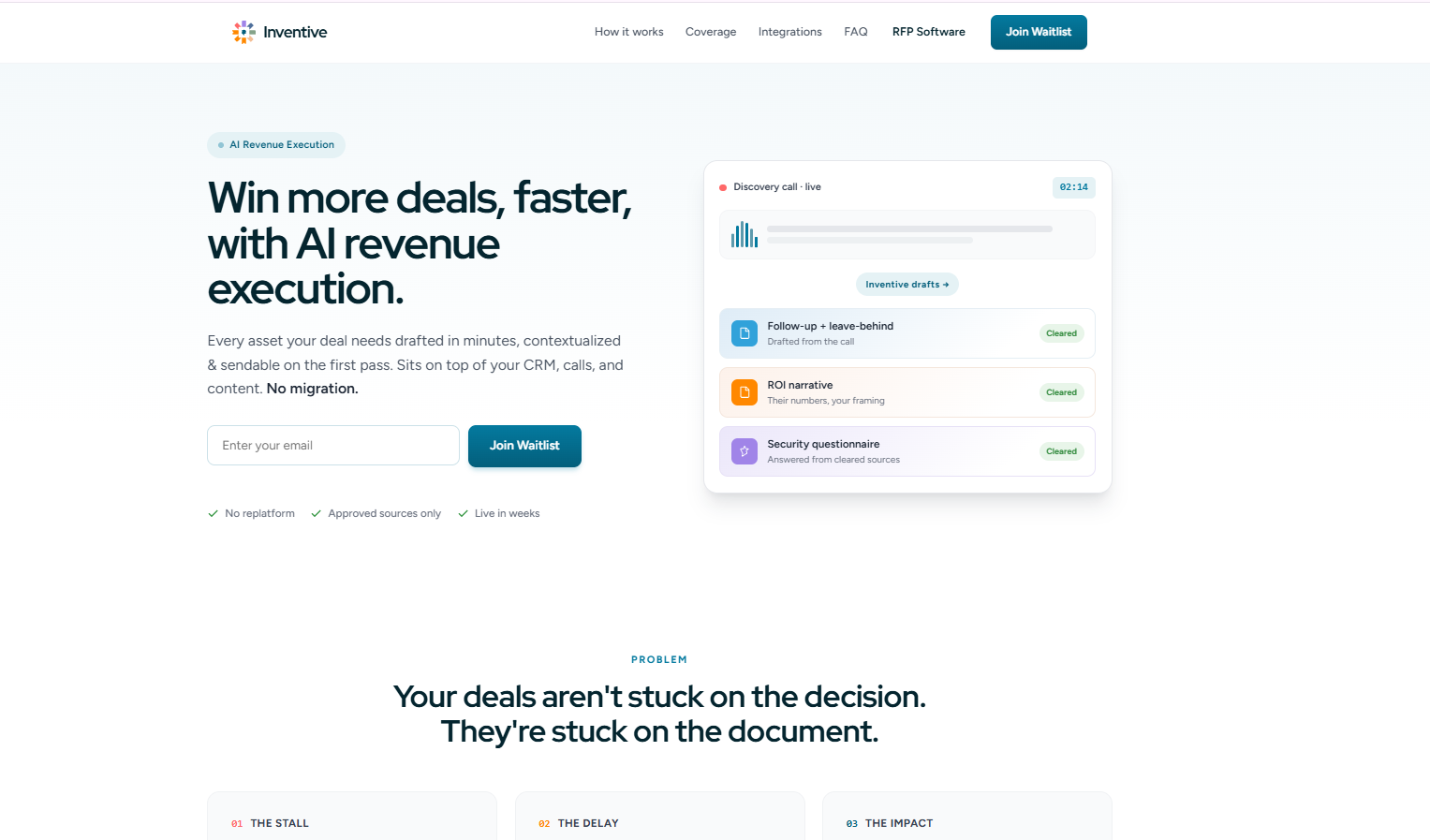
Inventive AI is the best AI-native Highspot alternative for revenue teams that want AI agents to reduce deal slippage. The agents flag what each deal is waiting on, build deal-specific sales assets from approved content, and update Salesforce or HubSpot, while reps approve the work. Inventive AI’s revenue execution platform is built for deals that stall on paperwork and internal sign-offs, and every capability below is live today.
What the AI agents do:
- Deal Slippage Agent: Shows what each deal is waiting on internally, such as a pricing approval, a redline with legal, or an open security review, and compares the rep’s close date with the likely one. It also drafts follow-up emails for the rep to send.
- Sales Collateral Agent: Builds briefs, one-pagers, ROI case studies, and pre-demo agendas from the Knowledge Hub, CRM, and call data, using the company’s own templates. Finished assets save to the CRM deal record.
- CRM Automation Agent: After each meeting, it updates Next Step, Description, and Stage in Salesforce or HubSpot, on approval or automatically for routine changes.
- Call Prep & Recap Agent: Preps reps with deal history and a suggested agenda before each call. After the call, it summarizes buyer needs, risks, and next steps, then creates the follow-up tasks.
Best features:
- Assets start from the call: If the buyer asks for a one-pager on the call, the agent starts building it in the background, without a rep opening a template.
- Sources on every asset: Each asset shows where its content came from: the Knowledge Hub, the CRM, or the web.
- Teams decide how much the AI does alone: For each type of task, teams choose "do it quietly," "do it and tell me," or "ask first." Emails and Slack messages to customers ask first by default, and everything waiting for sign-off sits in one approvals queue.
- A task list that mostly completes itself: The Task Execution Agent runs tasks like "send one-pager," closes tasks it sees the rep already did, shows what finished while the rep was away, and explains what it did and why.
- Custom agents: Reps and managers type requests such as "give me an update on this deal every Monday at 10am" or "alert me when the MSA is signed," and the agent runs on that schedule or event.
Limitations:
- Not for prospecting: Inventive AI is built for mid-market and enterprise deals already in the pipeline, not for cold outreach.
- Not a training tool: Teams that need rep courses, certifications, or role-play should pair it with Mindtickle or Allego.
- Call recorder support: Fathom is connected today. Gong, Zoom, and Fireflies are on the integration list, so teams using those should confirm timing.
Pricing: Contact for pricing.
G2 rating: 4.9/5 (about 100 reviews).
Gong: best Highspot alternative for call insights and coaching
Gong is the best Highspot alternative for teams that want to learn from their sales calls. It records and analyzes calls, flags deals at risk, and, since February 2026, includes Gong Enable for coaching and training.
Gong started as call recording software and grew into a full revenue AI platform. It suits teams that want coaching, deal reviews, and forecasting based on what buyers actually said, rather than on what reps typed into the CRM.
Best features:
- Call recording and analysis: Records calls and highlights topics, objections, and next steps.
- CRM updates from calls: Gong's AI Data Extractor fills in CRM fields based on what was said on the call.
- Gong Enable: Coaching scorecards and practice scenarios built from real calls.
- Deal and forecast views: Shows which deals are healthy and which are at risk.
Limitations:
- Not a content platform: Gong focuses on calls and deal data. It isn't built to create, manage, or share branded sales documents.
- Cost adds up: Pricing includes a per-user fee plus a platform fee, and add-ons such as Forecast, Engage, and Enable are sold separately.
- Built for larger teams: The platform fee makes it a bigger buy for small teams.
Pricing: Median contract of about $55,333/year across 1,141 deals (Vendr data).
G2 rating: 4.7/5 (about 6,700 reviews).
What users say: Reviewers value call insights and coaching. Cost and add-on pricing are the most common complaints.
Mindtickle: best alternative to Highspot for sales readiness and rep onboarding
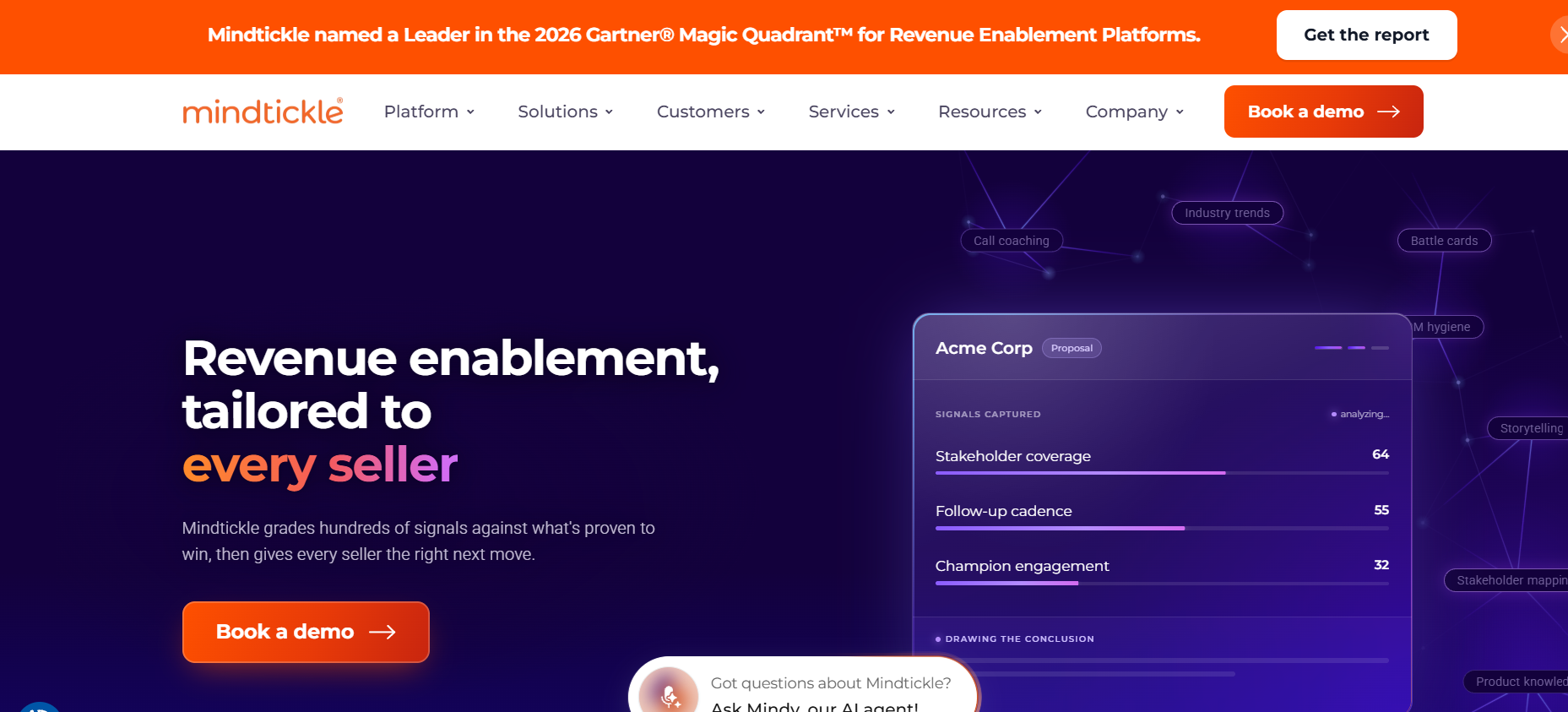
Mindtickle is the leading Highspot competitor for getting new reps ready to sell. It focuses on onboarding, role-play practice, and coaching, with content management in a supporting role.
Mindtickle fits enablement teams that track rep skills and ramp time (how long a new rep takes to become productive). Its Readiness Index shows which reps are ready and where skills are missing.
Best features:
- AI Sales Role Play: Reps practice real sales conversations with AI and get feedback without waiting for a manager.
- Readiness Index: Shows each rep's skill level and gaps.
- Call analysis: Records calls so managers can coach on real deals.
- Copilot: Helps with call prep, notes, and follow-up emails.
Limitations:
- Content comes second: Content tools support training rather than lead it.
- Not built for deal work: Teams that need sourced deal documents and CRM stage updates should test those directly.
- Needs an enablement team: The platform is broad and works best with someone dedicated to running it.
Pricing: Median contract of about $44,356/year (Vendr)
G2 rating: 4.7/5 (about 2,200 reviews).
What users say: Strong marks for training, onboarding, and role-play. Teams that need a deal document engine usually run it alongside another tool.
Showpad: best Highspot competitor for hybrid and field sales teams
Showpad is the top Highspot competitor for reps who present in person on tablets: in showrooms, at trade shows, or at client sites. It now includes the former Bigtincan platform.
In 2025, investment firm Vector Capital bought Showpad and merged it with Bigtincan under the Showpad name. Former Bigtincan customers should ask which features are fully combined and which still run separately.
Best features:
- Offline mode: Reps present approved content on tablets with no internet.
- Shared Spaces: Pages where reps share content with buyers and see what they open.
- AI search: Suggests the right content during a deal.
- CRM connections: Works with Salesforce, HubSpot, and Microsoft Dynamics and logs activity.
Limitations:
- Works from uploaded files: Admins must keep content bundles current, especially for offline use.
- Still merging: Two platforms are being combined, which can slow new features.
- No deal agents: It doesn't flag internal blockers or update deal stages.
Pricing: Custom quote across several plans.
G2 rating: 4.6/5 (about 1,900 reviews).
What users say: Reps like how easy it is to use and share. Admin tools draw the most complaints.
Spekit: best Highspot alternative for in-workflow contextual enablement
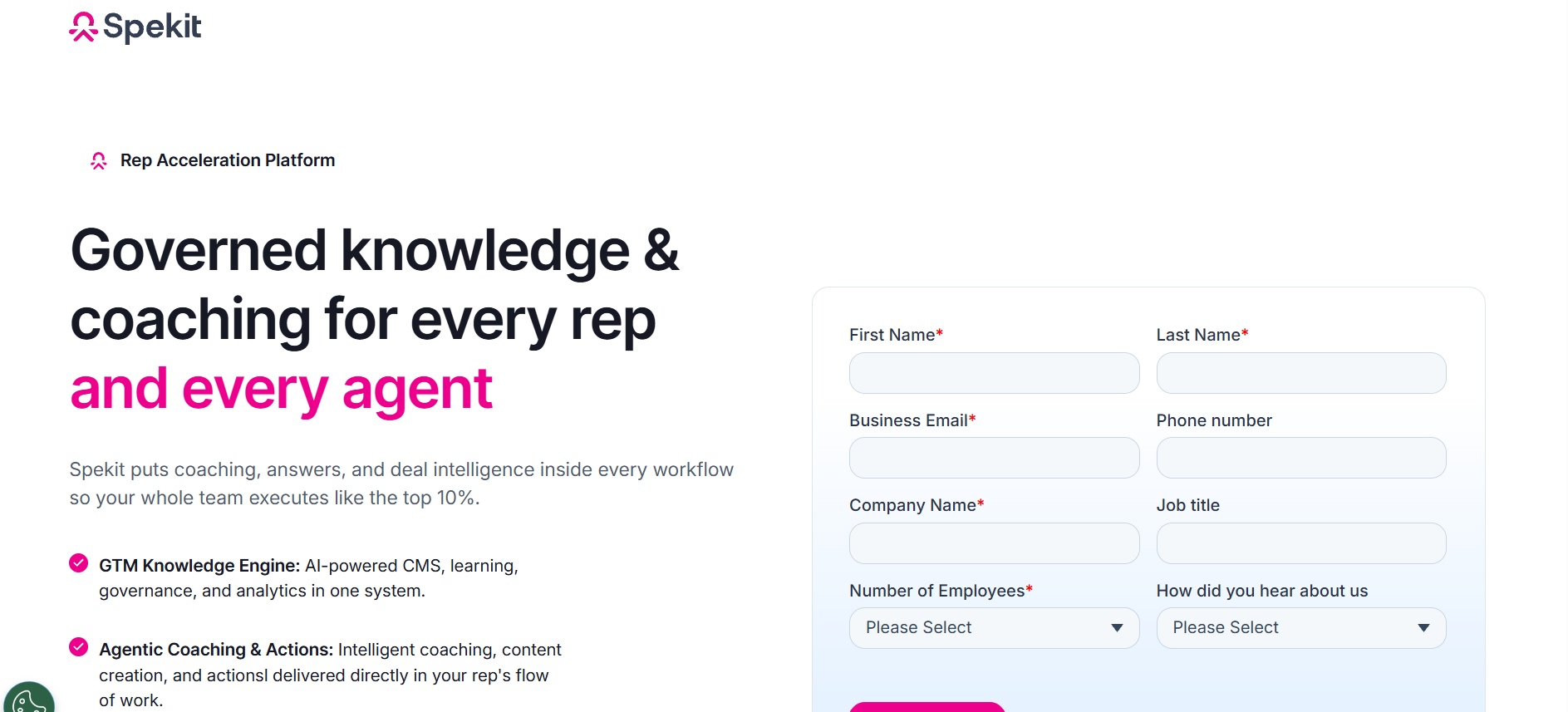
Spekit is the best Highspot alternative for teams that want answers and guidance to show up inside the tools reps already use, such as Salesforce, Slack, and Gmail, instead of in a separate portal.
Spekit started with short knowledge cards called Speks. In September 2026, it relaunched AI Deal Rooms: shared pages for each buyer that AI fills with deal-specific content and refreshes after calls.
Best features:
- In-app guidance: Speks appear next to the fields and tools reps use, through a browser extension.
- Spotlights: Pop-up alerts for urgent updates and announcements.
- AI Sidekick: Suggests content, drafts messages, and answers rep questions.
- AI Deal Rooms: Buyer pages with AI-written content and a dashboard for sales leaders.
Limitations:
- Guidance first: Spekit's materials focus on guidance, content, and deal rooms. They don't describe agents that update deal stages or chase internal approvals.
- Search: G2 reviewers mention weak search and slow loading.
Pricing: Contracts start around $8,700/year, as per Vendr.
G2 rating: 4.6/5 (about 300 reviews).
What users say: Quick to roll out, and reps actually use it. Complaints focus on search and speed.
GTM Buddy: best Highspot alternative for AI content suggestions in the flow of work
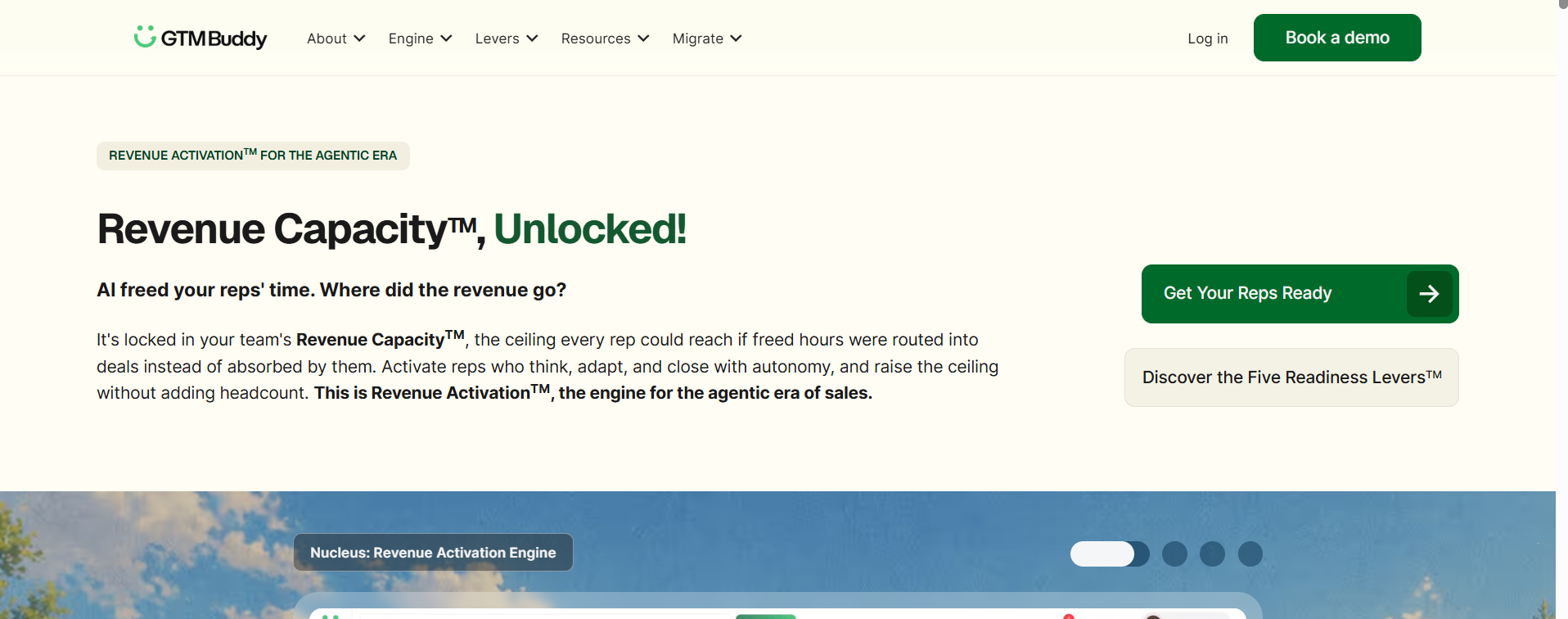
GTM Buddy is the best Highspot alternative for teams that want AI to suggest the right content without reps searching a portal. It surfaces content inside email, the CRM, and the calendar, based on the deal and the conversation.
GTM Buddy calls itself AI-native and brings content, training, coaching, role-play, and digital sales rooms into one platform. It's a good fit for mid-market teams that want to cut down on manual content tagging.
Best features:
- Content suggestions in context: Recommends content based on the buyer, the deal, and the conversation.
- Call prep in the calendar: Puts relevant information next to upcoming meetings.
- Auto-indexing: AI organizes content, so admins spend less time tagging files.
- Training and role-play: Coaching and practice tools in the same platform.
Limitations:
- Suggests more than it drafts: It focuses on finding and personalizing existing content. Teams should ask how much it creates new deal documents.
- No deal agents: Its materials don't describe flagging internal blockers or updating deal stages.
- Busy interface: G2 reviewers mention a crowded screen and a learning curve.
Pricing: Custom quote. Also sold through AWS Marketplace.
G2 rating: 4.8/5 (about 150 reviews).
What users say: Reviewers like the time saved on call prep and finding content. The interface takes some getting used to.
Allego: best alternative to Highspot for asynchronous video coaching
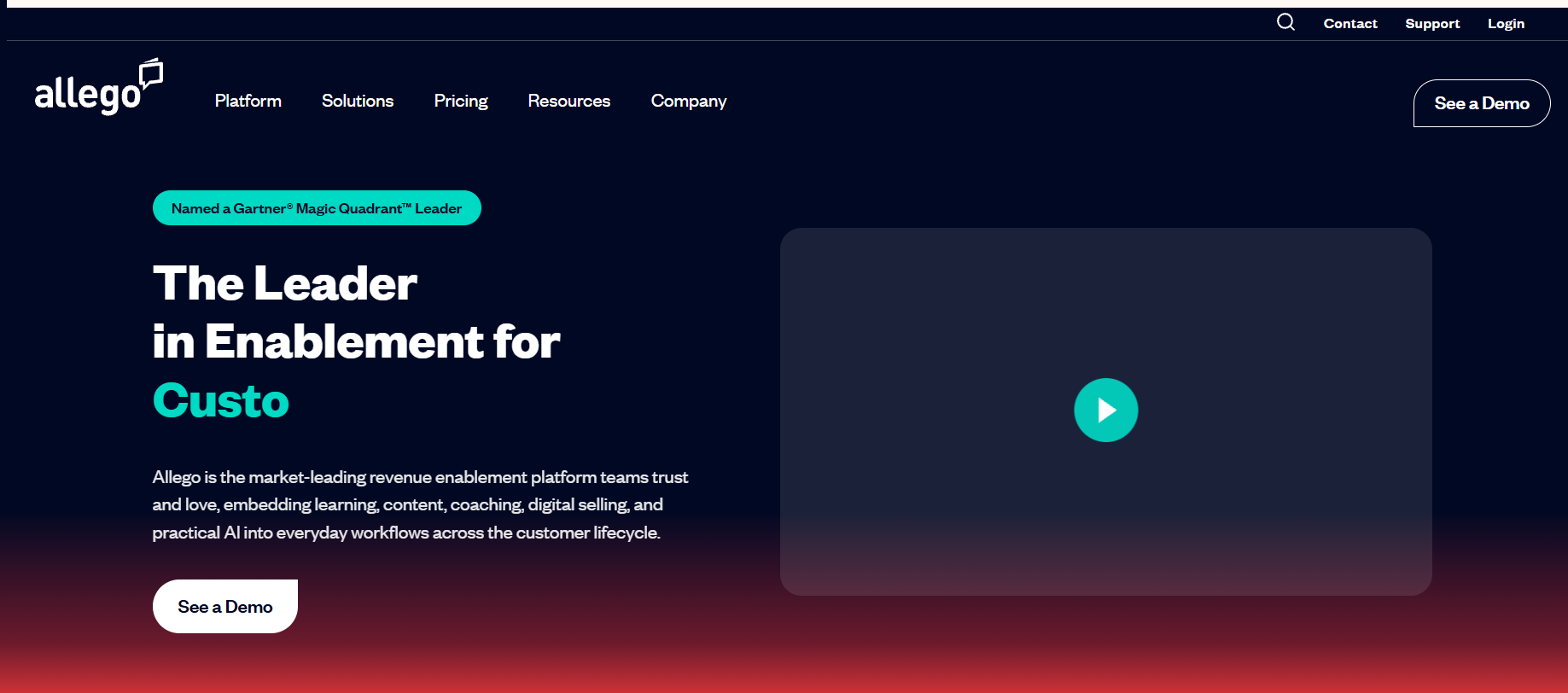
Allego is the best alternative to Highspot for teams that coach through video. Reps record practice pitches, get scored, and learn from top performers, all without scheduling live sessions.
Allego started as a mobile video learning tool and grew into a broader enablement platform. Its strength is still video practice for teams spread across locations.
Best features:
- Video pitch practice: Reps record pitches and get AI and manager feedback.
- Peer learning: Top performers' videos become coaching material for everyone.
- Content library: AI tagging and search across approved files.
- Digital sales rooms: Branded buyer pages with engagement tracking.
Limitations:
- Search in large libraries: Reviewers say finding files gets harder as the library grows.
- Admin learning curve: Setup is harder for admins than the rep experience suggests.
- No background deal work: It doesn't update the CRM or complete deal tasks for reps.
Pricing: Custom quote, per user, billed annually.
G2 rating: 4.6/5 (about 670 reviews).
What users say: Praised for video coaching and feedback. Less help with creating new sales documents.
Mediafly: best Highspot competitor for interactive value selling and ROI models
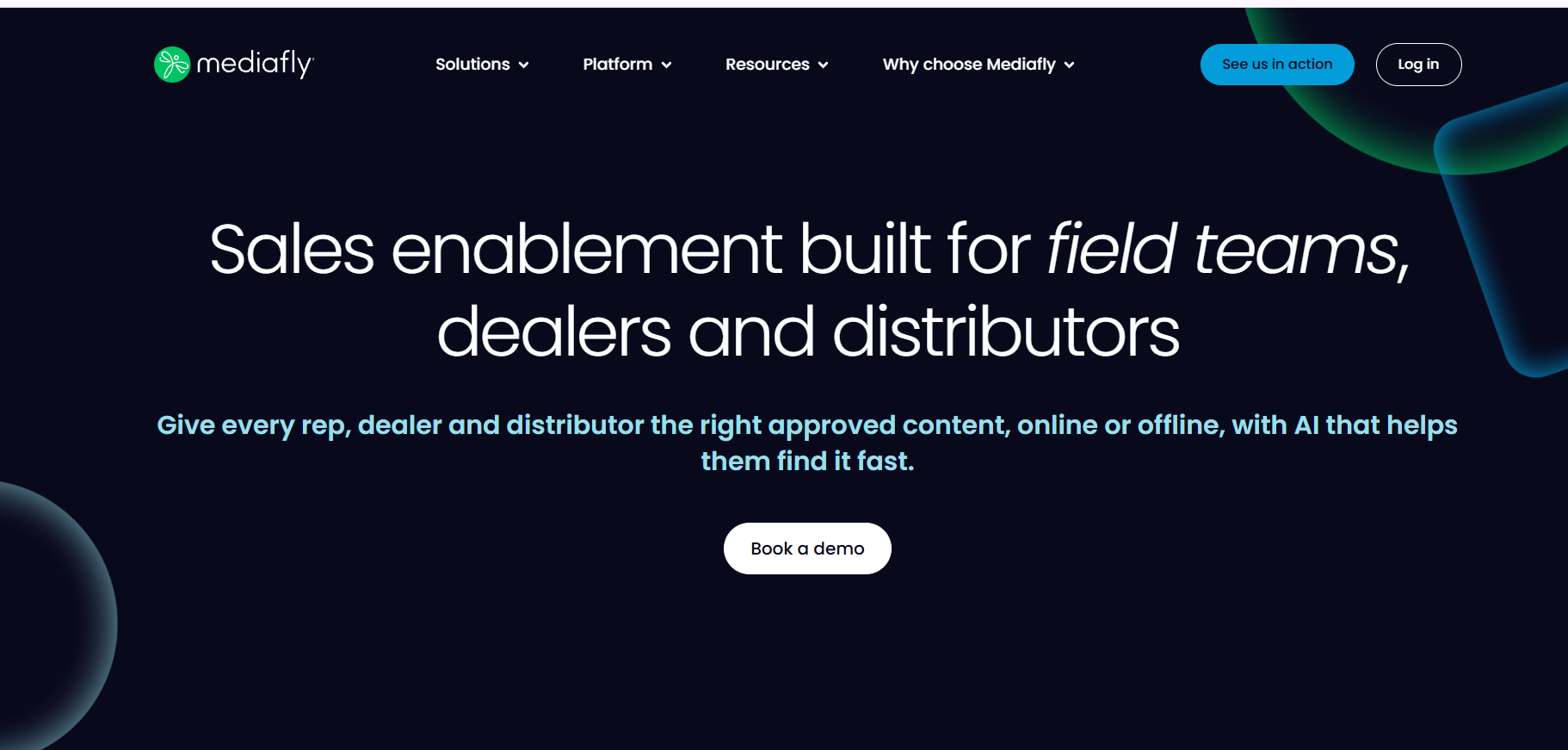
Mediafly is the right Highspot competitor for long enterprise deals where buyers need proof of value. Reps and buyers build ROI and total cost of ownership (TCO) calculators together, so the business case uses the buyer's own numbers.
Mediafly's value-selling tools came from its 2018 purchase of Alinean. Later purchases added revenue analytics and AI, all sold as modules in its Revenue360 platform.
Best features:
- ROI and TCO calculators: Interactive models that reps and buyers adjust together.
- Interactive presentations: Approved content delivered as clickable presentations.
- Engagement tracking: Shows which content and models buyers use.
Limitations:
- Setup takes time: Custom calculators need onboarding and consulting to build.
- Sold in modules: Buyers should map exactly which modules they need.
- Learning curve: Some G2 reviewers say the platform takes time to learn.
Pricing: Custom quote based on modules.
G2 rating: 4.4/5 (about 1,340 reviews).
What users say: Builds credibility in conversations with finance leaders. The calculators need setup before reps can use them.
SalesHood: best alternative for guided selling and team playbooks
SalesHood is best for teams that want clear, stage-by-stage sales playbooks. Managers turn their sales process into steps, and reps follow them deal by deal.
SalesHood combines playbooks, training, and buyer pages in one platform. Reps practice with AI feedback, and shared action plans keep the rep and buyer on the same timeline.
Best features:
- Guided selling: Plays and content for each deal stage, inside the CRM.
- Digital sales rooms and action plans: Shared buyer pages with next steps and owners.
- AI coaching: Pitch practice and role-play with AI scoring.
- AI Content Writer: Drafts content inside the platform.
Limitations:
- Training focus: SalesHood's materials focus on training, content, and coaching. They don't describe agents that watch for deal blockers or update deal stages.
- Admin learning curve: Some admins say complex programs take time to set up.
Pricing: Essential plan: $40 to $65/user/month. Professional plan: $50 to $75/user/month (Vendr)
G2 rating: 4.6/5 (about 830 reviews).
What users say: Good for getting everyone on one sales process. Some users say it feels more like a training tool than a daily deal workspace.
Zoomforth: best Highspot alternative for custom proposal microsites
Zoomforth is the top Highspot alternative for teams that want to send proposals as branded, trackable websites instead of PDF attachments.
Zoomforth focuses on what the buyer sees. Teams build polished proposal sites for big bids, renewals, and executive briefings, and control who can access them.
Best features:
- No-code builder: Drag-and-drop pages built from on-brand blocks.
- Section tracking: Shows which sections each visitor viewed and for how long.
- Enterprise security: Single sign-on, multi-factor login, and SOC 2 Type II.
Limitations:
- Narrow focus: No rep coaching, internal content library, or CRM automation.
- Needs existing content: The sites are only as good as the documents teams already have.
Pricing: Custom quote, with a 14-day free trial.
G2 rating: 4.6/5 (about 45 reviews).
What users say: Strong for high-stakes proposal presentations and quick to start. Teams still need their content ready.
What to check before evaluating Highspot alternatives for AI sales enablement
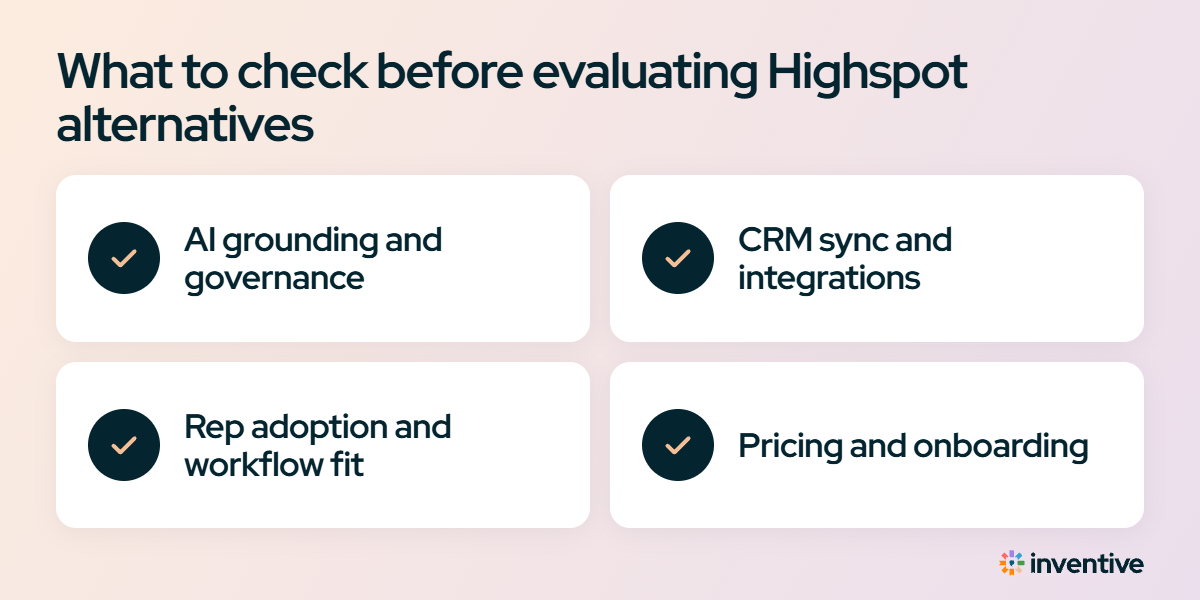
Revenue leaders evaluating Highspot alternatives for AI sales enablement should first check one thing: does the tool help deals close on time, or does it only help reps find files? The answer shows how much deal work stays with reps.
Ask these five questions in every demo:
- Does it show what each deal is waiting on before it slips? Look for internal blockers, such as a pending pricing approval or a contract redline with legal, and a realistic close date compared with the one the rep entered.
- Can it build an asset for a specific deal? Ask the vendor to create a one-pager, ROI case study, or pre-demo agenda live, using one of the team’s past deals.
- Does every asset show its sources? Without sources, someone has to fact-check the content before a buyer sees it.
- Does it update CRM next steps and deal stages, and can managers choose what needs approval? Approval settings per type of task stop automatic updates from creating new data problems.
- Does it show what the AI did and why? Reps and managers should be able to see each action the AI took, and its reasoning, before they trust it with live deals.
The quickest way to compare is to run every shortlisted tool on the same closed deal. Check which blockers it finds, the quality of the asset, the sources, and how many steps still need a rep. The same test works for any AI sales enablement tool you are willing to shortlist.
How to switch from Highspot to an AI-native platform
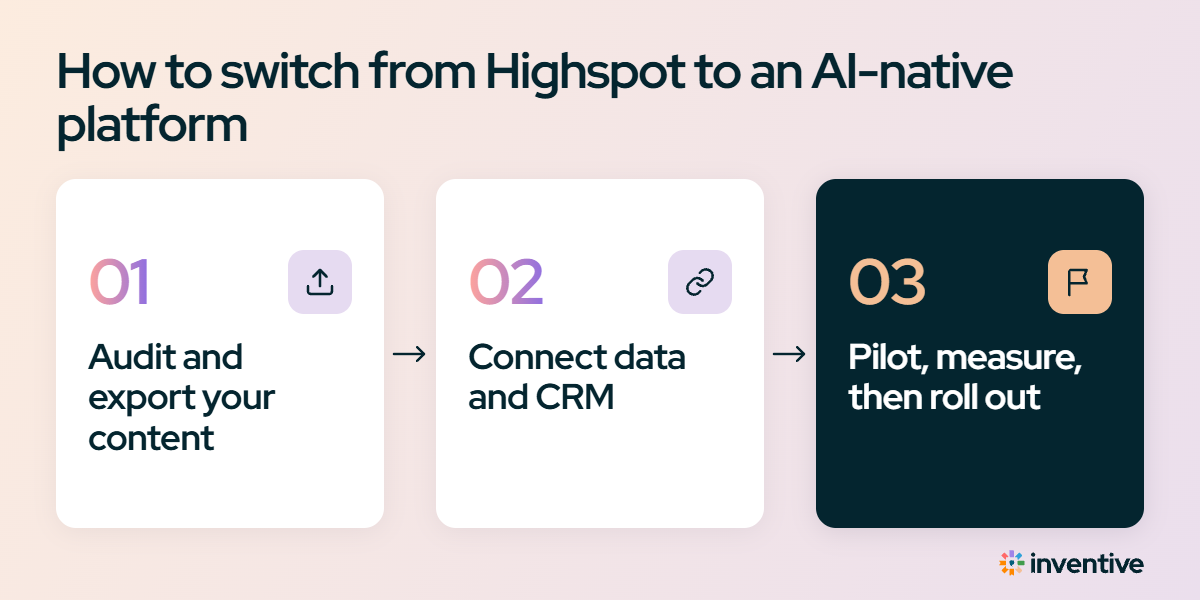
Switching from Highspot to an AI-native platform usually takes weeks, not quarters. The work is connecting the places where approved content already lives, not rebuilding folders. Since Seismic isn't forcing Highspot customers to move, teams moving to AI-native Highspot alternatives can run both tools side by side until renewal.
- List what reps actually send: Pull Highspot's usage data for the last two quarters. The files buyers opened are the ones worth connecting first.
- Connect where content already lives: Link the content sources that hold approved sales decks, case studies, and product material, instead of re-uploading files.
- Decide what buyers can see: Keep unreleased roadmaps, internal pricing notes, and draft messaging out of the sources used for buyer documents.
- Connect the CRM and call recorder: Link Salesforce or HubSpot plus a recorder such as Fathom, so the agents know each deal's stage, history, and what the buyer asked for. See the current integrations.
- Choose what needs approval: Let routine CRM updates happen automatically, and keep approval on anything sent to customers.
- Test on live deals for one quarter: Compare deal speed, document turnaround, and CRM accuracy against deals still running through Highspot. Then decide at renewal.
Bottom line: which Highspot alternative fits each type of sales team?
The right Highspot alternative depends on what slows the team’s deals down most:
- Deal slippage, deal-specific sales assets, and CRM updates: Inventive AI.
- Rep onboarding, practice, and certifications: Mindtickle or Allego.
- Coaching from sales calls: Gong.
- Selling in person or on tablets: Showpad.
- Guidance inside everyday tools: Spekit or GTM Buddy.
- Step-by-step playbooks: SalesHood.
- ROI business cases for finance buyers: Mediafly.
- Proposal presentations for large deals: Zoomforth.
For teams that want to close deals faster, the delays often come after the call: documents to build, approvals to get, and CRM updates to make. AI-native alternatives handle that work so reps spend more time selling.