Loopio vs HeyIris (2026): Features, Reviews, Limitations, and Alternatives
Loopio vs HeyIris compared on AI, pricing, support, and G2 ratings, plus who each fits and the AI-native alternative.
If you are shortlisting RFP software, Loopio and HeyIris show up on opposite ends of the market. Loopio is an established content-library platform with years of reviews behind it. HeyIris is a newer, AI-first tool built to draft responses fast. One is proven and process-heavy; the other is quick but still needs improvement.
The manual load is real: According to Salesforce, reps spend less than half their week actually selling, with the rest going to admin, research, and internal work- the same effort RFP response adds. The less of that work a tool leaves behind, the better.
So the real question is not just which is better, Loopio or HeyIris, but whether a library you maintain by hand still makes sense, or whether an AI-native platform that stays current on its own is the better fit.
Last reviewed: October 2026. This comparison is based on vendor-published materials, verified G2 and Capterra reviews, and third-party procurement data. Pricing is reported and may not match current rates; confirm with each vendor.
TL;DR
- Choose Loopio for ease of use, top-rated support in the category, a content library, and a fast rollout for a focused team.
- Choose HeyIris for AI-first drafting, quick setup, and per-seat pricing with unlimited collaborators, if you can accept lighter enterprise controls and a short track record.
- Loopio is a legacy content library with AI added on, and HeyIris is AI-first but still building out governance. If you want AI agents and automatic content governance, an AI-native platform like Inventive AI is the third option to weigh.
Loopio comparison with HeyIris at a glance
If you’re looking for better alternatives to RFP software, read our guide on: 15 Best RFP Software in 2026: Features, Prices and Reviews
What is Loopio and how does it work?
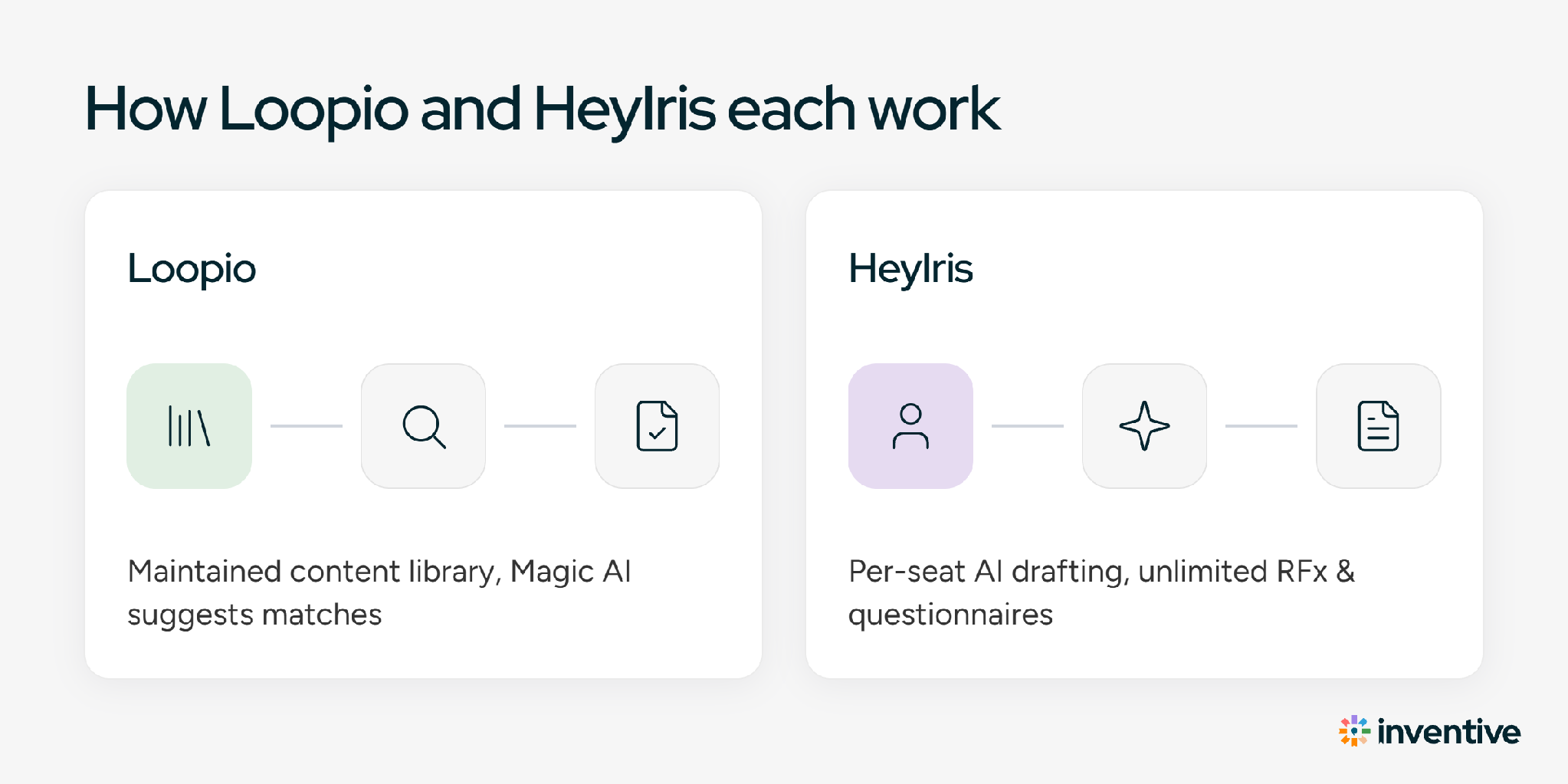
Loopio is an RFP and response management platform founded in Toronto in 2014. Teams use it to respond to RFPs, security questionnaires, and due diligence questionnaires from a central content library. Its Magic AI responds to incoming questions, and project features like milestone tracking and SME assignment keep a response moving. Loopio is known for a clean interface and strong customer support, which is why focused teams formalizing their process often start here.
What is HeyIris and how does it work?
HeyIris is an AI-first response tool that drafts answers to RFPs, security questionnaires, and DDQs from your past responses and connected knowledge. It markets deterministic AI, generating full first drafts rather than only responding to library matches, and adds task assignment, compliance checks, and audit trails. It is quick to adopt and priced per active seat with unlimited collaborators, which fits lean sales, pre-sales, and proposal teams that want to start fast.
Inventive AI: the AI-native alternative
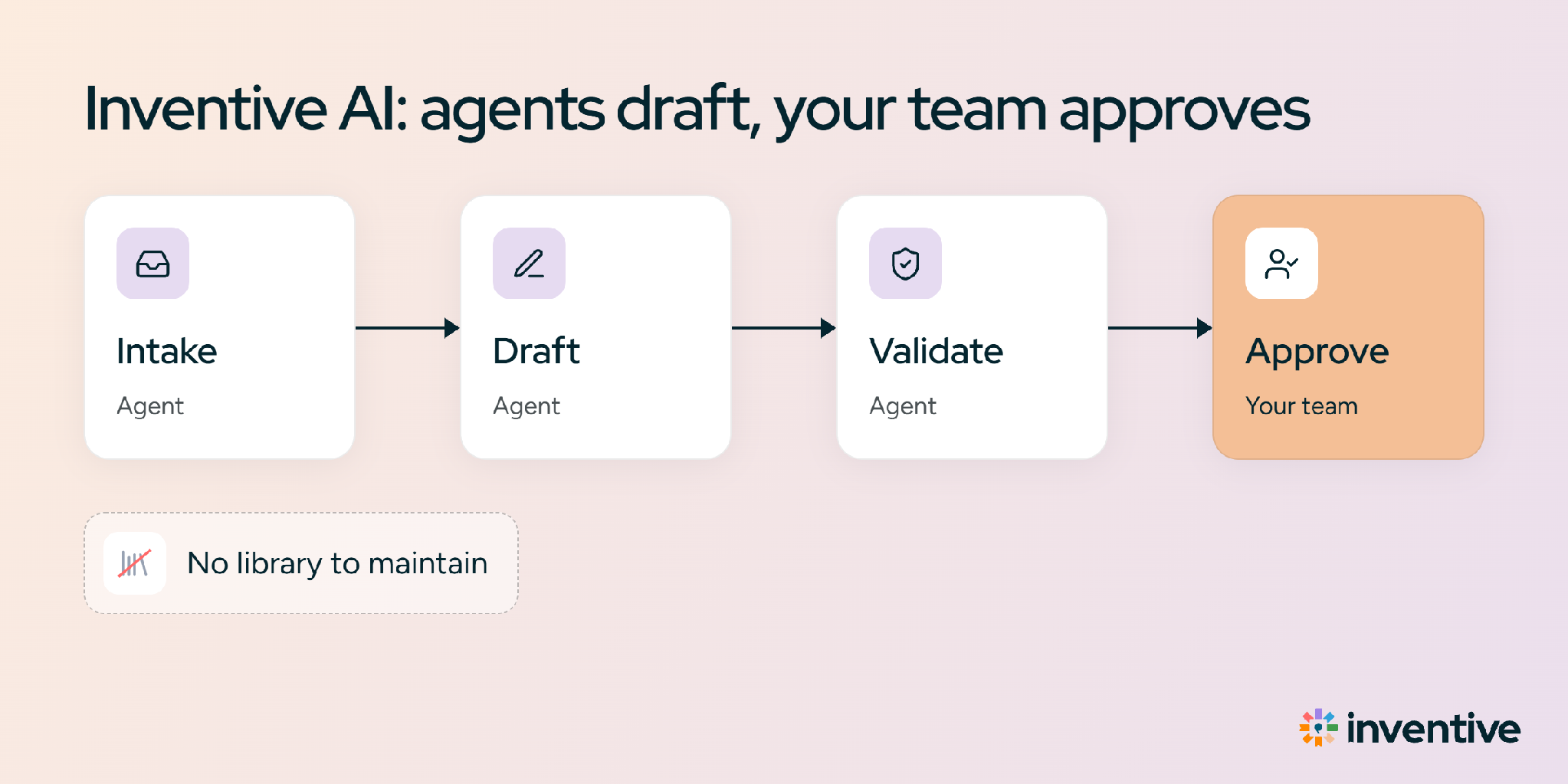
Inventive AI is AI RFP response software built the other way around. Instead of a content library your team maintains, it connects to your live sources, so there is nothing to curate or keep current. Where Loopio responses from a static library and HeyIris drafts from past responses, Inventive AI drafts full, source-cited responses tailored to the deal, flags outdated or conflicting content and sends only what needs judgment to a human. Less upkeep, fewer accuracy checks, and responses that fit the opportunity, not a generic library.
HeyIris vs Loopio: features, limitations, and reviews
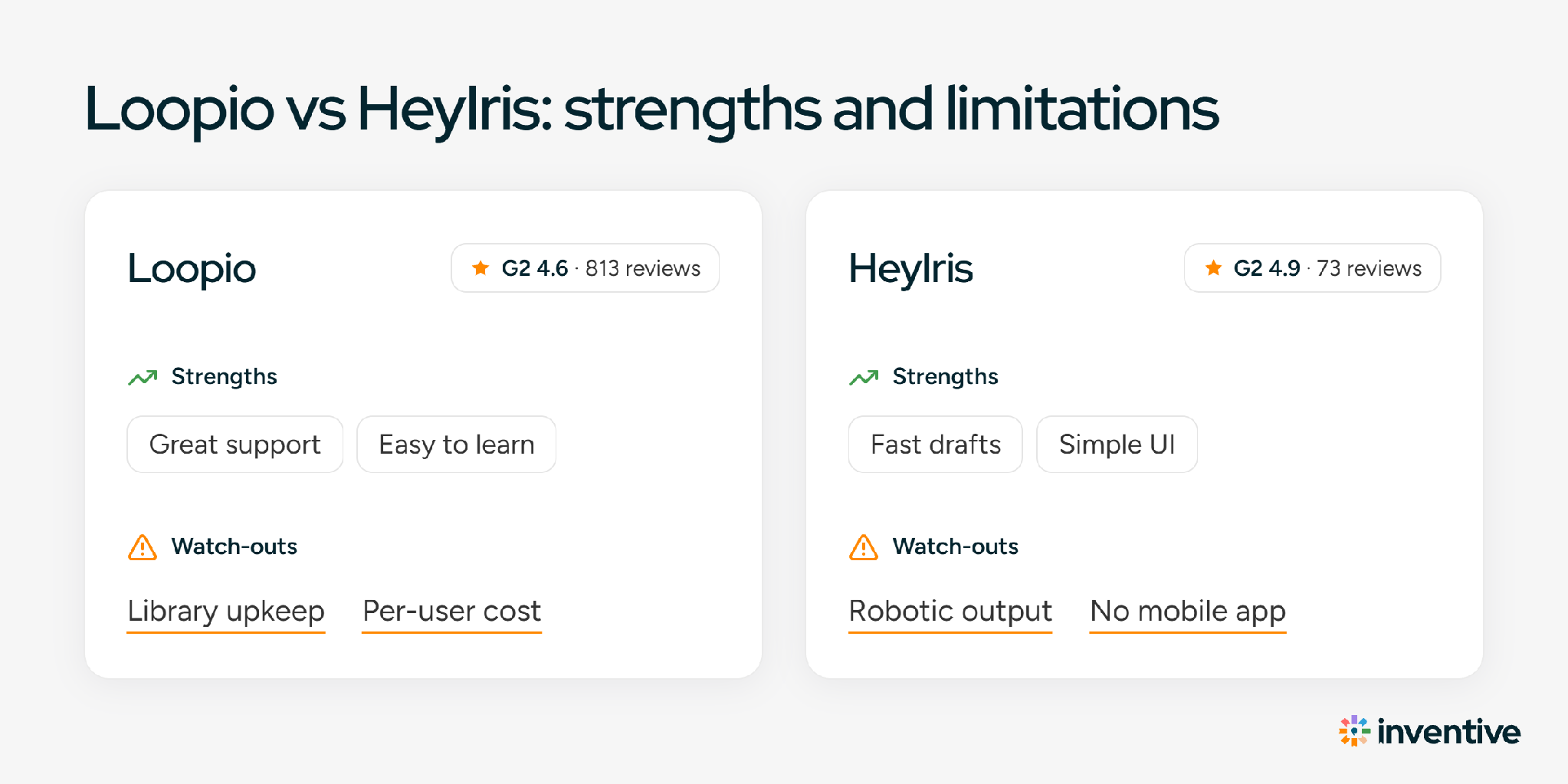
Loopio and HeyIris solve the same problem from different starting points: Loopio from a content library, HeyIris from AI-first drafting. Here is how each one looks up close, with verified ratings and real reviews.
Loopio best features
• Centralized content library with stacks, categories, and tags
• Magic AI for one-click answer response from approved content
• Milestone tracking and SME assignment for project management
• Content analytics for library health and completion tracking
• Portal-based response capability and a Chrome extension for filling questionnaires inside client portals
Loopio limitations
• AI drafts responses from a content library rather than generating context-aware drafts, so responses often need manual rewriting.
• No conflict detection, so contradictory or outdated answers across the library go unnoticed unless a person catches them.
• No competitive intelligence, so nothing in the platform helps research competitors or shape win themes.
• No deal-specific personalization, so every buyer draws from the same global library regardless of the opportunity.
• No inline source citations, so tracing a response back to its origin means a manual lookup.
• User-based pricing penalizes teams that need to loop in many occasional SMEs.
• Manual library upkeep is required and gets harder without a dedicated owner, a common reason teams start looking elsewhere.
Loopio pricing
• Tier and user-based subscription; Loopio does not publish list pricing.
• Vendr transaction data puts the median annual contract near $24,200, with most deals from about $11,800 to $59,300.
• Mid-market deployments of 10 to 25 users typically fall in the $30,000 to $60,000 range.
Loopio ratings and reviews
• G2: 4.6/5 (813 reviews)
• Capterra: 4.6/5
• TrustRadius: 8/10
What are real users saying about Loopio?
A G2 reviewer says:
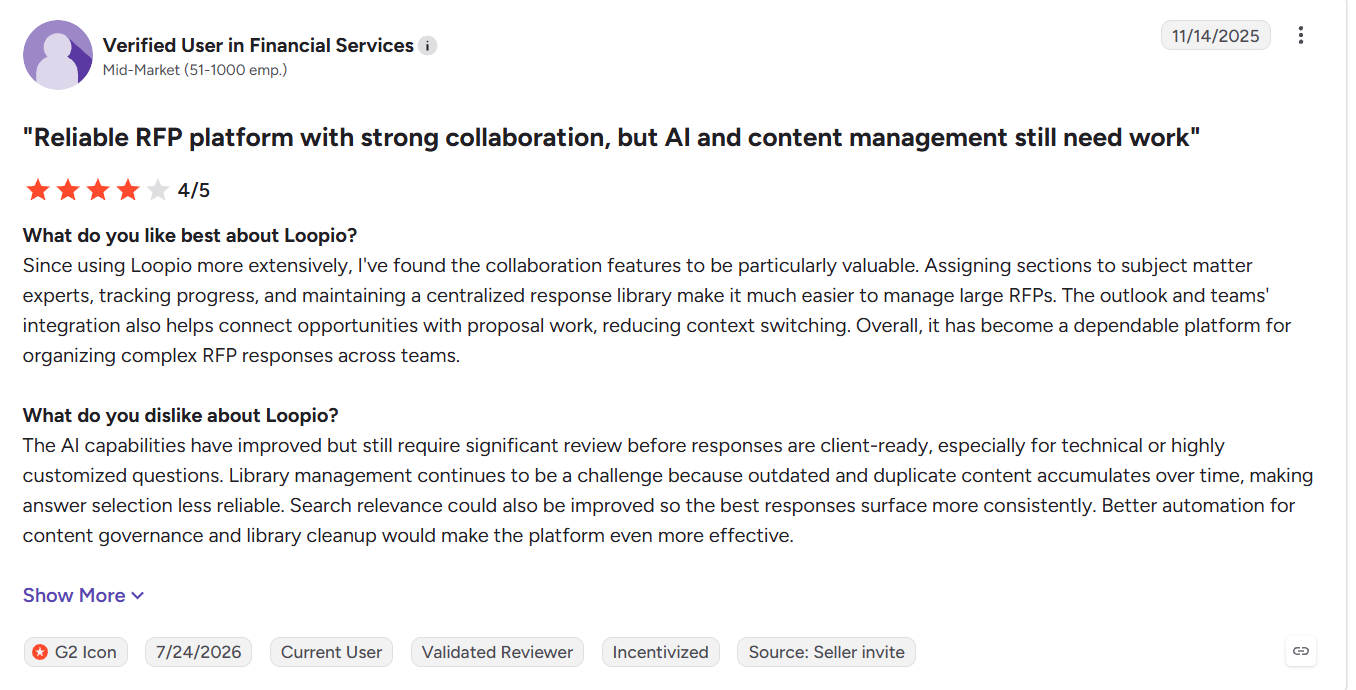
A Verified User in Financial Services (mid-market) rates Loopio 4/5. Collaboration and SME assignment are strong, but the AI needs heavy review before responses are client-ready, especially on technical questions. Outdated and duplicate content piles up and makes answer selection unreliable, and content governance and library cleanup need better automation.
Verified User in Financial Services, Mid-Market, 4/5 on G2
Also Read: Loopio vs Inventive AI: Better RFP Software?
HeyIris best features
• Deterministic AI that drafts full first responses from your connected knowledge
• AI qualification to score opportunity fit before you commit time
• Task assignment and unlimited collaborators on every seat
• Compliance checks and audit trails on responses
• Flags "not enough info" instead of guessing, which reviewers value on sensitive data
HeyIris limitations
• The AI aggregates several past responses into one instead of picking the single most relevant, so drafts need editing.
• Responses can read robotically and need custom instructions to match a buyer-ready tone.
• Enterprise controls and governance are lighter, which shows on high-volume, audited questionnaire work.
• Application integrations are limited, so some CRM, storage, or collaboration connections need manual work.
• No conflict detection, so contradictory entries are caught by people, not the system.
• With 73 G2 reviews, it has a short track record at enterprise scale.
HeyIris pricing
• Per active seat, quote-only; HeyIris does not publish list pricing.
• Each seat includes unlimited collaborators and unlimited RFP, DDQ, and security questionnaire credits.
• No reliable third-party dollar figure exists yet, because the product is new.
HeyIris ratings and reviews
• G2: 4.9/5 (73 reviews)
• Capterra: not widely rated yet
• TrustRadius: not widely rated yet
What are real users saying about HeyIris?
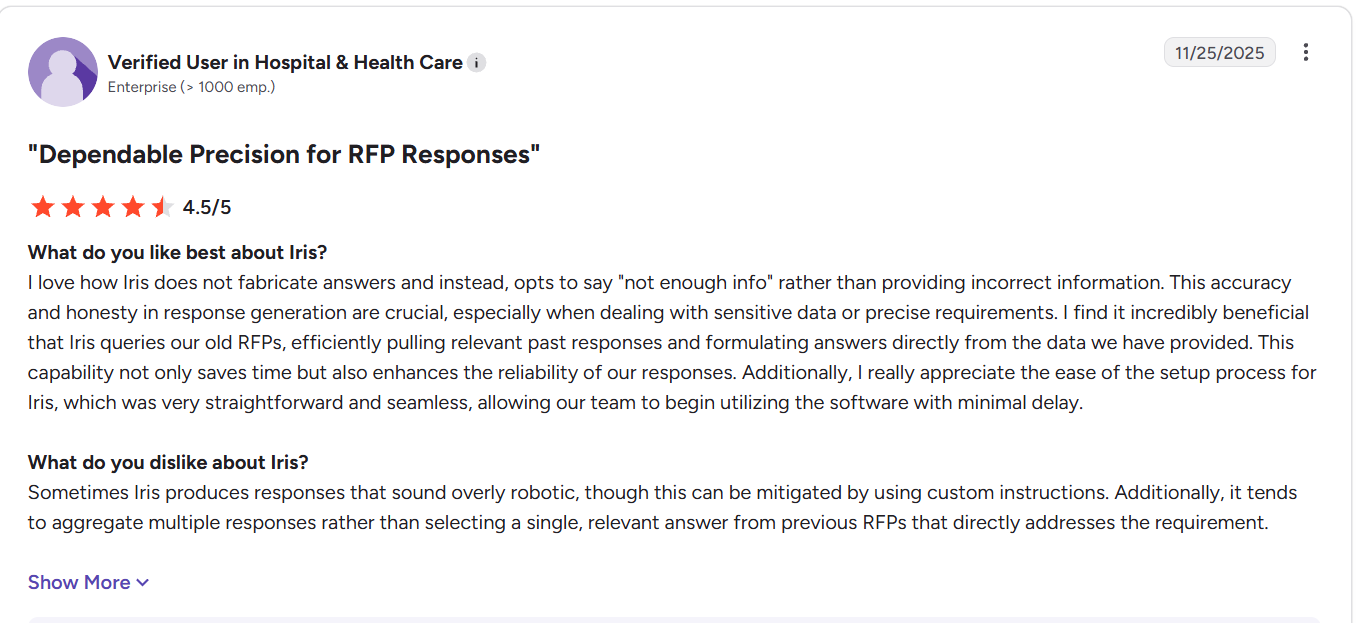
What are real users saying about HeyIris?
A Verified User in Hospital & Health Care (enterprise) rates Iris 4.5/5. It does not fabricate and flags "not enough info," and setup was easy. But responses sometimes sound robotic and need custom instructions, and it aggregates several past responses instead of picking the single relevant one.
— Verified User in Hospital & Health Care, Enterprise, 4.5/5 on G2
Also Read: HeyIris vs Inventive AI: A Head-to-Head Comparison
HeyIris vs Loopio: AI-native feature comparison
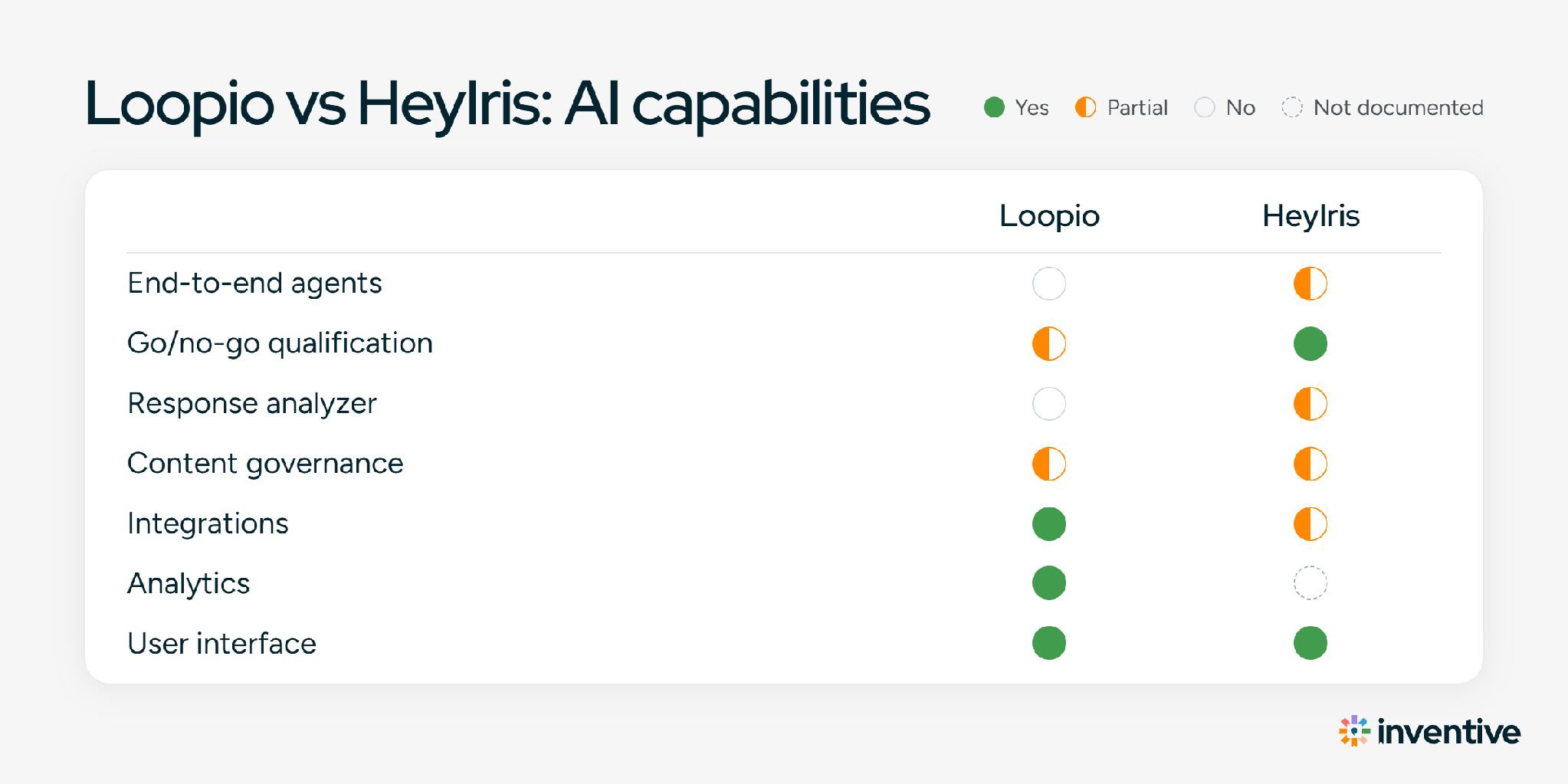
Here is a closer look at the AI capabilities proposal and security teams screen for, from end-to-end AI agents to content governance.
AI agents for end-to-end automation
- Loopio: No end-to-end agent. Magic AI surfaces and responds with matching answers, but a person drafts, routes, and finalizes each response.
- HeyIris: Partial. Its AI generates full first drafts across RFPs, DDQs, and security questionnaires, but intake, routing, approvals, and formatting stay manual, so no full pass runs unattended.
Go/no-go and bid qualification
- Loopio: Available as a paid add-on. It scores opportunity fit and lets you weigh named competitors to support the qualification call.
- HeyIris: Included. AI qualification scores an incoming opportunity against fit so teams can decide to pursue or pass before investing time.
Automatic response analyzer
- Loopio: No full-response analyzer. Quality control is manual, answer by answer, through SME review.
- HeyIris: Partial. Compliance checks validate responses, but there is no single pass across the whole document for contradictions and tone.
Automatic content governance
- Loopio: Partial. Response Intelligence detects duplicates, cleans content, and enriches metadata, but upkeep is still a manual job.
- HeyIris: Limited. Governance is lighter, and reviewers call its enterprise controls underdeveloped.
Integrations
- Loopio: Connects to Salesforce and HubSpot for CRM, Slack and Teams for collaboration, and 80+ content sources, plus a Chrome extension for portals.
- HeyIris: Strong on identity with SSO, SAML, and SCIM, but reviewers flag its application integration list as limited.
Analytics
- Loopio: Reporting on library health, proposal performance, and completion times, aimed at keeping a focused team on track.
- HeyIris: Reporting details are not publicly documented; confirm available dashboards with the vendor.
User interface
- Loopio: Reviewers consistently call the interface clean and intuitive and easy to train new people on, one of its most praised traits.
- HeyIris: Also rated highly for ease of use, with a clean interface a new user can pick up in a day.
Two capabilities neither platform fully delivers are agent-driven end-to-end automation and automatic content governance with conflict detection, which is exactly where AI-native platforms are pulling ahead.
Why AI-native RFP software is the future, and where Loopio and HeyIris fit
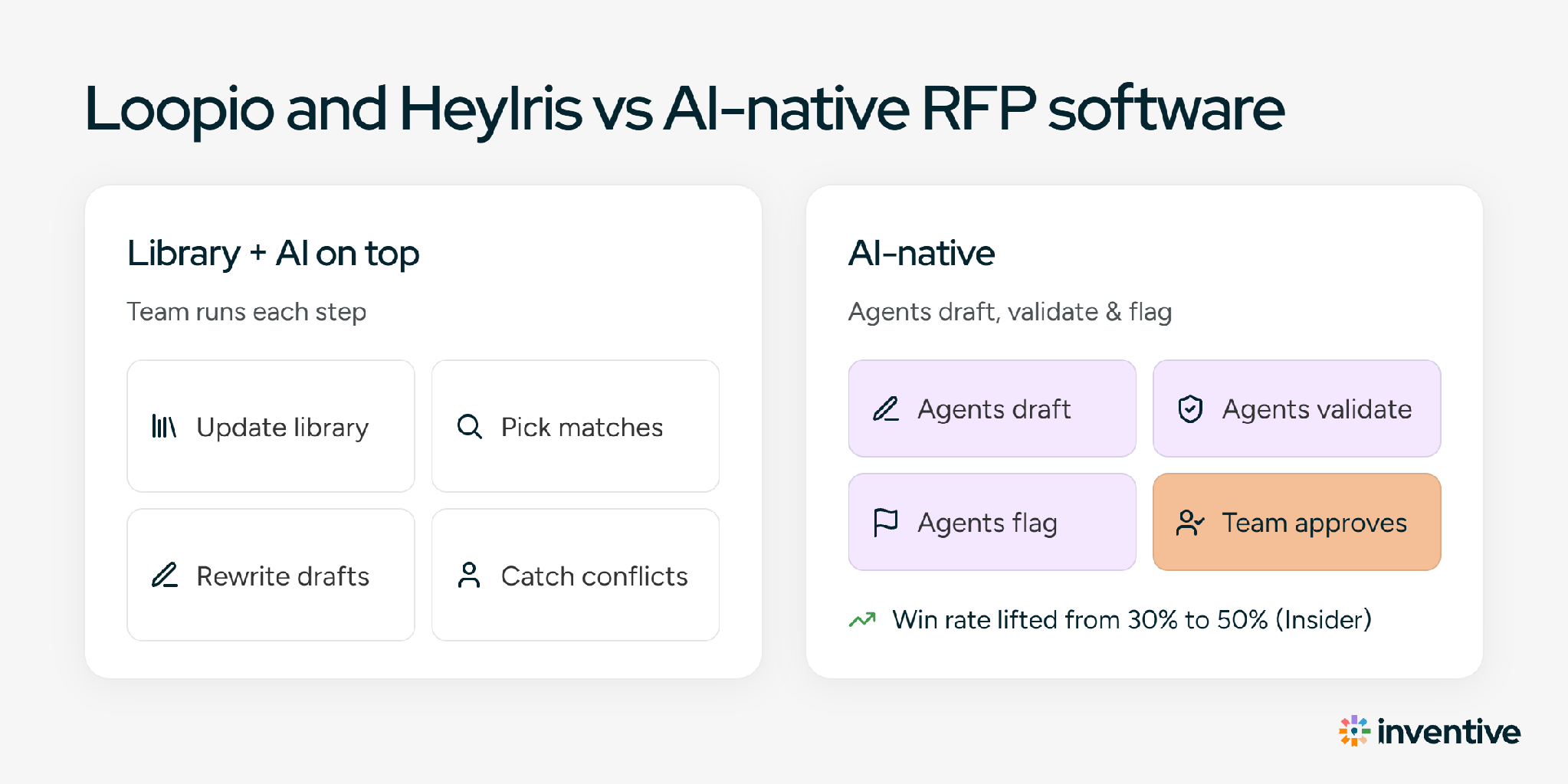
The real difference is architecture, and it decides how much work stays on your team.