AI Hallucination in RFP Responses: Cost, Measurement and Control
TL;DR
- What it is: An AI-invented claim in a proposal or questionnaire, not simply an outdated or conflicting one. That distinction determines the fix.
- What it costs: No verified RFP-specific benchmark exists. EY found 99% of surveyed organizations had AI-related financial losses, averaging $4.4M among affected companies. Build your own exposure model rather than trusting a vendor number.
- Where it happens: Ungrounded drafting, SME expansion, stale content reuse, requirement over-mapping, and security questionnaires, which carry the highest risk of the five.
- How to measure it: Internal catch rate, buyer-discovered rate, fact-check time, flags per proposal, and post-deal false claim rate.
- How to control it: Ground generation in live sources, use low-temperature settings, detect conflicts, require source attribution, apply risk-based review gates, run freshness checks, and close the loop post-deal.
- The trap to avoid: Stanford RegLab found legal AI tools marketed as hallucination-free still hallucinated 17 to 33% of the time. Treat any vendor accuracy claim as a starting point for questions.
An AI hallucination in an RFP response is an AI-generated claim in a proposal or security questionnaire that is not supported by your actual product, compliance status, security posture, pricing, or customer data. It differs from a merely outdated answer: a hallucination is invented, while stale content is inaccurate for a different reason.
In enterprise proposals this matters more than it does in a typical chatbot exchange. A hallucinated feature, certification, or timeline can become part of a contract, get flagged during a security review, or surface during onboarding when it is far more expensive to unwind.
This guide covers what causes hallucinations in RFP responses, what they can cost, how to measure hallucination rate, and the governance framework teams use to control them.
What is AI hallucination in RFP responses?
An RFP response hallucination is an AI-generated claim with no basis in your product documentation, CRM data, compliance evidence, or SME input. It is distinct from other RFP quality problems, and separating them matters for choosing the right fix.
A model that accurately quotes a stale case study has not hallucinated; it has surfaced a data governance problem. A model that invents a SOC 2 certification your company does not hold has hallucinated. Both produce a wrong answer, but they call for different fixes, and stale or duplicate answers in a knowledge base are usually the cheaper of the two to solve.
Why hallucinations in RFPs are riskier than general AI use
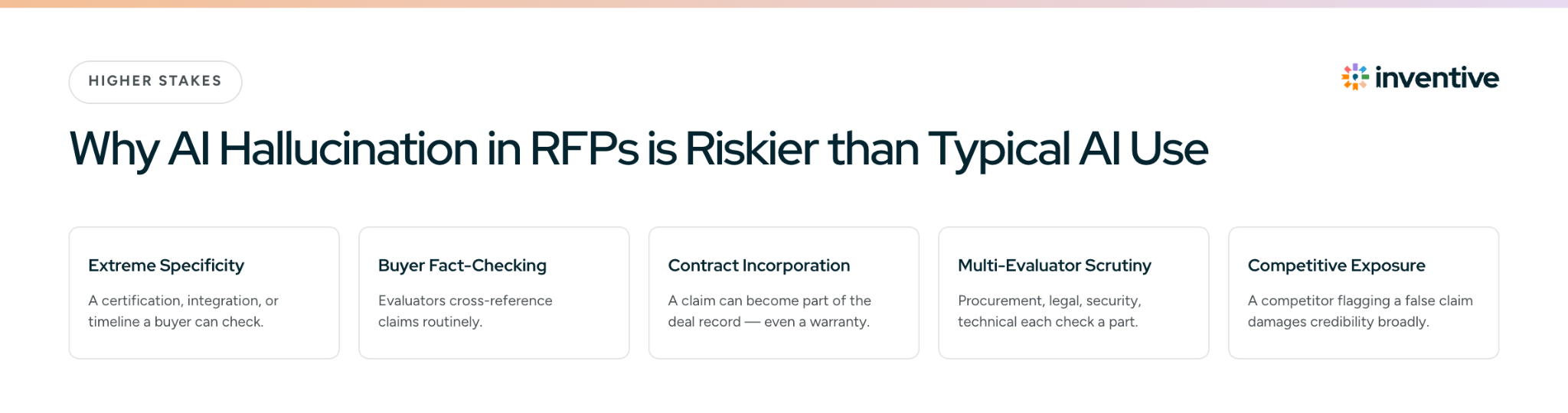
RFPs are riskier than typical AI use because claims are specific, checkable, multi-reviewed, and can become part of a signed contract. A chatbot hallucination gets corrected in the next message. An RFP hallucination that reaches a contract or an audit does not get that second chance.
- Extreme specificity: A certification level, a named integration, or a delivery timeline, not vague language a buyer cannot easily check.
- Buyer fact-checking: Evaluators routinely cross-reference claims against your website, documentation, sales team, and references.
- Contract incorporation: A specific claim in a proposal can become part of the deal record, and if it lands in the signed contract it can function as a warranty.
- Multi-evaluator scrutiny: Procurement, legal, security, and technical reviewers each check different parts of a response, raising the odds a false claim is caught, by you or by the buyer.
- Competitive exposure: A competitor pointing out a false claim during evaluation damages credibility beyond that single deal.
Why AI hallucinations cost more than teams assume
Hallucinations cost more than teams assume because the exposure is diffuse, a lost deal here and a delayed audit there, rather than a single visible line item that anyone adds up.
Where the exposure sits:
- Deal loss: A hallucinated claim caught during evaluation can sink a deal outright, particularly if it undermines trust in the rest of the response.
- Contract and legal exposure: A hallucinated claim in a signed contract can function as a warranty. Directive (EU) 2024/2853, the EU Product Liability Directive, extends strict product liability to software and AI-driven systems for the first time, removing the need to prove negligence. Member states must transpose it by December 9, 2026.
- Renewal and reference damage: A customer who discovers a false claim during onboarding, especially a compliance claim, tends to lose trust in the relationship broadly.
- Audit and compliance failure: A hallucinated compliance claim caught during a security review can trigger re-certification work and scrutiny well beyond the single deal.
- Fact-checking overhead: Manually verifying AI-generated claims consumes real SME and compliance time on every proposal, and it is the most measurable and controllable cost in this list.
Build your own exposure estimate
Rather than importing an unverifiable benchmark, build a model from numbers your team already has.
Estimated deal risk = RFPs per year × your estimated leakage rate × average deal size × your estimated probability that a caught hallucination costs the deal.
Fact-checking overhead = average fact-checking hours per proposal × RFPs per year × blended hourly cost for the staff doing that work.
This will not produce a defensible industry-wide number, but it produces a defensible number for your team, which is the one that matters for prioritizing a fix.
Where AI hallucinations enter the RFP workflow
Hallucinations enter at five predictable points. Knowing the stage tells you which control to apply, rather than a generic instruction to review more carefully.
Stage 1: Early drafting with minimal grounding
Risk: When a team asks an AI to draft from the RFP text and a generic prompt, without connecting it to CRM, product docs, or a content library, the model has nothing to ground its output in and pattern-matches on typical industry responses.
Example: Asked to describe healthcare sector experience, an ungrounded AI drafts a claim about serving 200 or more healthcare organizations when the actual customer list shows far fewer.
Control: Connect the drafting tool to your actual CRM and customer list before generation, and require source citations for any factual claim.
Stage 2: SME expansion
Risk: SMEs often provide a short, accurate input, and the AI expands it to fill the section, sometimes adding specifics the SME never stated.
Example: An SME writes that data is encrypted at rest and in transit. The AI expands this into a claim about a specific certification level and uptime figure the SME never confirmed.
Control: Require SMEs to review AI-expanded sections specifically for claims that were not in their original input, not just for tone. Defining the SME role in proposal work explicitly is what makes that review reliable rather than a skim.
Stage 3: Content library reuse
Risk: Boilerplate pulled from an older library carries forward assumptions that were true when written. This is the outdated-data problem rather than a hallucination in the strict sense, but it produces the same wrong answer.
Example: A case study describing an eight-week implementation gets reused years later, when typical timelines have lengthened.
Control: Audit the library on a regular cadence and flag anything not reviewed in several months. Content management practices for RFP teams show how to structure review cycles so freshness checks sit inside the approval workflow rather than becoming separate overhead.
Stage 4: Requirement mapping and overconfidence
Risk: When mapping your solution to evaluation criteria, an AI can over-claim fit, particularly on ambiguous questions.
Example: Asked whether the solution has an API, an AI describes a full API platform with webhooks and SDKs when the actual capability is a basic set of REST endpoints.
Control: Require SME or product manager sign-off on any requirement-compliance claim, and flag low-confidence generations for review. This is one of the more concrete levers for improving RFP response quality and accuracy without slowing the team down.
Stage 5: Security questionnaire compliance claims
Risk: Security questionnaires ask specific, binary questions about certifications and controls, and are the highest-stakes place for a hallucination.
Example: Asked about SOC 2 Type II certification, an AI answers yes when the actual status is in process. The distinction between SOC 2 Type I and Type II is exactly the kind of detail a model will smooth over.
Control: Treat every compliance claim as high-risk by default and require explicit compliance officer sign-off before submission.
How to measure AI hallucination rate
Measure hallucination rate with five metrics: internal catch rate, buyer-discovered rate, fact-check time per proposal, fact-check flags per proposal, and post-deal false claim rate. Treat any target you set as a baseline for your own team rather than an external standard, since no independent benchmark exists for acceptable hallucination rate in RFP workflows.
Track hallucinations by source
Tracking where hallucinations originate, whether product docs, CRM, content library, or SME input, tells you what to fix. If most flagged claims trace back to the content library, that is a freshness problem rather than a model problem, and the fix is a documentation audit rather than a prompting change.
Keep an audit trail
Log every fact-checked claim: what was claimed, who verified it, what evidence source was used, and its status. If a buyer later challenges a claim, that record reduces legal exposure and demonstrates due diligence to auditors. This is the same logic behind audit trail and version control for RFP responses, where the record matters as much as the answer.
The seven-control framework to prevent AI hallunications
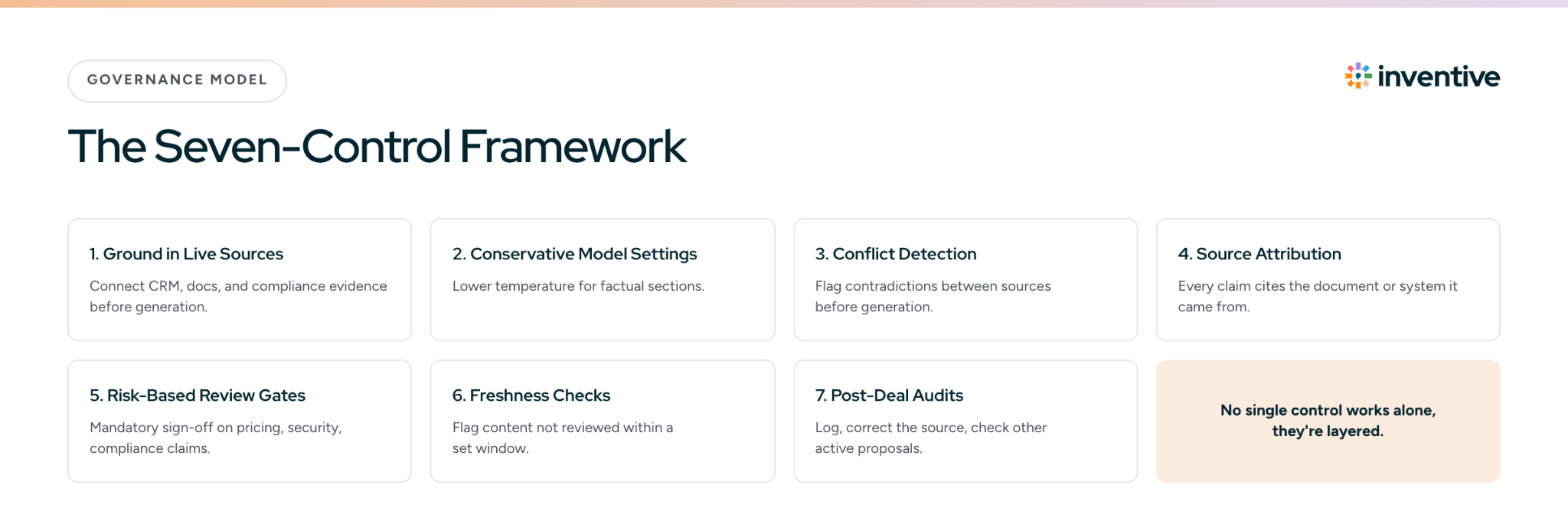
Seven controls, layered together, reduce hallucination risk: grounding, conservative model settings, conflict detection, source attribution, risk-based review gates, freshness checks, and post-deal audits. No single control works alone.
1. Ground generation in live, connected knowledge sources
What it is: Connecting the AI to your actual CRM, product documentation, compliance evidence, and content library before it generates, rather than letting it draft from a generic prompt and fact-checking afterward.
Why it matters: An AI with no connection to your real data has nothing to constrain its output except general patterns from training, which is exactly what produces confident, plausible, invented claims. Grounding rather than model size is what does the work here, which is the core of how AI RFP software prevents hallucinations.
Example: Instead of drafting a customer count from a generic prompt, a grounded system pulls the actual figure from your CRM and generates from that.
2. Use conservative model settings for factual sections
What it is: Lower temperature settings make output more deterministic and less prone to embellishment, which suits RFP and questionnaire drafting better than higher, more creative settings.
Why it matters: RFP responses need the most probable, fact-based answer from your knowledge sources rather than a creative one.
3. Implement conflict detection
What it is: Flagging contradictions between your own sources, such as CRM versus marketing site or sales notes versus delivery timelines, before generation rather than letting the AI silently pick one.
Why it matters: Internal disagreement between sources is a common and often overlooked root cause of what looks like a hallucination but is actually a data governance failure. When sources disagree, the system should surface the conflict for resolution rather than guessing.
4. Require source attribution for every claim
What it is: Every factual claim in a generated response should cite the document or system it came from.
Why it matters: Attribution makes false claims easier to spot, creates an audit trail, and surfaces inconsistencies between what your sources say and what gets written into the proposal. Source citations and confidence scores are the mechanism that makes this practical at volume.
5. Apply risk-based review gates
What it is: Not every claim carries equal risk. Pricing, timelines, security, and compliance claims warrant mandatory expert sign-off. General marketing language does not need the same scrutiny.
Why it matters: This prevents the common failure mode where an SME skims an entire proposal rather than specifically verifying the claims in their domain.
6. Run automatic freshness checks
What it is: Flagging content not reviewed within a set window, covering customer data, case studies, product claims, and compliance dates.
Why it matters: Stale content rather than model error is one of the most common sources of inaccurate claims, and it is addressed through content governance rather than better grounding.
7. Close the loop with post-deal audits
What it is: When a false claim surfaces after a deal closes, logging the root cause, correcting the source, and checking whether the same claim exists in other active proposals.
Why it matters: Without this step, teams repeat the same hallucination across multiple deals rather than fixing it once at the source.
How AI hallucinations differ in security questionnaires and product RFPs
Security questionnaires carry sharper risk than product RFPs because certification and control claims are checked against evidence immediately, while product RFP claims are often verified later, in negotiation.
For teams running AI security questionnaire software, the practical implication is to treat every compliance claim as high-risk by default and require an explicit evidence citation. Rather than a bare certification claim, a stronger answer names the certification, its current status, and where the evidence lives. Low-risk items such as company background do not need the same scrutiny; certification and control questions do.
Evaluating vendor hallucination claims
Every vendor hallucination claim is self-reported and should be verified in a live demo rather than taken at face value.
Stanford RegLab independently tested legal AI products from LexisNexis and Thomson Reuters that were explicitly marketed as retrieval-augmented and low-hallucination. Their study, Hallucination-Free? Assessing the Reliability of Leading AI Legal Research Tools, found Lexis+ AI hallucinated on over 17% of queries and Westlaw AI-Assisted Research on roughly 33%, well above the near-zero rates implied by their marketing, despite both genuinely outperforming a general-purpose model with no retrieval at all. The researchers' conclusion was that providers' claims are overstated.
That gap between stated architecture and independently measured performance is the reason to treat any hallucination-free or 95% accurate claim as a starting point for questions. Two structural points are worth holding onto:
- Library-based and connected-knowledge approaches are different trade-offs, not a hierarchy: A curated library gives a team direct control over every approved answer but requires ongoing manual upkeep. A live-connected system stays current automatically but depends on the underlying source systems being accurate and well governed. Neither eliminates hallucination risk by default; each shifts where the risk concentrates.
- The durable evaluation criteria are ones you can test directly: What sources is the platform grounded in, does it detect conflicts between those sources, does every claim carry a citation, and does it visibly route uncertain answers to a human rather than guessing.
Teams running a structured comparison will find the platform-by-platform detail in the breakdown of the most accurate AI RFP software on hallucination rate and the wider RFP software evaluation.
Building hallucination control into your workflow
Tooling covers roughly four of the seven controls above. The remaining three are process decisions no platform makes for you, and teams that expect software to cover all seven end up with an unmonitored gap.
Inventive AI connects to your existing systems rather than requiring a separate content library to be built and maintained in parallel. Here is how that maps against the framework:
Grounding architecture reduces hallucination rate. Measurement, review gates, and post-deal audits are what catch the remainder before it reaches a buyer. Teams that implement only the first half tend to discover the gap during a security review rather than during drafting.