Subject Matter Expert (SME): What They Are, Roles and Responsibilities
The SME role explained: what a subject matter expert does, their key skills and responsibilities, why they matter, and how to become one.
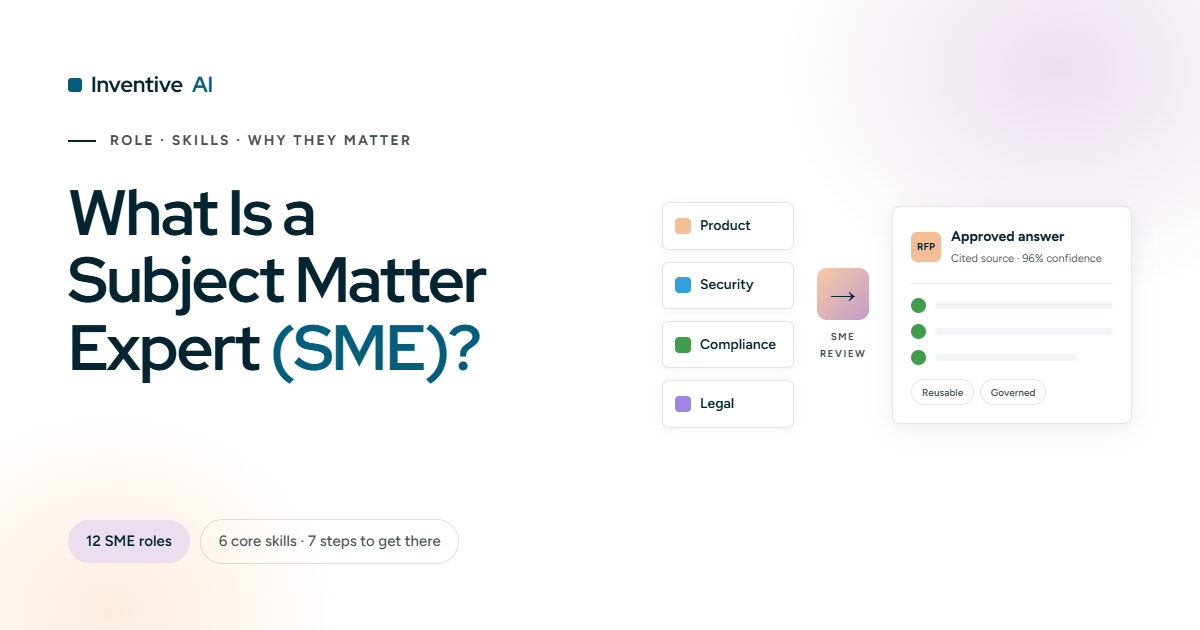
A subject matter expert (SME) is a person with deep, current knowledge of one specific domain. That domain could be a product, a regulation, a technology, or a process. Colleagues treat the SME as the authority on that topic and send their hardest questions to them.
Subject matter experts sit at the center of how a business makes accurate decisions. They guide product choices, review high-stakes content, train teams, and answer questions no one else can. This guide explains what a subject matter expert does, the skills the role demands, why it matters to a business, and how to become one.
Key Takeaways
- A subject matter expert (SME) is a person with deep, current knowledge of one domain, recognized as the authority on it.
- The SME role spans product, training, quality, compliance, sales, and proposals, not a single department.
- Core SME skills pair deep domain knowledge with clear communication, sound judgment, and the ability to teach.
- SMEs matter because they protect accuracy, reduce risk, and speed up decisions across the business.
- You become an SME by building depth in one domain, applying it in real work, and sharing it so others can rely on it.
SME Meaning: Subject Matter Expert vs. Small and Medium-Sized Enterprise
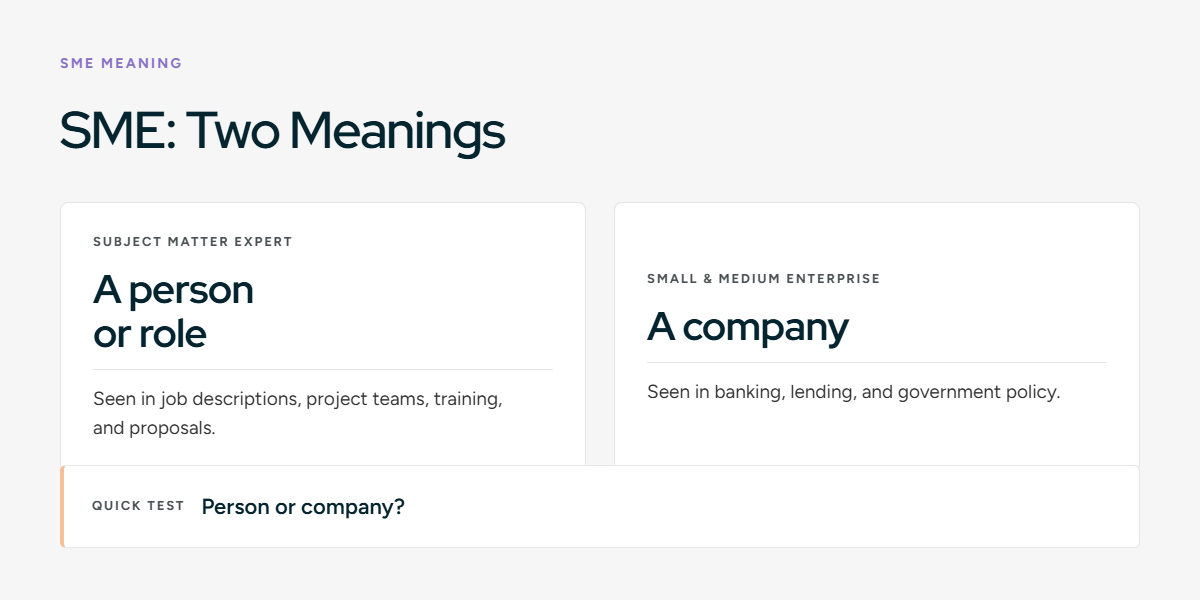
SME has two meanings, and context decides which one applies.
- Subject matter expert: a person with specialized knowledge in one field. You see it in job descriptions, project teams, training, and proposals.
- Small and medium-sized enterprise: a company below a set size threshold. You see it in banking, lending, and government policy.
This guide covers the first meaning, the subject matter expert. A quick test settles most cases: if SME describes a person or role, it means the expert. If it describes a company, it means the business class.
What Does a Subject Matter Expert Do? The Roles SMEs Play
An SME role reaches across the business. The same person is pulled into product decisions one day and a customer proposal the next. These are the main roles a subject matter expert plays.
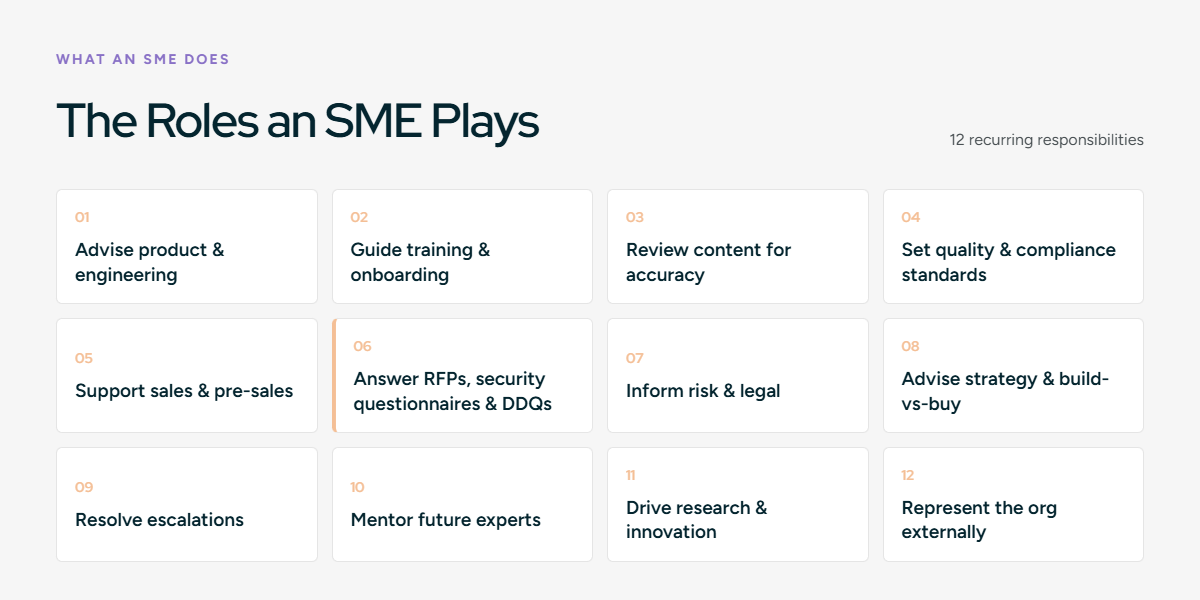
Advise product and engineering decisions
SMEs shape what gets built. Product and engineering teams bring them design questions, technical trade-offs, and feasibility checks before work starts. A cloud architecture SME, for example, may rule out a design that would not scale, saving weeks of rework. Expert input catches costly mistakes before they reach production.
Guide training, onboarding, and knowledge transfer
SMEs turn their expertise into training that others can use. They design onboarding, review course material, and mentor newer staff on real problems. A tax SME who documents how to handle multi-state payroll lets the whole team answer questions that once routed only to them. This spreads knowledge so the organization does not depend on one person.
Review content and documentation for accuracy
Marketing claims, technical docs, help articles, and release notes all pass through SMEs. They catch errors a non-expert would miss, from an overstated benchmark to an out-of-date API reference. Accurate content protects the brand, prevents customer confusion, and reduces support tickets.
Set and enforce quality and compliance standards
In regulated fields, SMEs define what "correct" means. They write the standards, review work against them, and sign off on high-stakes claims. A security SME who approves a SOC 2 control statement is putting their name behind its accuracy. Their approval is often what keeps the company compliant and audit-ready.
Support sales and pre-sales
Technical buyers ask hard questions during a deal. SMEs join calls, run technical demos, and answer architecture, integration, and security questions in real time. When a solutions engineer explains exactly how a data migration will work, that credibility often moves the deal forward. This role puts experts directly in the revenue path.
Answer RFPs, security questionnaires, and DDQs
Formal RFP documents ask hundreds of detailed questions about security, compliance, architecture, and operations. Only SMEs can answer many of them accurately, so proposal teams depend on expert time to hit deadlines. Because the same questions repeat across deals, this becomes one of the most time-consuming roles an expert holds. Many of the questions vendors face cannot be answered without them.
Inform risk, legal, and regulatory decisions
When a decision carries legal or safety risk, leaders bring in the SME. They explain what the rules require, where the real exposure sits, and what a defensible position looks like. A privacy SME weighing a new data flow against GDPR grounds the decision in fact rather than assumption. This lowers the chance of a fine, a breach, or a failed audit.
Advise leadership on strategy and build-vs-buy
Executives lean on SMEs when a choice needs technical judgment. Should the company build a capability or buy it? Is a new technology ready, or still a risk? An SME's read on where a field is heading shapes roadmaps and budgets. Their input keeps strategy connected to what is actually possible.
Resolve escalations in implementation and customer success
When a deployment breaks or a customer hits an edge case, the SME is the last line of support. They diagnose the root cause that frontline teams cannot, and they design the fix. A database SME who resolves a production issue during a major rollout protects both the account and the company's reputation.
Mentor and grow the next generation of experts
Strong SMEs build other experts, not just answers. They coach high-potential staff, review their work, and hand off ownership of subtopics over time. This reduces single-person risk and creates a bench, so the organization is not exposed when one expert leaves or takes leave.
Drive research, testing, and innovation
SMEs often lead the work that keeps a company current. They evaluate new tools, run proofs of concept, and test whether an emerging approach holds up. A machine learning SME piloting a new model gives leadership evidence instead of hype. This role turns deep knowledge into a competitive advantage.
Represent the organization externally
SMEs frequently speak for the company beyond its walls. They present at conferences, join standards committees, brief industry analysts, contribute to open-source projects, and sometimes serve as expert witnesses. This builds the organization's authority and makes it easier to hire and sell.
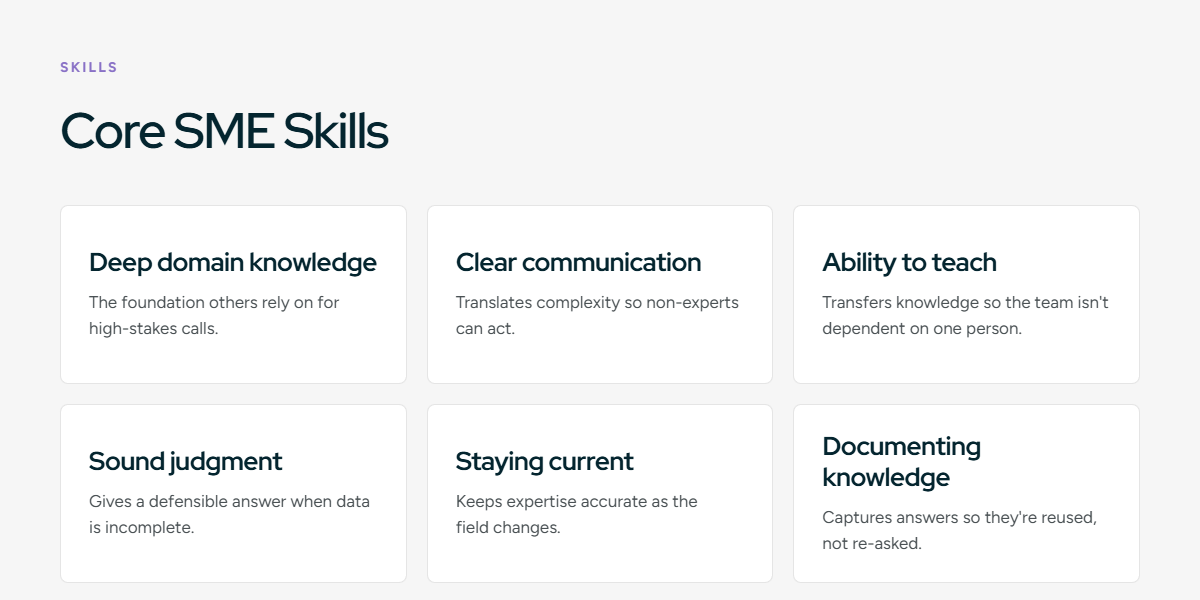
What Skills Does a Subject Matter Expert Need?
Deep knowledge alone does not make an effective SME. The role rewards people who can explain what they know and apply it under pressure.
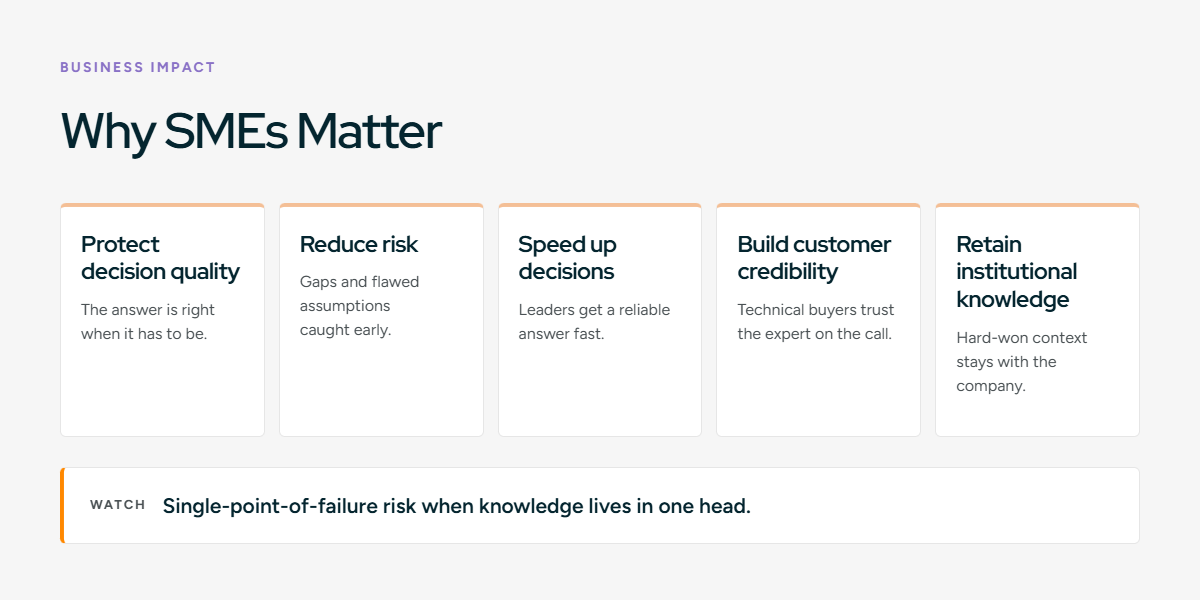
Why Are Subject Matter Experts Important to a Business?
Subject matter experts protect the quality of decisions. When a claim, a product choice, or a compliance answer has to be right, the SME is who makes it right. That accuracy has direct business value.
SMEs reduce risk. They spot the regulatory gap, the security flaw, or the flawed assumption before it becomes a problem. They also speed up decisions, because leaders get a reliable answer instead of a long investigation.
Experts build credibility with customers. In technical sales, a knowledgeable SME on a call can be the reason a buyer trusts the vendor. And SMEs retain institutional knowledge, so hard-won expertise does not walk out the door with one departure.
The same value creates a risk. When knowledge lives in one person's head, that person becomes a single point of failure. Spreading and documenting their expertise is how a business protects itself.
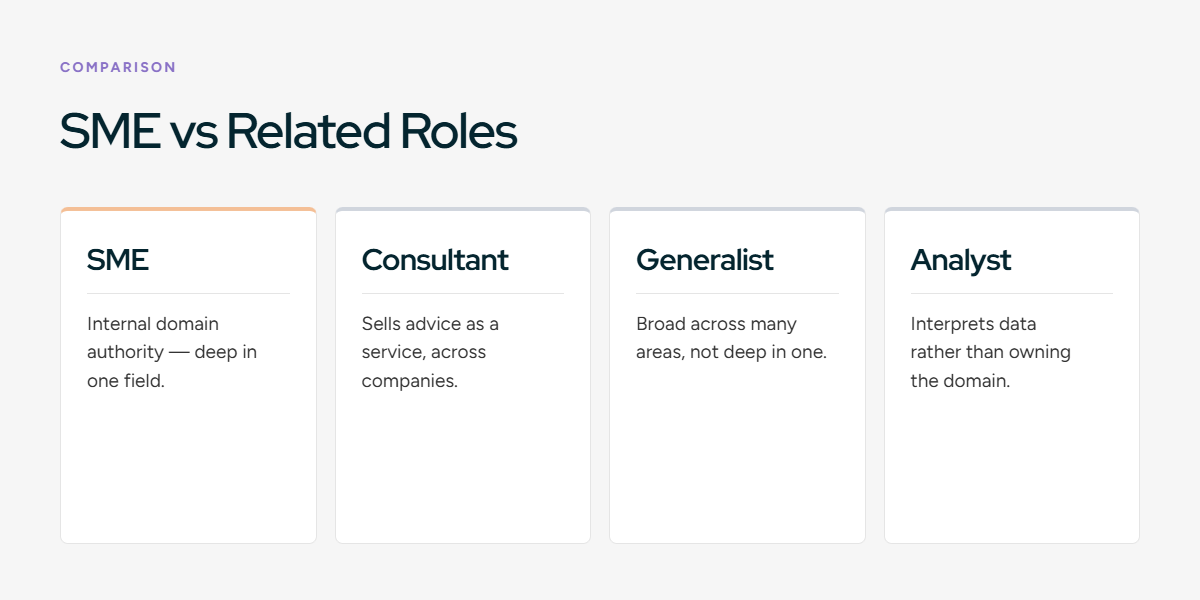
Subject Matter Expert vs. Related Roles
The SME label is often confused with nearby roles. The differences are practical.
Also read: What Does a Capture Manager Do? A Complete Guide for 2026
How to Become a Subject Matter Expert
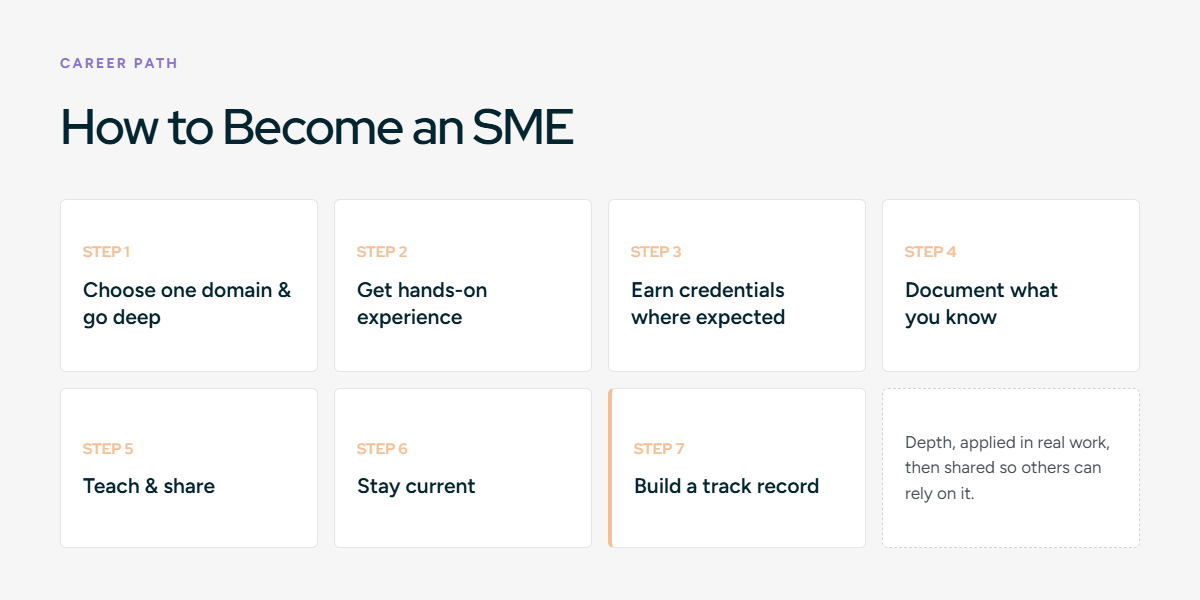
Becoming an SME is a path, not a certificate. These steps build the depth and the recognition the role requires.
- Choose one domain and go deep. Pick an area with lasting demand and commit to mastering it.
- Get hands-on experience. Real problems teach what textbooks cannot. Depth comes from doing the work.
- Earn credentials where the field expects them. A CISSP for security or a CPA for accounting can validate your knowledge, though no credential defines the SME role by itself.
- Document what you know. Write it down so others can use it and so your knowledge scales beyond you.
- Teach and share. Answer questions, mentor peers, and present your work. Recognition follows contribution.
- Stay current. Read, test, and update your knowledge as the field moves. An outdated SME loses authority.
- Build a track record. Consistent, reliable answers are what make colleagues route the hard questions to you.
The Challenges Subject Matter Experts Face
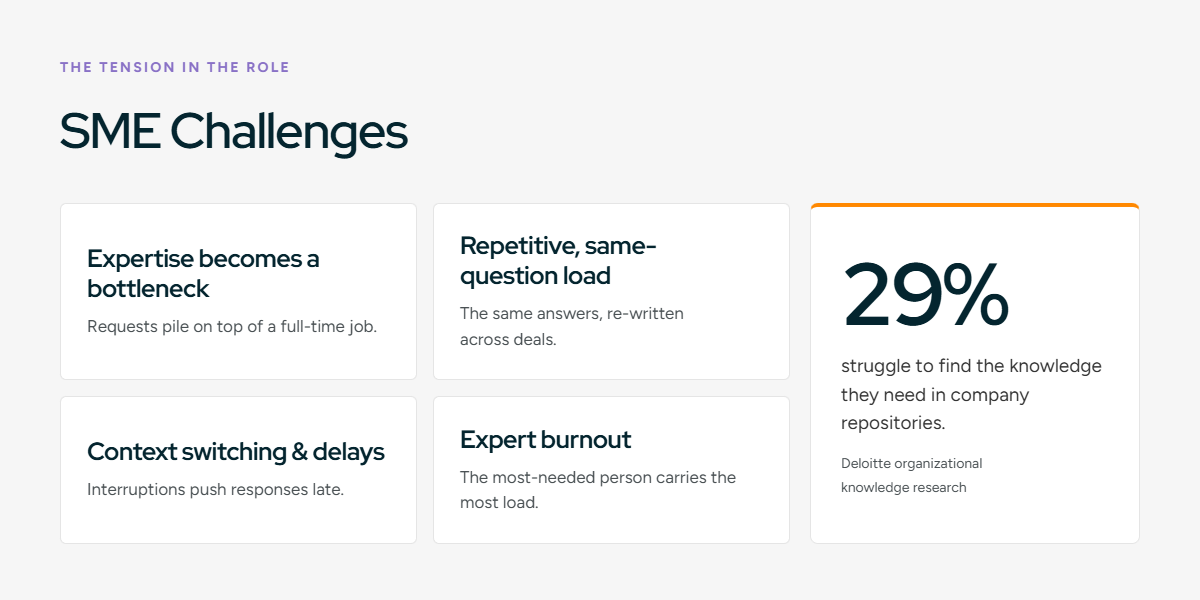
The SME role carries a built-in tension. The expertise that makes someone valuable also makes them a bottleneck. Requests pile up on top of a full-time job, and the expert becomes the constraint on other teams' work.
Much of that load is repetitive. SMEs answer the same questions across deals, projects, and documents, often from memory or scattered files. Deloitte's organizational knowledge research found that 29% of workers find it difficult or nearly impossible to extract the knowledge they need from company repositories. That is the gap teams hit whenever the SME is unavailable.
The result is context switching, delayed responses, and expert burnout. Reducing how often the same person answers the same question is the clearest way to protect an SME's time. A maintained answer library is one proven step.
How Inventive AI Reduces the SME Workload on Proposals and RFPs
RFPs, RFIs, security questionnaires, and DDQs eat more SME time than almost any recurring task. Experts re-answer the same questions across deals, from files scattered everywhere. What SMEs want is simple: answer once, get asked only what is new, and stop hunting for what they already know.
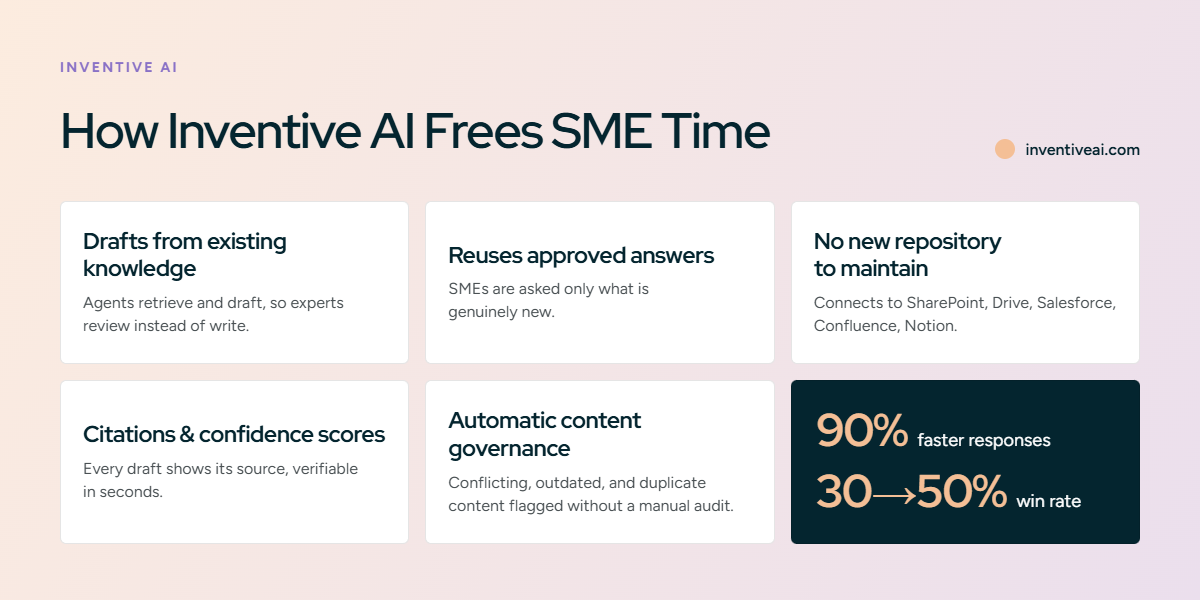
Inventive AI is an AI agent software built for that. Its agents draft each response from your connected company knowledge, so experts review instead of write. Here is how that maps to what SMEs need, starting with the basics.
The core needs come first:
- Drafts from knowledge that already exists. The agent retrieves answers from your systems and drafts each response, so experts review a draft instead of starting from a blank page, which saves SMEs hours of quality time.
- Answers reused, so experts are asked only what is new. Once an SME approves an answer, the platform reuses it on the next questionnaire and routes only genuinely new or unsupported questions back to the expert.
- No new repository to maintain. The Knowledge Hub connects to systems SMEs already use, such as SharePoint, Google Drive, Salesforce, Confluence, and Notion.
The advanced capabilities support that work:
- Citations and confidence scores on every answer. Each draft shows its source and confidence level, so an SME can verify it in seconds.
- Automatic content governance. A Content Governance Agent flags conflicting, outdated, and duplicate content, so the answer library stays accurate without a manual SME audit.
More Reads
- Effective RFP Response Team Roles and Responsibilities
- Bid Manager Responsibilities & Key Skills Guide
- RFP Specialist Role, Importance & Salary Insights
Frequently Asked Questions
What is a subject matter expert in simple terms?
A subject matter expert is the person who knows one topic better than anyone else on the team. Colleagues go to them when a question is too technical or too important to get wrong.
Is subject matter expert a job title?
Sometimes. Most SMEs hold another title, such as engineer, analyst, or manager, and serve as the expert on top of that role. Some large organizations, government contractors, and consulting firms hire for dedicated "Subject Matter Expert" positions tied to a named domain.
What does SME mean in a job description?
Almost always subject matter expert. If the posting asks for deep experience in one domain and lists advising, reviewing, or training duties, it is hiring an expert. Company-size SME appears only when a posting describes the employer or target market.
What skills does a subject matter expert need?
Deep domain knowledge first, then the skills that make it usable: clear communication, teaching, sound judgment, and staying current. The best SMEs also document their knowledge so it can be reused.
How do you become a subject matter expert?
Choose one domain, build depth through hands-on work, and earn credentials where your field expects them. Then document what you know, teach others, and stay current. Recognition follows a consistent track record.
What is the difference between a subject matter expert and a consultant?
A consultant sells advice as a service, often across many companies. A subject matter expert is usually the internal authority on one domain inside a single organization. The knowledge can be similar; the relationship is different.
What is an SME in an RFP?
In an RFP, an SME is a subject matter expert. It is the person who answers the technical, security, or compliance questions the proposal team cannot answer alone. Their input decides the accuracy of the response.
Also Read: Best AI RFP Software 2026: Ranked & Compared