Catering RFP Template + Response Guide for Vendors (2026)
.png)
The U.S. catering services market size is expected to grow at a CAGR of 7.7% and reach USD 109.4 billion by 2030. As demand increases, more organizations are issuing formal RFPs to select catering partners. If you are responding to a catering RFP template, expectations are high, and timelines are tight.
You are required to present detailed menus, transparent pricing, staffing plans, food safety standards, and proof of past performance, often across multiple bids at once. A single unclear response oran inconsistent section can push your proposal out before buyers even review the cost.
Below, you will find a ready-to-use catering RFP template, followed by a structured response framework designed specifically for vendors competing for catering contracts.
Standard Catering RFP Template (Copy-Paste Ready) Free Download
Organizations use a catering RFP to compare vendors on service quality, pricing structure, operational capability, and food safety standards. Below is a practical, copy-ready catering RFP template that reflects what most corporate, healthcare, and event buyers include.
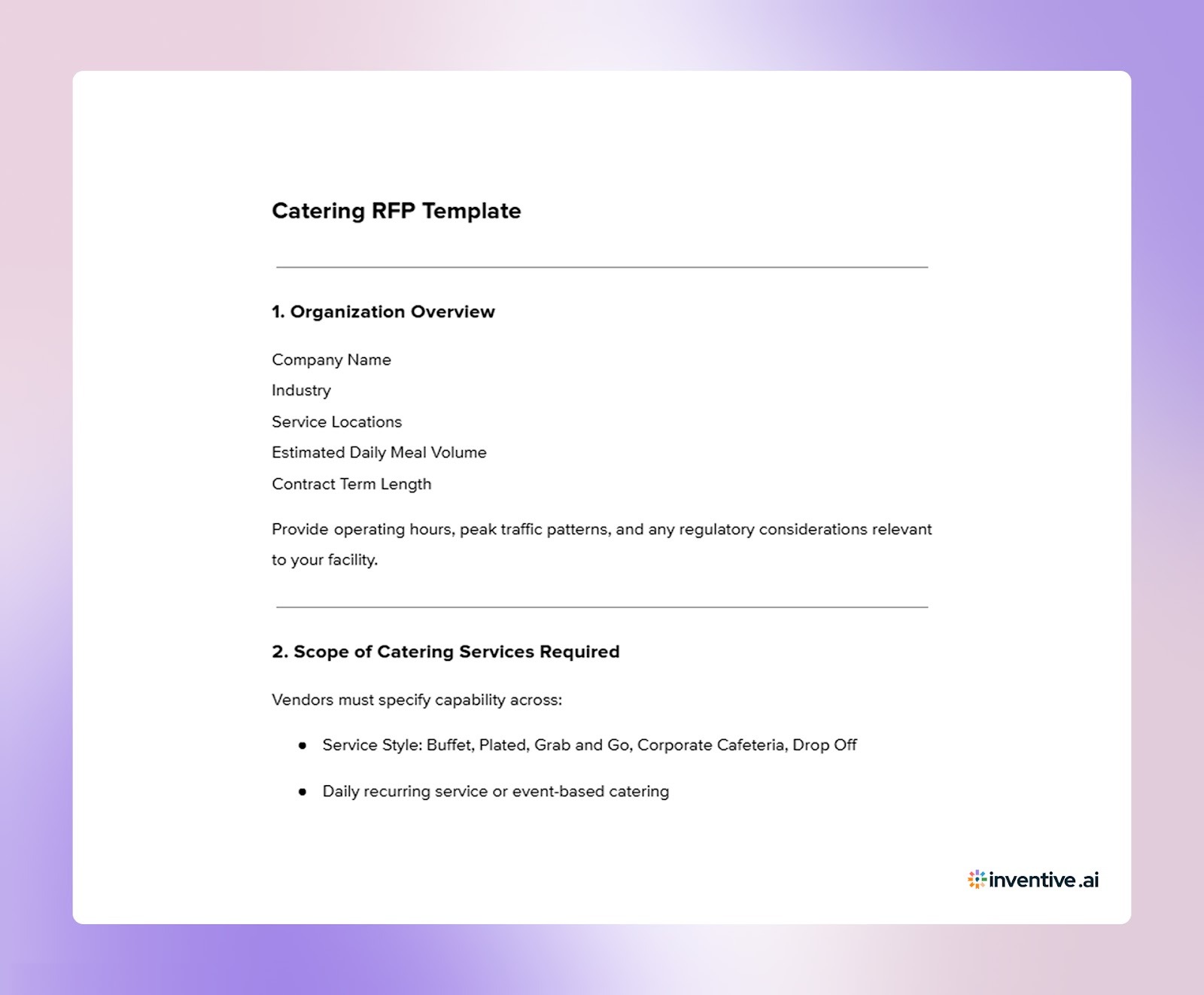

Now that you’ve seen what buyers typically request, the next step is understanding how to respond in a way that meets those expectations directly.
Structured Catering RFP Response Template for Vendors (Free Download)
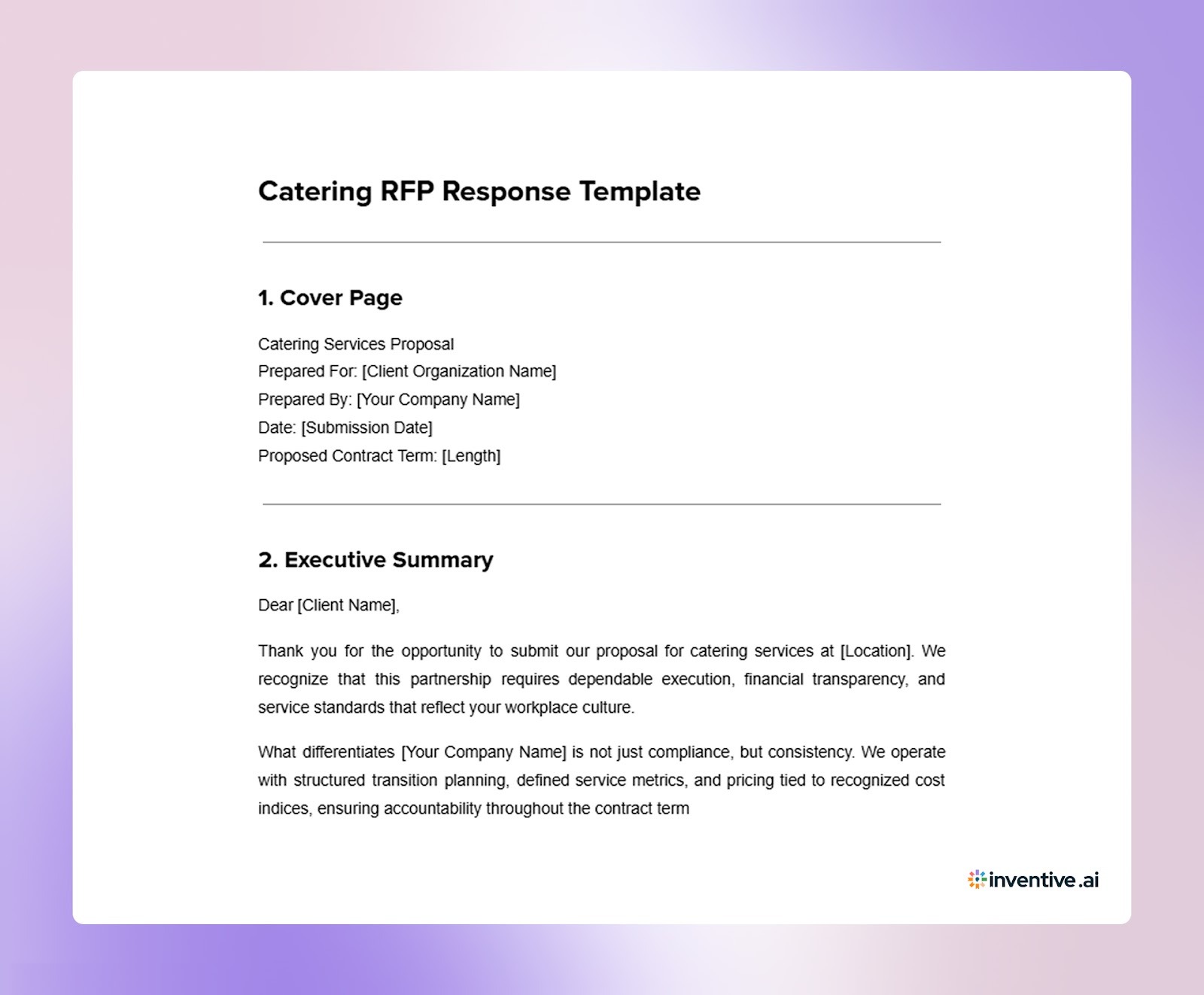

This response template is designed for catering companies bidding on corporate, healthcare, education, or multi-site contracts. It follows the structure buyers expect and addresses operational, financial, and performance requirements directly.
You can copy, customize, and adapt this framework to each opportunity.
1. Cover Page
Catering Services Proposal
Prepared For: [Client Organization Name]
Prepared By: [Your Company Name]
Date: [Submission Date]
Proposed Contract Term: [Length]
2. Executive Summary
Dear [Client Name],
Thank you for the opportunity to submit our proposal for catering services at [Location]. We recognize that this partnership requires dependable execution, financial transparency, and service standards that reflect your workplace culture.
What differentiates [Your Company Name] is not just compliance, but consistency. We follow a structured transition plan, clear service metrics, and pricing linked to recognized cost indices, maintaining accountability across the full contract term.
What differentiates us:
- Chef-led seasonal rotations designed to prevent menu fatigue
- Inclusive menu design so guests with dietary restrictions feel fully considered
- Defined service credits and proactive issue reporting
- Transparent pricing tied to the Consumer Price Index for Food Away From Home
We deliver consistency without losing the human element of hospitality.
3. Understanding of Your Requirements
Based on your RFP, your priorities include:
- Reliable daily service at projected meal volumes
- Clear allergen management and dietary inclusion
- Digital ordering visibility and reporting
- Sustainability accountability
- Minimal disruption during vendor transition
Our proposal directly addresses each of these evaluation criteria.
4. Culinary Program and Menu Strategy
Chef-Led Seasonal Rotation
Our four-week rotating program is designed to prevent repetition and sustain engagement. Seasonal produce, global flavor profiles, and balanced nutrition guide menu planning.
Examples include:
- Herb-marinated grilled chicken with citrus vinaigrette and roasted vegetables
- Plant-forward grain bowls with rotating house-made dressings
- Clearly labeled gluten-free, nut-free, and vegetarian selections
Menus are reviewed quarterly based on participation data and feedback.
Inclusive Menu Design
We design menus so employees with dietary restrictions do not feel like an afterthought.
Protocols include:
- Dedicated prep zones for allergen-sensitive items
- Color-coded utensils and storage containers
- Documented cross-contact prevention procedures
- Clear labeling for gluten-free, nut-free, and dairy-free options
Visual Portfolio
Embedded visuals include:
- Buffet and plated presentation examples
- Executive meeting setups
- Seasonal entrée photography
- Branded service displays
[Insert high-resolution food imagery]
[Insert event service imagery]
5. Health, Safety, and Compliance
We adhere to:
- HACCP protocols
- Local health department regulations
- Certified food handler training
- Continuous temperature monitoring logs
- Documented corrective action procedures
Cross-contamination prevention procedures are formally documented and audited.
Inspection documentation and certifications are available upon request.
6. Staffing Model and Guest Experience
Our on-site team includes:
- General Manager
- Executive Chef
- Dedicated culinary and service staff
Employee retention rate: [X% over last 12 months]
Guest Experience Standards
Our staff is trained not only in food safety, but also in hospitality conduct. Team members are coached on:
- Professional presentation
- Clear communication
- Attentiveness without disruption
- Brand-appropriate service demeanor
Your catering team becomes part of your employee experience.
7. Technology and Employee Ordering Experience
We provide a secure digital ordering platform accessible via mobile and desktop.
Employees can:
- View menus in advance
- Filter by vegan, gluten-free, or allergen-sensitive categories
- Review ingredient details
- Adjust headcounts in real time
- Receive automated confirmations
Administrative dashboards provide participation trends, cost summaries, and forecasting insights.
All integrations comply with your IT and cybersecurity standards.
8. Transition and Implementation Plan
30-60-90 Day Framework
Pre-Launch Phase:
Site review, staffing alignment, tasting session, vendor coordination.
Launch Phase:
On-site leadership presence, daily check-ins, and rapid issue correction.
Stabilization Phase:
Weekly KPI review, cost monitoring, service refinements.
This structured rollout minimizes disruption and uncertainty.
9. Performance Measurement and Service Standards
We track:
- On-time service rate
- Order accuracy percentage
- Satisfaction survey scores
- Waste reduction metrics
Proactive Service Recovery
If a service failure occurs, we notify your team before escalation is required. Same-day corrective action is initiated automatically.
Defined service credits apply if performance thresholds are repeatedly missed.
Quarterly performance reviews are built into the contract structure.
10. Sustainability and Community Commitment
Our sustainability commitments include:
- Compostable or recyclable packaging
- Documented waste diversion tracking
- Food donation partnerships
- Target of 20% produce sourced within a 100-mile radius where feasible
Quarterly sustainability reporting is provided.
11. Pricing Structure and Financial Controls
Pricing is submitted using your standardized sheet.
Service Tier Overview
Escalation clauses are tied to the Consumer Price Index for Food Away From Home. Adjustment schedules and caps are contractually defined.
12. Risk Management and Agility
Documented contingency protocols include:
- Backup suppliers
- Cold menu alternatives during power outages
- Staff substitution plans
- Equipment redundancy
Agility Commitment
We can accommodate up to a [10%] headcount variance with [4 hours] notice under standard operating conditions.
Cybersecurity safeguards are maintained for all digital systems.
13. References and Case Studies
Selected clients include:
- [Client A]
- [Client B]
- [Client C]
Full references available upon request.
Using a structured template helps, but customization is what separates average proposals from shortlisted vendors.
5 Ways to Customize Your Catering RFP Response to Win More Contracts
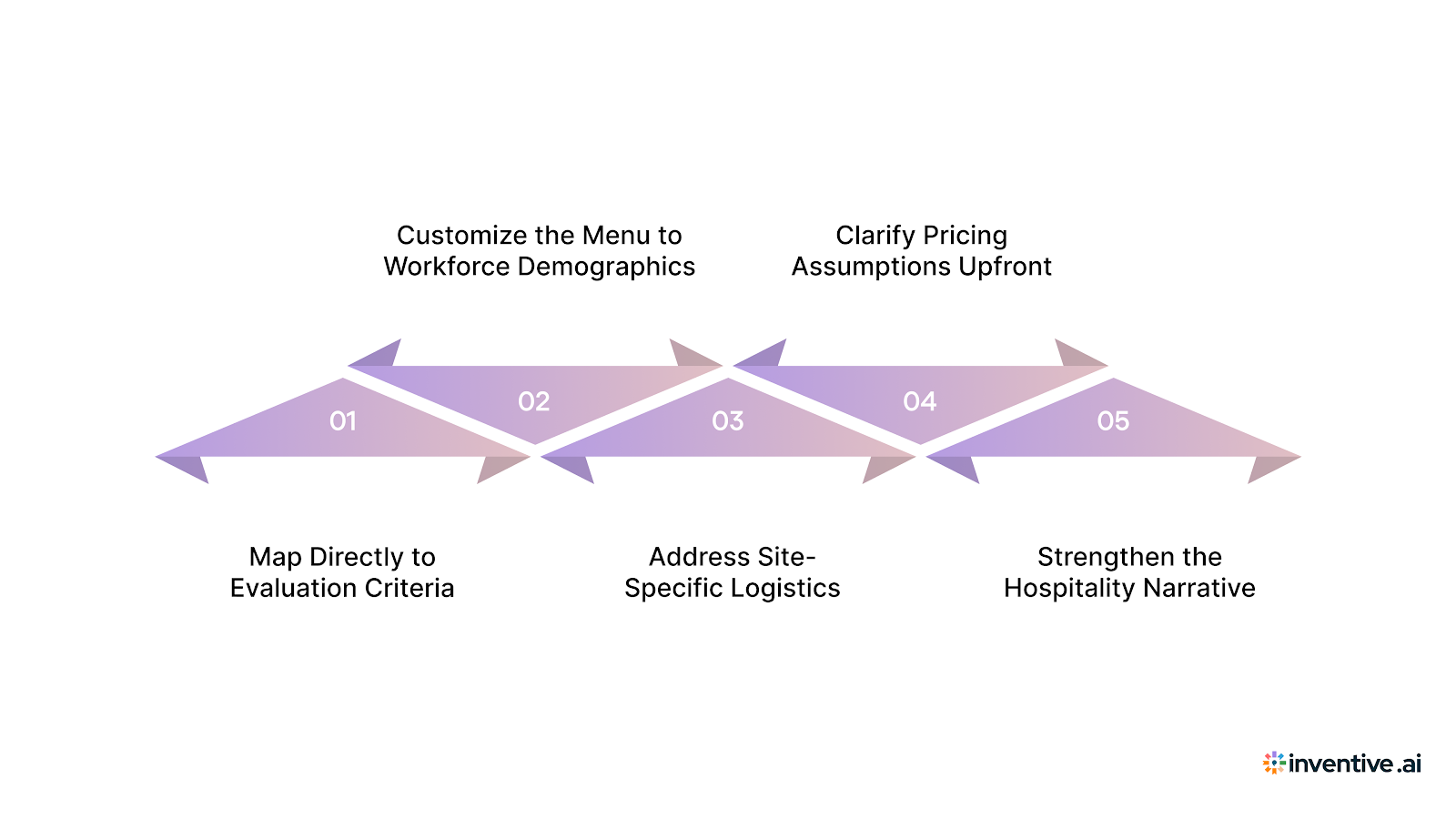
Submitting the template is only the starting point. Buyers quickly spot recycled answers that fail to reflect their site conditions, employee demographics, or service expectations. A customized response shows that you read the RFP carefully and built your proposal around their specific environment.
Use the following approach to make your catering RFP response more targeted and persuasive:
Map Directly to Evaluation Criteria
Mirror the buyer’s scoring structure inside your proposal. If evaluation is weighted toward food safety, sustainability, and cost control, organize your sections in that order and reference their language directly. This makes it easier for evaluators to assign higher scores.
Customize the Menu to Workforce Demographics
Review the client’s industry and employee profile. A healthcare facility may prioritize heart-healthy options and strict allergen controls, while a tech office may value global flavors and plant-forward meals. Reflect this context in your sample rotation rather than submitting a generic menu.
Address Site-Specific Logistics
Reference their building constraints, such as loading dock access, service hours, or limited prep space. When you explain how your team will operate within those conditions, you reduce perceived operational risk.
Clarify Pricing Assumptions Upfront
Spell out delivery windows, headcount variance policies, and escalation terms tied to a defined index. Transparent assumptions reduce back-and-forth negotiation and show financial discipline.
Strengthen the Hospitality Narrative
Briefly describe how your staff represents the client’s brand culture. Mention guest interaction standards, response time for issues, and proactive communication. Catering is not only about food quality; it reflects the daily employee experience.
Customizing every proposal takes time, especially when multiple bids are in motion. This is where automation becomes valuable.
Improve Catering RFP Response Speed and Accuracy with Inventive AI
In catering RFPs, the strength of your answers directly impacts scoring, shortlisting, and contract awards. Pricing alone does not win enterprise bids. Clarity, completeness, and consistency do.
With AI-powered RFP response software, Inventive AI automates the complex RFP management workflow while focusing on response quality across every section of your proposal.
Here’s what sets Inventive AI apart:
Context Engine
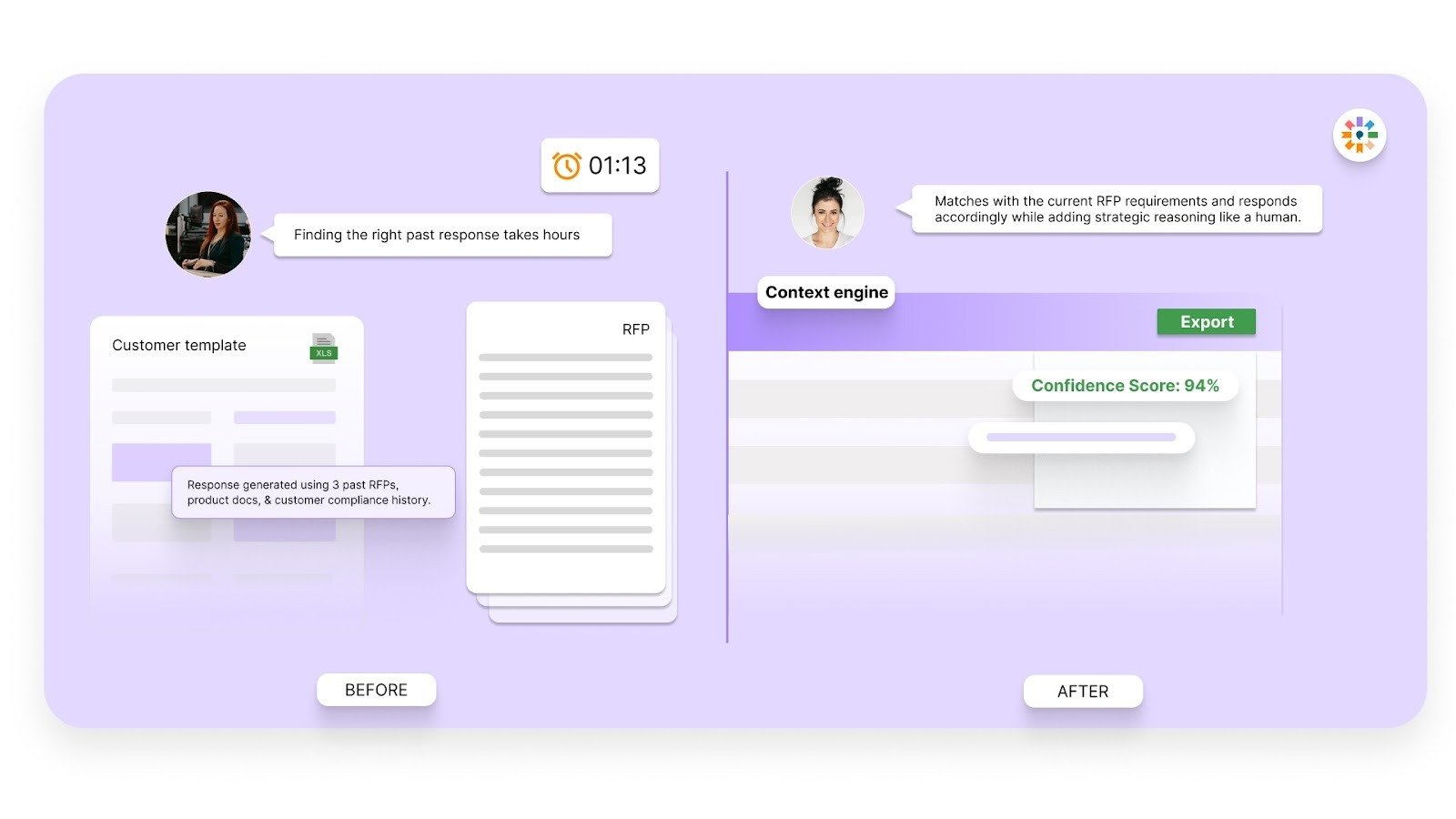
Inventive AI uses multi-layer reasoning that understands the entire solicitation context, including evaluation criteria, service volumes, compliance requirements, and pricing structures. This yields accurate, customized answers that feel like a human SME wrote them and directly address buyer priorities.
2x Accurate, Knowledge-Backed Responses
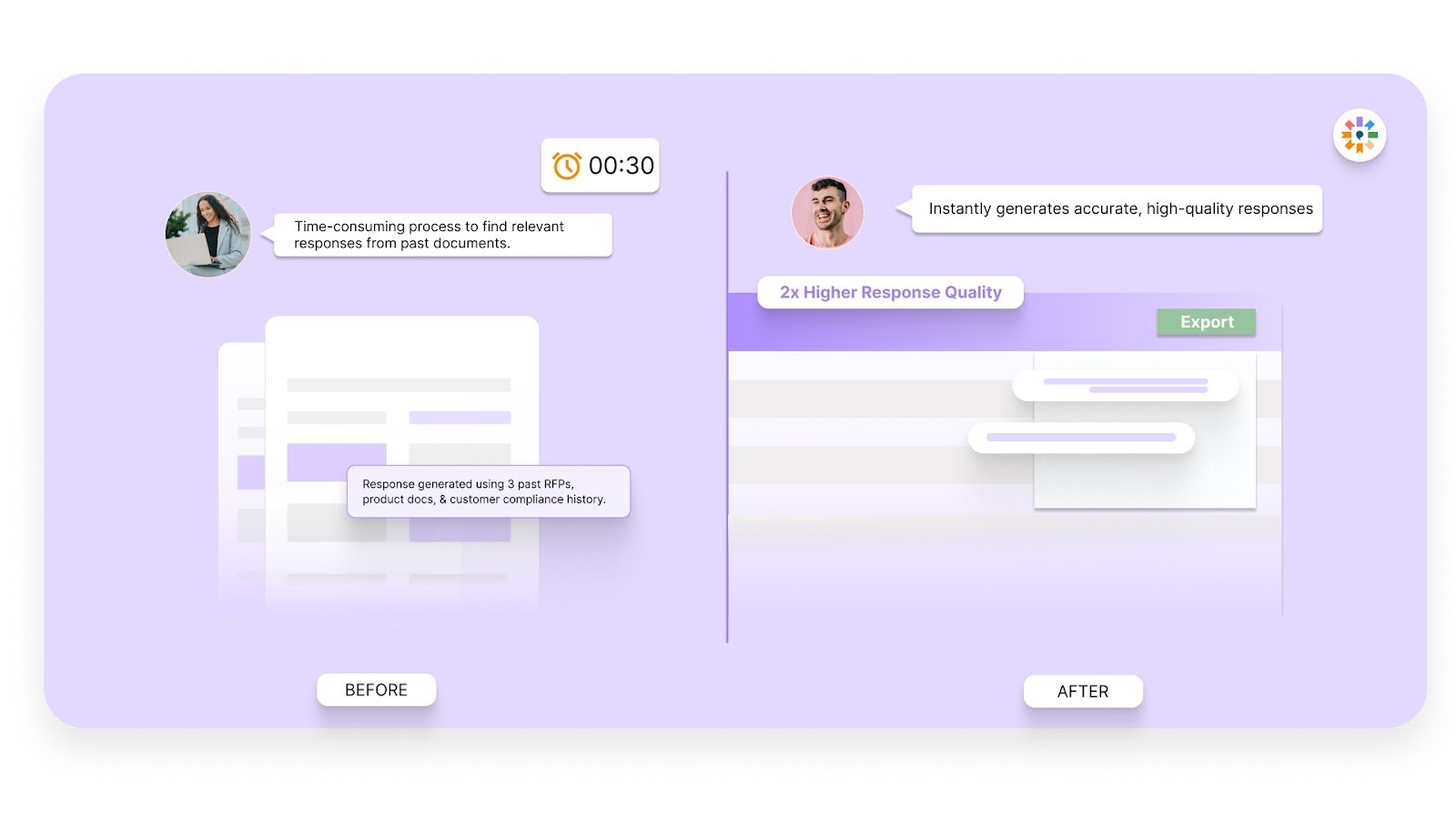
Inventive AI uses multi-layer reasoning to evaluate the full RFP context before generating answers. This produces structured, customized responses that reflect the buyer’s intent rather than generic template language.
Conflict Detection
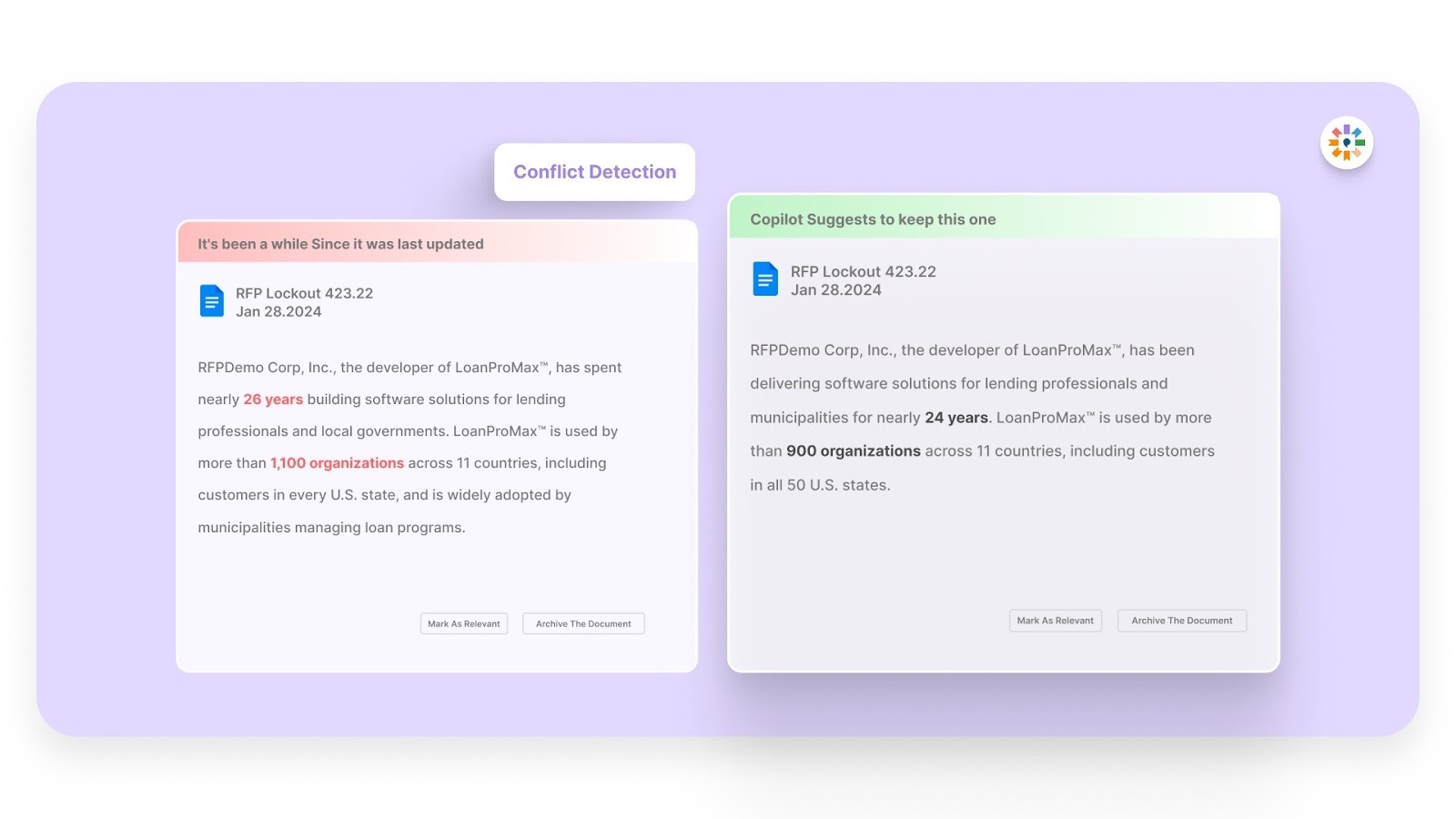
Catering proposals contain interdependent sections such as menu design, staffing ratios, pricing tiers, escalation terms, and service credits. Other tools cannot detect contradictions across these areas. Inventive AI flags conflicting statements instantly, preventing mismatched headcount policies, inconsistent safety claims, or unclear financial terms before submission.
Outdated Content Detection
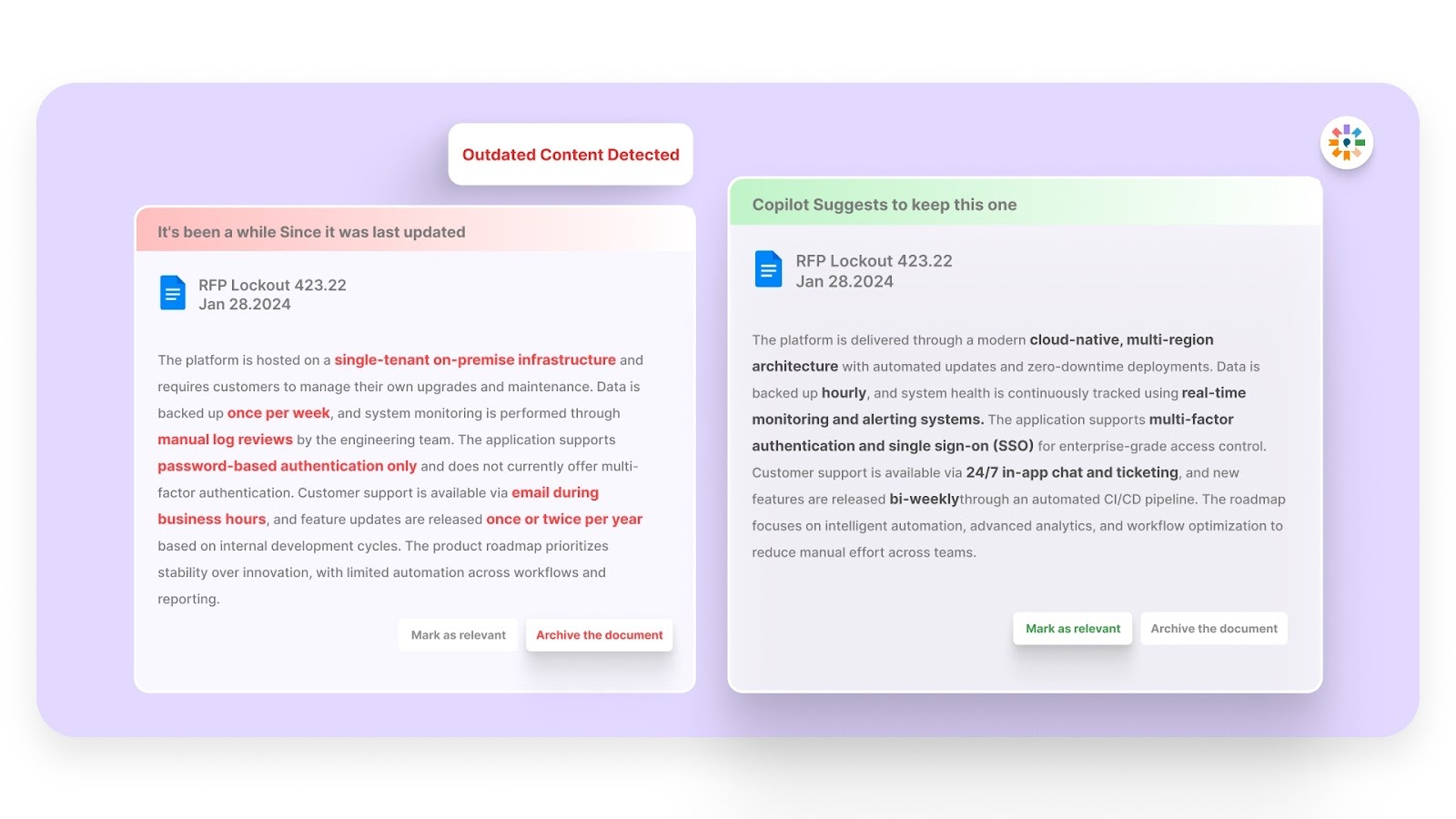
Food safety certifications, sourcing commitments, pricing assumptions, and technology integrations change over time. Many vendors maintain libraries of prior answers that may no longer reflect current standards. Inventive AI automatically catches outdated or non-compliant content before it appears in your proposal. This drastically reduces manual review and rewriting time.
Simple and Easy to Use UI and UX
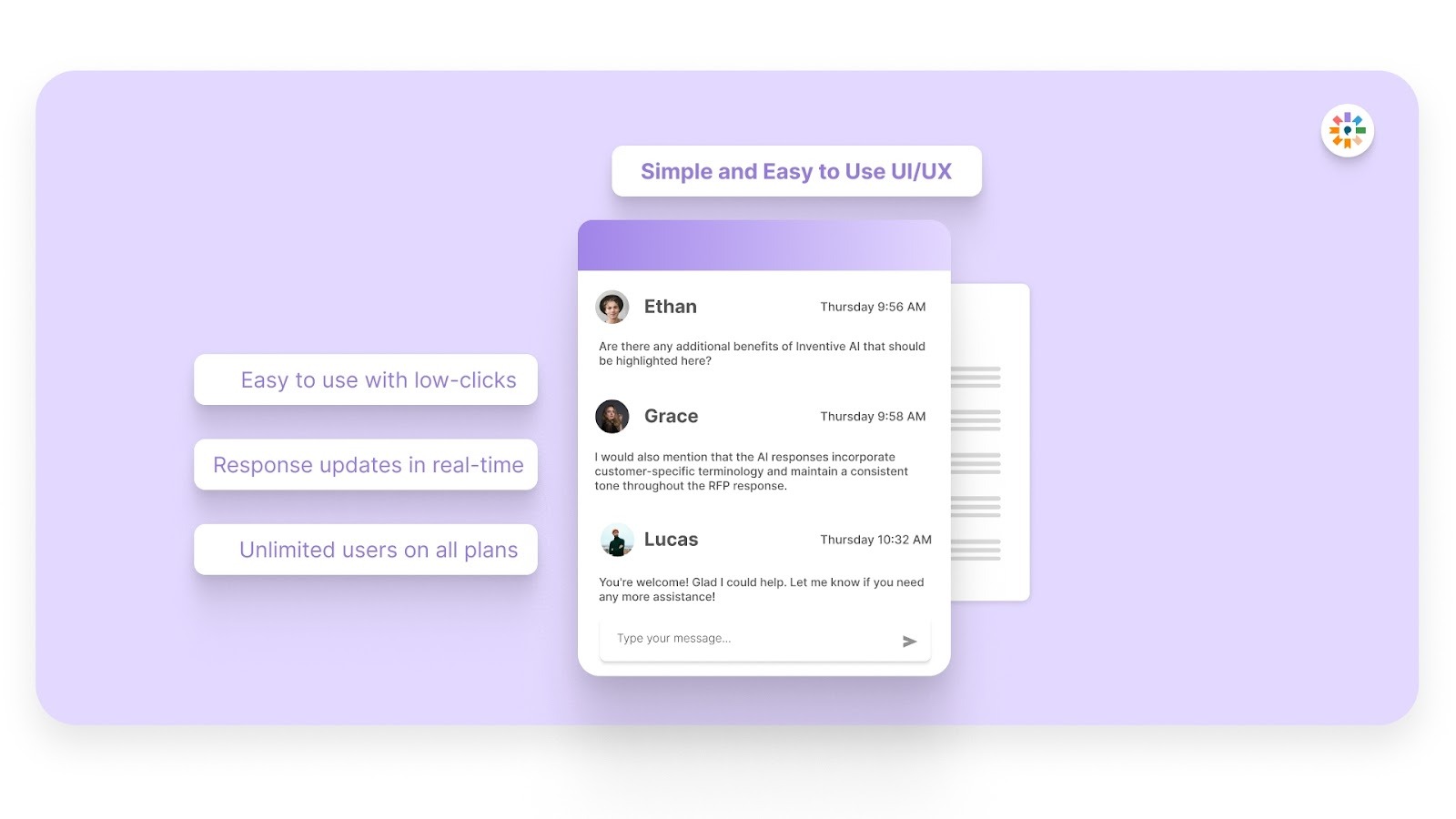
Inventive AI maintains a 100 percent adoption rate across its current customer base and is ranked the easiest-to-use RFP software on G2. Catering sales and operations teams can adopt the platform quickly, even if they are new to AI-based response tools, and produce consistent, contract-ready submissions without disrupting their workflows.
If your team is handling multiple catering RFPs and struggling to maintain speed and consistency, it may be time to modernize your response process.
FAQs
1. What should a catering RFP response include?
A strong response should cover menu design, staffing structure, food safety protocols, pricing transparency, transition planning, and measurable service standards. Mapping your answers directly to the buyer’s evaluation criteria improves scoring outcomes.
2. How detailed should a catering RFP response be?
For larger contracts, buyers expect structured transition plans, sustainability commitments, risk controls, and defined pricing terms. Generic or high-level responses often signal operational gaps.
3. How should vendors handle last-minute headcount changes?
State your variance policy clearly in the proposal. For example, specify what percentage increase you can accommodate and how much notice is required. Clear expectations reduce negotiation friction later.
4. What do procurement teams review before pricing?
Food safety compliance, operational reliability, staffing stability, and transition readiness are typically reviewed before cost. If these areas lack clarity, pricing alone will not secure the contract.
5. How can catering vendors improve RFP win rates?
Use structured templates, consistent safety documentation, and transparent pricing assumptions. Many teams also adopt AI-powered RFP response software to draft faster, maintain accuracy, and increase submission volume.



.avif)