Claude vs. Loopio: Which one should you pick for RFP response automation? [2026]
.webp)
Proposal teams evaluating AI for RFP responses keep landing on the same fork in the road. Down one path is Claude, a frontier AI assistant that writes with unusual polish and starts working the minute you sign up. Down the other is Loopio, a Toronto-built RFP platform that has been organizing answer libraries since 2014 and now serves over 1,700 customers. One is a writer without a system. The other is a system built before modern AI existed.
Full transparency: this comparison is published by Inventive AI. We compete with both tools, so every claim here leans on published pricing, G2 and Capterra review data, and practitioner discussions rather than our own opinion of the competition. We will also tell you, at the end, why we think an AI-native platform makes the whole debate obsolete. Judge that section as the argument it is.
Claude and Loopio: Two products, two philosophies
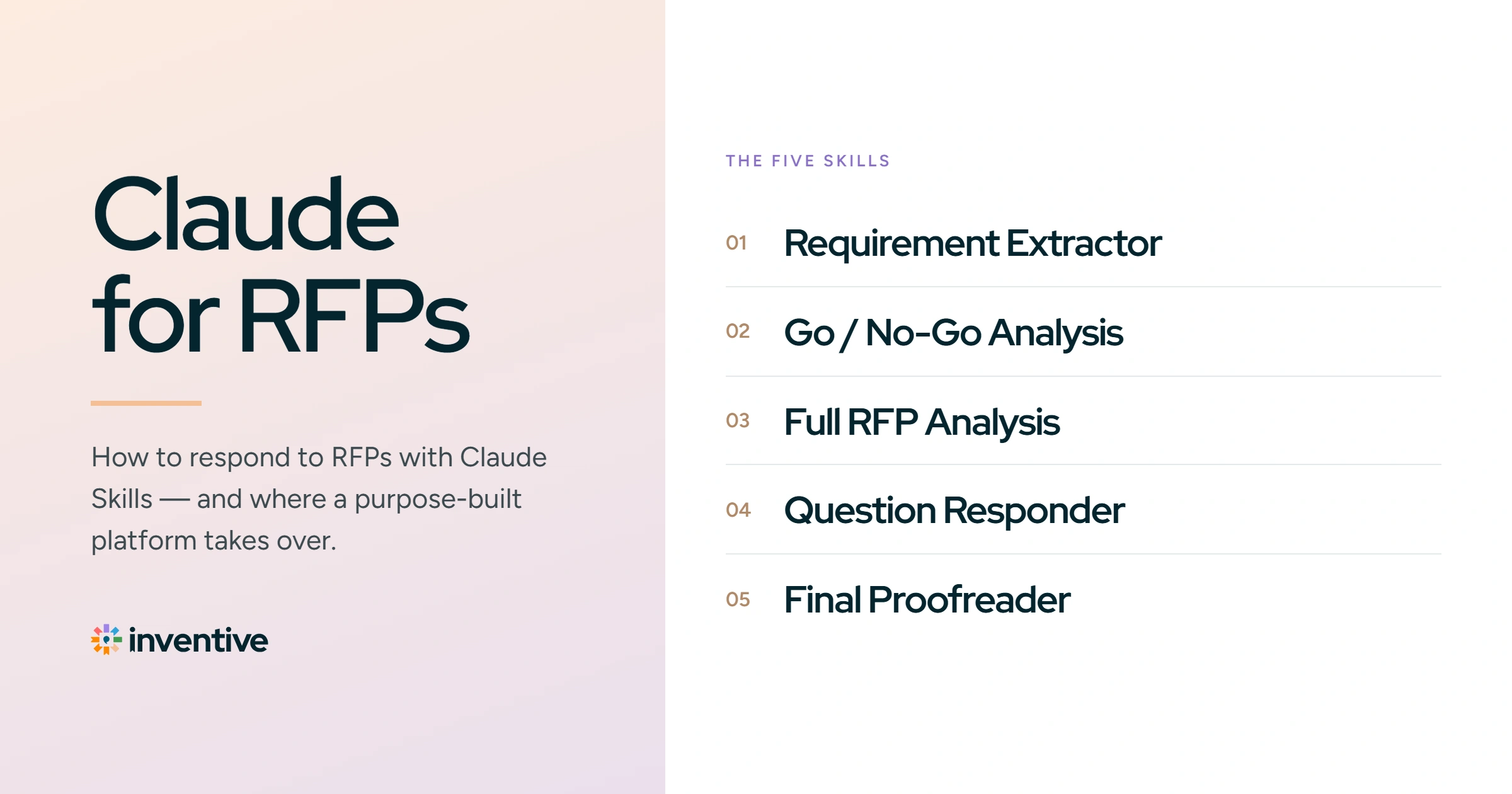
Claude, made by Anthropic, treats every RFP as a conversation. You bring the documents, you ask the questions, it writes. Individual access costs $20 per month on the Pro plan; the Team plan runs $25 to $30 per member monthly with a five-seat minimum.
Loopio treats every RFP as a database problem. Approved answers live in a governed library with owners, tags, and scheduled review cycles. Projects pull from that library through answer matching (a feature called Magic) and, more recently, generative drafting grounded in library content. Public pricing starts at $20,000 per year for 10 seats, with Enhanced and Enterprise tiers quoted individually. It holds a 4.6 out of 5 on G2 across roughly 813 reviews.
The philosophies matter because each one predicts exactly where the tool will disappoint you.
What Claude does well
Serious writing ability. Claude reads a 60-page solicitation and produces a requirements summary, win themes, or a tailored executive draft in minutes. For narrative-heavy sections where voice and persuasion matter, its output regularly beats what a rushed human writes at 11pm before a deadline.
Zero implementation. There is no library to build, no taxonomy to design, no onboarding project. A proposal manager can be productive within the hour. Compare that to the roughly two-month average implementation G2 reports for dedicated RFP platforms.
A price any team can absorb. Even a five-seat Team plan costs about $1,500 to $1,800 per year. Loopio's published entry point is more than ten times that figure before add-ons.
Range. The same subscription drafts emails, analyzes spreadsheets, and preps discovery calls. An RFP tool sits idle between bids. Claude does not.
Where Claude leaves you exposed
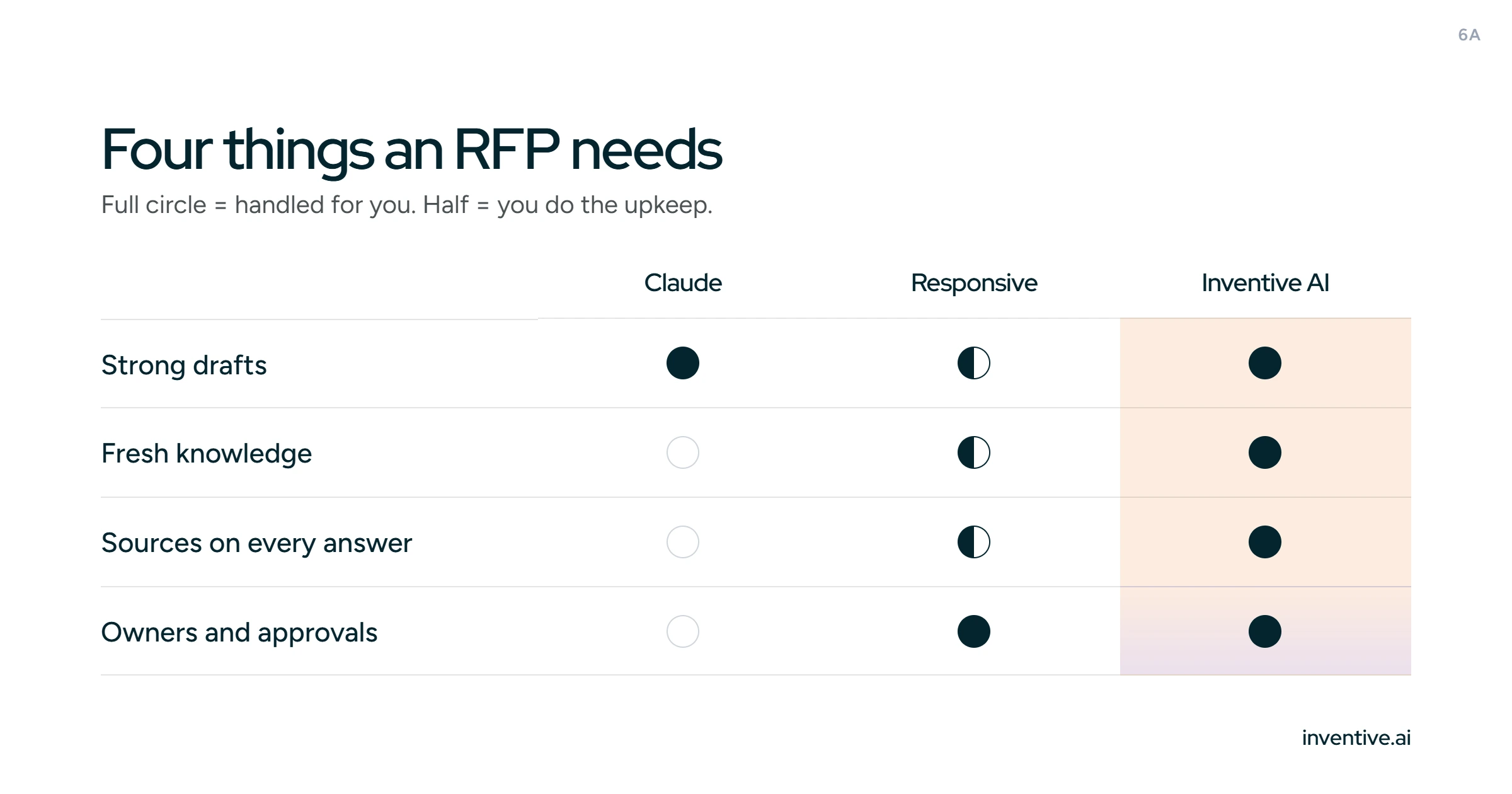
No single source of truth. Claude holds whatever you gave it, in whatever state you gave it. It cannot tell a current security policy from the one you replaced in March. Teams compensate by curating Claude Projects, but curation is exactly the manual librarian work they hoped to escape, and nothing alerts anyone when the content inside goes stale.
Answers you cannot trace. Ask Claude why it claimed your product supports a specific compliance control and you get prose, not evidence. There is no citation trail from answer to approved source document. On security questionnaires and DDQs, where a wrong claim carries contractual weight, every single answer needs human verification. That verification time quietly eats the drafting time you saved.
One conversation does not scale to a team. Five sellers running five private chats will produce five versions of your encryption answer. Nobody owns question 30, nobody approved question 55, and the audit trail is a screenshot in Slack. Claude has workspace sharing, but nothing resembling question-level assignment or an approval pipeline.
The customer's spreadsheet always wins. RFPs arrive as formatted Excel workbooks and portal forms. Claude's answers have to travel back into those formats by hand, row by row, without breaking merged cells or dropdown validations. Practitioners on Reddit consistently name this transfer step as the place where chat-based workflows bleed hours.
What Loopio does well
A genuinely governed library. Loopio's core competence is content control: owners per answer, scheduled review cycles, freshness indicators, permissions, and a Close the Loop workflow that feeds winning answers back into the library. For regulated industries where approved language is sacred, that structure has real value.
Usability that reviewers keep praising. Ease of use is Loopio's single most-mentioned G2 strength, with 140 mentions, and Capterra scores it 4.8 out of 5 on that dimension. Occasional contributors generally find the basic interface approachable.
Full project workflow. Question imports from Word, Excel, PDF, and web portals. Assignments, deadlines, reminders, multistep reviews. SmartScan pulls questions out of online portals and SmartFill pushes approved answers back in. This is process machinery Claude simply does not have.
Strong support. Capterra rates Loopio's customer service 4.9 out of 5, and reviews consistently describe the onboarding and success teams as attentive.
Established integrations. Salesforce, HubSpot, Slack, Microsoft Teams, SharePoint, Seismic, and SSO providers. SMEs can answer assignments from Teams or Slack without logging into the platform.
Where Loopio falls short
The AI arrived a decade after the architecture. Loopio was built around stored Q&A pairs, and its flagship Magic feature is answer matching: find the closest existing response and insert it. Generative drafting was layered on later and stays tethered to the library underneath. G2's review analysis counts 25 mentions of inaccurate responses, reviewers describe generated answers as too creative for high-risk questionnaires, and one Reddit practitioner reported that validating autofill output took longer than searching the library manually. Evaluators comparing it against AI-native platforms keep reaching the same verdict: the AI feels bolted on rather than built in.
A closed loop around its own library. Loopio's automation works on knowledge that lives inside Loopio, converted into maintained Q&A entries. Connectors for external sources exist, but the operating model still asks you to run a second content system parallel to the places your knowledge already lives: SharePoint, Confluence, your CRM, your past submissions. When your product docs change, the library does not know until a human tells it.
Governance is a feature you operate, not a service you receive. Review schedules, deduplication, archiving, conflict resolution: all of it runs on human effort. Reddit users describe library upkeep as "a job in itself," and G2 reviewers ask for automated recommendations on outdated content precisely because the platform does not provide them. Buy Loopio without staffing a content owner and the library decays until the AI built on top of it starts confidently serving last year's answers.
Parts of the interface feel dated. The base workflow earns its usability praise, but reviewers report click-heavy navigation, rigid permissions (completed questions can require an admin to reopen), weak cross-project visibility, and screens that look old. One customer evaluating the platform in a proof of concept put it less charitably, describing the UI as something from the 1990s.
Costs stack beyond the sticker. The $20,000 entry price covers 10 seats. Onboarding packages, professional services for library migration, translations, and certain industry integrations are listed as paid add-ons, and G2 tags Loopio with its highest cost indicator. Add the roughly two-month implementation and the ongoing librarian hours, and the true annual cost lands well above the contract line.
Round-trip formatting still leaks. With 24 G2 mentions of formatting issues, exports losing bullets and images, and complex Excel mappings misfiring, teams often polish the final deliverable in Word anyway and back-port the edits manually.
Claude vs. Loopio: Side by side comparison
The honest read: a lone proposal writer at a company with clean documentation and a light RFP load will get real mileage from Claude. An enterprise team with a staffed proposal operations function, steady volume, and budget for content governance can make Loopio earn its keep. What neither tool escapes is the same underlying bargain: Claude sells you drafting and keeps the knowledge problem yours. Loopio sells you a knowledge system and keeps the maintenance yours.
Before you pick either: evaluate on these 5 parameters
1. Pilot with your ugliest real RFP. Vendor demos use clean documents. Run the 400-row Excel workbook with merged cells and a portal component through every tool you evaluate, then count how much manual repair each one required.
2. Price the librarian on top of the license. Whatever a platform costs, add the loaded hours someone will spend building, deduplicating, and refreshing content. If no one on the team can own that work, a library-centric tool will underdeliver no matter how good the demo looked.
3. Demand a source for every answer. During evaluation, click through from generated answers to the exact document and passage behind them. A tool that cannot show its evidence is asking your reviewers to re-research every claim.
4. Give every answer an expiration date. Whether you use a chat assistant or a platform, untracked answer age is how a deprecated feature ends up in a signed proposal. Test how each tool surfaces stale content without a human hunting for it.
5. Watch the occasional contributor, closely. Your legal reviewer touches the tool four times a year. If they cannot complete their review in ten minutes without training, they will retreat to email, and your audit trail goes with them.
Why Inventive AI beats both sides of this trade
Claude gives you generation without governance. Loopio gives you governance that predates modern generation. Inventive AI collapses the trade by design: an AI-native, agentic platform where autonomous agents run the response process and humans stay in the loop for approvals.
The difference shows up in the parts both tools leave manual:
- Knowledge stays current without a librarian. Inventive AI reads from SharePoint, Google Drive, Salesforce, Confluence, Notion, and Zendesk where your content already lives, syncing whenever a source changes. Its Content Governance Agent hunts down conflicts, duplicates, and stale material on its own. No Q&A pairs to babysit, no quarterly review scramble.
- Every answer arrives with citations. Source citations and a confidence score ship with each response, and the platform returns "information unavailable" instead of improvising when the knowledge base has no answer.
- The whole document, one pass. Upload the full RFP in PDF, Word, Excel, or PPT. An agent extracts the questions, pulls deal-specific context per question through the Context Engine, and drafts the entire response for your team to review, improve, and approve.
- Approval is built into the same workspace. Question-level ownership, reviewer assignments across Product, Legal, and Security, and approved answers flowing back into the knowledge hub automatically.
Teams that evaluated Inventive AI head-to-head against the legacy platforms have published the result:
"We got 2x better response quality than AutoRFP, Loopio & Responsive."
That is Andrew MacLean, Head of Sales Enablement at RAD AI, after his team measured answer quality across vendors. The pattern repeats elsewhere: Insider lifted its win rate from 30% to 50% while cutting response time 90%, AssetWorks Facilities measured a 422% return and $105,000 in net savings, and MaxVal turned an 80-question RFP into a 3-hour task.
If your shortlist currently reads "brilliant writer" versus "well-organized filing cabinet," it is worth an hour to see what an AI-native platform does with one of your real RFPs. Book a demo and bring your hardest document.