Claude vs. Responsive for RFP Automation: An Honest Comparison for Response Teams [2026]
If you respond to RFPs for a living, your shortlist probably includes two very different animals. On one side sits Claude, a general-purpose AI assistant that writes beautifully and costs about as much as a team lunch. On the other sits Responsive, formerly RFPIO, one of the most established RFP platforms on the market. They attack different parts of the same problem, and picking wrong gets expensive in either direction.
A disclosure before we start: this post is published by Inventive AI, and we compete with both. So we will keep the comparison factual, lean on public reviews and published pricing, and concede what each tool genuinely does well. Near the end, we will make the case for why an AI-native platform outperforms both. Weigh that argument on its merits.
What each tool actually is
Claude is Anthropic's AI assistant. It was never designed for RFPs, but proposal and presales teams use it for them anyway: summarizing requirements, drafting answers, rewriting boilerplate for a specific customer. Claude Pro runs $20 per month. The Team plan costs $25 to $30 per member per month with a five-seat minimum.
Responsive is purpose-built software for what it calls strategic response management. It handles RFPs, RFIs, DDQs, and security questionnaires through a centralized content library, project workflows, and a long list of integrations. It holds roughly a 4.5 out of 5 rating on G2 across about 1,280 reviews. Pricing is quote-based: an annual platform fee plus named user licenses plus add-ons.
The case for Claude
The writing is genuinely good. Claude has a strong reputation for long-document synthesis and polished prose. Give it a dense requirements section and a pile of source material, and it produces a readable first draft faster than any human. For narrative sections, executive summaries, and cover letters, the output quality is hard to argue with.
It costs almost nothing. Twenty dollars a month buys a capable drafting assistant. For a team that sees five or six questionnaires a year, that math is difficult for any dedicated platform to beat.
Projects reduce some repetition. Claude Projects let you store product docs, policies, and past responses in a shared workspace. Anthropic added retrieval-augmented generation to Projects, expanding how much knowledge a project can hold by roughly ten times. Setup takes minutes, not months.
It does everything else too. The same subscription helps with emails, research, analysis, and code. No dedicated RFP tool can say that.
Where Claude breaks down for RFP teams
The context treadmill. Claude does not know which product details or security rules apply to which customer. Every new RFP means re-feeding background, re-explaining constraints, and re-tuning prompts. Projects soften this but do not solve it, because someone still has to curate what goes in and keep it current. When a product feature changes, nothing updates automatically. Five teammates running their own chats can send out five different answers.
Hallucination risk with real consequences. A model under pressure to answer will sometimes claim a certification you do not hold or an encryption mode you do not support. On a security questionnaire, one invented compliance statement can kill a deal. Claude has no built-in citation trail tying each answer to an approved source, so every claim needs manual verification.
The copy-paste loop. Claude is a chat window. An RFP with 80 questions means pasting questions in, checking answers, and copying them back out into the customer's Excel file, one at a time, while preserving row order and formatting. Teams consistently report that the time saved on writing gets spent on transfer and reformatting.
No real workflow. There is no question-level ownership, no way to assign question 12 to Legal and question 45 to Security, no draft-review-approved states, no audit trail of who signed off. Collaboration happens in side spreadsheets and Slack threads, which is where version control goes to die.
The case for Responsive
It runs an actual process. This is Responsive's core strength. You can import a questionnaire, break it into questions, assign owners and deadlines, route reviews and approvals, and track completion in one place. For teams juggling multiple concurrent bids with contributors across sales, product, legal, and InfoSec, that structure matters.
A governed content library. Approved answers live in one repository with tags, owners, and review dates. Reviewers on G2 and Capterra repeatedly praise this single-source-of-truth effect: consistent language, faster onboarding for new team members, less hunting through old proposals.
Extensive workflow integrations. Salesforce, Microsoft Teams, Slack, Seismic, Jira. On the workflow side, Responsive plugs into the systems your revenue team already runs, and reviewers rate those connectors well.
Enterprise governance. SSO, role-based access, audit data, business units, retention policies. Large or regulated organizations can usually get Responsive through a security review.
Users report real time savings. The most common theme across roughly 1,280 G2 reviews is reduced time spent searching, rewriting, and chasing people. Support also scores well.
Where Responsive falls short
AI layered on a legacy foundation. Responsive predates the generative AI wave by more than a decade, and its newer AI features sit on top of an architecture built around stored Q&A pairs. Teams that evaluated it against AI-native platforms describe the difference bluntly.
"Responsive feels like they've bolted AI on top of a legacy system. It doesn't work well."
That is Kate Snow at HarteHanks, whose team switched from Responsive to Inventive AI.
The library becomes a second job. Responsive's biggest strength carries its biggest cost. The content library must be built, deduplicated, tagged, and continuously maintained, and the AI is only as good as what is in it. In most deployments the library gets refreshed through periodic subject-matter-expert review cycles, quarterly in many organizations, which means an answer can sit stale for months before anyone looks at it again. Reddit threads about leaving RFPIO describe having to beg marketing and security teams to keep the library updated. When nobody owns the upkeep, answer quality decays quietly.
AI suggestions need babysitting. G2's review analysis counts many reviews citing inaccurate responses. Users describe matching that behaves like keyword search: the words align, but the suggested answer does not actually address the question. Susan Krelitz, Director of Solutions Consulting at MaxVal, put it plainly: even with AI, tools like Loopio, Responsive, and Qvidian still felt like Q&A pairs.
A real learning curve. G2 logs multiple reviews mentioning the learning curve and many calling the product not intuitive. Proposal managers who live in the tool adapt. Occasional contributors, the legal reviewer who logs in twice a quarter, often resist, which pushes collaboration back into email.
Formatting cleanup persists. Complex Word tables, merged Excel cells, and export fidelity are long-running complaints. Many teams finish the final document outside Responsive, then have to reconcile edits back into the library by hand.
Data-source integrations are still young. The workflow connectors are broad, but the integrations that pull live knowledge out of source systems are newer and more limited. In practice, most company knowledge still has to be imported into the content library and maintained there, rather than read from where it already lives.
Opaque, enterprise-grade pricing. No published prices. Named-user licensing means occasional reviewers may need paid seats. G2 reports an average implementation time of about two months, and operational readiness (a library clean enough to trust) often takes longer.
Claude vs. Responsive at a glance
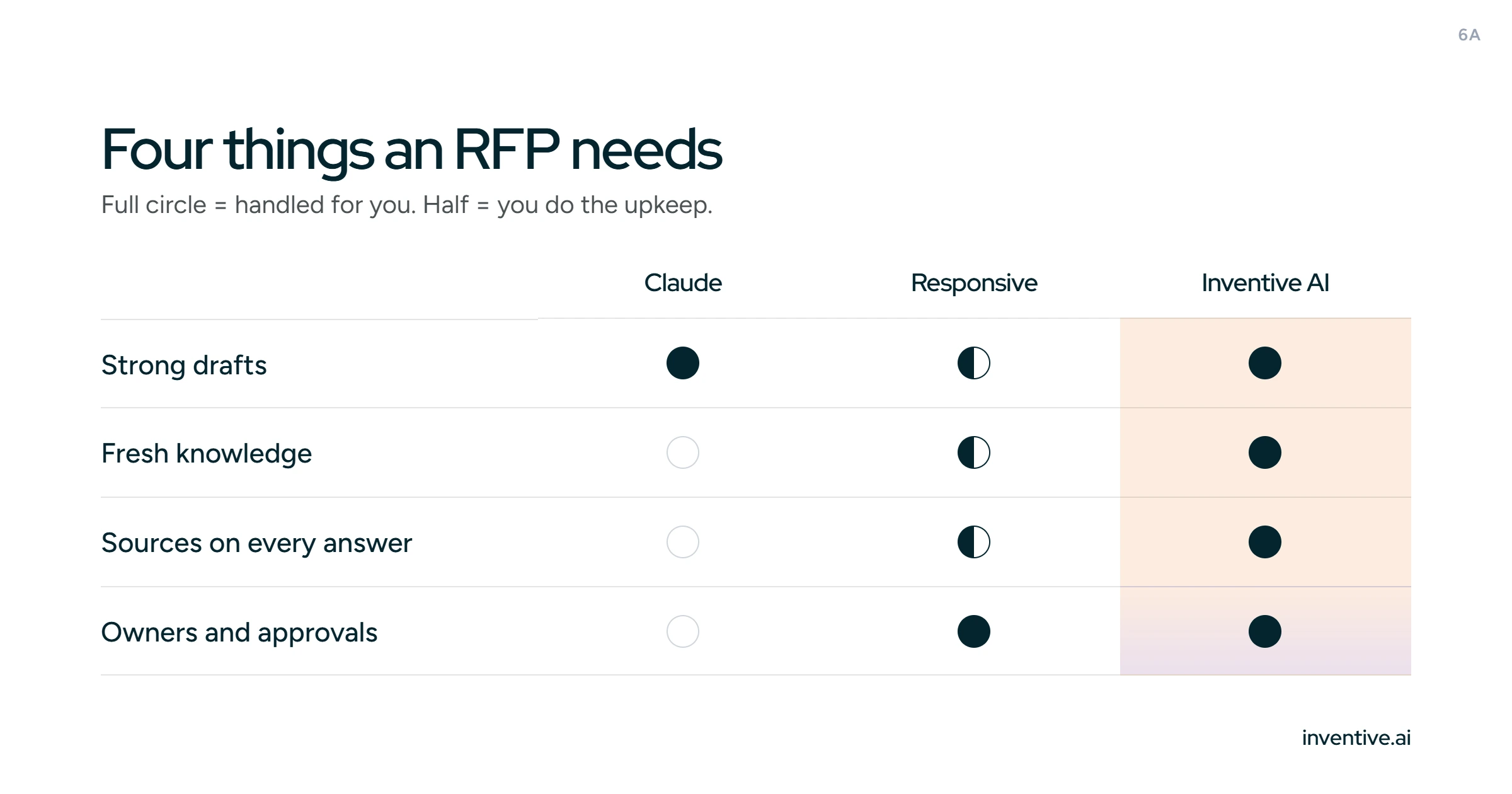
So which one? If you answer a handful of questionnaires a year and one person owns the process, Claude plus a curated folder of source documents is a defensible choice. If you handle steady volume, have a proposal operations function, and can commit a real owner to library upkeep, Responsive earns its place on the shortlist. The uncomfortable truth is that both leave you doing significant manual work. Claude makes you the workflow. Responsive makes you the librarian.
Five practices that separate strong AI RFP responses from risky ones
Whatever tool you choose, the teams getting real results tend to follow the same habits.
1. Ground every factual claim in an approved source. An answer without a traceable source is a liability, especially on security and compliance questions. Require citations, then spot-check them.
2. Treat "we don't know" as a valid answer. The most dangerous AI output is a confident guess. Configure your process so unanswerable questions get flagged to a human instead of filled with plausible fiction.
3. Keep knowledge live, not archived. Stale content is the root cause behind most bad AI answers, in chatbots and platforms alike. When a product spec or policy changes, the change should flow into your response system without a manual re-import.
4. Put drafting and approval in the same place. Every handoff between tools (chat window to spreadsheet to Slack to email) is a place where an outdated answer slips through. Question-level ownership and recorded approvals close that gap.
5. Measure review time, not drafting time. Generation is fast everywhere now. The metric that decides whether AI is actually saving you money is how long a human needs to verify and fix each answer. Track it before and after any tool change.
Why Inventive AI outperforms both
Notice the pattern in this comparison. Claude drafts well but has no governed knowledge and no workflow. Responsive has workflow, but its AI is layered onto a legacy library that you maintain and that users say needs heavy correction. Inventive AI was built AI-native from the ground up to close both gaps at once: an autonomous, agentic platform that runs the RFP response process with humans in the loop for approvals.
Here is what that looks like in practice:
- No new content repository. Inventive AI connects to SharePoint, Google Drive, Salesforce, Confluence, Notion, and Zendesk, and stays in sync when source documents change. A Content Governance Agent flags conflicts, duplicates, and outdated content automatically, so nobody babysits a Q&A library.
- Upload the full RFP, not one question at a time. An agent semantically reads the document (PDF, Word, Excel, PPT), extracts questions and requirements, and drafts responses for the entire file with the right context pulled per question.
- Hallucination control by design. Every response ships with source citations and a confidence score. When the knowledge base lacks an answer, the platform says "information unavailable" instead of guessing.
- Built-in review and approval. Assign questions to Product, Legal, or Security, track ownership, and approve in one shared workspace. Approved answers flow back into the knowledge hub automatically.
The results are measurable. Insider cut response time by 90% and lifted its RFP win rate from 30% to 50%. AssetWorks Facilities documented a 422% ROI with $105,000 in net savings. MaxVal completed an 80-question RFP in 3 hours, work that used to take most of a week. And RAD AI measured Inventive AI's responses as twice as accurate as other RFP AI tools it evaluated, including Responsive.
If your team is weighing a chat window against a content library, it is worth seeing the third option before you commit a budget cycle to either. Book a short demo and run one of your real RFPs through Inventive AI.

.webp)