Cost avoidance vs cost savings: the difference and why it matters
Cost avoidance vs cost savings: learn what each means, how they differ, how to calculate and report them, and when each one matters.
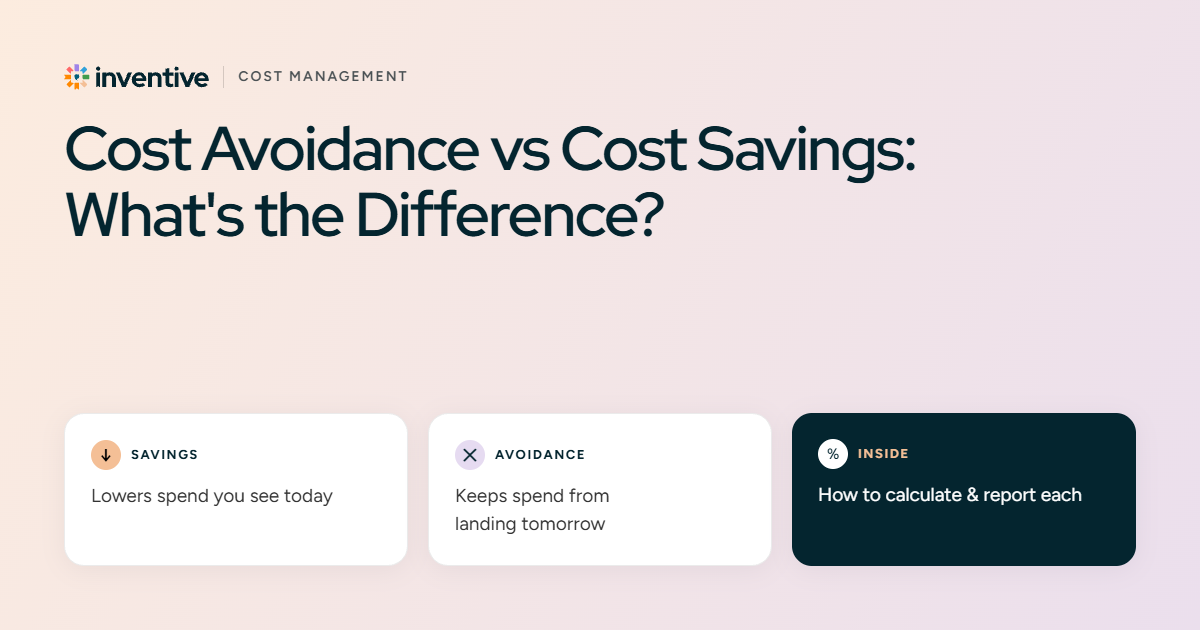
Cost savings and cost avoidance both reduce what your organization spends, but they are not the same, and finance treats them differently. Cost savings is a measurable reduction in what you actually pay, measured against a baseline. Cost avoidance is preventing a future cost that would otherwise have hit your budget. One lowers spend you can see today. The other keeps spend from landing tomorrow.
The difference matters most when you have to justify a decision to finance or leadership, such as renewing a software contract, consolidating tools, or growing output without adding headcount. This guide defines each term, gives clear examples, shows how to calculate them, explains how they differ from cost reduction, and covers how to report cost avoidance credibly, which is where most teams struggle.
TL;DR
- Cost savings is a realized reduction in current spend against a baseline, such as renewing a software contract at a lower rate. It is called hard savings because it shows up on the P&L.
- Cost avoidance is preventing a future cost, such as negotiating a proposed renewal increase down. It is called soft savings because it does not lower current spend.
- The core difference: cost savings reduces a cost you are already paying, while cost avoidance stops a cost you have not yet incurred.
- Finance books cost savings because it is verifiable. Cost avoidance is tracked as a separate metric, because it measures a cost that never happened.
- Both matter. Report them separately and label them clearly, so cost avoidance is never mistaken for money returned to the budget.
What is cost savings?
Cost savings is a measurable reduction in what your organization pays for something, measured against a defined baseline such as the previous price, the current contract, or the budgeted amount. It is often called hard savings, because the lower spend appears directly on the profit-and-loss statement and can be audited.
The defining feature is that the money is visibly no longer being spent. Cost savings is the metric that answers, "how much less are we spending than we were?" Finance relies on it because it can be tied to an invoice and directly improves the budget.
What is cost avoidance?
Cost avoidance is an action that prevents or reduces a future cost that would otherwise have occurred. It does not lower your current spend, so it is often called soft savings. Instead of cutting a cost you are paying, it keeps a new or higher cost from ever reaching your budget.
The defining feature is that the cost never appears, so there is nothing on the P&L to point to. Cost avoidance answers a different question: "how much more would we be spending if we had done nothing?" It captures the value of proactive decisions that protect future budgets, which is why it is easy to overlook and easy to overstate.
How to calculate cost savings and cost avoidance
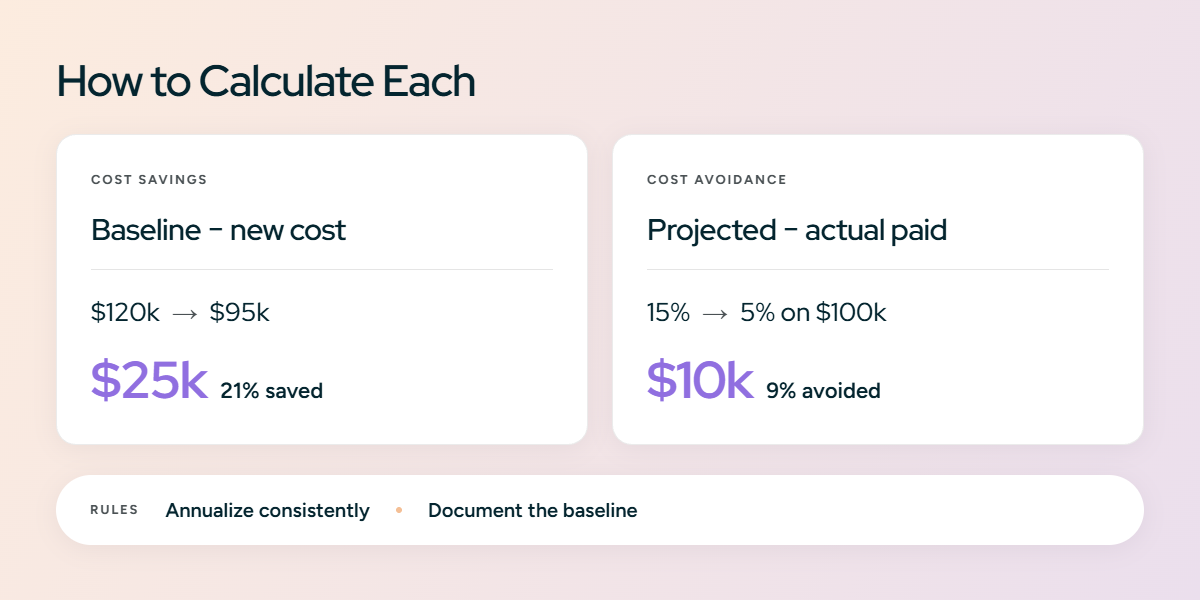
Both metrics use a simple subtraction: cost savings compares your new cost to what you paid before, and cost avoidance compares your actual cost to what you would have paid. The difference is the baseline. Savings measures against a known past price, while avoidance measures against a projected future one.
How to calculate cost savings
Use your previous price, current contract, or budgeted amount as the baseline.
- Amount: baseline cost − new cost
- Percentage: (baseline cost − new cost) ÷ baseline cost
For example, if you renew a software contract from $120,000 to $95,000 a year, your cost savings is $25,000, or about 21% ($25,000 ÷ $120,000).
How to calculate cost avoidance
Use the cost you would have paid as the baseline, drawn from a documented source such as a vendor quote, a market rate, or a signaled price increase.
- Amount: projected future cost − actual cost paid
- Percentage: (projected cost − actual cost) ÷ projected cost
For example, if a vendor proposes a 15% increase on a $100,000 contract but you negotiate it to 5%, you would have paid $115,000 and instead pay $105,000. Your cost avoidance is $10,000, or about 9% ($10,000 ÷ $115,000).
Two rules for a defensible number
- Annualize multi-year deals consistently. State whether a figure is one-year or total-contract value, and apply the same basis to every calculation, so numbers are comparable.
- Document the baseline. Keep the source of your before-price or projected cost on record, since that is the figure finance will question first.
Examples of cost savings and cost avoidance
The clearest way to tell the two apart is to see them side by side. In each case below, cost savings lowers a bill you are already paying, while cost avoidance keeps a future bill from growing.
Cost savings examples (money you are no longer spending):
- Renewing software at a lower rate. You renegotiate a sales tool from $120,000 to $95,000 a year. You save $25,000, or about 21%, and it lands in this year's budget.
- Consolidating overlapping tools. Two teams pay for two tools that do the same job. You drop one and remove its license cost entirely.
- Switching to a lower-priced vendor. You move a service to a provider that charges less for the same scope, and your monthly spend drops.
Cost avoidance examples (money you kept off the budget):
- Negotiating down a renewal increase. A vendor proposes a 15% price increase. You negotiate it to 5%. You still pay more than last year, but you avoided the 10% difference.
- Handling more work without hiring. Your team's workload doubles, but a better process or tool lets the same people absorb it. You avoid the cost of the new hire you would otherwise have needed.
- Locking a multi-year rate. You sign a two-year contract at today's price because the vendor has signaled an increase next year. You avoid that future increase.
Notice the pattern: every cost savings example changes a number on a current invoice, and every cost avoidance example changes a number you would have seen on a future one.
Cost avoidance vs cost savings: the key differences
Cost savings and cost avoidance differ on four points that decide how each is measured and reported. Cost savings reduces a current cost and appears on the P&L; cost avoidance prevents a future cost and does not.
The practical takeaway is that cost savings is easier to prove and easier to claim credit for, because the money is visibly gone from the budget. Cost avoidance is harder to prove, because it measures a cost that never happened. That does not make it less real, but it does mean it has to be documented carefully to be believed.
How to track and report both credibly
The most common mistake is reporting cost savings and cost avoidance as one number. Finance treats them differently, so combining them costs you credibility. Cost savings is booked by finance because it is realized and auditable. Cost avoidance is a counterfactual, an estimate of a cost that did not occur, so finance cannot put it on the P&L, and it is reported as a separate performance metric rather than money returned to the budget.
Cost avoidance is the one that gets challenged, because the avoided cost never appears on a statement and is easy to inflate. To make it defensible, follow four practices:
- Report the two separately. Keep realized (hard) savings and avoided (soft) savings on different lines, so no one assumes cost avoidance freed up cash.
- Anchor avoidance to a documented benchmark. Base the projected cost on a real reference, a written vendor quote, a published market rate, or a signaled increase, not a figure you produced yourself.
- Be conservative. When the number is uncertain, use the lower end. A modest figure you can defend is worth more than a large one you cannot.
- Agree the methodology with finance. Align once on how avoidance is calculated, then apply it consistently in every report, so the number is trusted rather than questioned.
Handled this way, cost avoidance becomes a metric leadership can rely on, rather than a soft number that gets dismissed.
Do cost savings or cost avoidance matter more?
Neither is more important; they measure different kinds of value, and a mature team tracks both.
Cost savings shows immediate, budget-level impact, which is what finance and leadership ask for first. Cost avoidance shows the value of proactive decisions, such as capping a renewal increase or scaling output without new hires, that protect the organization over time.
Report only savings, and you undervalue the work that prevents future costs. Report only avoidance, and you leave out the money you actually freed up.
Reducing the cost of your bid and proposal function with Inventive AI
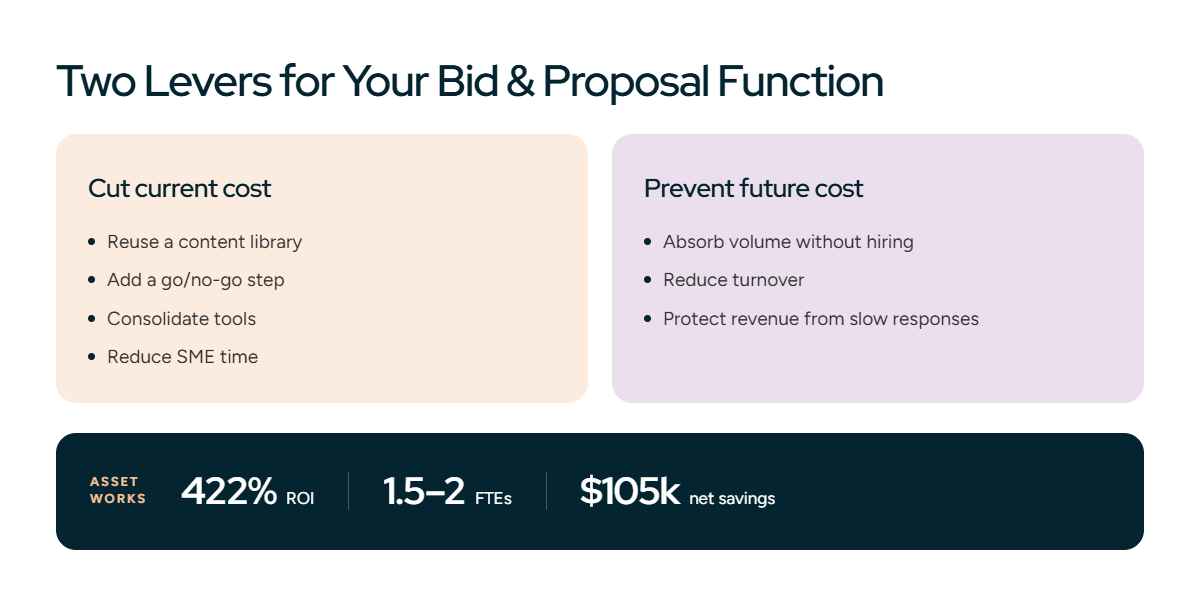
A bid and proposal function has recurring costs: the hours writers and subject-matter experts spend on each response, the tools the team pays for, and the deals lost to slow or inconsistent responses. Both levers apply here: cost savings on what you spend now, and cost avoidance on what you would spend as volume grows.
Cut current cost (cost savings):
- Reuse a central content library. When approved answers live in one place, writers reuse them instead of rewriting, cutting the hours per response.
- Qualify with a go/no-go step. Screening opportunities before you commit stops the team spending days on bids it cannot win.
- Consolidate overlapping tools. Teams often pay for several tools that each do part of the job. Moving to one platform removes duplicate license spend.
- Reduce SME time. Answering routine questions from your library first pulls experts in only for the ones that need them.
Prevent future cost (cost avoidance):
- Absorb more volume without hiring. If the same team can handle more bids as demand grows, you avoid adding headcount, the function's largest cost.
- Reduce turnover. Removing repetitive manual work keeps experienced people longer, avoiding the cost of rehiring and ramping replacements.
- Protect revenue from slow responses. Faster, more consistent responses win more of the bids you already pursue, avoiding the cost of a lost deal.
Most of these levers reduce the same thing: the manual, repetitive work that drives both the hours and the headcount. That is where automation fits. Inventive AI drafts each RFP, RFI, DDQ, and security questionnaire response from your approved content, so your team reviews instead of writing.

.avif)

%20(9).avif)