Free RFP Response Template in Google Docs & 4 Industry Formats

Are you spending hours copying answers from past proposals, only to reformat them again in Google Docs? If your team handles multiple bids each quarter, the right RFP response template in Google Docs setup can save serious time and reduce last-minute chaos.
Sales and proposal teams often juggle tight deadlines, scattered content, and constant edits from SMEs. Version conflicts, missing sections, and compliance gaps can quickly slow down momentum and hurt your chances of winning.
In this blog, we’ll explore ready-to-use Google Docs templates for general, SaaS, healthcare, government, and construction RFP responses, plus practical tips on customizing them to improve win rates and avoid common mistakes.
Free RFP Response Template (Google Docs Format)
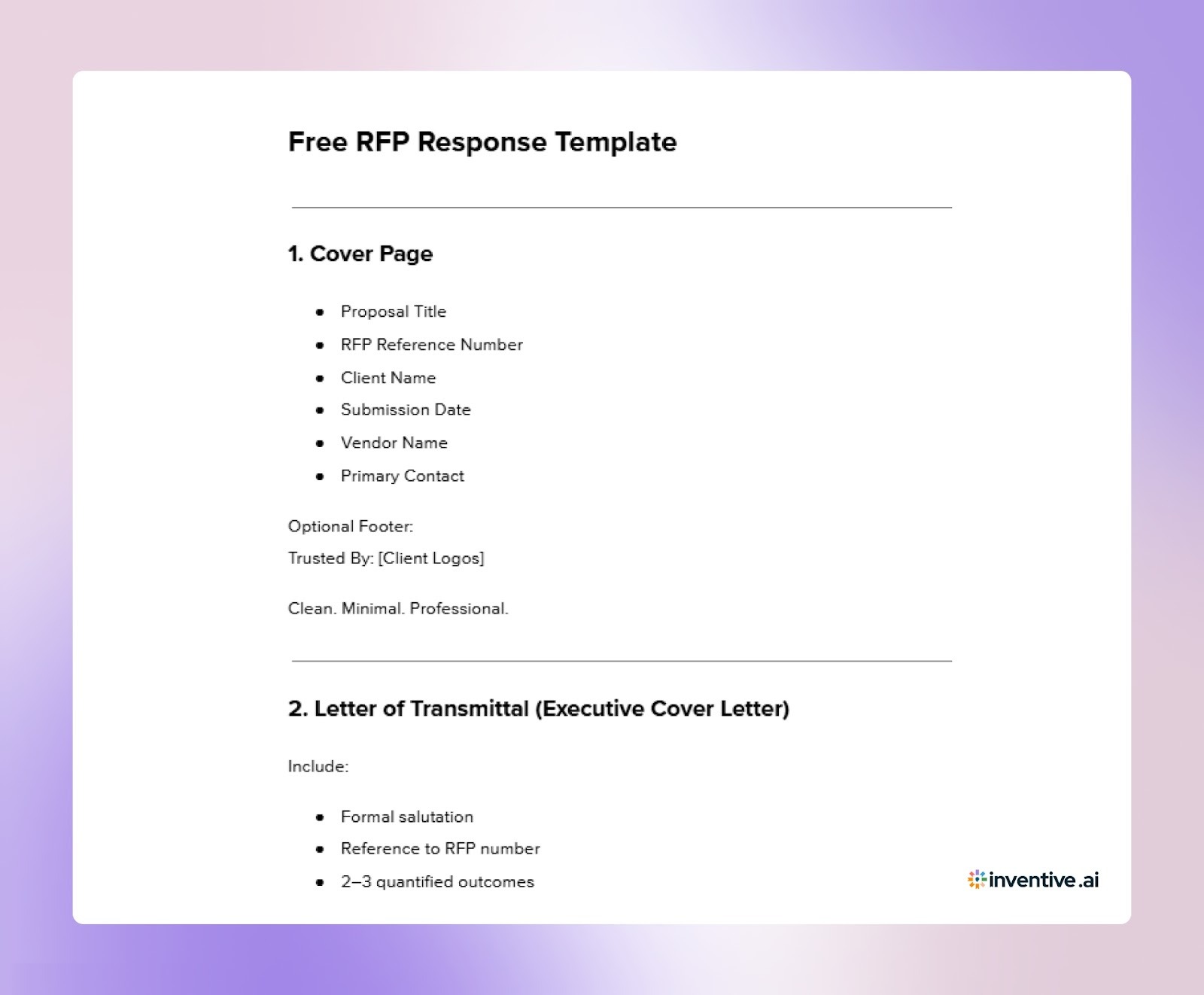

The general template below gives vendors a structured foundation that balances persuasion with compliance. It helps you present measurable outcomes, clear execution plans, and supporting proof in a format that procurement teams and evaluators can review quickly and score with confidence.
1. Cover Page
- Proposal Title
- RFP Reference Number
- Client Name
- Submission Date
- Vendor Name
- Primary Contact
Optional Footer:
Trusted By: [Client Logos]
Clean. Minimal. Professional.
2. Letter of Transmittal (Executive Cover Letter)
Placed immediately after the Cover Page.
Include:
- Formal salutation
- Reference to the RFP number
- 2–3 quantified outcomes
- Commitment statement
- Executive signature
Keep it narrative. One page max.
3. Executive Summary (Maximum: 2 Pages)
Golden Rule: If it exceeds two pages, it is no longer executive-level.
One-Sentence Unique Value Proposition (UVP)
What is the one thing only you can claim?
Example structure:
“We are the only provider in this category with [distinct capability], delivering [specific measurable outcome].”
The Problem as You Defined It
Use a callout blockquote:
“You asked for [Requirement X].”
Then respond directly:
We deliver [X] plus [additional measurable benefit].
Measurable Outcomes
Within [timeframe], we will:
- Improve [metric] by X%
- Reduce [risk/cost/time] by X%
- Achieve [strategic objective]
Use callout boxes for key statistics.
4. Compliance Matrix (Scoring-Ready Section)
| RFP Requirement ID | Requirement Summary | Response Section | Page # |
|---|
This protects you from missing scoring points.
5. Understanding Your Requirements
Mirror the client’s language.
Highlight:
- Success criteria
- Constraints
- Risk areas
- Evaluation priorities
Keep this tight and structured.
6. Proposed Solution & Transition Plan
Solution Overview
Tie each component directly to a requirement.
Transition / Onboarding Plan
Address switching anxiety:
- Knowledge transfer
- Timeline to stabilization
- Parallel processes (if needed)
- Governance checkpoints
Insert visual placeholder:
[Process Flow Diagram Here]
7. Differentiation – Why Choose Us for Your Organization
Force specificity. Avoid generic claims.
1. Unique Capability
What can you claim that others cannot?
2. Proven Industry Outcomes
Metric-backed proof relevant to this client type.
3. Reduced Execution Risk
Clear structure for accountability.
If this section sounds interchangeable with competitors, rewrite it.
8. Project Plan & Timeline
| Phase | Activities | Timeline | Owner | Client Responsibilities |
|---|
Including client responsibilities prevents project delays.
9. Team & Key Personnel
Key Roles
- Executive Sponsor
- Project Manager
- Technical Lead
For each person, include:
- Experience
- Certifications
- Relevant projects
- Why is this individual assigned to this engagement
Insert Org Chart Placeholder.
10. Key Risks & Mitigation
| Risk | Impact | Mitigation |
Shows operational maturity.
11. Pricing Structure
| Item | Description | One-Time | Recurring |
Pricing Assumptions
List scope boundaries clearly.
Out-of-Scope Items
Prevent future disputes.
📌 Place Social Proof Near Pricing
Example:
“96% customer satisfaction rating.”
“Client retained for 3 consecutive renewals.”
This reduces final-stage hesitation.
12. Case Studies (S.T.A.R. Format)
Situation
Task
Action
Result (quantified)
Keep each concise and outcome-driven.
13. About Our Company (Placement Depends on Bid Type)
For Commercial / Competitive Bids:
Keep this section here.
For Government / Technical Bids:
Move this section to Section 5 (after Compliance Matrix).
Content:
- Overview
- Years in operation
- Core capabilities
- Certifications
- Client portfolio snapshot
14. Compliance & Certifications
Confirm adherence to:
- Mandatory RFP criteria
- Regulatory standards
- Security protocols
15. Appendix (Dedicated Section)
This is where the “boring but required” material lives:
- Full CVs / Resumes
- Detailed Financial Statements
- Insurance Certificates
- Technical Specifications
- Legal Documentation
- Additional Compliance Forms
Keeping this separate preserves narrative strength.
16. Terms & Conditions
Validity period
Payment terms
Legal notes
17. Signature Page
Authorized Representative
Title
Signature
Date
Different sectors assess proposals using distinct criteria, which means your structure should reflect those priorities.
4 Specialized RFP Response Templates in Google Doc for Key Industries
RFP responses are not evaluated the same way across industries. Each sector emphasizes different risks, documentation standards, and proof points during scoring.
The templates below highlight what each sector prioritizes so you can customize your response accordingly.
1. SaaS / IT Services RFP Response Template (Google Doc)
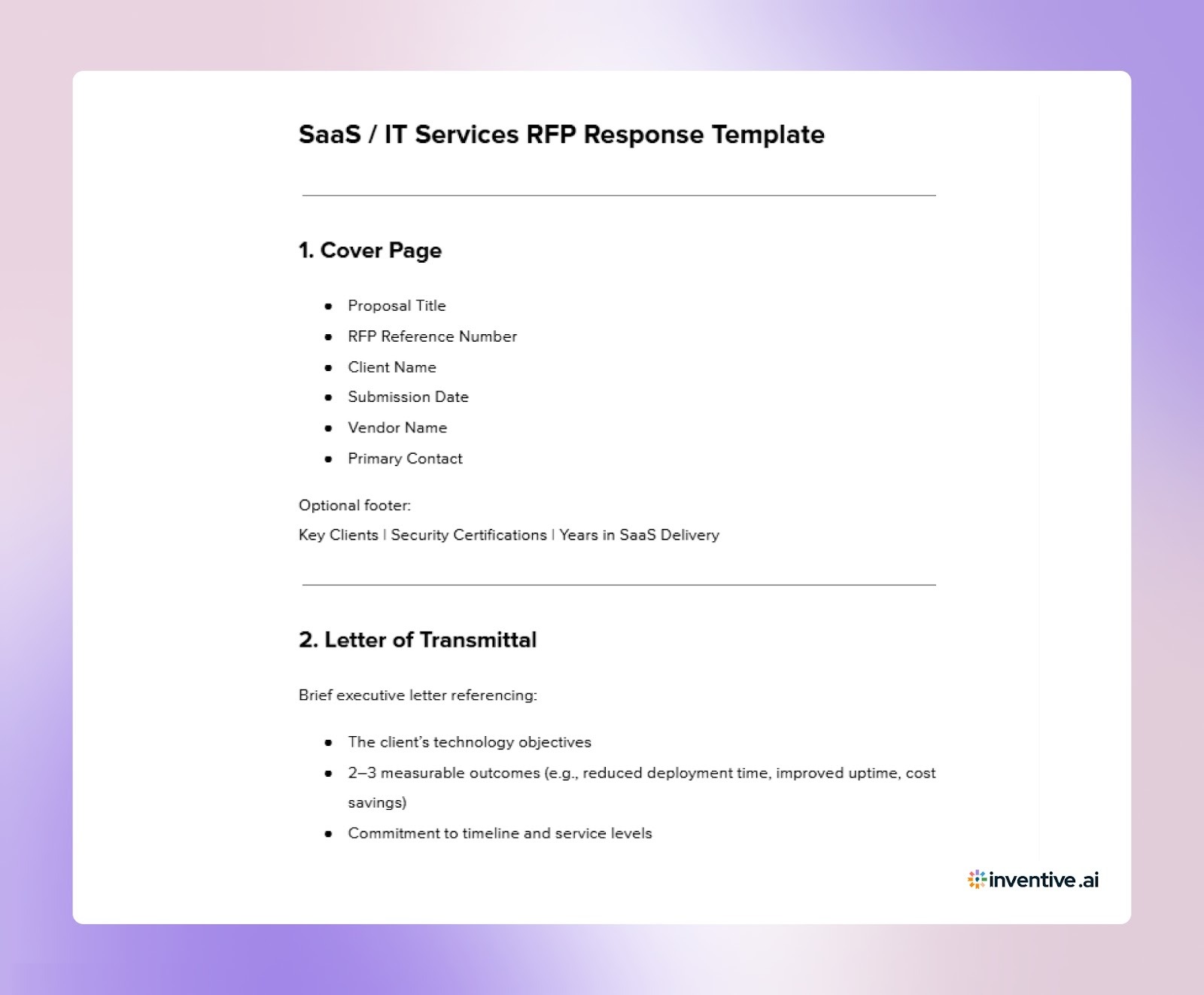
Technical evaluations focus on architecture clarity, security posture, system reliability, and documented proof of capability. Your response should clearly show how the proposed solution meets requirements and reduces operational risk.
Your response should address:
- Business objectives and expected system outcomes
- Compliance matrix aligned to technical requirements
- Proposed architecture and integration model
- Data security controls and certifications
- Transition and onboarding plan
- Service levels and support structure
This structure works best for vendors bidding on technically complex IT engagements where scoring depends on architecture clarity, compliance coverage, and operational stability.

2. Healthcare RFP Response Template (Google Doc)
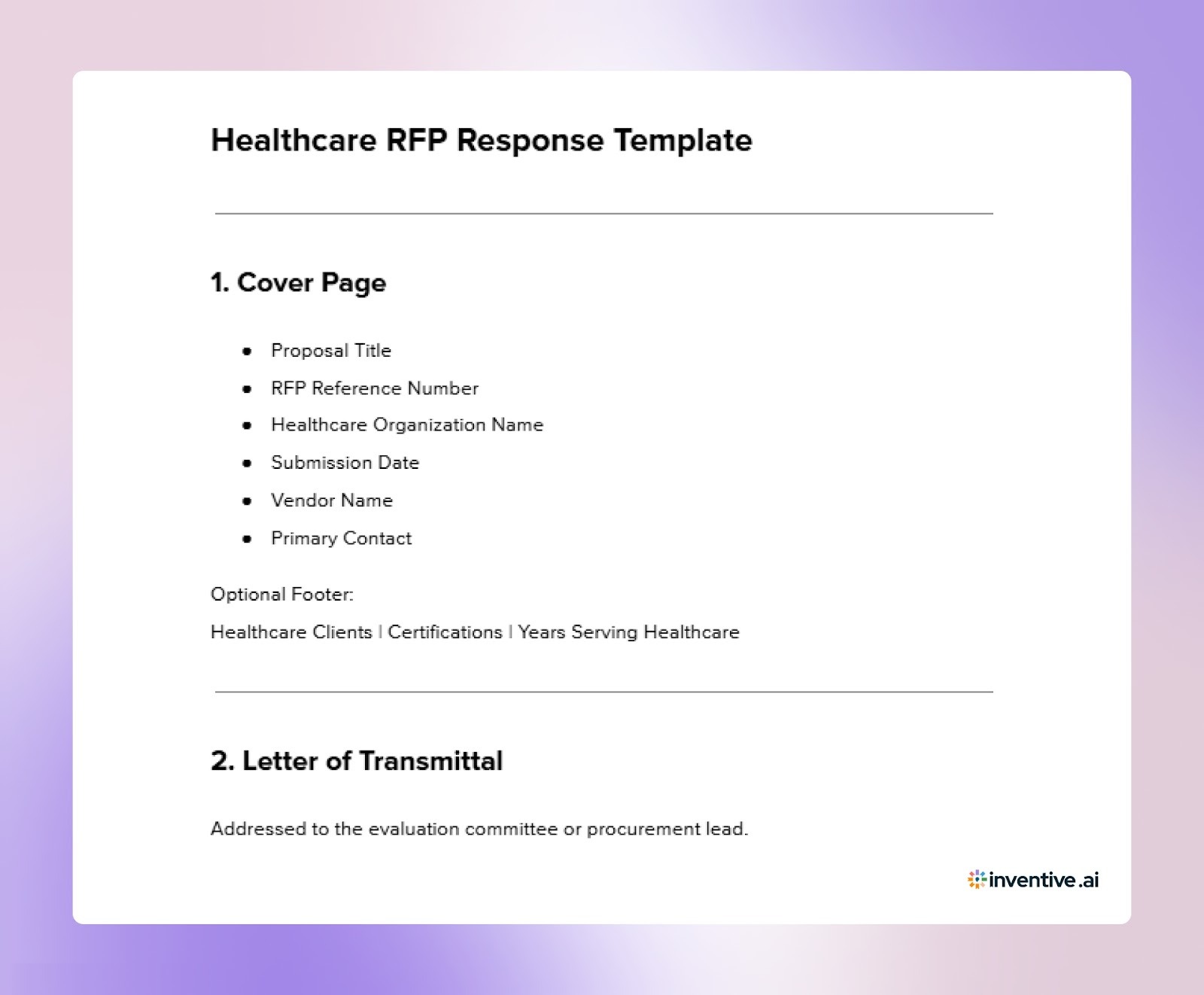
Healthcare procurement decisions are driven by regulatory adherence, patient safety controls, and measurable care or operational improvements. Proposals must show compliance depth and evidence of performance in clinical environments.
Your response should address:
- Clinical and operational objectives
- Compliance mapping to HIPAA and relevant standards
- Data privacy and security safeguards
- Workflow impact and continuity planning
- Staff training and adoption strategy
- Measurable outcomes and healthcare case studies
This structure works best for vendors bidding on regulated healthcare engagements where selection depends on compliance assurance and documented results.

3. Government RFP Response Template (Google Doc)
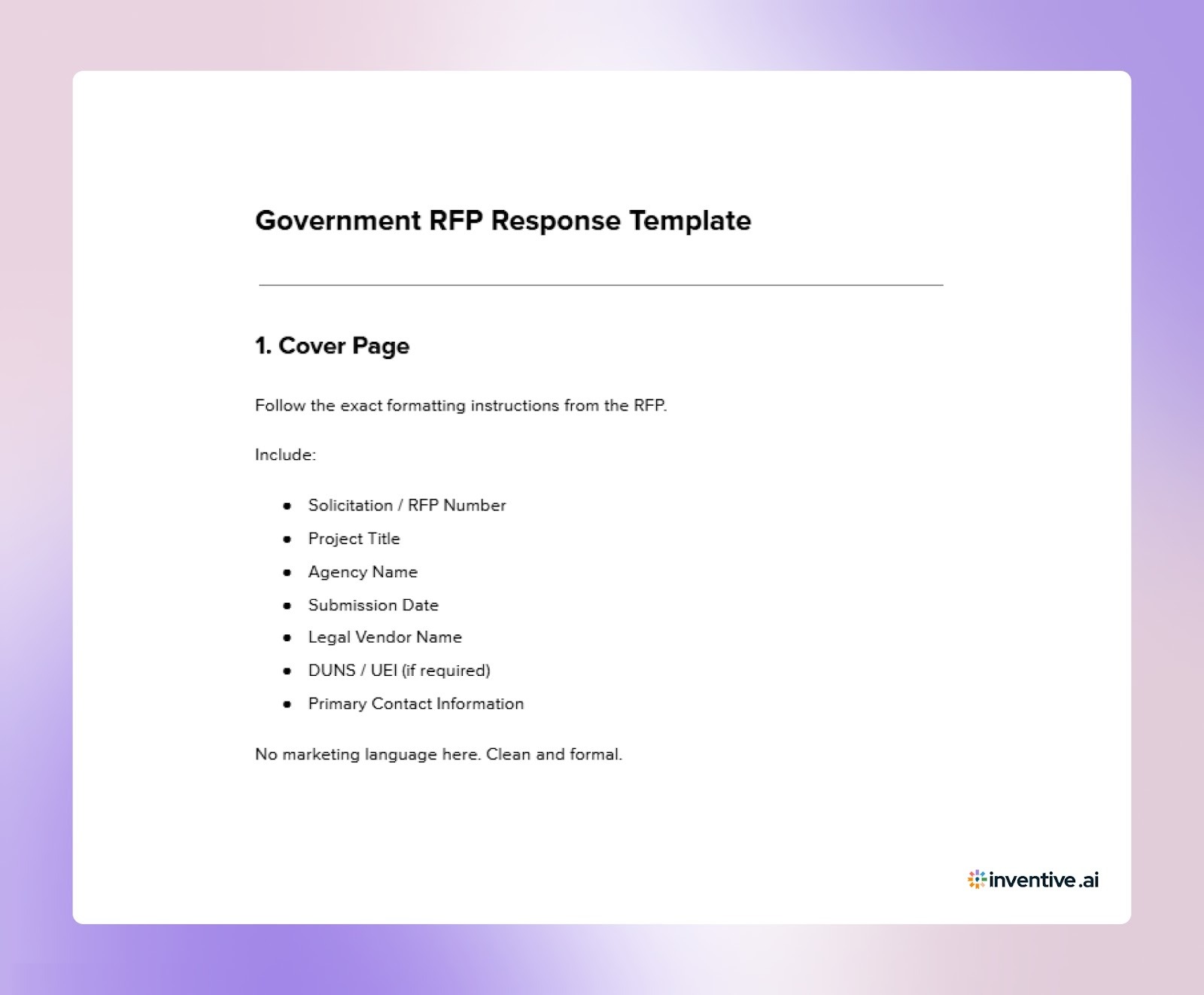
Public sector bids are scored against strict instructions and requirement traceability. Formatting, structure, and cross-referencing often carry as much weight as the proposed solution itself.
Your response should address:
- Solicitation scope and agency objectives
- Compliance matrix mapped to requirement IDs
- Technical approach aligned with RFP structure
- Project management and reporting plan
- Past performance documentation
- Pricing formatted per solicitation guidelines
This structure works best for vendors bidding on public sector contracts where selection depends on documentation accuracy and scoring alignment.

4. Construction / Project-Based RFP Response Template (Google Doc)
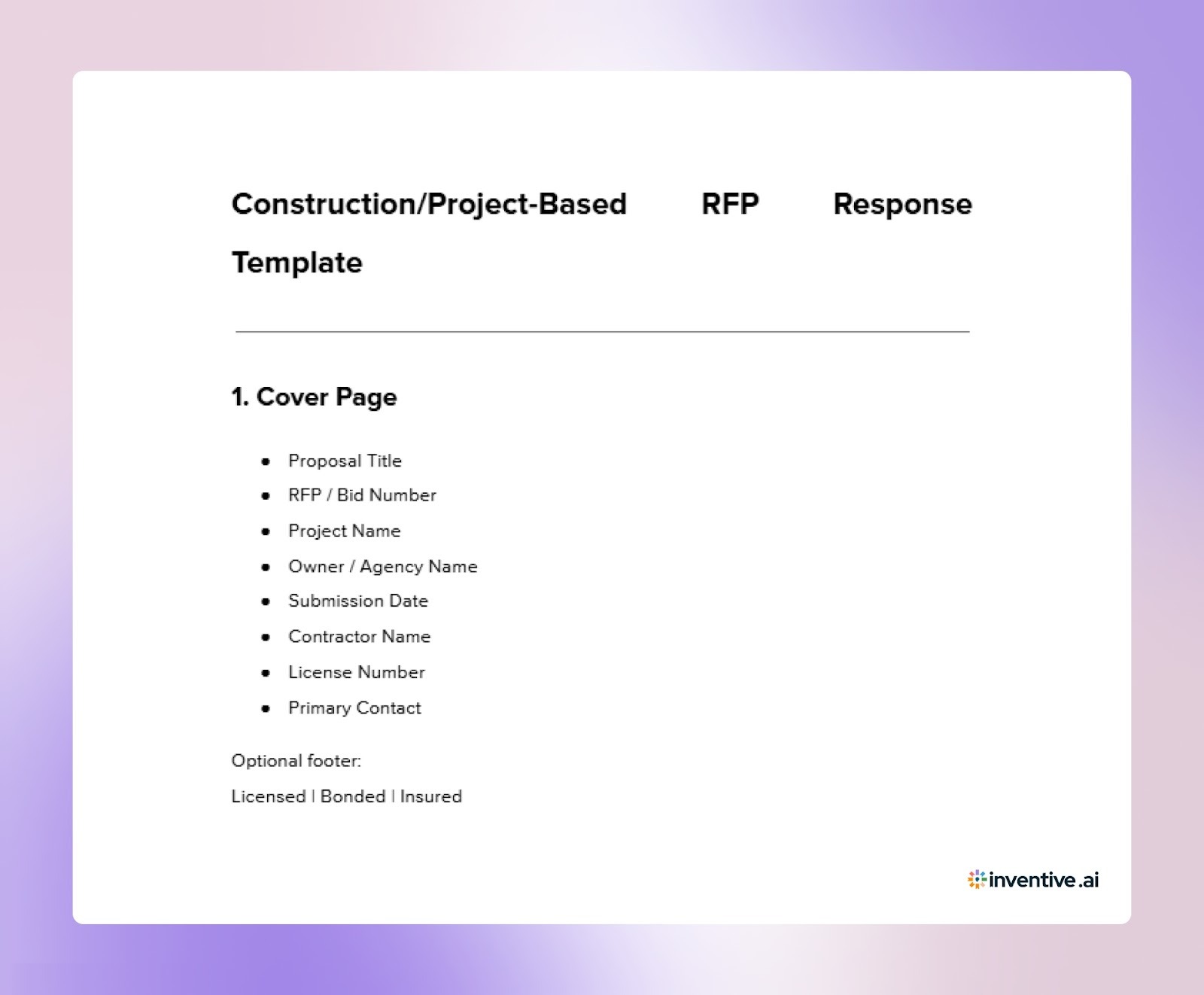
Capital projects are assessed on delivery credibility. Reviewers focus on scope definition, scheduling discipline, safety controls, subcontractor planning, and cost assumptions.
Your response should address:
- Detailed scope of work
- Milestone-based project schedule
- Staffing and subcontractor plan
- Safety and compliance standards
- Risk mitigation strategy
- Itemized pricing breakdown with assumptions
This structure works best for contractors bidding on project-driven engagements where scoring depends on execution readiness and financial transparency.

As you develop industry-specific response structures, standardized add-on templates are also required so that every submission meets baseline compliance and presentation requirements.
4 Essential Add-On RFP Process Related Templates for Submission Ready Responses
A core RFP response template provides structure, but supporting tools improve clarity, consistency, and final submission quality. Adding targeted templates for review, summaries, and executive framing helps proposal teams reduce errors and present a tighter, score-ready document.
Below are additional templates you can use to reinforce critical sections of your RFP response.
1. Pre Submission RFP Checklist Template
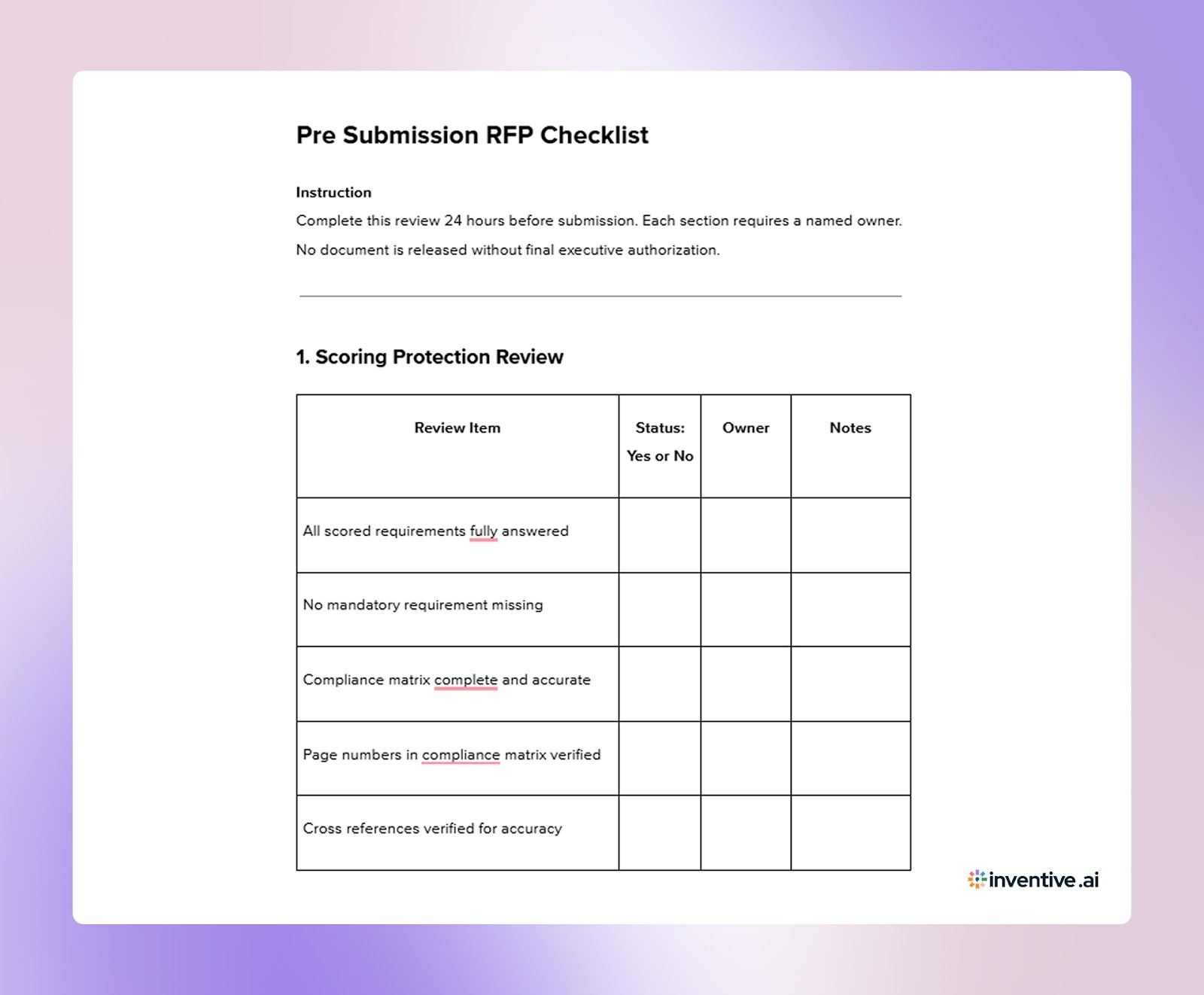
Even strong proposals lose points due to preventable errors such as missed requirement IDs, inconsistent metrics, formatting violations, or incomplete attachments. This checklist helps proposal teams validate accuracy, compliance, and submission readiness before the final upload.
What’s Included
- 50-point structured review framework
- Requirement ID and compliance verification checks
- Cross-section consistency review
- Formatting and page limit validation
- Pricing and scope confirmation steps
- Executive approval and go/no-go confirmation
- Final submission readiness checks

RFP Executive Summary Templates
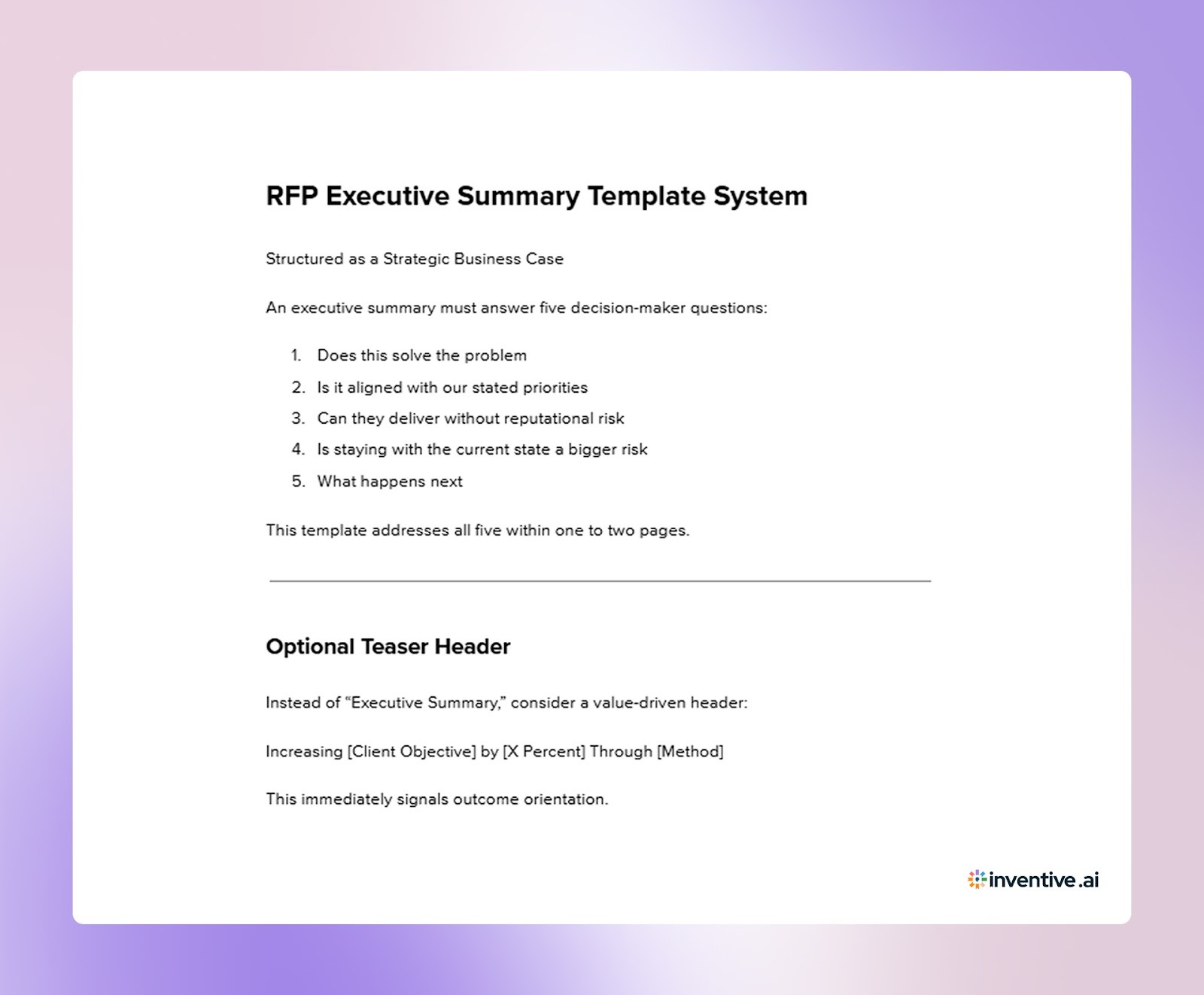
The executive summary often determines how evaluators perceive the rest of the proposal. These templates help you present measurable outcomes, clear differentiation, and risk awareness in a format that supports scoring clarity.
What’s Included
- Five industry-specific executive summary formats
- One-page and two-page structured layouts
- Outcome first value proposition framework
- Quantified results positioning guidance
- Section-by-section writing prompts
- Sample language calibrated for executive reviewers

RFP Cover Letter Template
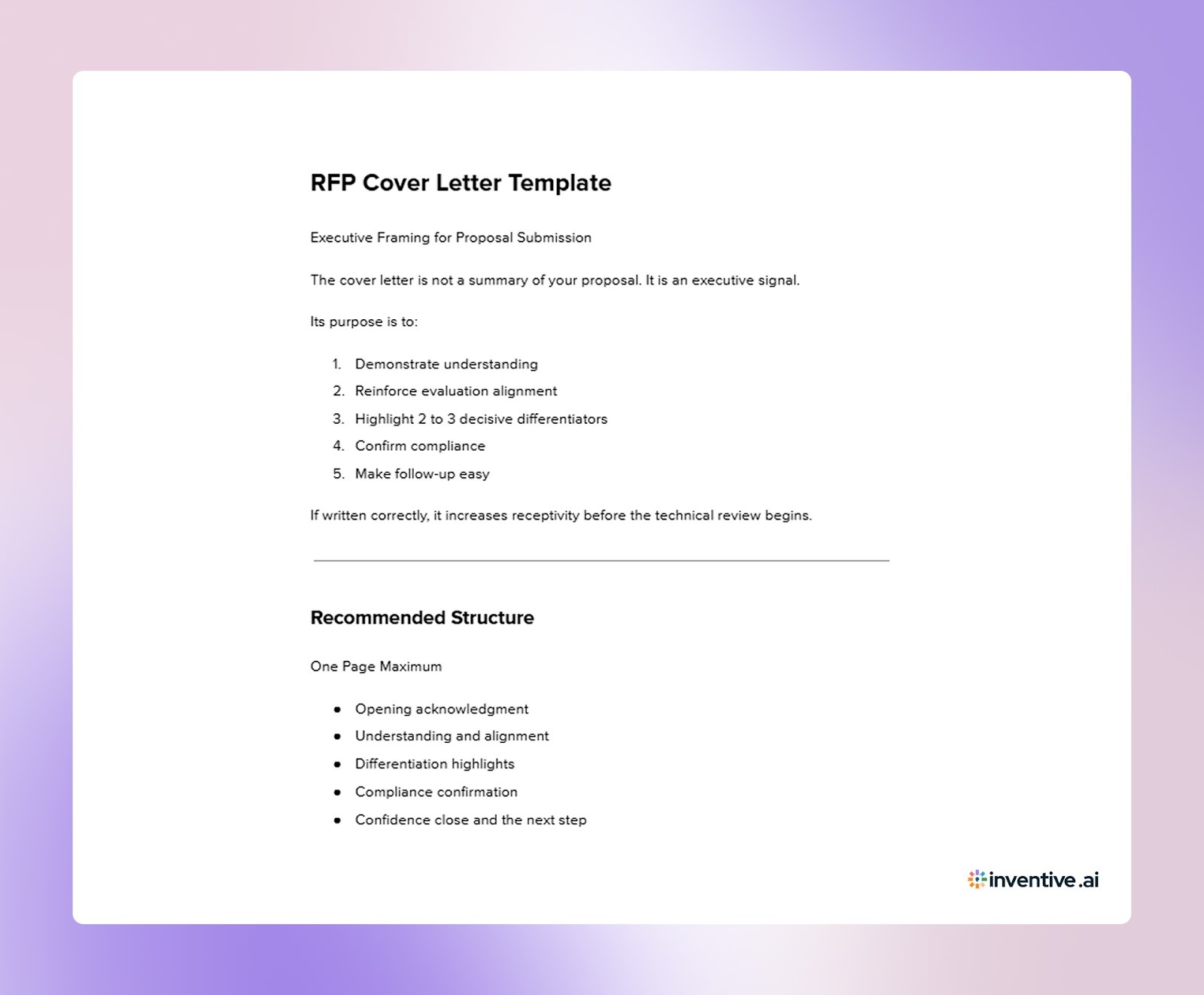
The cover letter frames your proposal before evaluators review technical content. This template provides a structured approach that communicates understanding, measurable value, and executive commitment within one page.
What’s Included
- Formal RFP reference and acknowledgment structure
- Client challenge positioning framework
- Quantified outcome statement prompts
- Differentiation positioning guidance
- Social proof placement suggestions
- Executive signature and closing format

RFP Visual Templates Pack
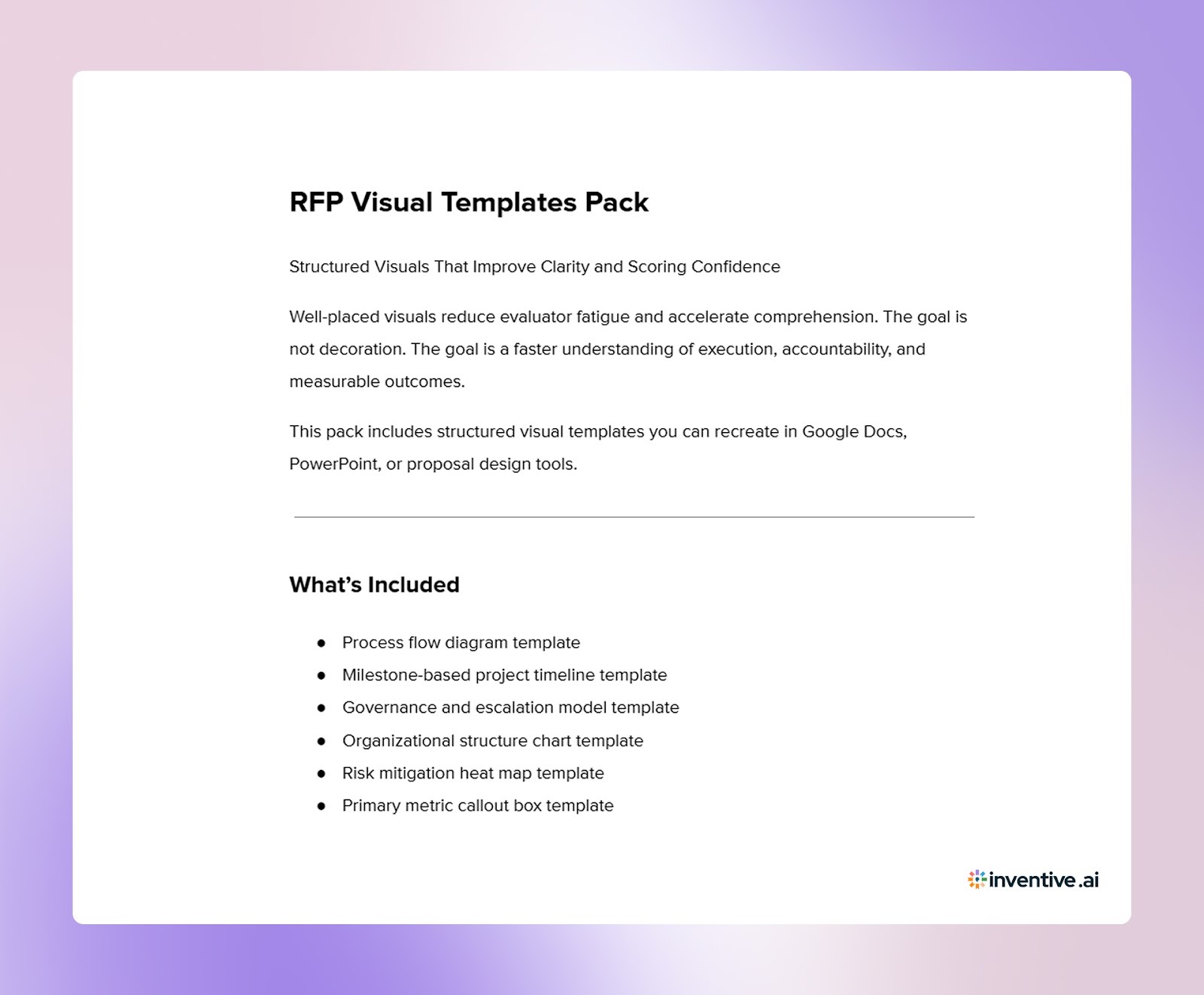
Clear visuals improve evaluator comprehension when explaining process flows, timelines, and accountability structures. This template pack provides structured placeholders that support clarity without unnecessary design elements.
What’s Included
- Process flow diagram framework
- Milestone-based project timeline layout
- Organizational chart structure
- Governance and escalation model template
- Visual labeling and referencing guidance

Beyond assembling the right components, you must customize each template to the buyer’s evaluation criteria and stated priorities to improve win probability.
How to Customize Your RFP Response Template for Higher Win Rates?
A template gives you structure. Winning requires specificity. Evaluators can spot reused language quickly, and generic responses lower confidence in your fit for the project.
To increase your chances of selection, focus on these targeted adjustments:
- Mirror the RFP Language: Use the exact terminology, section numbering, and requirement phrasing from the RFP so evaluators can match your response to their scorecard without searching.
- Lead With Measurable Outcomes: Replace generic claims with specific metrics tied to the client’s goals, such as cost reduction, turnaround time, risk reduction, or revenue impact.
- Tie Every Feature to a Requirement: For each capability you present, state which client need it addresses. Avoid listing features that are not directly connected to evaluation criteria.
- Customize Your Case Studies: Select examples from the same industry or with a similar scope, budget size, or regulatory context to increase relevance.
- Strengthen Your Differentiation: Clarify one distinct capability or operational model that competitors cannot easily claim, and connect it directly to the client’s stated challenge.
- Address Risk Proactively: Identify likely project risks and outline mitigation steps before the evaluator raises concerns internally.
If your organization handles frequent RFPs, automation can significantly improve drafting speed and response quality.
Automate Your RFP Process with Inventive AI
As RFP volumes increase, manual drafting and scattered content slow teams down. Proposal, sales, and revenue teams need automation to maintain speed and consistency without sacrificing accuracy. Inventive AI brings AI-driven automation to the response process, helping vendors manage knowledge, generate drafts, and improve proposal quality across every deal.
Here’s how Inventive AI supports teams responding to RFPs in Google Docs:
Context Engine
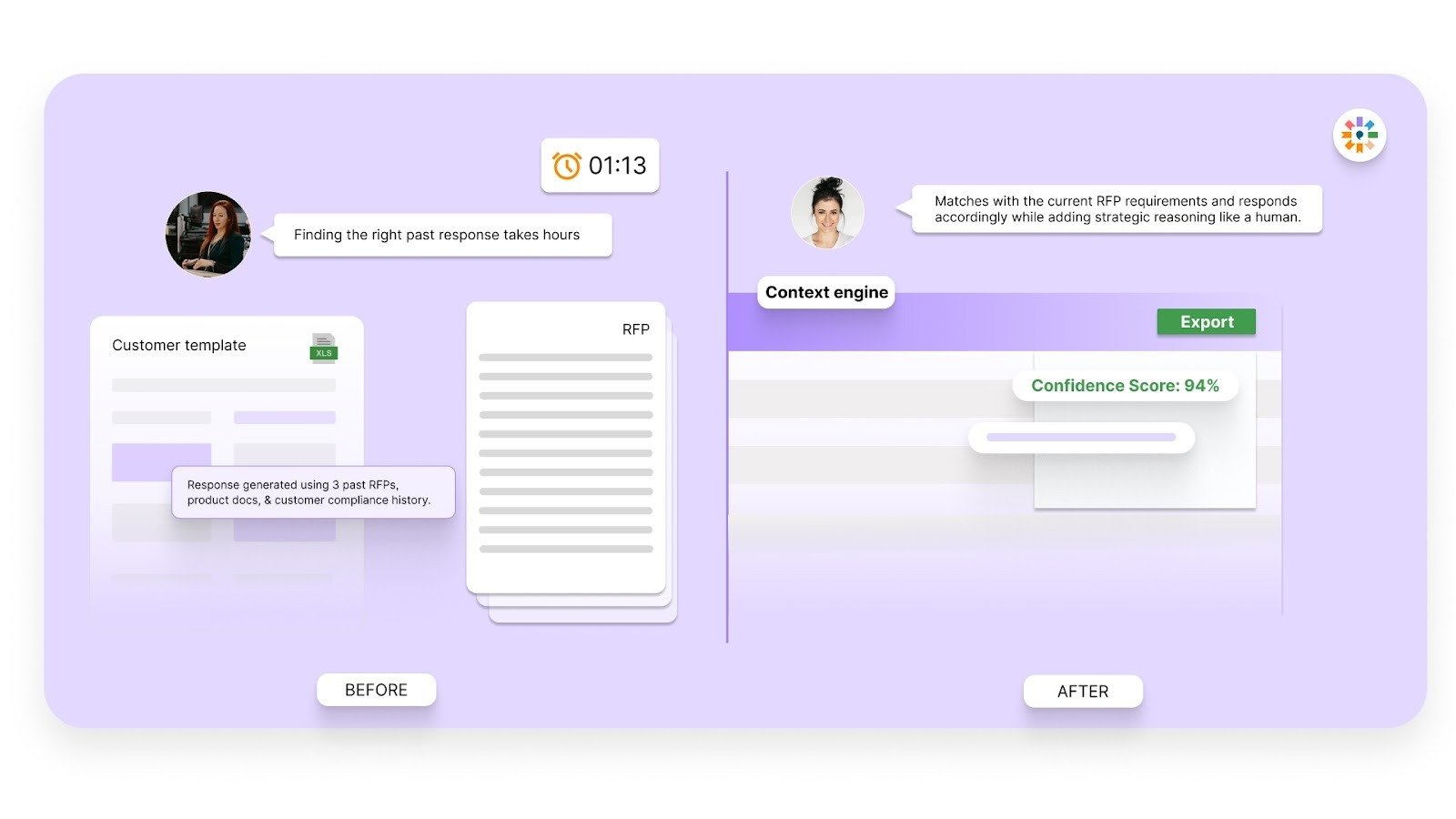
Many competitors rely on shallow ChatGPT or basic RAG lookup, which generates generic answers pulled from isolated documents. Inventive uses multi-layer reasoning that understands the full RFP context, including requirement IDs, evaluation criteria, and section dependencies. This yields accurate, customized responses that feel like a human SME wrote them and fit cleanly into structured Google Docs templates.
Conflict Detection
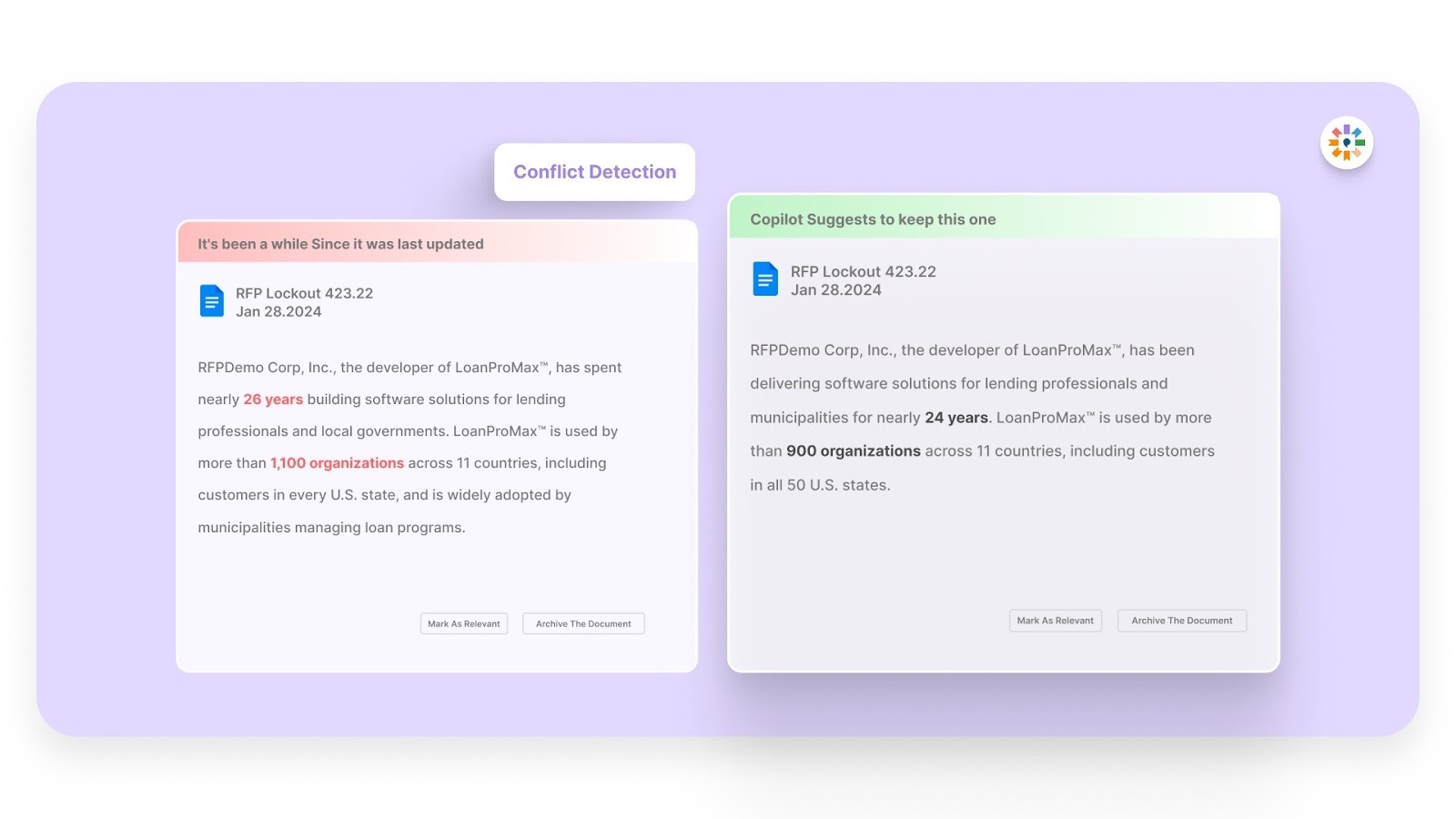
RFP responses often repeat information across executive summaries, compliance matrices, security sections, and pricing tables. Other tools cannot detect internal contradictions across these areas. Inventive flags conflicting statements instantly, preventing inconsistent claims about staffing, timelines, certifications, or outcomes before the document is finalized.
Outdated Content Detection
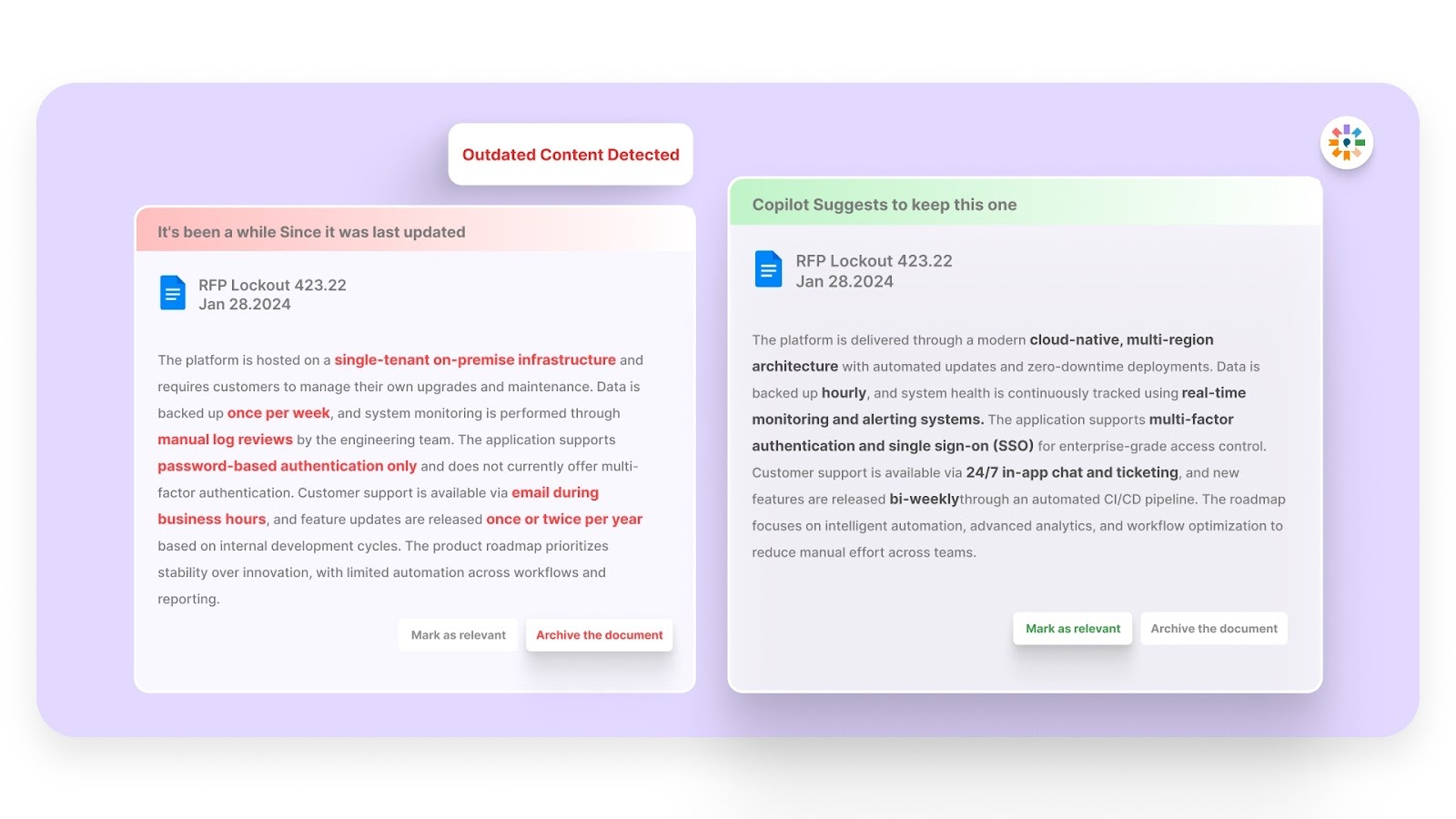
Most vendors store large libraries of prior answers, including certifications, case studies, and metrics that may change over time. Inventive automatically catches outdated or non-compliant content before it appears in your live draft. This drastically reduces manual review and rewriting time while protecting submission accuracy.
2X Quality Response
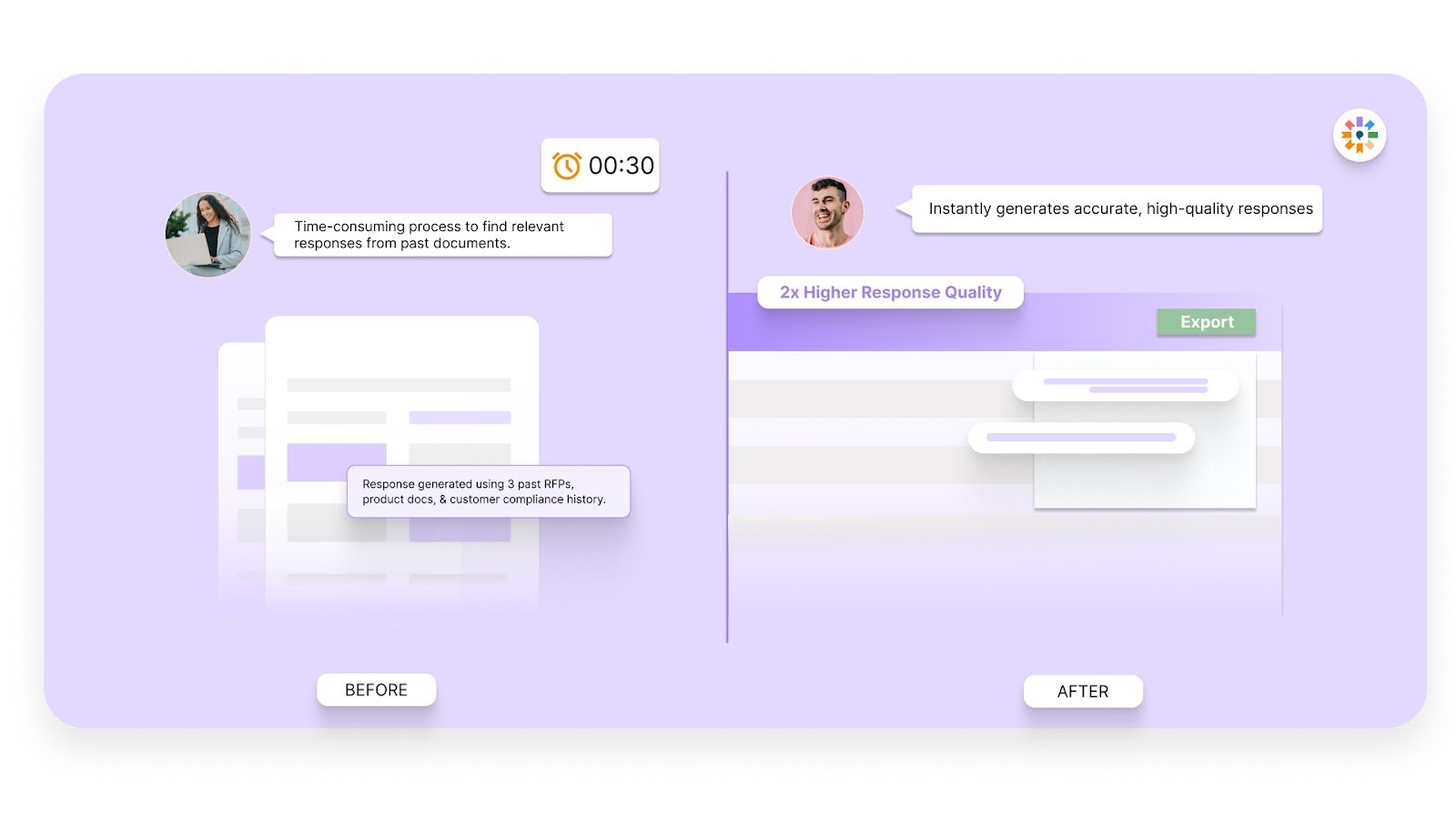
With its multi-agent AI system, Inventive offers strategic answers that interpret the true intent behind each requirement. Responses are accurate, clear, and complete, making it easier for evaluators to score your proposal within structured Google Docs formatting constraints.
Simple and Easy to Use UI and UX
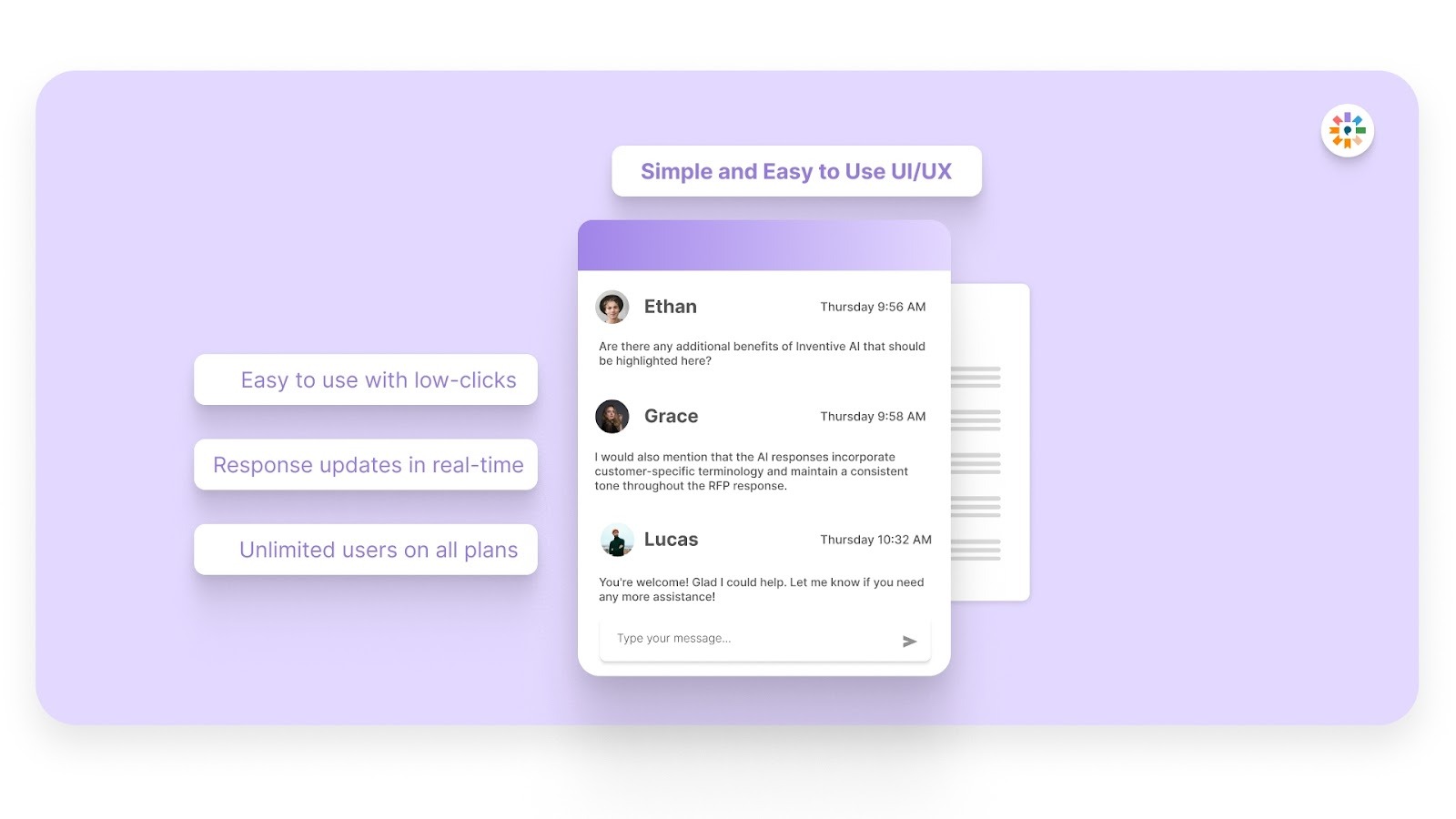
Inventive maintains a 100 percent adoption rate across its current customer base and is ranked the easiest-to-use RFP software on G2. Sales and proposal teams can adopt the platform quickly, even if they are new to AI-based response tools, and integrate it into their existing Google Docs workflow without disruption.
If your team manages frequent RFPs or complex security questionnaires, seeing the platform in action can clarify how it fits into your workflow.
FAQs
1. Can I use the same RFP response template for RFIs and security questionnaires?
You can reuse parts of your template, but the structure should change. RFIs focus more on capabilities and background, while security questionnaires require precise, validated answers tied to controls and policies. Adjust formatting and depth based on the document type.
2. Should I include visuals in an RFP response?
Yes, when they clarify complex information. Process diagrams, timelines, org charts, and architecture visuals help evaluators understand your approach quickly. Avoid decorative graphics and focus only on visuals that explain execution or accountability.
3. How do I handle page limits in strict RFPs?
Prioritize direct responses to scored requirements first. Use concise language, structured tables, and cross-references to avoid repetition. Move supporting details, such as extended resumes or technical documentation, into an appendix if allowed.
4. What’s the best way to manage version control during collaboration?
Assign one document owner responsible for the final review. Use suggestion mode for edits and require subject matter experts to work within defined sections. Before submission, confirm that all comments are resolved and placeholders are removed.
5. When should I decline to respond to an RFP?
If mandatory requirements cannot be met, timelines are unrealistic, budget expectations are misaligned, or the opportunity does not match your core services, it may be better to pass. Responding selectively helps maintain focus on bids with a higher probability of success.



.avif)

%20Industry%20Examples.png)