Proposal manager: what the role really involves and how to grow into it
A proposal manager makes sure complex bids and RFP responses actually get written, reviewed, checked for compliance, and submitted on time. The job is far bigger than editing documents. Proposal managers plan the response, coordinate subject matter experts (SMEs), manage the timeline, enforce compliance, and drive quality under a deadline that rarely moves.
The role sits at the intersection of sales, delivery, legal, finance, and marketing, which means proposal managers are constantly juggling competing priorities while keeping the proposal on track. Miss one requirement in a 40-page RFP, or let one SME's section slip, and the whole submission is at risk.
This guide covers what a proposal manager actually does, how the proposal management process works, the skills and qualifications that matter, typical salary ranges, and realistic career paths, along with where modern tools can take the manual work off your plate.
Key takeaways
- A proposal manager owns the end-to-end process of turning RFPs and opportunities into compliant, on-time, high-quality proposals.
- The role blends project management, writing and editing, stakeholder coordination, compliance, and proposal governance.
- Core responsibilities span planning, SME coordination, content development, reviews, quality control, and submission.
- Proposal manager, bid manager, RFP manager, and capture manager titles overlap; the distinctions depend on org size and sales model.
- Strong proposal managers combine writing skill, organization, commercial awareness, and comfort with proposal and CRM tools.
- Salaries vary by market and seniority. US averages sit around $90k to $108k, with senior and govcon roles paying more.
- Career paths typically move from coordinator or specialist to manager, senior manager, and director or VP of proposals.
What is a proposal manager?
A proposal manager is a professional who leads the end-to-end development and submission of proposals, bids, and grants, coordinating writers, SMEs, reviewers, and approvers to deliver a compliant, persuasive response on schedule.
They typically own the proposal plan, schedule, compliance matrix, content outline, review cycles, and final production. In many organizations they sit within sales operations, marketing, or a dedicated proposals and bids team, working closely with capture, sales, delivery, legal, and finance.
Responsibilities vary by company size. In smaller firms, one person may handle everything from intake to submission. In larger enterprises, strategy, writing, compliance, and production are split across specialized roles.
What does a proposal manager do?
.png)
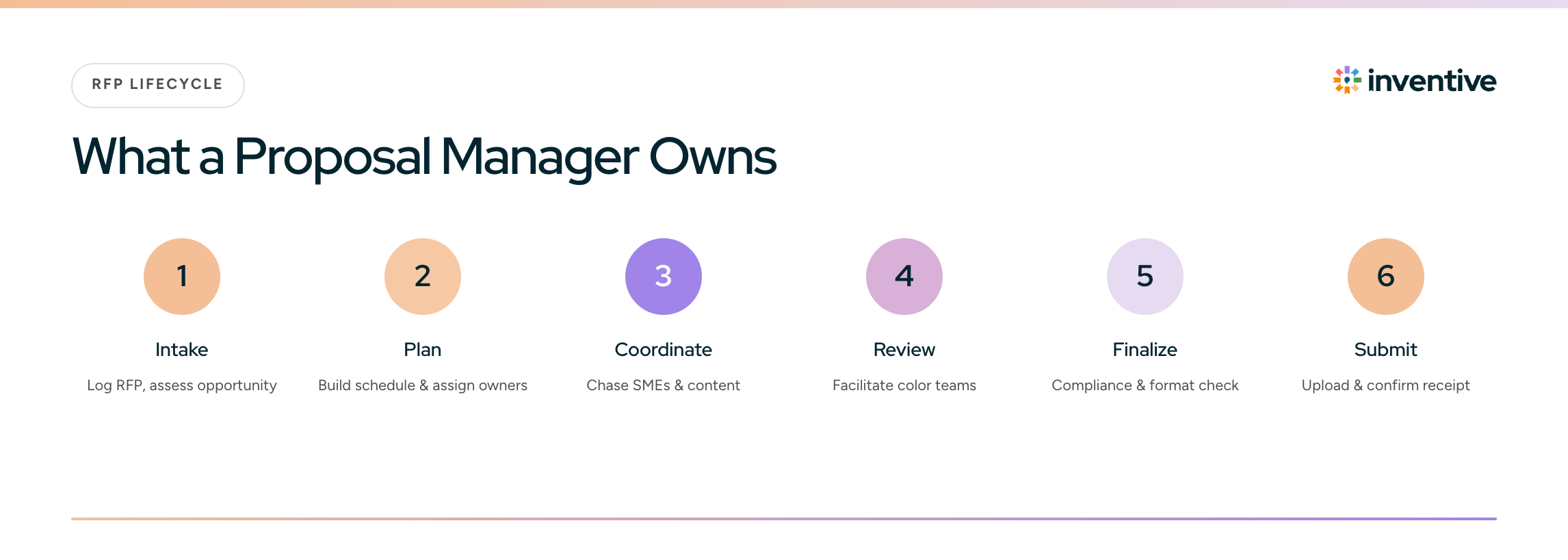
A proposal manager's work spans the full lifecycle of an opportunity, from the moment an RFP or bid invitation arrives through post-submission learning.
- Opportunity and request intake. They monitor pipelines and inboxes for new RFPs, RFIs, or tenders, log them in a tracker or CRM, and initiate a go/no-go decision process with sales and leadership.
- Requirement analysis. They read the solicitation to understand evaluation criteria, mandatory requirements, submission format, and deadlines, then translate this into a compliance matrix and proposal outline.
- Proposal planning. They build a realistic schedule with milestones for drafts, reviews, and production, assign owners for each section, and set SME deadlines.
- Response strategy. Working with capture or sales, they help turn win themes and differentiators into proposal messaging and structure.
- Timeline and milestone management. They run the proposal calendar, chase progress, re-sequence work when priorities shift, and escalate risks early.
- Team and SME coordination. They identify who needs to contribute, book working sessions, clarify what input is needed, and keep SMEs accountable without owning their day jobs.
- Content development. They write key sections, often executive summaries and management approaches, edit SME drafts, and keep a consistent voice and story.
- Content collection and reuse. They pull from content libraries, past proposals, and approved boilerplate to avoid reinventing the wheel while tailoring to the specific opportunity.
- Compliance tracking. They maintain the compliance matrix, verify that every requirement is addressed, and confirm formatting, page limits, and submission rules are met.
- Review cycles. They organize and facilitate color team reviews (pink, red, gold or equivalent), capture feedback, and manage revision rounds.
- Editing and quality control. They proofread for clarity, consistency, and persuasiveness, check for contradictions, and make sure the proposal reads as one coherent document.
- Executive approvals. They route the near-final proposal for sign-off by the right leaders and incorporate last changes without breaking compliance.
- Final production. They handle final formatting, assembly, file naming, packaging, and any portal uploads or hard-copy logistics.
- Submission. They submit the proposal before the deadline, confirm receipt, and archive the final version and supporting artifacts.
- Post-submission review. They support debriefs where available, capture lessons learned, update content libraries, and refine the process for the next bid.
Proposal manager responsibilities
While day-to-day tasks vary, most proposal manager roles cluster around these responsibility areas.
Proposal planning and project management
- Building proposal schedules, work breakdown structures, and milestone plans.
- Running proposal kickoff meetings and setting clear expectations with the team.
- Tracking progress, managing risks, and adjusting plans when scope or deadlines change.
Content management
- Creating and maintaining outlines, compliance matrices, and section assignments.
- Curating a content library of approved responses, case studies, resumes, and boilerplate.
- Ensuring version control so everyone works from the latest documents.
Stakeholder and SME coordination
- Identifying the right contributors across sales, delivery, finance, legal, and product.
- Running working sessions, clarifying asks, and following up to keep contributions on time.
- Translating technical or commercial input into clear proposal language.
Writing and editing
- Drafting high-impact sections such as executive summaries and approach descriptions.
- Editing SME content for clarity, tone, and alignment with win themes.
- Making sure the proposal tells a coherent story rather than a collection of sections.
Compliance and quality control
- Mapping every RFP requirement to a specific response and evidence.
- Checking formatting, page limits, submission method, and evaluation criteria alignment.
- Running quality gates and checklists before reviews and submission.
Review and approval management
- Scheduling and facilitating review meetings, capturing action items, and tracking closures.
- Managing revision cycles so feedback is incorporated without scope creep.
- Securing executive sign-off and managing last-minute changes safely.
Proposal governance and post-proposal analysis
- Maintaining proposal standards, templates, and playbooks.
- Tracking proposal metrics such as volume, on-time rate, and lessons learned.
- Feeding insights back into content libraries and process improvements, often anchored by a structured win-loss analysis.
Chasing SMEs for input and searching old proposals for reusable content are two of the most repetitive parts of this job, and both get harder as proposal volume grows. When you are juggling several bids at once, manually tracking outstanding sections and hunting for the right boilerplate eats into time that should go toward strategy and quality control. This is part of why more proposal teams now use AI-native platforms like Inventive to keep a live compliance matrix and surface approved content automatically, cutting down on manual chasing.
What is the proposal management process?
The proposal management process is the repeatable workflow that turns an opportunity into a submitted, compliant proposal. Organizations adapt it to their context, but a common flow looks like this.
Proposal manager vs bid manager vs RFP manager vs capture manager
These titles often overlap, especially at smaller organizations where one person wears multiple hats. In larger firms, particularly in government contracting or complex B2B sales, responsibilities are more clearly divided. The table below reflects common practical distinctions rather than universal definitions.
In practice, proposal manager and bid manager are often used interchangeably, RFP manager tends to signal a more operational, compliance-focused role, and the capture manager sits earlier in the sales cycle with a strategic, customer-facing focus.
Skills every proposal manager needs
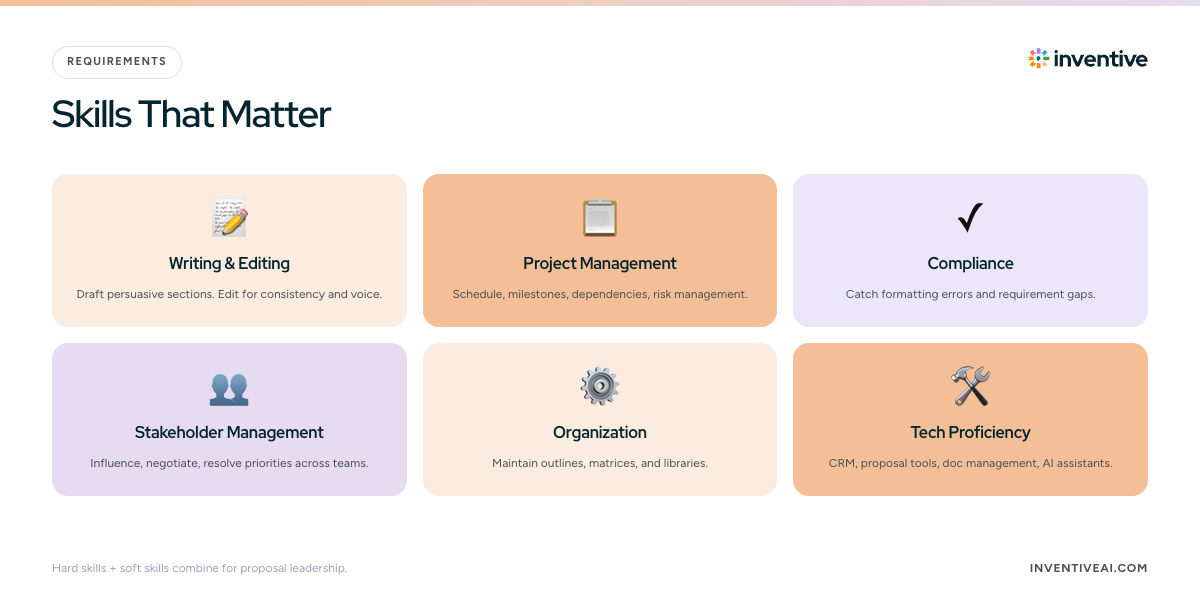
Effective proposal managers combine hard and soft skills that map directly to the work they do.
- Project management. They build realistic schedules, manage dependencies, and keep multi-threaded proposals on track under tight deadlines.
- Writing and editing. They craft clear, persuasive narratives and edit diverse SME content into one coherent voice.
- Communication. They brief executives, negotiate with SMEs, and explain requirements without creating friction.
- Stakeholder management. They influence people who do not report to them and resolve conflicting priorities across departments.
- Organization. They maintain outlines, compliance matrices, trackers, and libraries so nothing falls through the cracks.
- Time management. They prioritize ruthlessly when multiple proposals compete for the same SMEs and leaders.
- Attention to detail. They catch compliance gaps, formatting errors, and inconsistencies before submission.
- Research. They quickly understand new domains, customers, and evaluation criteria to shape relevant responses.
- Strategic thinking. They connect win themes and differentiators to specific proposal sections and evidence.
- Commercial awareness. They understand how pricing, risk, and delivery models affect the story and the customer's decision.
- Negotiation. They push for SME time, clarify scope, and protect proposal quality without damaging relationships.
- Critical thinking. They spot contradictions, weak arguments, and compliance risks early.
- Risk management. They identify schedule, resource, and compliance risks and escalate or mitigate them proactively.
- Collaboration. They run effective working sessions and make it easy for others to contribute.
- Technology and software proficiency. They use proposal platforms, CRM, project tools, document management, and increasingly AI-assisted writing and review tools.
Proposal manager qualifications
There is no single mandatory degree to become a proposal manager. Common backgrounds include business, marketing, communications, English, engineering, or sector-specific fields depending on the industry.
Many proposal managers move over from roles such as technical writer, marketing coordinator, sales operations, project coordinator, or subject matter expert who started contributing to proposals.
Certifications like APMP (Association of Proposal Management Professionals) Foundation, Practitioner, or Professional levels are valued, especially in government contracting and large enterprises. Professional training in proposal best practices, color team reviews, and compliance management also helps.
Transferable experience in project coordination, content development, or client-facing roles can be enough to break in, particularly if you can demonstrate hands-on proposal work in a portfolio.
How to become a proposal manager
- Start in adjacent roles. Look for positions such as proposal coordinator, bid coordinator, technical writer, marketing coordinator, or sales operations, where you can support proposals.
- Develop core skills. Focus on project management, clear writing, compliance thinking, and stakeholder coordination.
- Gain hands-on experience. Volunteer to help on RFP responses, build compliance matrices, draft sections, or run reviews, even if it is not your main job title.
- Learn the tools. Get comfortable with proposal and RFP platforms, CRM systems, document management, and collaboration tools; exposure to AI-assisted proposal tools is increasingly useful.
- Consider certifications. APMP Foundation or equivalent proposal management training can signal commitment and provide a common language.
- Build a portfolio. Collect anonymized examples of proposals you supported, outlines you created, or processes you improved to show during interviews.
- Move into management. After consistently leading smaller proposals or volumes, pursue full proposal manager roles where you own end-to-end responses.
Proposal manager career path
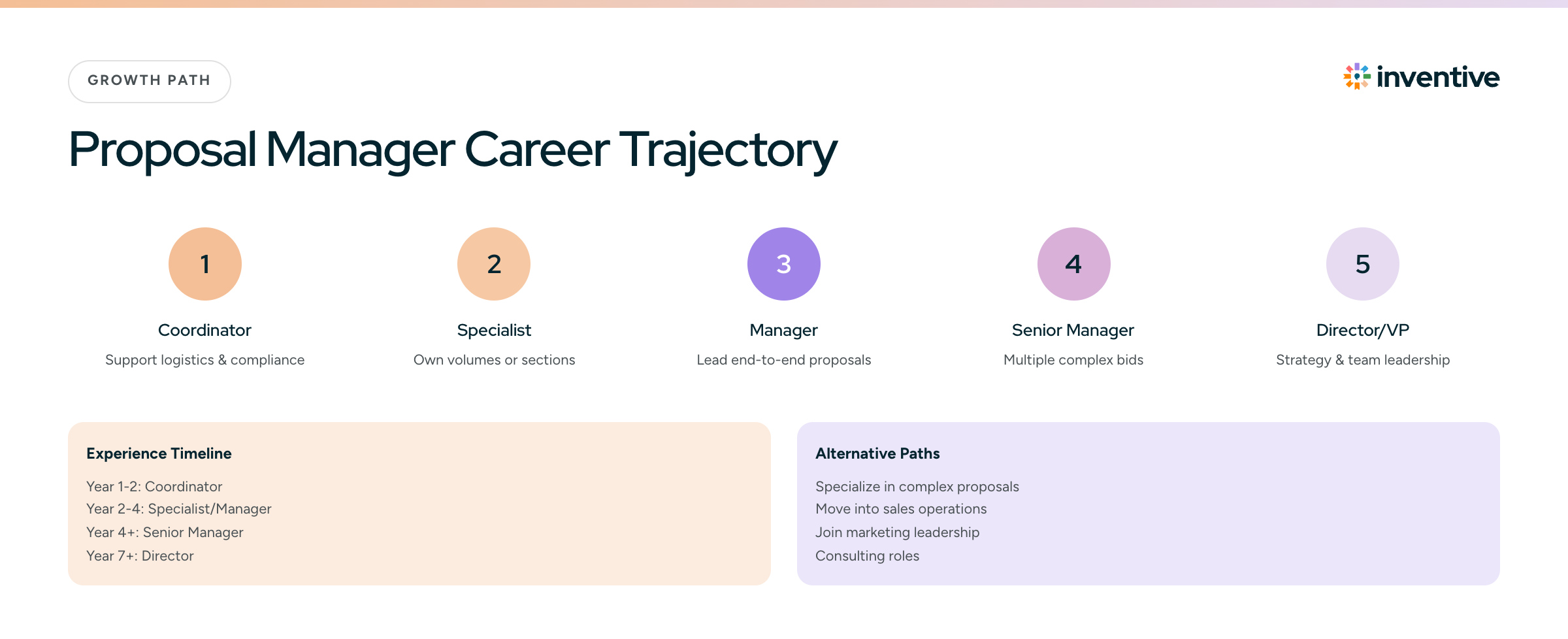
Career progression varies by organization and industry, but a common trajectory looks like this:
- Proposal coordinator. Supports logistics, formatting, compliance tracking, and review coordination.
- Proposal specialist or volume lead. Owns specific sections or volumes, runs reviews, and mentors coordinators.
- Proposal manager. Leads end-to-end proposals, manages cross-functional teams, and interfaces with capture and executives.
- Senior proposal manager. Handles multiple concurrent high-value proposals, develops standards, and leads a small team.
- Proposal or bid leadership (director, VP, head of proposals). Sets strategy, builds the function, manages managers, and partners with sales and delivery leadership.
Some professionals stay as individual contributors specializing in complex proposals, while others move into broader sales operations, marketing, or delivery leadership roles.
Proposal manager salary
Salary data for proposal managers varies by geography, industry, and seniority. Recent sources provide the following snapshots.
United States
- Average proposal manager salary: $107,975–$123,983 per year.
- Typical salary range: $73,000–$159,000.
- Senior proposal managers and directors in federal contracting, defence, aerospace and technology may earn $160,000–$240,000+.
Canada
- National salary range: C$91,000–C$111,500.
- Average midpoint: approximately C$101,750.
- Toronto salary range: C$94,913–C$116,295.
India
- Average proposal manager salary: approximately ₹14.7 lakh per year.
- Early-career salary: around ₹9.3 lakh.
- Lower-end salary: approximately ₹7.5 lakh.
- Senior proposal managers and bid-management professionals may earn considerably more.
United Kingdom
- Average proposal manager salary: approximately £55,483.
- Typical salary range: £45,000–£70,000.
- Senior or specialist roles may reach £65,000–£85,000+.
Additional compensation
Additional compensation such as bonuses, profit sharing, or overtime can affect total pay, especially in roles tied to win rates or revenue targets.
Proposal manager KPIs
Organizations evaluate proposal management performance using a mix of output, quality, and efficiency metrics. No single KPI tells the whole story, and win rate alone should not be used to judge a proposal manager, since many factors influence outcomes.
- Win rate. The percentage of proposals that result in a win, often tracked by segment or bid type. Useful at a portfolio level, but influenced by strategy, pricing, and market conditions.
- Proposal volume. The number of proposals or responses handled over a period, indicating workload and capacity.
- On-time submission rate. The percentage of proposals submitted by the deadline, reflecting schedule discipline.
- Proposal turnaround time. Average time from RFP receipt to submission, helpful for resourcing and forecasting.
- Compliance and error rate. The number of compliance gaps or errors found in reviews or by customers, indicating how well quality control is working.
- SME turnaround time. Average time SMEs take to deliver content, highlighting bottlenecks in the process.
- Content reuse. The percentage of content pulled from approved libraries versus written from scratch, showing efficiency gains.
- Review cycle time. Time spent in review and revision rounds, indicating how well feedback is managed.
- Cost per proposal. Internal cost (people hours, tools, external support) per proposal, useful for ROI discussions.
- Revenue won and contract value. Total value of contracts won from proposals the manager supported, often used at team or department level.
- Lessons learned and improvement trends. Qualitative and quantitative tracking of process improvements, reduced errors, or faster cycles over time.
These metrics help the business understand capacity, quality, and efficiency, and where to invest in training, tools, or process changes.
Proposal manager tools and software
Proposal managers rely on several categories of tools to keep proposals organized, compliant, and on schedule.
- Proposal management software. Platforms that centralize RFP intake, compliance matrices, content libraries, workflows, and submissions, reducing manual tracking and helping teams reuse approved content.
- RFP management platforms. Tools focused on parsing RFPs, building requirement matrices, and managing Q&A and responses, often with AI assistance to extract requirements.
- CRM systems. Systems like Salesforce used to track opportunities, stakeholders, and proposal outcomes, and to align proposals with pipeline stages.
- Project management tools. Task boards, timelines, and resource views to manage proposal schedules and dependencies alongside other work.
- Document management and knowledge repositories. Secure stores for past proposals, templates, resumes, case studies, and boilerplate that feed content libraries.
- Content libraries. Structured repositories of approved answers and sections that enable fast, consistent reuse across proposals.
- Collaboration tools. Chat, video, and co-editing platforms that support real-time working sessions and feedback cycles.
- AI-assisted proposal tools. Platforms such as Inventive AI help draft responses, summarize RFPs, check compliance, and suggest improvements, while keeping humans in the loop for review and sign-off.
- Reporting and analytics. Dashboards that track proposal volume, cycle times, win rates, and other KPIs to inform resourcing and process improvements.
Each category solves a specific problem: reducing manual admin, improving visibility, speeding up content creation, and maintaining quality and compliance at scale. When you are managing multiple concurrent proposals, chasing SMEs across time zones, or struggling to find and reuse past responses, a dedicated platform can centralize workflows, content, and compliance in one place, so proposal managers spend less time on manual coordination and more time on strategy and quality.
Challenges proposal managers face
Proposal managers routinely deal with a set of predictable pressures.
- Tight deadlines. RFPs often allow limited response time, forcing rapid planning and execution.
- Large volumes of information. Long solicitations with complex requirements demand careful reading and mapping.
- Unresponsive SMEs. Subject matter experts are busy with delivery work, making it hard to get timely, high-quality input.
- Conflicting stakeholder priorities. Sales, delivery, legal, and finance may have different views on risk, messaging, and effort.
- Last-minute changes. Scope, pricing, or staffing shifts late in the cycle can disrupt the entire proposal.
- Compliance requirements. Strict formatting, page limits, and submission rules leave little room for error.
- Version control. Multiple drafts and reviewers can lead to confusion over which document is current.
- Inconsistent source content. SMEs may provide conflicting or outdated information that needs reconciliation.
- Finding relevant past responses. Without a good library, teams waste time recreating content that already exists.
- Managing multiple proposals. Juggling several concurrent bids stretches attention and increases the risk of mistakes.
- Maintaining quality under time pressure. The temptation to cut corners on editing or compliance grows as deadlines approach.
Experienced proposal managers handle these challenges by planning early, setting clear ownership, using standardized workflows, enforcing review gates, and leveraging tools that automate tracking and content reuse.
Struggling to keep up with tight proposal deadlines?
Win more deals with Inventive AI’s faster, smarter RFP responses.
Proposal management best practices
- Early requirement analysis. Read the RFP thoroughly at kickoff, build a compliance matrix, and clarify ambiguities before writing starts.
- Clear ownership. Assign a single owner for each section and review type so accountability is unambiguous.
- Proposal calendars. Maintain a visible calendar with all key dates, reviews, and dependencies for every active proposal.
- Responsibility matrices. Use simple RACI-style views to show who writes, reviews, approves, and supports each part.
- SME deadlines. Set realistic but firm SME deadlines with reminders and escalation paths to avoid last-minute content gaps.
- Review gates. Define clear review stages, such as outline review, draft review, and compliance review, each with specific objectives.
- Compliance checks. Run formal compliance reviews separate from content reviews to catch requirement gaps and formatting issues.
- Version control. Use a single source of truth for documents, with clear naming conventions and change logs.
- Standardized workflows. Document your proposal process, templates, and checklists so every bid follows a repeatable pattern.
- Post-proposal analysis. Hold brief retrospectives after major bids to capture what worked, what did not, and what to change next time.
- Content libraries. Invest in a structured content library of approved responses, case studies, and boilerplate to speed up drafting and keep answers consistent.
- Reusing approved content. Encourage teams to search and adapt existing content before writing new sections from scratch.
In real environments, these practices look like shared trackers, standing review meetings, predefined templates, and a culture where compliance and quality are non-negotiable, even under pressure.
Is proposal management a good career?
Proposal management suits people who enjoy structured problem-solving, clear writing, and cross-functional coordination, and who get satisfaction from turning complex information into one coherent story under a real deadline. The role builds transferable skills in project management, communication, commercial awareness, and stakeholder influence, valued across sales, marketing, operations, and consulting, with opportunities spanning technology, professional services, government contracting, and infrastructure.
The trade-off is pressure: peak bid periods, frequent context switching, and dependence on SMEs who have their own deadlines. People who prefer ambiguity-free, low-interaction, or highly predictable work may find it frustrating. For those who enjoy the mix of strategy, writing, and operational leadership, though, it offers a clear path into senior proposal leadership and broader commercial roles.
How Inventive AI helps proposal managers win faster
Most of a proposal manager's week isn't spent writing. It's spent tracking down who owes a section, digging through old proposals for the right answer, and double-checking that nothing in the draft contradicts what's in the knowledge base. Inventive AI is an AI-powered platform for RFP response, automation, and content management that targets the coordination overhead specifically, rather than just the drafting.
Here's what that looks like in practice:
- The knowledge base stops being scattered. Past proposals, Q&A sheets, and approved answers connect from Google Drive or SharePoint into one searchable hub, so finding the right boilerplate doesn't mean messaging three people first.
- Outdated answers get flagged before they ship. An AI content manager checks the library for stale or contradictory content, which matters most in regulated or compliance-heavy responses where an outdated answer isn't just sloppy, it's a risk.
- Draft sections arrive already written. Rather than opening a blank document, proposal managers start from an AI-generated first pass built on the connected knowledge base, then spend their editing time on tone and accuracy instead of structure.
- Weak sections get reinforced automatically. The system checks a draft against context from Slack threads, email, and call notes to catch where a response is thin, filling gaps with what the deal team actually knows rather than a generic answer.
- Extra hands show up during peak season. AI agents take on competitor research and early drafting support, giving a stretched team more coverage without a headcount request.
The net effect for teams that have adopted this approach: proposal turnaround dropping by as much as 90%, and win rates climbing north of 50%, which means more capacity to take on volume without the usual trade-off in quality.


%20(23).avif)