RFP Manager: What the Role Involves, How It Works, and How to Build a Career
An RFP manager turns a buyer's requirements into a compliant and persuasive response. They coordinate the people, content, approvals, deadlines, and documentation needed to submit a competitive bid.
The role is common in B2B SaaS, financial services, insurance, healthcare, consulting, construction, engineering, and government contracting. Responsibilities vary by company, but the core job is the same: manage a complex response without missing requirements, making unsupported commitments, or creating unnecessary work for contributors.
TL;DR
- An RFP manager runs the response process for RFPs, RFIs, DDQs, and similar buyer questionnaires, from intake through submission and post-bid analysis.
- The role combines project management, writing and editing, requirement analysis, stakeholder coordination, quality control, and commercial awareness.
- RFP managers own the process, deadlines, compliance, reviews, and submission. SMEs own technical, legal, security, financial, and pricing answers.
- Common entry routes include proposal coordination, RFP writing, sales operations, business development, procurement, technical writing, marketing, and project management.
- Key KPIs include win rate, on-time submission, turnaround time, compliance, bid/no-bid effectiveness, content reuse, and revenue influenced.
- RFP manager, proposal manager, and bid manager can mean the same thing in smaller companies. Larger organizations often separate them.
- The career suits people who enjoy structured problem-solving, cross-functional work, writing, and deadline-driven projects.
What Is an RFP Manager?
An RFP manager organizes and manages a company's response to Requests for Proposal, vendor questionnaires, due-diligence requests, and related tenders. The goal is an accurate, complete, buyer-focused response delivered by the deadline.
The job goes well beyond writing answers. RFP managers review requirements, coordinate contributors, assign questions, manage versions, run reviews, secure approvals, and verify that the final submission follows the buyer's instructions.
They may sit within sales enablement, business development, revenue operations, marketing, proposal operations, or a dedicated bid and proposal team. In regulated industries, they work closely with legal, compliance, privacy, information security, finance, and contracts.
As RFP volume grows, the role becomes more process-driven. Missing a mandatory requirement, making an unapproved claim, using incorrect pricing, or submitting late can lose an otherwise strong opportunity.
RFP manager at a glance
| Area | What it means in practice |
|---|---|
| Primary purpose | Manage compliant, persuasive, on-time responses to RFPs, RFIs, DDQs, and tenders |
| Core outputs | Compliance matrix, response plan, assignments, review schedule, final submission, lessons learned |
| Typical stakeholders | Sales, business development, SMEs, legal, finance, security, product, executives, proposal writers |
| Main strengths needed | Project management, writing, editing, requirement analysis, stakeholder management, commercial awareness |
| Common industries | SaaS, financial services, healthcare, insurance, consulting, government contracting, construction, engineering |
| Common entry routes | RFP/proposal coordination, sales operations, technical writing, procurement, business development, project coordination |
| Potential next roles | Senior RFP manager, proposal manager, bid manager, capture manager, proposal operations director, sales enablement leader |
RFP Manager vs. Bid Manager vs. Proposal Manager
An RFP manager, bid manager, and proposal manager can be the same person, particularly in smaller companies. There is no universal definition for these titles, so the job description matters more than the title.
In larger organizations, the roles differ by where they sit in the pursuit process and how much strategic or commercial responsibility they carry.
| Role | Typical primary ownership | Main stage | Strategic/commercial involvement | Writing/content ownership |
|---|---|---|---|---|
| RFP manager | Structured RFP, RFI, DDQ, or questionnaire response | RFP receipt through submission | Supports qualification and strategy; may have limited pricing or deal authority | May write and edit, but often coordinates SME responses |
| Proposal manager | Persuasive, compliant proposal | Solicitation through submission | Often works with sales or capture on win themes and evaluator needs | Usually stronger ownership of narrative, editing, production, and design |
| Bid manager | Overall bid or tender pursuit | May begin before RFP release and continue through award | Often owns bid strategy, governance, risk, pricing coordination, and bid/no-bid input | Oversees proposal content without necessarily writing every section |
| Capture manager | Pre-RFP opportunity positioning | Primarily before RFP release | Focuses on customer strategy, competitors, win themes, solution shaping, and positioning | Contributes more to strategy than final proposal production |
Bid management is the broader, end-to-end pursuit role, while proposal management focuses on the period from RFP release through submission. Role definitions vary by company, but capture managers typically start working well before the RFP is even released.
When evaluating a role, ask:
- Who decides whether to pursue the opportunity?
- Who owns account strategy and win themes?
- Who coordinates pricing, risk, and commercial approvals?
- Who writes and edits the final response?
- Who resolves or escalates blockers?
- Does the role begin before the RFP is released?
- Does it continue into presentations, negotiations, or post-award handoff?
Those answers tell you more about the job than the title does.
Manage RFPs without the manual grind
See how AI can help build compliance matrices, assign SMEs, and speed up first drafts.
Book a DemoWhat Does an RFP Manager Do?
.png)
An RFP manager runs the response lifecycle from intake to post-submission learning, turning an external buyer document into an internal plan with clear owners, deadlines, decisions, and quality controls. A practical RFP management process usually moves through eight stages.
1. Intake and initial review
The RFP manager receives the RFP, RFI, security questionnaire, due-diligence request, or tender document from sales, a procurement portal, an existing customer, or a business-development channel.
The first step is to confirm:
- Submission deadline and time zone
- Submission method, portal, and file format
- Buyer contacts and clarification process
- Mandatory forms, certifications, signatures, and attachments
- Page and word limits, templates, and file-naming rules
- Evaluation criteria
- Commercial, legal, security, technical, and delivery requirements
- Questions requiring clarification
2. Go/no-go coordination
The RFP manager may not make the final go/no-go decision, but they supply the information behind it:
- Strategic fit with the target market and offering
- Buyer relationship and account history
- Probability of winning
- Contract value and margin potential
- Delivery capacity
- Competitive position
- Required capabilities or certifications
- Legal, privacy, security, or contractual risks
- Internal resource requirements
- Deadline feasibility
Not every RFP deserves a response. Poorly qualified bids consume specialist time and reduce capacity for opportunities the team can realistically win.
3. Requirement analysis and compliance planning
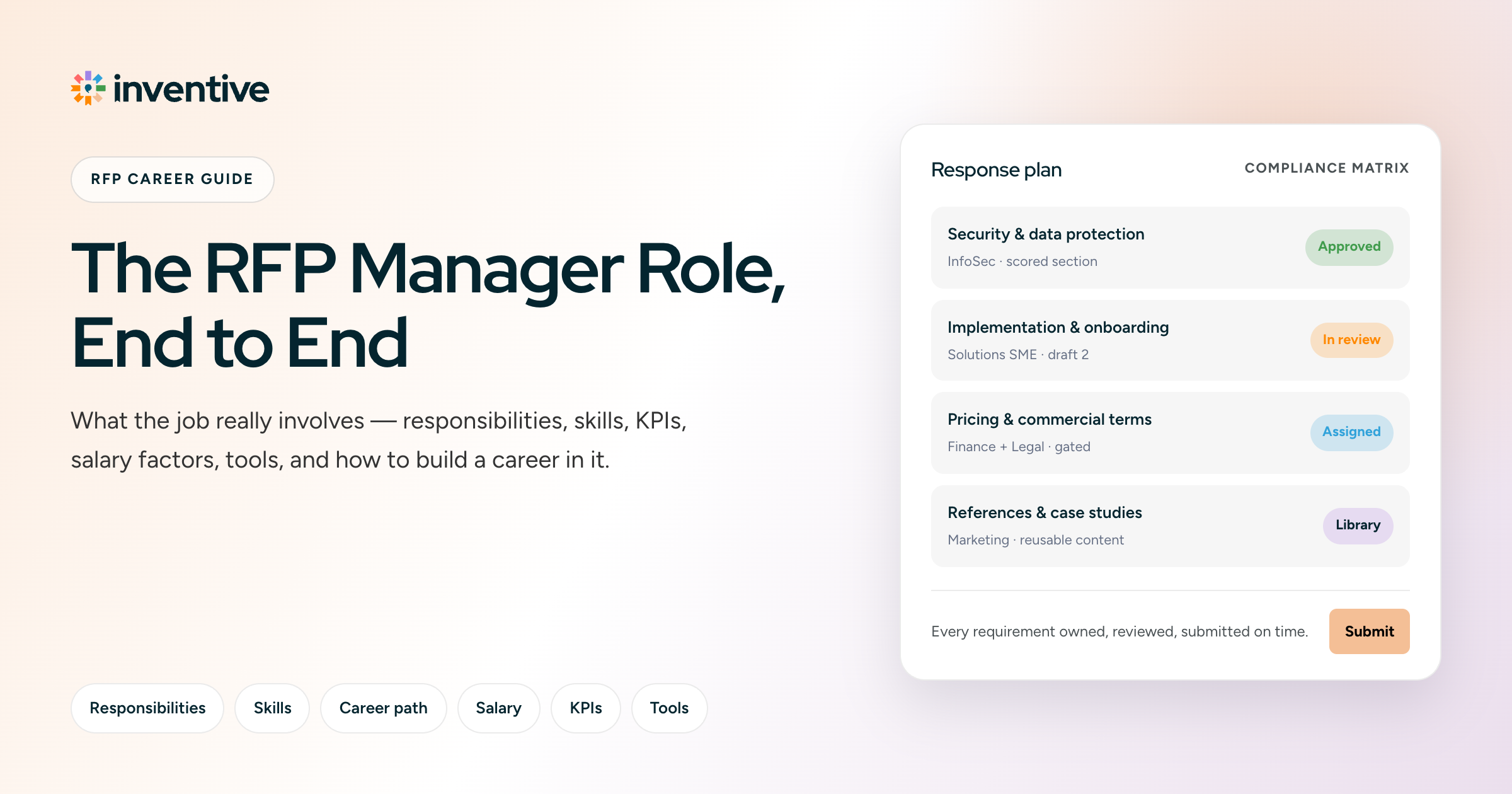
The RFP manager reviews the document for every instruction, question, sub-question, attachment, scoring factor, and risk. That analysis becomes a compliance matrix tracking each requirement, its source location, response owner, status, review status, and final response location.
| Field | Purpose |
|---|---|
| Requirement ID | Gives each requirement a unique reference |
| RFP source location | Records the page, section, or subsection |
| Buyer question or requirement | Preserves the exact language being answered |
| Response owner | Identifies the accountable SME, writer, or function |
| Internal due date | Sets a deadline before final submission |
| Response status | Tracks assignment, progress, review, approval, or blockers |
| Compliance status | Shows whether the answer is compliant, partially compliant, or noncompliant |
| Risk or dependency | Flags pricing, legal, security, product, or delivery issues |
| Final proposal location | Links the requirement to the completed response |
A compliance matrix keeps a response from being polished but incomplete. It also surfaces capability gaps and decisions that need escalation.
4. Response planning and kickoff
After qualification, the RFP manager works backward from the submission deadline to build a schedule. This covers SME input, drafts, technical review, legal and security review, pricing validation, editorial review, executive approval, final production, and portal upload with contingency time.
The kickoff aligns contributors on the customer, opportunity, timeline, response strategy, ownership, and review process.
Assignments should be specific. Instead of asking someone to "answer the implementation section," give them the exact buyer question, available source material, expected length, deadline, required evidence, and any decision or technical confirmation needed.
5. SME coordination and answer development
RFP managers work with subject matter experts across product, engineering, security, finance, implementation, legal, HR, and customer success. The job is not simply collecting answers. It is turning expert input into responses a buyer can actually use.
That may involve:
- Asking follow-up questions when an answer is incomplete
- Replacing internal jargon with customer-facing language
- Aligning answers with evaluation criteria
- Checking unsupported product claims
- Adding evidence, examples, metrics, or customer proof points
- Resolving conflicting or overlapping responses
- Checking consistency with legal, security, and pricing positions
- Tailoring reusable content to the buyer
Strong RFP managers reduce the burden on SMEs by providing a useful starting draft where possible and asking experts only for what they are uniquely qualified to provide.
Turn SME answers into buyer-ready responses faster
Explore how Inventive AI helps RFP managers draft, review, and reuse content across every response.
Book a Demo6. Reviews, approvals, and quality control
The review process should separate different types of feedback rather than combining everything into one cycle:
- Content review: Does the response answer the question and address buyer priorities?
- Technical review: Is the information accurate and deliverable?
- Legal and commercial review: Are commitments, pricing assumptions, and contract positions approved?
- Security and privacy review: Are security, compliance, and risk statements current?
- Executive review: Are major commitments and strategic messages aligned with leadership?
- Compliance review: Does the submission meet every buyer requirement?
The RFP manager coordinates these reviews, tracks approvals, and resolves issues before submission.
7. Final assembly and submission
Before submission, the RFP manager verifies that:
- Every required question is answered
- Mandatory forms are completed
- Required attachments are included
- Pricing and legal approvals are documented
- File names and formats follow buyer instructions
- Page limits and response limits are met
- Links, tables, and appendices work correctly
- Final versions are approved
- Submission receipt is confirmed
Strong teams submit early enough to absorb portal outages, file-size limits, and permission problems.
8. Post-submission activity and lessons learned
After submission, the RFP manager may support clarification requests, presentations, negotiations, best-and-final-offer rounds, or sales handoffs.
They should also document lessons learned:
- Questions that took too long to answer
- Missing or outdated content
- SME bottlenecks
- Review delays
- Buyer feedback
- Reasons for wins, losses, withdrawals, or disqualifications
- Process improvements for future responses
These insights feed back into content libraries, workflows, qualification criteria, and team capacity planning.
How the Role Changes by Industry and Company Size
| Environment | How the RFP manager role commonly differs |
|---|---|
| B2B SaaS | Enterprise RFPs, security questionnaires, privacy reviews, integrations, implementation planning, and content libraries |
| Financial services & insurance | Detailed due diligence, compliance, governance, security, and regulatory requirements |
| Healthcare | Privacy, security, interoperability, implementation, and regulatory scrutiny |
| Government contracting | Formal compliance requirements, evaluation criteria, pricing volumes, certifications, and structured review processes |
| Construction & engineering | Qualifications packages, project sheets, technical approaches, resumes, and proposal production |
| Professional services | Methodologies, staffing plans, case studies, references, and delivery approaches |
| Small organizations | One person may handle writing, coordination, formatting, pricing input, submissions, and tracking |
| Large enterprises | Greater coordination across legal, security, pricing, product, proposal, and executive teams |
Hiring expectations follow these differences. A SaaS RFP manager may need experience with security questionnaires and CRM systems, while a government proposal professional needs expertise in solicitation compliance and formal review processes.
A Day in the Life of an RFP Manager
An RFP manager spends less time writing than most people expect. Much of the role is coordination, decision-making, and keeping work moving.
A typical day may include:
- Reviewing a new RFP and identifying requirements
- Meeting with sales to discuss the opportunity
- Building or updating a compliance matrix
- Assigning technical, legal, pricing, security, and operational questions
- Editing SME responses
- Following up on blocked or overdue items
- Coordinating reviews and approvals
- Updating plans after buyer amendments
- Checking formatting and submission requirements
- Preparing the final submission
- Capturing approved content for future reuse
The work is deadline-driven and usually involves balancing competing priorities across several stakeholders at once.
Core RFP Manager Responsibilities
The lifecycle above describes the sequence of work. These responsibilities describe what an RFP manager is accountable for across it.
Strategic responsibilities
RFP managers support pursuit strategy by analyzing the buyer's needs, evaluation criteria, risks, and differentiators. They may contribute to bid/no-bid decisions, identify weak positioning, and help shape response themes.
If implementation is a major evaluation criterion, for example, the response should cover onboarding, milestones, integrations, training, support, and relevant customer outcomes rather than listing product features.
Project management responsibilities
The RFP manager turns the buyer's requirements into a delivery plan. They:
- Create schedules and assign owners
- Track deadlines and dependencies
- Monitor response progress
- Run meetings and record decisions
- Manage blockers and escalations
- Coordinate reviews and approvals
The U.S. Bureau of Labor Statistics describes project management specialists as coordinating schedules, timelines, procurement, staffing, and budgets, which maps closely to RFP management, although "RFP manager" is not a standalone BLS occupation.
Writing and content responsibilities
Depending on the organization, an RFP manager may write executive summaries, company overviews, implementation plans, case studies, product descriptions, and standard responses.
Even when SMEs provide the initial content, the RFP manager edits it for accuracy, clarity, buyer relevance, evidence, consistent tone and terminology, and alignment with requirements.
They often maintain the response library too: approved answers, templates, product information, policies, case studies, security content, and supporting evidence.
Stakeholder management responsibilities
RFP managers coordinate across functions without direct authority over contributors, so they need usable input from busy SMEs while keeping requests focused.
Effective requests make five things clear:
- What is needed
- Why it matters
- Which buyer requirement it supports
- What evidence or decision is required
- When it is due
This cuts back-and-forth and makes it easier to escalate genuinely blocked work.
Compliance and quality responsibilities
Compliance means meeting the buyer's requirements. Quality means producing a response that is accurate, consistent, readable, relevant, and approved. RFP managers check for:
- Missing answers or attachments
- Conflicting product statements
- Unsupported claims
- Incomplete forms
- Incorrect word or page counts
- Inconsistent terminology
- Unapproved pricing, legal, privacy, or security commitments
- Formatting errors
- Submission portal requirements
Reporting and analytics responsibilities
Mature RFP teams track workload, cycle time, outcomes, content health, and resource bottlenecks. RFP managers use that data to report on capacity, identify recurring delays, measure response performance, and show where the process or content library needs attention.
Skills Every RFP Manager Needs
.png)
RFP management combines execution, communication, analysis, and commercial judgment. Strong writing matters, and so do process control and the ability to work across functions.
| Skill | Why it matters |
|---|---|
| Project management | Converts complex requirements into schedules, assignments, review stages, and submission plans |
| Writing and editing | Produces clear, accurate, buyer-focused responses and removes jargon and inconsistencies |
| Requirement analysis | Identifies requirements buried in appendices, scoring criteria, forms, legal terms, and portal instructions |
| Stakeholder management | Gets usable input from SMEs, legal, finance, security, sales, and executives |
| Commercial awareness | Helps the team weigh pricing, delivery constraints, customer needs, risks, and differentiators |
| Research | Supports buyer, industry, competitor, and internal-content research |
| Attention to detail | Catches missing requirements, attachments, certifications, and inconsistent answers |
| Prioritization | Separates deadline-critical, high-risk, scored, and blocking tasks |
| Technology proficiency | Supports work across RFP platforms, CRMs, document repositories, spreadsheets, and collaboration tools |
| Data analysis | Identifies workload patterns, bottlenecks, content gaps, and win/loss trends |
| Risk identification | Surfaces product, commercial, security, legal, and resourcing risks early |
RFP Manager Qualifications and Experience
No single degree or certification is required. Employers prioritize experience managing complex, deadline-driven, cross-functional work.
Common educational backgrounds
Relevant degrees may include:
- Business administration
- Communications
- English, journalism, or professional writing
- Marketing
- Public administration
- Finance or economics
- Engineering, technology, or information systems
- Construction management, architecture, or design
- Healthcare, public policy, or another industry-specific field
A degree provides communication, research, or industry knowledge. Practical experience managing responses and producing accurate client-facing work counts for more.
Relevant experience employers look for
Experience in any of these areas transfers well:
- RFP, RFI, RFQ, tender, or DDQ responses
- Proposal or technical writing
- Sales enablement or sales operations
- Business development or capture support
- Project coordination or project management
- Procurement or sourcing
- Legal operations, compliance, privacy, or security questionnaires
- CRM and document-management systems
- Working with SMEs and executives
- Content libraries and knowledge management
Certifications and training
Certification is not mandatory, but it helps career changers and professionals moving into formal proposal, bid, or capture roles. APMP offers the most widely recognized certification pathway for bid, proposal, and capture professionals.
Other useful training depends on the target role:
- Project management: scheduling, risk, stakeholder, and delivery skills
- Procurement: sourcing, evaluation, and buyer-side processes
- Industry certifications: cybersecurity, cloud, privacy, healthcare, or government contracting
- Business writing: plain language, editing, and proposal design
Choose training based on the sector you want to work in. A government proposal role calls for very different knowledge from a SaaS role built around security questionnaires.
How to Become an RFP Manager
.png)
The most practical route is to build experience managing a response end to end, not just writing parts of one.
1. Start in an adjacent role
Roles that build relevant experience include RFP coordinator, proposal coordinator, proposal writer, bid administrator, technical writer, sales operations analyst, sales enablement specialist, business development coordinator, procurement analyst, project coordinator, customer success operations specialist, and security questionnaire specialist.
Each of these exposes you to response tracking, approvals, content reuse, stakeholder coordination, deadlines, and document production.
2. Learn the full RFP lifecycle
Go beyond drafting answers. Learn how to:
- Review buyer documents
- Build compliance matrices
- Support go/no-go decisions
- Create response schedules
- Assign and follow up with SMEs
- Coordinate legal, security, finance, and pricing reviews
- Assemble and submit final responses
- Run post-bid reviews
- Maintain a content library
Understanding the whole process is what separates an RFP manager from an RFP writer.
3. Develop practical writing and editing skills
RFP writing is not promotional copywriting. Responses need to be direct, specific, accurate, evidence-based, and tied to the buyer's requirements. Practice turning technical or internal information into clear buyer-facing answers, and learn to spot vague claims, unsupported statements, missing evidence, and responses that dodge the question.
A portfolio can include anonymized, simulated, or permissioned examples such as:
- Sample compliance matrix
- Response project plan
- Redacted or fictionalized RFP response
- Before-and-after technical rewrite
- Content-library structure
- Lessons-learned template
- Executive summary for a fictional buyer
Never include confidential proposals, pricing, security documentation, or proprietary content.
4. Learn the relevant tool categories
You don't need expertise in every platform, but you should understand how the main categories support the RFP process.
| Tool category | What it helps with |
|---|---|
| RFP management software | Question intake, assignments, drafting, reviews, content libraries, and analytics |
| Proposal management platforms | Proposal narratives, templates, content reuse, collaboration, and document production |
| Content repositories | Approved product, legal, security, company, and customer-proof content |
| Project-management tools | Assignments, deadlines, milestones, dependencies, and bottlenecks |
| CRM systems | Account context, opportunity value, sales stage, competitors, and pipeline |
| Collaboration tools | Communication, meetings, document sharing, and SME coordination |
| Document and PDF tools | Formatting, redlining, version control, and final assembly |
| AI-assisted response tools | Answer discovery, classification, summarization, drafting, and gap identification |
Platforms help with workload, turnaround, content reuse, and analytics. They don't replace clear ownership, current source content, or an established process.
5. Quantify your experience
When applying for RFP manager roles, show scope and outcomes rather than listing duties. Useful metrics include:
- Number of RFPs, RFIs, DDQs, or security questionnaires managed
- Average response turnaround time
- Number of SMEs or teams coordinated
- On-time submission rate
- Proposal value or pipeline influenced, where appropriate
- Content reuse improvements
- Reduction in manual work or review cycles
- Compliance issues prevented
- Volume of content maintained or updated
- Improvements in win/loss reporting
For example: Managed 30 enterprise RFPs and security questionnaires per quarter, coordinating sales, product, legal, privacy, and information-security SMEs while maintaining a 98% on-time submission rate.
That tells a hiring manager far more than "Responsible for RFP responses."
6. Build strategic and leadership capability
Senior RFP, bid, and proposal roles need stronger commercial judgment. Learn how opportunities are qualified, how buyers evaluate proposals, how pricing and delivery commitments are approved, and how win themes are developed. These roles also involve leading high-value pursuits, challenging assumptions, mentoring team members, improving processes, and influencing pursuit strategy.
RFP Manager Career Path

There is no single path, but a common progression looks like this:
| Career stage | Typical focus |
|---|---|
| RFP or proposal coordinator | Tracks deadlines, formats documents, maintains libraries, and supports submissions |
| RFP or proposal specialist | Owns smaller responses or sections and coordinates SMEs |
| RFP manager | Leads full responses, schedules, compliance, reviews, stakeholder coordination, and submission |
| Senior RFP or proposal manager | Handles strategic, high-value, global, or high-risk pursuits and mentors team members |
| Bid or capture manager | Takes greater ownership of pursuit strategy, competitive positioning, bid governance, and commercial coordination |
| Proposal operations or bid leadership director | Owns the team, operating model, technology, content strategy, reporting, and governance |
The path also branches sideways. RFP managers move into sales enablement, revenue operations, capture management, business development, contracts, procurement, customer operations, and product marketing.
RFP Manager Salary
Salary data varies because titles and responsibilities differ so much across companies.
As of September 01, 2026, Salary.com reports an average annual U.S. salary of $123,980 for an RFP Manager, with a 25th-to-75th percentile range of $112,997 to $133,598. It reports $102,998 at the 10th percentile and $142,355 at the 90th percentile.
What affects RFP manager salary?
- Geographic location
- Industry and technical complexity
- Specialized expertise in government, security, healthcare, or financial services
- Years of RFP, bid, or proposal experience
- Team and leadership responsibility
- Pricing or commercial ownership
- Deal size and scope
- Security clearances or specialized credentials
- Base salary, bonus, commission, equity, and other compensation
When comparing offers, check whether the role covers RFP response management alone or also includes capture, bid strategy, pricing, people management, presentations, and revenue accountability. Those differences can change compensation significantly, and they explain much of the gap between an RFP specialist and a manager-level role.
Top-Paying Cities for RFP Managers
Salary.com’s 2026 benchmarks show some of the highest average salaries in:
- San Jose: $156,376
- San Francisco: $154,664
- Oakland: $151,404
- New York: $142,749
- Paramus: $141,014
- Queens Village: $141,007
- Passaic: $140,890
- Bergenfield: $140,878
These are salary benchmarks, not guaranteed offers, and actual pay varies by experience, responsibilities, and employer.
RFP Manager KPIs and Metrics
.png)
RFP metrics should measure business outcomes and process performance, not just the number of responses completed.
| KPI | What it measures | Why it matters |
|---|---|---|
| Win rate | Percentage of submitted responses that result in a win | Indicates commercial outcome, but should be segmented by deal type, market, customer type, and opportunity quality |
| Bid/no-bid effectiveness | Results from pursued opportunities compared with declined or poorly qualified ones | Shows whether the company is using RFP resources selectively |
| Response volume | Number of RFPs, RFIs, DDQs, or questionnaires completed | Helps measure workload and capacity, but is not a standalone quality metric |
| On-time submission rate | Percentage of submissions completed by the buyer's deadline | Measures delivery reliability and process control |
| Turnaround time | Time from intake to submission | Identifies capacity constraints, slow reviews, and process bottlenecks |
| Compliance or error rate | Missed requirements, incorrect attachments, incomplete forms, formatting problems, or submission corrections | Measures response quality and reduces disqualification risk |
| Content reuse rate | Percentage of responses using approved reusable content | Indicates library usefulness, but must be balanced with tailoring and freshness |
| Content health | Accuracy, ownership, approval status, and recency of reusable content | Shows whether the knowledge base is reliable enough to support faster responses |
| SME response time | Time required for experts to return usable answers | Identifies resource constraints and informs internal service-level expectations |
| Cost per response | Labor, external support, technology, and production cost per response | Helps leaders understand response economics |
| Revenue or pipeline influenced | Value of opportunities supported by the RFP team | Connects proposal activity to business impact, while recognizing the team does not control all sales outcomes |
| Loss reasons | Patterns from buyer feedback, sales notes, and debriefs | Reveals recurring issues in pricing, fit, content, differentiation, product gaps, or qualification |
The point of these metrics is to prompt decisions. Rising SME response times may signal a capacity problem. Low content reuse often means the library is hard to search or out of date. A low win rate concentrated in one segment usually points to qualification or positioning rather than writing quality.
RFP Manager Tools and Software
RFP managers use several tool categories because the work spans content, workflow, sales data, collaboration, approvals, and submission.
RFP management software
RFP management platforms like Inventive AI centralize buyer questions, assignments, drafts, approvals, response libraries, and reporting. They earn their keep on teams handling recurring enterprise RFPs, security questionnaires, due diligence, and complex multi-contributor responses.
Common capabilities include:
- Importing and organizing RFP questions
- Assigning questions to SMEs
- Keeping knowledge sources up to date
- Managing review workflows
- Tracking completion and bottlenecks
- Maintaining content ownership and review dates
- Exporting completed responses
- Reporting on volume, turnaround, reuse, and workload
- AI-first answer discovery and drafting
AI now appears across the RFP workflow: finding approved answers, classifying questions, summarizing source documents, drafting responses, and flagging gaps.
A single response may draw on approved content, CRM records, product documentation, previous responses, customer conversations, and opportunity-specific details. When those inputs sit in separate systems, teams still burn hours assembling context before anyone writes an answer.
Inventive AI brings together approved company knowledge, CRM data, and conversation context to help revenue teams create deal-specific, buyer-ready content without rebuilding the context for every opportunity. For RFP teams, that can mean:
- Finding relevant approved content instead of starting from scratch
- Adapting existing knowledge to the specific buyer and opportunity
- Pulling deal context from CRM records and customer conversations
- Drafting responses using company-approved information
- Reducing the manual work of gathering context across systems
AI-generated content still needs human review. Check every response for:
- Factual accuracy
- Current and approved information
- Relevance to the buyer's question
- Consistency with product, legal, privacy, and security commitments
- Response limits and formatting requirements
- Unsupported claims or promises
- Appropriate handling of confidential information
The goal is to cut the repetitive work of finding, assembling, and adapting information so the RFP manager can focus on qualification, strategy, review, and quality control.
Proposal management platforms
Proposal management tools focus more on customer-facing proposals: narratives, templates, branded content, collaboration, and document production. The two categories overlap when a company has to manage both structured questionnaires and polished proposal documents.
Knowledge and content repositories
A governed content library stores approved material the team can reuse:
- Product capabilities
- Implementation methods
- Security controls
- Privacy and compliance information
- Policies and certifications
- Company descriptions
- Customer stories and references
- Executive bios
- Legal and commercial language
- Standard responses to recurring questions
Every item needs clear ownership, approval status, and a review date so the team knows what can be reused and when it needs updating.
Common RFP Manager Challenges
RFP managers work under tight deadlines, across multiple stakeholders, with incomplete information and limited direct control.
- Tight deadlines. Some buyers give short response windows or issue amendments after work has started.
What helps: build a reverse schedule, identify critical-path work, reserve time for final checks, and escalate blocked decisions early. - Unresponsive SMEs. Experts are usually juggling customer work, product development, or audits.
What helps: send precise questions, provide a starting draft, explain the buyer impact, set internal deadlines ahead of the submission date, and escalate when necessary. - Poor source content. Response libraries fill up with outdated, inconsistent, unapproved, or generic answers.
What helps: assign content owners, set review dates, establish approval workflows, and prioritize updates to frequently used or high-risk content. - Conflicting stakeholder priorities. Sales may want a stronger commitment than product, legal, or finance will support.
What helps: document the issue, clarify the risks and approval authority, present the options, and escalate the decision rather than making an unauthorized commitment. - Version-control problems. Contributors working across email, local files, shared drives, and chat create conflicting versions fast.
What helps: use one controlled workspace, define document ownership, keep a change log for major decisions, and set a content freeze before final assembly. - High response volume. Teams handling large numbers of RFPs, RFIs, DDQs, and security questionnaires hit capacity limits quickly.
What helps: standardize intake, triage opportunities, maintain approved reusable content, automate repeatable tasks, and use workload data to plan resources.
RFP Management Best Practices
Effective RFP management depends on a repeatable process rather than last-minute coordination.
- Standardize RFP intake. Collect the document, deadline, opportunity details, buyer relationship, estimated value, known competitors, and required level of support.
- Use a structured go/no-go process. Weigh strategic fit, win probability, resources, product alignment, risk, deal value, and deadline feasibility.
- Build a compliance matrix before writing. Capture requirements, owners, response limits, attachments, review stages, and submission instructions.
- Create a reverse schedule. Work backward from submission and allow time for SME input, reviews, approvals, production, portal upload, and contingency.
- Assign one accountable owner per response item. Several people can collaborate, but one person delivers the answer.
- Give SMEs focused requests. Include the buyer question, source material, expected response, evidence needed, deadline, and required decision.
- Maintain a governed content library. Track ownership, review dates, approval status, source evidence, and usage guidance.
- Separate review types. Keep content, technical, legal, security, executive, and compliance reviews focused on their specific purpose.
- Use a final submission checklist. Validate responses, forms, attachments, file names, formats, page limits, portal fields, and receipt confirmation.
- Run post-bid analysis. Capture lessons and use them to update content, qualification criteria, workflows, and training.
Is RFP Management a Good Career?
RFP management suits people who enjoy combining writing, project management, research, business strategy, and cross-functional work. The role tends to fit those who like:
- Organizing complex work into clear plans
- Working with experts across different functions
- Producing business documents
- Managing deadlines and tangible deliverables
- Solving process problems
- Learning about customers, industries, products, and commercial models
- Building and improving systems
The skills travel well into proposal leadership, bid management, capture, sales enablement, revenue operations, business development, contracts, procurement, customer operations, and product marketing.
It is also demanding work. RFP managers deal with constant follow-up, shifting priorities, incomplete information, late stakeholder input, detailed quality checks, and deadline pressure. If you enjoy creating order from ambiguity while balancing speed, detail, and commercial judgment, it's a strong fit.
Ready to see Inventive AI on your next RFP?
Try it on a live response to see how much manual work AI can take off your plate.
Book a Demo
Frequently Asked Questions
Can an RFP manager work remotely?
Yes. Many RFP manager jobs are remote or hybrid because the work runs on digital collaboration, shared content libraries, RFP platforms, CRM systems, and video meetings. Remote teams do need especially clear ownership, disciplined schedules, responsive SMEs, and controlled document processes.
How many RFPs can one RFP manager handle at once?
There is no universal number. Capacity depends on the length and complexity of each response, the deadline, how many SMEs are involved, the quality of the response library, available writing support, and whether pricing, legal, security, or executive reviews are required. A five-question renewal questionnaire and a complex public-sector tender should not be treated as equal workloads.
Does an RFP manager need Salesforce experience?
Not always, but CRM experience is valuable in sales-led organizations. Salesforce and similar platforms hold account history, opportunity value, deal stage, buyer contacts, competitor information, and previous activity that help RFP managers qualify opportunities, tailor responses, and report business impact.
Can a procurement professional become an RFP manager?
Yes. Procurement experience transfers well because procurement professionals already understand buyer requirements, sourcing workflows, vendor evaluation, contract terms, compliance, and stakeholder management. Moving to the supplier side calls for stronger proposal writing, commercial positioning, sales-process, and response-production skills.
Does an RFP manager need to be a subject matter expert?
Not in every technical, legal, security, or financial area. They need enough subject knowledge to understand the buyer's questions, identify gaps, ask useful follow-ups, and recognize risk, and they rely on SMEs for detailed accuracy and approval. Deep expertise in a specific industry is a real advantage in regulated or technical markets.
What should an RFP manager do when a buyer requirement cannot be met?
Don't hide the gap or make an unapproved promise. Document the requirement, confirm current capability with the relevant SME, identify alternatives or workarounds, assess the legal and commercial implications, and escalate the decision to the appropriate owner. Depending on company policy and buyer rules, the final response may state a qualified exception, a roadmap position, a partner-supported option, or clear noncompliance.
What is a color-team review?
A color-team review is a structured proposal-review method used especially in government contracting and complex bids. Each stage evaluates a draft from a particular perspective, such as compliance, technical quality, executive readiness, or likely evaluator scoring. The color labels vary by organization, so the purpose of each review matters more than the name.