What is a bid manager? A practical guide to the role, work and career
A bid manager owns the difference between a good solution and a winning submission. Give five subject matter experts the same technical answer, and a skilled bid manager turns it into a proposal that scores well, reads clearly, and lands on time. Hand the same inputs to a team without that coordination, and the answer can get buried in inconsistent formatting, a missed compliance requirement, or a submission that arrives too late to be evaluated at all.
The role sits where project management, stakeholder coordination and commercial judgment meet. Bid managers do not just track deadlines. They decide which opportunities are worth pursuing, turn buyer requirements into a response plan, and make sure dozens of moving contributions come together as one coherent, compliant document.
This guide covers what bid managers actually do, the skills and qualifications the role calls for, typical salaries, and how the job differs from adjacent titles like RFP manager and proposal manager.
Key takeaways
- A bid manager owns the end-to-end process of turning tender opportunities into compliant, competitive submissions.
- The role blends project management, stakeholder coordination, commercial input and quality control across the bid lifecycle.
- Titles and responsibilities vary. In smaller firms, one person may cover bid, proposal and capture work; larger firms split these across specialists.
- Core skills include project management, communication, commercial awareness, writing and editing, risk management, and proficiency with bid tools.
- Typical progression runs coordinator, bid manager, senior bid manager, then head or director of bid and proposal management.
- Salaries vary by location and seniority. Recent 2026 data shows UK averages around £48k to £70k, US around $76k to $110k, and Australia around AU$115k to $155k.
- Strong bid teams track multiple KPIs, including win rate, on-time submission, cost per bid and lessons learned, rather than relying on win rate alone.
What is a bid manager?
A bid manager is the professional responsible for planning, coordinating and delivering an organisation's response to tenders, RFPs and other competitive bidding opportunities, making sure submissions are compliant, compelling and on time.
In practice, a bid manager typically owns the bid process from opportunity assessment through to submission and post-bid review. They decide whether to pursue an opportunity, set the bid timetable, coordinate inputs from sales, legal, finance and technical subject matter experts (SMEs), manage reviews and approvals, and confirm the final proposal meets the buyer's requirements and evaluation criteria.
Bid managers usually sit within sales, business development or a dedicated bid and proposal function, working at the intersection of commercial strategy and project delivery. The role exists because winning competitive contracts takes more than a strong solution: it takes disciplined process, clear ownership, consistent messaging and rigorous compliance.
The exact scope varies by organisation. In smaller companies, a bid manager may handle everything from opportunity qualification to proposal writing and pricing coordination. In larger enterprises, responsibilities are often split between bid managers, proposal managers, RFP managers and capture managers, with the bid manager focused on process, coordination and quality control.
In this context, a bid is a formal offer submitted in response to a buyer's tender, RFP, RFQ or similar procurement process, typically for public sector contracts, large enterprise deals or complex services.
What does a bid manager do?
Bid managers work across the full bid lifecycle, acting as the central coordinator and quality gate for each pursuit. Their work breaks down into stages.
Opportunity identification and intake
Bid managers monitor tender portals, CRM pipelines and sales inputs to identify new opportunities, gathering details such as buyer, scope, deadlines, evaluation criteria and submission format.
Bid qualification and bid/no-bid coordination
They run structured bid/no-bid decisions, weighing strategic fit, delivery capability, resource capacity, competition, risk and realistic win probability. The outcome is a documented decision with clear rationale and executive approval.
Requirement analysis and strategy development
Once an opportunity is approved, bid managers analyse tender documents to extract mandatory requirements, evaluation weightings, compliance obligations and key themes, then work with sales and solution leads to define win themes and response strategy.
Bid planning and timeline creation
They build a detailed bid plan with milestones, owners, review gates and submission checkpoints, including internal deadlines for SME input, pricing, legal review and executive sign-off, usually with buffer time for the unexpected.
Work allocation and SME coordination
Bid managers assign sections to appropriate subject matter experts (SMEs), issue clear briefs and track progress, chasing contributions and resolving ambiguities so inputs stay aligned with strategy and evaluation criteria.
Commercial and pricing coordination
They coordinate with finance, sales and delivery to develop pricing models, commercial terms and risk assessments. They may not own pricing decisions, but they keep the pricing narrative consistent with the technical response.
Risk identification and compliance
Bid managers maintain risk registers, track open assumptions, and confirm compliance with mandatory criteria, formatting rules and submission instructions, flagging issues early.
Review cycles and executive approvals
They organise and lead review sessions (pink, red, gold or equivalent), incorporating feedback on content, compliance, differentiation and risk, and secure final approval before submission.
Submission and post-bid review
Bid managers manage the final submission through the buyer's portal, confirm receipt, and track clarification questions. After the outcome, they lead debriefs to capture lessons learned and update content libraries.
Bid manager responsibilities
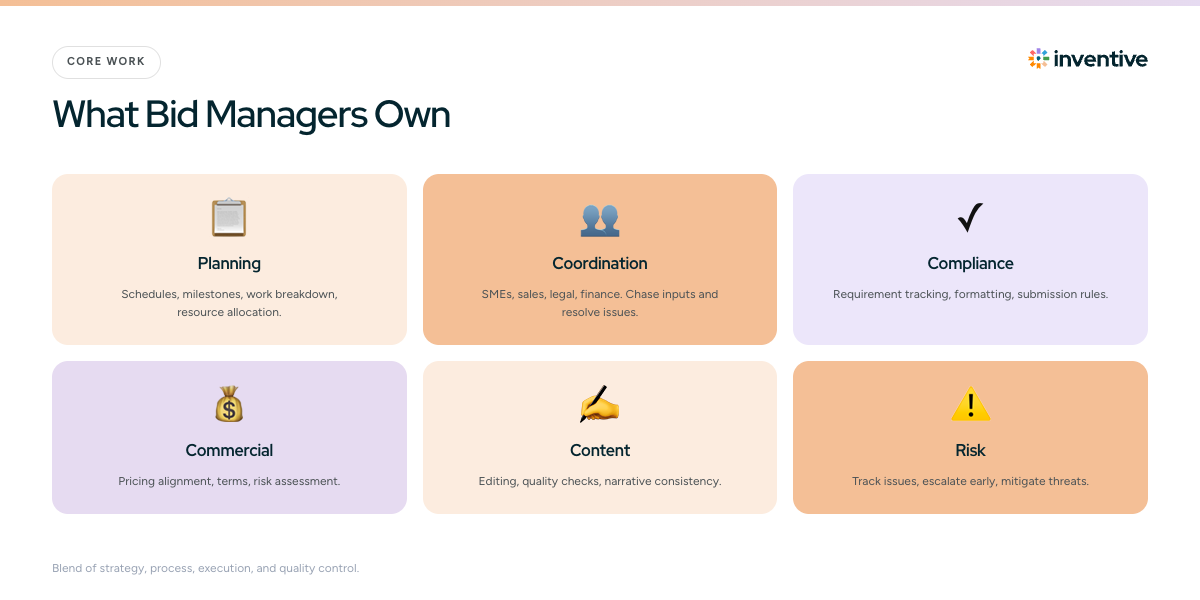
Beyond the stage-by-stage lifecycle, a bid manager holds ongoing responsibility across a set of functional areas that cut across every bid they run. These responsibilities are less about "when" in the process and more about what the role is accountable for at all times.
- Bid planning. Owning the bid schedule, milestones and review gates keeps the team working to a realistic plan and cuts down on last-minute rushes.
- Project management. Scope definition, resource planning, risk management and quality assurance are central to delivering complex, multi-contributor bids on time.
- Stakeholder management. Bid managers influence busy SMEs, sales leaders, legal, finance and executives without direct authority, keeping contributions on track and momentum going.
- Commercial coordination. Bid managers make sure pricing, commercial terms and risk positions line up with the technical response and buyer expectations.
- Content and response management. They shape, edit and quality-check proposal content so it stays clear, consistent and aligned with win themes, turning expert input into scored, evidence-based answers.
- Compliance and quality control. Verifying that submissions meet every mandatory requirement and formatting rule matters because compliance failures can disqualify an otherwise strong bid.
- Risk management. Identifying, logging and mitigating delivery, commercial, resourcing and timeline risks protects the organisation from overcommitting or underpricing.
- Bid governance. Enforcing approval workflows, version control and document management supports auditability and reduces errors in high-stakes submissions.
- Post-bid analysis. Structured reviews after each outcome capture reusable content and feed lessons into future pursuits.
Coordinating SMEs and hunting through old proposals for the right supporting content are two of the most time-consuming parts of this role, and both get harder as bid volume grows. When a bid manager is running several pursuits at once, manually searching for past answers eats into time that should go toward strategy and review quality. This is part of why more bid teams now use AI-native platforms like Inventive AI to surface first-pass answers from a connected knowledge base, freeing bid managers to focus on judgment calls instead of file searches.
What is the bid management process?
The bid management process is a structured, repeatable sequence that turns a raw opportunity into a submitted, compliant proposal. Most organizations follow some version of the seven stages below, adapting the depth of each based on deal size and internal governance.
This framework is adaptable. Some organisations compress or expand stages depending on deal size, sector and internal governance.
Bid manager vs RFP manager vs proposal manager vs capture manager
These four titles get used interchangeably, but they map to different parts of the deal cycle: capture happens before the RFP exists, bid management owns the process end to end, and proposal and RFP managers focus more narrowly on response workflow and document quality. The comparison below breaks down where each role's focus actually sits.
In practice, the bid manager is the strategic pilot of the deal, involved from capture through to contract award, while the proposal manager focuses on producing the written response once the RFP is issued. The RFP manager tends to emphasise workflow and compliance, and the capture manager works earliest in the sales cycle to improve the odds of winning before a formal bid exists.
Because responsibilities vary, always check the actual job description and organisational structure rather than assuming a fixed definition.
Skills every bid manager needs
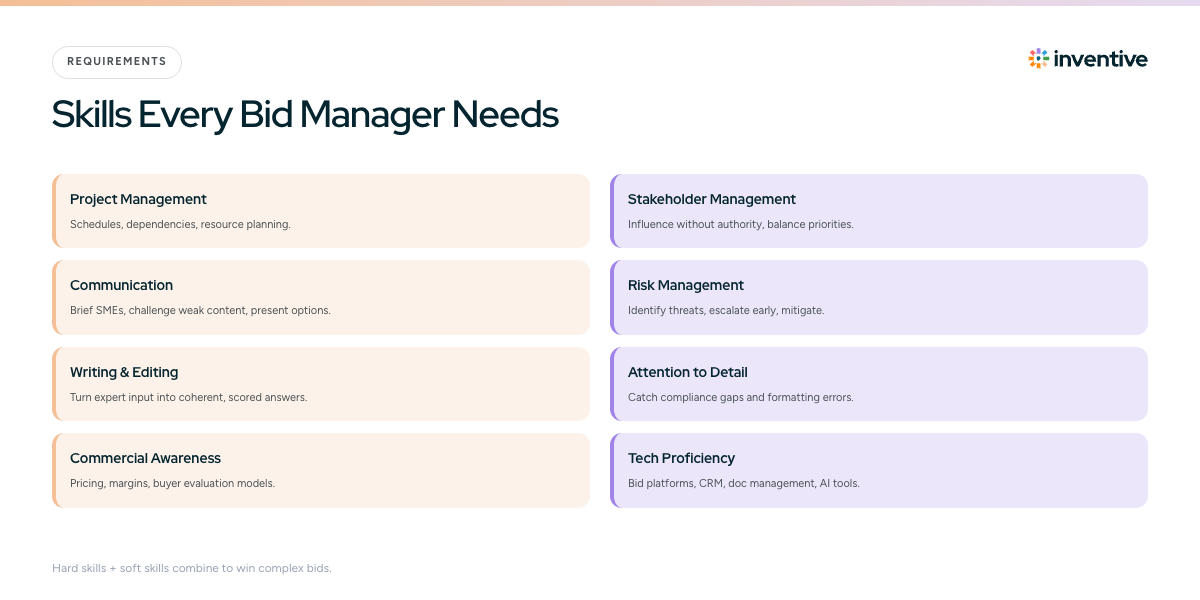
Bid management rewards people who can move between structured process work and high-pressure stakeholder influence in the same afternoon. The skills below combine project management fundamentals with the commercial and interpersonal judgment the role depends on.
- Project management. Running multiple deadlines, dependencies and contributors in parallel, and escalating risk early.
- Communication. Briefing SMEs, challenging weak content, negotiating deadlines and presenting options to executives, in writing, in meetings and in status updates.
- Writing and editing. Turning expert input into coherent, scored answers that address evaluation criteria.
- Commercial awareness. Understanding evaluation weightings, pricing models, margin expectations and risk exposure.
- Negotiation. Securing SME time internally, handling external clarifications with buyers, and sometimes negotiating commercial terms with partners.
- Stakeholder management. Influencing busy people without direct authority and balancing conflicting priorities to keep momentum.
- Time management and organisation. Juggling multiple bids, each with its own deadlines and teams.
- Risk management. Identifying, logging and mitigating delivery, pricing, resourcing and timeline risks.
- Attention to detail. Compliance failures, formatting errors and missed requirements can disqualify a bid regardless of solution quality.
- Strategic thinking. Seeing how a pursuit fits the pipeline, which opportunities are worth the effort, and how to position against competitors.
- Research and data analysis. Researching buyers, markets and competitors, and analysing evaluation criteria and win/loss data.
- Procurement knowledge. Understanding tender processes, evaluation models and public sector rules.
- Technology and software proficiency. Familiarity with bid management platforms, CRM systems, document management tools and AI-assisted proposal tools.
Bid manager qualifications
There is no single mandatory degree or certification for bid managers. Common educational backgrounds include business, marketing, communications, engineering or related fields, but many successful bid managers come from sales, project management, consulting or delivery roles.
Relevant previous roles include proposal coordinator, project coordinator, sales operations, account management, consulting analyst or delivery manager. Experience coordinating cross-functional work, managing deadlines and producing client-facing documents transfers well.
Certifications can strengthen credibility. The APMP (Association of Proposal Management Professionals) offers globally recognised credentials at Foundation, Practitioner and Professional levels for bid, proposal and capture professionals.
Project management certifications such as PMP or PRINCE2 are also useful, given the strong PM component of the role.
Professional training courses in bid and proposal management, tender writing and win strategy can help candidates build practical frameworks.
A specific degree is not required. Many bid managers move into the role by taking on bid coordination tasks in their current job, building a portfolio of successful submissions, and then moving into a formal bid manager title.
How to become a bid manager
Breaking into bid management usually happens by taking on bid-adjacent tasks in an existing role, not by applying directly for the title. The steps below outline a realistic path from entry-level exposure to a formal bid manager position.
- Start in entry-level or related roles.
Look for bid coordinator, proposal coordinator, tender administrator, sales operations analyst or project coordinator positions, which expose you to the bid lifecycle and stakeholder dynamics. - Develop core skills.
Focus on project management, writing and editing, stakeholder influence and commercial awareness, and look for chances to lead small bids or sections of larger ones. - Gain relevant experience and learn tools.
Volunteer to coordinate RFP responses, manage content libraries, run reviews or own compliance checks. Get familiar with common bid and proposal platforms, CRM systems, document management tools and collaboration suites. Document your contributions and outcomes. - Consider certifications.
APMP Foundation is a strong starting point, followed by Practitioner as you gain experience. PMP or PRINCE2 can complement this if your organisation values formal PM credentials. - Demonstrate bid experience. Build a portfolio of bids you have supported, noting your role, deal size, sector and outcomes where shareable, and use it in interviews and reviews.
Bid manager career path
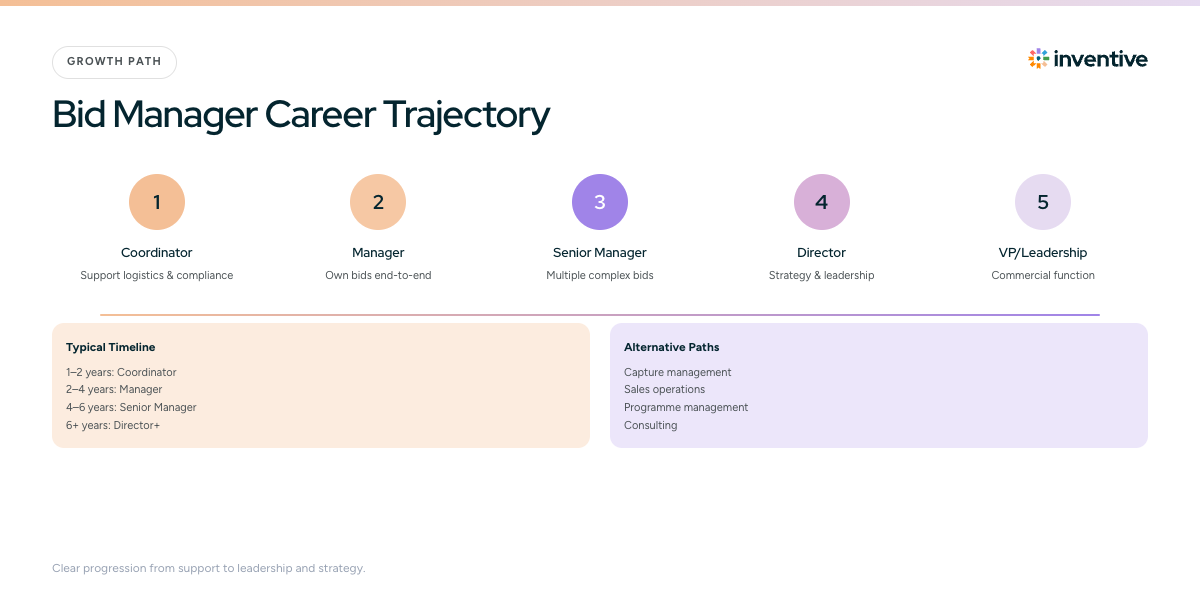
Bid management has a fairly linear vertical track, with progression driven more by bid complexity and demonstrated impact than by years in the seat. Here's what that path typically looks like from coordinator to director-level roles.
A typical vertical path looks like this:
- Bid coordinator or proposal coordinator
- Bid specialist or bid manager
- Senior bid manager
- Head of bid management, bid director or proposal director
- VP or C-level roles overseeing revenue, growth or commercial functions in some organisations
In the UK, heads of bid management earn on average around £22,000 more than bid managers, reflecting the added scope and leadership responsibility.
Some professionals move laterally into capture management, sales operations, programme management or consulting, drawing on their commercial and process expertise.
Progression tracks bid volume, complexity and demonstrable impact on win rates more closely than time served. Someone coordinating dozens of smaller bids may advance faster than someone supporting a few large pursuits.
How much does a bid manager earn?
Bid manager salaries vary significantly by country, seniority and organisation size, with UK, US and Australian benchmarks all landing in different ranges. The figures below reflect 2026 data and should be checked against current local postings.
- United Kingdom
- Average bid manager salary: approximately £48,530.
- Experienced bid managers: £55,000–£70,000.
- Senior bid managers: £65,000–£90,000.
- Heads of bids may earn £90,000–£150,000+.
- United States
- Average bid manager base salary: approximately $76,053.
- Proposal managers average approximately $108,000.
- Experienced proposal managers commonly earn $90,000–$125,000.
- Senior roles may reach $110,000–$160,000+.
- Australia
- Average bid manager salary: approximately A$118,000.
- Typical bid manager range: A$100,000–A$130,000.
- Senior bid managers: A$130,000–A$160,000.
- Major-project and head-of-bids roles may reach A$160,000–A$195,000+.
- India
- Tender or bid executive: approximately ₹3 lakh–₹8 lakh annually.
- Bid manager: approximately ₹8 lakh–₹18 lakh.
- Senior bid manager: approximately ₹15 lakh–₹30 lakh.
- Manager-level bid-management roles may reach ₹18 lakh–₹40 lakh+.
- Contractors and consultants
- Experienced specialists may charge around US$500–US$900+ per day in mature markets.
- Rates depend on industry, contract complexity, location, experience and contract duration.
- APMP certification and international RFP experience may improve earning potential, but do not guarantee a fixed salary premium.
These figures are indicative. Check them against local job postings and salary surveys for the most current data.
Bid manager KPIs
Win rate alone doesn't tell you whether a bid function is actually performing well. Mature bid teams track a broader set of metrics that capture efficiency, selectivity and content quality alongside win rate.
- Win rate. The percentage of submitted bids that result in contract awards, calculated as (bids won ÷ bids submitted) × 100. Mature teams track both volume-based and value-based win rates.
- Bid volume and submission rate. The number of opportunities reviewed, pursued and submitted, which helps assess pipeline activity and resourcing.
- On-time submission rate. The percentage of bids submitted by deadline, a signal of process discipline.
- Bid turnaround time. Average time from opportunity intake to submission, which highlights bottlenecks.
- Bid/no-bid effectiveness. Metrics such as pursue rate (opportunities pursued ÷ opportunities reviewed) show how selective and aligned the team is before committing resources.
- Revenue won and contract value. Tracking the value of won contracts and win rate by contract value shows whether the team is winning the right work, not just more work.
- Proposal quality and compliance. Internal scoring of quality and compliance rates provides leading indicators of future win performance.
- SME turnaround time. How quickly SMEs deliver their sections, which helps identify resourcing or process issues.
- Cost per bid. Estimating internal cost per pursuit supports ROI analysis and bid selection.
- Lessons learned and improvement trends. Tracking implementation of lessons learned, content reuse rates and automation rates shows whether the function is improving over time.
A healthy bid function looks at a balanced set of KPIs to understand both efficiency and effectiveness.
Bid manager tools and software
Bid managers typically work across several categories of tools rather than one all-in-one platform, covering opportunity tracking, content storage and team collaboration. The stack below reflects what most teams piece together as bid volume and complexity grow.
- Bid and proposal management software. Platforms such as Loopio, RFPIO, Responsive and Xait centralise opportunity tracking, task assignment, content libraries, review workflows and submission management.
- RFP and tender management platforms. Tools like mytender.io, Bidhive and sector-specific solutions help track tender opportunities, automate initial drafting and manage compliance matrices.
- CRM systems. Salesforce, HubSpot and monday CRM log opportunities, track stages, manage stakeholders and align bid activity with the broader sales pipeline.
- Project management tools. Asana, Trello, MS Project and Jira manage bid schedules, dependencies and resourcing where dedicated bid software is not in place.
- Document management and knowledge repositories. SharePoint, Google Drive, Confluence or dedicated knowledge bases store past proposals, case studies and standard content, supporting reuse and version control.
- Collaboration tools. Microsoft Teams, Slack and similar platforms support real-time collaboration and quick clarifications across distributed teams.
- AI-assisted proposal tools. Emerging AI tools help with initial drafting, requirement extraction, content suggestions and compliance checks, though human oversight remains critical for strategy and quality.
- Reporting and analytics. Dashboards within bid platforms or BI tools track win rate, submission timeliness, cost per bid and lessons learned.
The right tool stack depends on bid volume, team size, sector and existing technology. Many teams start with a mix of CRM, document management and PM tools, then adopt dedicated bid software as complexity grows. A growing number are moving toward AI-native platforms such as Inventive, which pull first-pass answers directly from a connected knowledge base and keep content current as it is reused, rather than relying on static libraries alone.
Challenges bid managers face
Bid management is a high-pressure role by nature, with tight deadlines and dependency on people outside the bid manager's direct control. The challenges below are the ones that come up most consistently, along with how experienced bid managers tend to handle them.
- Short deadlines. Compressed writing, review and approval cycles raise the risk of errors. Pre-approved templates, content libraries and fast kick-off processes help.
- Large and complex requirements. Breaking lengthy RFPs into clear task lists, assigning SMEs early, and using compliance checklists reduces missed requirements.
- Unresponsive SMEs. Setting clear expectations early, escalating delays, and drafting content for SME review rather than waiting for blank-page contributions all help.
- Conflicting stakeholder priorities. Aligning sales, delivery, legal and finance around evaluation criteria and win themes, and running focused review sessions, keeps priorities in sync.
- Pricing delays. Early involvement of finance and sales, clear pricing narratives and parallel workstreams manage this.
- Last-minute changes. Version control, clear change logs and disciplined review gates are essential.
- Compliance requirements. Compliance matrices, checklists and dedicated reviews avoid disqualification on technicalities.
- Version control. Central document repositories, clear naming conventions and controlled edit windows reduce confusion across contributors and review cycles.
- High bid volume. Prioritisation frameworks, clear go/no-go discipline and resourcing plans are critical when capacity is stretched.
- Poor historical content. A central, curated content repository with clear ownership and review cycles pays off over time.
- Incomplete information. Clarification questions, assumptions logs and risk registers help manage uncertainty when buyers don't provide complete requirements.
Experienced bid managers accept that some pressure is inherent to the role, but use process, tools and governance to keep it manageable.
Bid management best practices
Strong bid functions rely on a consistent set of practices rather than reacting to each pursuit individually. The practices below cover planning, content, compliance and governance, and work best when applied together rather than in isolation.
- Early bid qualification. Apply a consistent go/no-go framework before committing significant resources, and document the rationale.
- Clear ownership. Assign a single bid manager per pursuit with clear authority to drive the process and make day-to-day decisions.
- Bid calendars. Maintain a forward-looking calendar of key dates across all active bids to see peaks, conflicts and resource constraints.
- Responsibility matrices. Use RACI-style matrices to clarify who is responsible, accountable, consulted and informed for each section and review gate.
- Requirement tracking. Maintain a live compliance matrix mapping each requirement to a response section, owner and status.
- SME deadlines. Set internal SME deadlines ahead of final submission, with buffer built in for late inputs.
- Content reuse. Curate a central content library with approved answers, case studies, bios and certifications, tagged by theme, sector and evaluation criterion.
- Review gates. Implement structured reviews with clear objectives: strategy check, compliance and quality check, and final sign-off.
- Compliance checks. Run dedicated compliance reviews separate from content reviews, focused solely on mandatory requirements and formatting rules.
- Version control. Enforce a single source of truth for the master proposal with controlled edit windows.
- Risk tracking. Maintain a live risk register for each bid, with owners, mitigation actions and escalation paths.
- Post-bid analysis. Conduct structured debriefs for wins and losses, capture lessons learned, and adjust go/no-go criteria based on evidence.
These practices work best when embedded in a consistent bid governance model and supported by the right tools.
Is bid management a good career?
Bid management suits people who enjoy complex, cross-functional work, tight deadlines, and a clear line between effort and revenue outcomes. The role builds transferable skills in project management, stakeholder influence, commercial awareness, and strategic thinking, valued in sales operations, programme management, and consulting. Career paths lead toward senior bid leadership, capture management, or commercial leadership roles, with steady demand across technology, infrastructure, professional services, energy and public sector.
The trade-off: regular pressure around submission deadlines, dependency on busy SMEs, and, at some organisations, an under-invested bid function that leaves the team overworked and under-recognised. People who prefer deep specialist work, low interaction, or predictable routines may find the constant context-switching and stakeholder juggling frustrating.
If you enjoy orchestrating complex deals across functions and are comfortable with pressure and ambiguity, it's a strong career choice.
How Inventive AI helps bid managers win faster
Inventive AI is an AI-powered RFP response, automation, and management platform built to simplify and speed up how teams respond to complex RFPs. It serves bid managers, proposal teams, sales teams, and revenue leaders who need to draft accurate responses quickly and keep content organized without the manual overhead.
Bid managers often ask how Inventive AI solves their day-to-day bid challenges. Here's how:
- Creates drafts up to 10x faster. A proprietary AI system drafts responses far faster than manual writing, giving bid managers a strong starting point to refine instead of a blank page to fill.
- Acts as a single hub for knowledge. Every knowledge source lives in one place. Upload past RFPs, connect Google Drive or SharePoint, and manage Q&A sheets without hunting across separate systems.
- Keeps content current with an AI content manager. It flags outdated or conflicting answers in your knowledge base, so only accurate, up-to-date information makes it into a proposal, cutting down on compliance risk.
- Surfaces win themes to lift conversion. It spots gaps in a draft response and fills them using context pulled from Slack, email, and call notes, so answers reflect what the team actually knows about the deal.
- Extends the team with AI agents. Agents support competitor research, idea generation, and drafting, giving bid managers more coverage without adding headcount.
Teams using Inventive AI have cut RFP response time by up to 90% and improved throughput and win rates by more than 50%, giving bid managers room to handle more bids without sacrificing quality.



.avif)