Bid manager vs proposal manager: what's the difference?
Bid manager vs proposal manager is a common question because the two roles frequently work on the same opportunity and share a lot of the same responsibilities. In some organizations, the titles are used interchangeably. In others, they signal genuinely different scope and ownership.
The difference becomes clearer once you look at scope, ownership, timing, strategy, content, commercial involvement, and stakeholder responsibility. Bid managers often steer the end-to-end pursuit and commercial strategy. Proposal managers often own development and coordination of the written response. That split is not universal. It depends entirely on how the organization structures its bid function.
Key takeaways
- Bid managers and proposal managers often work on the same opportunities but may own different parts of the process depending on organizational structure.
- Bid management tends to be broader and more opportunity-oriented, while proposal management focuses more heavily on developing and coordinating the written response.
- In some organizations, one person handles both roles. In others, bid manager is the broader role and proposal manager focuses on content and compliance.
- The biggest practical differences show up in scope, ownership, timing, commercial involvement, and decision-making authority.
- Overlap is common in planning, SME coordination, deadlines, content, compliance, reviews, and submission, but accountability and strategy ownership often differ.
- Smaller organizations frequently combine the roles. Larger or highly regulated environments often separate them to manage complexity and risk.
- Seniority depends on the organization, reporting structure, and scope rather than the title alone.
What is a bid manager?
A bid manager is the professional responsible for overseeing the end-to-end process of responding to a tender, RFP, or competitive opportunity. Their job is to qualify the opportunity, plan the response, coordinate contributors, manage risk and compliance, and deliver a competitive, on-time submission.
In practice, a bid manager typically owns more of the commercial and strategic dimension of a response than a proposal manager, whose primary accountability is the written document itself.
What is a proposal manager?
A proposal manager is the professional responsible for producing a high-quality, compliant, and persuasive written response to an RFP or tender. They coordinate subject matter experts, writers, designers, and reviewers to deliver a finished proposal document on time and to the required standard.
Proposal managers focus on content planning, writing quality, consistency, compliance with tender requirements, version control, and review cycles. In some organizations, they also manage the full response process under a different title.
Bid manager vs proposal manager: key differences
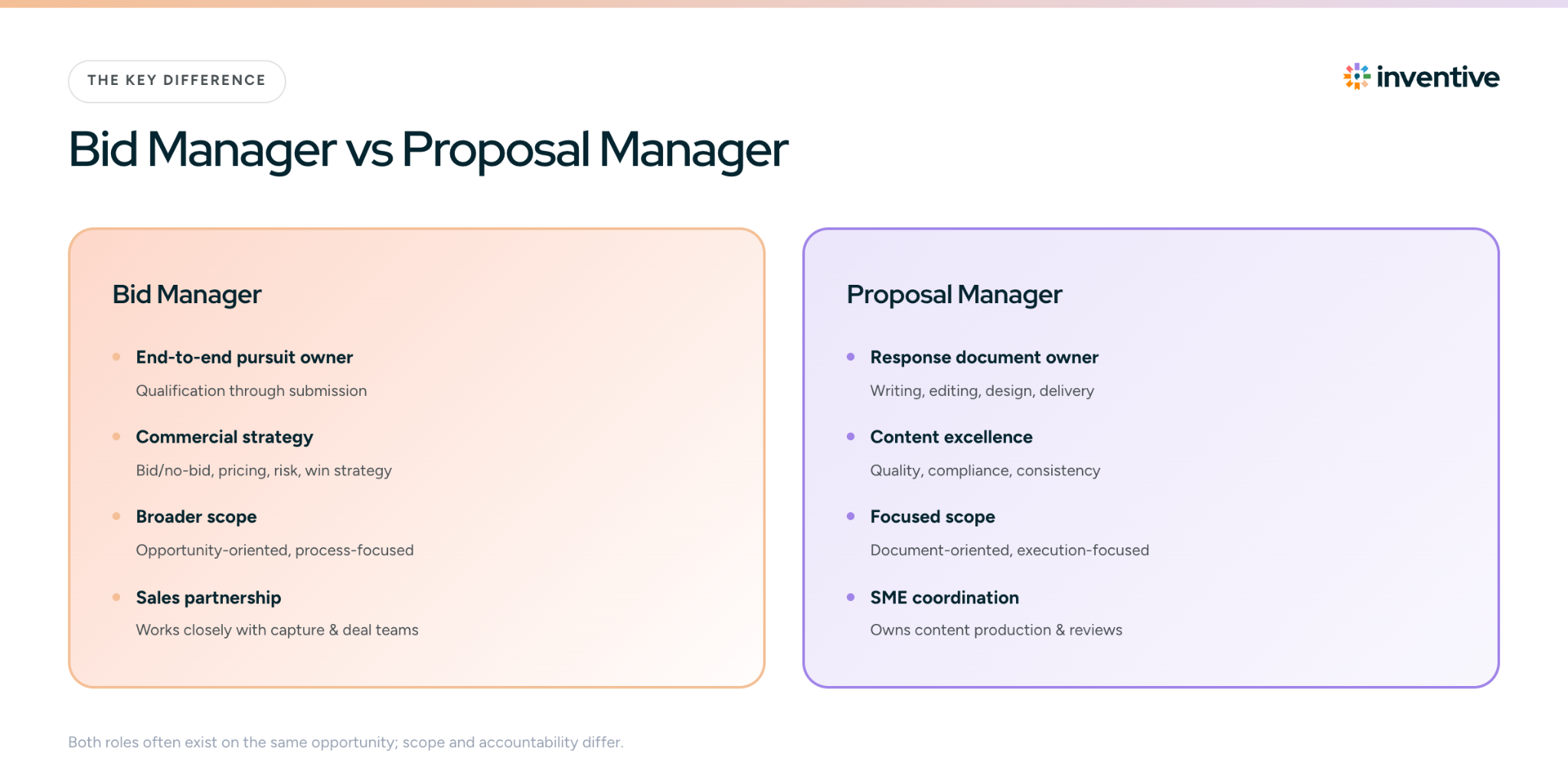
The titles may overlap, but the difference is usually clearer when you compare scope, ownership, and commercial involvement. The table below summarizes typical distinctions seen across organizations and industries.
In organizations that separate the roles, the bid manager typically owns the end-to-end pursuit, including qualification, strategy, pricing, and submission, while the proposal manager owns the document itself: content, structure, design, and deadline.
The biggest difference between a bid manager and a proposal manager
The most important distinction between bid manager and proposal manager is scope and ownership. Bid management tends to be broader and more process and opportunity-oriented. Proposal management tends to focus more heavily on developing and coordinating the actual proposal response.
This is not a universal rule. Some organizations use "bid manager" for the person managing the entire opportunity response. Others use "proposal manager" for the same role. Some organizations have both, with the bid manager coordinating the broader pursuit and the proposal manager owning response development. Many organizations use neither distinction formally.
In government contracting and highly regulated industries, job postings use a range of titles for overlapping responsibilities, including capture manager, pursuit manager, proposal coordinator, RFP manager, and BD manager. This variation reflects different ways of structuring the same underlying work.
The simple conceptual distinction across sources is that a bid manager typically owns more of the commercial and strategic dimension of a response, while a proposal manager's primary accountability is to the written document itself.
Bid manager vs proposal manager across the bid lifecycle
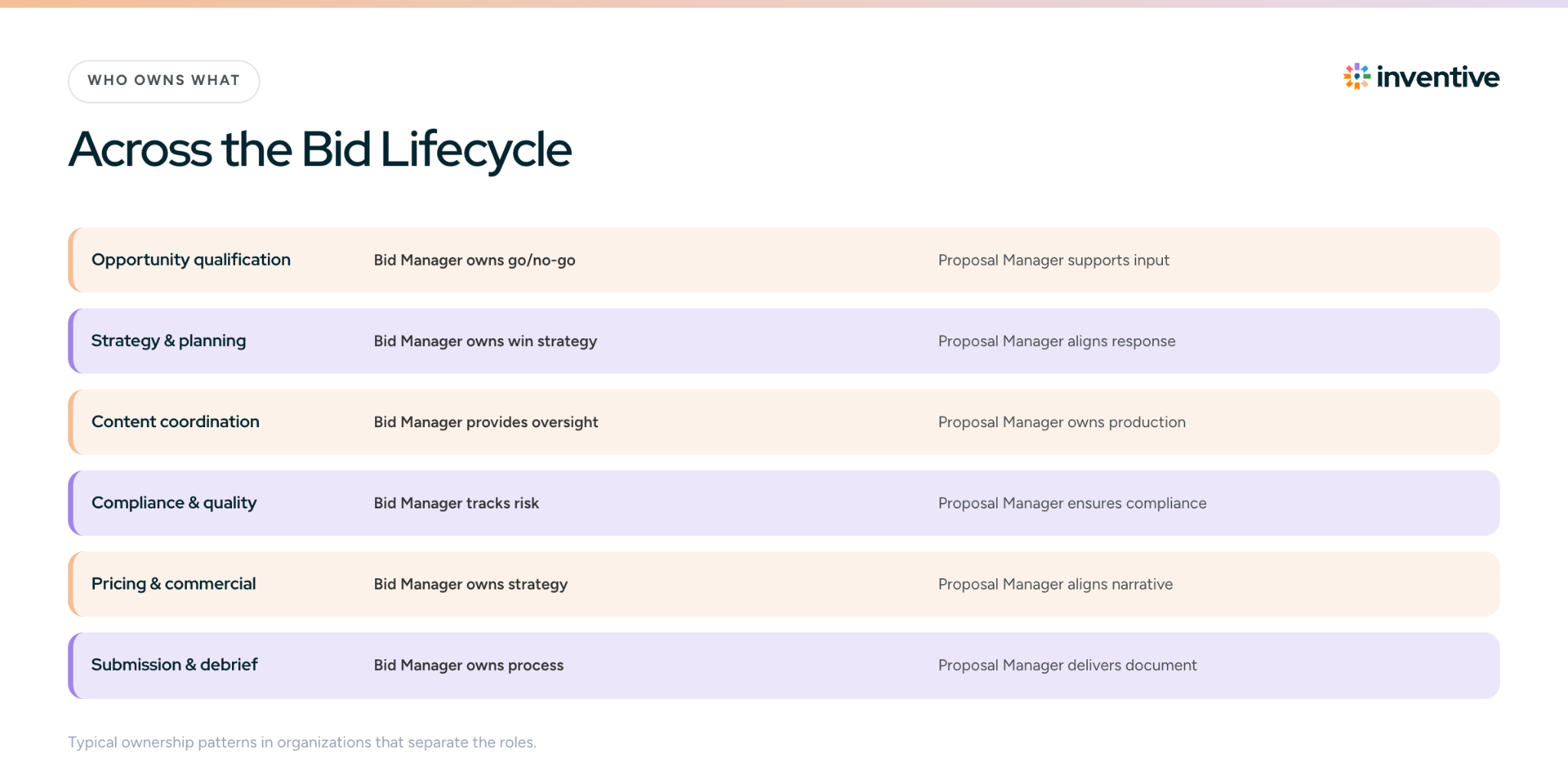
Instead of repeating responsibilities, it is more useful to show who typically owns what at each stage. The table below reflects common patterns, not universal rules. Ownership varies by organization, industry, and deal size.
In large organizations, bid teams are made up of several specialized roles. Capture managers own the opportunity before the RFP is released. Bid managers lead the pursuit from kickoff to submission. Proposal writers draft content. Pricing analysts build cost models. Content managers curate reusable assets. A closer look at how these bid response team roles typically divide work can help you decide what your own structure needs.
Treat these ownership assignments as typical patterns rather than fixed rules. The exact division of work depends on organizational structure, industry norms, and the complexity of the procurement process.
Where do bid managers and proposal managers overlap?
Bid managers and proposal managers are often confused because they work on the same opportunities and share many responsibilities. Overlapping areas commonly include planning, requirement analysis, SME coordination, deadlines, content, compliance, reviews, submission, and stakeholder communication.
Overlap does not mean the roles are identical. The distinction usually comes down to scope, accountability, decision-making, commercial ownership, opportunity strategy, and content ownership. A bid manager may own the bid/no-bid decision and pricing strategy. A proposal manager may own the compliance matrix and final document quality. Both roles care about winning, but they are often accountable for different pieces of the puzzle.
Can one person be both a bid manager and proposal manager?
Yes. In smaller organizations, it is common for a single professional to handle end-to-end bid management and proposal development under whichever title the organization prefers.
Larger organizations may separate the roles to manage complexity, distribute workload, and reduce risk. Factors that determine whether separation is useful include bid volume, deal size, number of stakeholders, regulatory requirements, and the need for specialized skills in strategy, commercials, and content.
In a combined role, the individual typically owns the full lifecycle from opportunity qualification through submission, including bid strategy, content coordination, compliance, pricing input, and final delivery. This "one-person army" model can work well when supported by clear priorities and realistic expectations.
When should companies separate bid manager and proposal manager roles?
Separating bid manager and proposal manager roles can make sense once the operational complexity of the bid function outgrows what one person can effectively own. Common triggers include high bid volume, large enterprise deals, complex procurement, multiple stakeholders, highly regulated industries, large proposal teams, complex commercial models, several concurrent bids, and government or public-sector contracts.
The reasoning is straightforward. Separation lets one role focus on opportunity strategy, commercials, risk, and governance while the other focuses on content quality, compliance, and on-time delivery. This division of labor can improve win rates, reduce burnout, and create clearer accountability across the bid lifecycle.
In government contracting, dedicated bid and proposal leadership is often essential to navigate formal procurement rules, evaluation criteria, and compliance requirements. Separating the roles can help ensure both strategic positioning and document quality get adequate attention.
Bid manager vs proposal manager: which role is more senior?
Neither role is automatically more senior. Seniority depends on the organization, reporting structure, scope, revenue responsibility, team ownership, and decision-making authority.
In some organizations, the bid manager is more senior because they own commercial strategy and the end-to-end pursuit. In others, the proposal manager is more senior because they lead large proposal teams and own high-value submissions. Salary benchmarks show overlapping ranges for both roles, with senior proposal managers earning $140k to $180k or more, and bid managers in the UK earning roughly £55k to £70k, depending on market and scope.
Career progression also varies. Proposal managers may progress from coordinator to writer to manager to senior manager to director. Bid managers may progress from coordinator to manager to head of bids to director of bid management. The title alone does not determine seniority.
Bid manager vs proposal manager: skills overlap and differences
Bid managers and proposal managers share many core skills, including project management, stakeholder management, compliance, and communication. The emphasis differs depending on scope and ownership.
Bid managers typically need stronger commercial awareness and bid strategy skills because they own pricing, risk, and go/no-go decisions. Proposal managers typically need stronger writing, editing, and content management skills because they own the quality and compliance of the written response. Both roles require excellent stakeholder management and compliance discipline.
How AI is changing the bid manager and proposal manager roles
Modern proposal and bid technology is changing how both roles work by reducing manual coordination and repetitive tasks while leaving strategic decisions and high-risk approvals with humans. Key areas of impact include centralized knowledge, content reuse, search and retrieval, workflow management, SME collaboration, approval workflows, compliance checks, AI-assisted drafting, response analysis, and reporting.
For bid managers, technology can centralize opportunity intake, automate compliance checks, track bid pipelines, and provide analytics on win rates and cycle times. For proposal managers, technology can accelerate first-draft generation, enforce style guides, manage version control, and coordinate reviewers and approvers in a single workflow.
A growing number of purpose-built platforms now offer AI capabilities for drafting, compliance automation, and enterprise security, supporting both bid and proposal workflows from the same system. The goal is not to replace either role, but to free both of them from repetitive work so they can focus on strategy, storytelling, and risk management.
How Inventive AI helps bid managers and proposal managers win faster
Whichever title your organization uses, the daily friction tends to look the same: nobody is sure who has the latest version of a section, the compliance matrix lives in a spreadsheet that is a week out of date, and someone is still messaging SMEs for a third reminder. Inventive AI is built to remove that friction regardless of how your bid and proposal work is split.
Here is what changes when both roles work from the same platform:
- Shared knowledge base, one source of truth. Connect Google Drive or SharePoint once, and both the bid manager's strategy documents and the proposal manager's approved content live in the same searchable hub, so nobody rebuilds an answer that already exists.
- A compliance matrix that stays current. Requirements are pulled from the RFP automatically and mapped to response status in real time, so whoever owns compliance, bid manager or proposal manager, works from one live compliance matrix instead of a static spreadsheet.
- First drafts ready before anyone starts writing. Sections are drafted from the connected knowledge base, giving whoever owns the document an edited starting point instead of a blank page.
- SME accountability without the chasing. Outstanding sections and deadlines are tracked automatically, cutting down on the manual follow-ups that eat into both roles' week.
- Visibility across every open pursuit. Dashboards give bid leadership a live view of pipeline, turnaround time, and win rate, useful whether one person owns the full lifecycle or it is split across a team.
Teams using Inventive AI have cut RFP response time by up to 90% and lifted win rates by more than 50%, freeing up bid and proposal managers alike to spend more time on strategy and less on manual coordination.


.avif)