AutogenAI vs Inventive AI (2026): Which AI RFP Tool Fits Your Team?
TL;DR: AutogenAI and Inventive AI both draft responses with AI, but they're built for different jobs. AutogenAI is strong on long-form narrative bids, tenders, and grants, with custom language engines and a GovCon-ready federal offering. Inventive AI is an AI-native RFP and proposal platform that drafts cited answers to RFPs, RFIs, DDQs, and security questionnaires from a company's approved knowledge sources, with unlimited users and go-live in days.
Teams running high-volume Q&A questionnaires and security reviews tend to prefer Inventive AI; teams writing book-length public-sector proposals lean toward AutogenAI.
Disclosure: we're Inventive AI, so yes, we put ourselves in this comparison. We've kept AutogenAI's write-up factual based on neutral and authoritative media, sourced its ratings from G2, and named where it's the better fit. Confirm pricing and features with each vendor before you buy, since both change.
Most proposal teams don't shop for AI software until a bad week forces it. A 180-page RFP lands with a two-week turnaround, the content library has three conflicting answers to the same security question, and two subject matter experts (SMEs) are out. That's the week the AutogenAI vs Inventive AI question actually gets asked: which tool clears the backlog without putting a wrong answer in front of a buyer? This comparison answers that with features, limitations, pricing, and what real users report, so a proposal manager can match the tool to the work instead of the demo.
For a more comprehensive evaluation, read our ranked list on the best RFP software.
AutogenAI vs Inventive AI: what's the core difference?
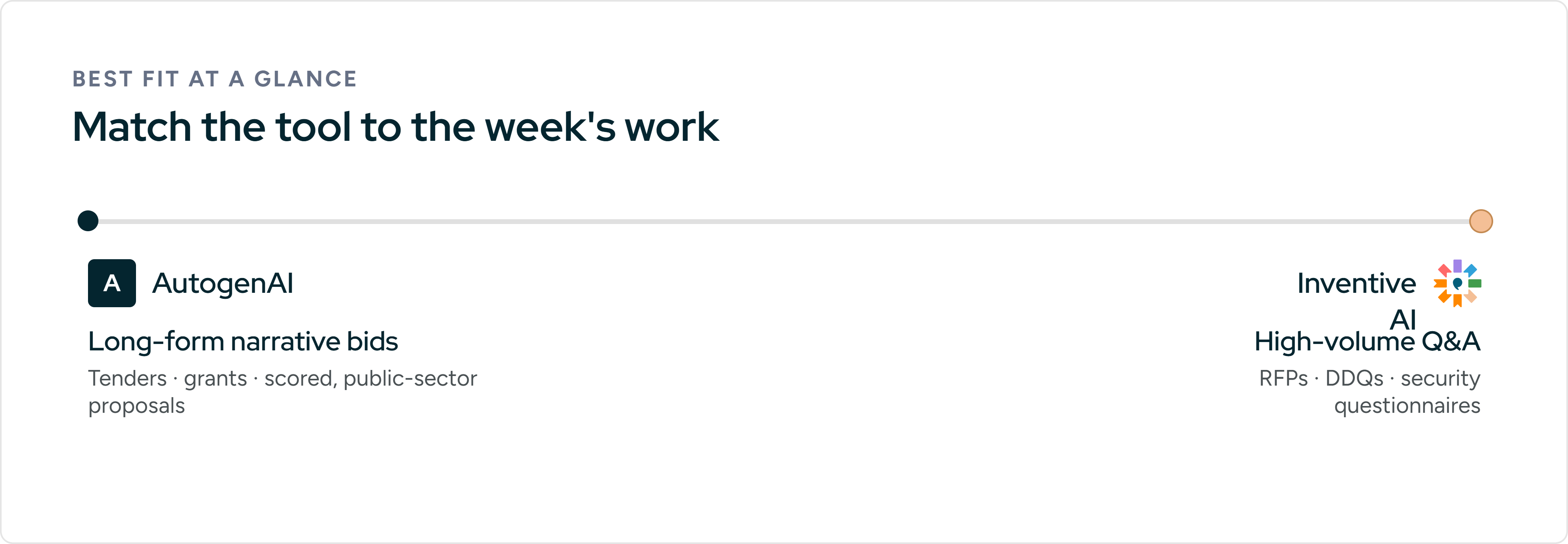
The core difference is what each tool writes from. AutogenAI generates long-form proposal narrative using custom language engines trained on a client's past bids and style. Inventive AI generates answers from a company's connected, approved knowledge sources and attaches inline citations, so every response traces back to a document a reviewer can open.
That shapes everything downstream. AutogenAI is organized around winning themes, section drafts, and evaluator scoring, which suits tenders, grants, and public-sector bids where the deliverable is a persuasive document. Inventive AI is organized around questions and answers at volume, which suits RFPs, due diligence questionnaires (DDQs), and security questionnaires where the deliverable is hundreds of accurate, defensible responses.
Neither approach is "better" in the abstract. The right call depends on whether a team spends its week writing prose or answering questions, and on how much review time a wrong answer can cost.
AutogenAI vs Inventive AI comparison table
Here's the side-by-side on the criteria that decide most AI RFP software deals. Ratings are from G2 as of November 2026; pricing is as publicly reported.
AutogenAI review: features, limitations, and pricing
AutogenAI is an AI proposal-writing software aimed at bid, proposal, tender, and grant teams, headquartered in New York. It takes a team from requirements to a first draft using language engines customized to each client, and it holds a 4.3 out of 5 rating on G2 across roughly 157 verified reviews. (Worth clearing up first: AutogenAI the proposal company is not Microsoft AutoGen, the open-source framework developers use to build AI agents. Same-sounding name, unrelated product.)
Best features:
- Custom language engines: drafts are generated from models tuned to a client's past bids, tone, and terminology, which helps long narrative read on-brand.
- Requirement extraction and compliance matrix: pulls requirements out of a tender and maps them, so nothing in the response schedule gets missed.
- Gamma Review: scores a draft against the evaluation criteria and flags weak sections before submission.
- Go/No-Go and gap analysis: supports the qualification decision early, before a team sinks hours into a bid it can't win.
- GovCon depth: an AutogenAI Federal offering with FedRAMP and IL5 references, plus Microsoft 365 and SharePoint support, fits public-sector and defense workflows.
Limitations:
- Learning curve: reviewers cite onboarding and ramp as a hurdle, with 18 G2 reviews naming the learning curve and 15 noting user difficulty.
- Interface friction: 8 reviews describe the interface as less intuitive than they'd like.
- Q&A is secondary: Excel questionnaires run through Q&A Workbooks, but the platform is built around narrative, so high-volume question-and-answer work isn't the center of gravity.
- Opaque, per-seat pricing: cost is quote-only and reportedly scales per seat, which gets expensive for larger teams and makes budgeting harder.
Pricing: AutogenAI doesn't publish pricing. It's quote-only and reported as per seat, so the real number depends on team size and comes from a sales conversation.
View AutoGen AI pricing ->
What users say: On G2, the loudest praise is time saved (56 reviews) and support quality, with efficiency close behind (55 reviews). The recurring complaint is complexity: the learning curve and occasional platform changes that force retraining. For teams writing long tenders and grants, reviewers generally find the trade-off worth it.
Inventive AI review: features, limitations, and pricing
Inventive AI is an AI-native RFP and proposal platform that drafts cited answers to RFPs, RFIs, DDQs, and security questionnaires from a company's approved knowledge sources. Agents handle intake, drafting, and conflict flagging, people approve, and every plan includes unlimited users. It holds a 5.0 out of 5 rating on G2 across 26 reviews.
Best features:
- Governed, cited answers: Inventive AI drafts each answer from connected knowledge sources with inline citations and confidence scores, and flags when information is unavailable instead of inventing a response. That matters most on security questionnaires, where one wrong answer becomes a contract liability.
- Long RFPs handled whole: Inventive AI reads a 200-page PDF in full rather than in fragments, and Excel questionnaire answers export straight back into the original file.
- AI Content Manager: flags conflicting and outdated content and routes reminders to content owners, so the library stays current without a quarterly cleanup project.
- Go/No-Go agent: maps requirement coverage as fully met, partially met, not met, or unknown, so the qualification call rests on evidence.
- The whole team in one place: SME assignment, comments, and review status live in one workflow, which cuts the email chasing that stretches a deadline.
Limitations:
- Narrative-heavy public tenders: teams whose work is mostly book-length persuasive prose for government tenders may find a narrative-first tool like AutogenAI closer to that specific job.
- Smaller review base: Inventive AI is newer, so its 91 G2 reviews are fewer than long-established vendors, even at a 4.9 average.
- Memory is in beta: the Memory capability that reuses prior context is still labeled beta.
Pricing: Inventive AI’s pricing is transparent and starts from $830 per month, billed annually, with unlimited users. Because seats aren't metered, cost doesn't climb as a proposal team grows.
What users say: Customers report concrete outcomes. Insider cut response time by about 90% and lifted win rate from 30% to 50%, and RadAI reports roughly 2x more usable responses. On G2, reviewers score Inventive AI highly on ease of use, which speaks to the days-not-months onboarding.
Which tool should a proposal team choose?
Choose by the shape of the work, not the demo. The two tools win different weeks.
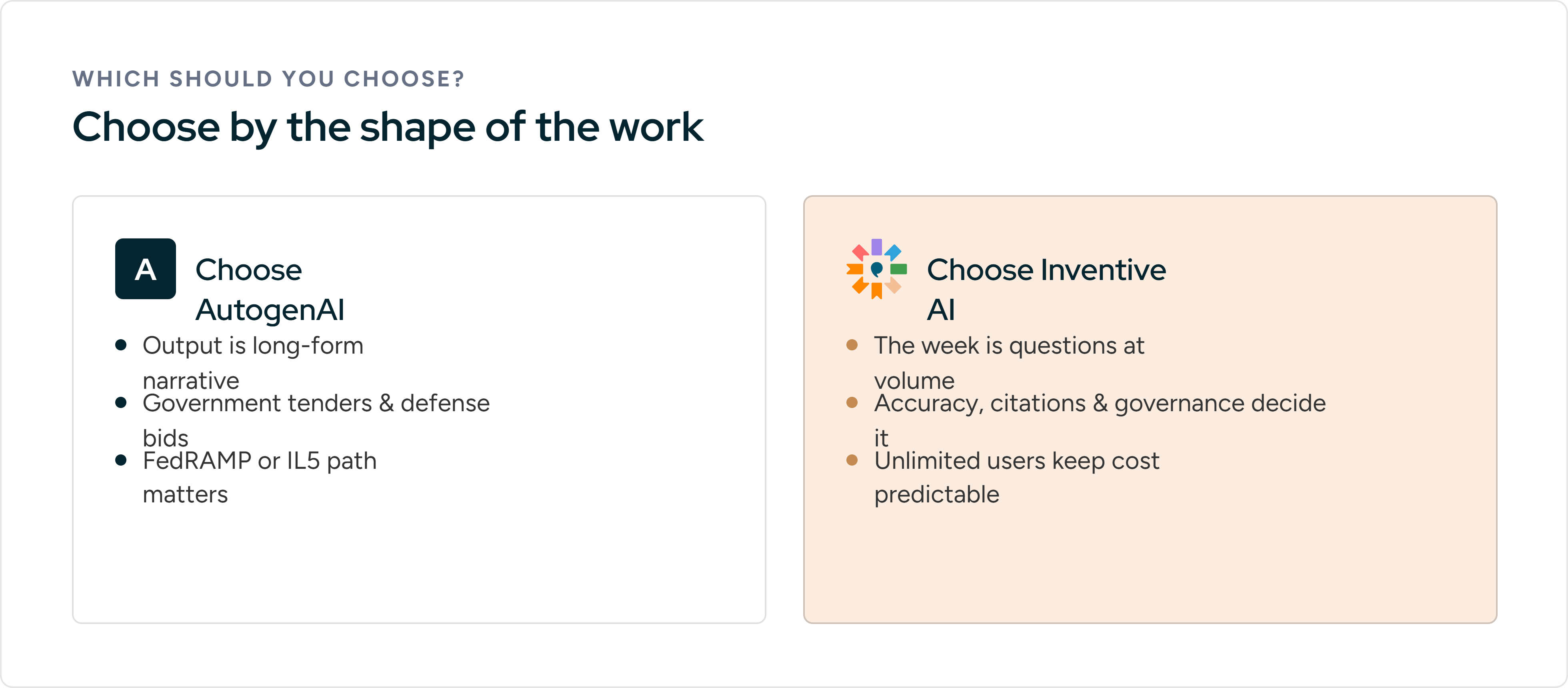
Choose AutogenAI if the team's output is long-form narrative: public-sector tenders, grants, and defense bids where a FedRAMP or IL5 path matters and the deliverable is a persuasive, evaluator-scored document. AutogenAI's custom language engines and Gamma Review are built for that.
Choose Inventive AI if the team's week is questions at volume: RFPs, DDQs, and security questionnaires where accuracy, citations, and library governance decide the outcome, and where unlimited users and fast onboarding keep cost predictable. As an AutogenAI alternative, Inventive AI fits teams that care less about writing prose and more about answering hundreds of questions without a wrong one slipping through.
Book a demo with Inventive AI ->
Plenty of teams do both kinds of work. In that case, the test is which job dominates the calendar and which job carries the most risk when an answer is wrong.