RFP Template for ERP Software Selection: Industry-Specific Examples

ERP RFPs cannot be built using boilerplate templates. Buyers reuse static formats, but ERP requirements vary across process flows, integrations, and reporting structures, making those templates unusable for structured evaluation.
Vendors receive these mixed-format RFPs and respond based on their own interpretation. Some map requirements line by line, while others submit narrative documents or attachments, creating inconsistent response structures.
This blog provides ERP RFP templates for businesses running ERP procurement, along with structured vendor response templates, so requirements and answers align in a single evaluation sheet.
RFP Templates for ERP Use Cases to Structure Industry-Specific Requirements
ERP requirements are defined by industry processes, not by a standard template. Financial controls, operational workflows, and system dependencies vary, so the RFP structure must align with how the business operates.
Below are the most common ERP RFP use case templates you may need, each structured in XLS format to define requirements and capture vendor responses consistently.
1. RFP Template for Multi-Entity ERP
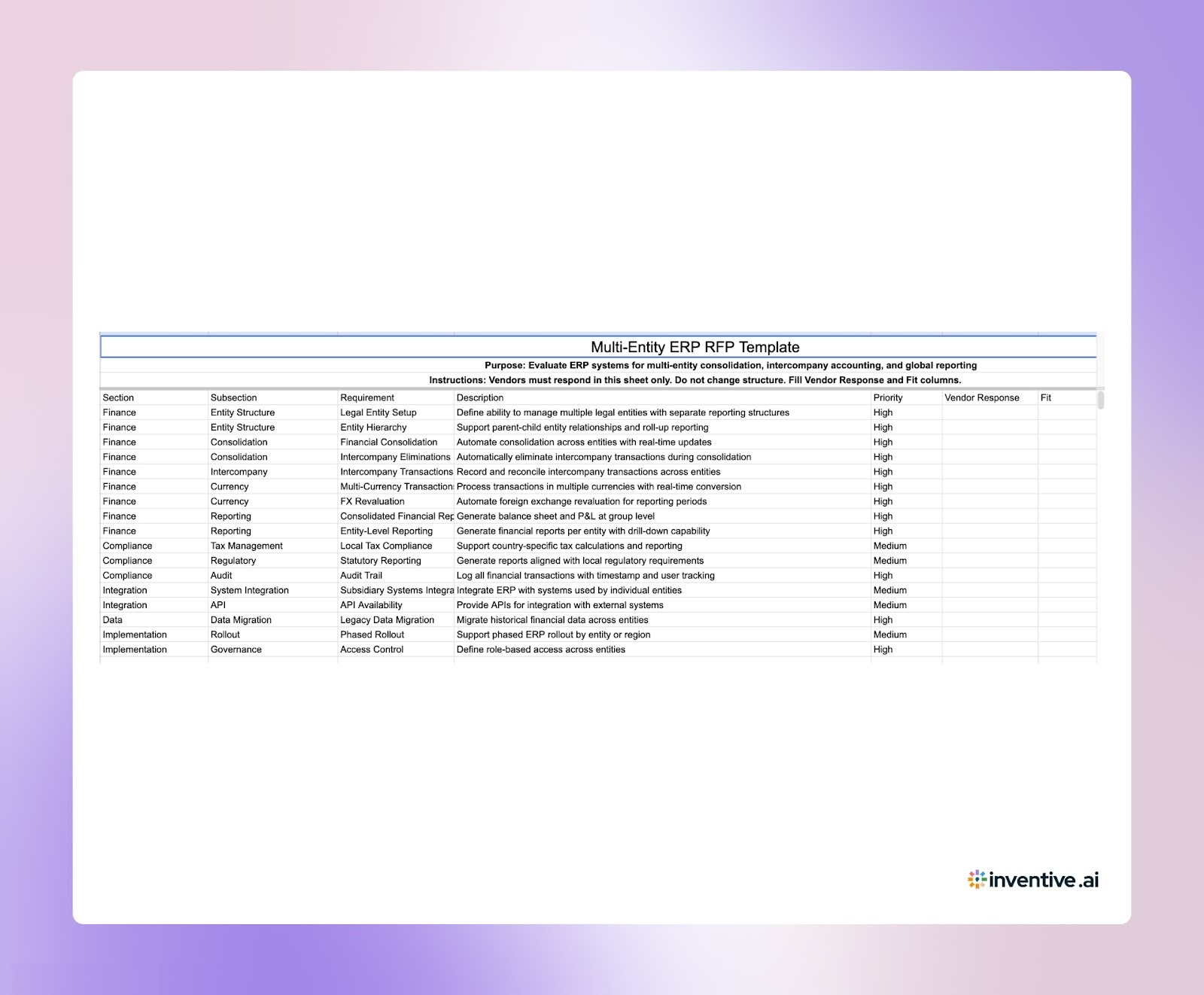
Organizations managing multiple entities must define intercompany workflows, currency handling, and consolidation rules at the requirement level.
This template structures financial and reporting requirements so vendors can map consolidation capabilities without interpretation gaps.

2. RFP Template for Manufacturing ERP
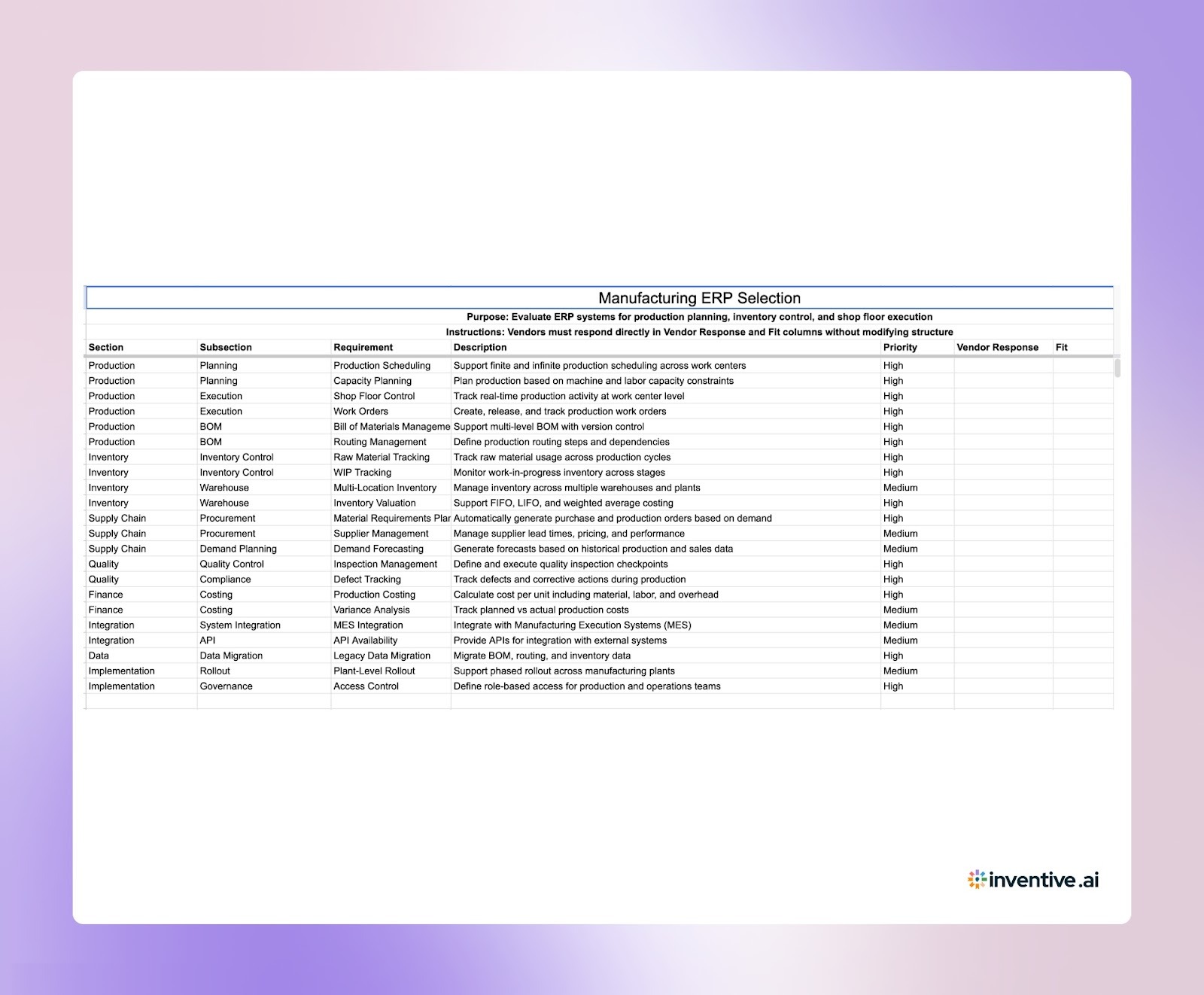
Manufacturing environments require alignment between production planning, inventory movement, and cost tracking.
This template defines bill of materials, scheduling logic, and warehouse processes in a format that vendors can respond to line by line.

3. RFP Template for Service-Based ERP
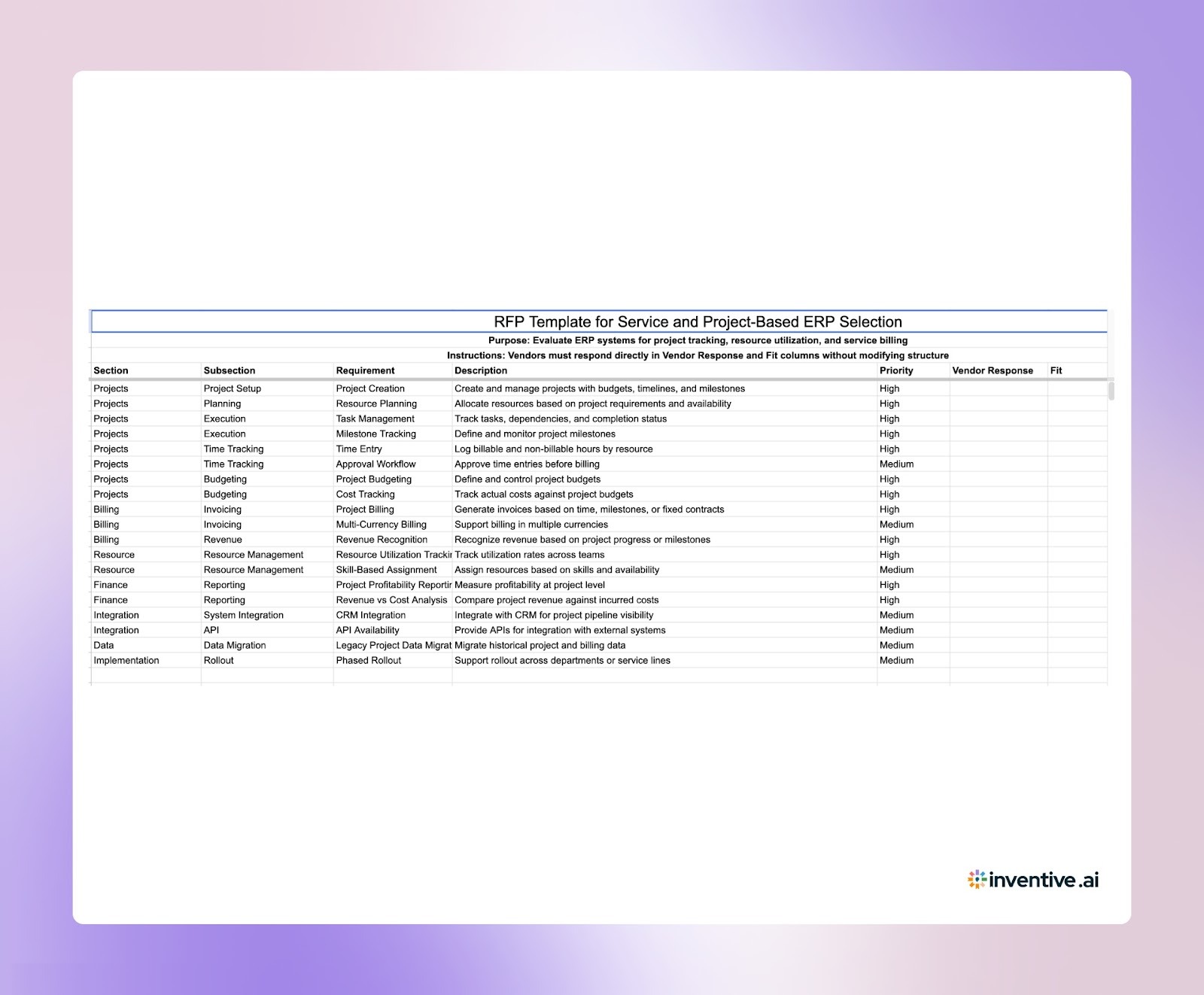
Service organizations depend on accurate project accounting, time tracking, and revenue recognition.
This template captures project workflows and billing structures so vendors can demonstrate how their system supports service delivery models.

4. RFP Template for High-Growth ERP
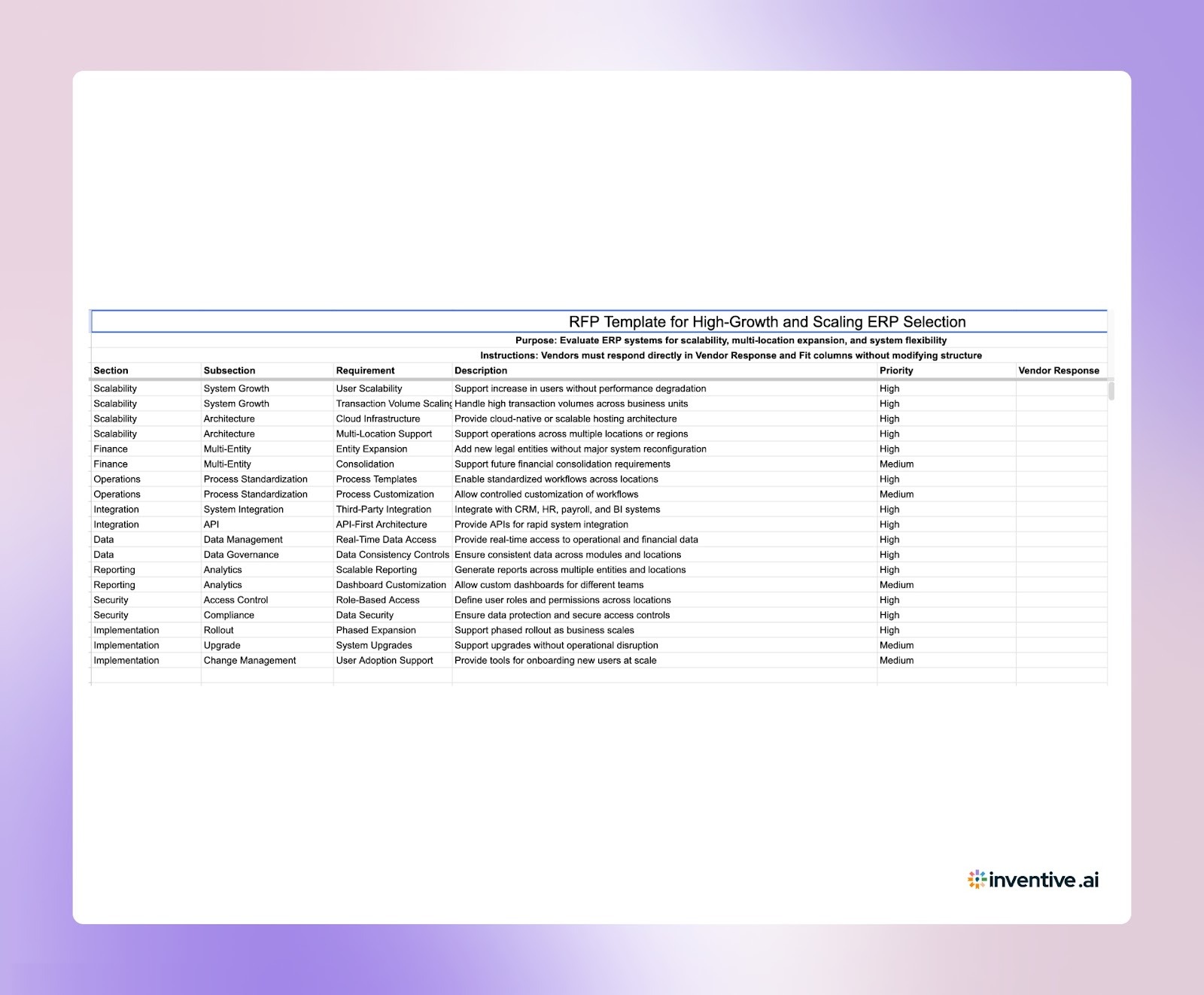
Rapidly scaling companies must validate whether ERP systems can support expansion without restructuring core processes.
This template focuses on modular architecture, integration flexibility, and multi-location scalability requirements.

5. RFP Template for Compliance-Driven ERP
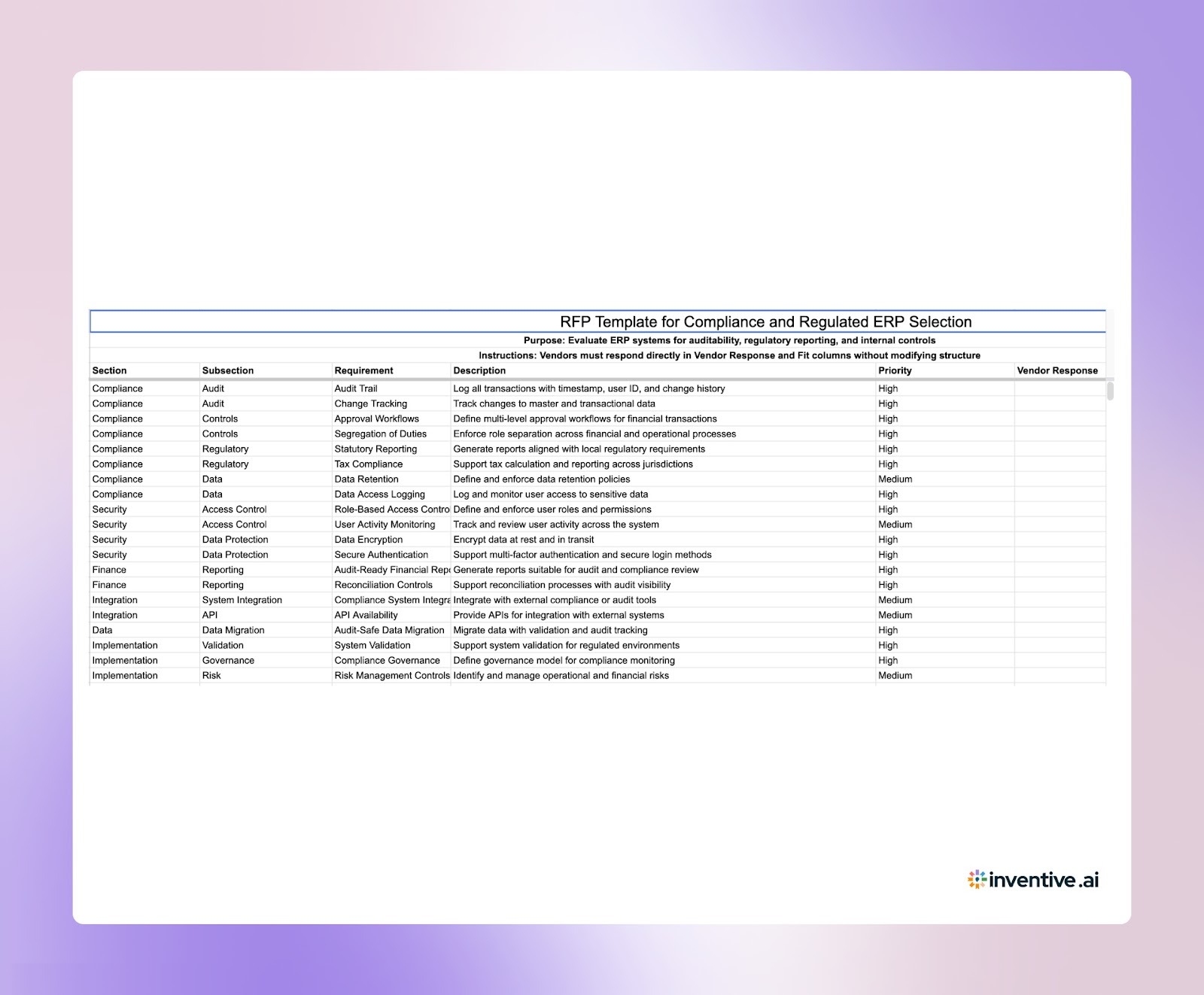
Regulated industries must validate access controls, audit trails, and reporting accuracy during the RFP stage.
This template structures compliance requirements so vendors can clearly map governance capabilities to each control point.

If you are responding to an ERP RFP, use the structured template below to align directly with buyer requirements and avoid misinterpretation.
ERP Proposal Response Template to Match Buyer Evaluation Structure
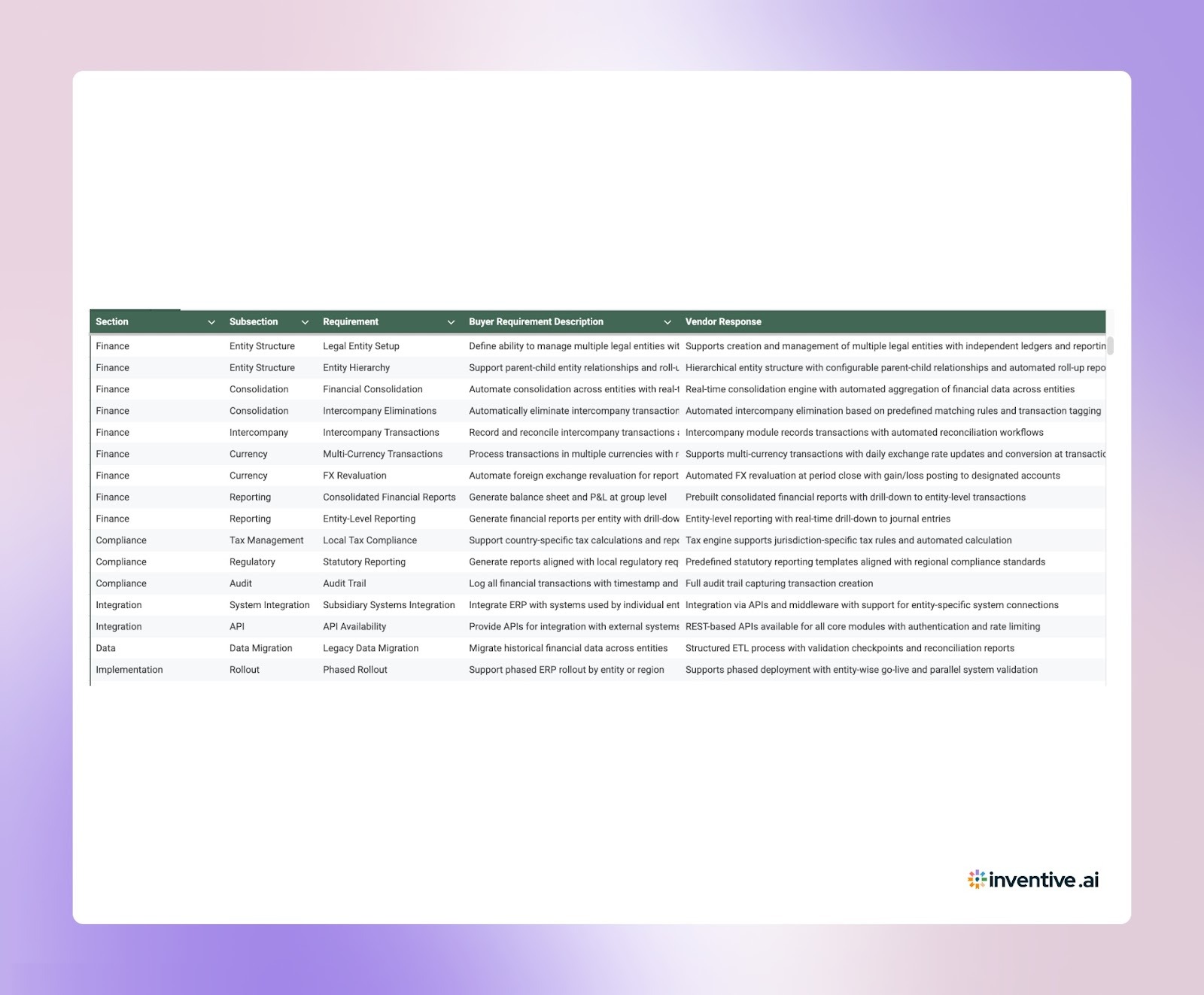
ERP proposals must align line-by-line with buyer requirements. When vendors submit narrative documents, buyers must reinterpret answers before evaluation. This creates gaps between stated capability and actual fit during comparison.
This template structures vendor responses so each requirement is answered directly, allowing buyers to evaluate without restructuring submissions.

1. Executive Summary
The executive summary positions the ERP against the buyer’s operating model, scale, and constraints. It should reflect how the system fits the buyer’s process complexity rather than listing product features.
Example: “Our ERP supports multi-entity consolidation, automated intercompany accounting, and real-time reporting for manufacturing groups operating across three regions.”
2. Requirement Mapping
Responses sit directly against each requirement in the buyer sheet. Each row reflects capability, configuration level, or gap without shifting format into separate documents.
Example:
Requirement: Intercompany Eliminations
Response: Automated elimination during consolidation with configurable rules
Fit: Standard
3. Functional Coverage
Functional detail reflects how workflows execute across finance, operations, and reporting. Buyers assess whether processes run end-to-end, not whether features exist in isolation.
Example: “The production module links BOM, routing, and inventory, ensuring material availability before work order release.”
4. Technical Architecture
Architecture description reflects system structure, deployment model, and integration readiness. Buyers assess whether the ERP fits into existing systems without redesign.
Example: “Cloud-native architecture hosted on AWS with API-first design, enabling direct integration with CRM and reporting systems.”
5. Implementation Approach
Implementation detail reflects execution structure, sequencing, and ownership across phases. Buyers evaluate delivery risk based on how clearly rollout is defined.
Example: “Four-phase rollout including discovery, configuration, controlled data migration, and plant-level go-live with validation checkpoints.”
6. Integration Framework
Integration detail reflects how the ERP connects with surrounding systems such as CRM, payroll, and BI. Gaps here create operational workarounds post-implementation.
Example: “Prebuilt connectors for Salesforce and REST APIs supporting real-time synchronization with external systems.”
7. Data Migration Strategy
Migration detail reflects how legacy data moves into the ERP with validation and reconciliation. Data errors at this stage impact financial reporting immediately after go-live.
Example: “Staged migration with reconciliation checkpoints and parallel runs before production cutover.”
8. Risk Mitigation
Risk handling reflects awareness of common ERP failures such as scope drift, data issues, and adoption gaps. Buyers look for structured control, not reactive fixes.
Example: “Dedicated change management lead monitors adoption and resolves workflow gaps during rollout.”
9. Client References
References reflect execution capability in similar operational environments. Buyers validate whether the vendor has delivered at a comparable scale and complexity.
Example: “Implemented ERP for a multi-entity manufacturing group with five plants, including consolidation and production planning modules.”
Scale ERP RFP Submissions With Inventive AI Without Manual Rework
ERP vendors responding to RFPs must map requirements across finance, operations, integration, and compliance. These responses are usually assembled from past proposals, spreadsheets, and internal documentation. This slows response cycles and introduces inconsistencies across sections.
Inventive AI solves this problem with AI-powered RFP response software designed for vendors. Instead of assembling answers manually, teams generate structured, context-aware ERP RFP responses aligned with buyer templates. The result is 95% accurate drafts, 0% hallucinations, and response cycles that are up to 10× faster.
Here are Inventive AI’s key capabilities that improve ERP RFP responses.
1. Context Engine
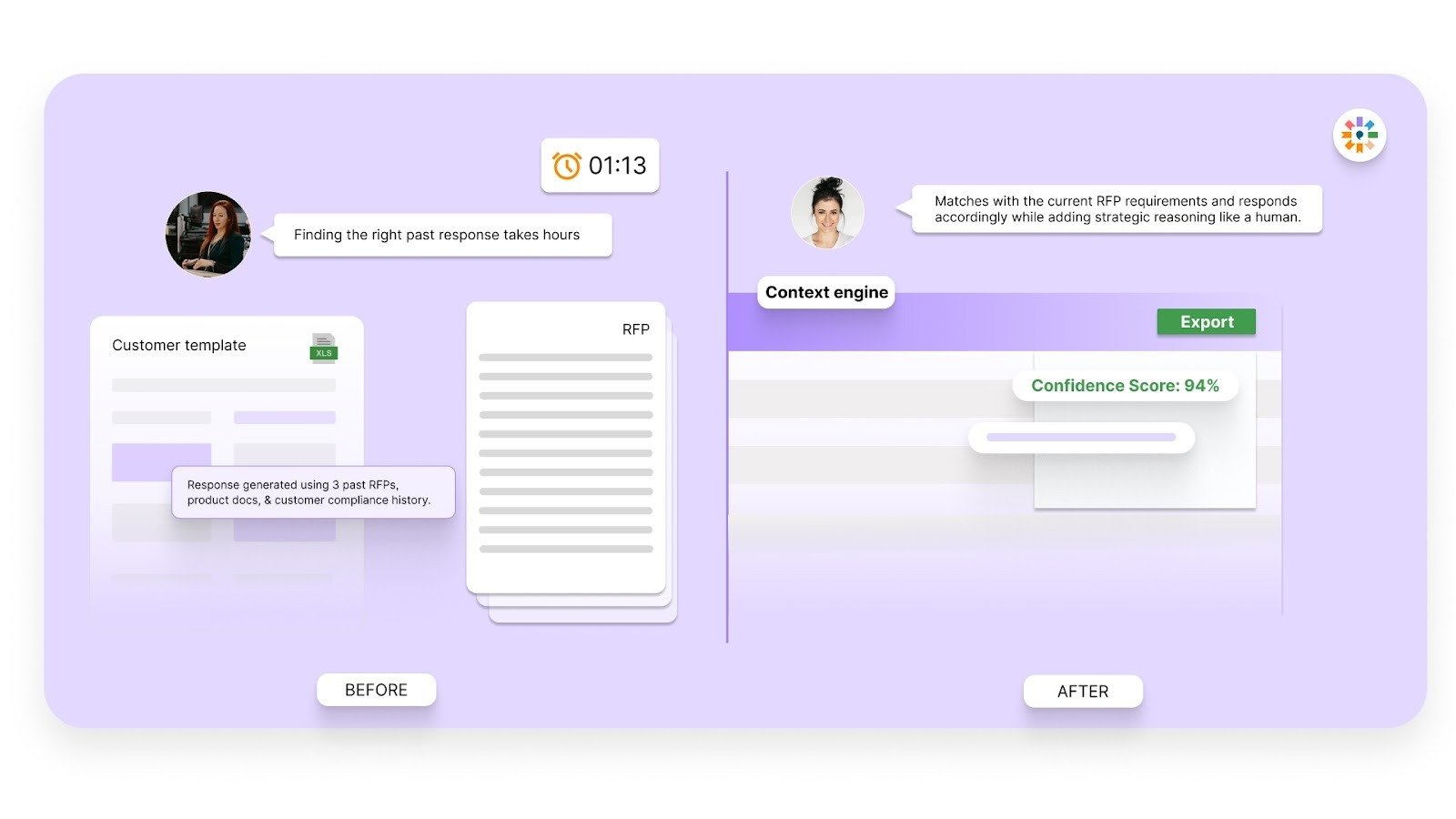
Most tools rely on keyword retrieval that produces generic ERP answers. Inventive AI analyzes the full RFP, including industry, use case, and requirement structure.
This allows responses to align directly with buyer requirements instead of generic ERP capability descriptions.
2. Conflict Detection
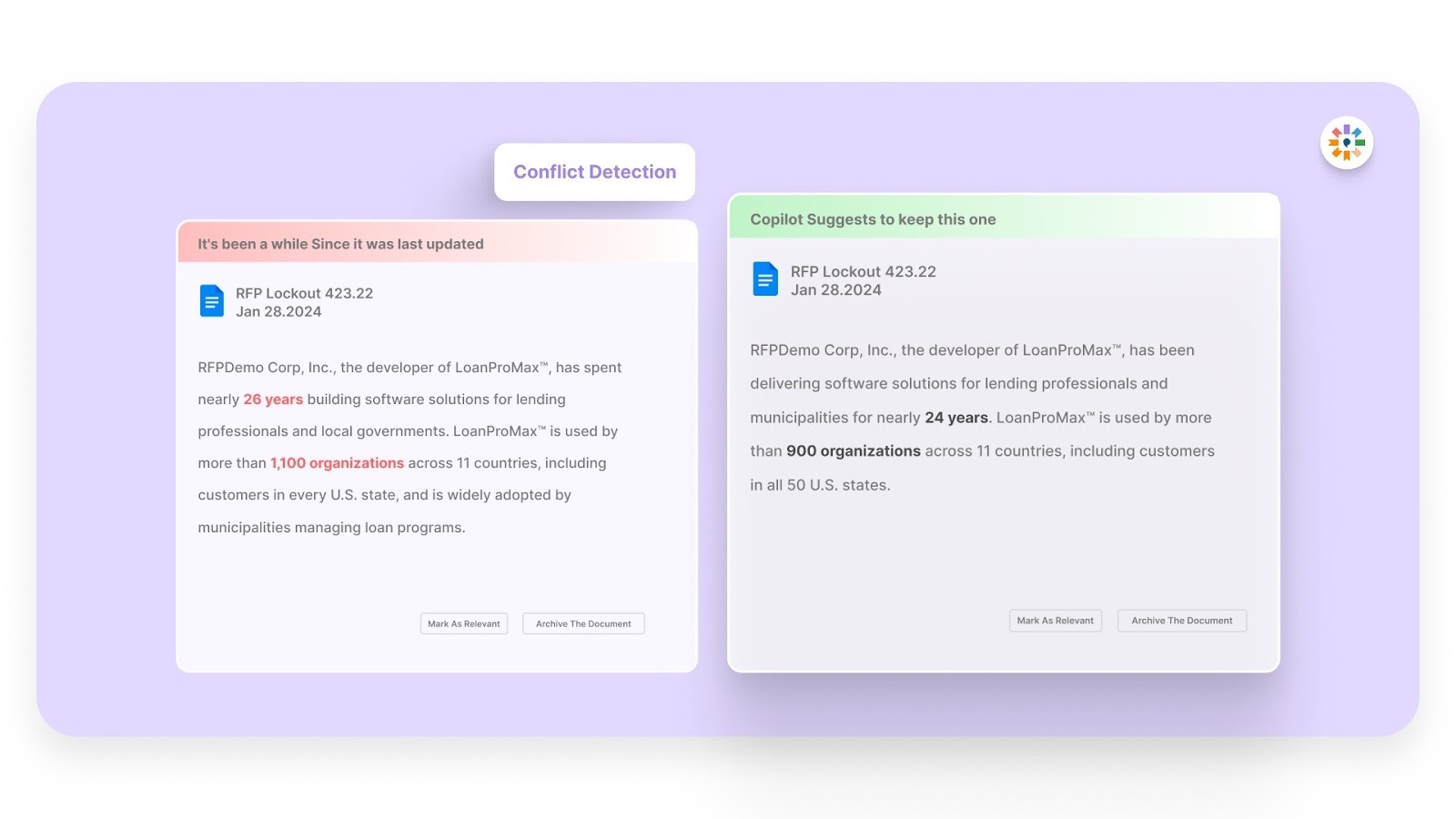
ERP RFPs often include overlapping requirements across finance, integration, and reporting sections. Manual responses can introduce conflicting statements across these areas.
Inventive AI identifies contradictions before submission, ensuring consistency across the entire response.
3. Outdated Content Detection
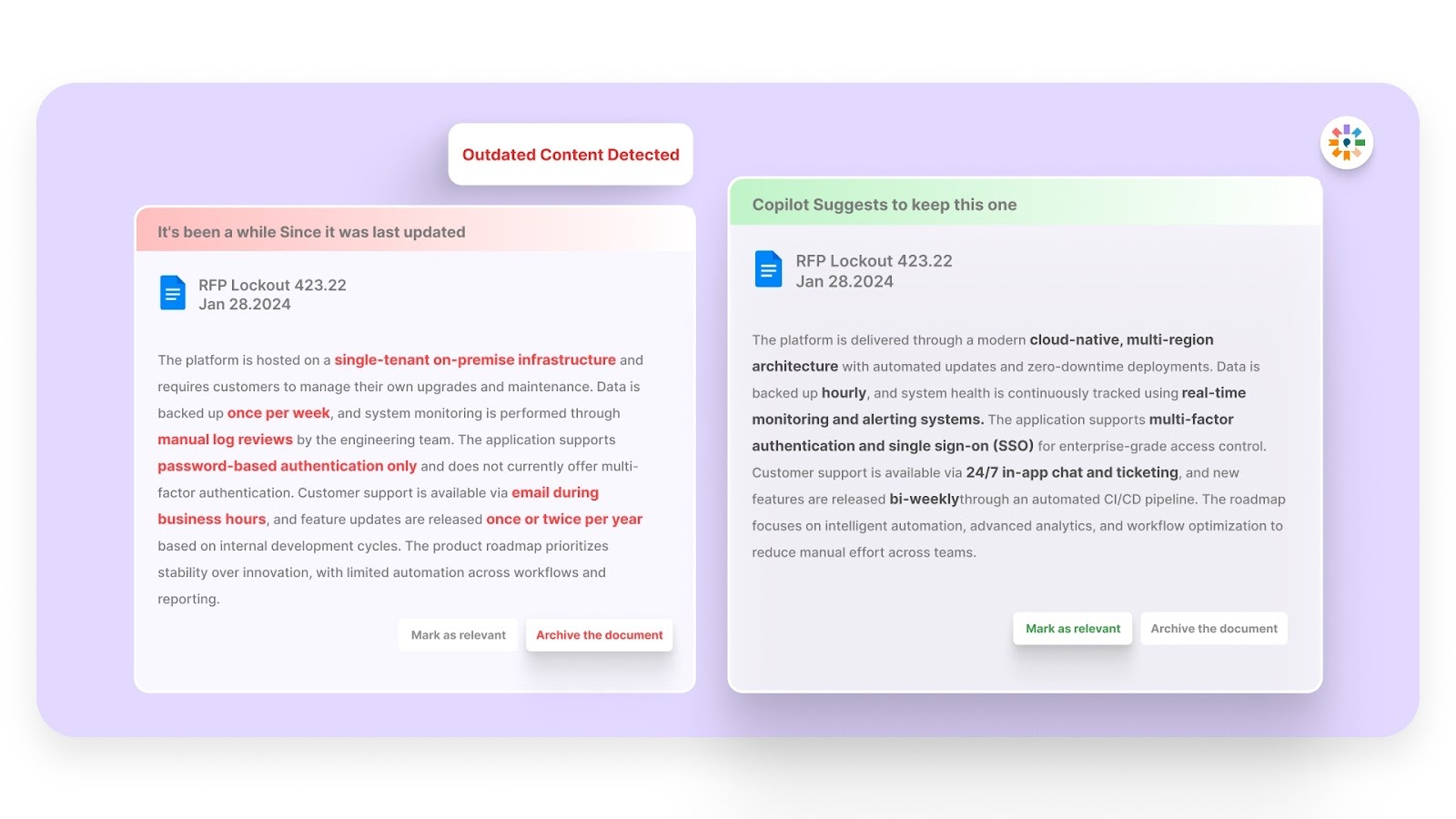
ERP response libraries often contain outdated product information or legacy module references. These errors reduce credibility during evaluation.
Inventive AI flags outdated content before it appears in the response, ensuring accuracy and consistency.
4. Higher Quality Responses
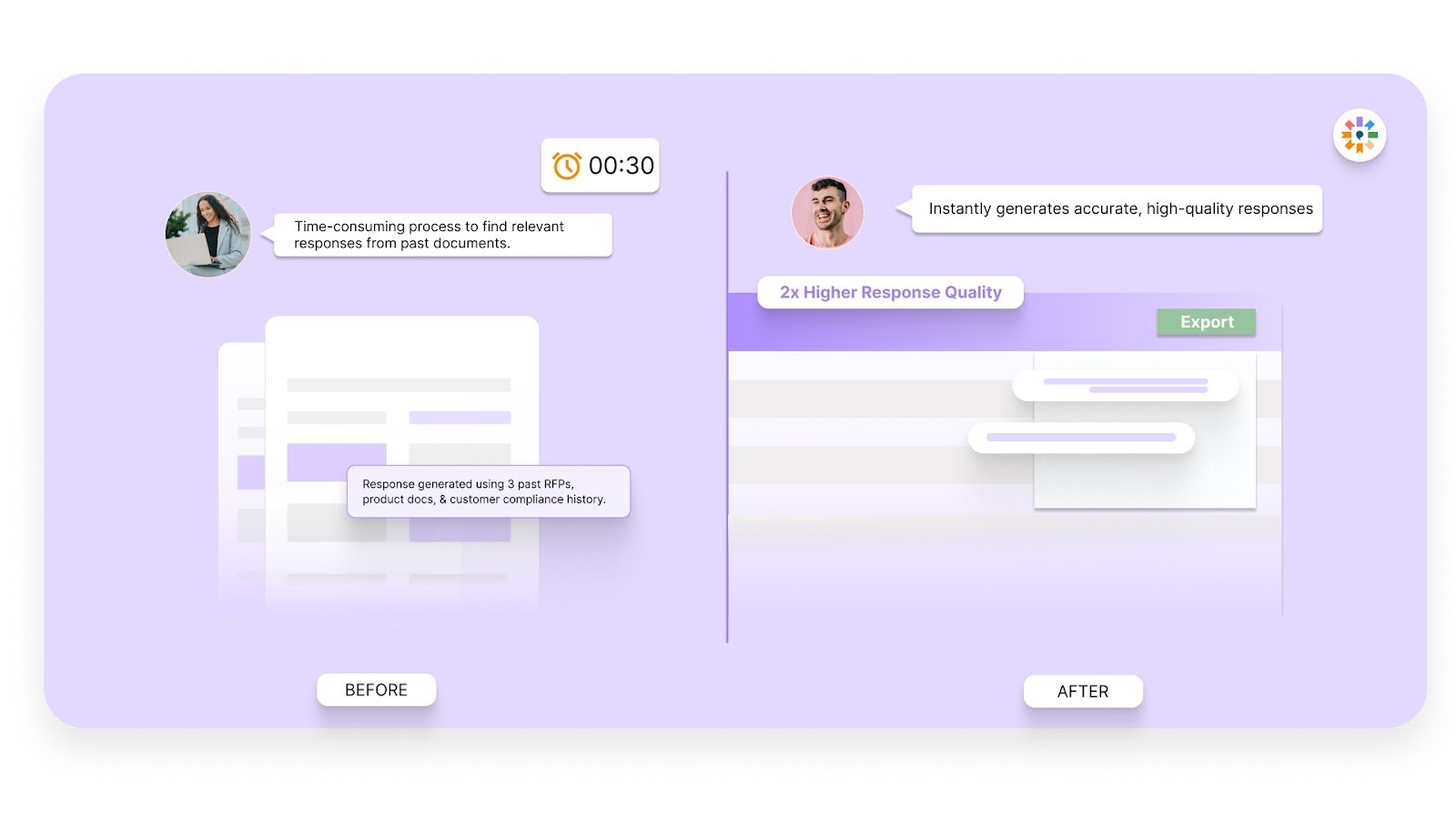
ERP responses often vary in depth across sections when created manually. Some requirements receive detailed answers, while others remain incomplete.
Inventive AI generates complete, structured responses across all requirements, improving consistency and coverage during evaluation.
5. Simple and Easy-to-Use Interface
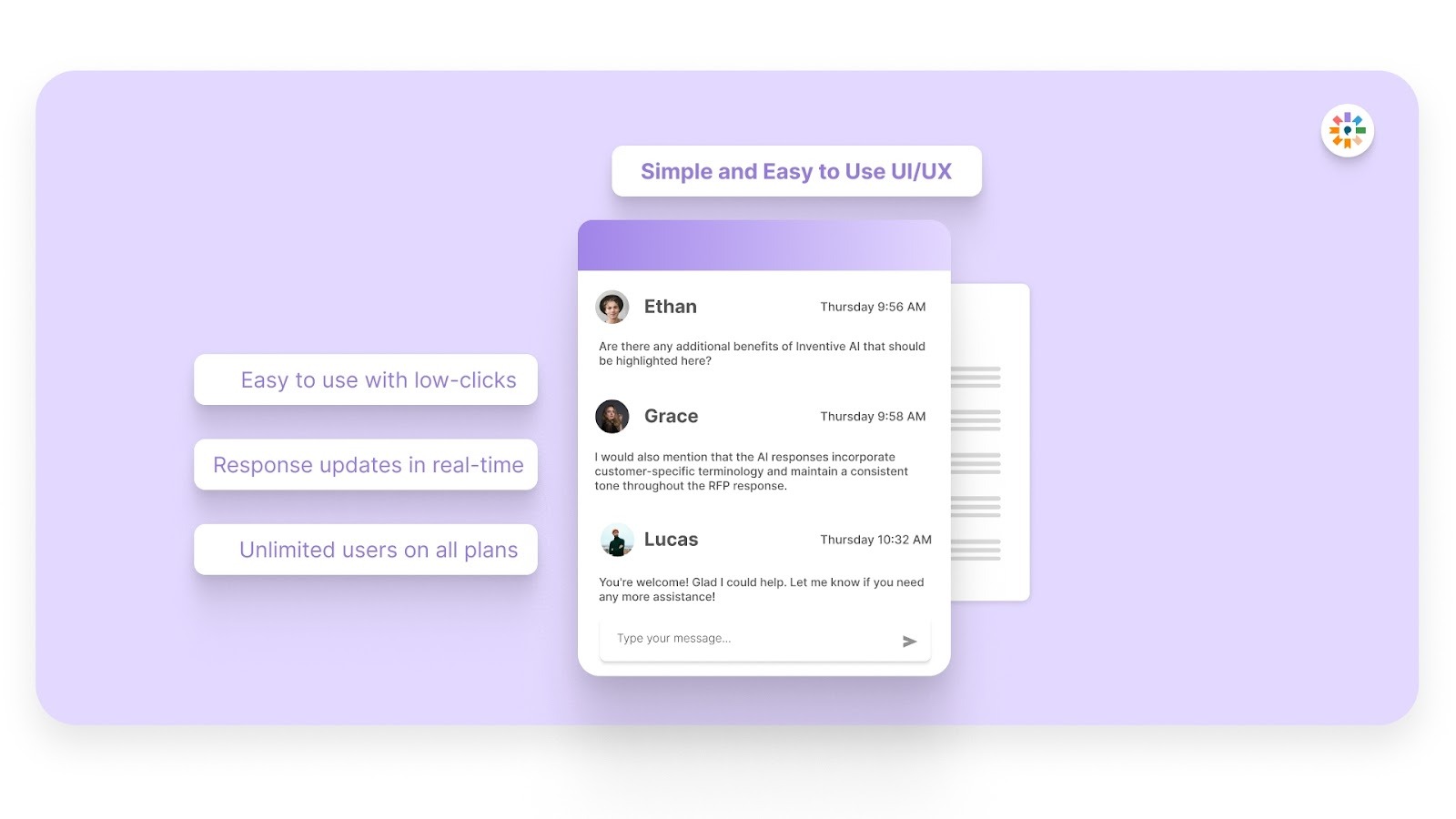
ERP response teams operate under tight deadlines while coordinating across sales, product, and delivery teams.
Inventive AI provides a simple interface that allows teams to generate structured responses without complex setup or workflow delays.
6. Narrative Proposal Generation
ERP RFPs require both structured spreadsheets and narrative documents such as executive summaries and technical overviews.
Inventive AI generates narrative responses that align with requirement-level answers, preventing mismatches between sections.
FAQs About RFP Templates for ERP Software Selection
1. What factors should influence the decision beyond feature lists?
Consider system flexibility, scalability, support availability, vendor stability, and alignment with long-term business goals to ensure the ERP supports growth and operational resilience.
2. What common mistakes occur when responding to ERP RFPs?
Frequent errors include submitting narrative-only documents, mismatched response formats, incomplete functional coverage, and missing integration or compliance details.
3. Should historical data and legacy systems be addressed in the RFP?
Yes, detailing legacy systems, data formats, and migration needs allows vendors to plan for seamless data transfer and integration during ERP implementation.
4. How should companies handle confidential information in ERP RFPs?
Include clear confidentiality clauses and limit sensitive data sharing to pre-qualified vendors to protect financials, operational plans, and proprietary processes.
5. How important is multi-language or localization support in an ERP RFP?
For global or multi-region operations, specifying language and localization requirements ensures users across locations can work effectively without workflow friction.

.avif)

.png)
.jpg)