ERP RFI Template: Industry-Specific Examples (For Buyers and Vendors)
.png)
Drafting an ERP RFI template sounds straightforward until stakeholders start adding conflicting requirements. Finance asks for reporting depth, IT pushes for architectural clarity, and operations focuses on workflow coverage. What begins as a simple document quickly turns fragmented and difficult to manage.
Without structure, an ERP RFI template creates more confusion than clarity. Vendors interpret questions differently, responses arrive inconsistently, and side-by-side comparison becomes time-consuming.
To streamline your ERP software RFI process at this early stage, this blog provides structured buyer and vendor ERP RFI templates and outlines industry-specific RFI types based on different evaluation needs.
ERP RFI Template For Buyers: Structure Your Evaluation With Clarity
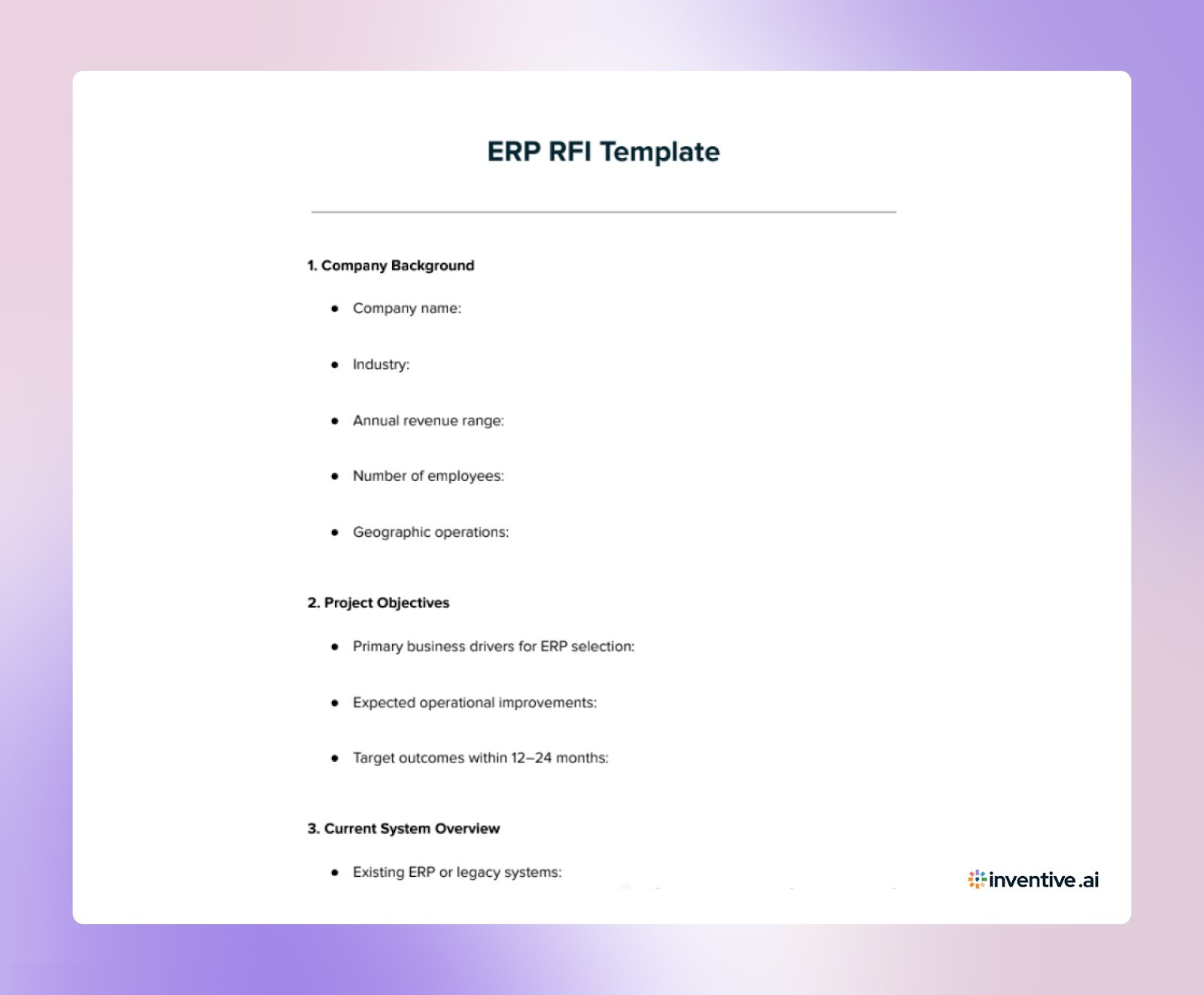
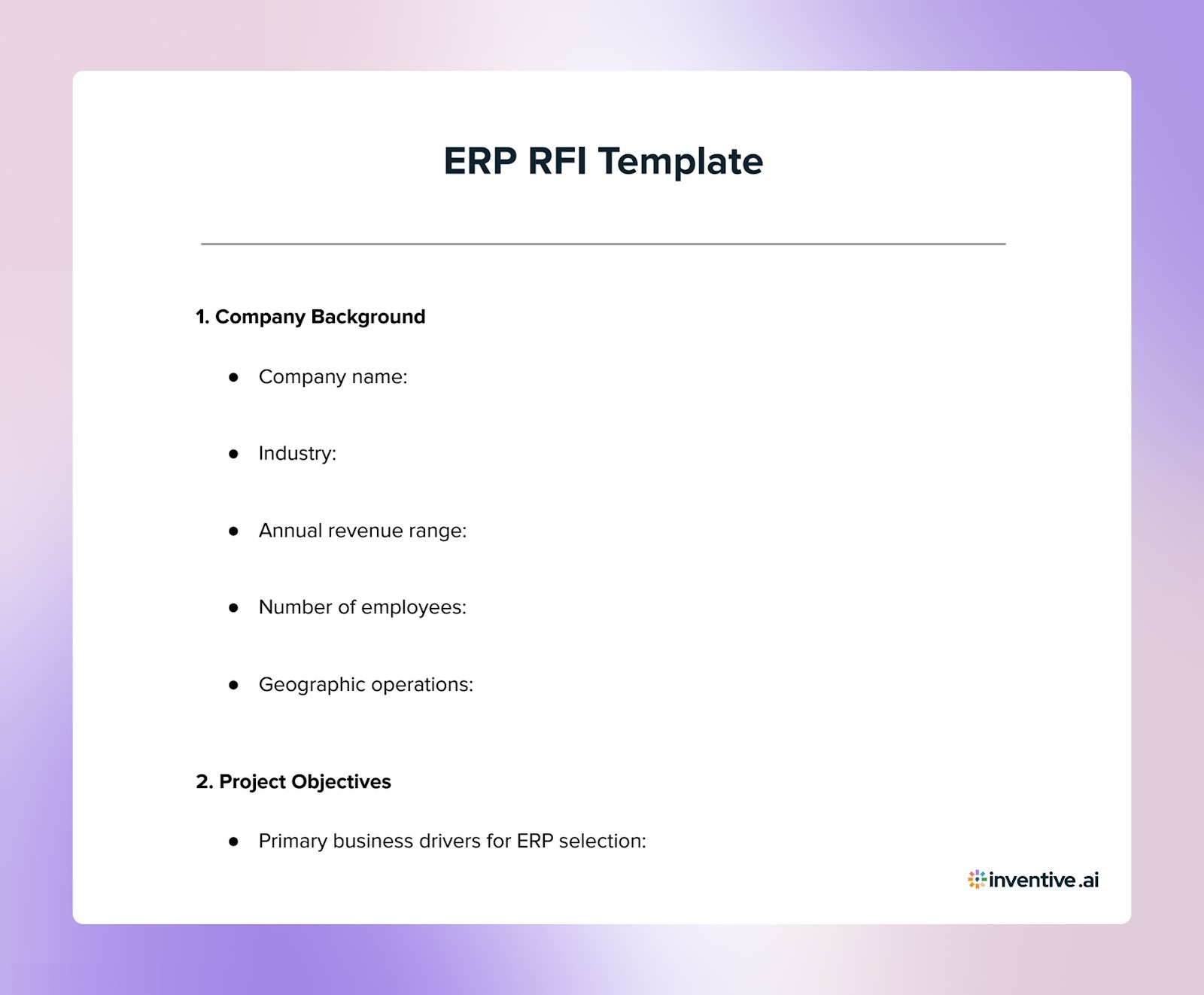
If you are issuing an RFI for ERP software in your business, customization is critical. Every organization has different operational models, regulatory requirements, and growth plans. Below is a standard ERP RFI template structure you can adapt to your business context.

Standard sections in an ERP RFI:
- Company Background: Provide a brief overview of your organization, industry, size, and geographic presence.
- Project Objectives: Clearly state what you expect the ERP system to achieve operationally and strategically.
- Current System Overview: Describe existing systems, limitations, and integration challenges.
- Functional Requirements: List required modules and key process workflows across departments.
- Technical Requirements: Specify deployment preferences, architecture expectations, and infrastructure constraints.
- Data Migration Requirements: Outline legacy data sources, volumes, and data quality considerations.
- Integration Requirements: Identify critical third-party systems requiring real-time or batch integration.
- Security and Compliance Overview: Define required certifications, data controls, and access management standards.
- Implementation Timeline: Share expected milestones, go-live targets, and internal resource availability.
- Vendor Qualification Questions: Request relevant industry experience, client references, and details on the implementation methodology.
5 Industry-Specific ERP RFI Template to Accelerate ERP Shortlist
ERP evaluation criteria vary by industry. Regulatory exposure, transaction complexity, operational scale, and financial reporting requirements shape what must be validated before advancing vendors to the RFP stage.
Below are five ERP RFI template types structured around the critical risks and operational requirements that must be confirmed early in the selection process.
1. SaaS And Technology ERP RFI Template
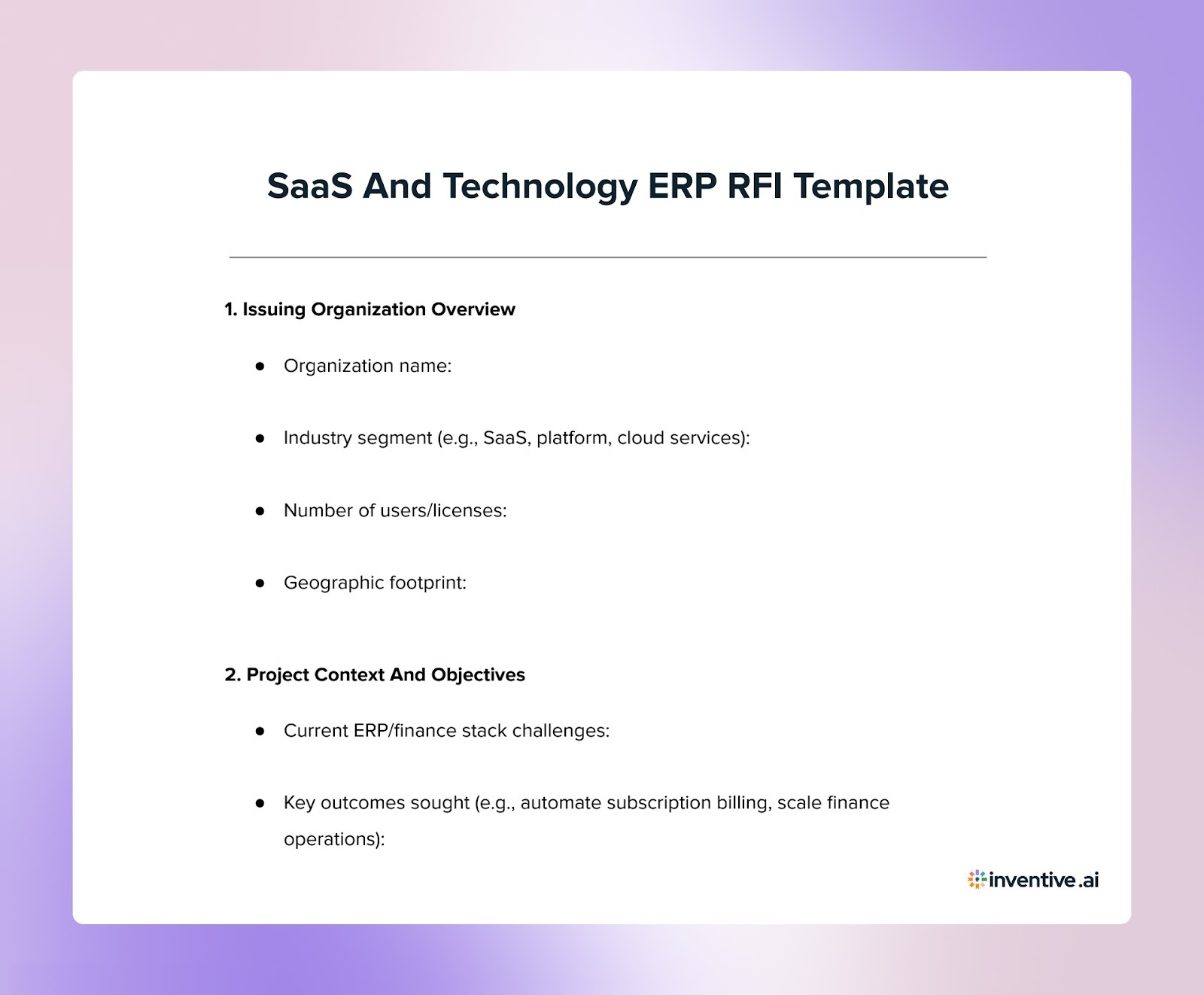
SaaS and technology organizations prioritize revenue accuracy, scalability, and integration flexibility. Subscription complexity and global expansion introduce accounting and reporting risks that require early validation.
This ERP RFI template helps technology companies determine whether an ERP platform can sustain recurring revenue models and multi-entity growth without financial control gaps.

2. Healthcare ERP RFI Template
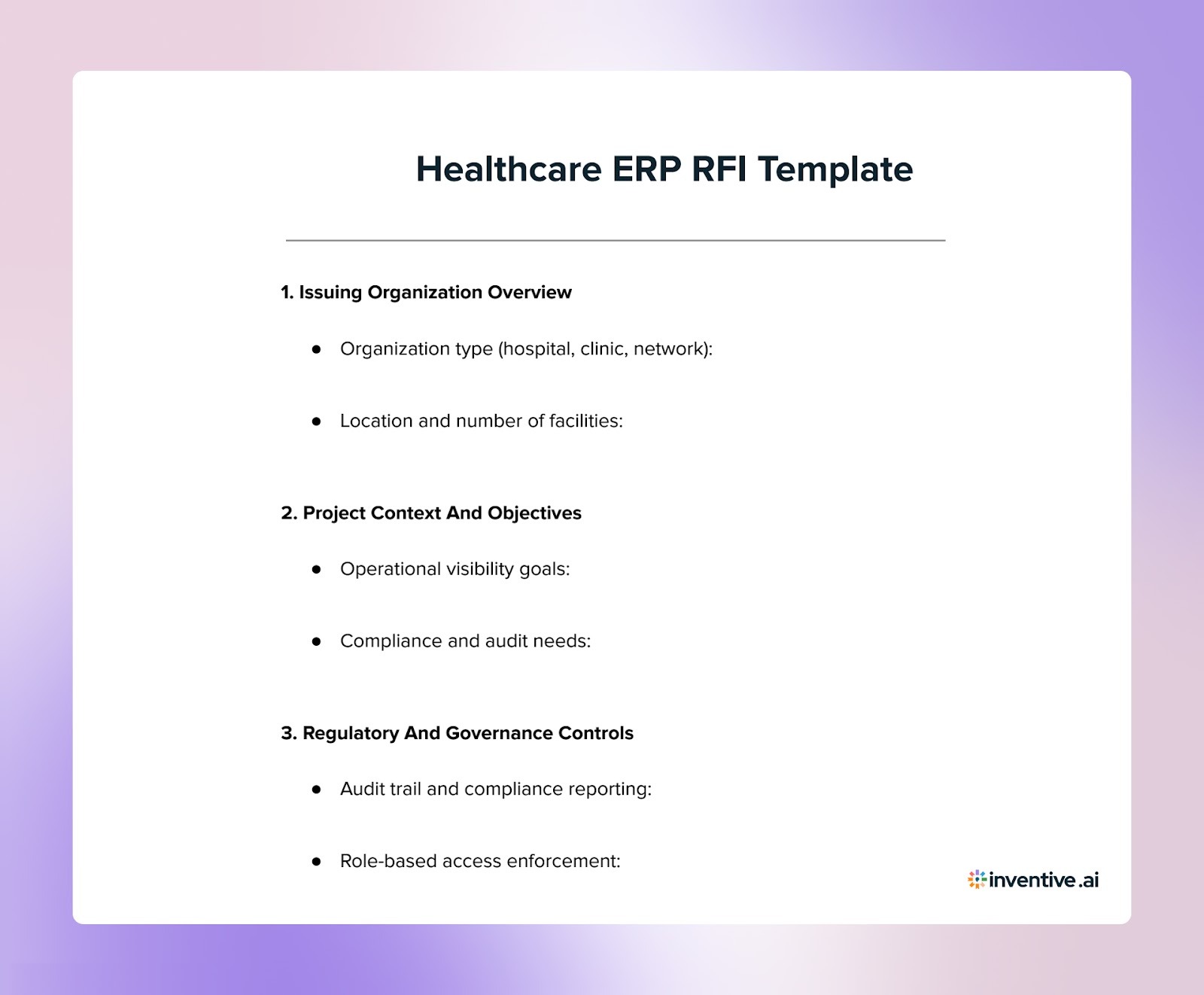
Healthcare organizations operate under regulatory scrutiny and require financial and procurement traceability. ERP limitations can introduce audit exposure and operational blind spots.
This template validates governance structures, access controls, and reporting transparency before narrowing the vendor list.

3. Financial Services ERP RFI Template
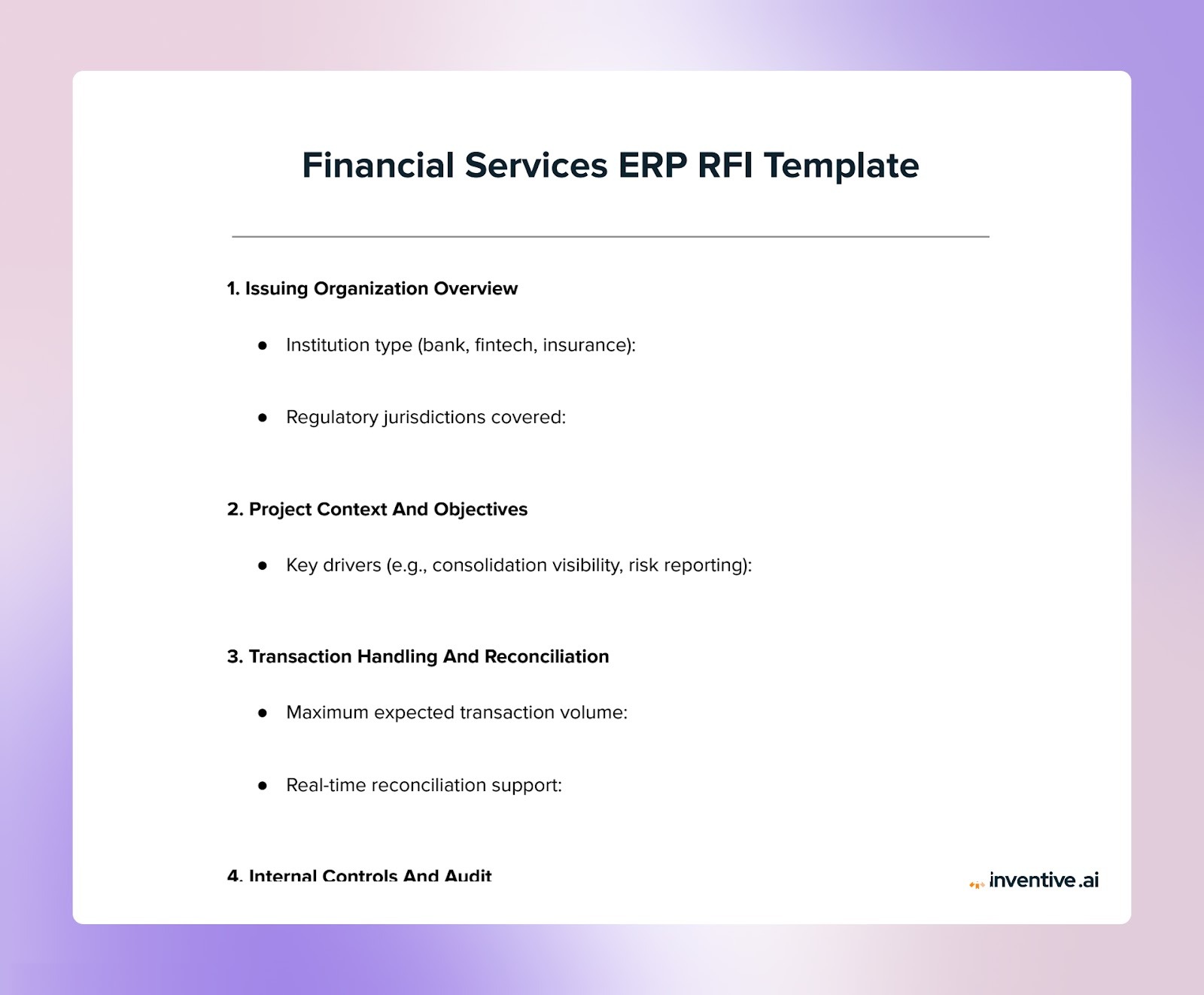
Financial institutions assess ERP platforms through a transaction integrity and governance lens. High-volume activity demands strong internal controls and secure access oversight.
This template confirms operational control maturity before moving into deeper technical and commercial discussions.

4. Manufacturing ERP RFI Template
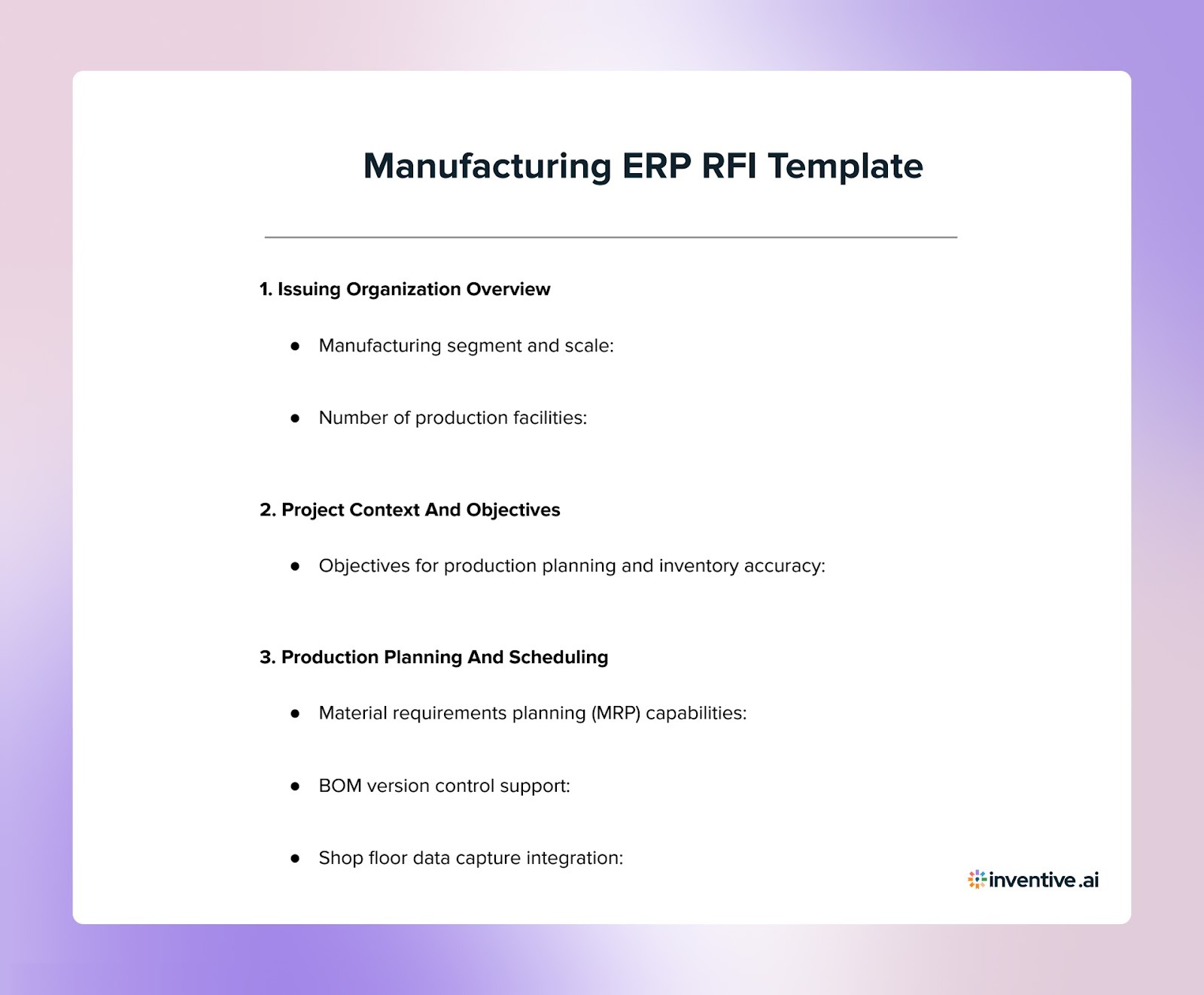
Manufacturing enterprises depend on production continuity, cost control, and plant-level visibility. Weak inventory or planning controls create downstream supply chain disruptions.
This template validates whether an ERP system can coordinate production, warehousing, and distribution without operational friction.

5. Logistics And Distribution ERP RFI Template
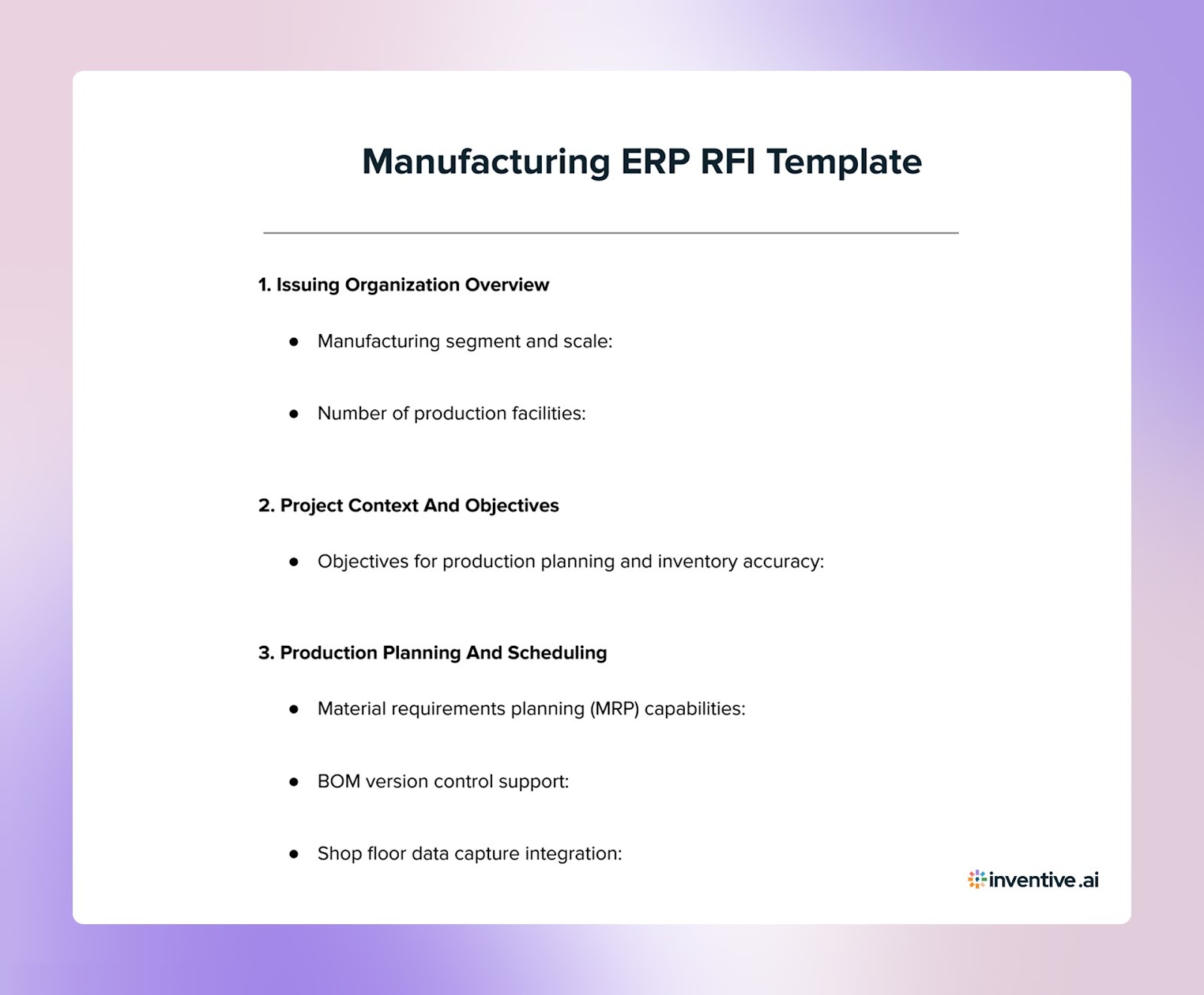
Logistics and distribution operations require movement visibility, margin control, and multi-location synchronization. Reconciliation gaps impact cash flow and customer commitments.
This template evaluates whether financial controls integrate seamlessly with operational execution systems.

While buyers structure the evaluation, vendors must structure their responses just as carefully. If you are responding to an ERP RFI, use the vendor template below to present your capabilities clearly and consistently.
ERP RFI Response Template For Vendors: Improve Your Shortlist Chance
Vendors must approach ERP RFIs with discipline and strategic intent. This stage determines whether you advance to a detailed RFP discussion or exit the evaluation cycle.
A well-contextualized response signals execution maturity and reduces perceived implementation risk. Below is a detailed format you can use to clearly position your ERP solution.

1. Executive Summary
This section shapes first impressions for executive reviewers. It should clearly position your ERP solution within the buyer’s industry context and business priorities. Decision-makers look for alignment with growth strategy, operational scale, and risk tolerance.
Instead of repeating marketing language, connect your ERP strengths directly to the buyer’s stated objectives. Keep it concise but strategic.
Example: “Our ERP platform supports multi-entity financial consolidation and real-time supply chain visibility for mid-market manufacturers operating across North America and Europe.”
2. Capability Mapping Table
Buyers want to compare vendors side by side. A standardized mapping table reduces ambiguity and demonstrates transparency. Direct alignment between requirements and capabilities builds confidence.
Clearly label whether functionality is standard, configurable, or requires customization. This prevents misunderstandings during later evaluation stages.
Example:
- Requirement: Multi-currency consolidation.
- Response: Native real-time FX conversion with automated intercompany elimination.
- Classification: Standard feature.
3. Functional Coverage Details
This section validates operational depth across modules. Buyers assess whether your ERP supports real workflows rather than surface-level features.
Organize responses by business function. Highlight automation, reporting depth, and cross-module integration.
Example: “The finance module includes automated revenue recognition, configurable approval hierarchies, and embedded audit trails for regulatory reporting.”
4. Technical Architecture Overview
Technical leaders evaluate scalability, reliability, and long-term flexibility in this section. Clear articulation of system architecture reduces integration and performance concerns.
Explain hosting environment, data security controls, and system extensibility in operational terms.
Example: “Cloud-native architecture hosted on AWS with role-based access controls, encrypted data storage, and API-first integration framework.”
5. Implementation Approach
Buyers assess execution risk during this phase. A well-defined implementation roadmap demonstrates governance maturity and realistic planning.
Outline phases, stakeholder involvement, and milestone checkpoints. Emphasize accountability and change management readiness.
Example: “Four-phase model including discovery, configuration, controlled data migration, and Coordinated user adoption planning.”
6. Integration Framework
ERP rarely operates in isolation. This section confirms how your solution connects with CRM, BI, payroll, or legacy systems. Explain standard connectors and API capabilities to show integration flexibility.
Example: “Prebuilt connectors for Salesforce and REST-based APIs supporting real-time synchronization with third-party systems.”
7. Data Migration Strategy
Data transition risk is a primary concern during ERP projects. Clear methodology reduces buyer hesitation.
Describe your validation processes, testing environments, and parallel run strategies.
Example: “Systamtic ETL framework with staged validation, reconciliation checkpoints, and parallel testing before production cutover.”
8. Risk Mitigation Plan
Senior stakeholders look for proactive risk identification. Address common ERP risks such as scope creep, user resistance, or integration delays.
Show proactive mitigation processes rather than reactive responses.
Example: “Dedicated change management lead assigned to oversee training adoption and executive-level progress reporting.”
9. Client References And Case Examples
Proof strengthens credibility. Provide relevant, industry-aligned examples that demonstrate measurable execution success.
Avoid generic claims and focus on implementation scope and outcomes.
Example: “Implemented ERP across three subsidiaries for a $250M manufacturing company within nine months.”
These templates clarify buyer evaluation frameworks, but operationalizing that insight across complex submissions requires an enterprise RFP response platform such as Inventive AI.
Write Effective and Accurate ERP RFI Responses At Scale With Inventive AI
Inventive AI addresses this response-quality gap with AI-powered RFP response software designed for vendors. Instead of assembling answers manually, teams generate structured, context-aware ERP RFI responses aligned with buyer requirements. The result is 95% accurate drafts, 0% hallucinations, and response cycles that are 90% faster.
Here are Inventive AI’s key capabilities that strengthen ERP RFI responses:
Context Engine
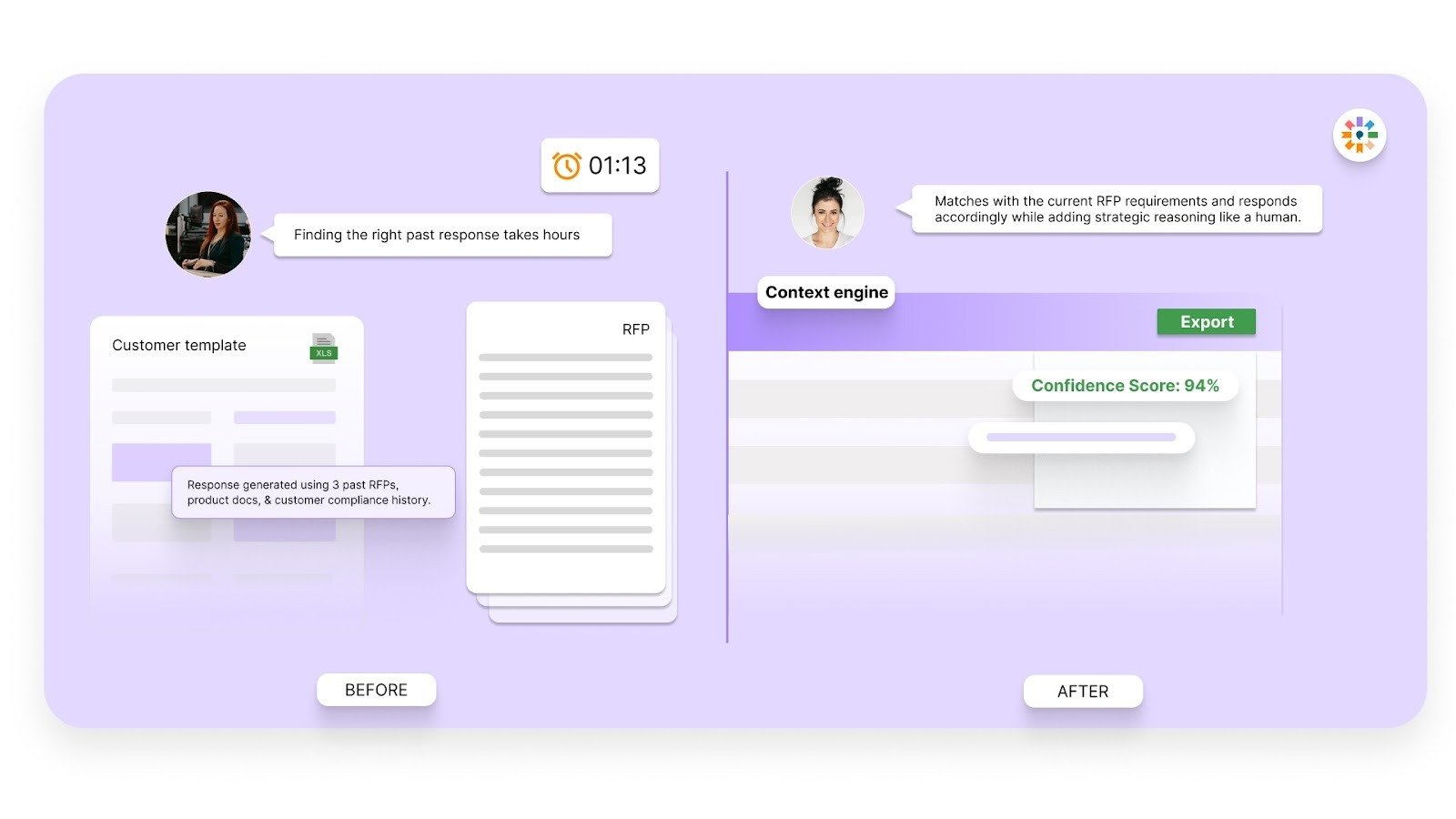
Most tools rely on shallow retrieval methods that produce generic ERP answers. Inventive AI uses multi-layer reasoning to understand the full RFI context, including industry, scope, and technical depth. This results in tailored responses that read like a subject matter expert wrote them.
Conflict Detection
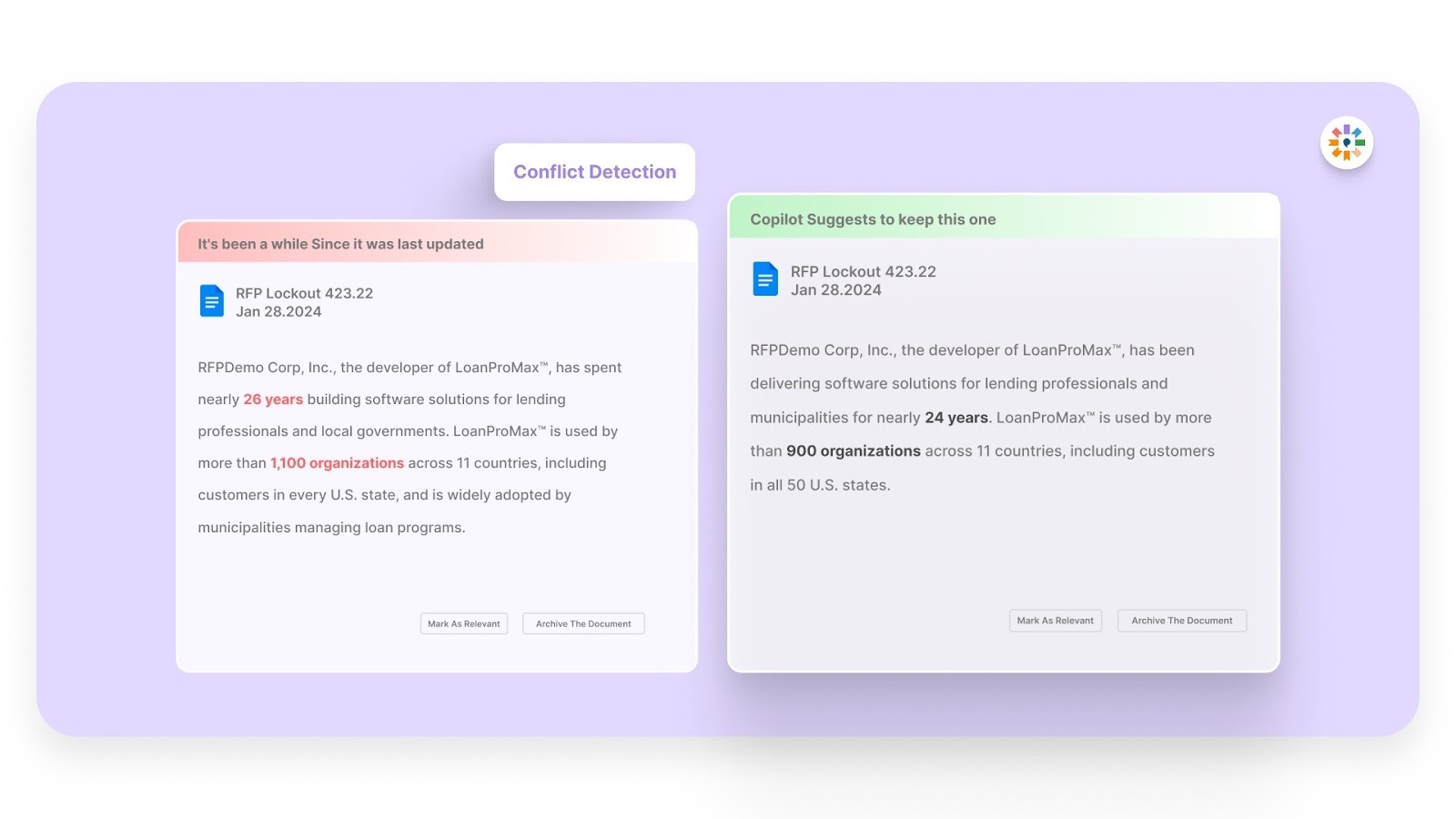
ERP RFIs often include overlapping financial, technical, and integration requirements. Inventive AI flags contradictory statements across modules before submission. This reduces credibility risk during evaluation.
Outdated Content Detection
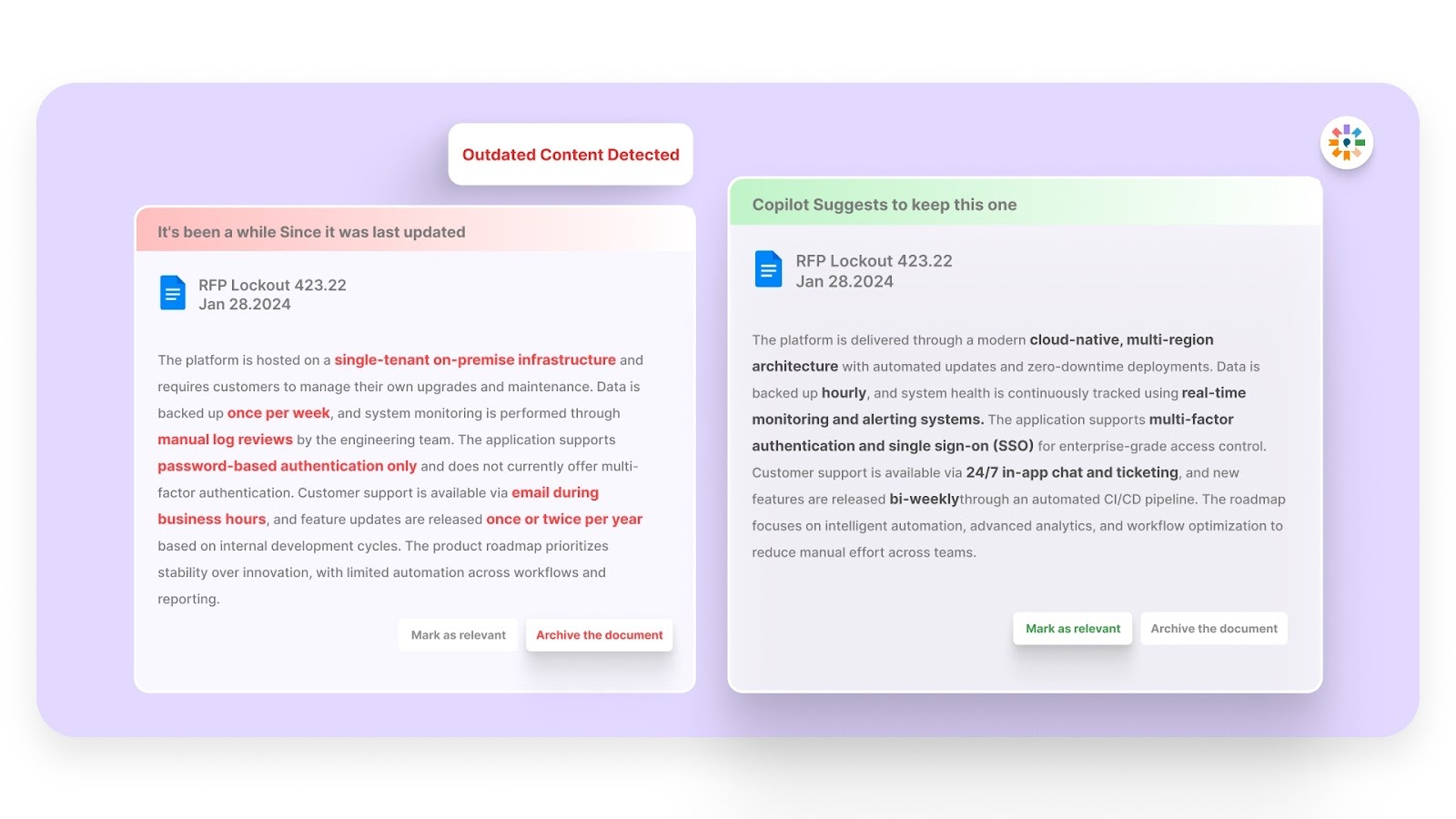
Large content libraries frequently contain deprecated product information. Inventive AI automatically identifies stale or non-compliant content before it appears in your response. Teams reduce manual review time and eliminate version confusion.
2X Quality Response
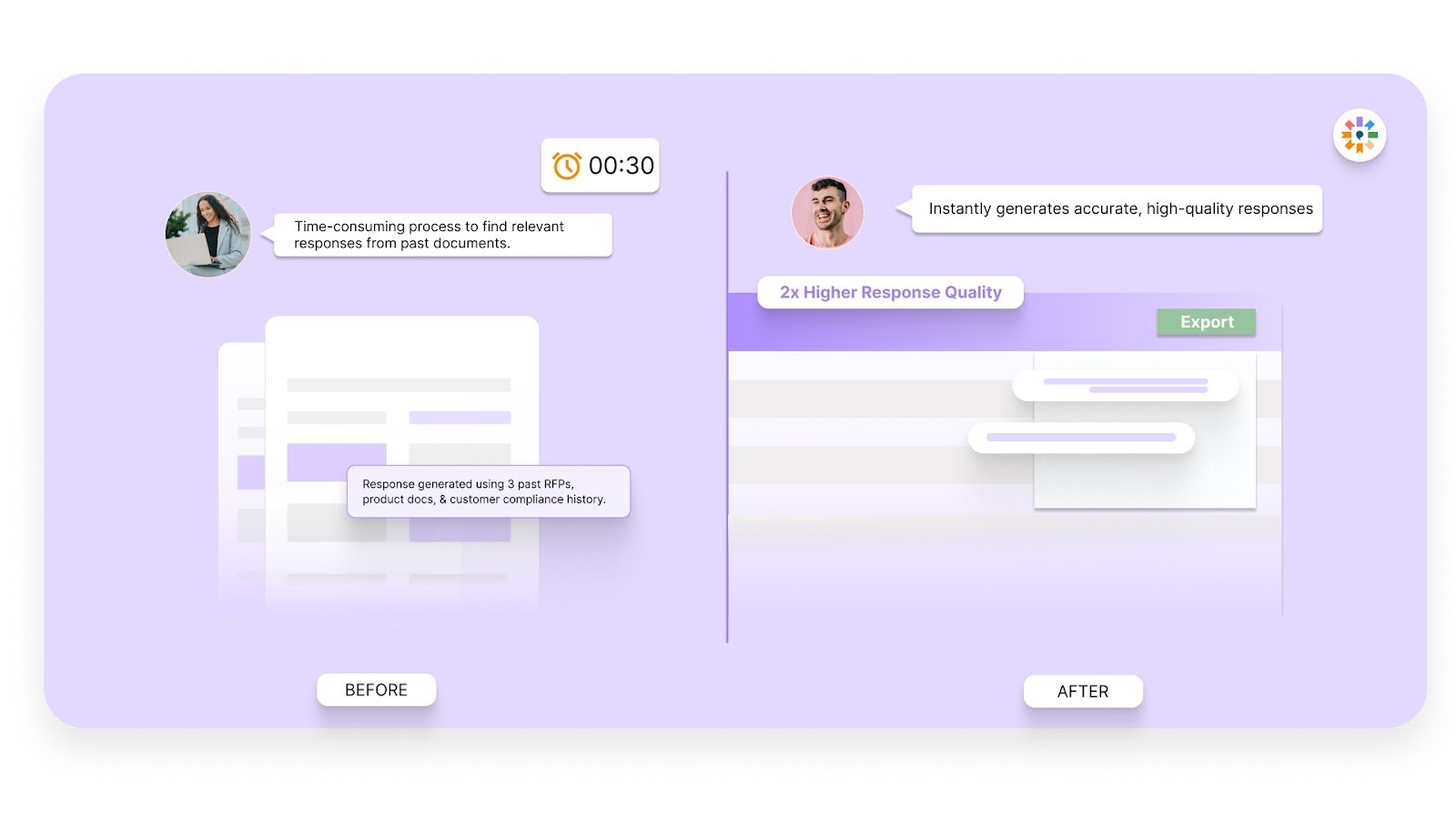
Inventive AI’s multi-agent system produces responses with higher clarity, accuracy, and completeness. Answers address buyer intent directly, improving perceived execution readiness during the RFI stage.
Simple And Easy To Use UI/UX
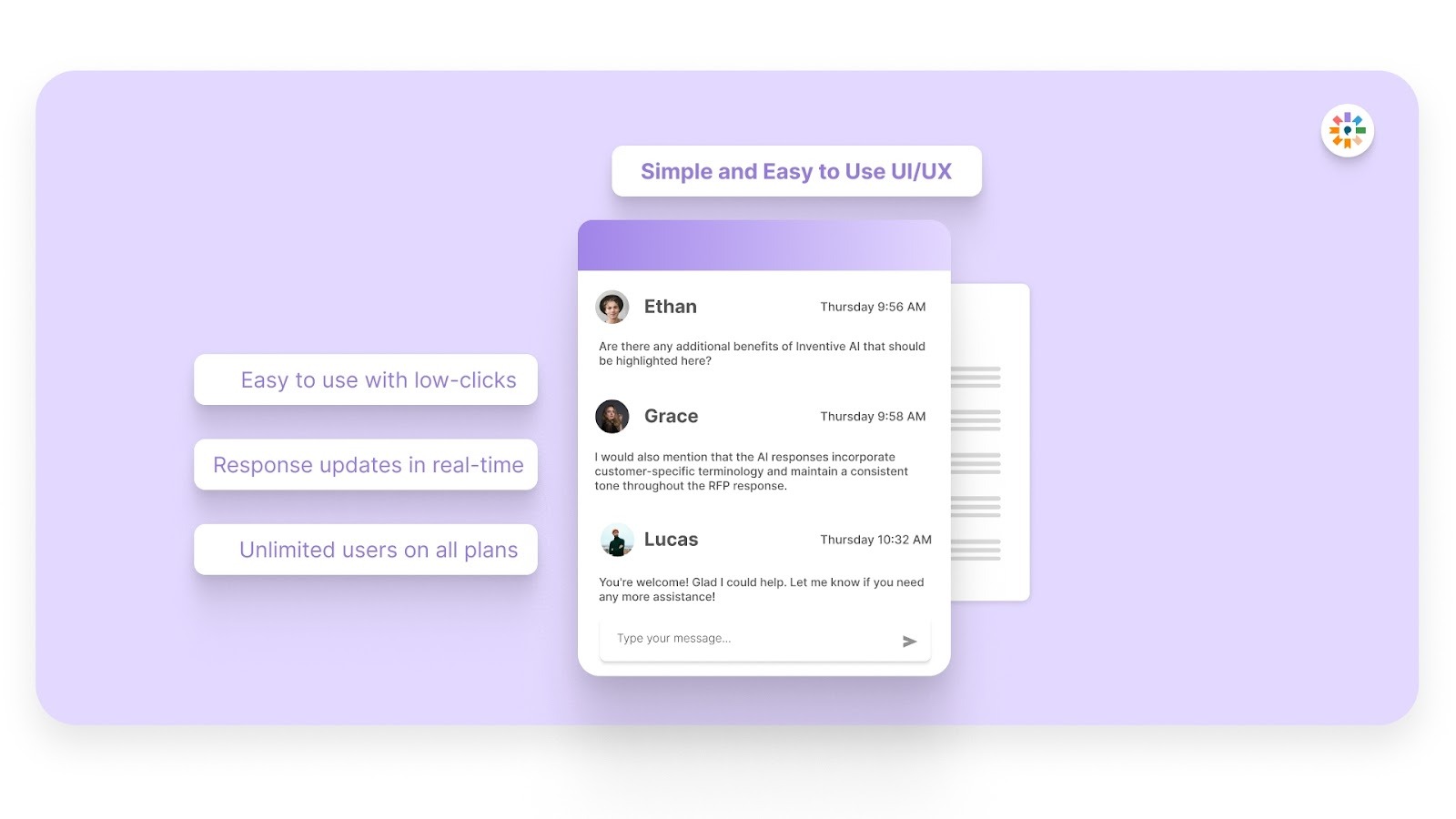
Adoption matters in high-pressure response environments. Inventive AI is recognized as one of the easiest RFP tools to use, enabling teams to generate systematic ERP RFI responses without operational friction.
Narrative-Style Proposals
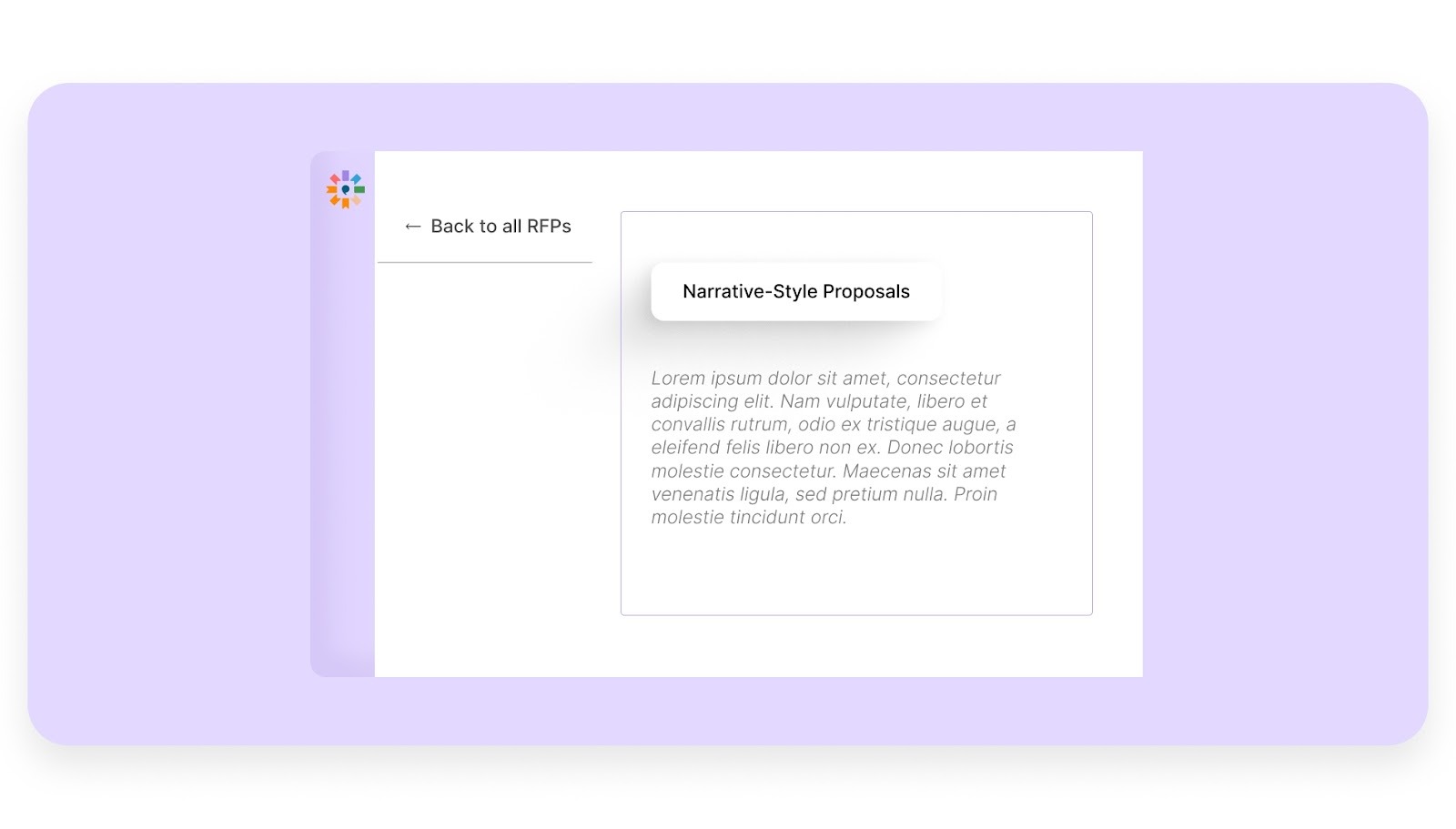
Beyond structured Q&A, Inventive AI generates long-form narrative responses such as executive summaries and technical overviews. This capability strengthens ERP RFI positioning when buyers request consolidated documents.
FAQs About ERP RFI Template
1. What Is The Ideal Length Of An ERP RFI?
An ERP RFI typically ranges between 20 and 60 structured questions. The goal is to validate capability fit without turning the document into a full proposal exercise.
2. Should ERP RFI Responses Include Pricing Details?
ERP RFIs generally focus on capability validation, architecture, and experience. Detailed pricing is usually requested later during the RFP or RFQ stage.
3. How Long Does The ERP RFI Evaluation Stage Take?
The RFI stage commonly lasts two to six weeks, depending on the number of vendors and internal alignment cycles. Larger enterprises may require additional review rounds.
4. What Causes Vendors To Get Eliminated At The RFI Stage?
Vendors are often removed due to incomplete responses, inconsistent technical explanations, or unclear integration capabilities. Structured, precise answers improve shortlist probability.
5. Can An ERP RFI Be Used To Compare Cloud And On-Premise Systems?
Yes. An ERP RFI can include deployment-specific questions covering infrastructure, data residency, scalability, and integration architecture to compare different hosting models objectively.
.avif)



%2010%20Free%20Response%20Templates%20By%20Industry%20%26%20Service.jpg)


.jpg)