Investment Management RFP: What It Includes and How to Respond
What an investment management RFP includes, how it's scored, and the step-by-step process to respond and win.

An investment management RFP is a formal document that organizations such as pension funds, endowments, and investment committees use to select an investment manager or advisor. It asks competing firms the same questions about strategy, team, track record, and fees so that buyers can compare them fairly.
For the firms responding, an investment RFP is a chance to win a long-term client, but only if the response is precise, tailored, and clearly stronger than the competition. And that starts with understanding how buyers build and score these RFPs in the first place.
This guide covers both sides: how organizations issue an investment management RFP, and how responding firms turn one into a win.
Key Takeaways
- An investment management RFP has six parts: organization background, investment goals, services needed, manager qualifications, investment strategy, and fees.
- Issuers plan the RFP, send it out, then score responses, usually with a weighted checklist. Knowing that scoring tells responders what to focus on.
- Responders win by tailoring each answer to the client's goals. Copy-paste responses lose to firms that clearly fit.
- Clear, itemized fees build trust and often decide the deal. If yours are higher, show why they're worth it.
- Track record and team matter most, so lead with similar client results, not generic claims.
Also Read: RFP Basics: The Ultimate Guide to RFPs
What is an Investment Management RFP?
An investment management RFP is the formal document an institutional investor uses to evaluate and hire an asset manager or investment consultant. It standardizes the search by asking every competing firm the same questions about philosophy, process, performance, risk controls, team, and fees. That gives the committee a like-for-like comparison across firms.
The organizations that issue them are usually pension funds, endowments, foundations, and 401(k) plan sponsors. They run an RFP to award a new mandate, replace an existing manager, or complete a scheduled review of their current one. The standardized format lets them compare firms objectively and keep a documented record of why they made their choice.
For the firm responding, that structure is the opportunity. The RFP spells out the client's priorities and how each answer will be scored. Reading it closely is what separates a response that merely complies from the winning one.
How Buyers Run and Score an Investment RFP

Understanding the process on the other side of the table helps you time and shape a stronger response. Institutions typically run an RFP in three stages.
- Planning. Before the RFP goes out, the buyer defines its objectives, service requirements, selection criteria, and timeline, often with a consultant's help. What this means for you: by the time you receive the RFP, those priorities are already fixed. Answer to the criteria they actually set, not the ones you wish they'd asked.
- Issuance. The buyer sends the RFP to a shortlist of invited or qualified firms, opens a window for clarifying questions, then enforces the submission deadline. What this means for you: use that Q&A window — good questions signal diligence and prevent costly misreads — and never miss the deadline, since late submissions are usually disqualified outright.
- Evaluation. The buyer scores each response against a fixed set of criteria using a weighted scoring model, records the results in a comparison matrix, and shortlists a few firms for finalist interviews. A representative scorecard looks like this:
Key Components of an Investment Management RFP

For issuing or responding, an investment management RFP is built around six sections. Here's what each one asks for, the details that matter, and what a strong response does.
1. Introduction & background.
The buyer describes their organization and why they're running the RFP, and it's full of signals worth reading. Note the institution type (pension fund, endowment, foundation, or 401(k) plan), roughly how much they manage, who's deciding (an internal committee or an outside consultant scoring responses), and whether they're replacing an existing manager. These shape your pitch: a large pension expects a different response than a small foundation, and if a consultant is scoring, answer every question in full detail.
2. Investment objectives & constraints.
This is what the buyer wants their money to achieve: a target return, an acceptable level of risk, a time horizon, liquidity needs, and any rules they must follow, often set out in an Investment Policy Statement that can ban certain holdings or require ESG standards.
"Success" varies by institution: a pension must earn enough to cover future retiree benefits, an endowment aims to fund ~4–5% of annual spending without shrinking, and a US private foundation must pay out at least 5% of assets a year by law. Tie your approach to their exact goal, not a generic "we'll grow your money."
3. Scope of services.
This defines exactly what they're hiring you to do: manage investments actively (picking holdings to beat the market) or passively (tracking an index), run one asset class or the whole portfolio, how often you'll report, and extras like proxy voting, tax management, or ESG investing. Answer every item; skipping one suggests you can't offer it. If they want one firm to run the entire portfolio (an "outsourced CIO," or OCIO, mandate), show you can coordinate all of it, not just one slice.
4. Manager qualifications & experience.
This asks who you are and whether you can be trusted with the mandate: your firm's size and stability, the team who'd run the account, and your results on similar work. Institutions look closely at two things: team stability (low turnover) and performance shown after fees against your benchmark index, ideally reported to a recognized standard called GIPS that keeps those claims honest and comparable. Lead with genuinely comparable client experience and name the senior people involved; vague claims or cherry-picked numbers cost you credibility.
5. Investment strategy & approach.
This goes deeper into how you invest: your philosophy, how you build and balance the portfolio, and how you manage risk when markets fall. Evaluators want a repeatable process that results from a consistent method, so explain the reasoning behind your decisions, not just past returns, and tie it back to the client's goals in Section 2.
6. Fee structure.
This asks exactly what you charge and how. Fees usually take one of three forms: a flat fee, a percentage of assets managed (often lower as the amount grows), or a performance fee tied to returns. Buyers also want the full picture, including extra costs like custody (safekeeping the assets) and administration, since they compare firms on total cost after fees. Lay out every charge clearly, and if you're pricier than rivals, show the after-fee results or added services that justify it.
Responding to an Investment Management RFP: A Detailed Guide
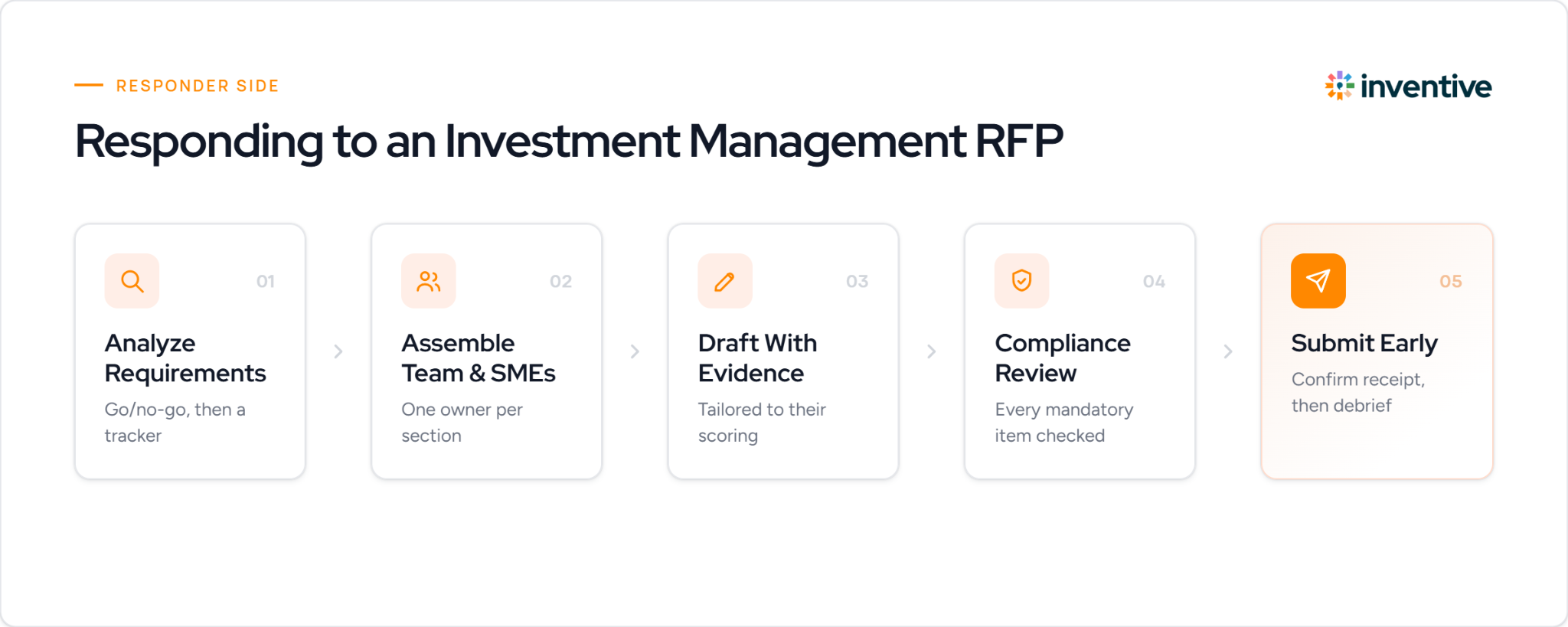
A strong response follows a disciplined process, not a rush to fill in answers. Here are the steps top firms follow, from the moment the RFP lands to after you submit.
Before you write
1. Make a Go/No-Go decision. Assess three things before committing: how well the mandate fits your strengths, whether an incumbent already holds the advantage, and whether you can staff a quality response on time. A disciplined "no" protects your win rate and frees senior people for the bids you can actually win.
2. Break down the RFP. Read the full document and pull every question, mandatory requirement, required attachment, format rule, and date into one tracker. Flag each mandatory item; a missed requirement, word limit, or attachment can disqualify a strong response before it's scored. This breakdown becomes both your checklist and your work plan.
3. Use the clarifying-questions window. Buyers set a period for written questions; use it to resolve anything unclear about scope, evaluation criteria, or format. Well-framed questions prevent misaligned answers and signal diligence to the evaluator, while guessing on an ambiguous requirement risks points you can't recover.
4. Assemble the team and assign owners. Identify who each section needs: portfolio managers for strategy, compliance and legal for disclosures, client service for references, and give every section one owner with an internal deadline ahead of submission. Clear ownership prevents gaps and last-minute scrambles when several people write in parallel.
Writing the response
5. Research the client and their scoring. Study the institution's objectives, its constraints (the Investment Policy Statement), and the weighted criteria the RFP lays out. Direct the most effort to the factors that carry the most points, and frame every answer around their priorities, return targets, risk limits, ESG, or fees. A response built around their scoring beats one built around your standard pitch.
6. Define your win themes. Choose the two or three reasons you're the best fit for this specific mandate: a track record in their asset class, a stable senior team, a risk framework suited to their liabilities. Thread those themes through every section so the evaluator sees one consistent, evidence-backed case rather than scattered claims.
7. Draft each answer directly and tailored. Answer the exact question asked in the client's terms, and lead with the direct response before the supporting detail. Use approved content to move quickly, but respond to each question as per the client's needs/specific demands. Evaluators recognize recycled boilerplate and mark it down. Where a committee member may not be a specialist, replace jargon with plain explanation.
8. Include the required documents. Investment RFPs almost always require supporting materials: a GIPS-compliant, net-of-fee performance record, senior team bios, your Form ADV, references from comparable clients, and any requested due-diligence questionnaire (DDQ) or compliance disclosures. Provide each in the exact format requested, and make sure performance figures reconcile across the whole response.
Before you submit
9. Check compliance and completeness. Using your Step 2 tracker, confirm every mandatory question is answered, every required document is attached, and the response meets all format, length, and labeling rules. Non-compliance is one of the most common reasons otherwise strong proposals are eliminated.
10. Review, get sign-off, and format to spec. Edit the full response for accuracy and a single consistent voice, and resolve any contradictions between sections that different people wrote. Then route the response through compliance and legal for sign-off, which is mandatory in a regulated industry like investment management. Once it is approved, format the response exactly as the RFP instructs before you submit it.
11. Submit early and confirm receipt. Deliver through the required channel, portal, email, or hard copy, ahead of the deadline, and confirm the buyer received everything intact. Late or incomplete submissions are routinely rejected regardless of quality, so leave a buffer for upload or delivery problems.
After you submit
12. Prepare for the finalist presentation. A strong written response usually earns you a spot on the shortlist, but the finalist meeting is where the mandate is actually decided. Rehearse with the same team who would manage the account, and prepare for the questions the committee is most likely to ask. Use the meeting to reinforce your win themes in person and show the client who they would be working with.
13. Debrief and update your content library. After the buyer makes a decision, request feedback and run a win/loss review to understand what shaped the outcome. Then fold your strongest answers back into your approved content library. This way, your next response starts from better material and stays consistent across bids.
Also Read: 15 Best RFP Software in 2026: Features, Prices and Reviews
How Inventive AI Helps You Respond Faster
Investment management RFPs are quite demanding: they ask for detailed strategy, a verifiable track record, team credentials, and compliance disclosures, and most of that content already exists somewhere in your firm. The slow part is finding the current, approved version and tailoring it to each mandate.
Inventive AI is an autonomous AI agent platform for RFPs, RFIs, and security questionnaires that takes on that work, so your team can focus on strategy and the finalist meeting.
- Reads the RFP: Uploads the document and automatically pulls out every question and requirement, so nothing gets missed.
- Drafts first responses: Generates a first answer to each question, giving your team a starting point instead of a blank page.
- Connected knowledge: Draws from your existing content, such as past RFPs, SharePoint, Salesforce, and more, so performance data and strategy language stay consistent across responses.
- Cited answers: Attaches the source behind every answer, which matters when compliance and legal review your track record and disclosures.
- Content Governance Agent: Flags outdated or conflicting content, so an expired certification or old performance figure does not slip into a submission.
- Team collaboration: Lets portfolio managers, compliance, and legal work in one place, with clear owners and no version confusion.
- Human approval: Keeps your team in control, reviewing and approving every answer before it goes out.
FAQs
1. How long do firms usually get to respond to an investment management RFP?
Most issuers give responding firms three to four weeks from the release date. Larger or more complex mandates may allow longer. The RFP itself usually states the response window, the deadline for clarifying questions, and the final decision date.
2. How often should an organization put its investment manager out to RFP?
Best practice is every three to five years, even when the current manager is performing well. Periodic RFPs confirm the manager still fits the mandate, keep fees competitive, and satisfy the committee's due diligence and fiduciary responsibilities.
3. What is the difference between an RFP, an RFI, and a DDQ in investment management?
An RFI (Request for Information) is an early, lighter request used to gather background and build a shortlist. An RFP (Request for Proposal) is the full proposal used to evaluate and select a manager. A DDQ (Due Diligence Questionnaire) is a detailed operational and compliance review, usually completed before hiring and repeated periodically afterward.
4. How many firms are usually invited to respond to an investment RFP?
There is no fixed number. Issuers invite a shortlist they can realistically evaluate, often around five to eight firms, sized to the depth of questions and the committee's review capacity. For a responding firm, this means you are competing against a small, qualified field, so clear differentiation matters.
5. Why do investment management RFP responses usually lose?
The most common reasons are missing a mandatory requirement or deadline, submitting generic answers that do not map to the client's objectives, a track record that is not clearly comparable, and fees that are unclear or unjustified. Most of these are avoidable with careful qualification, tailoring, and a compliance check before submission.

.avif)



%20for%20Sales%20Teams.jpg)