Proposal Cover Letter: A Simple Guide with Examples and a Template
A proposal cover letter introduces your proposal and makes the case to keep reading. Here's what it is, the main types, examples, a template, and how to write one.
When you send a business proposal, the first thing the reader sees is not your solution or your price. It is your cover letter. A proposal cover letter is the short note on top that introduces the proposal, shows you understand what the reader needs, and gives them a reason to read the rest.
This guide explains what a proposal cover letter is, when you need one, the main types, how to write one step by step, and a template you can download. It's written for anyone sending a proposal, whether that's a sales pitch, a consulting offer, or a formal bid.
TL;DR
- A proposal cover letter is a one-page letter at the front of a business proposal that introduces you, shows you understand the reader's goal, and gives them a reason to read the full proposal. It frames the proposal; it doesn't summarize it.
- Include five parts: a named greeting, an opening about the reader's goal, why you fit (with one measurable proof point), a clear next step, and a signature from someone with authority.
- Write it in five steps: research the reader, format the header and greeting correctly, open with their goal, prove your fit with one specific number, and close with a next step and a real signature.
- Keep it to one page, 250 to 400 words, in standard block business-letter format, three to five short paragraphs.
What is a proposal cover letter?
A proposal cover letter is a one-page letter at the front of a business proposal, addressed to the decision-maker. In three to five short paragraphs, it shows you understand the reader's goal, connects your offer to it, and gives them a reason to read the full proposal. It uses standard business-letter format and is written to a named person.
It is not the proposal, and it is not an executive summary. The proposal sets out your approach, scope, timeline, and pricing. The executive summary is a short recap of that content. The cover letter does something different: it introduces the proposal and shows the reader why it is relevant to them, before they reach any detail.
Proposal cover letter vs. the proposal
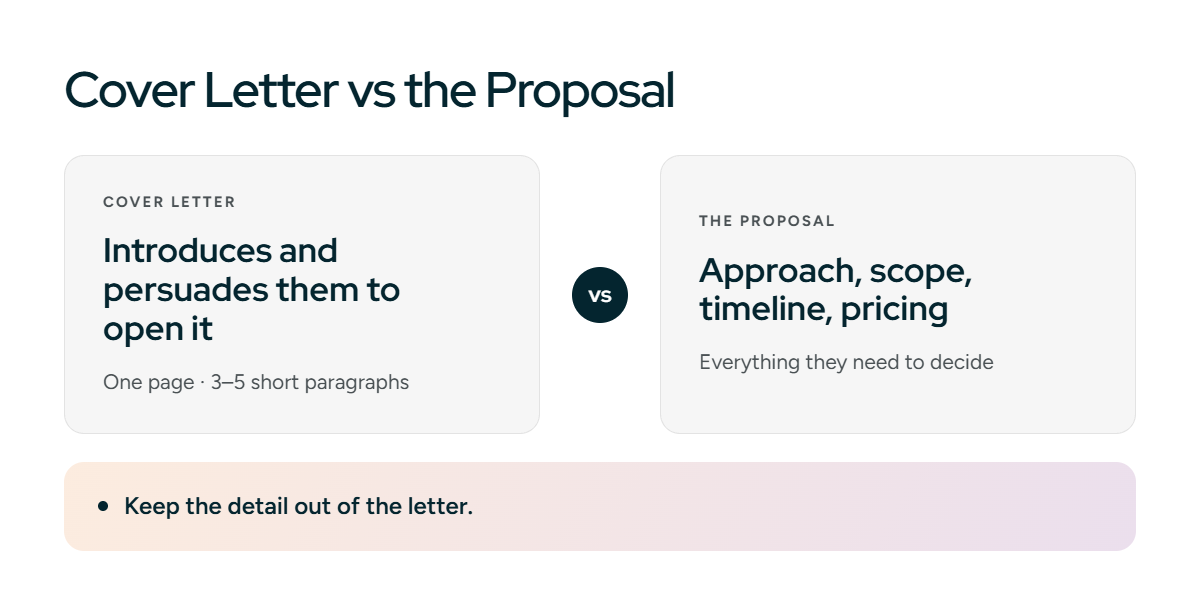
These are easy to confuse, so keep the roles separate. The cover letter is the short introduction that frames the proposal and makes the reader want to open it. The proposal is the full document: your approach, scope, timeline, and pricing.
The cover letter persuades the reader to engage. The proposal gives them everything they need to decide. Keep detail out of the letter and keep the letter out of the proposal, and each does its job better.
When do you need a proposal cover letter?
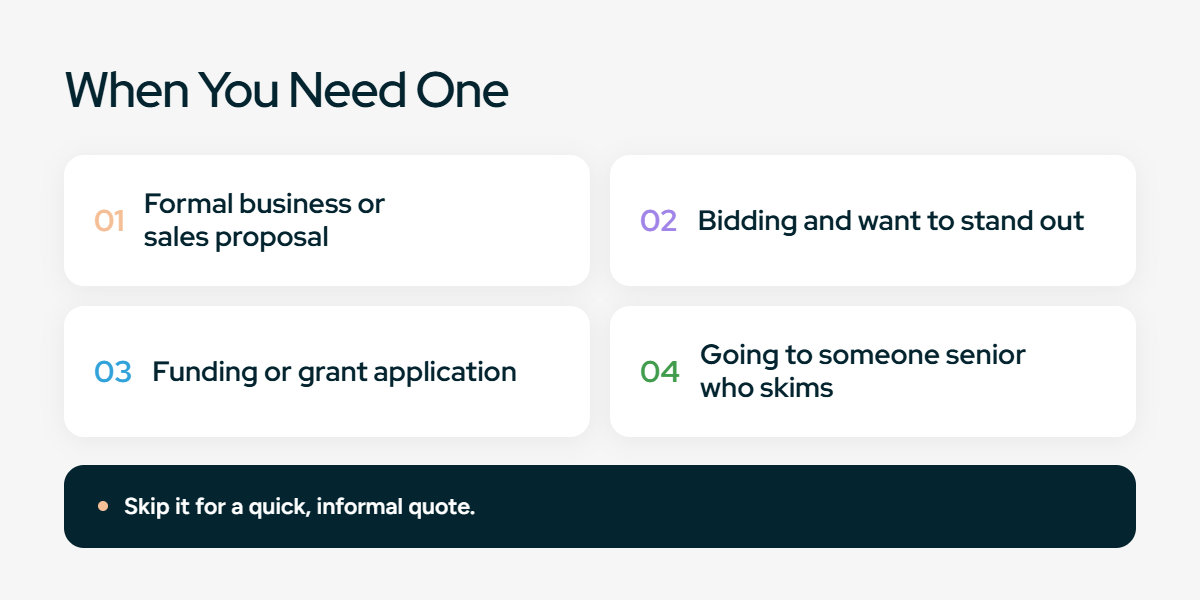
Not every proposal needs one, but most benefit from it. You should include a cover letter when:
- You are sending a formal business or sales proposal to a prospect.
- You are bidding on work and want to stand out before the reader reaches your pricing.
- You are applying for funding or a grant and need to introduce your organization.
- The proposal is going to someone senior who may only skim the first page.
You can skip it for a quick, informal quote or when a buyer has asked only for a number. If the reader will spend real time deciding, a cover letter helps them start on your terms.
Types of proposal cover letters
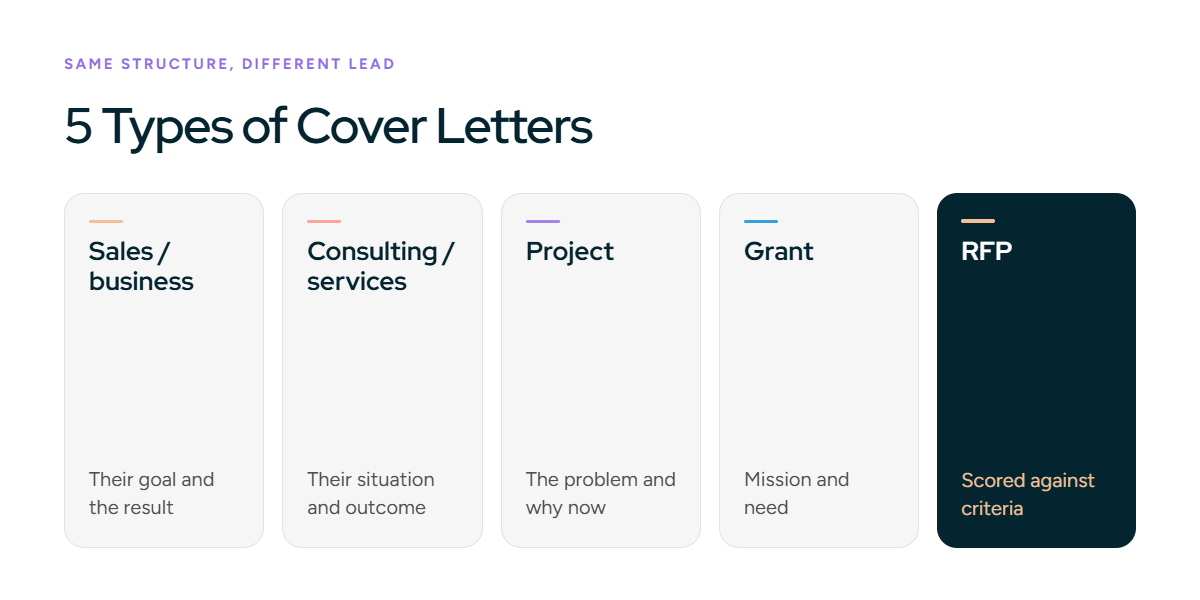
"Proposal cover letter" covers several situations. The structure is similar across all of them, but the emphasis shifts depending on who you are writing to.
- Sales or business proposal cover letter. You are pitching a product or service to a prospect. The focus is on their goal and the result you help them reach.
- Consulting or services proposal cover letter. You are offering expertise. The focus is on your understanding of their situation and the outcome of your engagement.
- Project proposal cover letter. You are proposing a specific project, often internally or to a partner. The focus is on the problem the project solves and why now.
- Grant proposal cover letter. You are requesting funding. The focus is on your mission, the need you address, and why your organization is the right one to fund.
- Request for proposal (RFP) cover letter. You are responding to a formal RFP from a buyer who set the rules. This one has stricter conventions, since an evaluator scores your response against criteria. If that's your situation, we cover it in depth in our RFP cover letter guide.
Knowing which type you are writing tells you what to lead with. A grant letter leads with mission; a sales letter leads with the prospect's result.
What to include in a proposal cover letter

A proposal cover letter is short, usually three to five short paragraphs on one page. Here is what each part does.
- A proper greeting. Address a named person, not "To whom it may concern." Getting the name right signals you did your homework.
- An opening about them. Start with the reader's goal or challenge, in their words, not with your company history.
- Why you fit. In a sentence or two, connect your offer to that goal, with one specific proof point, such as a comparable result you delivered.
- A clear close. State what you would like to happen next, whether that's a call, a meeting, or their review of the attached proposal.
- A signature. Sign from a real person with the authority to stand behind the proposal.
You do not need pricing tables, deep technical detail, or a full feature list here. Those live in the proposal. The letter's job is to get the reader into it.
Also Read: Proposal Writing: A Complete Guide
How to write a proposal cover letter
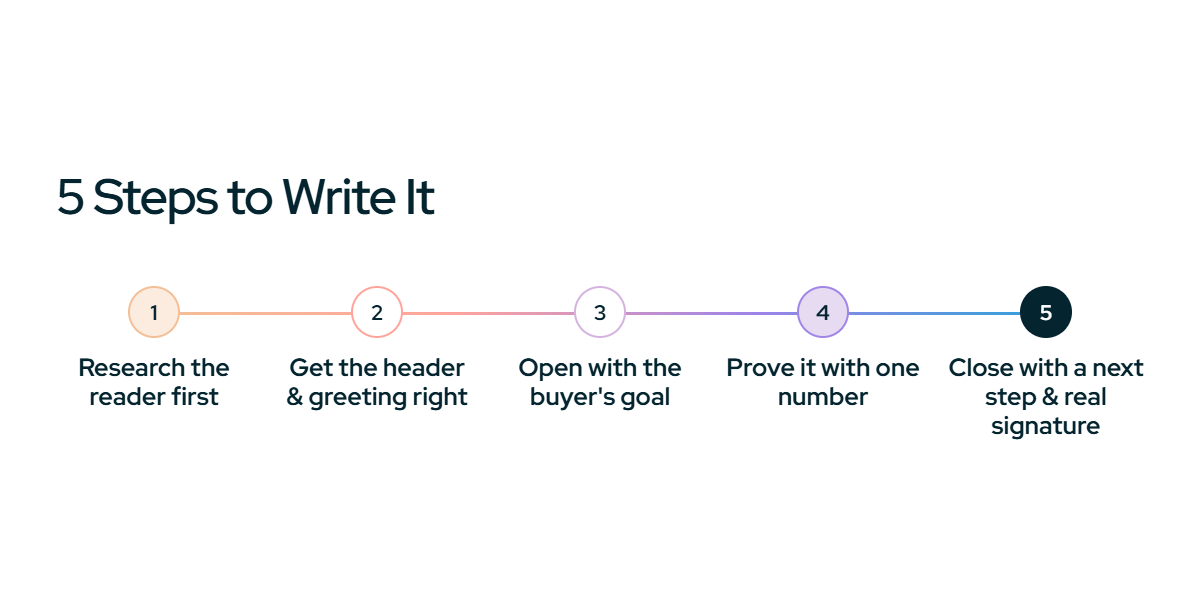
A proposal cover letter uses standard business-letter format: block style, single-spaced, left-aligned, one page. Within that, five steps decide whether it works.
Step 1: Research the reader first
Get the decision-maker's name, title, and correct spelling, and the organization's legal name. Then pin down two things: their main objective, and the one constraint driving the decision, budget, timeline, compliance, or risk. Pull these from your discovery calls, their brief, or the RFP itself. If it's an RFP, note the exact project name or solicitation number for your opening line. A letter written before you know the reader's priority always reads generic.
Step 2: Get the header and greeting right
Lead with your sender block (name, title, company, contact), then the full date (March 4, 2026), then the recipient's block. Address one named person: "Dear Ms. Chen." Use a colon for formal bids, a comma for warmer sales letters. Never write "To whom it may concern", it signals you didn't identify the buyer. If no name is available, "Dear Selection Committee" is the acceptable fallback.
Step 3: Open with buyer’s goal
Your first sentence names their objective in their own words; your second connects your offer to it. Thank them, reference the specific project, state their top priority, then bridge to why you deliver it. Keep the whole opening about them, no company history, no "We are a leading provider." The reader decides in the first few lines whether to keep going.
Step 4: Prove it with one number
Back your claim with a single, verifiable result from a comparable project: what you did and the measurable outcome ("cut supplier onboarding time 40% while passing a SOC 2 audit with zero exceptions"). Match the proof to the priority you named in Step 3, if it's speed, cite a speed result. One number beats three adjectives, and don't stack wins, it dilutes the one that matters.
Step 5: Close with a next step and a real signature
State what happens next, review of the attached proposal, a call, a meeting, and give a direct contact. Use a standard close ("Sincerely,") and a four-line signature: signature, name, title, company. The signer should hold authority for the deal, an account owner for routine bids, an executive for high-value ones. A senior signature tells the buyer the proposal has real backing.
Best practices for a proposal cover letter
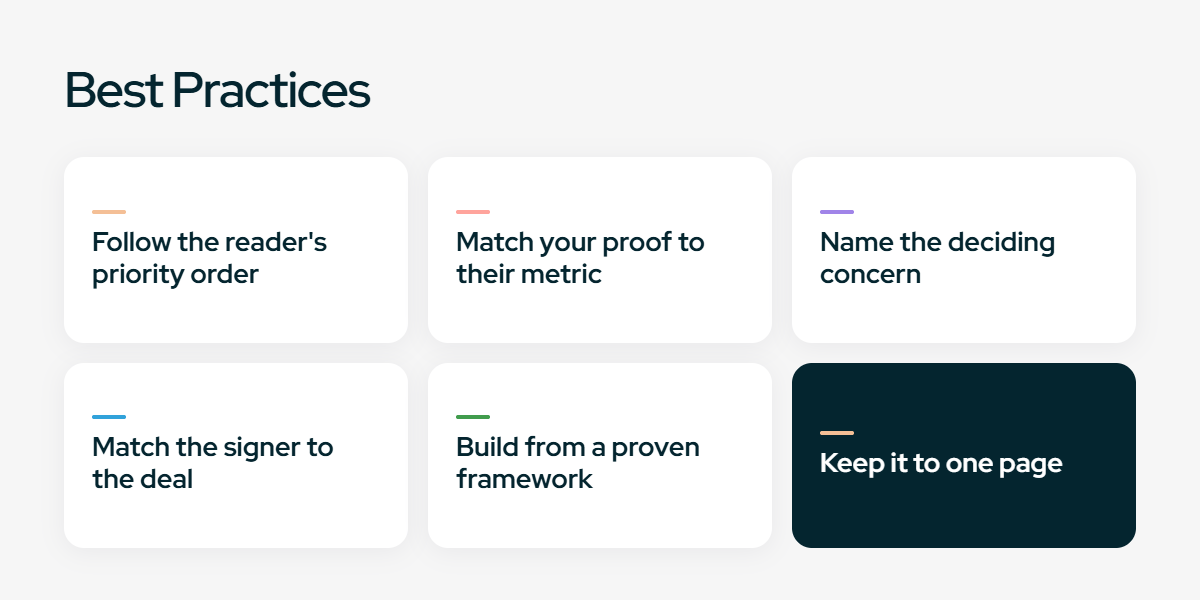
These are the strategic moves that make a proposal cover letter work harder for your team.
- Follow the reader’s priority order. Address the reader's priorities in the same order they listed them in the brief or the RFP. Evaluators scan for the factors they're scoring, so matching their order makes your fit easy to see.
- Match your proof to their metric. Lead with the one result that maps to how this buyer measures success: cost saved, time to value, uptime, win rate, and put a number on it. A metric tied to their goal beats an impressive but unrelated stat.
- Name the deciding concern. If one factor will make or break the decision, timeline, budget, or risk, speak to it directly and show how you handle it. Addressing it up front builds more trust than leaving it unspoken.
- Match the signer to the deal. Route routine bids to the account owner and high-value ones to a VP or executive. The right signature shows the proposal has real backing behind it.
- Build from a proven framework. Keep a tested cover-letter structure your team reuses, then tailor the opening, priority, and proof point for each buyer. This keeps quality consistent when you're sending at volume.
- Keep it to one page. Three to five short paragraphs, 250 to 400 words. A tight letter gets read in full; a long one gets skipped for the price.
- Draft from proposal software. Use proposal or RFP response software to generate a first draft from your past proposals and approved content, then personalize the opening and proof point. It saves the blank-page time and keeps quality consistent across the team.
Proposal cover letter examples
The structure stays the same across industries; what changes is the goal you lead with and the proof you show. Here are three short examples.
SaaS / technology sales.
Leads with the buyer's operational goal and a measurable result.
Construction / professional services.
Leads with schedule and disruption, the priorities that matter on-site.
Free proposal cover letter template
Want a ready-made starting point? Our template pack includes a fill-in-the-blank proposal cover letter, the three completed examples above, and a pre-send checklist, all in standard one-page business-letter format. Replace the bracketed fields with your specifics and you have a letter ready to send.
Draft your next proposal cover letter in minutes with Inventive AI
Writing every cover letter from a blank page is slow, and it gets harder to keep quality consistent as more people on your team write proposals.
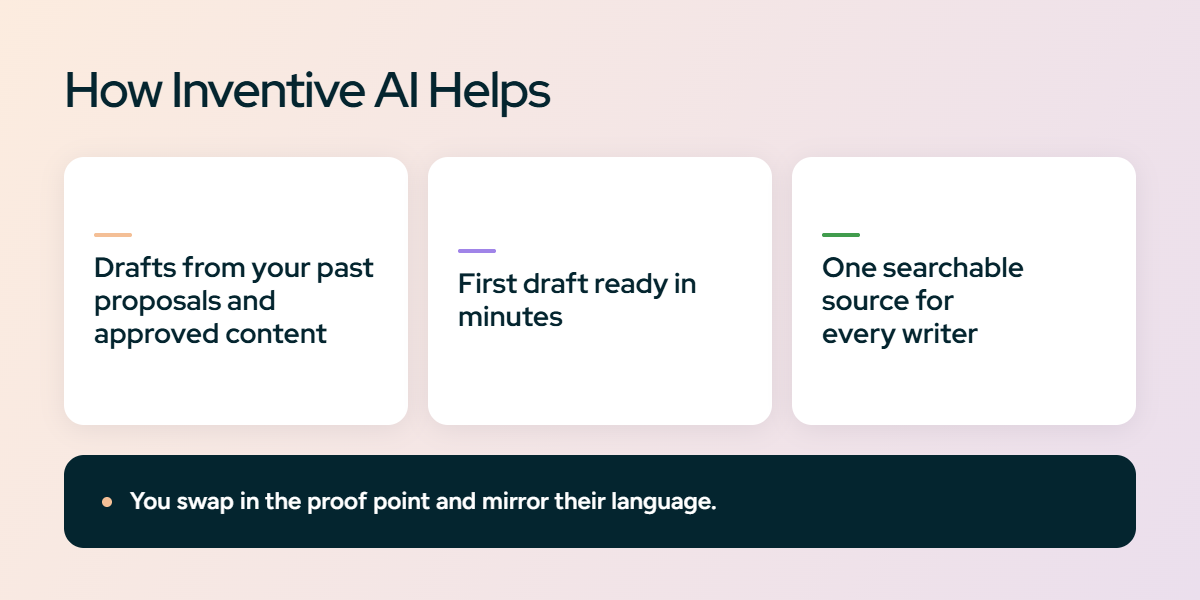
Inventive AI is an autonomous AI agent platform for proposals, RFPs, RFIs, and security questionnaires. It drafts your cover letter from your past proposals and approved company knowledge, so a first draft is ready in minutes and already reflects the openings and proof points that have won work before. Because that content lives in one searchable place, every writer starts from the same strong baseline instead of reinventing it.
From there, you do the part that wins: swap in the proof point that matches this buyer's goal, mirror their language, and confirm the details. Inventive AI removes the repetitive drafting; you keep the judgment that makes each letter land.


.jpg)