RFP Executive Summary: How to Write One That Wins Deals
Learn how to write an RFP executive summary that wins deals. Includes a ready-to-use template, a full example, common mistakes, and best practices.
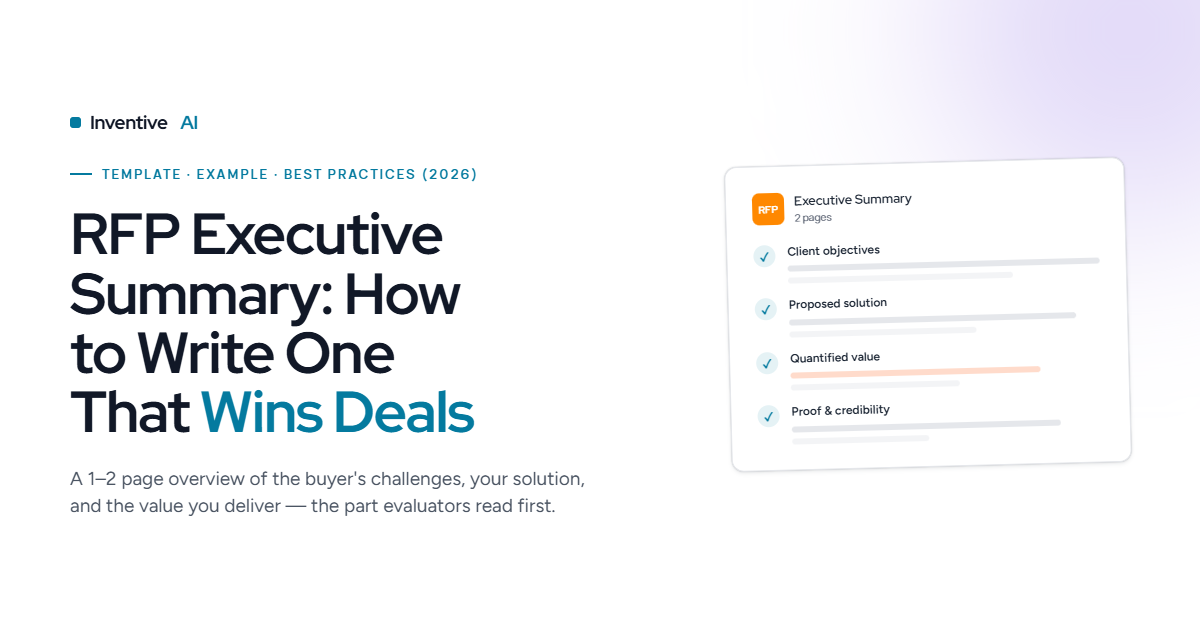
An RFP executive summary is often the most influential page in your entire proposal. Before evaluators review your technical approach, pricing, or implementation plan, they use this section to decide whether your team understands their business and is worth serious consideration.
A strong executive summary doesn't simply introduce your proposal. It explains the buyer's challenges, presents your solution in business terms, and builds confidence that you can deliver the outcomes they're looking for. A weak one, on the other hand, forces evaluators to work harder to understand your value before they've even reached the rest of your response.
In this guide, you'll learn what an RFP executive summary is, why it matters, what it should include, how to write one, common mistakes to avoid, and how AI can help proposal teams create stronger executive summaries faster.
TL;DR
- An RFP executive summary is a one-to-two-page overview at the front of a proposal that proves you understand the client's problem and positions your solution as credible.
- It shapes how evaluators score the rest of the proposal, so a weak one puts your entire response at a disadvantage before anyone reads past page one.
- It differs from a cover letter: the summary makes the business case, the cover letter sets the tone.
- The strongest summaries are drafted early to align the team, then finalized last, once the full proposal reveals the strongest proof points.
- AI tools can speed up parsing requirements and drafting a first version, but the judgment on what to emphasize for a specific client still has to come from the team.
What Is an RFP Executive Summary?
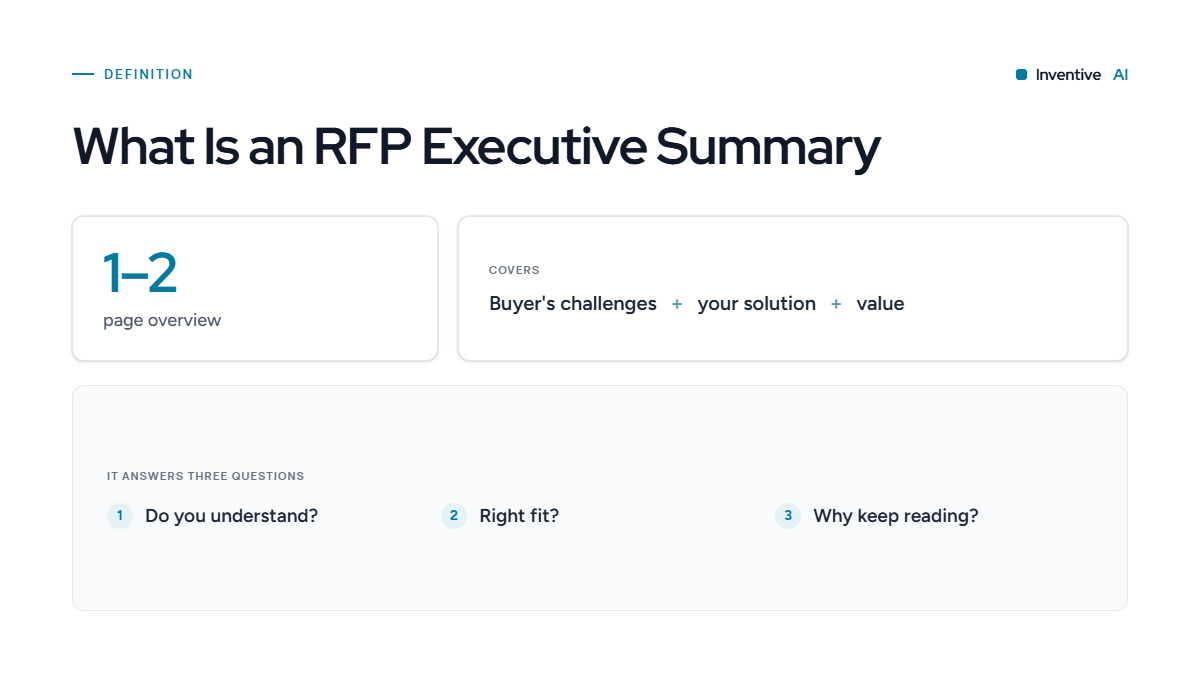
An RFP executive summary is a one-to-two-page overview at the beginning of your proposal that explains the buyer's challenges, your proposed solution, and the value you'll deliver. It should stand on its own, giving evaluators enough context to understand your proposal without reading the entire response.
Despite its name, an RFP executive summary isn't simply a summary of your proposal. It's a persuasive business document that demonstrates you understand the buyer's priorities, positions your solution as the best fit, and encourages evaluators to continue reading.
Unlike a table of contents or a proposal introduction, the executive summary makes the business case for your solution.
It should quickly answer three questions:
- Do you understand the buyer's challenges?
- Is your solution the right fit?
- Why should they keep reading?
Because executive stakeholders often review multiple proposals under tight deadlines, the executive summary is sometimes the only section they read in detail. While technical reviewers focus on features and implementation, decision-makers are more interested in business outcomes such as cost savings, risk reduction, and strategic value. An effective executive summary addresses both audiences.
If you're new to proposal writing, it helps to understand how an RFP is structured before drafting this section.
Who Writes the RFP Executive Summary?
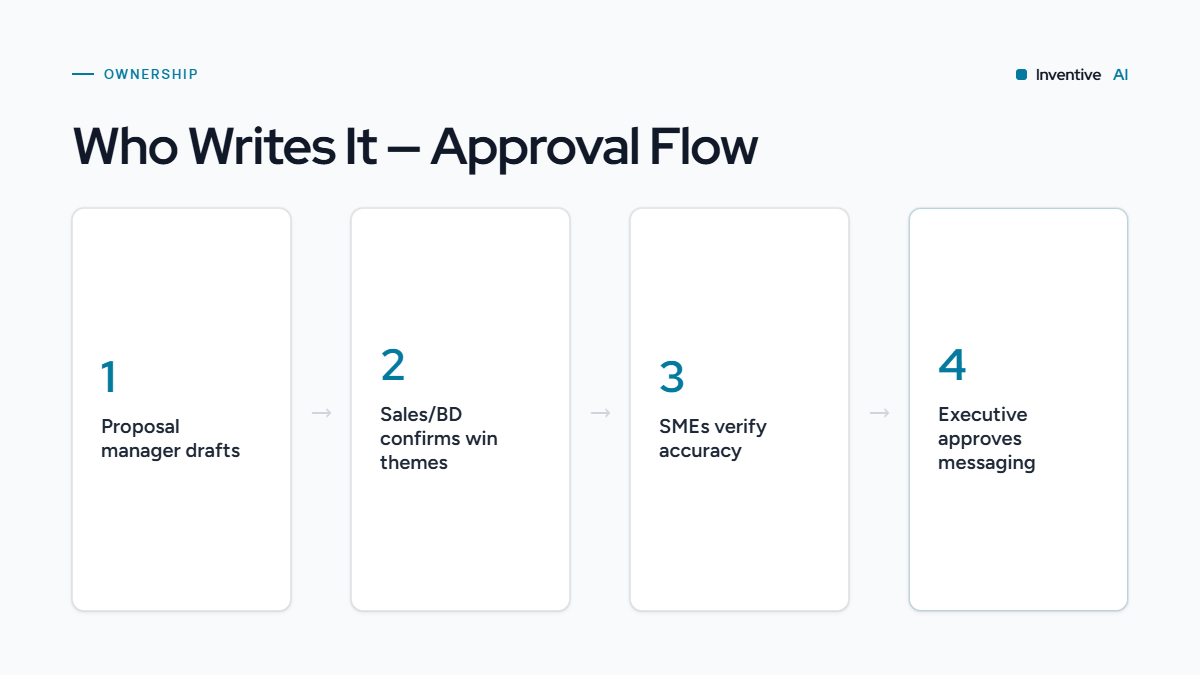
In most organizations, the proposal manager owns the executive summary, though it is rarely written in isolation. Sales or business development typically weighs in to confirm the summary reflects the win themes established during the bid decision, and subject matter experts review it for accuracy.
A typical approval flow looks like this:
- Proposal manager drafts the summary using the agreed template
- Sales or business development confirms alignment with the client relationship and win themes
- Subject matter experts verify factual accuracy
- An executive approver reviews the final messaging before submission
In smaller organizations, sales or marketing may write the summary directly rather than a dedicated proposal manager. Either way, treating it as a single-author task is a common source of weak summaries. It benefits from input by anyone close to the client relationship, not just the person assembling the final document.
RFP Executive Summary vs. Cover Letter
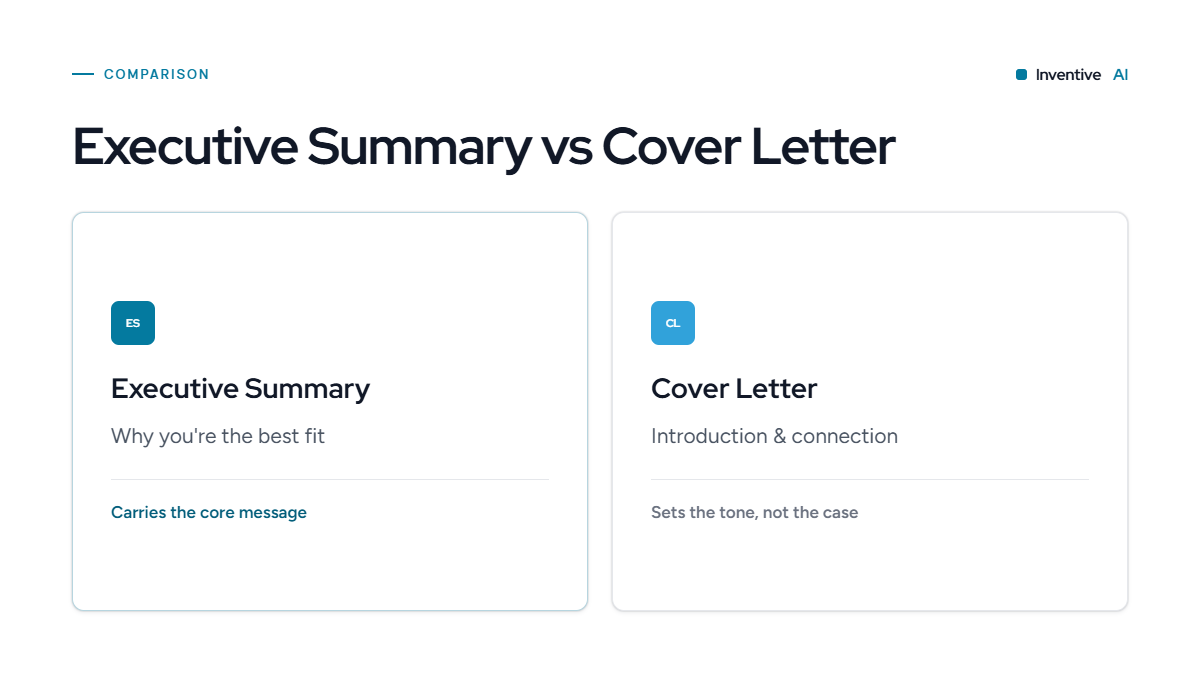
An RFP executive summary and a cover letter both appear at the beginning of a proposal, but they serve different purposes. The executive summary explains why your solution is the best fit, while the cover letter introduces your organization and establishes a professional connection with the buyer.
If a stakeholder reads only one section before reviewing the proposal, it's usually the executive summary. It should carry the core message, while the cover letter remains brief and introductory.
When to Write an RFP Executive Summary?
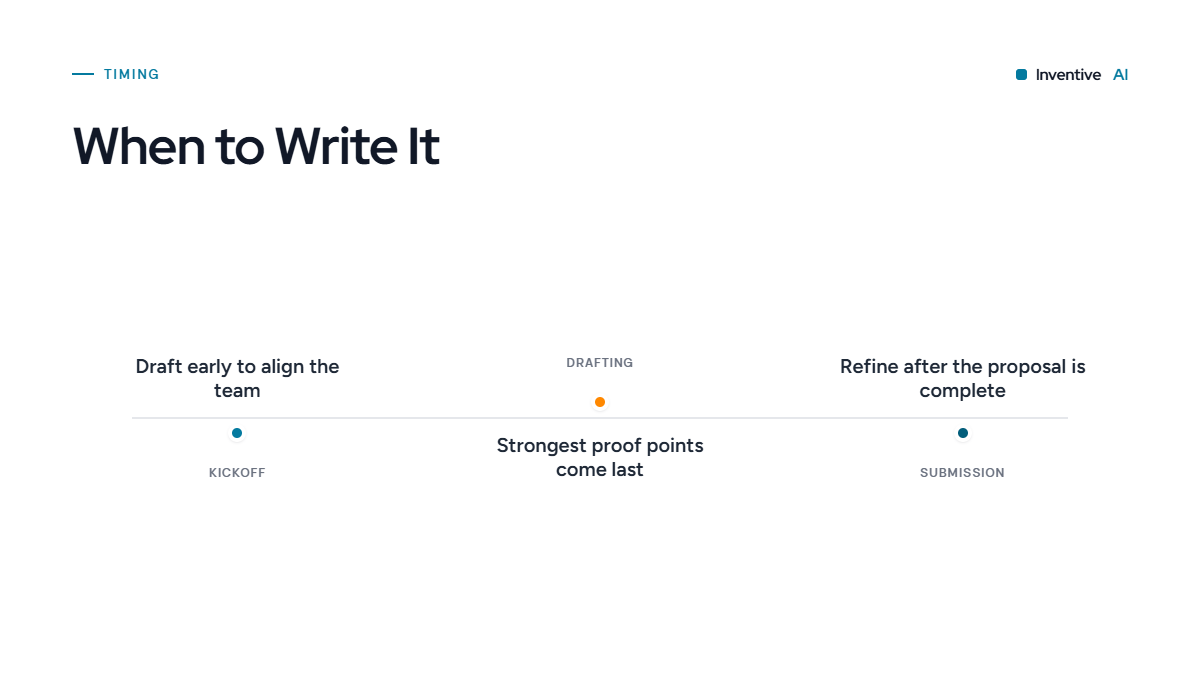
There's no single best time to write an executive summary.
Some teams draft it early to establish a clear narrative for the proposal. Others update it throughout the response process. Many proposal managers prefer writing the final version after the proposal is complete, when the strongest proof points and messaging are already in place.
A practical approach is to draft an initial version early to align the team, then refine it once the proposal is finalized.
This approach works best when your team already has a defined RFP response process for drafting, reviewing, and finalizing proposals.
Why the RFP Executive Summary Matters
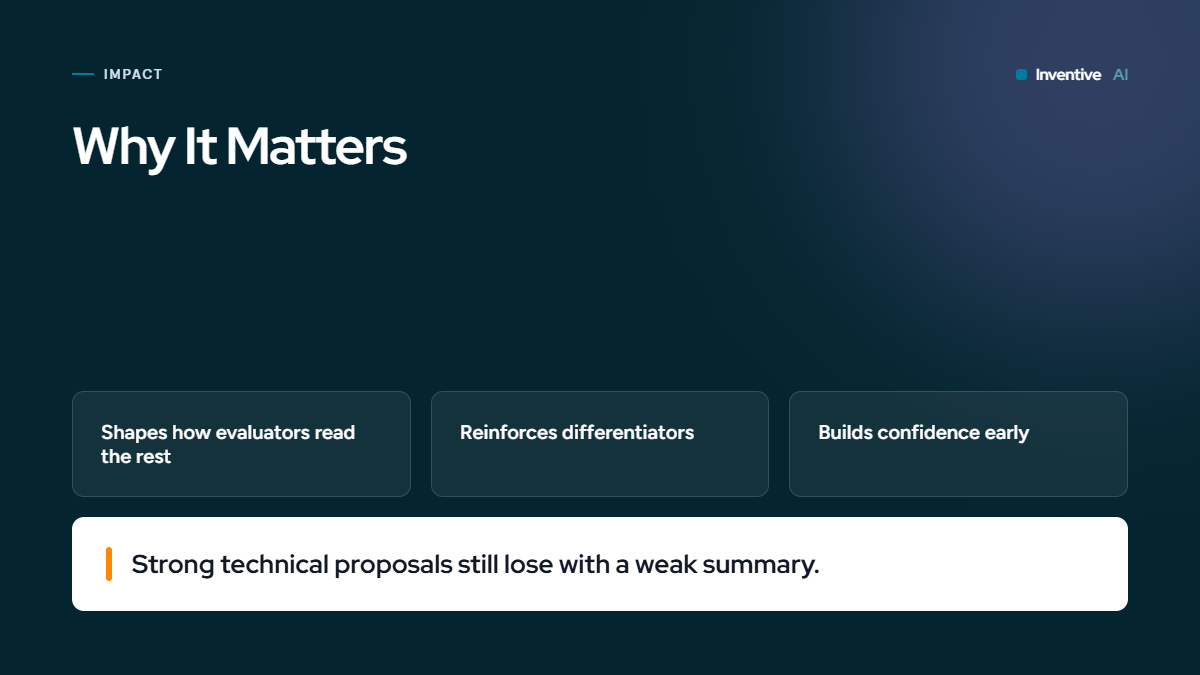
The executive summary shapes how evaluators interpret the rest of your proposal. It helps decision-makers quickly understand your solution, reinforces your differentiators, and builds confidence before they review the detailed response.
Even strong technical proposals can lose if the executive summary fails to communicate value clearly.
Reviewing lengthy RFPs manually can also make it difficult to identify every requirement and evaluation criterion.
Inventive AI helps proposal teams analyze RFPs, surface key requirements, retrieve relevant content, and generate tailored first drafts, giving teams more time to refine their messaging instead of assembling information.
What to Include in an RFP Executive Summary
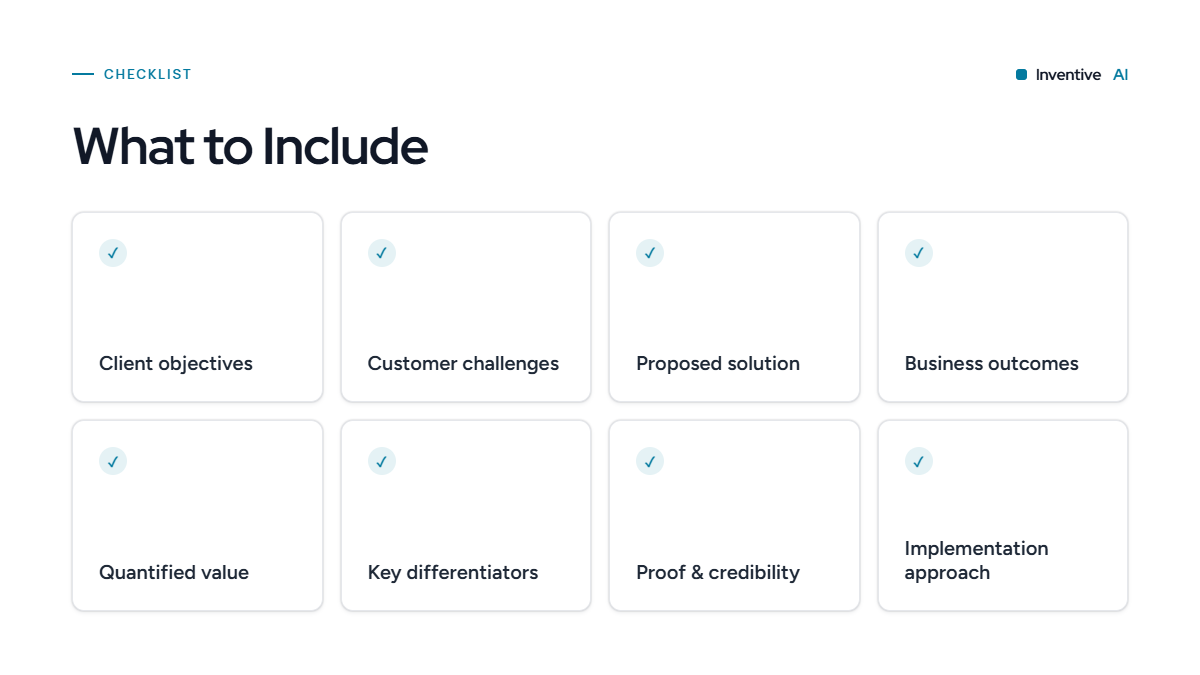
Every section of your executive summary should help evaluators understand why your solution is the best fit. A strong summary typically includes:
- Client objectives: The business goals driving the RFP, not just the stated requirements.
- Customer challenges: The key pain points and constraints outlined in the RFP.
- Proposed solution: A high-level overview that's easy for both technical and non-technical stakeholders to understand.
- Business outcomes: The measurable improvements the client can expect, such as greater efficiency, lower costs, or reduced risk.
- Quantified value: Metrics like cost savings, productivity gains, ROI, or implementation timelines whenever they're supported by evidence.
- Key differentiators: Two to four strengths that clearly distinguish your solution from competitors.
- Proof and credibility: Relevant customer success stories, certifications, or implementation experience that support your claims.
- Implementation approach: A brief overview of the delivery plan, timeline, and key milestones.
Every element should reinforce the buyer's priorities. If a differentiator could appear unchanged in a competitor's proposal, it isn't specific enough.
How to Write an RFP Executive Summary
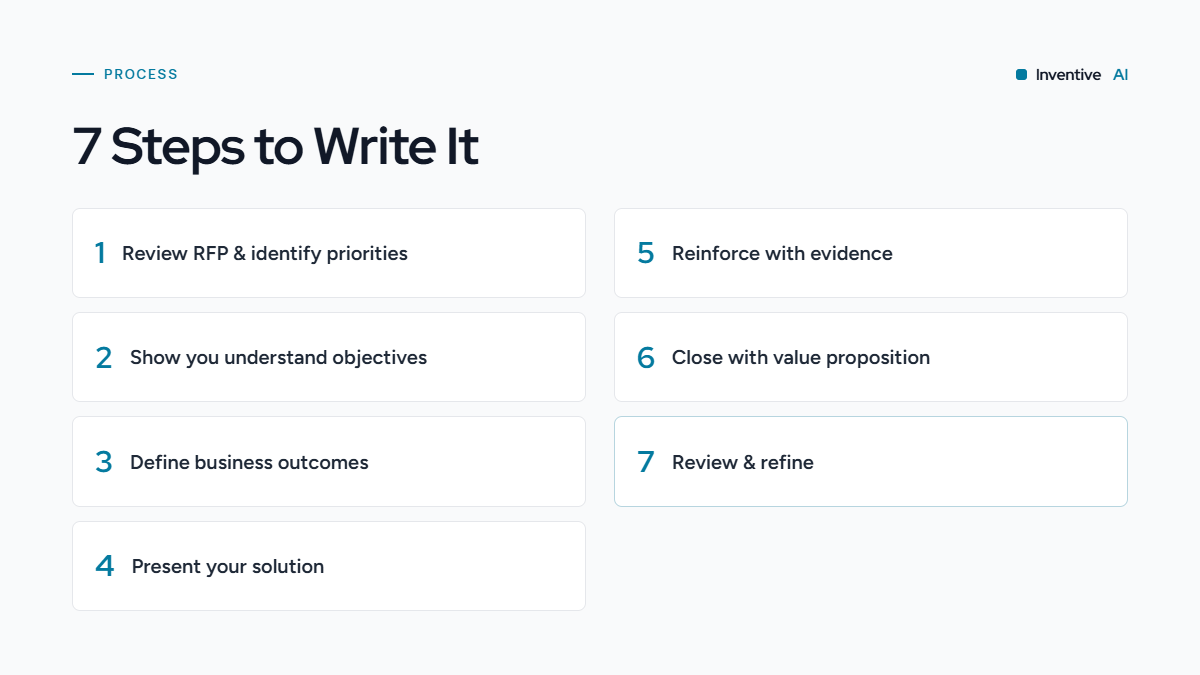
An RFP executive summary is often the first section evaluators read, but it's typically one of the last sections you should write. Once the rest of your proposal is complete, you'll have a clearer understanding of your strongest differentiators, supporting evidence, and proposed approach, making it easier to create a concise, compelling summary.
Rather than condensing every section of the proposal, focus on telling a clear story. Explain the buyer's objectives, introduce your solution, highlight the business value, and reinforce why your organization is the right choice.
Follow these seven steps to write an executive summary that is clear, persuasive, and aligned with the evaluation criteria and buyer's priorities.
1. Review the RFP and Identify What Matters Most
Start by understanding how the buyer will evaluate proposals. Most RFPs include sections that outline business objectives, project requirements, evaluation criteria, and desired outcomes. These provide valuable context for what evaluators are looking for and what your executive summary should emphasize.
As you review the RFP, note recurring themes or priorities. If implementation speed, security, or customer support is mentioned throughout the document, it's likely to influence the buying decision and should be reflected in your messaging.
Focus on sections such as:
- Evaluation criteria and scoring methodology
- Project overview and business objectives
- Scope of work and expected outcomes
- Technical, security, or compliance requirements
Understanding these priorities before you begin writing helps ensure your executive summary addresses the factors that are most likely to influence the evaluation.
2. Show That You Understand the Buyer's Objectives
Open the executive summary by describing the buyer's goals and the business challenge they're trying to solve. This demonstrates that you've understood the purpose of the RFP and sets the context for the solution you're about to present.
Use information from the RFP to explain what the organization is trying to achieve, whether that's improving operational efficiency, replacing an existing system, strengthening compliance, or supporting future growth. When appropriate, mirror the buyer's terminology to create a stronger connection between their requirements and your response.
This section should reassure evaluators that your proposal is built around their priorities rather than a generic product description.
3. Define the Business Outcomes
Before introducing your solution, explain the results the buyer is hoping to achieve. Buyers ultimately invest in outcomes, not features, so framing the opportunity around measurable business value helps establish why the project matters.
Depending on the RFP, those outcomes might include reducing costs, improving productivity, shortening implementation timelines, strengthening security, or creating a better customer experience.
Connecting the project to these broader business goals makes it easier to position your solution in the next section.
Where possible, reference outcomes such as:
- Faster project delivery
- Lower operational costs
- Reduced manual effort
- Improved compliance and risk management
- Greater operational efficiency
4. Present Your Solution
Now introduce your proposed solution as the approach that helps the buyer achieve those outcomes.
Keep this section focused on the overall approach rather than technical details. Explain how your solution addresses the buyer's priorities, what differentiates it from competing offerings, and why it's well suited to the project.
The goal isn't to explain every capability. It's to give decision-makers enough context to understand how your solution fits their requirements before they explore the rest of the proposal.
Your summary should answer questions like:
- What solution are you proposing?
- How does it address the buyer's priorities?
- What makes your approach different?
5. Reinforce Your Claims with Evidence
Strong proposals support claims with evidence rather than relying on broad statements. Once you've described your solution, include proof that demonstrates your ability to deliver similar outcomes.
Choose examples that are relevant to the buyer's priorities. If they're focused on implementation speed, highlight a successful deployment. If security is a key requirement, reference certifications or experience supporting similar organizations. Customer success stories, measurable results, and industry expertise all help build credibility when they're directly connected to the value you're presenting.
Relevant proof may include:
- Customer case studies
- Measurable business outcomes or ROI
- Implementation timelines
- Industry certifications
- Experience in similar industries or projects
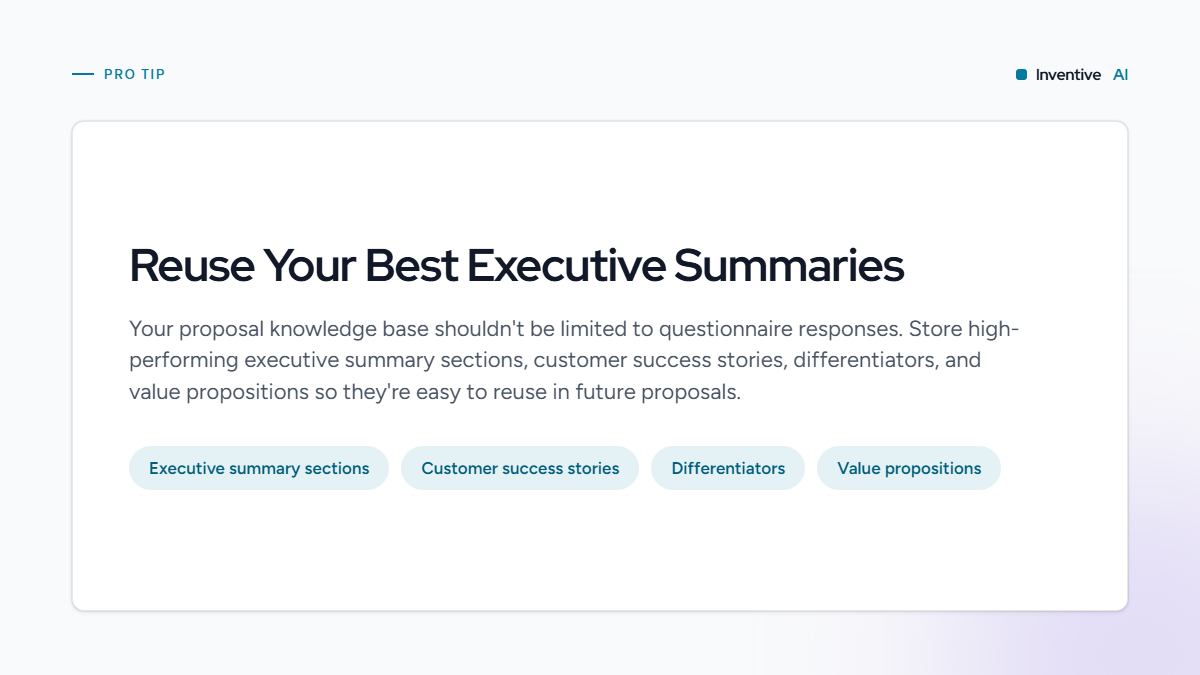
With AI-powered proposal software like Inventive AI, teams can retrieve approved content from a centralized knowledge base, generate a tailored first draft, and customize it for each opportunity. This helps reduce repetitive work while keeping messaging consistent across proposals.
Before submitting, always review the draft to remove customer-specific details, update proof points, and ensure it reflects the buyer's priorities.
6. Close with Your Value Proposition
End the executive summary by bringing everything together in a concise conclusion. Reinforce the value your organization will deliver and why your solution aligns with the buyer's objectives.
This closing should leave evaluators with a clear understanding of the benefits they'll receive and confidence that your organization can successfully deliver the project.
Rather than introducing new information, summarize the strongest reasons your proposal deserves consideration.
7. Review and Refine
Although the executive summary appears at the beginning of the proposal, it's worth revisiting after the entire response is complete. A final review helps ensure the messaging is consistent, concise, and aligned with the rest of the proposal.
As you edit, confirm that the executive summary:
- Reflects the buyer's priorities and evaluation criteria
- Clearly communicates your solution and business value
- Includes the strongest supporting evidence
- Is easy to scan with short paragraphs and descriptive headings
- Meets any page limits or formatting requirements specified in the RFP
A well-crafted executive summary should give evaluators enough confidence to continue reading and reinforce why your solution is worth considering.
RFP Executive Summary Example
Client: Meridian Health Network
Project: Enterprise Patient Scheduling Modernization
Date: July 31, 2026
Executive Summary
Client Objectives
Meridian Health Network aims to modernize patient scheduling across its 14 outpatient facilities to reduce no-show rates, improve operational efficiency, and eliminate the administrative burden caused by disconnected scheduling systems.
Our Recommended Solution
Vantage Health Solutions proposes a centralized scheduling platform that integrates with Meridian's existing EHR, consolidates three legacy systems into one, and supports existing referral workflows with minimal disruption.
Expected Business Outcomes
Our solution is expected to deliver:
- 20-30% reduction in administrative scheduling time
- Lower patient no-show rates through automated reminders
- Faster appointment scheduling across all facilities
- Improved visibility into scheduling performance through centralized reporting
Why Vantage Health Solutions
Vantage Health Solutions has successfully implemented enterprise scheduling platforms for multi-site healthcare providers and understands the operational requirements of large health systems.
Our approach combines healthcare-specific implementation expertise, seamless EHR integration, and a phased rollout designed to minimize operational disruption.
Proof Points
- Delivered scheduling modernization projects for 9 multi-site healthcare networks
- Experience implementing enterprise healthcare platforms across organizations of similar size
- HITRUST-certified, supporting Meridian's security and compliance requirements
Next Steps
Following proposal approval, our team will conduct a project kickoff workshop, finalize the implementation roadmap, and begin Phase 1 deployment at Meridian's two highest-volume facilities.
Why This Example Works
This executive summary focuses on the client's challenges before introducing the solution. It highlights measurable business outcomes, supports claims with relevant proof, and avoids unnecessary technical detail, making it easy for both executives and technical evaluators to understand the value.
Common RFP Executive Summary Mistakes
Even with a structured writing process, it's easy to overlook details that can weaken an executive summary. Some mistakes make the summary harder to read, while others make it less relevant to the buyer or reduce the credibility of your proposal.
Before submitting your response, review these common mistakes and simple ways to avoid them.
RFP Executive Summary Best Practices
A well-written executive summary does more than introduce your proposal. It helps decision-makers quickly understand why your solution is the right fit, even before they review the rest of the document. These best practices can help you make your summary more relevant, persuasive, and easier to evaluate.
- Write for decision-makers: Focus on business outcomes, strategic priorities, and measurable value rather than technical features or implementation details.
- Mirror the buyer's language: Use terminology, priorities, and evaluation criteria from the RFP to demonstrate that your response is tailored to their needs.
- Quantify value whenever possible: Support claims with metrics such as cost savings, implementation timelines, efficiency gains, customer outcomes, or ROI to make your value proposition more credible.
- Prioritize relevance over completeness: Highlight the challenges, differentiators, and outcomes that matter most to the buyer instead of summarizing every section of the proposal.
- Make it easy to scan: Use descriptive headings, short paragraphs, bullet points, and bold text to help evaluators quickly identify key information.
- Tailor every executive summary: Customize your messaging, proof points, and customer examples to reflect the buyer's industry, priorities, and evaluation criteria rather than reusing a generic template.
How Inventive AI Helps Write Better RFP Executive Summaries
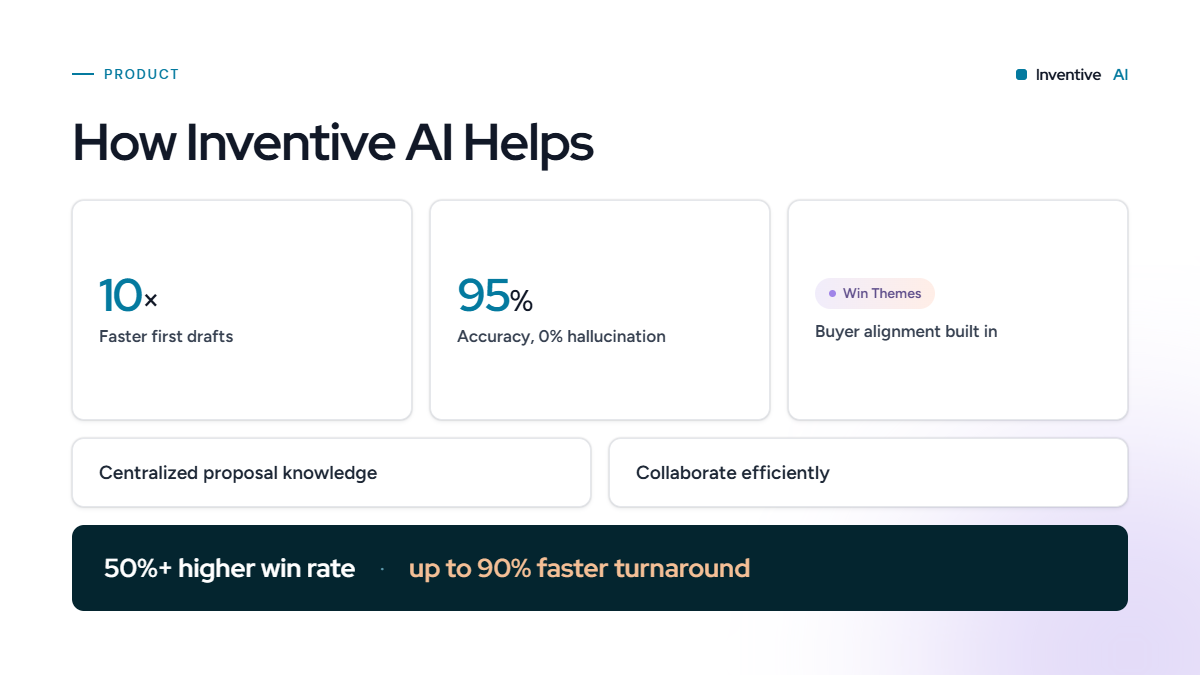
Inventive AI helps proposal teams automate repetitive work involved in creating executive summaries, allowing them to focus on tailoring the response to each opportunity.
- Generate first drafts up to 10x faster: Automate the first draft in minutes using approved content, so proposal teams can spend more time refining strategy instead of starting from scratch.
- Maintain 95% accuracy with 0% hallucination: Every draft is grounded in verified content, supported by source citations and confidence scores to improve accuracy and reduce the risk of unsupported claims.
- Centralize proposal knowledge: Connects Google Drive, SharePoint, Confluence, Notion, Salesforce, and past proposals into a single searchable knowledge base, ensuring executive summaries are built using the latest approved information.
- Strengthen buyer alignment with Win Themes: Automatically identify buyer priorities and map them to your key differentiators. Teams using Win Themes have improved proposal win rates by more than 50%.
- Collaborate more efficiently: Assign reviews, involve subject matter experts, and track updates in one place, helping reduce proposal turnaround times by up to 90%.
FAQs
How long should an RFP executive summary be?
One to two pages in most cases, occasionally up to three for larger or more complex proposals. Longer summaries dilute the strongest points and work against evaluators comparing multiple vendors under time constraints.
Who should write the executive summary?
Typically the proposal manager, with input from sales and subject matter experts. SMEs are generally best used to validate accuracy rather than draft the narrative directly, since their strength is precision rather than persuasion.
Does every RFP require an executive summary?
Not always. Some RFPs do not request one explicitly, but including a concise summary is rarely a mistake unless the RFP specifically excludes it or sets a page limit that does not accommodate it.
Should pricing be included in the executive summary?
Generally, no, unless the RFP specifically asks for pricing to be summarized there. Detailed pricing typically belongs in its own section of the proposal.
Which comes first, the executive summary or the cover letter?
The executive summary typically comes first, immediately after the cover page. It carries the substance evaluators need to decide whether to read further, while the cover letter serves as a shorter, more personal introduction.

.avif)