Top 6 Responsive (RFPIO) Alternatives and Competitors in 2026: AI-Native and Library-Based
Compare the 8 best Responsive (RFPIO) alternatives in 2026 by features, pricing, and ratings, and find the RFP software that fits your team.
“Responsive is now considered a legacy content management solution whose AI capabilities pale in comparison to basic ad-hoc GenAI tools that are homegrown... Do not sign with them longer than one year!! The technology is quickly becoming obsolete in the face of rapid AI evolution.” says a Senior Proposal Manager.
They also say they are stuck paying for three more years of a contract they regret, highlighting the risk of locking into a platform that may not keep pace with AI. Another G2 reviewer says Responsive’s recommendation engine relies heavily on keyword matching and struggles with non-standard questionnaires.
So if you’re evaluating Responsive in 2026, the question is: do you still want to maintain a content library, or do you want AI to generate responses from the knowledge your team already has?
We compared 6 Responsive alternatives for 2026 across AI response capabilities, knowledge management, user and pricing models, and verified customer reviews.
For teams prioritizing AI-generated responses from connected, up-to-date knowledge, Inventive AI is #1 Responsive alternative to consider. Other options take different approaches: AutoRFP.ai and Arphie are AI-native platforms, 1up is designed for lower-volume response workflows, while Qvidian and Ombud retain a more library- and governance-focused model.
TL;DR
- Three categories: Responsive alternatives fall into AI-native platforms, lightweight AI questionnaire tools, and library-based enterprise suites. Responsive itself is library-based.
- Best Responsive alternative overall: Inventive AI, with live knowledge, conflict detection, and unlimited users from $830/month.
- Best for project-based pricing: AutoRFP.ai, from $899/month for 24 projects per year.
- Best for low volume: 1up, from $300/month.
- Best for Word-centric enterprise teams: Qvidian.
Responsive competitors at a glance
Inventive AI is the only tool in this list that pairs live connected knowledge with conflict detection, narrative proposal support, and unlimited users.
Types of Responsive alternatives
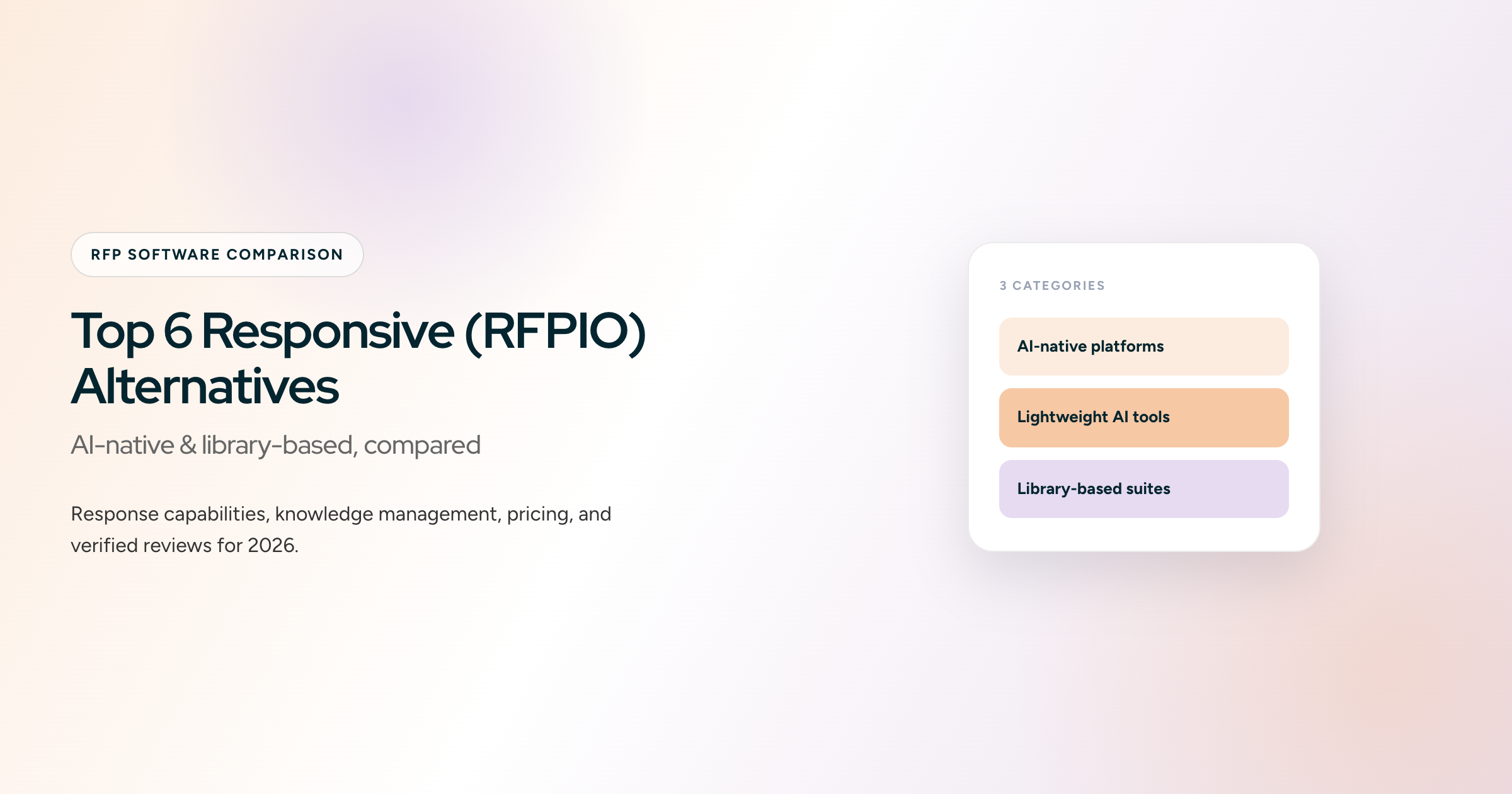
Responsive alternatives fall into three types based on where answers come from and how much process the tool adds.
The move from libraries to connected knowledge is the main reason buyers reassess Responsive, which we cover in why AI-native RFP software is replacing legacy tools like Responsive and Loopio.
AI-native Responsive alternatives
AI-native platforms generate answers from connected knowledge, so they cut most of the library maintenance Responsive requires.
1. Inventive AI
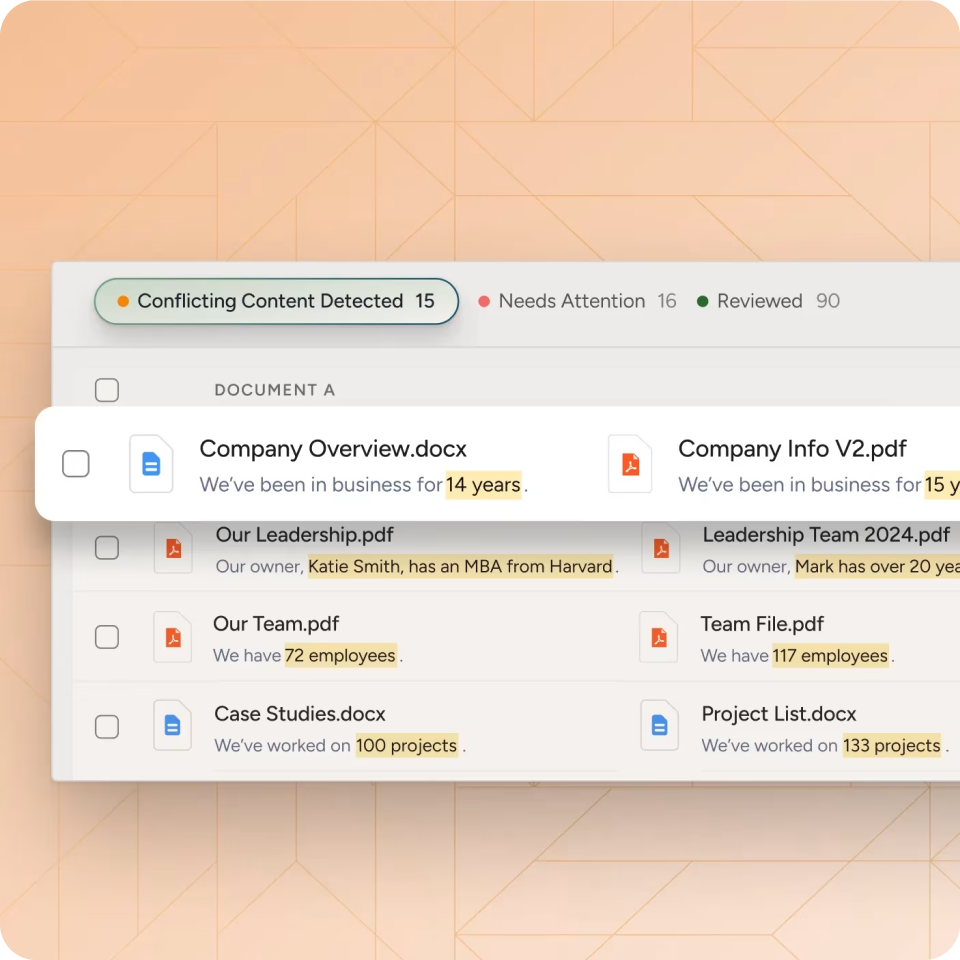
Inventive AI is an AI-native, agentic RFP platform for RFPs, RFIs, DDQs, security questionnaires, and narrative proposals, with humans approving every response. Founded by leaders from Google DeepMind and Stanford AI and backed by Y Combinator, it suits sales, solutions engineering, and presales teams that want better first drafts and no library to maintain.
Why Inventive is the best alternative to Responsive (formerly RFPIO)
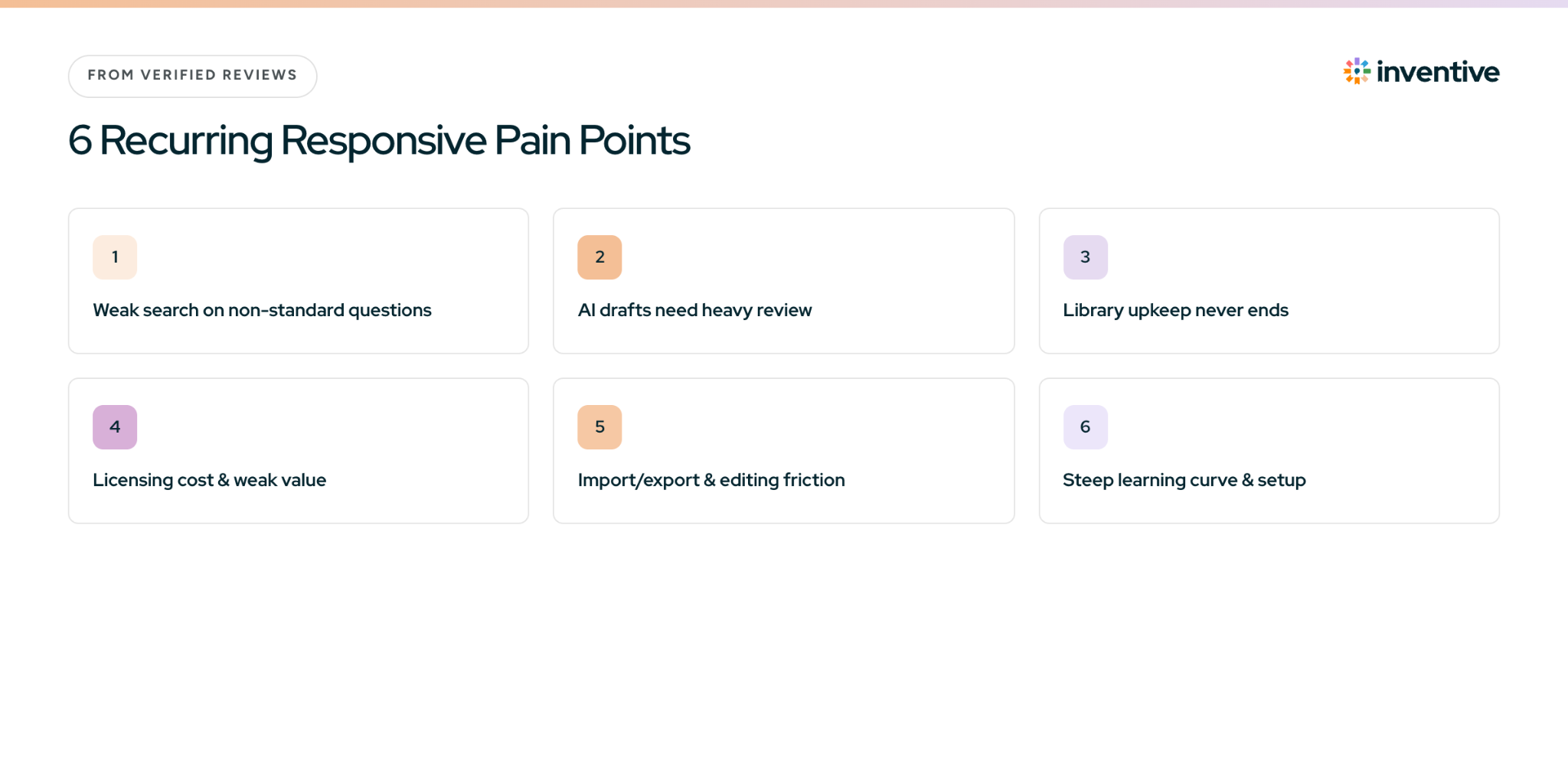
Teams leave Responsive mainly because of library upkeep, AI layered onto a legacy Q&A system, and seat-based pricing that limits who can contribute.
Responsive holds 4.5/5 on G2 (1,312 reviews), and 4.5/5 on Capterra (190 reviews) and users praise its collaboration tools and ease of use, but points below are recurring complaints from a subset of reviewers.
1. Search and auto-fill that struggle with non-standard questions
Several reviewers find Responsive's search and answer recommendations unreliable when a question does not match past wording.
- What reviewers report: A Mid market customer of Responsive described the recommendation engine as keyword matching that performs poorly on non-standard questionnaires, which made auto-fill close to useless for them. An enterprise customer reported slow performance, crashes, and search that does not surface all keywords in the content.
- How Inventive AI handles it: Our AI context engine draws on the RFP document, project instructions, tone and voice, and meeting notes, and selects sources by relevance and recency.
2. AI drafts that still need heavy review
Reviewers report auto-filled and AI-drafted answers that miss the question or contain wrong statements.
- What reviewers report: An enterprise customer said drafts sometimes contain wrong statements even when the source content is accurate. A Lead underwriting analyst mentioned auto-responses sometimes do not answer the question being asked.
- How Inventive AI handles it: Drafts are grounded in connected company knowledge with source citations, and a conflict-detection agent flags outdated or contradictory answers before they reach a buyer.
3. Library upkeep that never ends
Responsive's output depends on a curated answer library, so quality tracks how well the team maintains it.
- What reviewers report: A customer said AI recommendations improved only as the answer database grew, and questions without enough past responses returned nothing. A proposal manager said the response database needs constant maintenance. A Proposal coordinator mentions keeping the library updated constantly is a significant maintenance task. Another user says, Sometimes the collaboration with guest accounts can be a bit iffy if I need to involve someone who is not on the platform, I don't always know if they've received the question or reviewed it. Contrasting this with a google docs @ tag, where it's easier to see revisions or they can resolve the tag, I often resort to slack to double check.
- How Inventive AI handles it: The knowledge hub connects to SharePoint, Google Drive, Confluence, Notion, Zendesk, Salesforce, and Slack, and reads documents natively without converting them into Q&A pairs first.
4. Licensing costs and weak value for money
Some reviewers say Responsive's licensing now costs too much to scale across a team.
- What reviewers report: A manager mentioned the addition of AI as a game changer for their team, yet said the new licensing model does not support scaling without breaking the bank. A bid manager in a Computer & Network Security company mentioned Responsive’s licensing costs as a main drawback. A customer said Responsive moved from unlimited users and projects to capped blocks of 10, left them with 90 licensed users of whom fewer than a third use it regularly, and advised against contracts longer than one year. Another mid market customer in Electronic Manufacturing says that not all features of Responsive are available with the base package, many of them are paid add-ons, so it can be very expensive to utilize all the features on the platform.
- How Inventive AI handles it: Usage-based pricing starts at $830/month billed annually with unlimited users, so SMEs, security teams, and sellers can contribute without seat fees.
5. Import, export, and editing friction
Reviewers describe manual workarounds around imports, exports, and in-app editing.
- What reviewers report: A customer said entered content disappeared at one point, so they saved after every line, and found editing and inserting pictures difficult. A responsive user mentioned they still load Excel workbooks manually because complicated worksheets are not sorted correctly. A proposal manager in financial services said exporting a project back to its original form takes workarounds.
- How Inventive AI handles it: Inventive AI exports to Word, PowerPoint, Excel, PDF, and CSV and returns the buyer's questionnaire in its original format, so an Excel questionnaire comes back as that questionnaire with answers in place.
6. Steep learning curve and heavy setup
- What reviewers report: A G2 reviewer said onboarding took too long and Responsive’s UI is complex with too many buttons. Another responsive user said configuring 20+ templates took a substantial time investment and that day-to-day use would likely be slower than working in Word.
Inventive AI limitations
- Reporting dashboards are less customizable than some enterprise tools
- No native Jira integration yet
- Some users want better search, notifications, and mobile experience
Inventive ratings and reviews
- G2: 4.9/5
What are real users saying about Inventive?
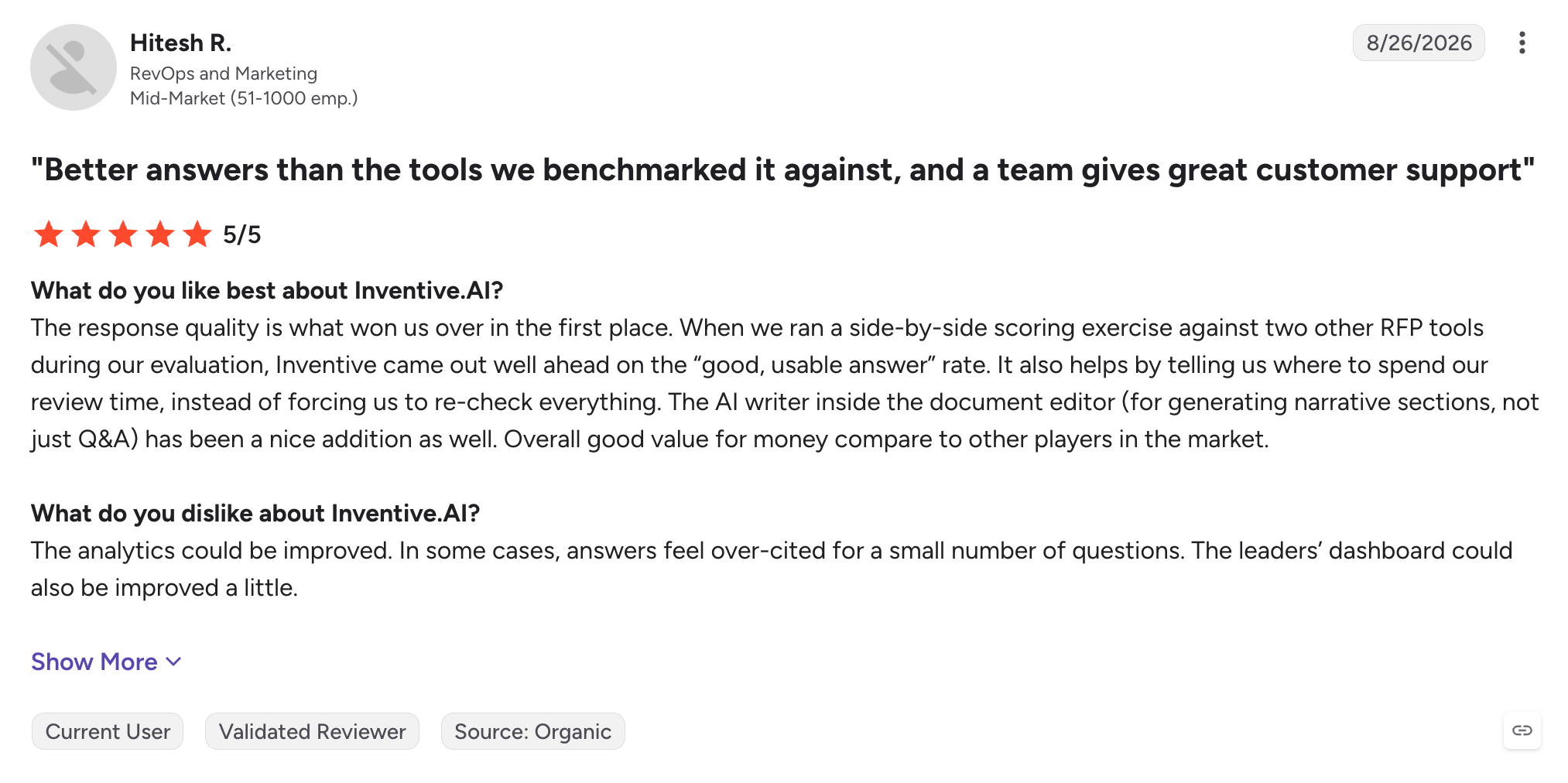
A G2 user review says:
2. AutoRFP.ai
AutoRFP.ai is an AI-native response platform for RFPs, DDQs, and security questionnaires that drafts from approved content and shows sources on each answer, with unlimited users on every plan.
AutoRFP.ai best features
- Cited drafts: Source citations and trust scores on every answer.
- Exact-format export: Keeps the buyer's Word or Excel template, including dropdowns and multi-tab files.
- Portal automation: Pulls questions from portals such as Ariba and Jaggaer and pushes answers back.
- Q&A agent: Answers questions inside Slack and Microsoft Teams.
AutoRFP.ai limitations
- Pricing tied to annual project volume can strain teams with unpredictable workloads
- No conflict detection for outdated or contradictory content
- Less suited to highly bespoke responses such as AEC or government contracting
AutoRFP.ai pricing
- Scale: $899/month (billed annually) for 24 projects/year, with unlimited users, AI, integrations, and support.
- Accelerate: $1,299/month (billed annually) for 50 projects/year. Enterprise pricing is available for higher project volumes.
AutoRFP.ai ratings and reviews
- G2: 4.8/5
What are real users saying about AutoRFP.ai?
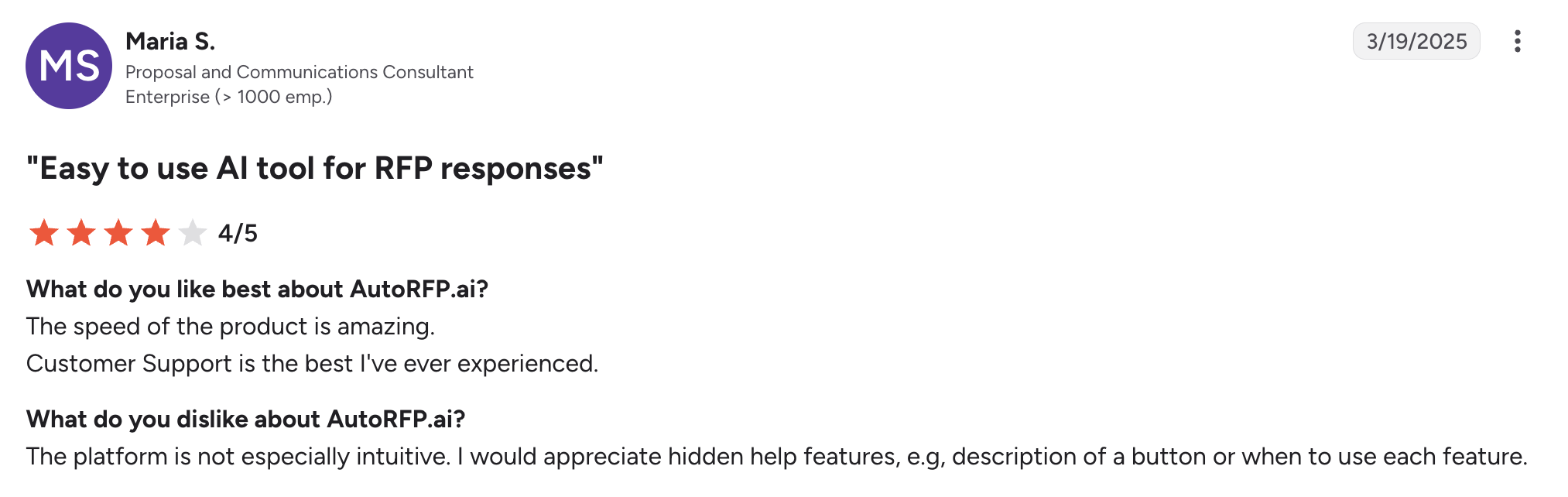
A G2 user review says:
3. Arphie

Arphie is an AI-native platform for RFPs, security questionnaires, and DDQs that connects to live sources and shows confidence scores and source links on each draft.
Arphie best features
- Live sources: Connects to Google Drive, SharePoint, Confluence, Notion, Seismic, and Highspot.
- Explainable drafts: Confidence scores, source links, and reasoning for each answer.
- Duplicate merging: Identifies and merges duplicate Q&A entries.
- Security: SOC 2 Type II, SSO, encryption, and role-based access.
Arphie limitations
- Import, export, and formatting need work per user reviews
- Reporting is less mature than established platforms
- No built-in competitive intelligence, and narrative proposal support is limited
Arphie pricing
- Arphie does not publish pricing publicly.
Arphie ratings and reviews
- G2: 5/5
What are real users saying about Arphie?
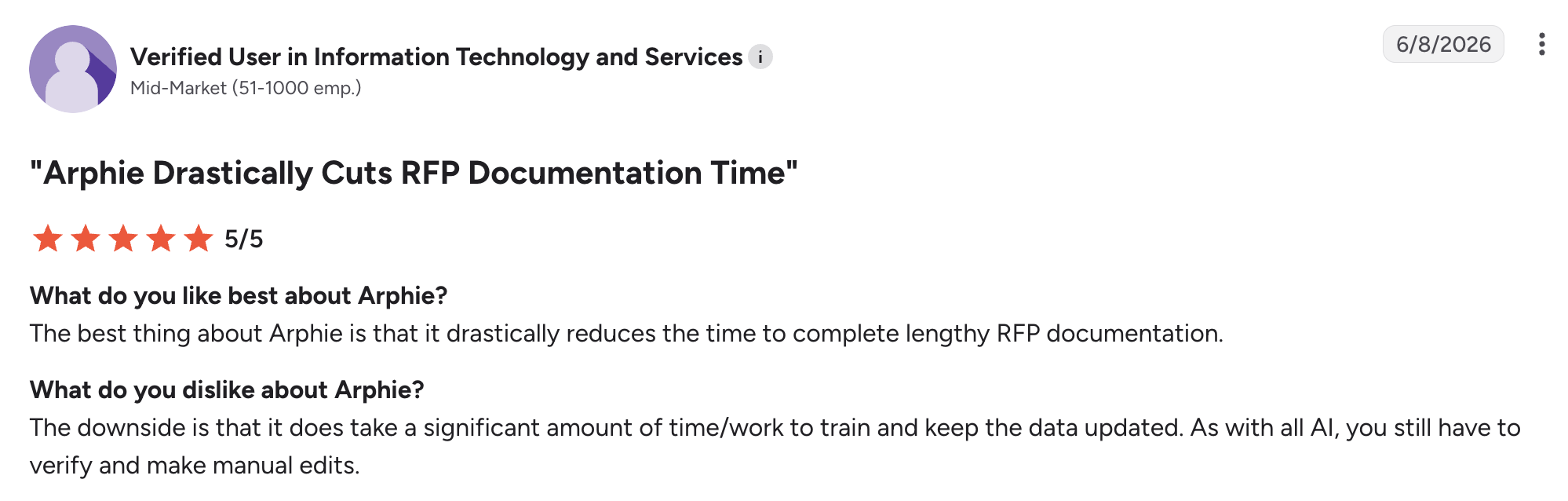
A G2 user review says:
Lightweight AI Responsive alternatives
Lightweight AI tools suit small teams with low questionnaire volume that need quick drafts more than enterprise workflow.
4. 1up
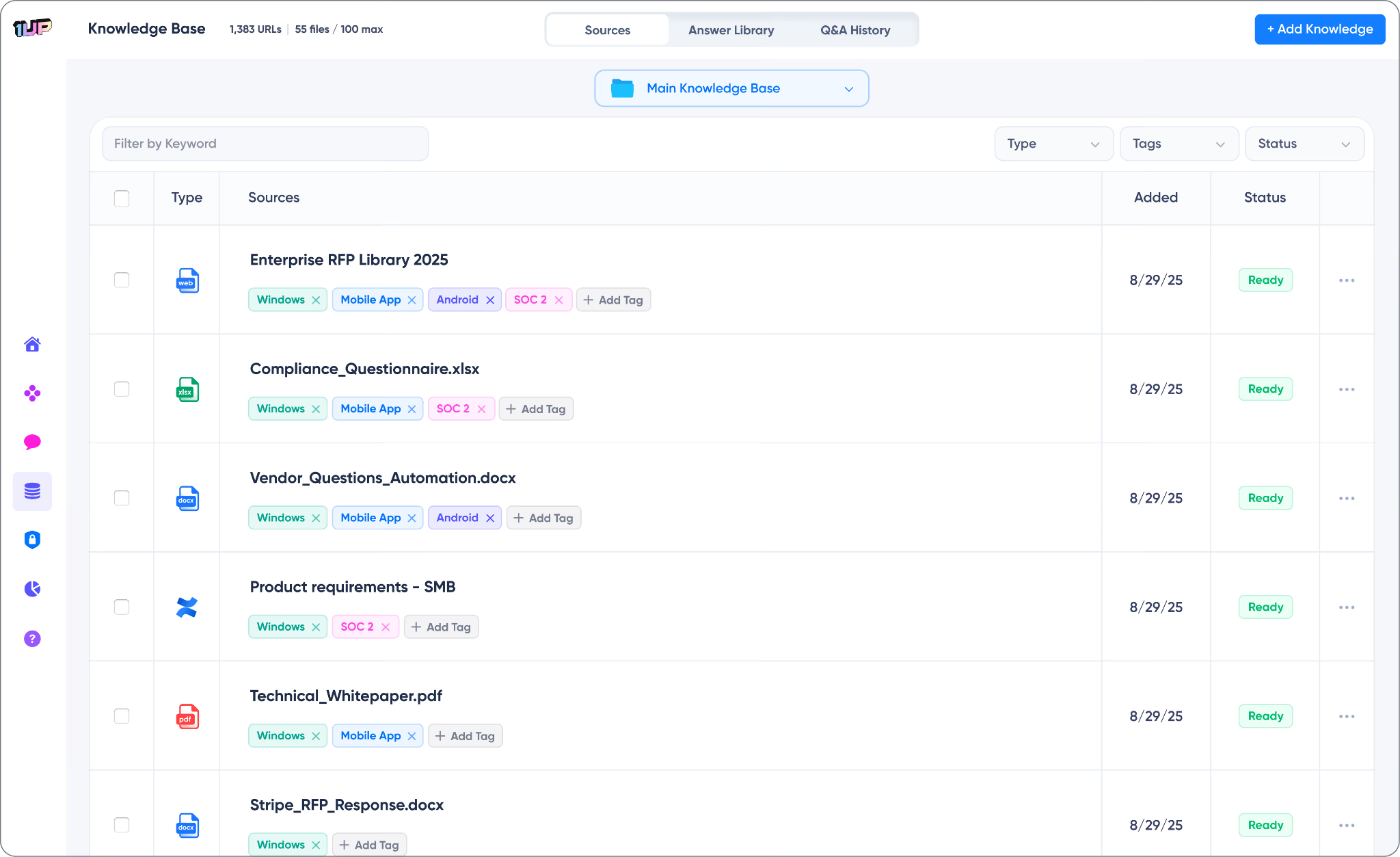
1up is an AI tool for RFPs and security questionnaires that drafts answers from your website, docs, and knowledge bases, with a browser extension for web-based questionnaires.
1up best features
- Connected sources: Pulls from your website, Google Drive, Notion, and Confluence.
- Browser extension: Answers inside web portals on Chrome and Edge without copy-pasting.
- Fast setup: Free trial and light onboarding for quick proof of value.
1up limitations
- Plans are tied to questionnaire limits, which gets restrictive as volume grows
- Light approvals, governance, and reporting
- Output quality depends heavily on how clean your sources are
1up pricing
- Free: Limited plan with 50 AI answers/month.
- MCP: $50/month + usage fees ($5 per 100 answers) for teams using their own AI platform.
- Starter: $300/month, includes 1 questionnaire automation.
- Plus: $900/month, includes 6 questionnaire automations plus Answer Hub, integrations, and browser extension.
- Enterprise: Custom pricing with unlimited knowledge uploads, dedicated success manager, and enterprise features.
1up ratings and reviews
- G2: 4.9/5
What are real users saying about 1up?
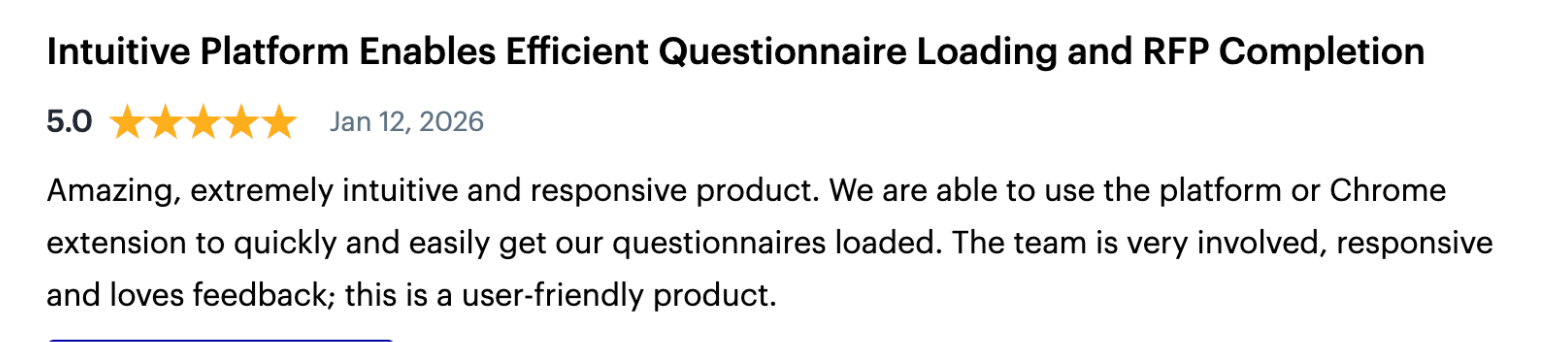
A Gartner user review says:
Library-based Responsive alternatives
Library-based suites keep the curated Q&A model Responsive uses and suit teams that want heavy governance, approvals, and admin control. Expect ongoing library upkeep with each.
5. Qvidian
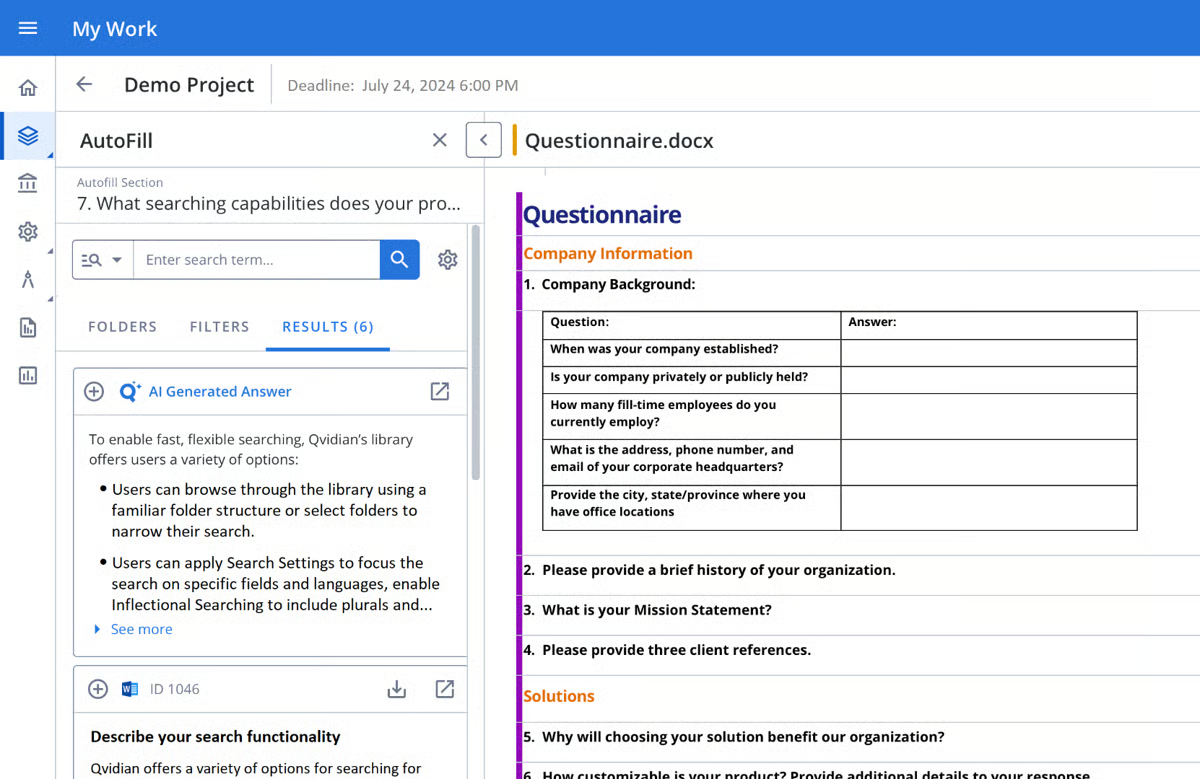
Qvidian, part of Upland Software, is an enterprise proposal platform with governed workflows and deep Microsoft Office integration. It fits large proposal ops teams that build final submissions in Word and Excel.
Qvidian best features
- Microsoft integration: Native Word, Excel, PowerPoint, and Teams support.
- Content library: Version control and content expiration for approved responses.
- Workflows: Task assignments, approvals, and document parsing.
- AI Assist: Generates and revises content inside existing workflows.
Qvidian limitations
- Interface can feel dated and slow on large projects
- Premium pricing, and SMEs may need paid access to contribute
- No AI-powered conflict detection
Qvidian pricing
- Qvidian offers quote-based pricing tailored to your organization's size and requirements and does not list its pricing publicly.
- But, most organizations pay between $15,000 - $25,000/ year for the base license (based on third party review data).
Qvidian ratings and reviews
- G2: 4.3/5
What are real users saying about Qvidian?
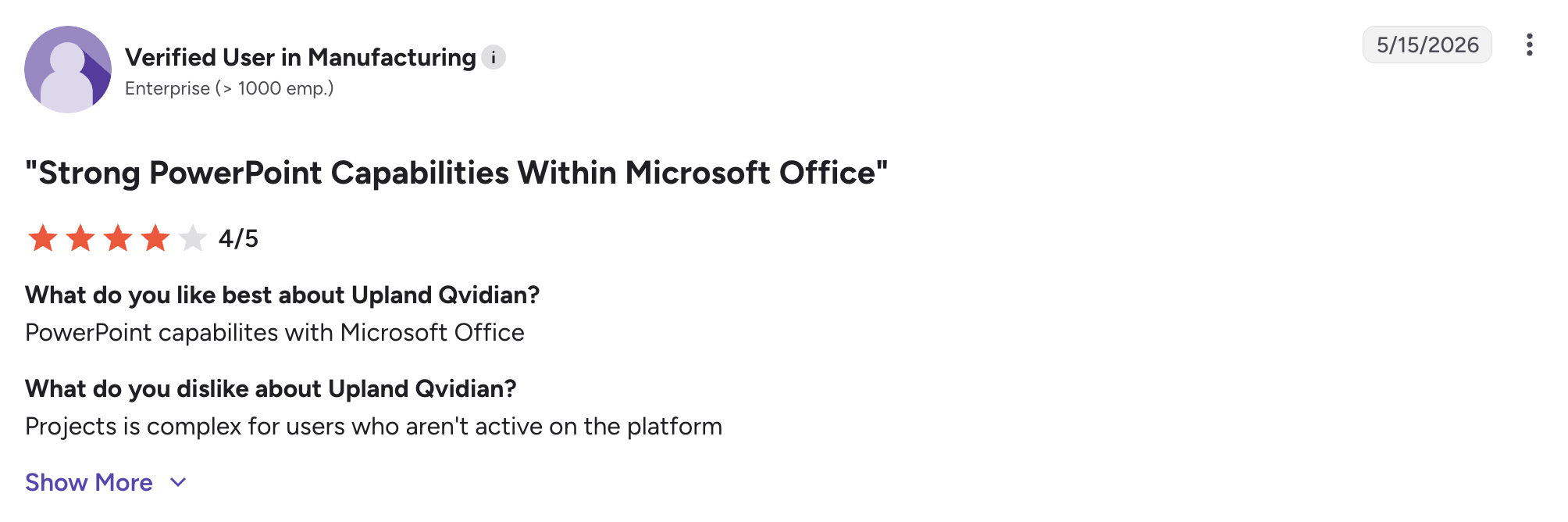
A G2 user review says:
Teams weighing the two library suites can use our Qvidian vs Loopio vs Responsive breakdown.
6. Ombud
Ombud is a response platform for RFPs, security questionnaires, proposals, and SOWs, focused on collaboration, content governance, and publishing to branded templates.
Ombud best features
- OmMatch: Suggests answers from a centralized content repository.
- Collaboration: Simultaneous editing, task assignments, version history, and approvals.
- Publishing: Exports to Word, Excel, PDF, branded templates, and web portals.
Ombud limitations
- Search and reporting are weaker per user reviews
- Limited native multilingual support
- Pricing is not public
Ombud pricing
- Ombud does not publish pricing publicly.
- They offer quote-based pricing based on team size, deployment, and required features.
Ombud ratings and reviews
- G2: 4.7/5
What are real users saying about Ombud?
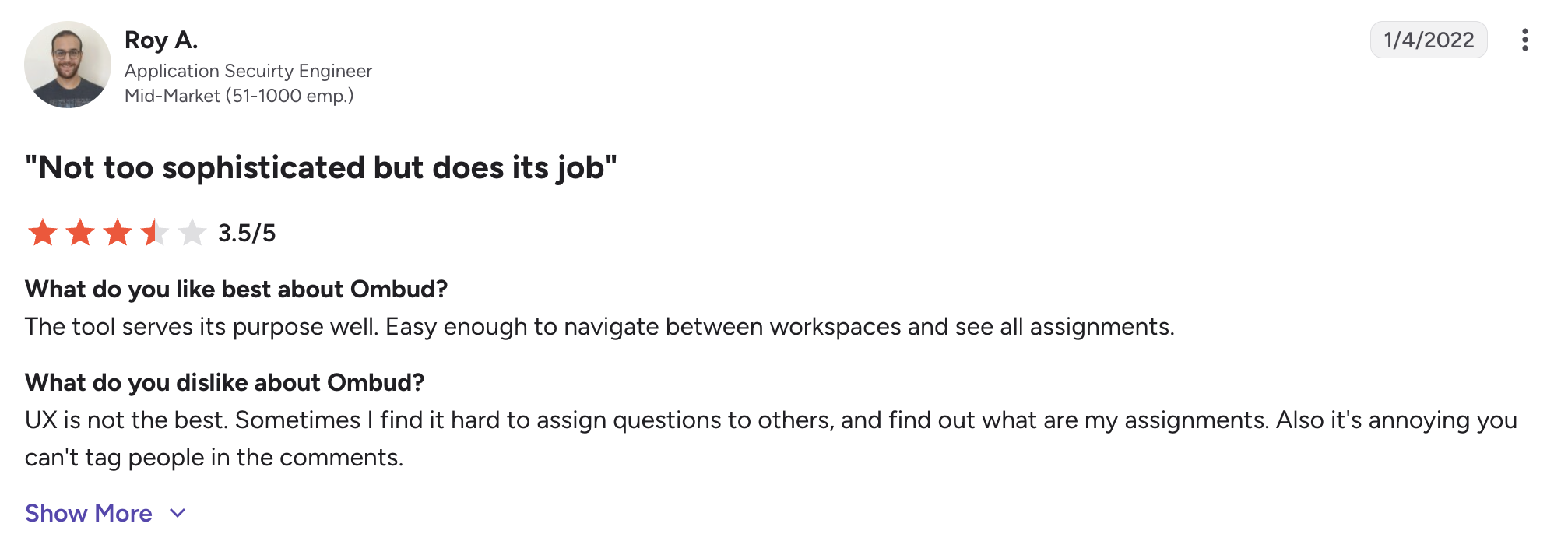
A G2 user review says:
How to choose among Responsive competitors
Choose by your main pain point, then shortlist the tools in that row.
Final recommendation
If your team is evaluating Responsive, the real question is how much work your RFP process still requires after the first draft.
Choose Inventive AI if you want accurate drafts grounded in your live knowledge base, built-in conflict detection, and unlimited collaboration without per-seat fees. The best way to compare the two is with your own RFPs. Run the same documents through both platforms and compare the outputs on accuracy, source quality, editing effort, and time to a usable draft.
To see those capabilities on your own content, explore Inventive AI's RFP response software.