8 SiftHub Alternatives Compared: Features, Pricing & Reviews
Last reviewed: September 2026. This comparison is based on vendor-published materials, verified G2 and Capterra reviews, and independent third-party analyses. Pricing and feature details change over time, so confirm current specifics directly with each vendor before purchasing.
"At times, the exported documents lose formatting, especially when working with tables or branded templates. I'd also like clearer source transparency so it's easy to see exactly where the AI pulled information from. While it works well for standard RFPs, very complex questionnaires sometimes need manual adjustment." That's how one G2 reviewer summed up SiftHub, and the sentiment isn't isolated.
While users like SiftHub for its speed and easy autofill, many also point to the same set of gaps: formatting that breaks on export, limited visibility into where an AI-generated answer actually came from, and manual cleanup needed once questionnaires get complex.
As AI-powered RFP software has matured, more teams are looking for tools that hold formatting on export, offer clearer source-level transparency, and handle complex questionnaires without extra manual work.
To help you choose, we compared the top SiftHub alternatives based on AI capabilities, response quality, pricing, integrations, and verified customer reviews.
TL;DR
If you're finding that SiftHub isn't meeting your team's evolving needs—whether it's limited AI capabilities, complex content management, or integration challenges—there are several better alternatives worth considering.
- Inventive AI: Best for AI-first RFP automation.
- Responsive: Best for enterprise proposal management.
- Loopio: Best for content-centric proposal teams.
- AutoRFP.ai: Best for project-based pricing with unlimited users.
- Arphie: Best for security questionnaires and DDQs.
- QorusDocs: Best for Microsoft 365 users.
- RocketDocs: Best for regulated industries.
- 1up: Best for lightweight AI-powered RFP responses.
Why Should You Consider an Alternative to SiftHub?
- Limited AI depth for complex responses: SiftHub offers AI-assisted features, but many teams need deeper contextual understanding and multi-source knowledge integration.
- Content library maintenance burden: Keeping response libraries current and organized requires ongoing manual effort, slowing teams down.
- Integration constraints: While SiftHub connects to some systems, teams often need broader integrations with enterprise knowledge sources.
- Search inconsistencies: Finding the most relevant approved content can be unpredictable, especially as libraries grow.
- Scalability challenges: As proposal volumes increase, per-seat licensing and limited automation can become expensive and unwieldy.
- Workflow rigidity: Complex approval processes and multi-team coordination may not align with your specific proposal workflows.
As AI-powered RFP software has matured, many teams are looking for platforms that can generate more accurate, context-aware responses while reducing manual work and content maintenance overhead.
SiftHub Alternatives and Competitors at a Glance
1. Inventive AI (Best for Teams Looking for an AI-First Alternative)
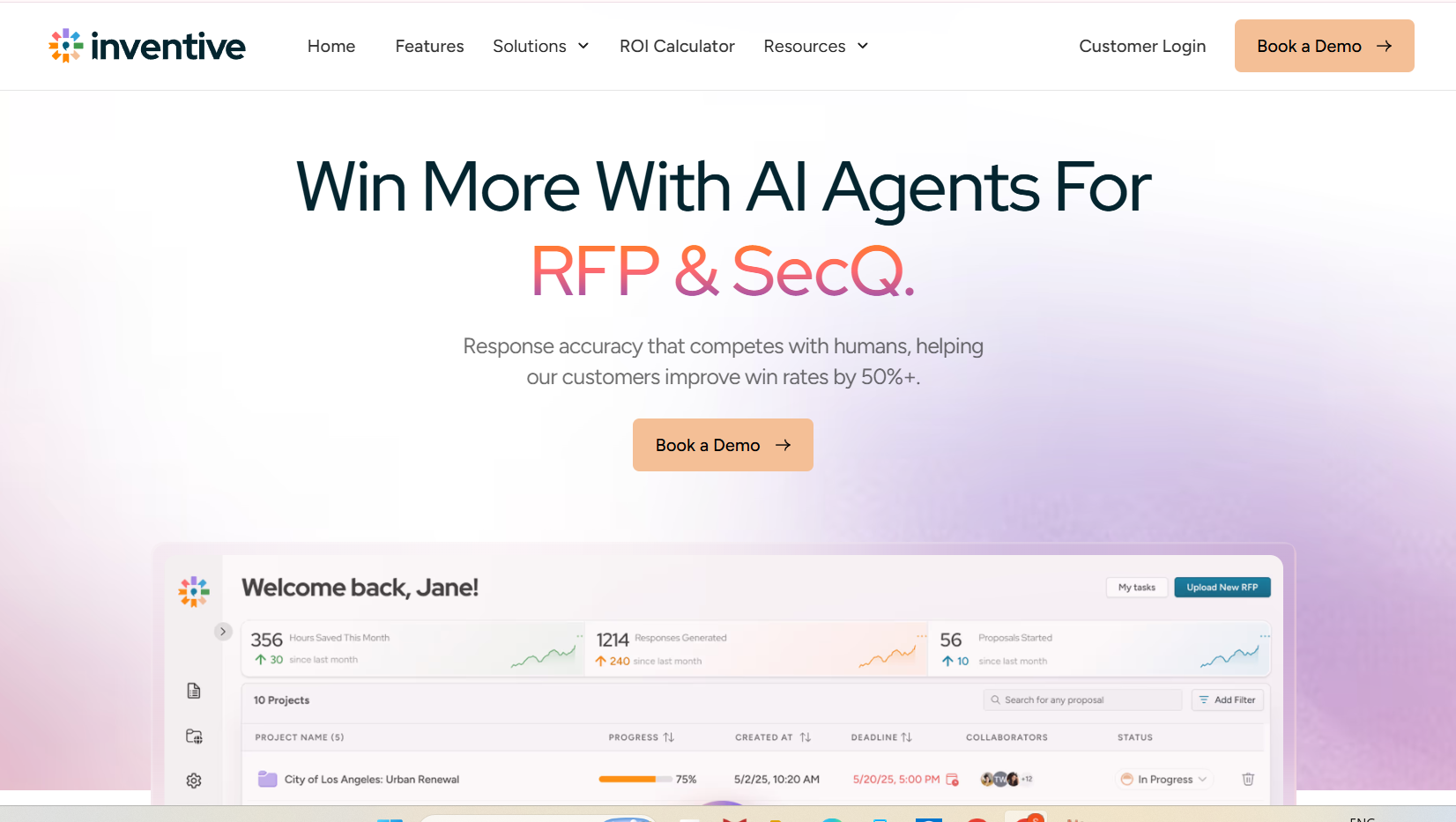
Most RFP platforms ask teams to do the heavy lifting: build content libraries, maintain them constantly, and hope the AI can match the right answer to each question. Inventive AI flips this model entirely. Instead of treating your knowledge as something that needs to be cataloged and stored, it treats knowledge as something that already exists across your organization—in Google Drive folders, SharePoint repositories, Slack conversations, past proposals, and systems like Salesforce. The platform's job is to tap into that distributed intelligence.
This architectural difference matters because it eliminates the constant librarian work that slows down traditional RFP tools.
Ideal for: Organizations tired of content library maintenance, teams handling complex multi-stakeholder RFPs, and companies where institutional knowledge is scattered across too many systems.
Inventive AI Best Features
- Pulls from living knowledge sources: Instead of retrieving from a static Q&A database, generates responses by synthesizing current information from connected systems like Google Drive, SharePoint, Confluence, Notion, Salesforce, and past proposals.
- Quality control built-in: Automatically detects when responses might pull outdated info, contradictory statements, or duplicate answers—and flags them before they reach the customer.
- Personalization that sticks: Creates buyer-specific drafts tailored to the details of each RFP, rather than pulling the same boilerplate answer every time.
- Win research automation: Built-in agents can research competitors and surface competitive angles directly into proposal workflows.
- Format flexibility: Handles everything from Excel questionnaires to Word docs, PDFs, and longer narrative-style proposals.
- Streamlined team reviews: Integrated workflows let reviewers approve, bulk-edit, and assign sections without jumping between tools.
Inventive AI Limitations
- Reporting dashboards are functional but not as customizable as some enterprise alternatives.
- Jira syncing isn't available yet if that's core to your workflow.
- Some early users flagged that mobile experience and search filtering could be smoother.
Inventive pricing
- Priced by volume of RFPs and security questionnaires handled, no per seat cost—unlimited users included
- Starts at $830/month, billed annually
Inventive ratings and reviews
What are real users saying about Inventive?
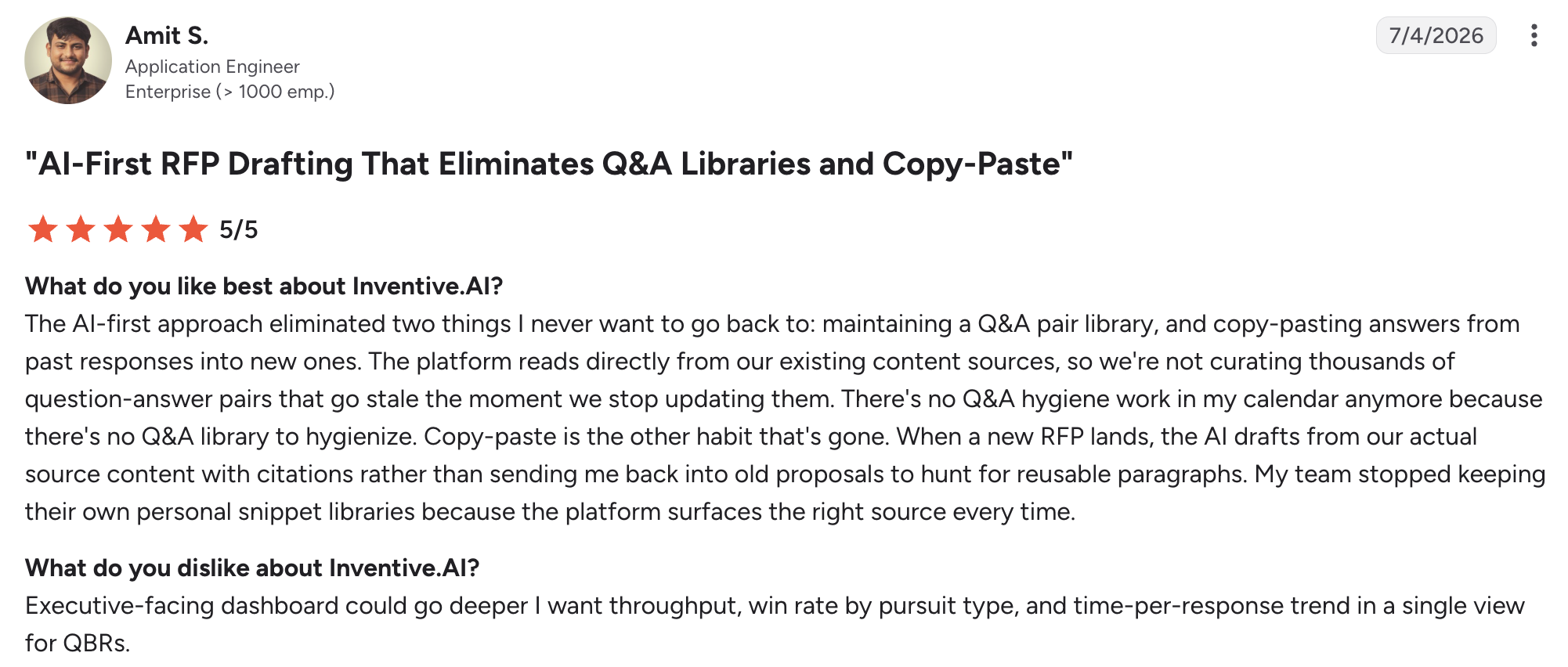
A G2 user review says:
2. Responsive (Best for Enterprise-Scale Proposal Management)
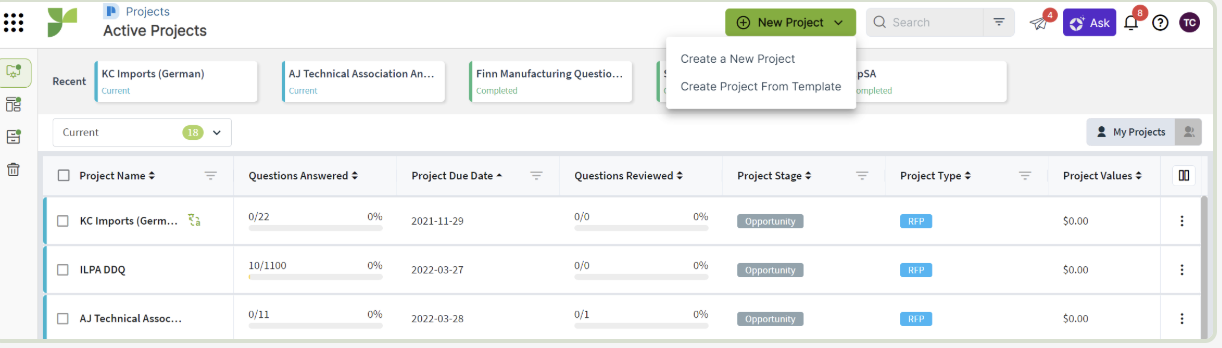
Responsive (formerly RFPIO) brings a structured, enterprise-first approach to RFP management. The strength isn't in pushing boundaries; it's in doing the fundamentals at scale: managing complex workflows, integrating deeply with your existing tools, and giving large teams the ability to collaborate without chaos.
Ideal for: Fortune 500 companies, organizations with 50+ proposal volume annually, government contractors, and teams where compliance and audit trails matter as much as speed.
Responsive Best Features
- Deep enterprise integrations: Connects natively to 30+ systems with 75+ APIs for broader customization.
- Global proposal operations: Handles 23+ languages with content linking across versions, so international teams aren't managing separate libraries.
- AI-assisted drafting: AI agents generate first drafts with citations, pulling from your approved library.
- Security questionnaire automation: Detects repeated security questions across RFPs and auto-fills common responses.
- Flexible participation model: Occasional contributors don't need full seats, pay only for active proposal team members.
- Workflow sophistication: Approval routing, task assignments, and version tracking that can match your internal governance requirements.
Responsive Limitations
- AI works within your existing content library, not from live knowledge sources. More accurate when your Q&A base is well-maintained, less flexible if it's outdated.
- Won't automatically catch duplicate or conflicting content across a large library.
- Competitive intelligence and custom buyer personas aren't built-in features.
- Buyer-specific customization still requires manual tweaking.
Responsive Pricing
- Entry at $5,000/year for smaller teams, scaling to custom enterprise pricing. Per-user licensing model means costs grow with team size.
Responsive ratings and reviews
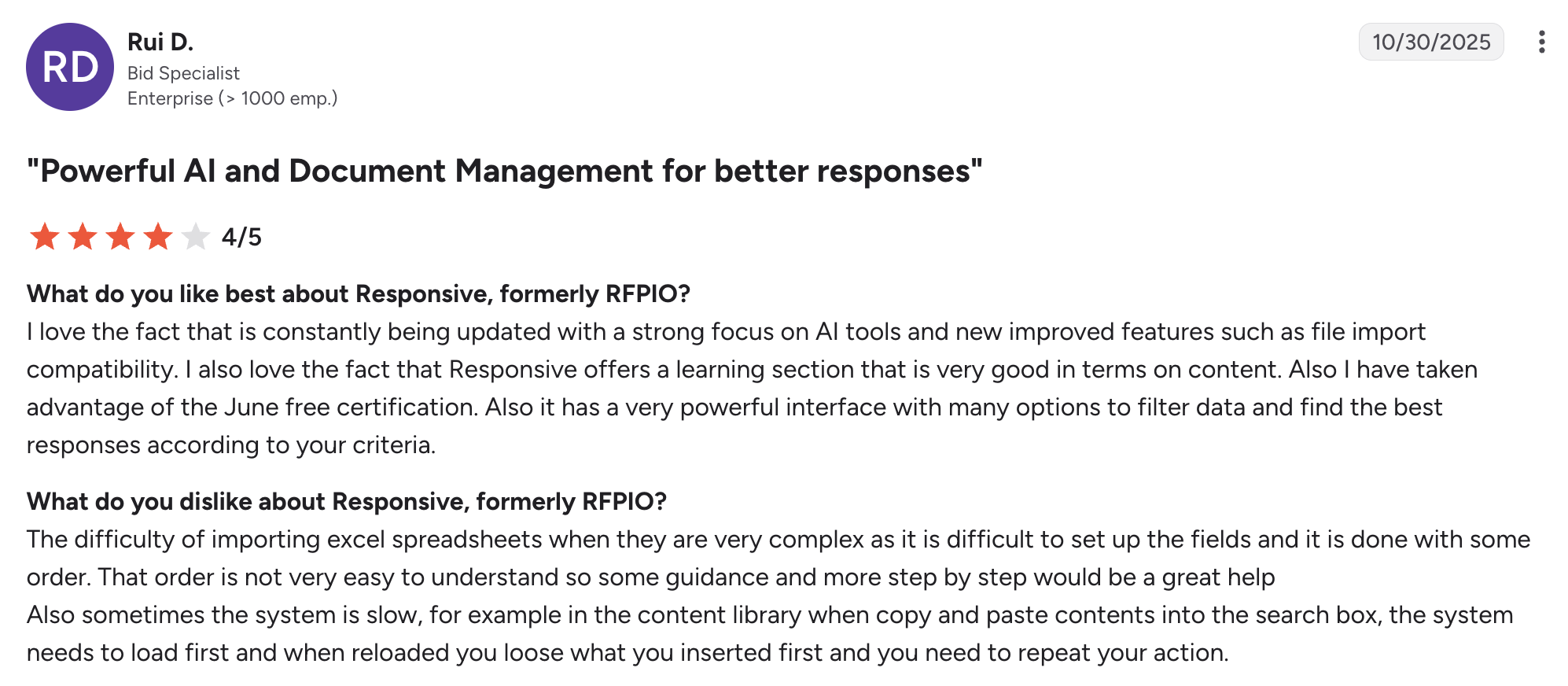
What are real users saying about Responsive?
A G2 user review says:
Compare more options: Responsive Alternatives
3. Loopio (Best for Content-Centric Proposal Teams)
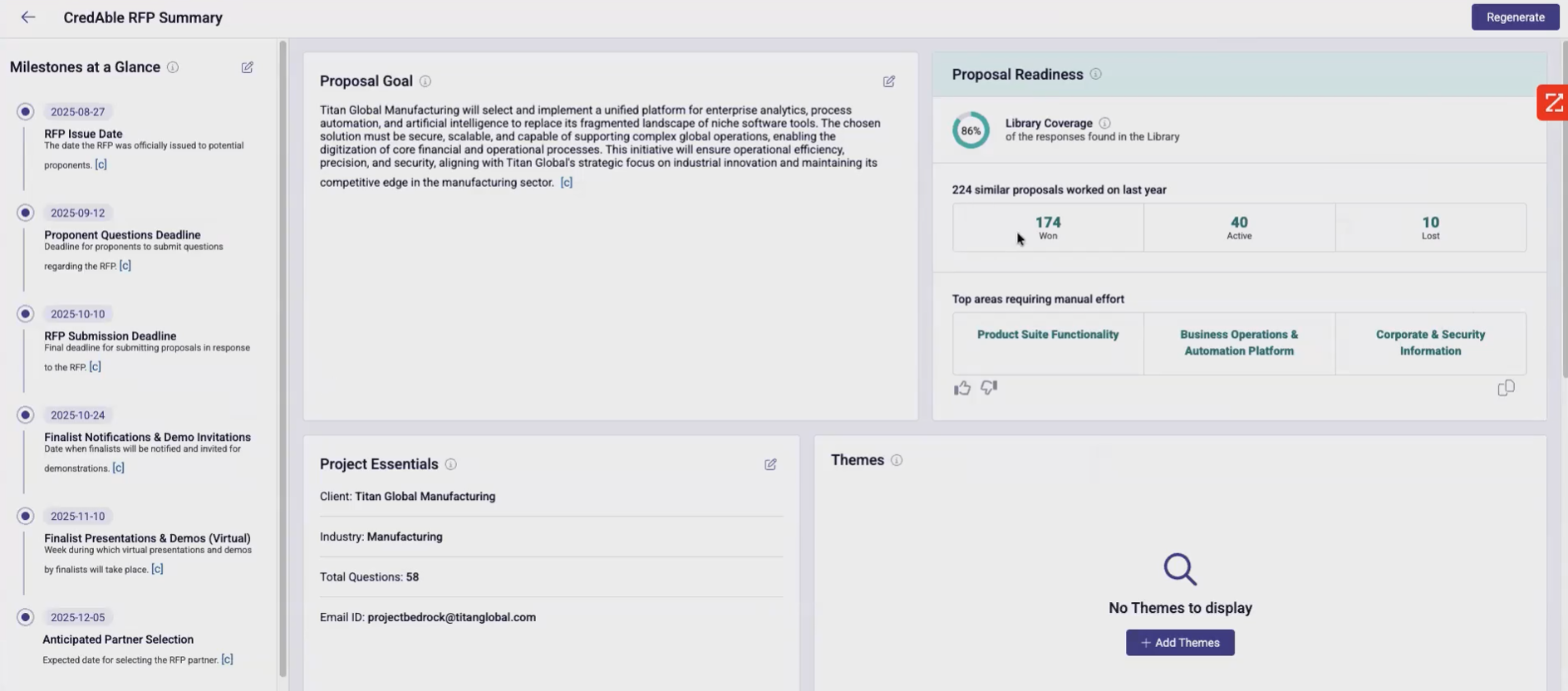
Loopio gives teams a centralized way to manage and respond to RFPs, due diligence requests, and security questionnaires. The platform brings response content, team collaboration, and review processes into one place, making it easier to reuse relevant information, maintain consistency, and keep approvals organized throughout the response process.
Ideal for: Mid to large proposal teams with established libraries, organizations with mature content governance, and industries where standardized answers work (as opposed to highly customized, one-off responses).
Loopio Best Features
- Organizes content with tags, categories, and duplicate detection.
- Suggests relevant, approved answers from the content library using AI.
- Assigns questions to experts and tracks approvals.
- Tracks content reuse, library gaps, and proposal progress.
- Helps complete web-based RFPs through a Chrome extension.
- Supports direct responses through procurement platforms like Ariba.
Loopio Limitations
- AI relies on existing library content rather than creating fresh, contextual responses.
- Content libraries need regular maintenance to stay accurate and up to date.
- Lacks tools for competitive research and buyer-specific positioning.
- Deal-specific customization often requires manual editing.
- Suggested answers don't provide clear source or attribution details.
Loopio Pricing
- Loopio uses a tier-based subscription model with pricing based on users, features, and deployment scope and does not publish public list pricing
- According to Vendr’s transaction data, typical annual contracts range from $15,000 to $150,000+
- Mid-market deployments (10–25 users) typically fall in the $30,000–$60,000 annual range
Loopio Ratings and reviews
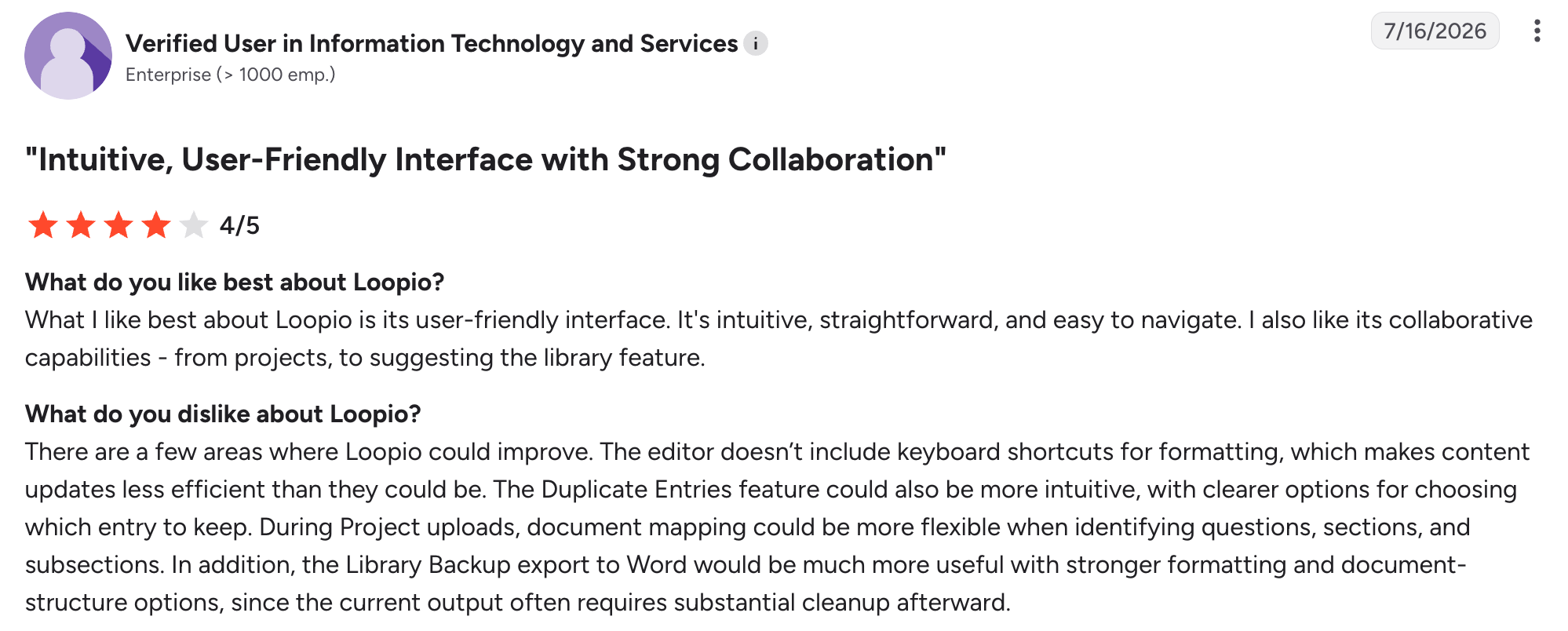
What are real users saying about Loopio?
A G2 user review says:
4. AutoRFP.ai (Best for Project-Based Pricing with Unlimited Users)
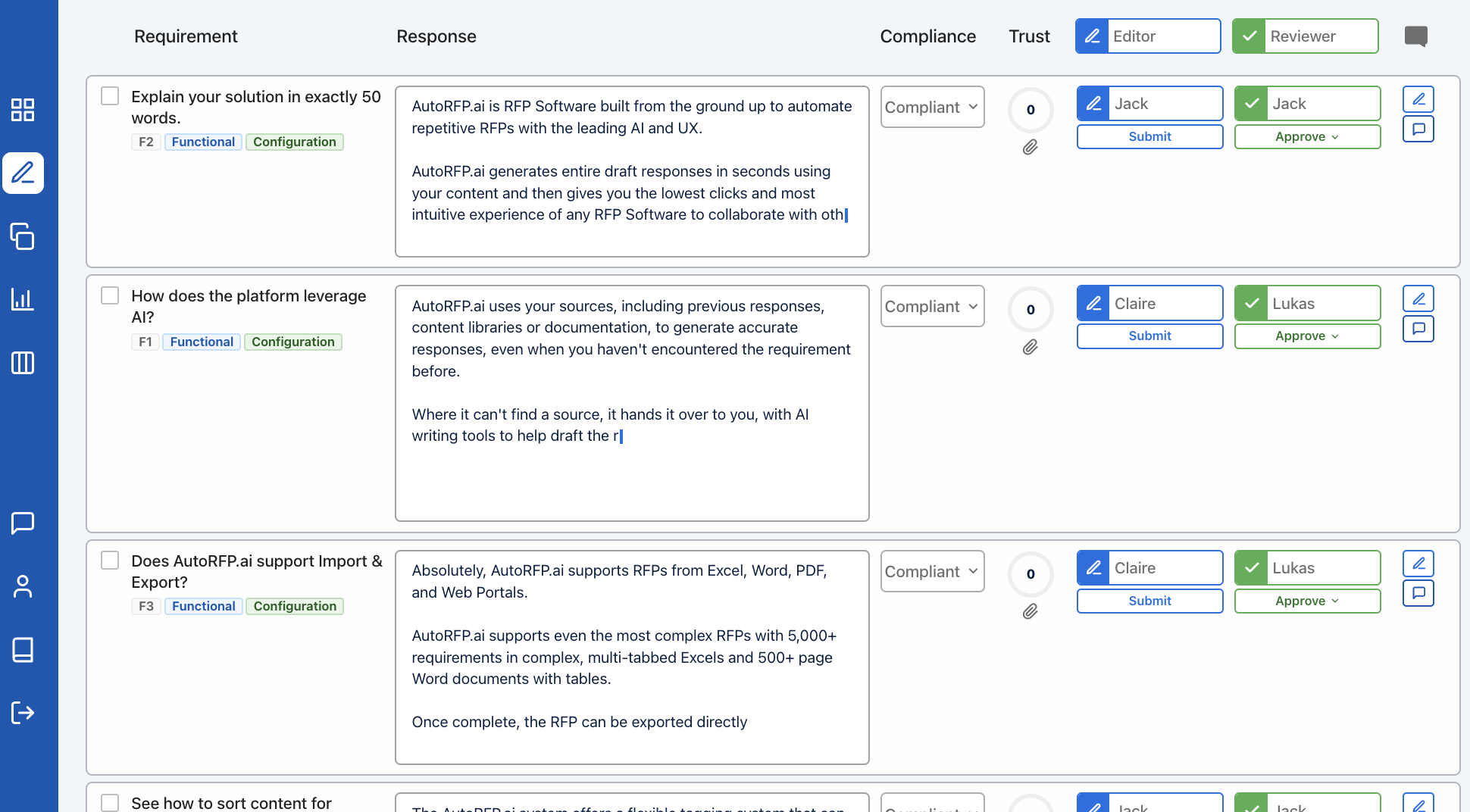
AutoRFP.ai is an AI-driven response platform built for sales, presales, and proposal teams. It streamlines RFPs, RFIs, DDQs, and security questionnaires by generating AI-assisted responses with source citations and supporting team review.
Ideal for: Growing businesses, teams with changing proposal volumes, and revenue teams looking for faster AI-powered responses without complex procurement or vendor restrictions.
AutoRFP.ai Best Features
- Creates AI-generated responses with confidence scores and source citations.
- Automates tasks such as summaries, bulk edits, and web research.
- Supports Word, Excel, PDF, and 44+ languages.
- Offers unlimited users without headcount-based pricing.
- Connects with tools like SharePoint, Confluence, Salesforce, Google Drive, Slack, and Teams.
- Simple interface enables teams to get started quickly.
AutoRFP.ai Limitations
- Project-based pricing can be challenging when proposal volumes fluctuate.
- Some workflows require extra clicks due to a basic interface.
- Content conflict detection isn't fully automated.
- Governance and approval features are less extensive than enterprise platforms.
AutoRFP.ai Pricing
- Scale: $899/month, billed annually, with 24 projects per year.
- Accelerate: $1,299/month, billed annually, with 50 projects per year.
- Enterprise: Custom pricing for larger project volumes.
AutoRFP.ai Ratings and Reviews
What are real users saying about AutoRFP.ai?
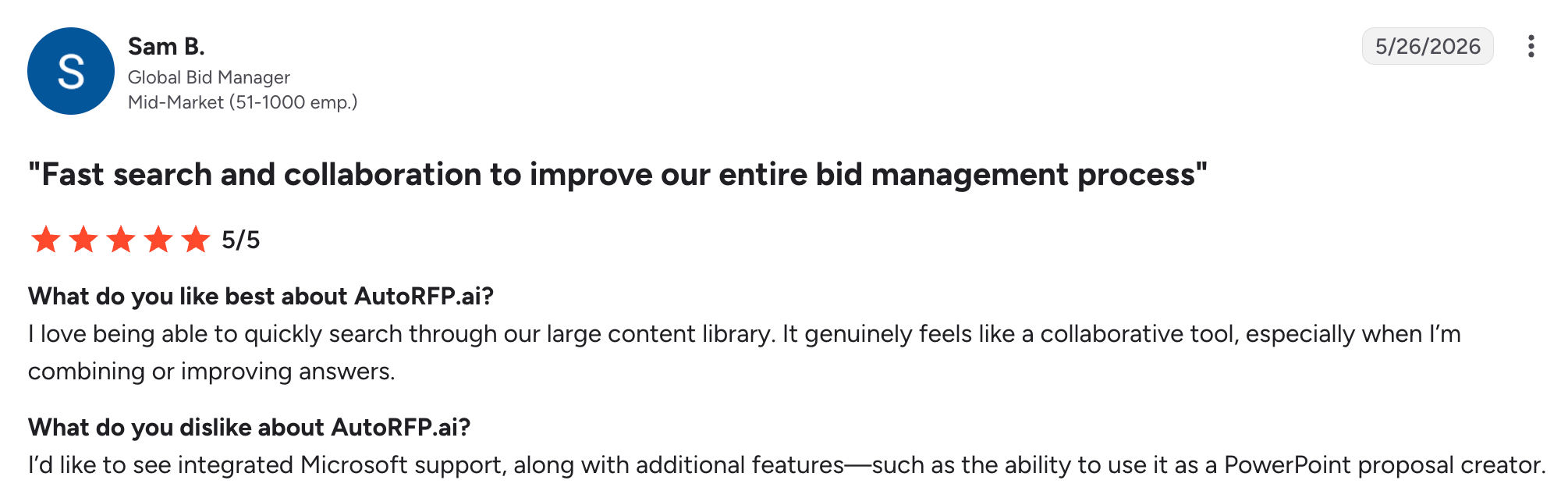
A G2 user review says:
Read more: Top AutoRFP AI Alternatives & Competitors For 2026
5. Arphie (Best for Security Questionnaires and DDQs)

Arphie is an AI-powered platform that helps teams handle RFPs, security questionnaires, and DDQs. It connects with existing company knowledge sources to create accurate, context-aware responses while giving reviewers visibility into the sources behind each answer.
Ideal for: Security teams, cybersecurity and fintech companies, and organizations that handle large volumes of RFPs and security questionnaires.
Arphie Best Features
- Connects with tools like Google Drive, SharePoint, Confluence, Notion, Seismic, and Highspot to pull from current company information.
- Shows source citations and confidence levels with AI-generated answers, making review easier.
- Detects duplicate answers and helps consolidate outdated or overlapping content.
- Supports collaboration with role-based permissions, comments, and review workflows.
- Offers enterprise security features including SOC 2 Type 2 compliance, SSO, encryption, and data governance.
Arphie Limitations
- Import, export, and formatting workflows may still need refinement for some use cases.
- Reporting and analytics aren't as extensive as those offered by some mature enterprise platforms.
- There's no dedicated competitor intelligence functionality.
- The platform is primarily optimized for structured RFPs and questionnaires rather than lengthy narrative proposals.
Arphie pricing
- Arphie does not publish pricing publicly.
Arphie ratings and reviews
- G2: 5/5
- Capterra: Not enough reviews
What are real users saying about Arphie?
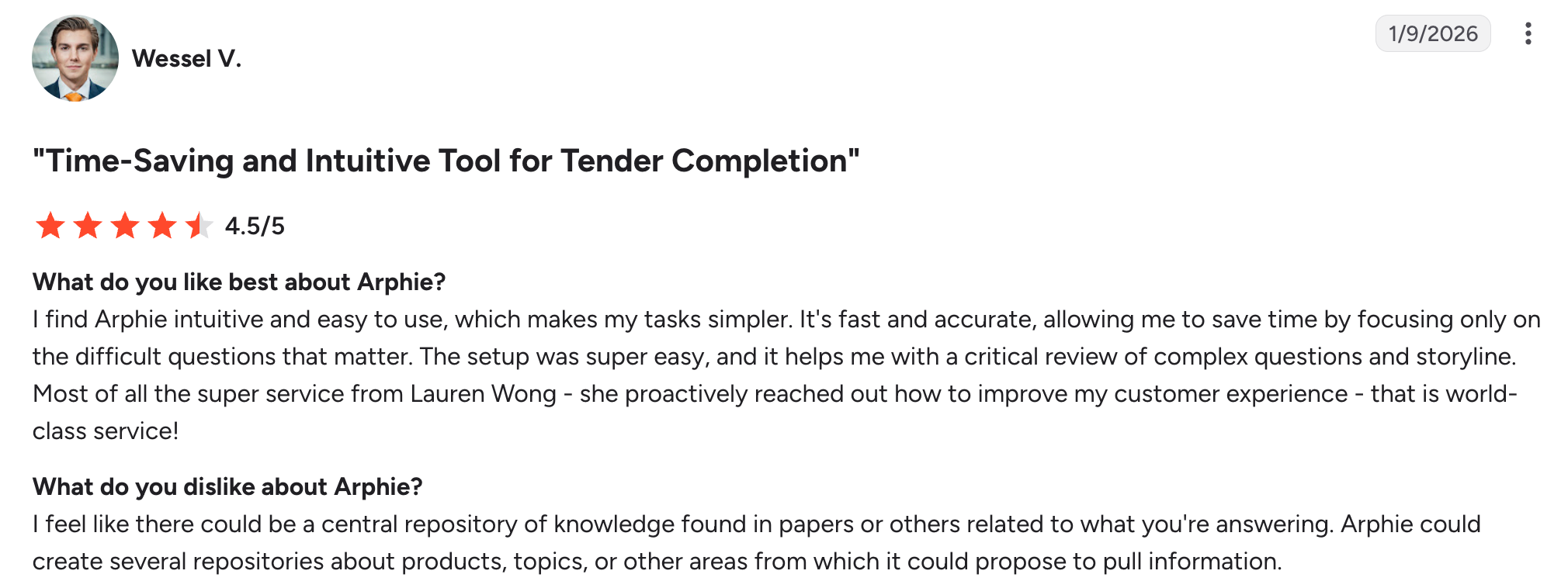
A G2 user review says:
Explore more tools: Arphie alternatives for modern RFP teams
6. QorusDocs (Ideal for Microsoft 365-based proposal management)
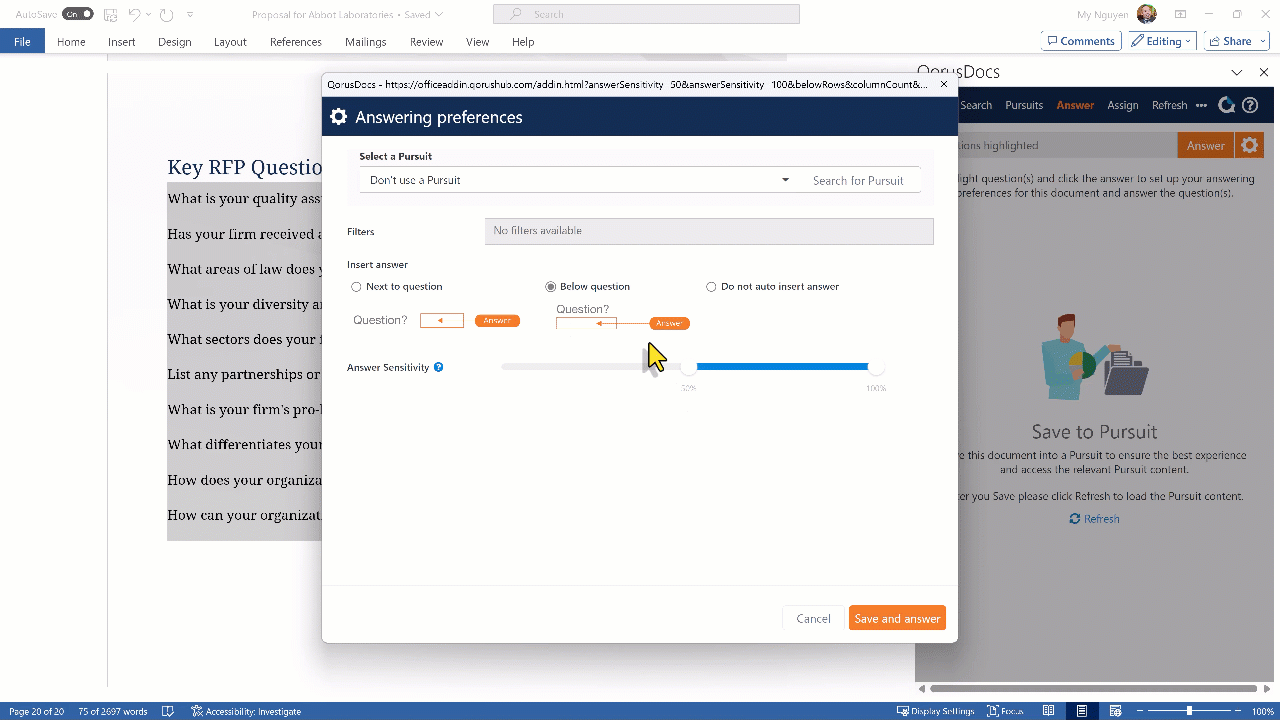
QorusDocs is a proposal management solution built for teams that rely on Microsoft 365. It supports proposal creation, RFP responses, and presentations across professional services, IT, legal, and business development teams, using familiar tools such as Word, PowerPoint, SharePoint, and Teams.
QorusDocs Best Features
- Works directly with Word, PowerPoint, SharePoint, Outlook, and Teams for proposal creation and team collaboration.
- Uses AI to help draft responses from approved templates and existing content.
- Keeps case studies, templates, presentations, and sales materials in one centralized library.
- Supports customizable workflows for managing proposals and business development tasks.
QorusDocs Limitations
- Best suited to organizations already invested in Microsoft 365 and SharePoint.
- Larger or more complex documents may face performance limitations.
- Advanced customization can require technical assistance.
QorusDocs Pricing
- QorusDocs uses quote-based pricing and doesn't publicly list its rates.
- Costs depend on the package, team size, and deployment requirements.
QorusDocs ratings and reviews
What are real users saying about QorusDocs?
A G2 user review says:

Read more: Top QorusDocs Competitors & Alternatives for Modern RFP Teams
7. RocketDocs (Best for regulated industries and Microsoft Office users)

RocketDocs is an enterprise platform for managing RFPs, RFIs, DDQs, and security questionnaires. It combines AI-powered response assistance with content management, workflow automation, and Microsoft Office integrations, making it suitable for organizations with strict security and compliance needs.
RocketDocs Best Features
- Uses a private, self-hosted Llama model to generate responses within a controlled environment.
- Integrates with Microsoft Word and Excel for working on questionnaires directly in Office.
- Provides a centralized content library with AI-powered answer matching and reusable responses.
- Includes approval workflows, audit trails, SOC 2 Type II, and ISO 27001 certifications.
RocketDocs Limitations
- Finding specific content can become harder as the library grows.
- Setting up advanced configurations may require additional training.
- Formatting, exports, and some content management tasks can involve manual work.
RocketDocs Pricing
- Pricing is quote-based and depends on factors such as team size and business requirements.
RocketDocs ratings and reviews
What are real users saying about RocketDocs?
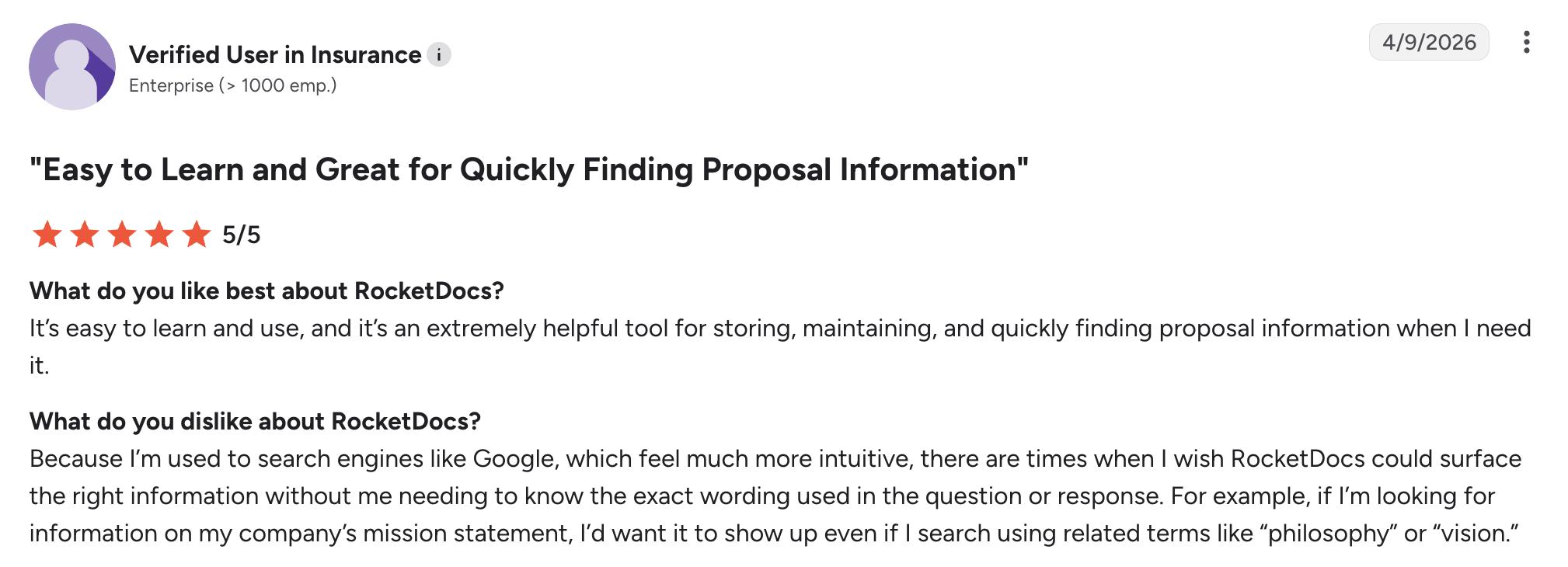
A G2 user review says:
Compare more options: Top 10 RocketDocs Alternatives and Competitors 2026
8. 1up (Best for Lightweight AI-Powered RFP Responses)
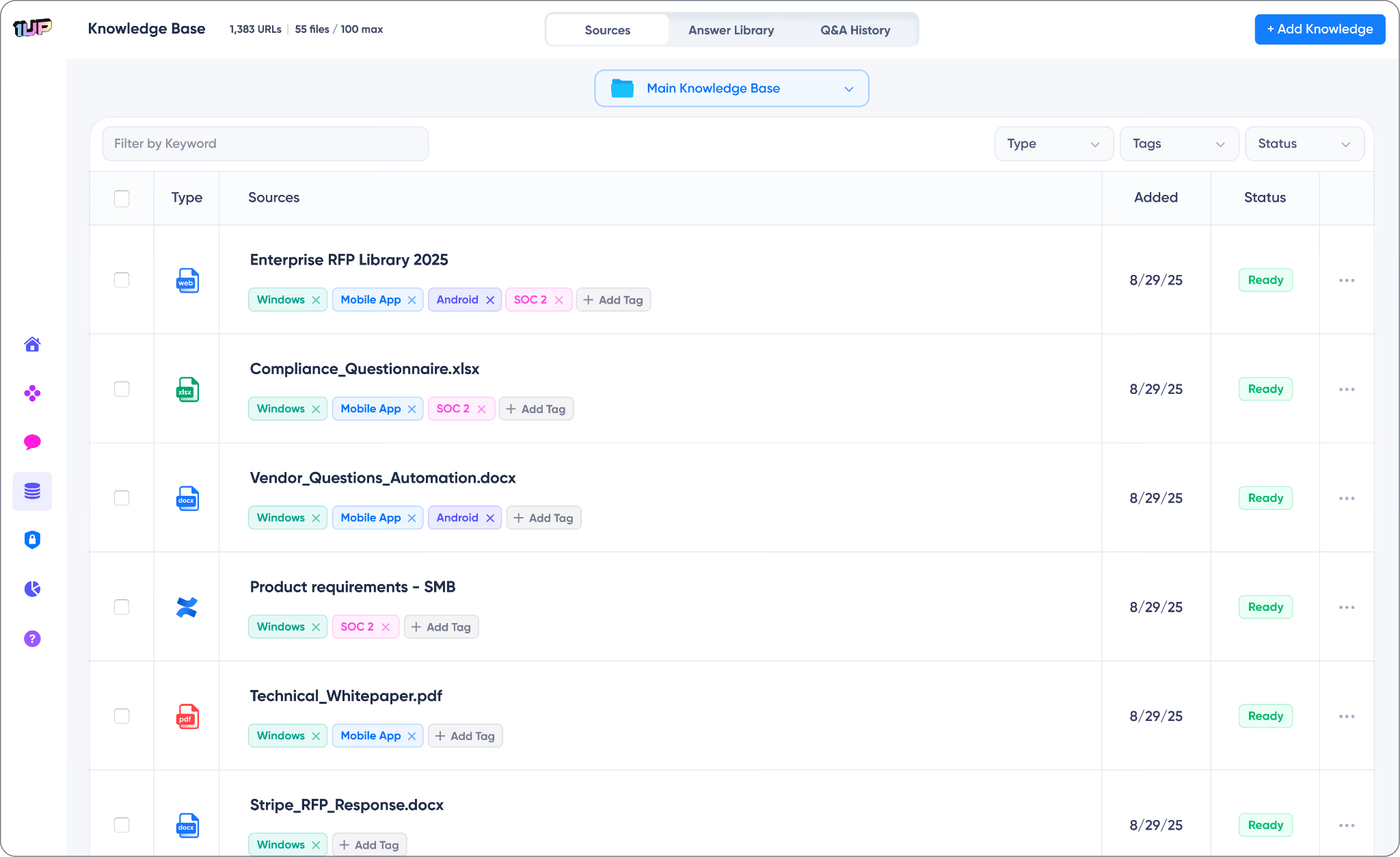
1up.ai is an AI-powered platform that helps sales, presales, and revenue teams automate knowledge-based tasks and RFP responses. It connects with internal data sources to answer customer questions, complete security questionnaires, and create bid responses more quickly.
1up Best Features
- Automatically fills out web-based questionnaires through its browser extension.
- Answer Hub enables customers to find answers themselves, while Slack and Microsoft Teams support internal Q&A.
- Connects with Confluence, Slack, Google Drive, Notion, Microsoft Office, and SharePoint.
1up Limitations
- Technical or compliance-focused responses may need additional prompt refinement.
- Can have difficulty handling lengthy or highly complex questionnaires.
- May produce responses when relevant source information isn't available instead of highlighting knowledge gaps.
- Collaboration capabilities for SME assignment, approvals, and version control are limited.
1up pricing
- Free: Limited plan with 50 AI answers/month.
- MCP: $50/month + usage fees ($5 per 100 answers) for teams using their own AI platform.
- Starter: $300/month, includes 1 questionnaire automation.
- Plus: $900/month, includes 6 questionnaire automations plus Answer Hub, integrations, and browser extension.
- Enterprise: Custom pricing with unlimited knowledge uploads, dedicated success manager, and enterprise features.
1up ratings and reviews
- G2: 4.9/5
- Capterra: Not enough reviews
What are real users saying about 1up?
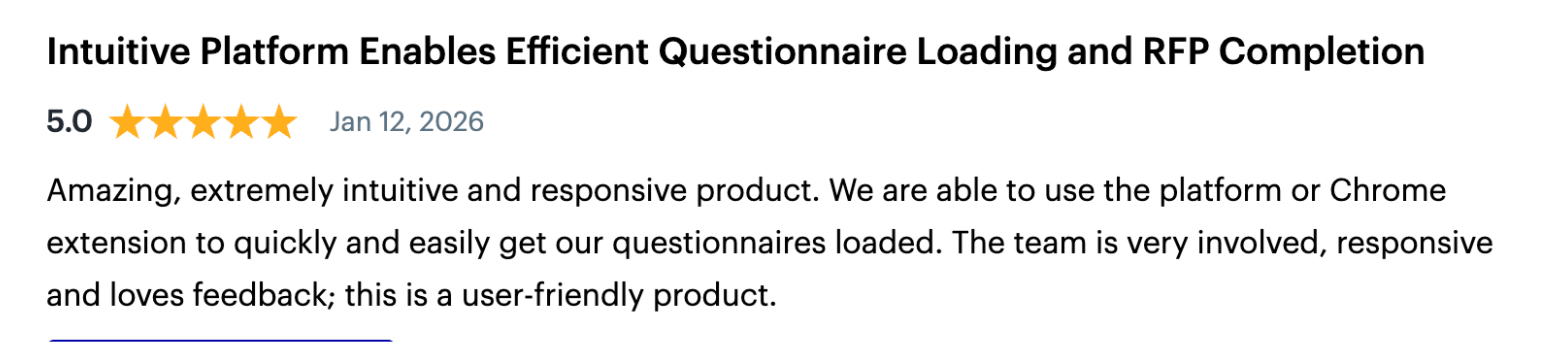
A Gartner user review says:
Which SiftHub Alternative Should You Choose?
The best alternative depends on your team's workflow, proposal volume, and priorities.
Sifthub vs Inventive: How they differ
Which One Should You Actually Pick?
If your team already relies on a centralized content library and structured review workflows, SiftHub may be a fit for managing RFPs and security questionnaires.
If you're looking to reduce manual content maintenance and want AI to work across your existing company knowledge, Inventive AI offers a more context-driven approach to proposal automation.
The best way to compare the two is to run one of your actual RFPs or security questionnaires through both platforms. Evaluate the quality of the first drafts, how much editing they require, how accurately they reflect your current information, and how well each platform fits into your existing workflow.


.png)