Loopio vs Responsive: Which RFP Software Is Better in 2026?
Comparing Loopio and Responsive on AI, pricing, and workflow. See where both legacy tools fall short, and why teams are switching to AI-native platforms.
If you're evaluating RFP software, you've almost certainly landed on Loopio and Responsive. The right pick depends less on which platform is objectively better and more on what your team actually requires and how much complexity you're willing to trade for power.
This guide breaks down both platforms feature by feature, based on verified reviews, vendor materials, and independent analysis, so you can make the call with real data instead of a sales pitch.
Last reviewed: July 2026. This comparison is based on vendor-published materials, verified G2 and Capterra reviews, and independent third-party analyses. Pricing and feature details change over time, so confirm current specifics directly with each vendor before purchasing.
TL;DR
- Loopio works well for organizations looking for an intuitive platform that teams can adopt quickly.
- Responsive is better equipped for enterprises that need advanced workflow customization, broader integrations, and support for large-scale proposal operations.
What Should You Consider When Choosing Between Loopio and Responsive?
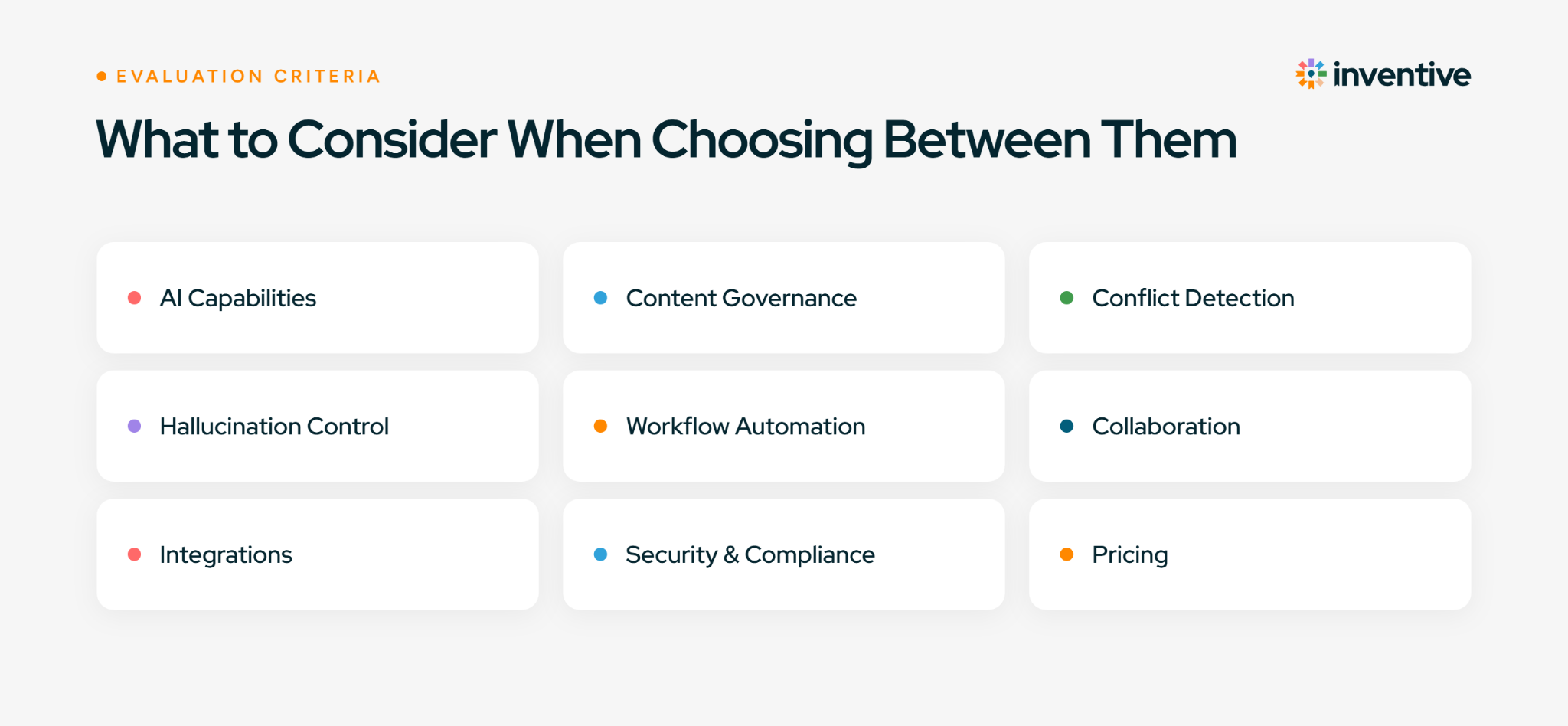
These are the evaluation criteria that most consistently separate a good fit from a bad one, based on patterns across dozens of buyer reviews:
- AI capabilities. Does the AI draft usable first answers, or just suggest matches from your library? How much editing does the output typically need?
- Content governance. Does the platform actively manage the health of your knowledge base, or does that fall entirely on your team?
- Conflict detection. Can the platform flag contradictory or outdated answers across sources before they reach a client?
- Hallucination control. Does the AI stay strictly within your approved content, or can it generate plausible-sounding answers from outside your library?
- Narrative-style proposals. Can the platform handle long-form, narrative responses, not just structured Q&A formats?
- Content management. How much manual upkeep does the library require?
- Workflow automation. How well does it handle routing, approvals, and multi-department sign-off?
- Collaboration. How easily can you loop in occasional SMEs without friction or extra licensing cost?
- Integrations. Does it connect to your CRM, storage, and communication tools out of the box?
- Security and compliance. Does it support audit trails, source citations, and content-boundary controls for regulated industries?
- Analytics. Does it give usable performance data, or just activity tracking?
- Pricing. Is Loopio pricing or Responsive's pricing transparent and predictable, or does it require a sales conversation and scale unpredictably?
- Ease of implementation. How long until a team is productive, and how much IT involvement is required?
- Enterprise scalability. Can it handle multiple concurrent projects, global teams, and multi-language needs?
Loopio vs Responsive at a Glance
| Criteria | Loopio | Responsive |
|---|---|---|
| Best for | Teams formalizing their RFP process for the first time, fast onboarding | Enterprise teams with complex, high volume proposal operations |
| G2 rating | 4.6/5 | 4.5/5 |
| AI capabilities | Human-in-the-loop, surfaces answers from a static library, not AI-native | Legacy tool where AI is bolted on, not built as AI first. |
| Response quality | Consistent on repetitive questions, weaker on nuance | Handles complex questionnaires well, occasional hallucination reported |
| Conflict detection | Not available | Not available |
| Content management | Clean, curated Q&A library with Response Intelligence for cleanup and duplicate detection | Metadata heavy enterprise knowledge base with AI retrieval (Ask and LookUp) and TRACE Score validation |
| Competitive intelligence agents | Not available | Not available |
| Collaboration | Structured SME workflows, manual validation, controlled updates | Deep integration into Salesforce, Slack, and Microsoft ecosystems for real time collaboration |
| Integrations | Salesforce, HubSpot, Slack, Microsoft Teams. Basic API support | Broader CRM and sales enablement coverage, extensive API layer for custom workflows |
| Workflow automation | Lightweight | Enterprise-grade, more complex |
| Security | SOC 2 and GDPR compliant | SOC 2 Type II, GDPR, and ISO 27001 compliant |
| Pricing | Tier based, not publicly listed. Typical contracts range $15,000 to $150,000+/year. Mid market (10 to 25 users) usually lands between $30,000 and $60,000/year | Starts at $5,000/year for 5 users (Lite plan). Mid and enterprise tiers are custom quoted based on users, features, and deployment scope |
| Customer support | Frequently praised for fast response times and helpful implementation guidance | Knowledgeable support and structured onboarding, but some reviewers cite inconsistent resolution on standard tiers |
Note: Public pricing figures reflect reported figures and may not match current rates. Confirm directly with each vendor.
Loopio (Best for teams new to response management)
Loopio is a response management platform founded in Toronto in 2014. It targets teams formalizing their RFP process for the first time and is used for RFPs, security questionnaires, due diligence requests, and web-based questionnaires.
Loopio best features
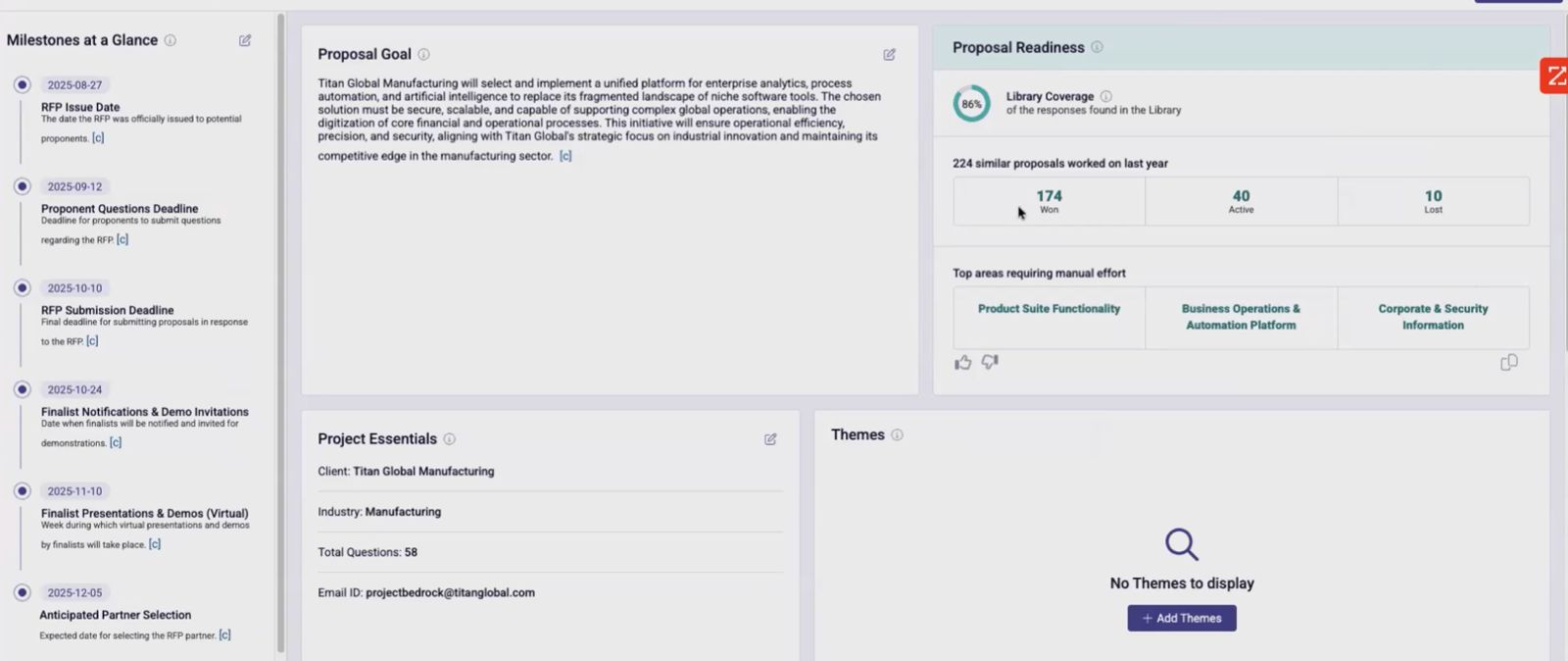
- Centralized content library with stacks, categories, and tags
- Magic AI for one click answer suggestions from approved content
- Milestone tracking and SME assignment for project management
- Content analytics for library health and completion tracking
- Portal based response capability, added recently
- Chrome extension for filling out questionnaires inside client portals
Loopio Limitations
- AI is limited to suggesting matches from a static library. It doesn't generate context-aware drafts, so responses often still need heavy rewriting.
- No conflict detection. Contradictory or outdated answers across the library go unnoticed unless a human catches them.
- No competitive intelligence agents. Nothing in the platform helps research competitors or build win themes.
- No deal-specific personalization. Every buyer gets pulled from the same global library, regardless of the RFP or opportunity.
- No inline source citations, so tracing an AI suggestion back to its origin means a manual lookup.
- User-based pricing penalizes teams that need to loop in many occasional SMEs.
- Manual library upkeep is required and becomes harder to manage without a dedicated owner, a common reason teams start exploring Loopio alternatives
Loopio Pricing
- Loopio uses a tier-based subscription model with pricing based on users, features, and deployment scope and does not publish public list pricing
- According to Vendr’s transaction data, typical annual contracts range from $15,000 to $150,000+
- Mid-market deployments (10–25 users) typically fall in the $30,000–$60,000 annual range
https://www.inventive.ai/blog-posts/loopio-pricing-features-reviews
Loopio Ratings and reviews
- G2: 4.6/5
- Capterra: 4.6/5
- TrustRadius: 8/10
What are real users saying about Loopio?
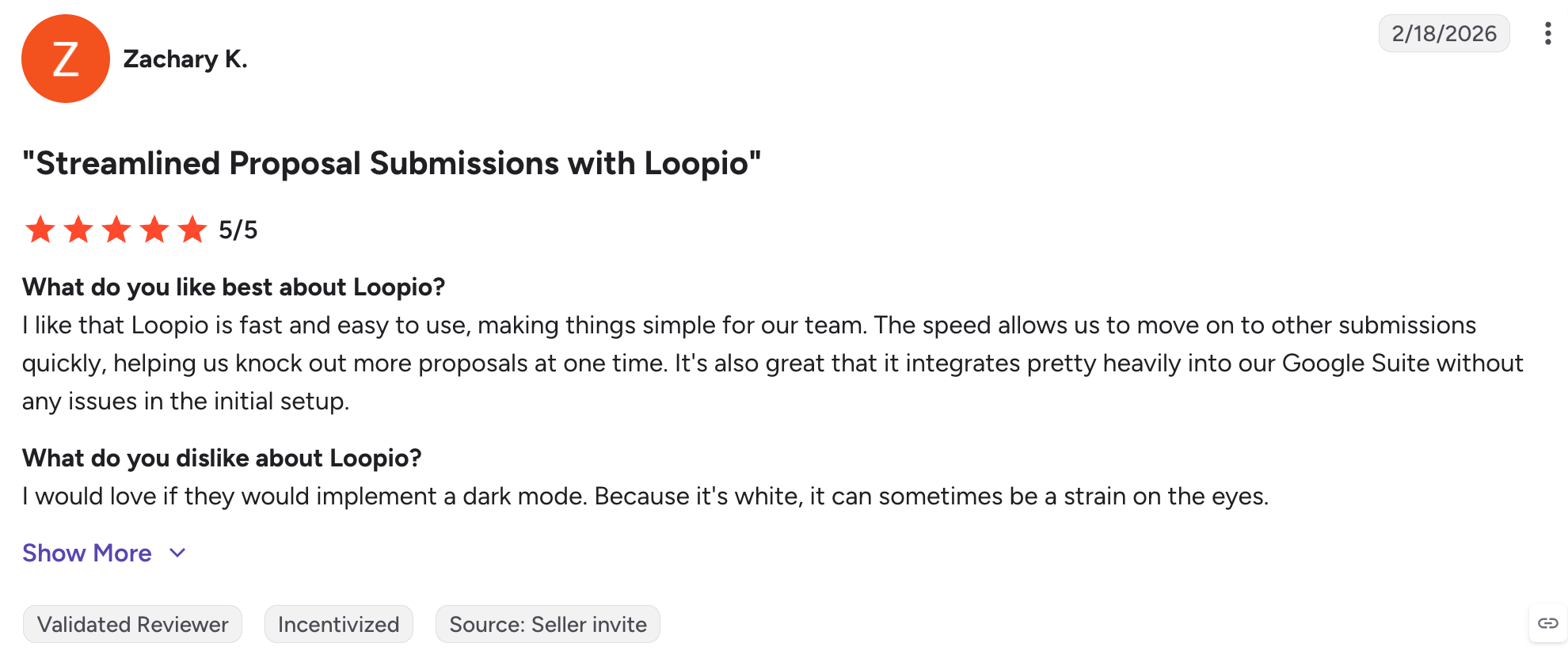
A G2 user review says:
I like that Loopio is fast and easy to use, making things simple for our team. The speed allows us to move on to other submissions quickly, helping us knock out more proposals at one time. It's also great that it integrates pretty heavily into our Google Suite without any issues in the initial setup.
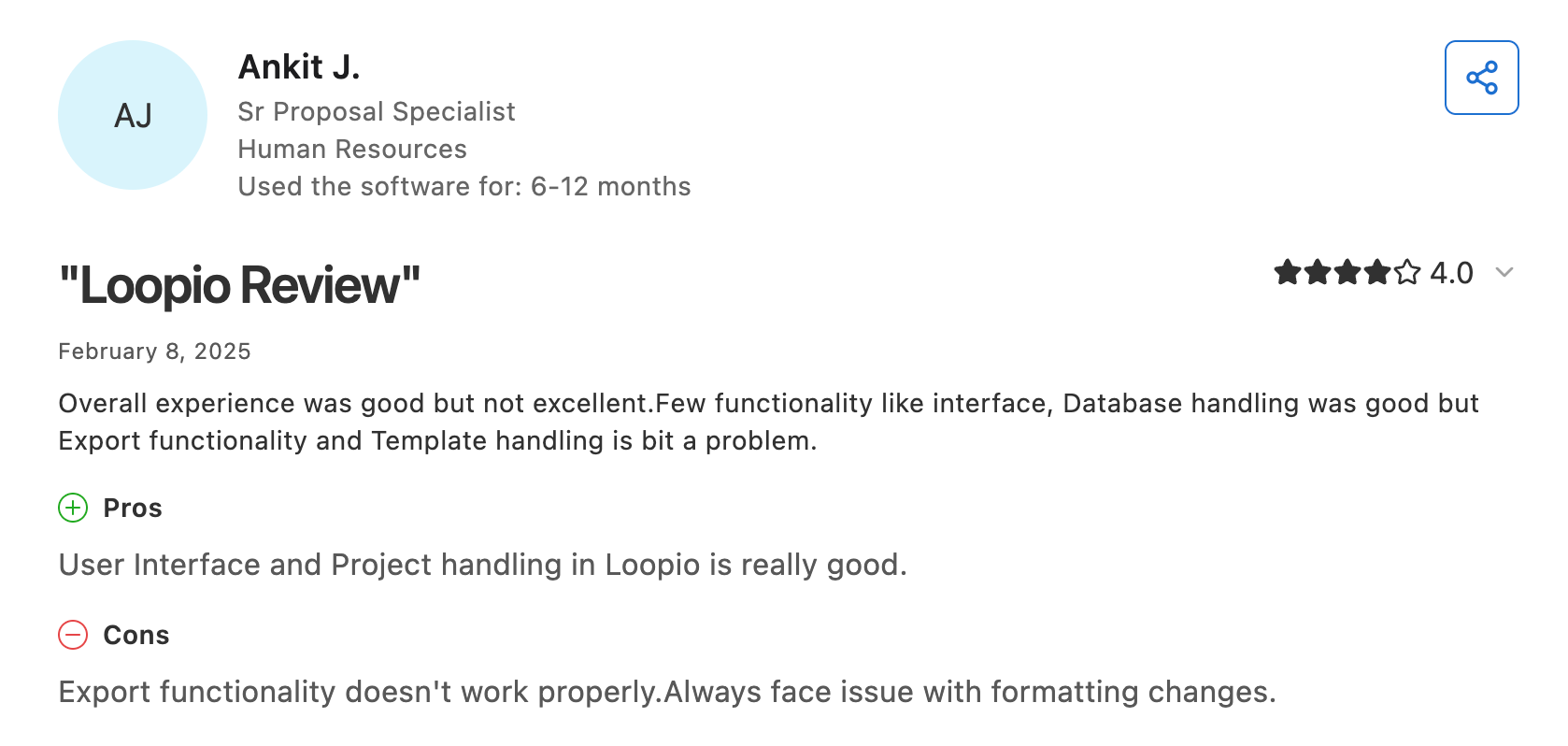
A Capterra user review says:
Overall experience was good but not excellent. Few functionality like interface, Database handling was good but Export functionality and Template handling is bit a problem.
Responsive
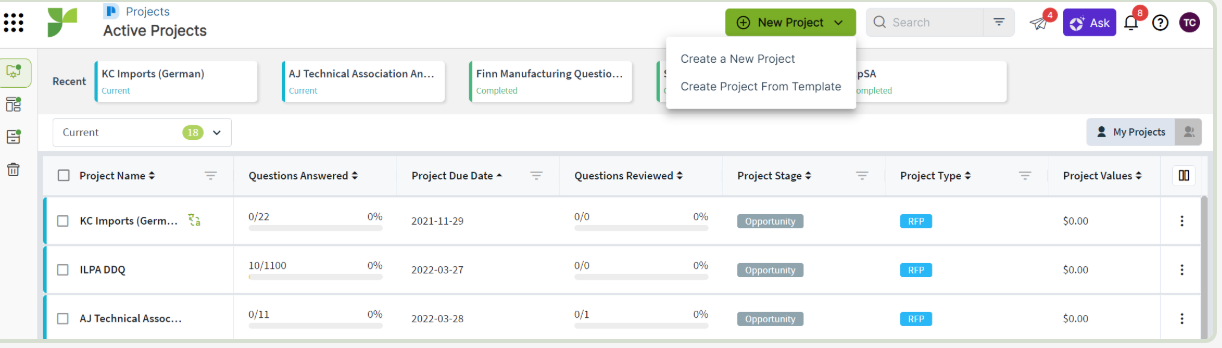
Responsive, formerly RFPIO, positions itself as an AI-first strategic response management platform built for RFPs, InfoSec questionnaires, government bids, DDQs, and sales proposals at enterprise scale.
Responsive best features
- AI Assistant and AI agents for generative first draft creation, including source-cited outputs
- Auto answering for security questionnaires and vendor assessments
- Broad integration ecosystem, reported at close to 30 native integrations plus 75+ open APIs
- Multi-language support, reported at 23+ languages, with version linking for global teams
- Project-based pricing that supports large numbers of occasional contributors without per seat cost
Responsive limitations
- Markets itself as AI-first, but the AI sits on top of a legacy Q&A-pair architecture, not a system built around live, connected knowledge
- No conflict detection. TRACE Score validates individual responses but doesn't catch contradictions across the library
- No competitive intelligence agents built into the core workflow
- No deal-specific personalization by default. Responses draw from a shared library regardless of buyer or opportunity
- AI can, per user reports, generate answers from outside the approved content library, a real governance risk in regulated industries
- UI complexity slows down even experienced daily users, with key actions often buried in menus
- Pricing is per-user and harder to forecast than Loopio's as teams scale, which is part of why some buyers start comparing Responsive alternatives early in their evaluation
Responsive pricing
- Starts at $5,000/year for 5 users (Lite plan), with higher tiers for growing and enterprise teams.
- Mid and enterprise plans are custom-priced based on users, features, and deployment needs.
- Overall pricing is quote-based with per-user licensing and add-ons, so costs vary by scale.
Responsive ratings and reviews
- G2: 4.5/5
- Capterra: 4.5/5
- TrustRadius: 8.9/10
What are real users saying about Responsive?
A G2 user review says:
I love the fact that is constantly being updated with a strong focus on AI tools and new improved features such as file import compatibility. I also love the fact that Responsive offers a learning section that is very good in terms on content. Also I have taken advantage of the June free certification. Also it has a very powerful interface with many options to filter data and find the best responses according to your criteria.

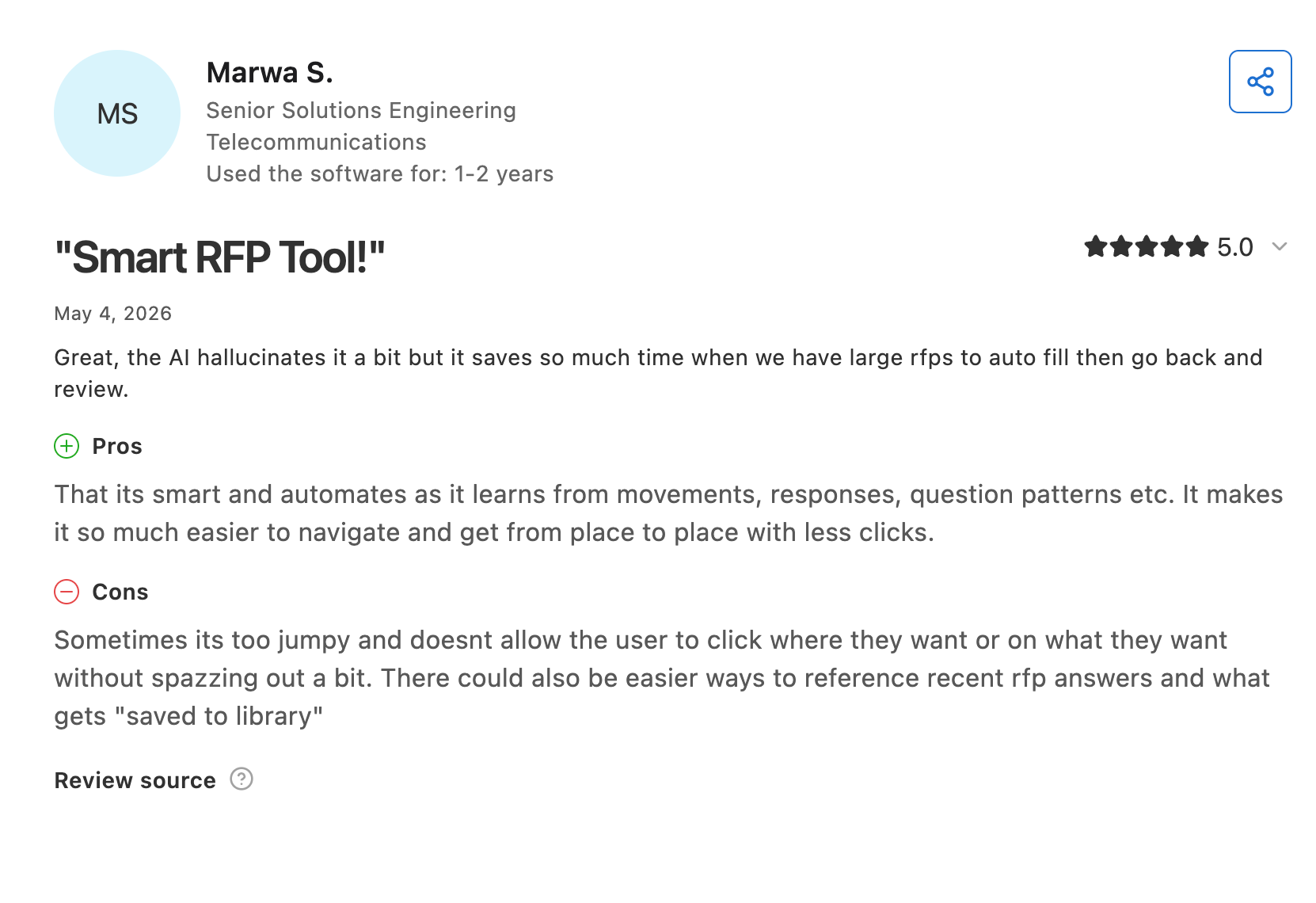
A Capterra user review says:
Great, the AI hallucinates it a bit but it saves so much time when we have large rfps to auto fill then go back and review.
Loopio vs Responsive: Feature-by-Feature Comparison
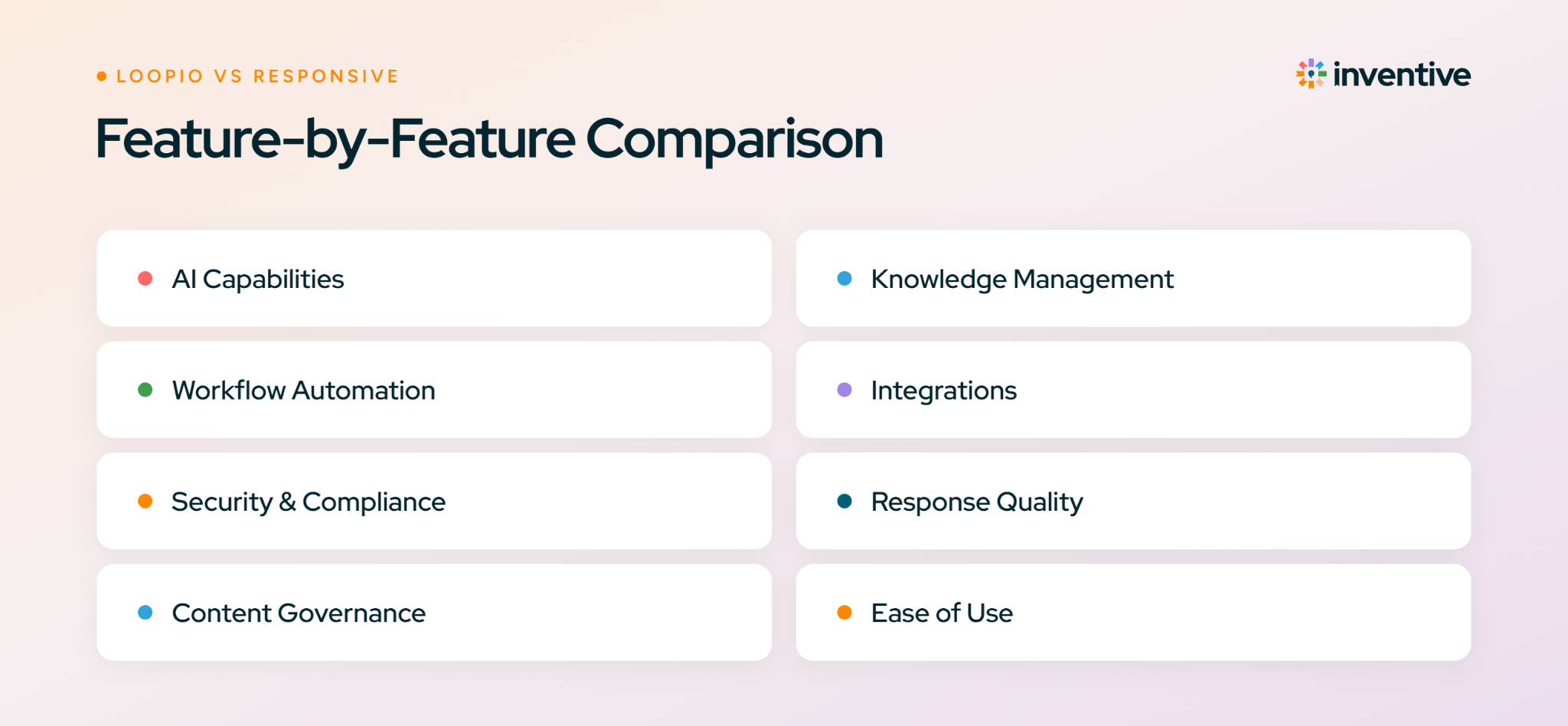
AI Capabilities
Loopio
- Human-in-the-loop model, surfaces verified answers from a structured library
- No full draft generation, more suggestion than creation
- Governance via AI duplicate detection, cleanup, and metadata enrichment
Responsive
- Markets itself as AI-first, but AI sits on top of a legacy Q&A platform, not built AI-native
- Generative agents auto-draft full responses across RFPs, DDQs, and security questionnaires
- Includes multi-document analysis, requirement mapping, and automated compliance scoring (TRACE Score)
Note: According to multiple sources, neither platform reliably prevents AI from generating answers outside the approved library. Verify this directly during a demo. Test a few edge case questions your library does not already cover and see what each platform actually does with them.
Knowledge Management
Both platforms use a Q&A pair based library that requires ongoing human maintenance. This is one of the few points where reviews of both tools consistently agree.
Loopio
- Focuses on a clean, curated, Q&A-style knowledge library designed for ease of use and strong human oversight
- Uses Response Intelligence™ to support content cleanup, duplicate detection, and surfacing of pre-approved answers
- Relies on structured SME workflows for review, ensuring accuracy through manual validation and controlled updates
Responsive (formerly RFPIO)
- Built as a metadata-heavy, enterprise knowledge base designed for large-scale, multi-department content governance
- Uses AI-driven retrieval (Ask & LookUp) with TRACE Score™ to generate and validate responses using contextual and historical data
- Strong integration layer that connects knowledge directly into tools like Salesforce, Slack, and Microsoft ecosystems for real-time access
Workflow Automation
Loopio
- Focuses on user-friendly workflow automation designed for fast onboarding, structured collaboration, and simple project management
- Uses Magic to automate response building through keyword-based matching and retrieval of pre-approved library content
- Keeps workflow control lightweight with manual SME assignment, clear notifications, and easy-to-use progress tracking dashboards
Responsive (formerly RFPIO)
- Built for enterprise-grade workflow orchestration with complex, multi-team project structures and advanced automation capabilities
- Uses generative AI drafting with contextual understanding, SLA tracking, and automated escalation for large-scale response management
- Supports deep API and integration layers, enabling highly customizable workflows across CRM, communication, and enterprise systems
Integrations
| Area | Loopio | Responsive (formerly RFPIO) |
|---|---|---|
| CRM connectivity | Supports key CRMs like Salesforce and HubSpot for standard sales workflows | Broader CRM coverage with deeper enterprise alignment across complex stacks |
| Team collaboration tools | Works with commonly used tools like Slack and Microsoft Teams for basic collaboration | Strong integration ecosystem across collaboration and productivity platforms |
| Sales enablement platforms | Limited native depth, relies more on lighter integrations and extensions | Stronger alignment with enterprise sales enablement tools and ecosystems |
| API capabilities | Basic API support for standard use cases and workflows | Extensive API layer designed for advanced, custom enterprise workflows |
| Document & browser workflows | Chrome-based tools for handling RFP portals and responses | More advanced automation for handling large-scale, multi-system workflows |
Security and Compliance
- Loopio: Supports enterprise security requirements with SOC 2 and GDPR compliance
- Responsive: Offers SOC 2 Type II, GDPR, and ISO 27001 compliance for organizations with stricter security and governance needs
Note: Evaluate both closely against your specific audit needs and consider dedicated compliance-focused alternatives as part of your search.
Analytics
- Loopio: Tracks content health, proposal performance, and response completion times.
- Responsive: Offers advanced reporting and dashboards for tracking performance across large teams and multiple projects.
Customer Support
- Loopio: Customer support is frequently highlighted for fast response times and helpful implementation guidance.
- Responsive: Users praise its knowledgeable support team and structured onboarding, but some reviewers cite inconsistent resolution and support staff who do not always have deep RFP domain expertise.
Response Quality
- Loopio: consistent on repetitive, well-covered questions; nuanced ones often need manual rework
- Responsive: handles complex, high-volume questionnaires better; occasional hallucination reported, requiring a review pass
Content Governance
- Loopio: manual SME review cycles, basic duplicate detection
- Responsive: more metadata-driven, but still depends on periodic human review to catch drift
Note: Both lack automated conflict detection, contradictory answers go unnoticed unless a person catches them
Ease of Use
- Loopio: more intuitive, faster onboarding
- Responsive: more feature-dense interface, steeper learning curve per reviewer feedback
Also Worth Considering: Inventive AI
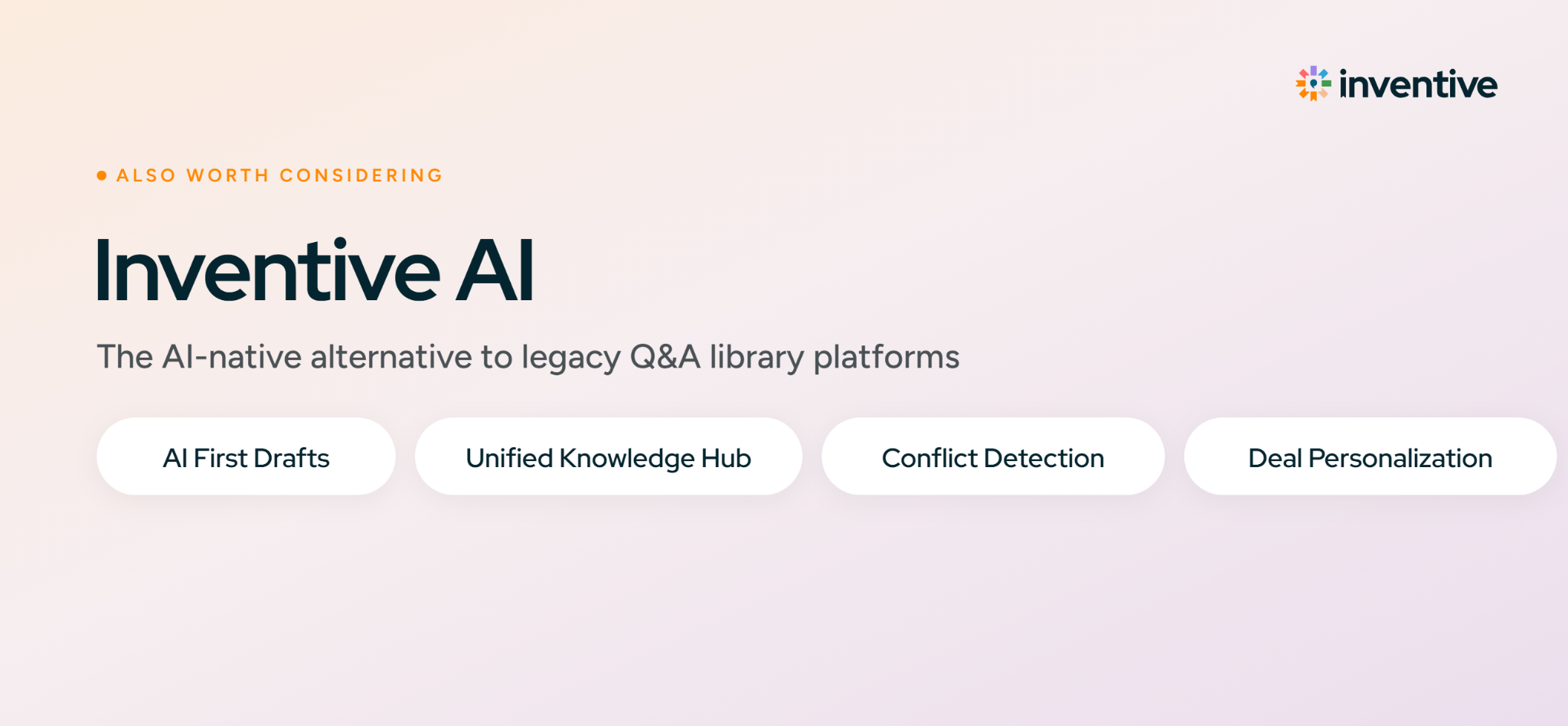
If you are evaluating Loopio and Responsive as part of a broader search, it is worth knowing that there is a newer category of AI-native proposal platforms that take a different architectural approach. Inventive AI is one such example.
Inventive AI is an agentic AI and autonomous platform built specifically for RFP, RFI, and security questionnaire responses, aimed at sales, solution engineering, and presales teams.
Key capabilities of Inventive AI
- AI-generated first drafts. Pulls answers directly from your connected knowledge base, not a blank document or manual search. Teams get a submission-ready draft in minutes, so reviewers spend less time refining and more time writing from scratch. Cited at up to 10x faster and 95% context accuracy.
- Unified knowledge hub. Consolidates documents, past proposals, and FAQs from disconnected storage into one live source. Answers stay current without manual re-entry.
- Conflict detection. Proactively flags outdated, stale, or contradictory content across sources, catching inconsistencies before they reach a client.
- Deal-specific personalization. Drafts are generated per RFP, not pulled from a shared library, so responses reflect the actual buyer.
- Competitive intelligence agents. Built-in agents handle competitor research and win-theme brainstorming as part of the workflow.
- Format flexibility. Handles both Excel-based questionnaires and long-form narrative proposals.
- Collaborative review. Nested sections, bulk actions, and filtering for team sign-off.
- Integrations: Confluence, SharePoint, Google Drive, Notion, Salesforce.
Best for: Teams looking for an AI-native alternative to legacy Q&A library-based platforms, particularly where reducing manual drafting time and centralizing scattered documentation are top priorities.
Why buyers comparing Loopio and Responsive might look at Inventive as an alternative
Both Loopio and Responsive rely on manually curated Q&A libraries that require ongoing maintenance to remain accurate. Inventive AI's approach, which proactively flags stale content and draws from a broader knowledge base rather than a fixed Q&A library, is positioned as a direct response to that specific pain point.
Frequently Asked Questions
Why does keeping the content library clean feel like a full-time job on both platforms?
Both Loopio and Responsive rely on a Q&A-pair library that needs ongoing human maintenance. Neither has automated conflict detection, so duplicate or outdated answers are typically caught during manual review, not by the platform itself. Teams without a dedicated content owner often find the library gets harder to manage within 6-12 months.
Which platform handles long, narrative-style RFPs better versus structured DDQs?
Responsive is more commonly used for narrative proposals and government bids, alongside standard Q&A. Loopio leans more toward structured, question-and-answer-style RFPs and security questionnaires. If your mix includes a lot of long-form narrative work, that's worth testing directly with both vendors.
How much "proposal ops" support do we actually need to get value from these tools?
Both platforms assume someone is actively managing the library, workflows, and governance. Without that role in place, either tool can end up underused, since the AI in both cases works from whatever's in the library, not from thin air.
Is there an AI native alternative to Loopio and Responsive?
Yes. A newer category of AI-native proposal platforms has emerged, including tools like Inventive AI. These generally take a different approach to content management, aiming to reduce the manual library maintenance burden, a consistent pain point for both Loopio and Responsive.

.avif)