Responsive AI Price, Features, Reviews & Ratings 2026
In this blog, you’ll find a breakdown of its pricing, core features, and limitations so you can decide whether it truly fits your needs, or if you should consider a more advanced alternative like Inventive AI.
Responsive (formerly RFPIO) is an RFP solution for teams, offering valuable content management and collaboration features. However, as RFP workloads explode, with industry reports revealing that companies now spend 24 hours writing a proposal and involve 7 people in the process, the platform is starting to show its limitations.
The challenge is clear: many teams are still using RFP tools built a decade ago, designed for simpler workflows and slower sales cycles. As RFP complexity and volume continue to grow, traditional platforms like Responsive are struggling to keep up with the scale and speed required today.
This has led to a shift towards AI-driven RFP platforms like Inventive AI. Built for modern businesses, Inventive AI offers advanced automation and real-time content management, helping teams respond quickly and accurately without sacrificing quality.
In this blog, we’ll explore Responsive’s pricing, features, strengths, and limitations, and explain why AI-first RFP automation, such as Inventive AI, is fast becoming the new standard for enterprises looking to improve their RFP processes.
Key Takeaways
- Responsive (RFPIO) offers strong collaboration and centralized content management for mid-sized teams.
- It works well for standard proposal workflows, but becomes harder to scale as RFP volumes and compliance layers increase.
- Inventive AI provides multi-agent automation, contextual intelligence, and verified, zero-hallucination responses.
- Enterprise sales teams using Inventive AI report 50% higher win rates, 90% faster response cycles, and improved cross-functional collaboration.
- Responsive suits small to mid-sized teams; Inventive AI is suitable for all kinds of teams starting from small-scale to big businesses and enterprises with multi-department workflows, security questionnaires, and global operations.
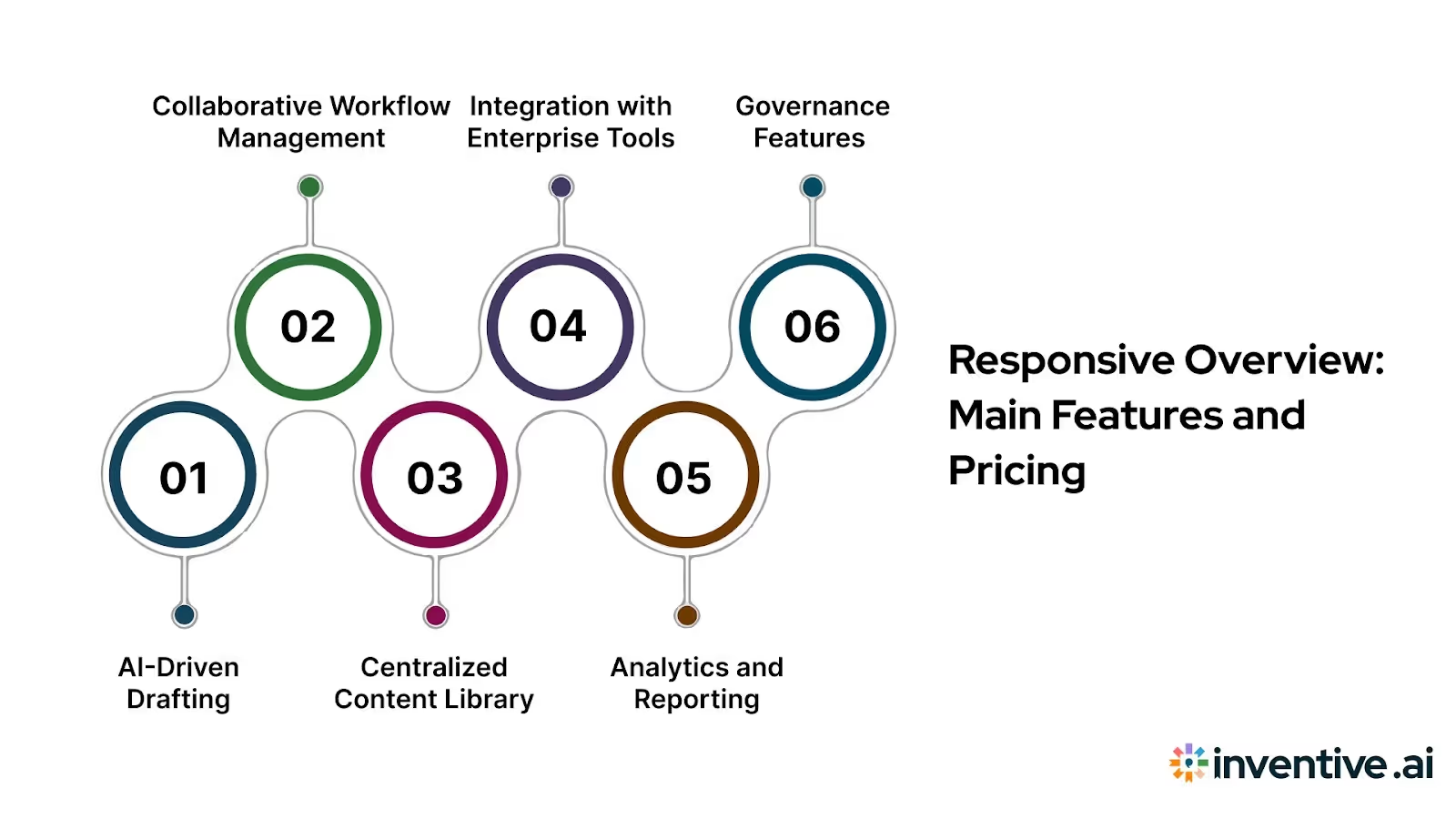
Responsive (Formerly RFPIO) Overview: Key Features and Pricing
Responsive, previously known as RFPIO, has been a well-known RFP solution for more than a decade. It helps teams automate and simplify responses to RFPs, RFIs, DDQs, security questionnaires, and other complex information requests.
But as AI-driven automation becomes important for efficiency, organizations are evaluating whether its capabilities and its pricing still align with enterprise requirements.
1. AI-Driven Drafting and Automation
It uses AI to help draft and suggest answers, but it’s fairly basic. The AI can speed up the process, but responses often still need manual adjustments to fully meet the buyer’s requirements.
2. Collaborative Workflow Management
Teams can collaborate, assign tasks, and track progress with the workflow tools. However, these workflows lack flexibility and may not be robust enough for complex or multi-departmental RFPs.
3. Centralized Content Library
The content library helps organize and reuse proposal content. While useful, search and filtering options are basic, and it may become harder to find specific content as the library grows.
4. Integration with Enterprise Tools
It integrates with tools like Microsoft Office, CRM systems, Slack, and Teams. While this is helpful, syncing large amounts of data across multiple systems can cause delays or inconsistencies.
5. Analytics and Reporting
Responsive offers executive dashboards and content portfolio analytics designed to track ROI and win-loss trends; however, the impact of these insights often depends on the consistency of a team's CRM data and internal reporting habits.
6. Multilingual and Governance Features
It supports multiple languages and governance features, like role-based access and audit trails. However, it may not meet the more advanced compliance needs of larger organizations.
While Responsive offers some features to simplify RFP workflows, it's important to understand how its pricing aligns with the needs of larger teams and more complex operations.
Pricing Breakdown
You may need to upgrade to a custom tier as your RFP volume grows and you add users, integrations, or advanced features. To avoid surprises, budget for scaling costs.
To determine the platform's total cost of ownership, smaller teams should carefully evaluate user seats, expected RFP volume, and integrations or support needs.
Responsive Strengths and Weaknesses
Like most mature RFP automation platforms, it provides a solid foundation for teams managing proposal responses. With a 4.2/5 rating on Gartner Peer Insights, it is frequently praised for its intuitive interface, centralized content library, and collaboration-friendly workflows that help sales and proposal teams stay aligned.
As organizations scale and their RFP operations become more complex, the platform’s limitations start to surface. Teams increasingly require deeper automation, stronger contextual AI, and scalable data governance. These are areas where traditional tools struggle to keep up. These gaps become more noticeable in high-volume environments involving multi-department reviews, complex questionnaires, and global compliance requirements.
Strengths
- Time-Saving: Responsive automates basic RFP drafting, saving time and reducing manual effort. This helps businesses with manageable proposal volumes focus on strategic tasks, like refining responses and aligning with buyer needs.
- Simple and Intuitive Interface: Responsive is easy to use, with a user-friendly design that doesn’t require extensive training. This makes it ideal for smaller teams or businesses without dedicated technical staff, allowing for quicker implementation and smoother use.
- Easy Collaboration: Responsive allows real-time collaboration across teams, speeding up decision-making and ensuring alignment throughout the proposal process. This improves messaging consistency and enhances submission quality.
Weaknesses
- Limited Features: Responsive lacks some advanced tools, like content optimization, automatic updates, and deeper integrations, making it less effective for larger businesses that need to scale their RFP processes.
- Inefficient Search Functionality: Searching for specific content in Responsive can be slower compared to other platforms. As proposal volume grows, this inefficiency can waste time and reduce overall productivity.
- Limited Customization: Responsive offers fewer customization options, making it harder for companies with unique RFP workflows to tailor the platform to their needs as they grow.
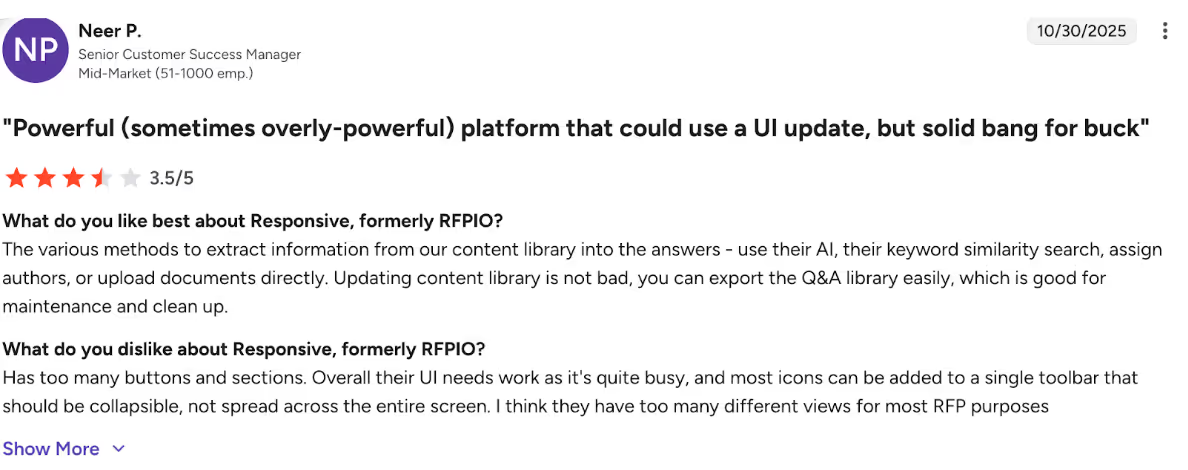
Users have expressed frustration with these limitations, particularly around the learning curve and search functionality. As businesses grow and RFP volumes increase, these issues become more pronounced. Here’s what users have to say about their experience with the platform:
How Inventive AI Outperforms Responsive (Formerly RFPIO)?
Inventive AI is designed to meet the real needs of enterprise teams handling complex RFPs and proposals. It offers faster responses, higher accuracy, and unmatched scalability, providing a clear advantage over Responsive.
With a 5-star rating on Gartner Peer Insights, Inventive AI stands out for its precision, efficiency, and ability to handle large-scale, multi-department workflows with ease. It simplifies the RFP process by automating drafting, ensuring real-time content governance, and offering context-aware AI, all while delivering consistently high-quality, customized content.
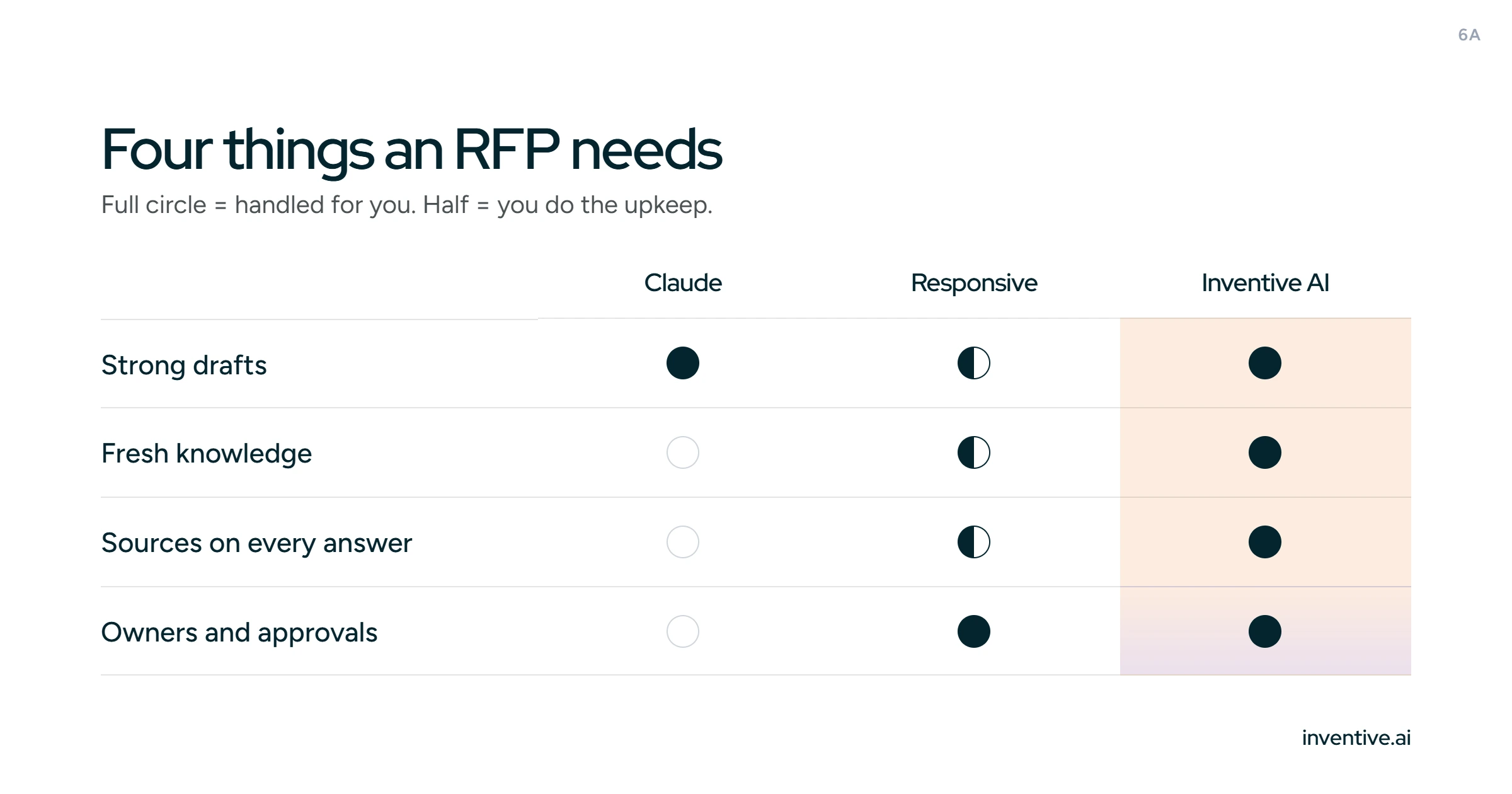
- 2x better response quality. Inventive's context engine and multi-agent reasoning produce answers that are ~2x better than Responsive — deeply tailored to each buyer's requirements and submission-ready with no rewrites. Responsive leans on content-library snippets and AI-assisted drafting that lack context and need manual rework to fit.
- Built-in real-time conflict detection. Inventive automatically flags contradictions and inconsistencies across answers before submission. Responsive has no real-time conflict detection, so it's a manual review.
- Automated stale/outdated content detection. Inventive proactively flags aging answers so nothing outdated slips into a proposal. Responsive relies on teams manually reviewing the library for freshness.
- Fast setup + simple UX. Inventive gets teams live in hours with an easy learning curve; Responsive is a weeks-to-months implementation with a steep one.
When it comes to RFP automation, Inventive AI outperforms Responsive in every key aspect. If you’re looking for an AI-powered tool to simplify your RFP response process, increase win rates, and scale effortlessly, Inventive AI is the clear choice.
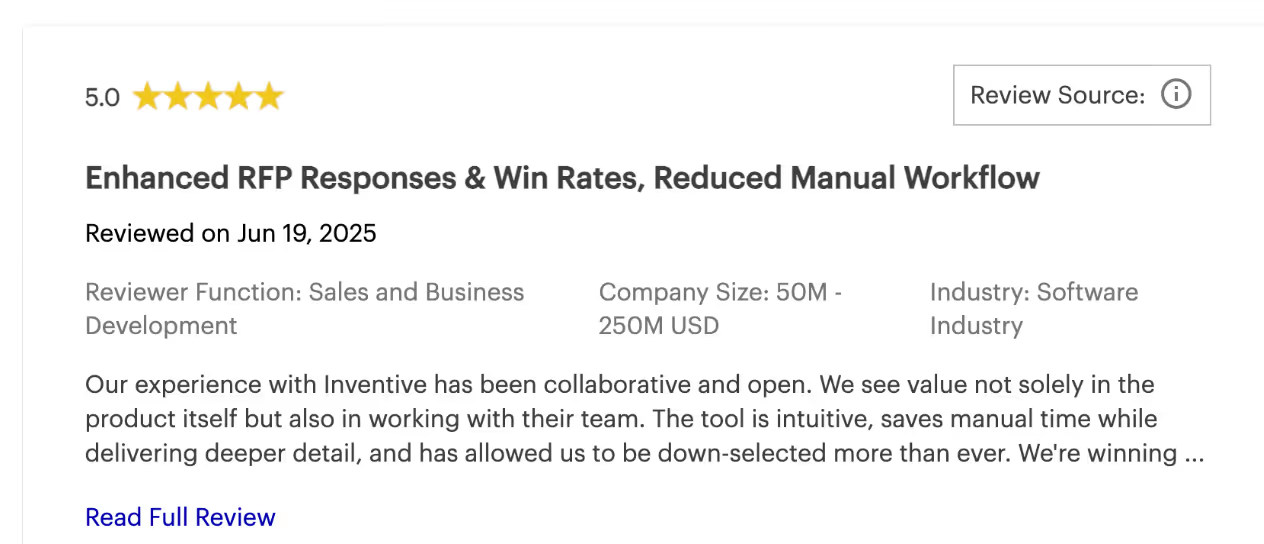
Curious about what users think of Inventive AI? Here’s what they have to say:
FAQs
1. What is Responsive (formerly RFPIO) used for?
Team members can automate parts of the RFP, RFI, and security questionnaire process with Responsive. It simplifies collaboration, centralizes content in a knowledge library, and lets multiple contributors work on responses simultaneously.
2. How much does Responsive cost?
Responsive does not publish fixed pricing on its website. Market data and user reports suggest that pricing for smaller teams starts around $10,000 per year, with enterprise contracts often ranging between $50k–$100k+.
3. Is Responsive suitable for enterprise-level RFP management?
Responsive performs well for mid-market and enterprise teams with structured RFP processes, but it can become challenging to scale for complex, multi-department workflows or high-volume global operations.
4. How does Inventive AI differ from Responsive (RFPIO)?
Inventive AI is an AI-powered RFP Response Software purpose-built for enterprise scalability and contextual accuracy. Its multi-agent AI system understands buyer intent, automates content generation, and validates every response with verified sources without hallucination, unlike traditional tools.