Inventive AI vs Responsive: Features, Pricing & Reviews 2026
Compare Inventive AI and Responsive on AI capabilities, response quality, pricing, knowledge management, content governance, and G2 reviews.
Responsive has been a legacy software for managing RFPs, RFIs, and security questionnaires. As proposal software evolves, buyers are asking whether a legacy response management platform or an autonomous agent platform is the better long-term choice.
That said, let’s compare Inventive AI and Responsive across the AI capabilities for response quality, knowledge management, pricing, customer feedback, and overall fit.
Key Takeaways
- Choose Inventive AI if you want end-to-end AI agents to generate faster first drafts, retrieve knowledge, and AI content governance, keeping human in loop for approval.
- Choose Responsive if you prefer structured response workflows, centralized content management, and human-managed content governance.
- The biggest difference: Responsive helps teams manage the proposal process, while Inventive AI uses AI agents to complete more of the work before human review.
Inventive AI vs Responsive: Quick Comparison
Here's a side-by-side comparison of Inventive AI and Responsive across the capabilities proposal teams evaluate most.
| Category | Inventive AI | Responsive |
|---|---|---|
| Best For | Teams looking to automate more of the proposal process with AI agents | Organizations focused on structured response management and collaboration |
| Gartner Rating | 5.0/5 | 4.2/5 |
| AI Capabilities | Ground-up AI for response generation, review, and AI content governance. | Response management platform with AI for drafting, review, and response assistance |
| Knowledge Management | Connects to business systems like SharePoint, Salesforce, Google Drive, Confluence, and Notion | Structured content library managed by proposal teams |
| Response Quality | Context-aware responses grounded in connected business knowledge | AI-generated responses built from approved content and organizational knowledge |
| Narrative Proposals | Supports long-form proposal sections alongside questionnaires | Supports questionnaires and proposal responses |
| Content Governance | Content governance agent detects outdated, duplicate, and conflicting content | Content governance managed through structured workflows and human review |
| Strategic Agents | Reviews complete proposals for missing requirements, inconsistencies, compliance, and tone | AI-assisted review with quality scoring (TRACE Score) and human validation |
| Competitive Intelligence | Identifies competitor-specific positioning opportunities | No publicly documented competitor comparison capability |
| Pricing | Usage-based pricing with unlimited users and all AI capabilities included. | Starts at $5000/year for 5 users. Enterprise plans available |
Inventive AI vs Responsive: Strengths and Limitations Based on Real Reviews
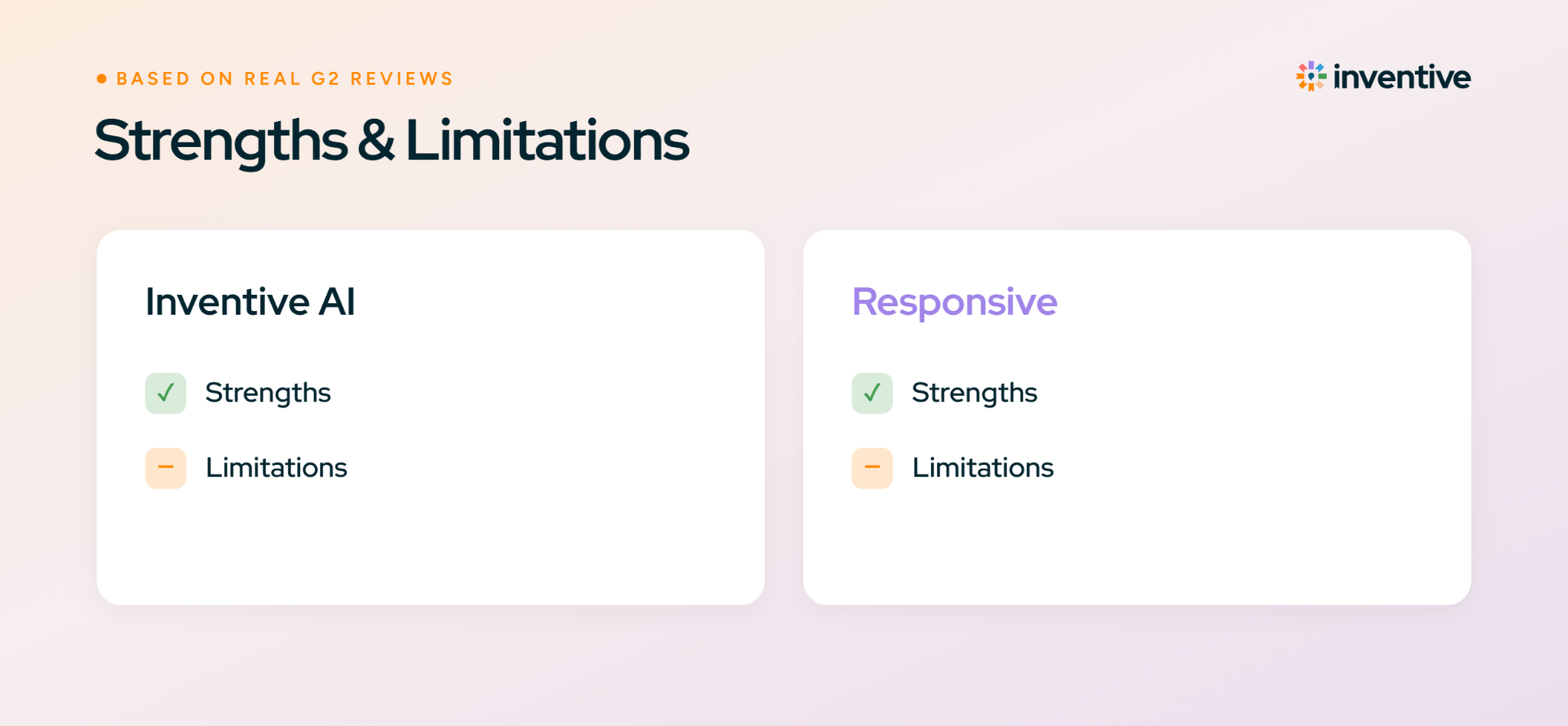
Here's what G2 reviewers consistently praise, and where they see room for improvement.
What G2 Reviewers Say About Inventive AI
Strengths
- G2 reviewers consistently praise the quality and contextual accuracy of AI-generated responses, saying they require minimal editing before submission.
- Users say Inventive significantly reduces RFP response time by retrieving information from connected knowledge sources instead of relying on manual searches.
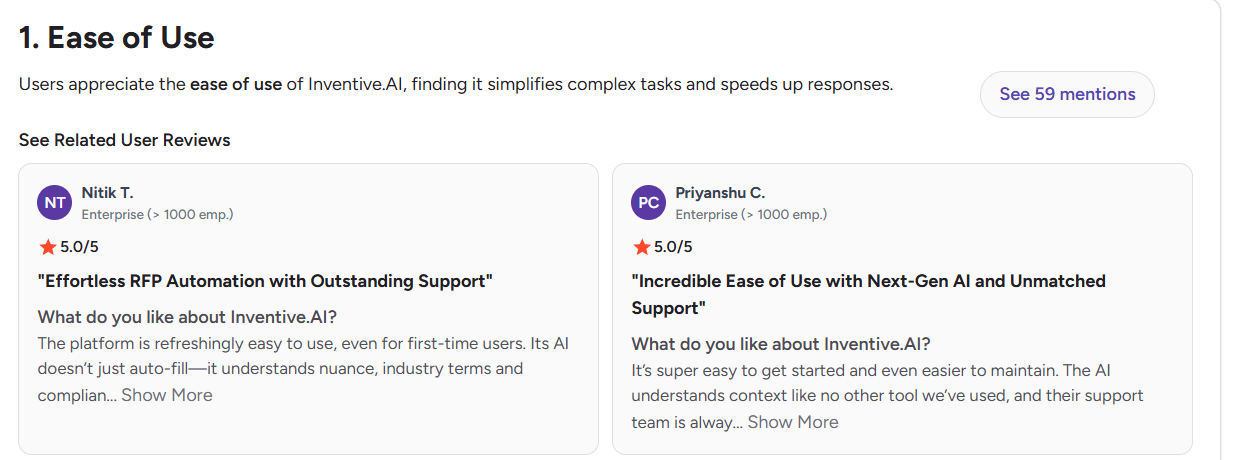
- Reviewers highlight the platform's ease of use, intuitive interface, and fast onboarding.
- Users value integrations with knowledge sources such as Google Drive, Confluence, Notion, and SharePoint, along with features like conflict detection and source citations.
- Customer support is frequently described as responsive and receptive to product feedback.
Limitations
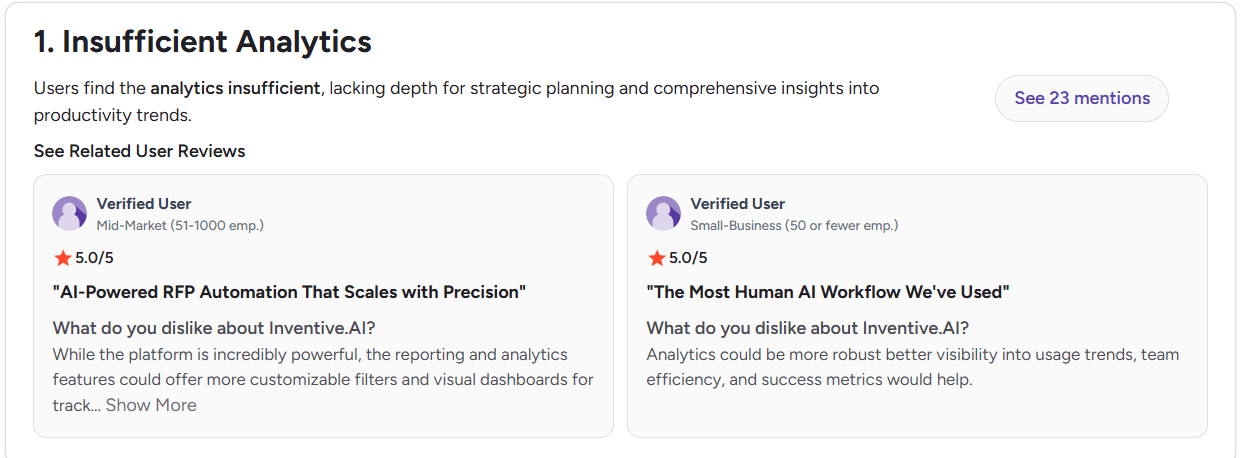
- G2 reviewers say they'd like more advanced reporting and analytics, including better visibility into content usage, adoption, and productivity trends.
- Some users would like more granular role-based permissions and workflow controls.
- A few reviewers mention they'd like broader enterprise integrations and additional administrative capabilities.
What G2 Reviewers Say About Responsive
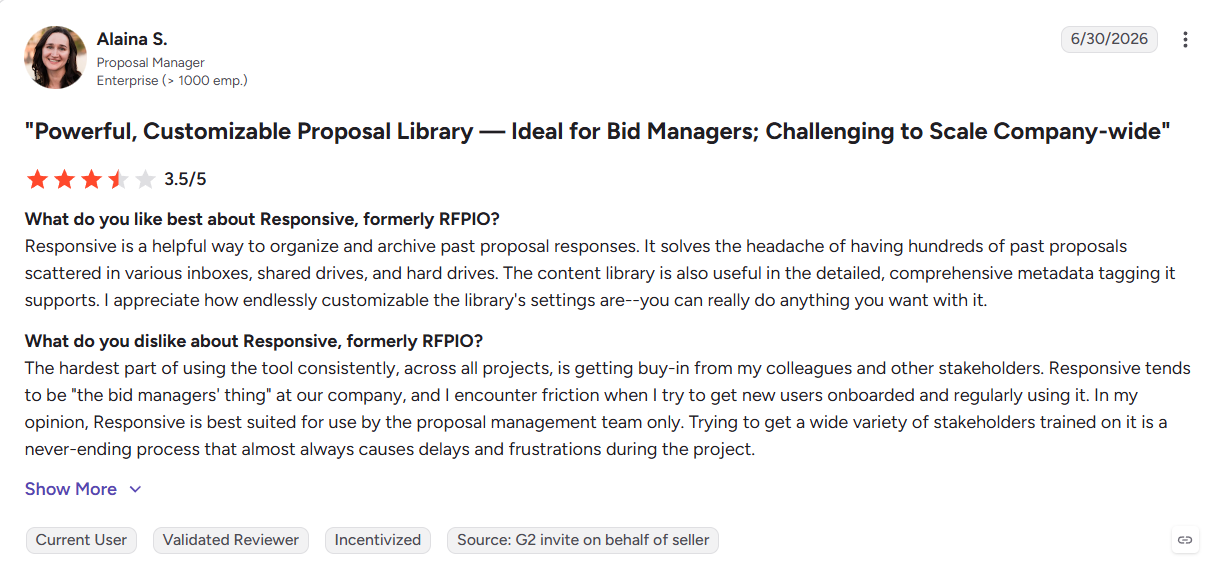
Strengths
- G2 reviewers value Responsive's content library, collaboration features, and structured response management workflows.
- Users say the platform helps teams standardize responses and collaborate across SMEs more efficiently.
- Reviewers appreciate AI features such as AI Draft, Smart Search, TRACE Score, and document analysis for accelerating first drafts and proposal reviews.
- Many users highlight Responsive's integrations and enterprise workflow capabilities.
Limitations
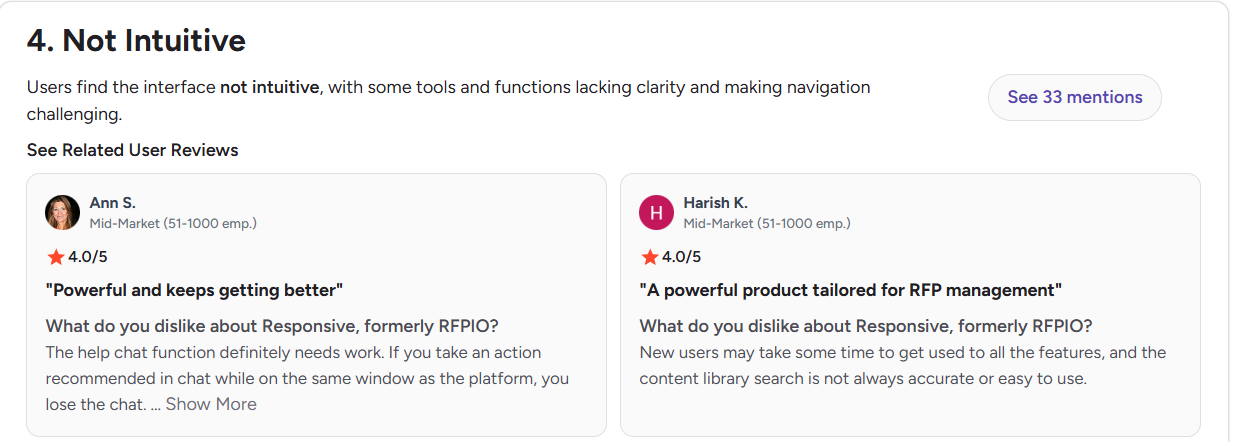
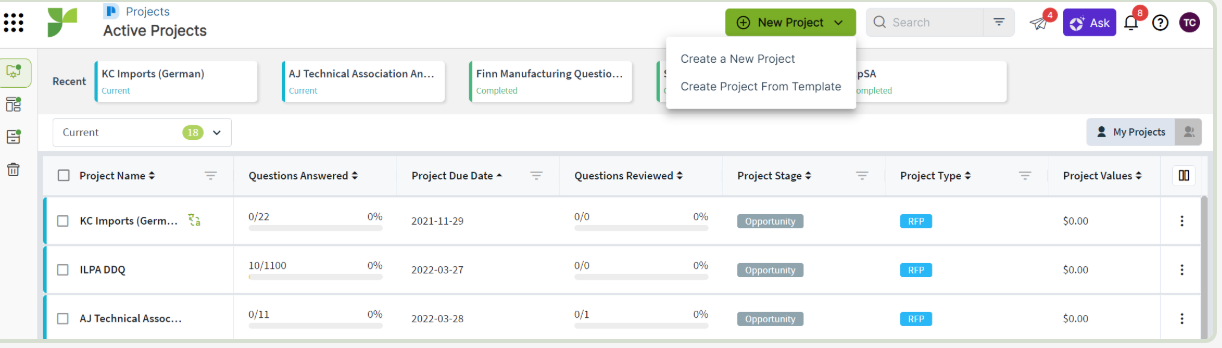
- G2 reviewers say the platform has a steeper learning curve, particularly because of its features and configuration options.
- Some users describe parts of the interface as clunky or dated, requiring more clicks than expected for common tasks.
- Reviewers report that AI-generated responses sometimes require additional editing before they're ready for submission.
- Some users would like improvements to formatting, usability, and AI capabilities
How Inventive AI and Responsive Compare Across Key Capabilities
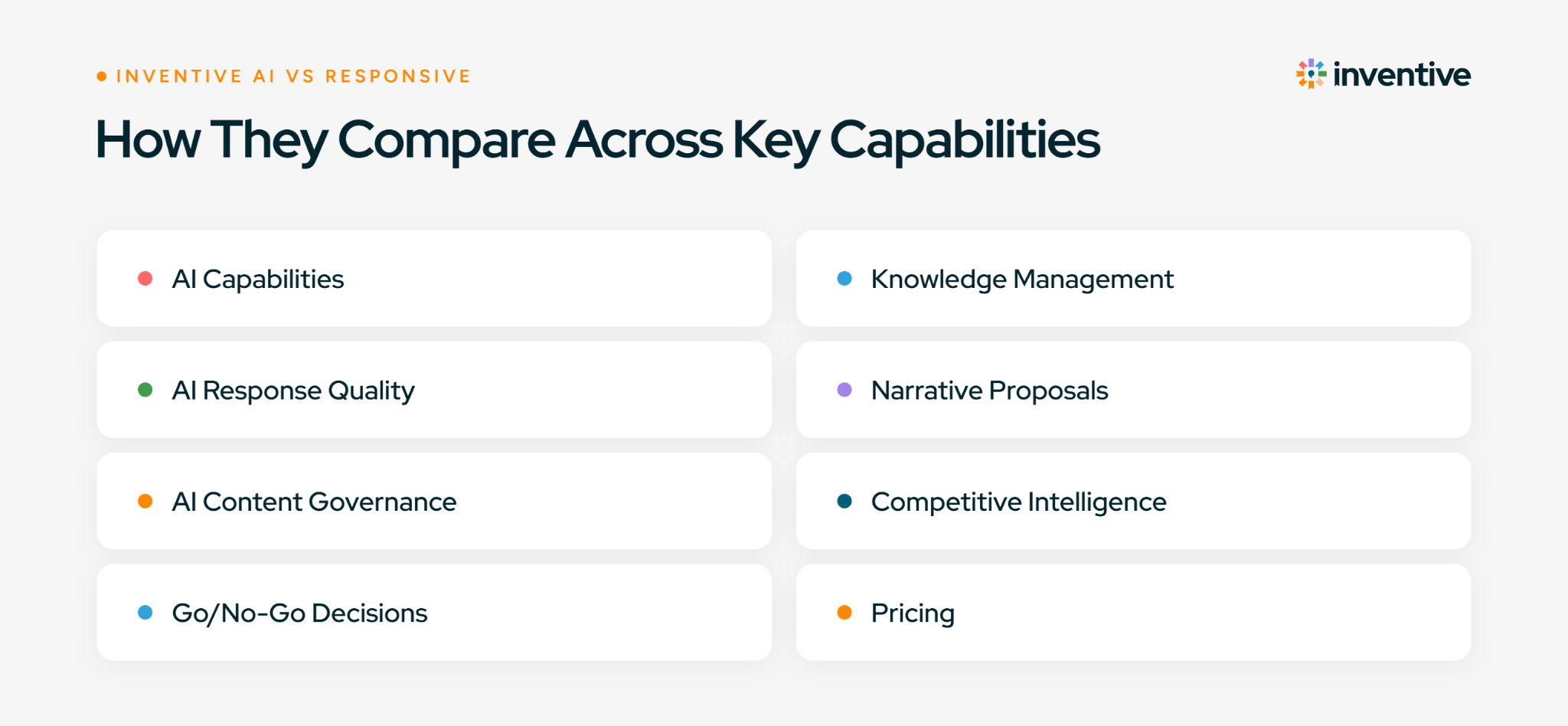
Both platforms cover the core proposal workflow, but they differ in where AI is applied, how knowledge is managed, and how much manual work remains for proposal teams.
AI Capabilities
Inventive AI is designed from the ground up for AI-powered proposal automation, using AI agents for go/no-go analysis, knowledge retrieval, response generation, proposal review, and AI content governance while keeping humans in control of final approvals.
Responsive uses AI on top of its Strategic Response Management platform for document analysis, response generation, proposal review, go/no-go analysis, and workflow automation.
Knowledge Management
Inventive AI retrieves business knowledge directly from connected systems such as SharePoint, Salesforce, Google Drive, Confluence, Notion, and websites, reducing dependence on a separate Q&A repository.
Responsive combines connected knowledge with a governed Content Library that proposal teams organize, review, and approve over time, giving AI access to both approved responses and connected content.
AI Response Quality
Inventive AI analyzes each RFP requirement, retrieves supporting business knowledge, and generates contextual responses with source references. When information is missing, it flags the gap instead of guessing.
Responsive generates first drafts using approved Content Library responses, connected knowledge, and prior successful answers. Responses include source citations and a TRACE Score that evaluates trustworthiness, relevance, accuracy, and completeness.
Narrative Proposal Generation
Inventive AI generates executive summaries, methodologies, implementation plans, statements of work, and other long-form proposal sections while maintaining context across the proposal.
Responsive supports long-form proposal creation through reusable content, proposal templates, AI-assisted drafting, and dedicated AI agents such as the Executive Summary Agent.
AI Content Governance
Inventive AI has a content governance agent to identify outdated, duplicate, conflicting, and low-quality content before it's reused, reducing manual content maintenance.
Responsive relies on human-managed content governance, where content owners review, approve, and maintain reusable responses through approval workflows and governance policies before they're published or reused.
Competitive Intelligence
Inventive AI helps proposal teams strengthen competitive positioning by identifying differentiation opportunities and generating competitor-aware proposal content.
Responsive supports competitive analysis through customizable AI agents in Agent Studio, but does not publicly document out-of-the-box competitor-aware proposal generation.
Go/No-Go Decisions
Inventive AI reviews RFP requirements, summarizes key risks, evaluates bid fit against your qualification criteria, and recommends whether an opportunity is worth pursuing.
Responsive uses AI-assisted document analysis to summarize RFPs, highlight key requirements, and support go/no-go decisions alongside configurable evaluation workflows.
Pricing
Inventive AI offers simple, usage-based pricing with unlimited users.
Responsive price starts at $5,000/year for 5 users (Lite Edition); higher-tier plans add advanced AI, automation, and enterprise capabilities.
Has AI Changed What Proposal Teams Should Expect from RFP Software?
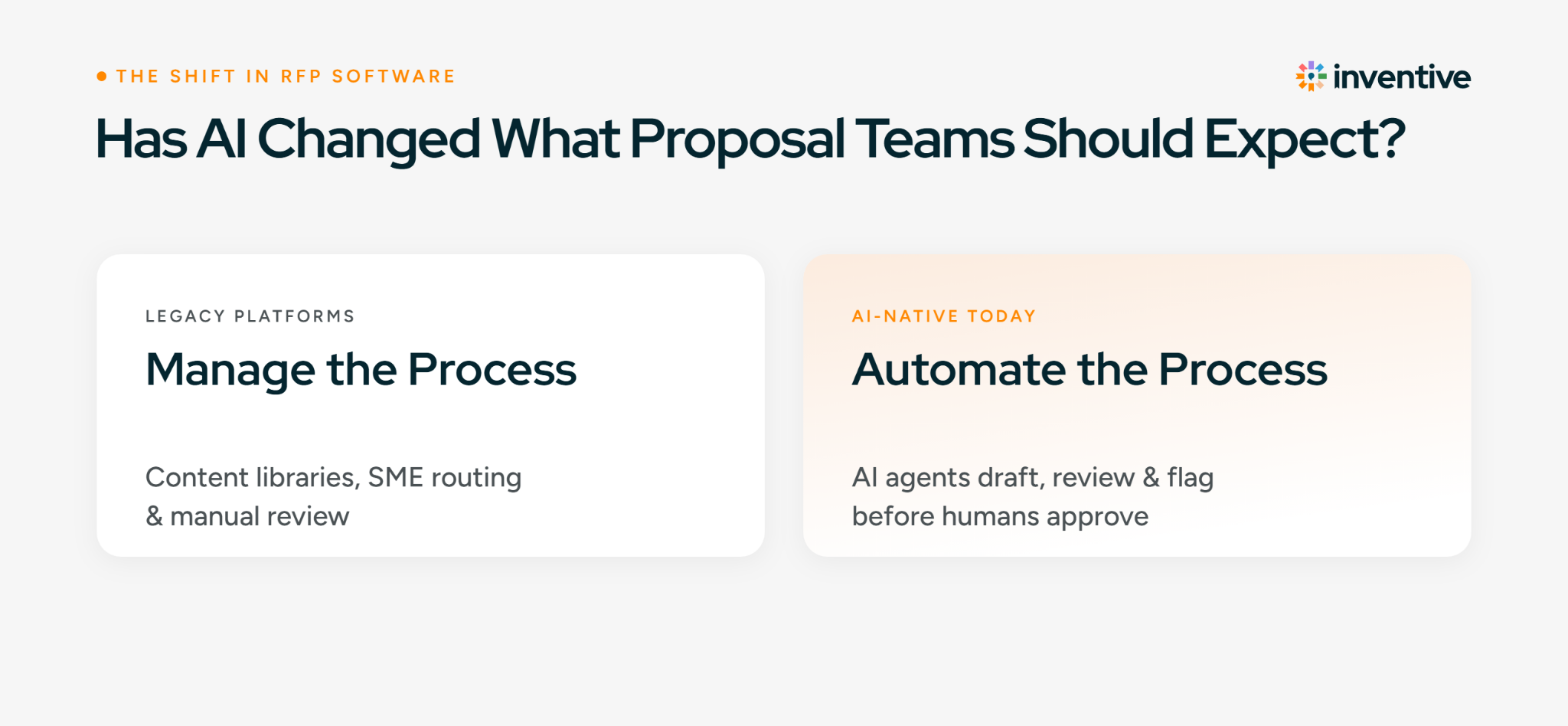
AI has changed what proposal teams expect from RFP software.
Earlier platforms helped teams manage content libraries, collaborate with SMEs, route reviews, and reuse approved responses. AI later improved drafting and proposal review, but most of the work still depended on people.
Today's autonomous agents handle much more of the proposal process end-to-end. They can understand RFP requirements, retrieve the right business knowledge, generate contextual responses, review proposals for gaps and conflicts, and identify content that needs human approval.
Both platforms reflect this shift. Responsive integrates AI into its Strategic Response Management platform, while Inventive AI is purpose-built to automate proposals end-to-end with AI agents, leaving final review and approval to people.
Where Does Human Effort Go in Each Platform?
Both platforms keep humans involved throughout the proposal process. The difference is where proposal teams spend their time.
With Responsive, proposal teams continue to manage content governance, library maintenance, response approvals, and workflow coordination. AI accelerates drafting, document analysis, proposal review, and qualification, while people remain responsible for keeping library content accurate and up to date.
With Inventive AI, autonomous agents handle much of the repetitive proposal work before review. Instead of managing content and reviewing every response manually, proposal teams can focus on proposal strategy, customer messaging, and final approvals.
For teams managing a high volume of RFPs, the amount of manual work each platform requires becomes an important differentiator.
Which RFP Software Should You Choose?
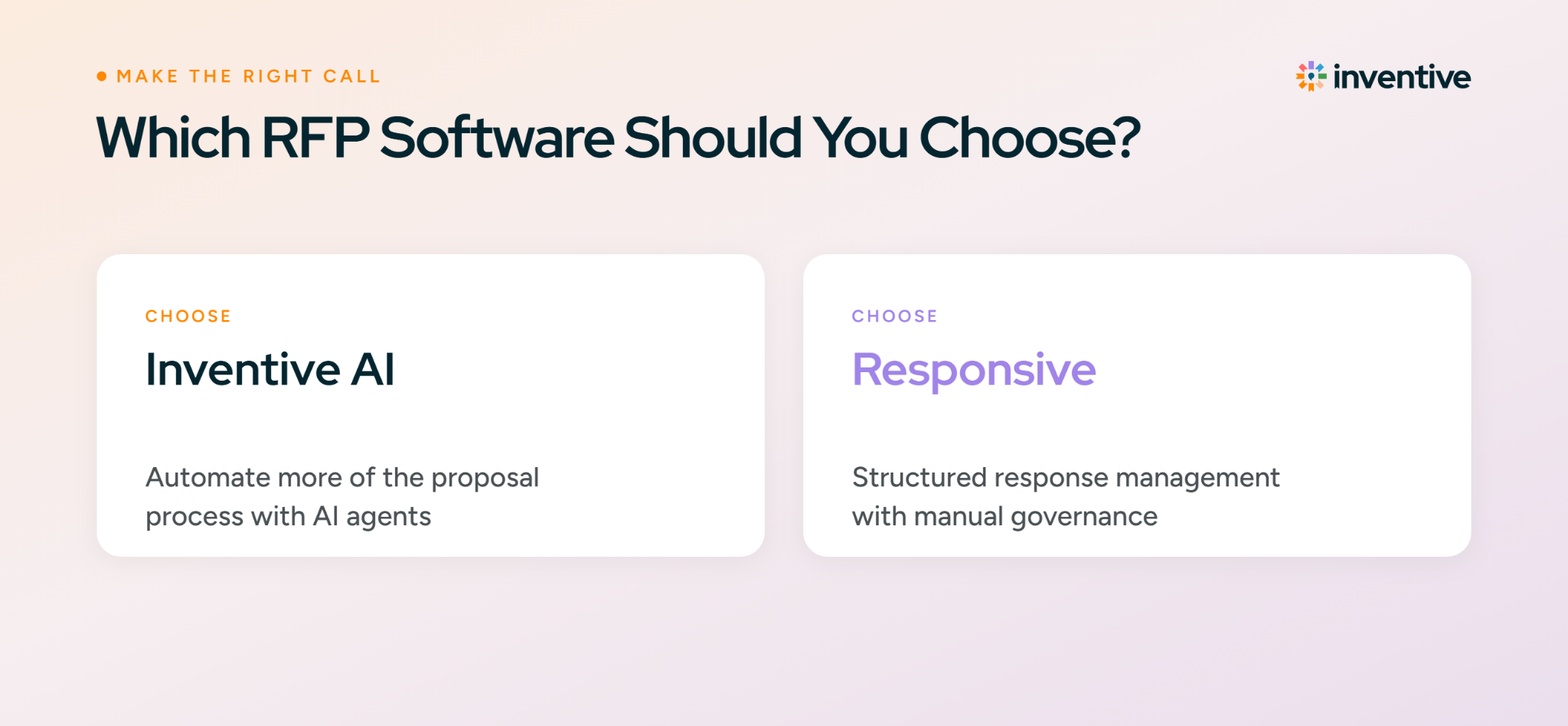
The right platform depends on how your team manages proposals today, and how much of the proposal process you want to automate going forward.
| Choose Inventive AI if you... | Choose Responsive if you... |
|---|---|
| Want AI to automate more of the proposal process, with generating faster first drafts. | Need a response management platform with established workflows and manual governance. |
| Prefer generating responses from connected business knowledge instead of maintaining a large Q&A library. | Already have a well-maintained Content Library and dedicated content owners. |
| AI to help identify outdated, duplicate, and conflicting content instead of relying on manual content reviews. | Prefer people to manage content quality through approval workflows and review cycles. |
| Respond to a high volume of RFPs and want to reduce manual effort as proposal volume grows. | Need strong collaboration, project management, and governance across large proposal teams. |
| Create both questionnaires and narrative proposals within the same workflow. | Primarily respond to structured RFPs, RFIs, DDQs, and security questionnaires. |
See the Results on Your Own RFP
Insider increased win rates to 50–70% and reduced RFP response time by 90% with Inventive AI.
Book a DemoFAQs
Is Responsive or Inventive AI better for enterprise RFP teams?
Both platforms support enterprise proposal teams, but they're designed differently. Responsive is a Strategic Response Management platform with mature workflows, collaboration, and content governance. Inventive AI focuses on automating more of the proposal lifecycle using AI, including response generation, proposal review, and AI content governance, while keeping humans in control of final approvals.
Can both platforms generate narrative proposals as well as questionnaires?
Yes. Both Inventive AI and Responsive support questionnaires and long-form proposal documents. The difference lies in how responses are generated, reviewed, and maintained throughout the proposal process.
Do I need a content library to use Inventive AI or Responsive?
Responsive is built around a governed Content Library that proposal teams maintain over time. Inventive AI can retrieve information directly from connected business systems such as SharePoint, Google Drive, Confluence, Salesforce, and Notion, reducing the need to maintain a separate Q&A repository.
Which platform requires less manual content maintenance?
Responsive relies on content owners to review, approve, and maintain reusable responses. Inventive AI uses AI content governance to identify outdated, duplicate, and conflicting content, helping reduce ongoing maintenance while keeping human reviewers in control of final decisions.
How should I evaluate AI RFP software during a product demo?
Rather than comparing AI drafting alone, evaluate how each platform retrieves knowledge, handles missing information, supports proposal review, manages content quality, integrates with your existing systems, and scales as your RFP volume grows. Using one of your own active RFPs is often the most reliable way to compare platforms.

.avif)