LLMs for RFPs: Which Models to Use, How to Build an RFP Response Workflow, and When to Buy Instead
Every response team has now had the conversation. Someone senior looks at the RFP software line item and asks why an engineer cannot wire GPT-5 or Claude to the SharePoint folder over a sprint. It is a fair question, and it deserves a better answer than either "AI can do anything" or "buy our product."
This guide is that answer. It covers which large language models are best suited to RFP work in 2026, how to choose between them, what a production-grade RFP response workflow built on an LLM actually contains, and where the build stalls. Proposal teams answered an average of 166 RFPs last year at about 25 hours each, according to Loopio's RFP Trends and Benchmarks research, so the prize is real. We build RFP automation software at Inventive AI and we run on these same models, which means we know precisely where the hard parts live. We will be candid about both sides.
Should You Build an RFP Response Tool on an LLM?
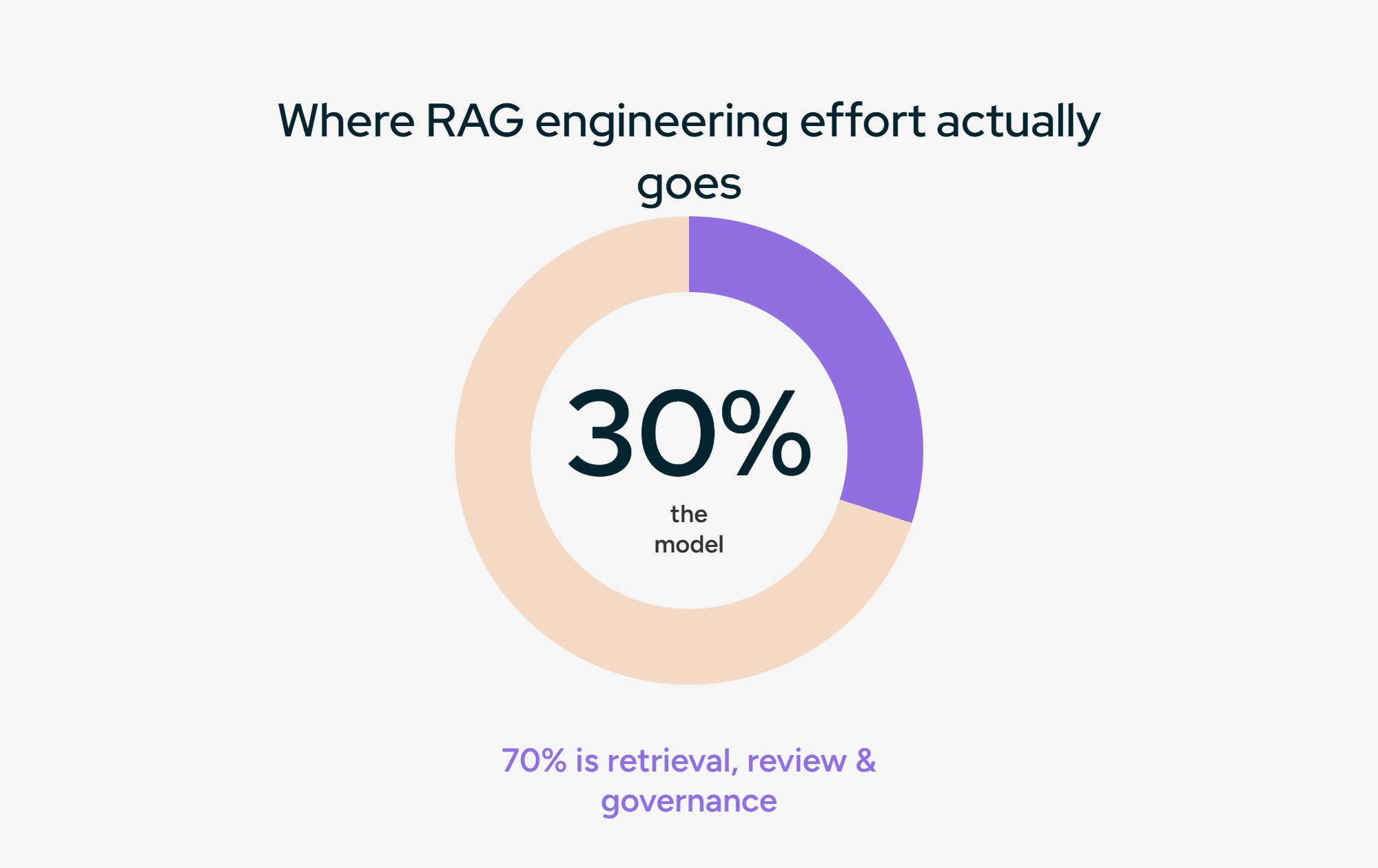
Start with a ratio practitioners keep arriving at independently. Engineers who have shipped retrieval-augmented generation (RAG) systems into production report spending roughly 70% of their effort on document preparation, retrieval quality, and evaluation, and about 30% on the model itself. Sales teams describe the same split from the other side: generating text solved about 30% of their RFP workload, and the remaining 70% was review, assignment, and approval.
That ratio reframes the question. The LLM is the cheap, easy part. Everything around it is the product.
Three tiers of "build" exist, and they are not the same project:
- A prototype. One document source, a vector index, a chat box. A weekend.
- An internal drafting assistant. PDF and Excel intake, an answer library, citations, a review queue, basic permissions. Commonly 8 to 16 weeks with two to four engineers.
- A production response system. Multiple connected sources, hybrid retrieval, governed content, approvals, audit trail, evaluation harness, and resilience to model changes. Three to nine months, then a permanent maintenance allocation.
Build the first tier whenever you like. Build the second if one proposal manager owns the process and the drafting alone is worth it. Build the third only if RFP response is your company's product. The rest of this guide gives you what you need for tiers one and two, and shows the math on tier three.
Which LLM Is Best for RFP Responses in 2026?
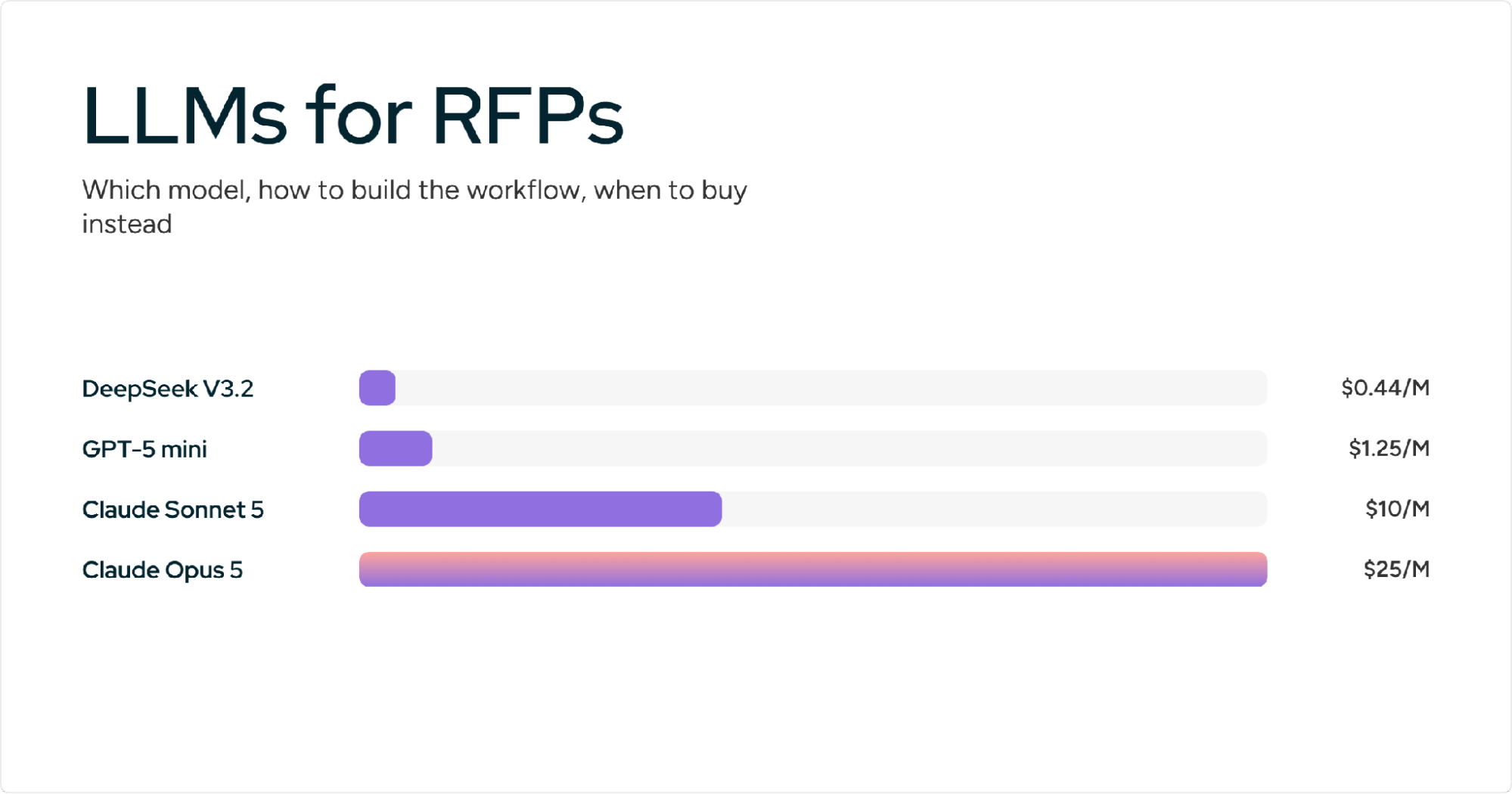
RFP work stresses a model in specific ways: reading 200-page packages without losing the amendment on page 187, extracting requirements verbatim into a fixed schema, comparing a question against internal evidence, and writing polished prose that sounds like your company. Here is how the current field stacks up on those jobs. Prices are list API prices per million tokens as of September 2026 and change often, so confirm on each vendor's pricing page before budgeting.
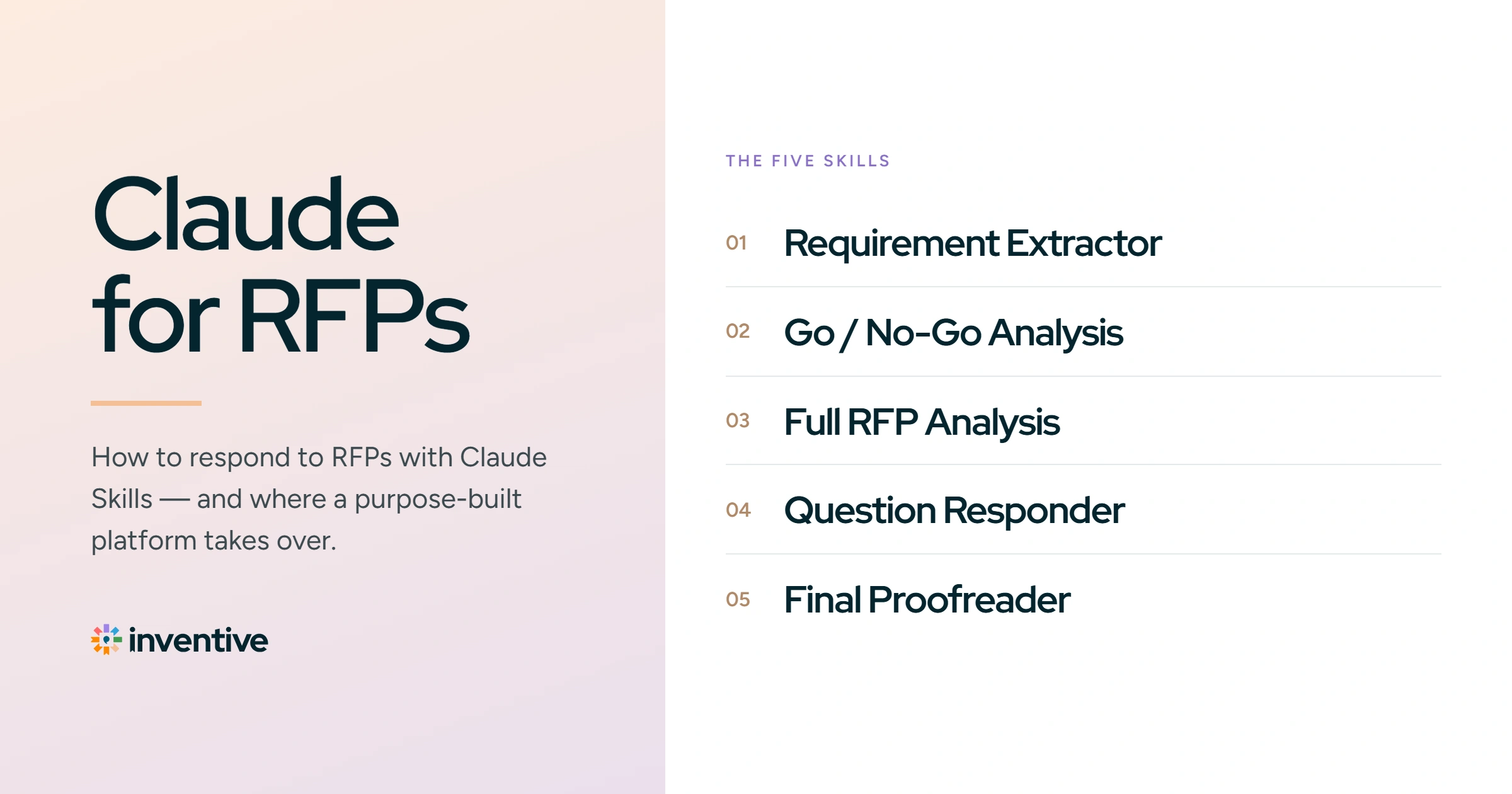
The default. Claude Sonnet 5 is the strongest single choice for most teams: a full RFP plus supporting material fits in context, extraction is reliable, and the drafting reads like a person wrote it. Reserve Opus 5 for the hard 10%: contradictory requirements, final compliance review, must-win bids.
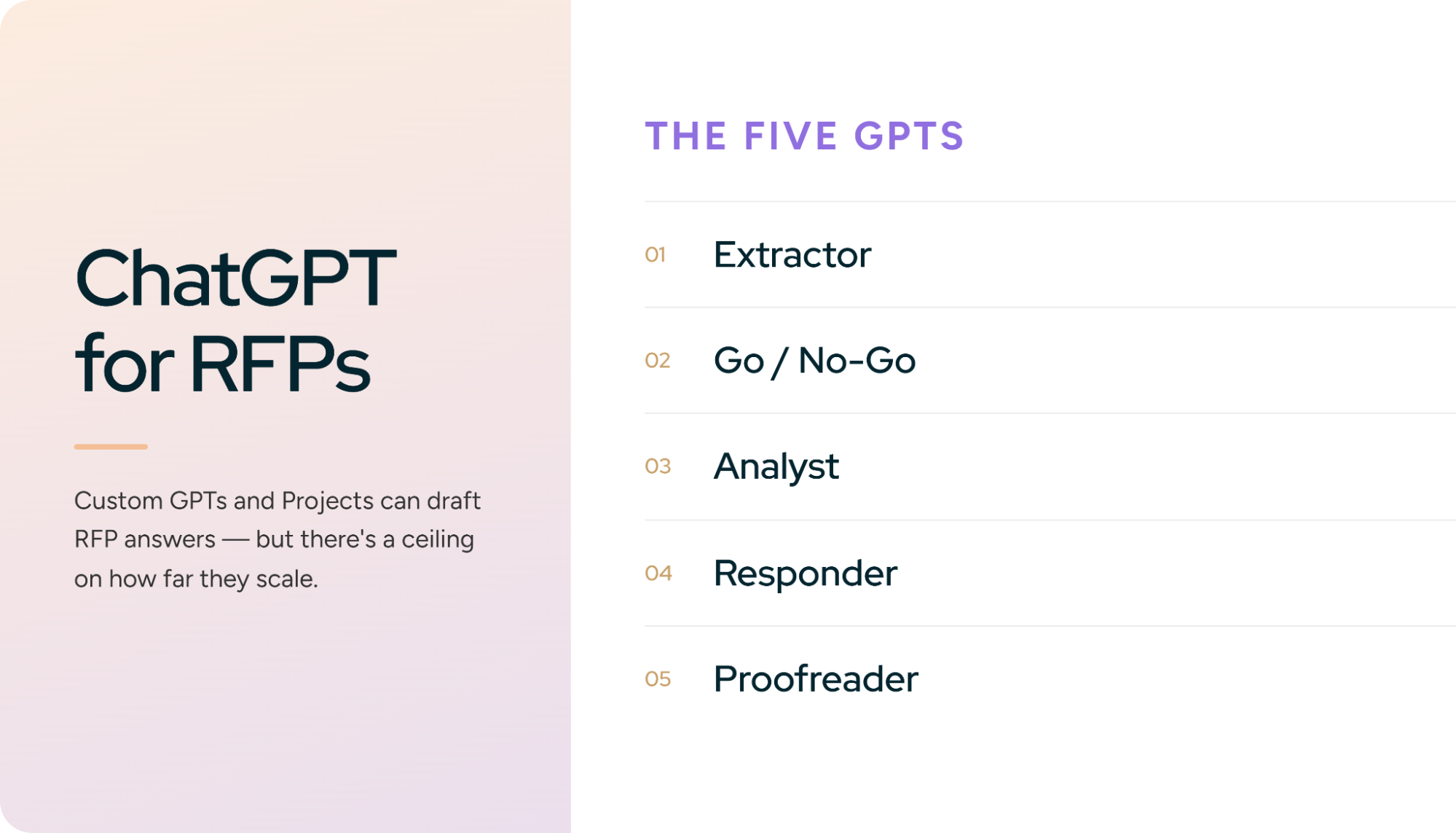
Microsoft shops. If your knowledge lives in SharePoint and your IT team already runs Azure OpenAI, GPT-5 is the pragmatic pick. Its structured-output mode makes pipeline stages easier to wire together, and GPT-5 mini is a cheap, capable extraction worker.
Big, messy packages. Gemini 3.x Pro handles scanned pages, tables, and diagrams better than most, and Vertex AI gives you regional endpoints and enterprise controls.
Air-gapped or sovereign. Llama 4 is the clearest self-hosting route when bid data cannot touch an external API. Budget for GPUs, inference engineering, and an evaluation effort your API-based peers skip. Self-hosting is not automatically cheaper.
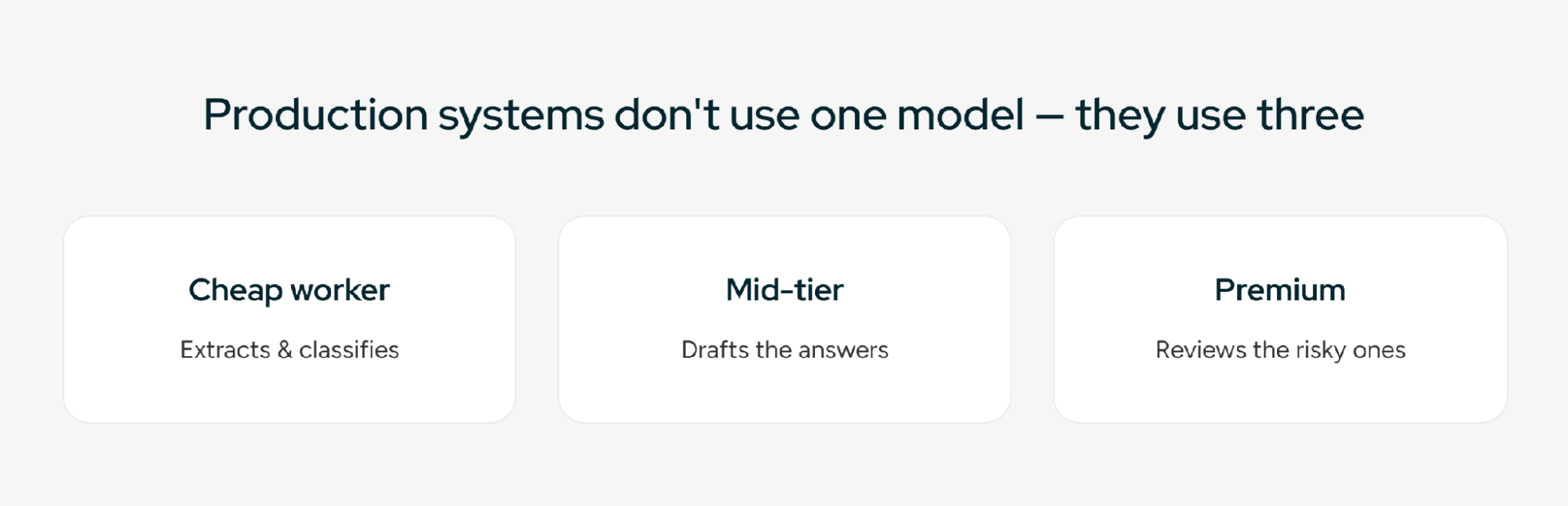
The real answer is two or three models. Production systems rarely use one. A cheap worker (GPT-5 mini, Gemini Flash, Mistral Small) classifies pages and extracts fields. A mid-tier model (Sonnet 5, GPT-5) drafts. A premium model (Opus 5, GPT-5 Pro) reviews the high-risk answers. Design for a cascade from day one.
How to Choose an LLM for RFP Automation: Seven Criteria
1. Long-document accuracy, measured on your own RFPs. A 1M-token window is a marketing number. What matters is whether the model finds the liability clause on page 187 of a 200-page package. Take three past RFPs, plant ten known requirements, and count what each model recovers.
2. Structured output reliability. Every pipeline stage hands JSON to the next. A model that returns a compliance table in a slightly different shape one time in twenty will break your export step at 2 a.m. before a deadline.
3. Grounding and abstention behavior. Give each model a question your documents do not answer. The right response is "not found in approved sources." A confident, plausible paragraph is a disqualifier.
4. Cost at your volume. Do the arithmetic before you assume inference is the expensive part. At 166 RFPs a year with 80 questions each, drafting every answer with about 8,000 tokens of retrieved context and 500 tokens of output on Sonnet 5 costs under $300 a year in model fees. Triple it for retries and a review pass and you are still under $1,000. The engineers maintaining the system will cost more than that per day.
5. Data residency and training terms. OpenAI, Anthropic, and Google Vertex commercial APIs do not train on customer content by default, and several offer regional processing. Read the actual terms for your plan and cloud, since a direct API contract and an Azure or Bedrock contract are not identical. Self-hosting moves the entire obligation to your infrastructure team.
6. Cloud availability where you already have controls. Confirm the exact model ID, region, JSON schema support, and provisioned throughput on Bedrock, Azure, or Vertex. "Available on the cloud" is not a specification.
7. Deprecation cadence. Models retire. Anthropic retired Claude 3.5 Sonnet in October 2025 and Claude 3.7 Sonnet in February 2026. OpenAI commits to at least six months' notice for generally available models and retired the Assistants API in August 2026. Every migration means re-running your full evaluation set, and sometimes rewriting prompts and parsers. Plan for one migration a year.
How to Build an RFP Response Workflow with LLMs
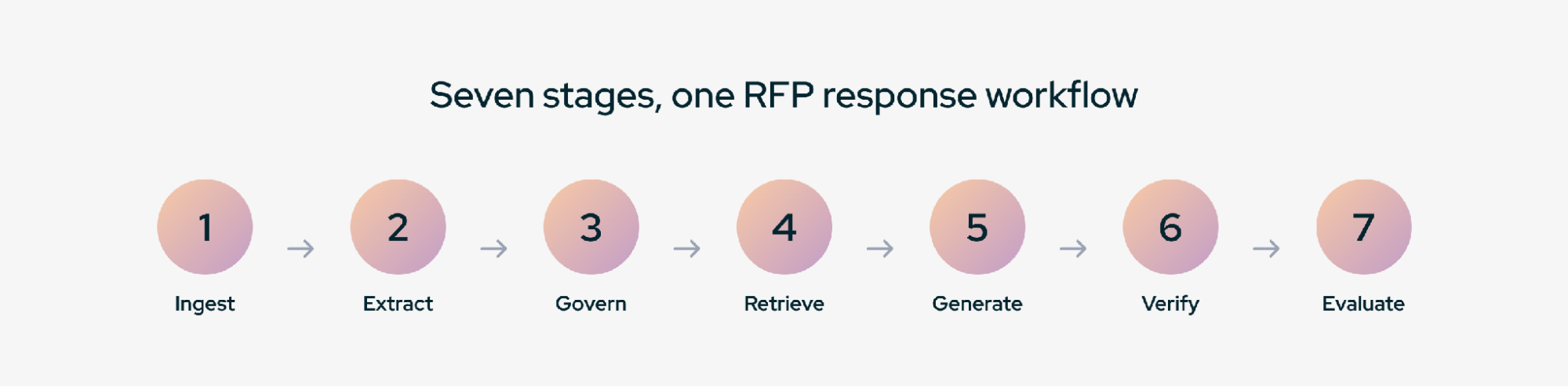
Here is the architecture that separates a demo from a tool people trust. The companion download includes the system prompts for stages two, five, and six plus an evaluation rubric for stage seven.
1. Ingest with structure intact. RFPs arrive as PDFs with two-column layouts, Word files with nested tables, and Excel workbooks with merged cells and hidden rows. Use a layout-aware parser, keep tables together, and preserve page, section, and cell coordinates on every chunk. Plain text extraction that loses the relationship between a requirement and its subclauses is not good enough for compliance work.
2. Extract requirements into a schema. Every requirement becomes a record: ID, verbatim text, source location, mandatory or optional, deadline, evidence needed, suggested owner, open ambiguity. "Shall" and "must" are always mandatory. Submission rules (format, page limits, forms) are requirements too.
3. Govern the knowledge before you index it. This is the stage most builds skip and most builds die on. Every source document needs an approval status, an owner, an effective date, an expiry date, and product and region tags. Without them, last year's data-residency answer and this year's sit side by side in the index with equal authority, and semantic similarity decides which one your prospect sees. The rules in our guide to building a competitive RFP answer library apply directly.
4. Retrieve with hybrid search. Pure vector search treats "SOC 2 Type II" and "ISO 27001" as semantically similar. RFPs are full of exact identifiers: control numbers, product SKUs, standards, version numbers. Combine keyword search (BM25) with dense retrieval, filter on metadata, and rerank the candidates. Retrieve small chunks for precision, then hand the parent section to the model for context.
5. Generate only from evidence. The prompt requires every material claim to carry a source ID that maps to a retrieved chunk, and it distinguishes four states: supported, partially supported, not found, and needs SME confirmation. Never let the model invent certifications, customer names, dates, or pricing. Most hallucinations begin as retrieval failures, so when the model guesses, look upstream first.
6. Verify and route. A second pass (a cheaper model or a rules engine) checks that each citation actually supports the sentence next to it, scans for unsupported numbers and commitments, and sends low-confidence answers to the named SME. This is also where a human approval state has to exist. Without it, the tool becomes an unofficial chatbot rather than a system of record.
7. Evaluate continuously. Build a golden set of 100 to 500 real questions with verified answers and the documents that should have been retrieved. Run it after every change to chunking, embeddings, prompts, parsers, or models. Track retrieval recall, citation coverage, unsupported-answer rate, and the human edit rate. Teams that skip this make decisions on demo vibes and undo them later.
Stages one through seven are the same seven things Inventive AI does under the hood, with agents running each stage and humans approving at the end. If you would rather see them working than build them, book a 20-minute demo.
Pros and Cons of Building RFP Automation on LLMs
Where building wins
Total control of the stack. You choose the model, the retrieval design, the hosting region, and the retention policy. For sovereign or air-gapped environments this can be the only option.
Exact fit to one workflow. If your RFP process is genuinely unusual, an internal tool can mirror it without waiting on a vendor roadmap.
Cheap inference. As the arithmetic above shows, model fees for a proposal team's volume are a rounding error.
A capable drafting assistant is achievable. A narrow tier-two tool that drafts from a governed library, for one owner who reviews everything, can pay for itself.
Where building costs you
Document ingestion never finishes. Every new issuer brings a new Excel layout or PDF structure, and writing 200 answers back into a rigid workbook without breaking merged cells or validation is a document automation product in its own right.
Stale content is a governance problem, not a model problem. No LLM knows which of two similar documents is approved. You build the metadata model, the review queues, and the conflict detection, or you ship wrong answers.
Collaboration has to be built from scratch. Assignments, reviewer routing, approval states, version control, and audit trails are months of full-stack work that has nothing to do with AI.
Key-person risk and model churn. The engineer who understands the retrieval pipeline leaves, a retirement notice arrives for your pinned model, and the quarter's roadmap now includes a full re-evaluation of legacy code nobody wants to touch.
The Build vs. Buy Decision: Seven Questions for Your Engineering Lead
Before committing engineers, put these to the person who would own the build:
- Who rebuilds the tool as model capabilities, memory, and agent architectures change every quarter?
- How does the retrieval layer guarantee the right context reaches the model every time, for every product line and region?
- When the product changes, who writes the code that makes the AI use the newest spec instead of an outdated answer from an old RFP?
- Who scopes the infrastructure to process a 200-question workbook without timeouts or crashes?
- Who builds the project management layer so five people can work on one RFP with assignments and approvals?
- Who writes the export that returns answers into the issuer's Excel template without breaking the formatting?
- Are we willing to pull two or three full-time engineers off the customer-facing roadmap for six to twelve months to build and maintain this?
Question seven usually decides it. Practitioner estimates for an internal RFP assistant with PDF and Excel intake, an answer library, and a review queue land around $75,000 to $250,000 in engineering time; a production system with connectors, governance, approvals, and evaluation runs $150,000 to $500,000, followed by half an FTE to two FTEs of ongoing maintenance. Those are planning ranges, not quotes, and they exclude the opportunity cost of features your customers were waiting for.
The principle: build where you differentiate your product, buy where you run your operations. Our build vs. buy guide for RFP software goes deeper on the economics, and the RFP response automation checklist covers what to test in a vendor proof of concept.
Five Best Practices for LLM-Based RFP Automation
Test on your ugliest RFP first, not your cleanest. Pick the 40-tab Excel questionnaire or the scanned 300-page government package. If the pipeline survives that, the average bid is easy. Most builds test on clean PDFs and discover the wall in month four.
Make abstention a first-class output. "Not found in approved sources" should be a normal, expected answer that routes to an SME. A system that always answers is a system that sometimes lies.
Version and expire every source document. Approval status, owner, effective date, expiry date. Index nothing without them. When a product spec changes, retire the old file the same day.
Budget for one model migration a year. Pin model versions, keep your golden set current, and treat a deprecation notice as a scheduled project rather than an emergency.
Measure the human edit rate. If SMEs substantially rewrite more than 40% of drafts, stop tuning prompts and fix the knowledge base. The model is rarely the bottleneck.
How Inventive AI Handles RFP Response Management
Inventive AI is an agentic RFP response platform that runs the seven-stage workflow above so your engineers do not have to. Upload the full RFP in PDF, Word, Excel, or PowerPoint. AI agents extract the questions, pull the right context per question from a Knowledge Hub connected to the systems you already use, and draft every answer with source citations and a confidence score. Your team reviews and approves in one shared workspace.
- Knowledge Hub with live sync to SharePoint, Google Drive, Salesforce, Confluence, and Notion, so there is no second repository to maintain
- Content Governance Agent that flags conflicting, outdated, and duplicate content automatically
- Citations and confidence scores on every answer, tailored per deal by the Context Engine, and "Information unavailable" instead of a guess
- Full Response Analyzer and Go/No-Go agents for whole-document compliance checks and early qualification
- Assignments, reviewer workflows, approvals, and progress tracking across RFPs, RFIs, DDQs, and security questionnaires
- Formatted export back into the issuer's original template
- SOC 2 Type II compliance, and customer data is never used to train public models
RAD AI measured Inventive AI's answers as 2x more accurate than other RFP AI tools. Insider cut response time by 90% and moved its win rate from 30% to 50%. AssetWorks Facilities reported a 422% ROI with $105K in net savings.
If you have read this far and the seven questions gave you pause, book a demo with Inventive AI and bring the RFP that broke your prototype.
.avif)