Pharmaceutical Vendor Qualification: How Suppliers Answer Questionnaires and Pass GxP Audits
How sponsors run pharmaceutical vendor qualification, the GxP questionnaires and audits they send, and how vendors respond faster.
Pharmaceutical vendor qualification is how a drug company checks that a supplier is safe to work with before it buys anything. The drug company (the buyer, often called the sponsor) runs the checks. The supplier (the vendor) is the one being checked.
This guide is written for the vendor. If your company supplies an API, excipient, packaging, testing, manufacturing, clinical, or software service to a drug company, you are the one being qualified. You complete the questionnaires, send the documents, and host the audits that the buyer uses to approve you.
How well you handle qualification decides how fast you get approved and start earning revenue. This guide explains what the buyer asks for, the rules behind it, and how to respond without slowing every deal.
TL;DR
- Pharmaceutical vendor qualification is how drug companies (sponsors) approve and monitor suppliers against GxP standards.
- Vendors can’t sell to a sponsor until they’re qualified, so slow responses delay contracts.
- High-risk suppliers, such as API and sterile manufacturers, face on-site GxP audits. Lower-risk suppliers usually complete a questionnaire and a document review.
- Qualification takes from a few weeks to several months. It’s based on ICH Q7, Q9, and Q10, EU GMP, and 21 CFR Part 211.
- Approved vendors sign a quality agreement and are requalified every one to three years.
- The biggest delay is answering a different questionnaire for every sponsor. One approved source of answers keeps responses consistent and fast.
What is pharmaceutical vendor qualification?
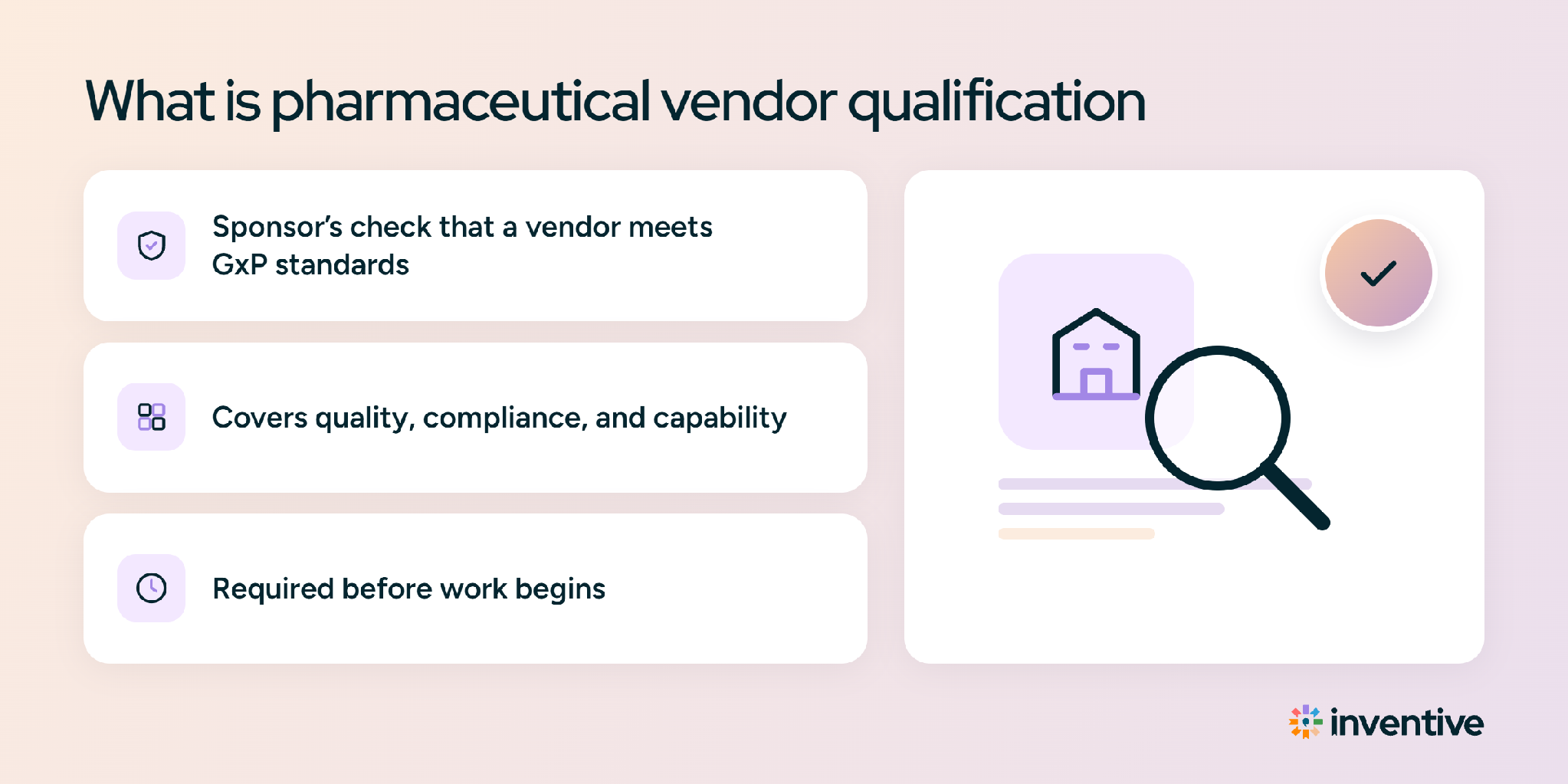
Pharmaceutical vendor qualification is the documented process a sponsor uses to approve a supplier and to keep re-checking it over time, so only vendors that consistently meet GxP standards stay in its supply chain. “Vendor qualification” and “supplier qualification” mean the same thing.
It is part of the sponsor’s quality system. A sponsor stays responsible for any work it outsources, so it has to prove every vendor is in control, and qualification is the record of that.
GxP is the umbrella term for the industry’s “good practice” rules: GMP (manufacturing), GLP (laboratory), GCP (clinical), and GDP (distribution). A vendor can be almost any supplier these rules touch: an API or excipient maker, a contract manufacturer (CMO or CDMO), a testing lab, a contract research organization (CRO), a packaging or logistics provider, or a software vendor running a GxP system.
Why Pharma sponsors audit and qualify vendors
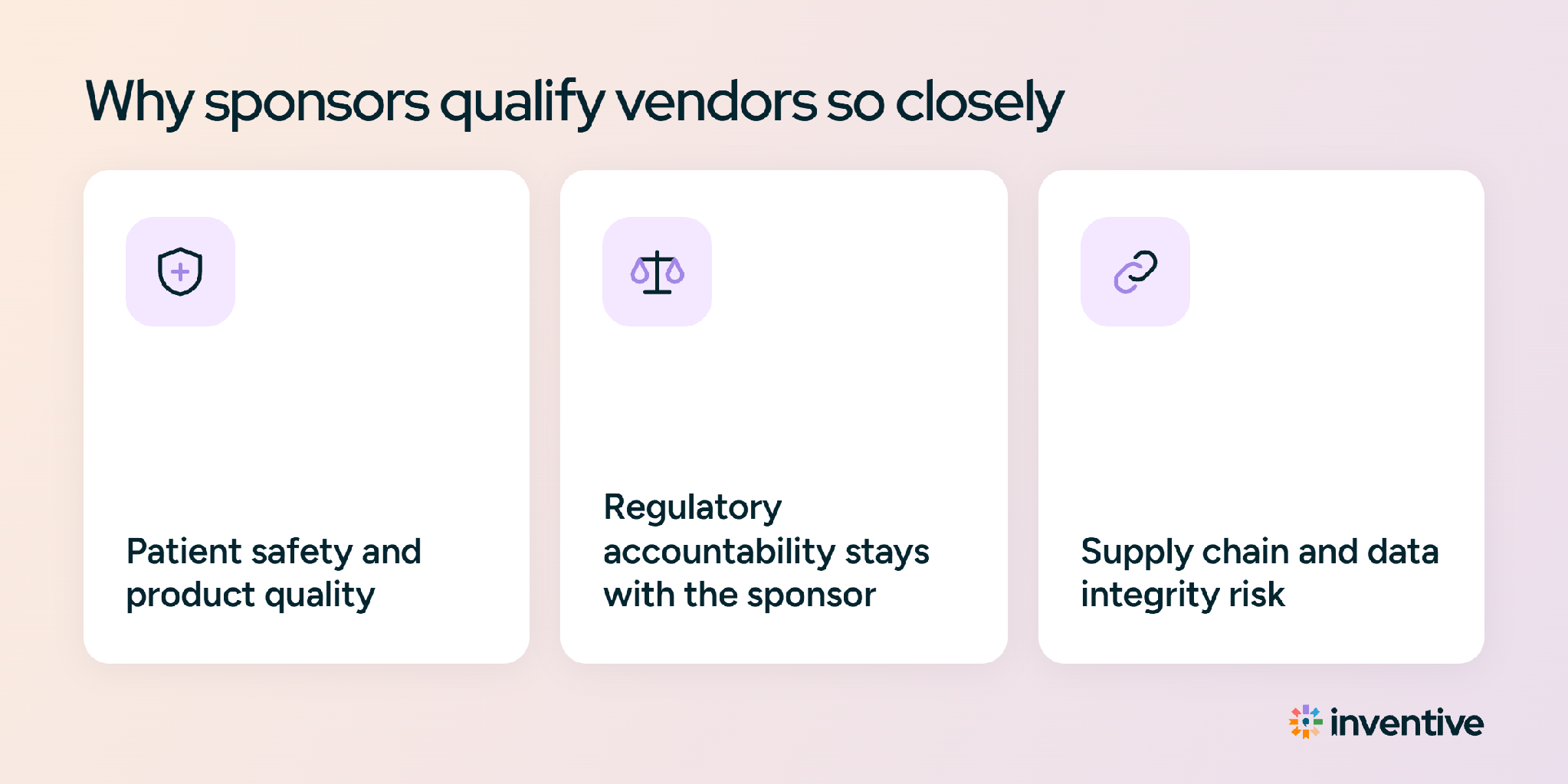
Sponsors qualify vendors closely because they carry the regulatory and patient-safety risk for work they do not perform themselves. Three forces drive it:
- Responsibility cannot be outsourced. Under ICH Q10 and EU GMP, the sponsor stays accountable for the quality of outsourced activities and purchased materials. If your component fails, it becomes their batch failure, their recall, and their regulatory finding.
- The supply chain is global and complex. The FDA reported that only 28% of the API manufacturing facilities serving the US market were located in the US, with the rest overseas. More suppliers, in more countries, means more for a sponsor to verify.
- Outsourcing keeps growing. Technavio estimated the contract development and manufacturing (CDMO) outsourcing market would grow by $136.9 billion between 2024 and 2028. As sponsors outsource more, they qualify more vendors and rely more heavily on each one's documentation.
A weak vendor becomes the sponsor's problem: a failed inspection, a data integrity finding, or a supply interruption. That is why sponsors want proof you are in control before they commit, not after.
Which teams approve pharma vendors, and the rules behind their decision
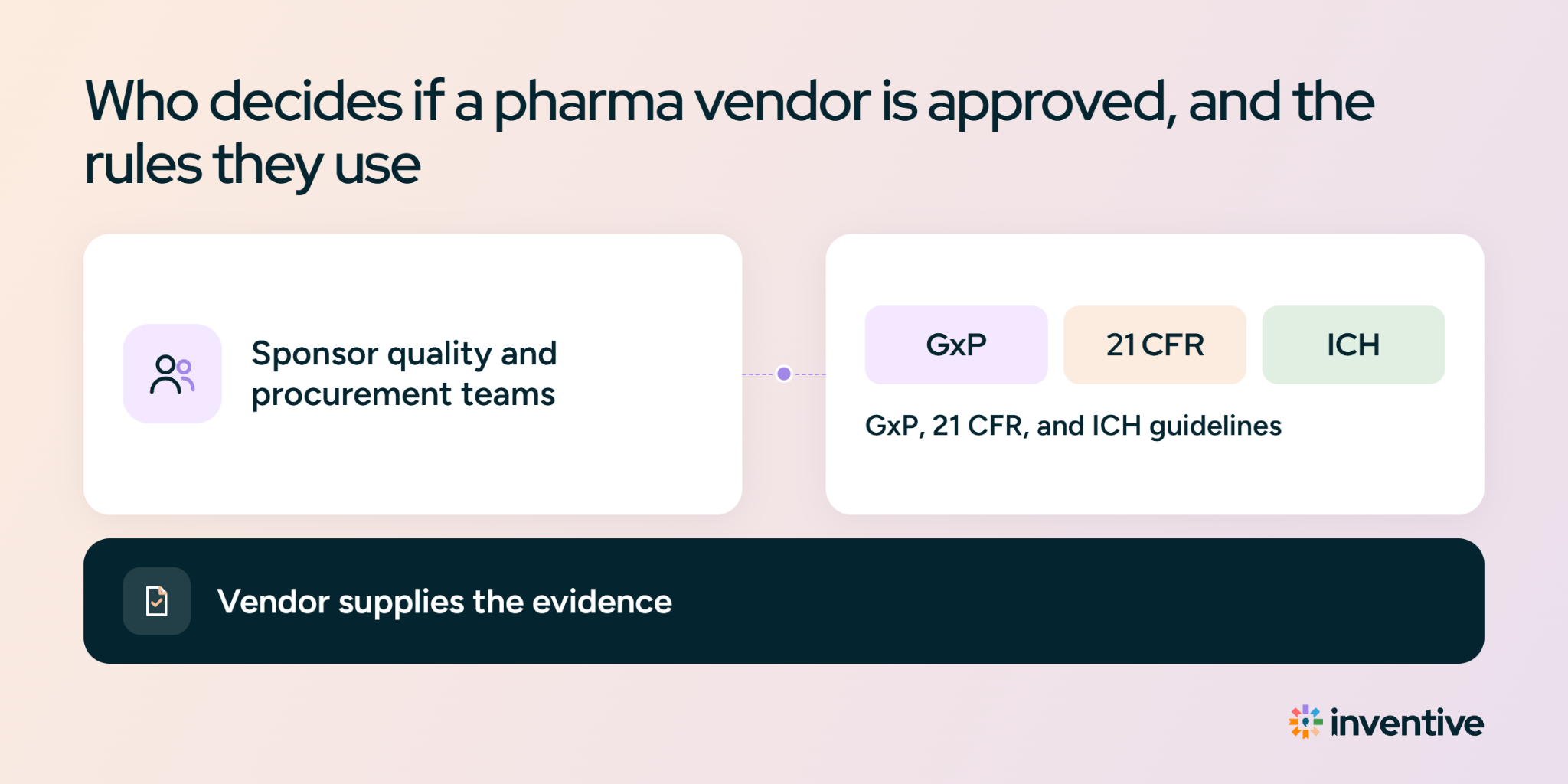
Qualification is rarely one person's decision. On the sponsor's side, several functions review different parts of your company:
- Quality assurance (QA) owns the process and makes the approval decision.
- Regulatory affairs checks your licenses, registrations, and inspection history.
- Procurement and supply chain handle commercial terms and continuity of supply.
- For software vendors, IT and validation teams assess your system against computer system validation and 21 CFR Part 11.
These teams do not set their own bar. They apply established GxP rules, and knowing the rules tells you what you will be asked to prove:
- ICH Q7 sets GMP for active pharmaceutical ingredients, including how sponsors evaluate and approve material suppliers.
- ICH Q9 defines quality risk management, which is why qualification is risk-based and scales with how critical you are.
- ICH Q10 describes the pharmaceutical quality system and the control of outsourced activities and purchased materials.
- EU GMP Chapters 5 and 7 cover supplier approval for starting materials and the written agreement required for any outsourced activity.
- 21 CFR Part 211 is the US EU GMP sets standards for manufacturing, testing, and quality control of medicinal products, which also inform GMP vendor qualification for suppliers supporting pharmaceutical operations. cGMP regulation for finished drugs, including the testing and approval of incoming components under 211.84.
- GAMP 5 guides how sponsors assess software and computerized-system vendors.
So, when a sponsor sends a GMP vendor qualification request or cites 21 CFR, it is asking you to show evidence against these frameworks, not just describe your company.
The vendor qualification process: 5 steps to approval
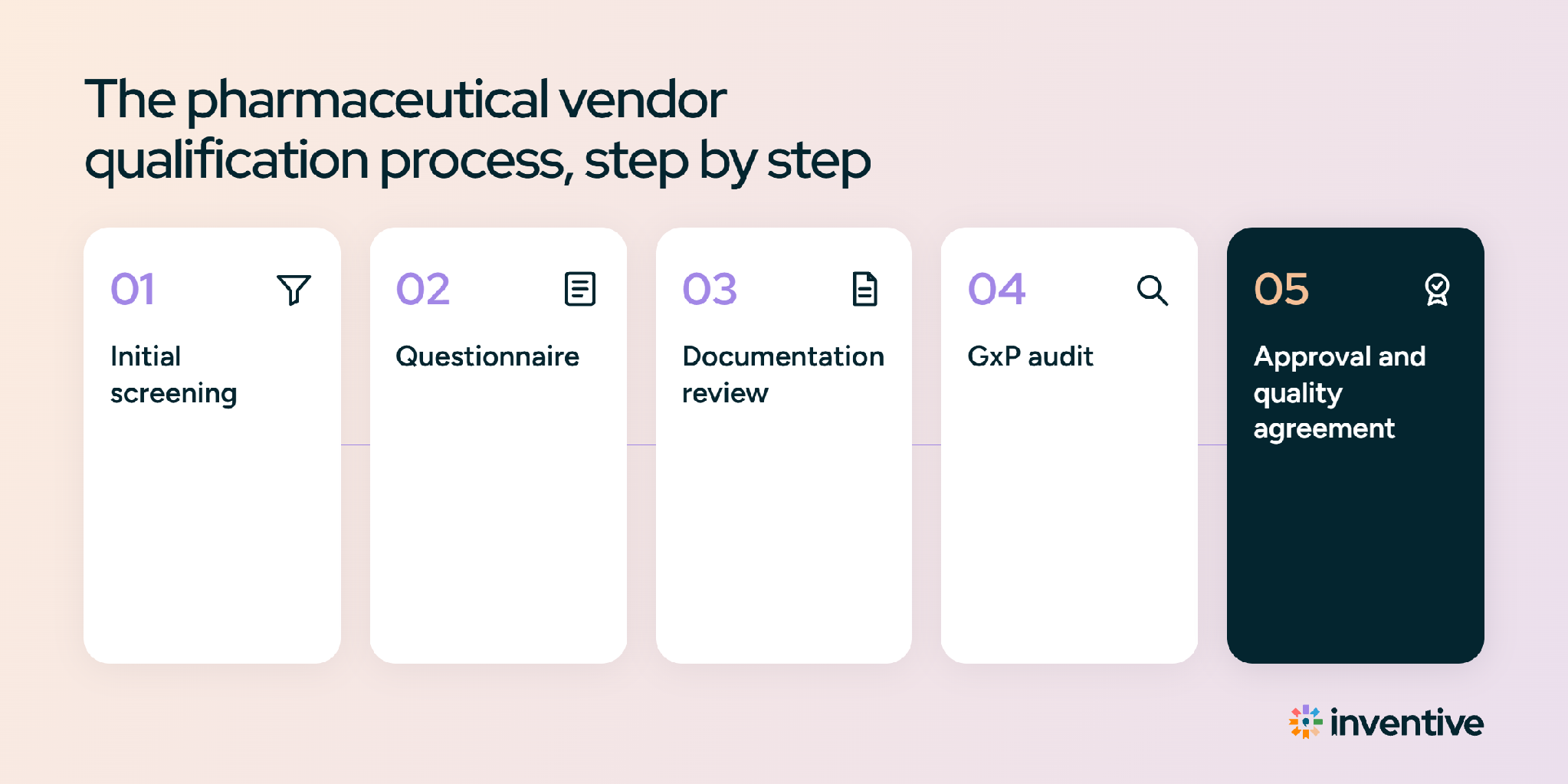
Most sponsors run the vendor qualification process in four stages. Knowing which stage you are in tells you what to prepare next.
- Selection and risk assessment. The sponsor rates how critical you are to product quality. An API or sterile manufacturer is high risk and gets the most scrutiny. A non-critical supplier may need far less. To see the evaluation framework and risk-scoring matrices sponsors use to classify your tier, see this Vendor Risk Assessment Template.
- Qualification. The sponsor gathers evidence through a questionnaire, a document review, and, for higher-risk vendors, an audit. The outcome is usually approved, approved with conditions, or not approved.
- Ongoing monitoring. After approval, the sponsor tracks your performance: quality of deliveries, on-time supply, deviations, complaints, and how quickly you close issues.
- Requalification. On a risk-based schedule, often every one to three years, the sponsor repeats the review. A critical supplier may face a fresh on-site audit, while a lower-risk one may need only a document review.
Once approved, you are added to the sponsor's approved supplier list, which is the list its teams are allowed to buy from. Staying on it depends on the monitoring and requalification steps above.
What suppliers must submit to get qualified?
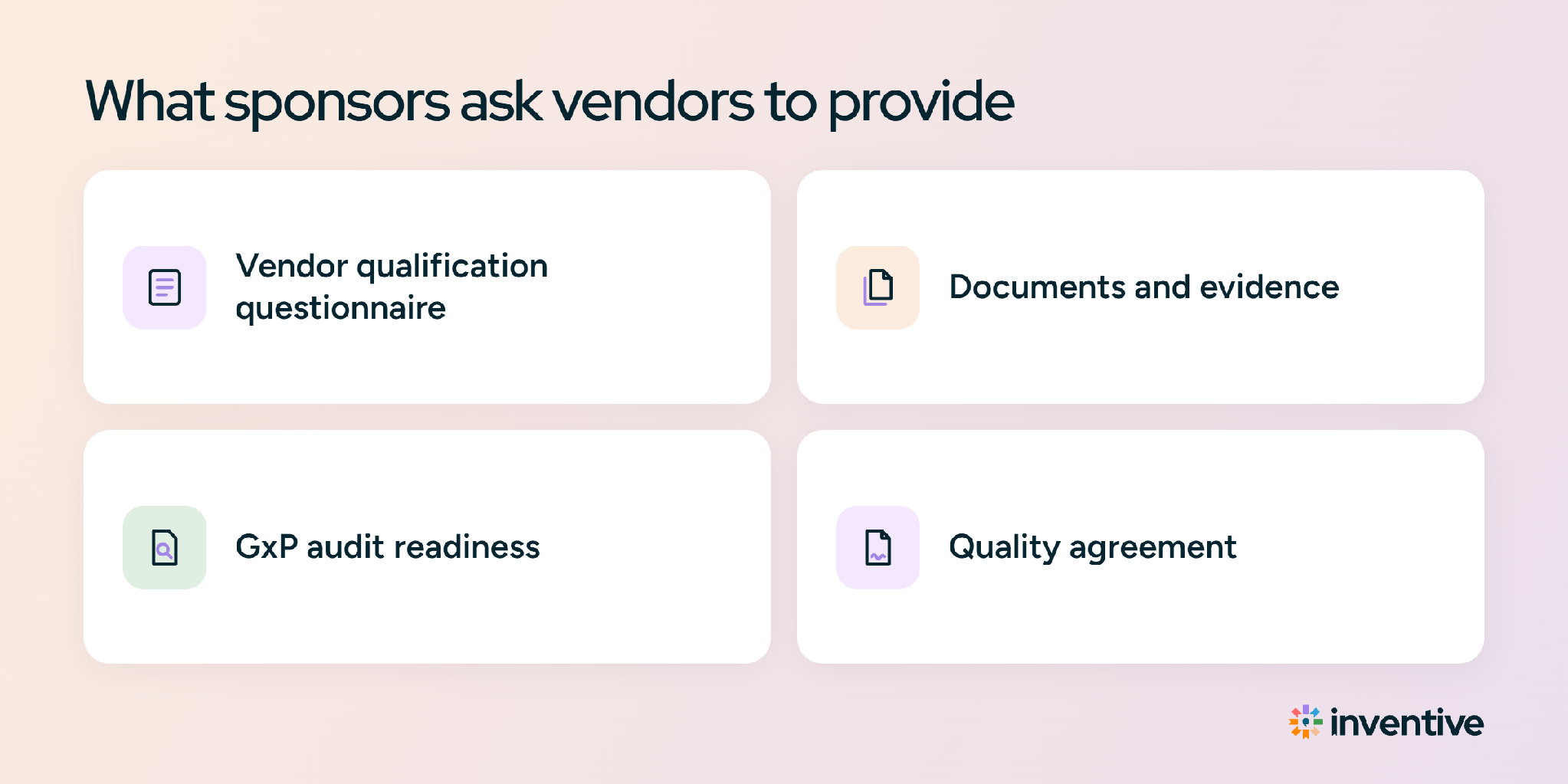
Across the process, sponsors ask for the same core set of things. Keeping them current, accurate, and consistent is most of the work on your side.
The vendor qualification questionnaire
The vendor qualification questionnaire, sometimes called a vendor audit questionnaire or supplier quality questionnaire, is usually the first formal request. It can run from a single page to well over a hundred questions, and it asks how your quality system actually works. Common areas include:
- Quality system and certifications. For example: "Do you hold a current GMP certificate or ISO 9001 or ISO 17025 accreditation, and when was your last regulatory inspection?"
- Facilities and manufacturing controls. For example: "How do you prevent cross-contamination and mix-ups, and how do you handle environmental monitoring?"
- Change control and deviations. For example: "Will you notify us before any change to the process, site, or specification, and how do you manage deviations and CAPA?"
- Data integrity. For example: "How do you ensure records follow ALCOA principles, and are audit trails enabled on your GxP systems?"
- Subcontractors. For example: "Do you outsource any part of this work, and how do you qualify your own suppliers?"
- For software vendors: computer system validation, access control, and 21 CFR Part 11 compliance for electronic records and signatures.
For practical guidance on managing lengthy vendor questionnaires, see How to Handle Security Questionnaires Without Slowing Deals.
Documents and evidence
Sponsors ask you to back up the questionnaire with records. Expect requests for:
- Your quality manual and the SOPs most relevant to the work.
- GMP or GDP certificates, business licenses, and ISO certifications.
- Certificates of analysis, specifications, and validation or stability data where relevant.
- Your regulatory inspection history and recent audit outcomes.
- A completed quality or technical agreement once approval is close.
How to pass the GxP audit (desk, remote, or on-site)
For higher-risk vendors, a questionnaire is not enough. The sponsor runs a supplier audit, which is a formal check of your quality system against GxP requirements. A GxP audit takes three main forms:
- A desk or paper audit, where you send documents for off-site review. Common for lower-risk suppliers.
- A remote audit, conducted over video with live document sharing.
- An on-site audit, where auditors visit your facility. Expected for critical suppliers such as API and sterile manufacturers.
After a successful review, you and the sponsor sign a quality agreement. This document, aligned with FDA guidance on contract manufacturing arrangements and EU GMP Chapter 7, sets out who is responsible for each GMP duty between the two companies.
These three tools overlap, but each one proves a different thing.
To see how sponsor procurement teams build these audits and the specific question sets they include, see How to Create an AI Supplier Questionnaire for Vendors
The supplier response checklist: 6 records to keep ready
Suppliers that clear qualification in days keep these six records verified and ready to send the moment a sponsor questionnaire arrives:
- Active Certifications & Licenses: Valid GMP, GDP, or ISO certificates (ISO 9001/17025) within their effective dates.
- Quality Manual & Core SOPs: An updated quality manual and your most-requested procedures: change control, deviations, and CAPA workflows.
- Quality Agreement Baseline: Standard terms or pre-approved fallback positions to prevent post-audit contract delays.
- Inspection & Audit History: Recent health authority audit summaries (including FDA Form 483s) and the formal CAPAs that closed each finding.
- Approved Q&A Content: Verified answers for recurring questions on data integrity (ALCOA), 21 CFR Part 11, and facility controls.
- A Dedicated Response Owner: A designated bid manager or QA lead to triage, route, and track questionnaires so requests never stall.
The common mistakes are predictable: sending an expired certificate, giving responses that differ from one sponsor to the next, or letting a single overloaded person handle every request. Each one triggers follow-up questions and adds weeks to approval.
The real bottleneck: a different qualification questionnaire for every sponsor
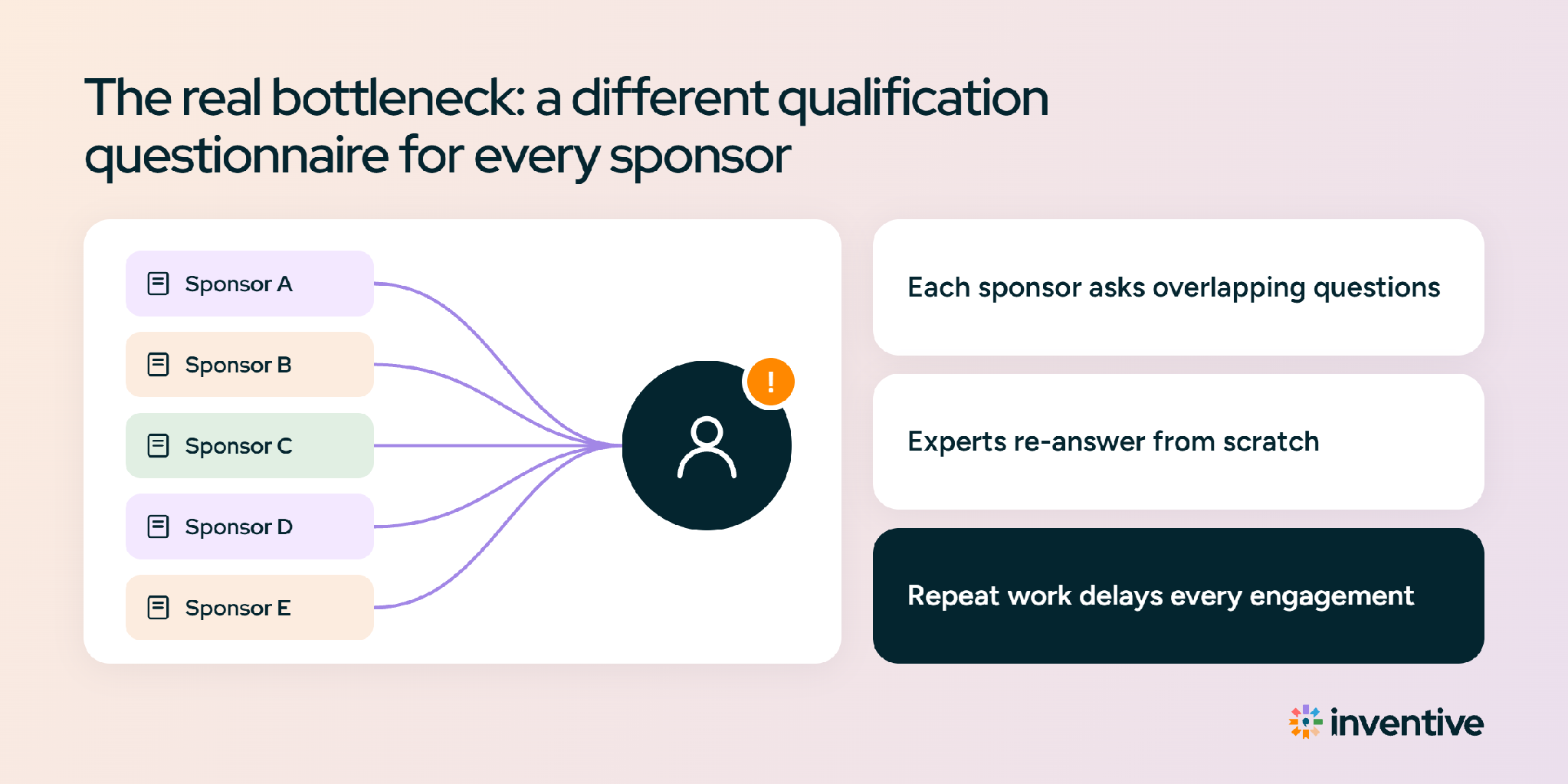
For most vendors, the slow part is not any single qualification. It is the repetition. Every sponsor sends its own questionnaire, and the questions overlap but are never identical.
Here is why that adds up:
- Each sponsor uses its own format. Your QA team rewrites similar responses by hand for every new request.
- Technical questions wait on experts. Deeper questions on validation or data integrity sit until a subject-matter expert replies.
- Deadlines are tied to deals. A slow questionnaire can hold up a contract and the revenue behind it.
- Responses drift. Two people respond to the same question differently, or an expired figure slips through to a sponsor.
Response automation built for due diligence and quality questionnaires solves this. Tools in this category draft a response to each question from your approved company knowledge, flag any question they cannot support instead of guessing, and keep a person in the loop to review and approve every response.
Inventive AI is one option in this category. It is AI-native software for responding to RFPs, DDQs, and security and quality questionnaires. Its agents draft each response from your connected, approved content, add a source citation and a confidence score, and flag responses that are outdated or conflict with your current documents before you submit. Your QA and regulatory teams still review and approve everything, so you stay in control of what goes to a sponsor. For a vendor answering similar qualification questions across dozens of sponsors, that turns repeated manual work into a consistent, reviewed process.