How to Write a Winning Bid Proposal
Learn how to write a winning bid proposal step by step, from the bid/no-bid decision to pricing, compliance, and submission. Includes a worked example and expert tips.
A bid proposal is your formal, priced offer to win a specific project. For most opportunities, the buyer compares several bids and scores each one against the same criteria. So your goal is simple: answer what they asked, in their words, and back every claim with proof.
This guide walks you through the whole process, from deciding whether to bid to structuring, pricing, and submitting a proposal that wins. Along the way, you will see a worked example and the common mistakes that get strong bids rejected. It is written for sales, revenue, and proposal teams responding to RFPs, RFQs, and tenders.
Key Takeaways
- A bid proposal is a priced offer that responds to a buyer's RFP, RFQ, or tender with a clear solution, timeline, and terms.
- Decide whether to bid before you write. Bidding on the wrong opportunities wastes time you could spend winning the right ones.
- Structure your proposal around the buyer's requirements and evaluation criteria, not your own story.
- Support every claim with proof, and state your assumptions and pricing clearly.
- Most bids are lost on avoidable errors: missed instructions, vague scope, or a late submission.
What Is a Bid Proposal?
A bid proposal is a formal document you submit in response to a buyer's request, such as an RFP or RFQ. It sets out your proposed solution, scope, deliverables, timeline, pricing, and terms for a specific project. In short, it is your priced offer to do defined work, written to match what the buyer asked for.
Bid proposals are common wherever organizations buy through competitive procurement: construction, government and public sector, IT and technology, professional services, and marketing. In each case, the buyer uses your proposal to judge one thing above all: can you deliver what they need, at a price and level of risk they accept?
It helps to separate a few terms that often get mixed up:
- RFP (Request for Proposal): the buyer describes a problem and asks vendors to propose a solution and price. Your reply is a bid proposal.
- RFQ (Request for Quotation): the buyer knows exactly what they want and asks mainly for pricing.
- RFI (Request for Information): an early, information-gathering step before any formal bid.
- Tender: another word for the full bid process, used more often in the UK, EU, and public sector.
The Essential Elements of a Winning Bid Proposal
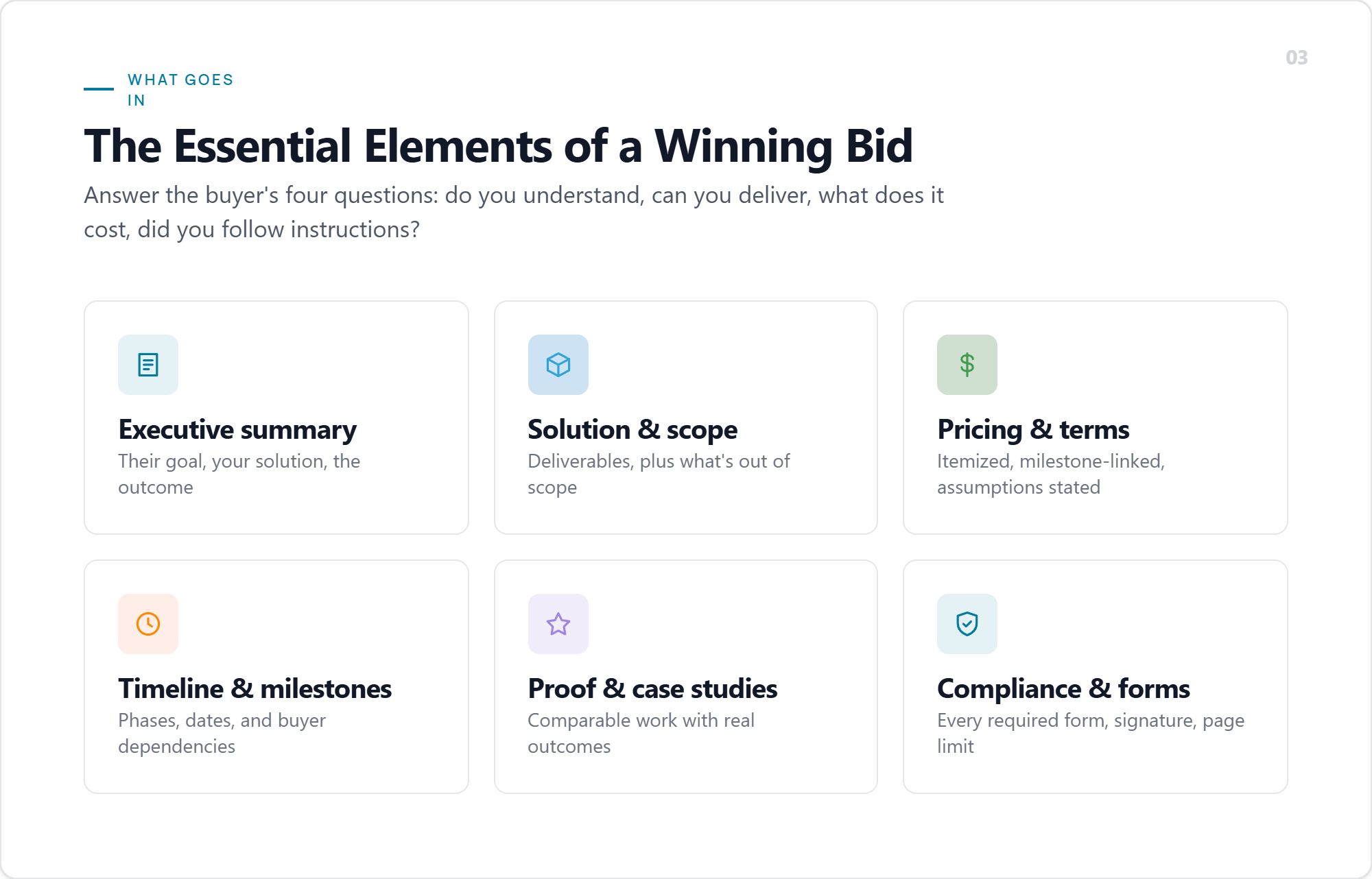
Every strong bid proposal answers the same underlying questions for the buyer: Do you understand our need? Can you deliver it? What will it cost? Did you follow our instructions? The sections below cover each of those. Include the ones that fit your opportunity, and always follow the buyer's required structure if they give one.
| Section | What the evaluator needs to see | Common mistake to avoid |
|---|---|---|
| 1. Cover & submission details | Project or solicitation name, your company, submission date, and offer validity | Copying the wrong project name from a past bid |
| 2. Executive summary | A short link between the buyer's goal, your solution, and the outcome | Opening with your company history instead of their need |
| 3. Client information | The buyer's name, company, and the correct decision-maker | Addressing it to the wrong person or a generic "To whom it may concern" |
| 4. Your company overview | A brief, credible summary of who you are and why you qualify | Listing everything you do instead of what's relevant to this bid |
| 5. Understanding of needs | Proof that you grasp the buyer's problem, goals, and constraints | Skipping straight to your solution |
| 6. Proposed solution & scope | A direct response to each requirement, with clear deliverables and boundaries | Describing features without tying them to the requirement |
| 7. Pricing & payment terms | A clear, itemized price with a payment schedule and stated assumptions | Hiding costs or leaving key assumptions unspoken |
| 8. Timeline & milestones | Realistic dates or phases, with the buyer inputs each one depends on | Promising dates without naming what you need from them |
| 9. Team & governance | The people accountable for delivery and how you'll manage the work | Listing names with no link to their role in this project |
| 10. Relevant experience & proof | Case studies, results, or references from comparable work | Generic testimonials that don't match this buyer's situation |
| 11. Terms & conditions | The commercial and legal terms, including how changes are handled | Leaving scope changes and dependencies undefined |
| 12. Signature & acceptance | Signature fields for both parties to formally accept the bid | Forgetting them, so the buyer has no clear way to say yes |
How to Write a Bid Proposal: Step by Step
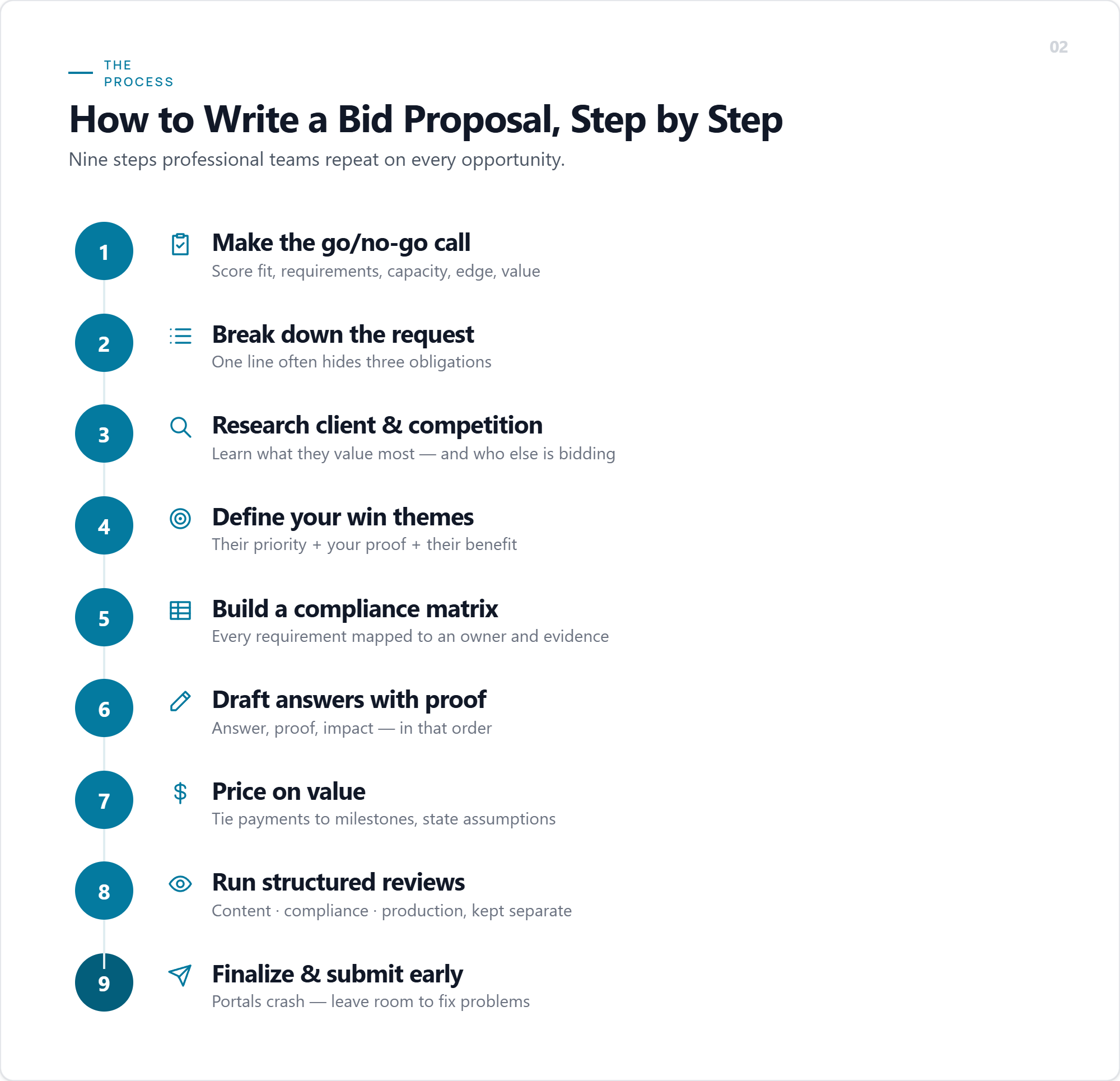
Knowing what goes into a proposal is only half the job. Winning bids follow a repeatable process that keeps the whole document focused on the buyer. Here are the nine steps professional teams use.
Step 1 — Make the go/no-go decision
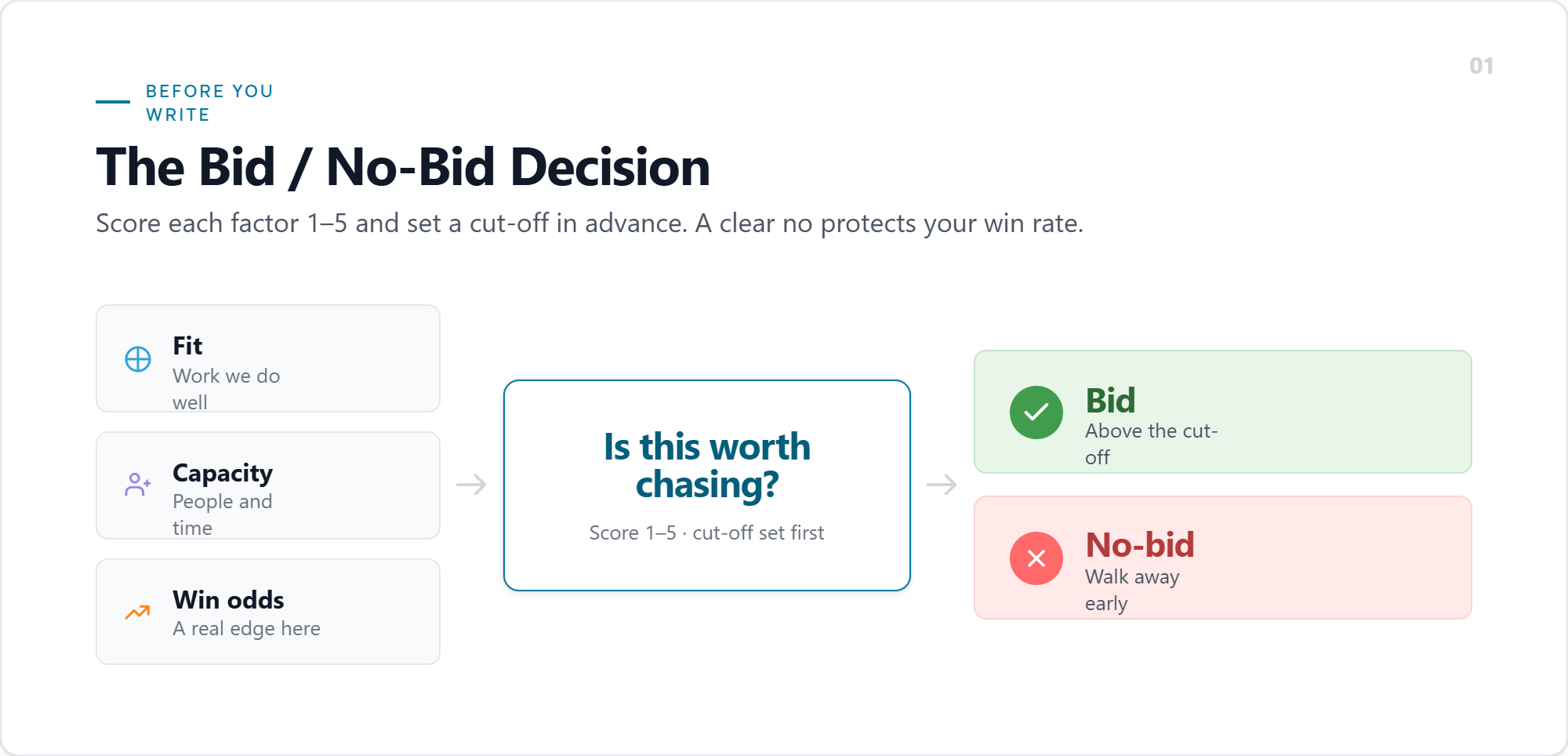
Don't bid on everything. Each proposal takes real time, so every one you chase is time away from another. Before you write, decide whether the opportunity is worth pursuing by asking five questions:
- Fit: Does the work match what you do well?
- Requirements: Can you meet every mandatory requirement? Miss one and you may be disqualified.
- Capacity: Do you have the people and time to write the bid and deliver the project?
- Reason to win: Do you have a real edge here, or is an incumbent likely to keep the contract?
- Value: Is the contract worth the cost of chasing it, at a margin you accept?
Score each factor from 1 to 5 and set a cut-off in advance. If an opportunity falls below it, walk away. A clear "no" protects your win rate on the bids you do pursue.
Step 2 — Read and break down the request.
Read the entire request before you write anything: the main document, appendices, pricing sheets, terms, and any questions-and-answers or amendments the buyer has issued. Pull out every requirement and instruction into a list. Break compound sentences into separate obligations, because one line often hides two or three things you must respond to.
Step 3 — Research the client and competition
Learn the buyer's business, their goals, and the pressures they face. Read their website, recent news, and the request itself for clues about what they value most: cost, quality, speed, or risk. Ask who is likely competing and who the incumbent is, so you can position against them honestly rather than guess.
Step 4 — Define your win themes
A win theme is a short, repeatable message that connects a buyer priority to your strength and the result they get. Pick two to four and weave them through the proposal where they sharpen an answer.
Example: If the buyer's top concern is avoiding downtime, your win theme is: "Zero-downtime migration, proven on three similar projects, so your operations never stop." That single line links their priority, your proof, and their benefit.
Step 5 — Build a compliance matrix
A compliance matrix maps every requirement to where you answer it and who owns that answer. It is the single best tool for making sure you miss nothing and for helping evaluators score you quickly.
| Requirement | Source | Response section | Owner | Evidence | Status |
|---|---|---|---|---|---|
| 12-week implementation plan | RFP 4.2 | Timeline | Delivery lead | Approved project plan | In review |
| ISO 27001 certification | RFP 6.1 | Compliance | Security lead | Certificate PDF | Complete |
Fill one row per requirement. Anything without an owner or evidence is a gap you need to close before submission.
Step 6 — Draft your answers with proof
Write each answer using a simple pattern: answer, proof, impact. State how you meet the requirement, show the evidence, then explain what it means for the buyer. This keeps you focused on benefits instead of a list of features.
Example:
- Weak (feature only): "Our software automates data entry."
- Strong (answer, proof, impact): "Our software automates data entry. One client cut manual entry by 90%, which freed their team 15 hours a week to focus on higher-value work."
If you can't support a claim with proof, flag it for an owner to verify rather than polishing it into something you can't back up.
Step 7 — Price on value, with clear assumptions
Set your price against the scope and the value you deliver, not just your costs. Break it down, tie payments to milestones, and state the assumptions behind it, such as what the buyer must provide and by when. A transparent price builds more trust than a low one with hidden conditions.
Step 8 — Run structured reviews
Don't rely on a single read-through. Professional teams separate reviews into three types:
- Content review: Does each answer respond fully to the requirement and make a persuasive case?
- Compliance review: Is every requirement, form, signature, and page limit met? A dedicated reviewer checks the matrix, not the narrative.
- Production review: Do the final files open correctly, with the right names, working links, and attachments?
Keeping these separate stops a strong writer from missing a compliance gap, and a compliance checker from rewriting your story.
Step 9— Finalize and submit early
Lock one final version, then submit ahead of the deadline. Portals crash, files get rejected, and uploads take longer than you expect. Submitting early leaves room to fix problems. Keep proof of submission, such as a confirmation receipt, with your records.
See how Inventive AI runs these steps with you, from intake to review, so your team drafts faster and submits with fewer errors.
Book a demoBid Proposal Template
You don't need to build your structure from scratch. A solid bid proposal template usually covers around twelve sections:
Cover and submission details, executive summary, client information, your company overview, understanding of needs, proposed solution and scope, pricing and payment terms, timeline and milestones, team and governance, relevant experience, terms and conditions, and signature.
Use it as a starting point, then adapt. If the buyer supplies their own headings, page limits, or forms, follow those instead, because responsiveness to their format is part of how you are scored.
For a ready-to-use version, download our free bid proposal template in Word, which includes five industry-specific templates for construction, IT, government, consulting, and subcontractor bids.
Bid Proposal Example to Help You Respond Better
Here is a worked example showing what strong sections look like in practice. It follows a fictional IT project from start to finish. The names, numbers, and dates are for illustration only, so use the structure and the reasoning behind each section, not the facts.
Scenario: ABC Tech Solutions issued an RFP to modernize its data storage. Its aging on-premise servers cause frequent downtime and rising costs. Below is how a vendor, Innovative Solutions Inc., might respond.
Understanding of needs
"Your RFP identifies three problems: storage costs rising roughly 20% year over year, downtime during peak hours, and no clear disaster-recovery plan. You've stated that any solution must avoid disruption to daily operations and leave your internal team able to manage the system after handover. Our proposal is built around those three needs and those two constraints."
Why it works: it proves the vendor read the RFP and mirrors the buyer's own priorities before pitching anything.
Executive summary
"We propose a phased migration to cloud storage, completed in 10 weeks with zero downtime during business hours. The move cuts your storage costs by an estimated 30% in the first year and includes a built-in disaster-recovery layer. By handover, your IT team will be fully trained to run the system without outside help."
Why it works: it leads with the buyer's outcome, not the vendor's company history, and puts a number on the value.
Proposed solution and scope
- Audit the current infrastructure and document findings.
- Design and deploy a cloud storage solution with automated backups.
- Migrate all data in phases, with no downtime during business hours.
- Train the IT team and provide full documentation.
- Out of scope: hardware disposal and third-party software licensing, available as priced add-ons.
Why it works: it defines exactly what's included and, just as important, what is not, so there's no argument later.
Pricing and assumptions
- Total: $50,000 — 25% at kickoff ($12,500), 50% at migration complete ($25,000), 25% at handover ($12,500).
- Assumptions: the client provides system access within five business days of kickoff, and the three data sources use standard interfaces. Work beyond the defined scope follows a written change-control process.
Why it works: the price is tied to milestones, and the assumptions protect both sides if conditions change.
Timeline and milestones
| Phase | Timing | Milestone | Client dependency |
|---|---|---|---|
| Audit & design | Weeks 1–2 | Design signed off | Access to current systems |
| Build & migrate | Weeks 3–7 | Data live in cloud | Test data approved |
| Test, train, hand over | Weeks 8–10 | Production acceptance | IT team available for training |
Why it works: it names what the vendor delivers and what the client must provide at each stage, so delays have a clear owner.
Relevant experience and proof
"We recently completed a similar 12TB migration for a mid-market client with zero downtime, cutting their storage costs by 30% within six months. Reference available on request."
Why it works: it answers the buyer's real question, "can you actually do this?", with a comparable result rather than a generic claim.
Also Read: 15 Best RFP Software in 2026: Features, Prices and Reviews
How Bid Proposals Differ by Industry
The core structure stays the same, but what evaluators weigh most shifts by sector. Know the emphasis before you write.
Construction. In construction bids, cost accuracy and delivery reliability drive the decision. Buyers expect a detailed cost breakdown, itemized quantities, and a clear project schedule. They also look for proof of bonding, insurance, and a strong safety record. Your proposal is scored closely on how well it follows the project's plans and specifications, so accuracy matters more than persuasion.
Government and public sector. Government bids are evaluated against strict, published rules. In US federal contracting, FAR 15.203 requires the buyer to state exactly what information the proposal must contain and which factors they will use to evaluate it. FAR 15.305 then requires them to judge proposals only on those stated factors. This means you should answer each factor directly, in the order the solicitation lists them, and acknowledge every amendment the buyer issues. Leaving out a required form can disqualify you, no matter how strong the rest of your bid is.
IT and B2B services. In technology and business services, buyers focus on outcomes, security, and evidence. Lead with the results you can deliver, map your response to each requirement with a compliance matrix, and support every security claim with proof, such as relevant certifications.
Common Bid Proposal Mistakes to Avoid
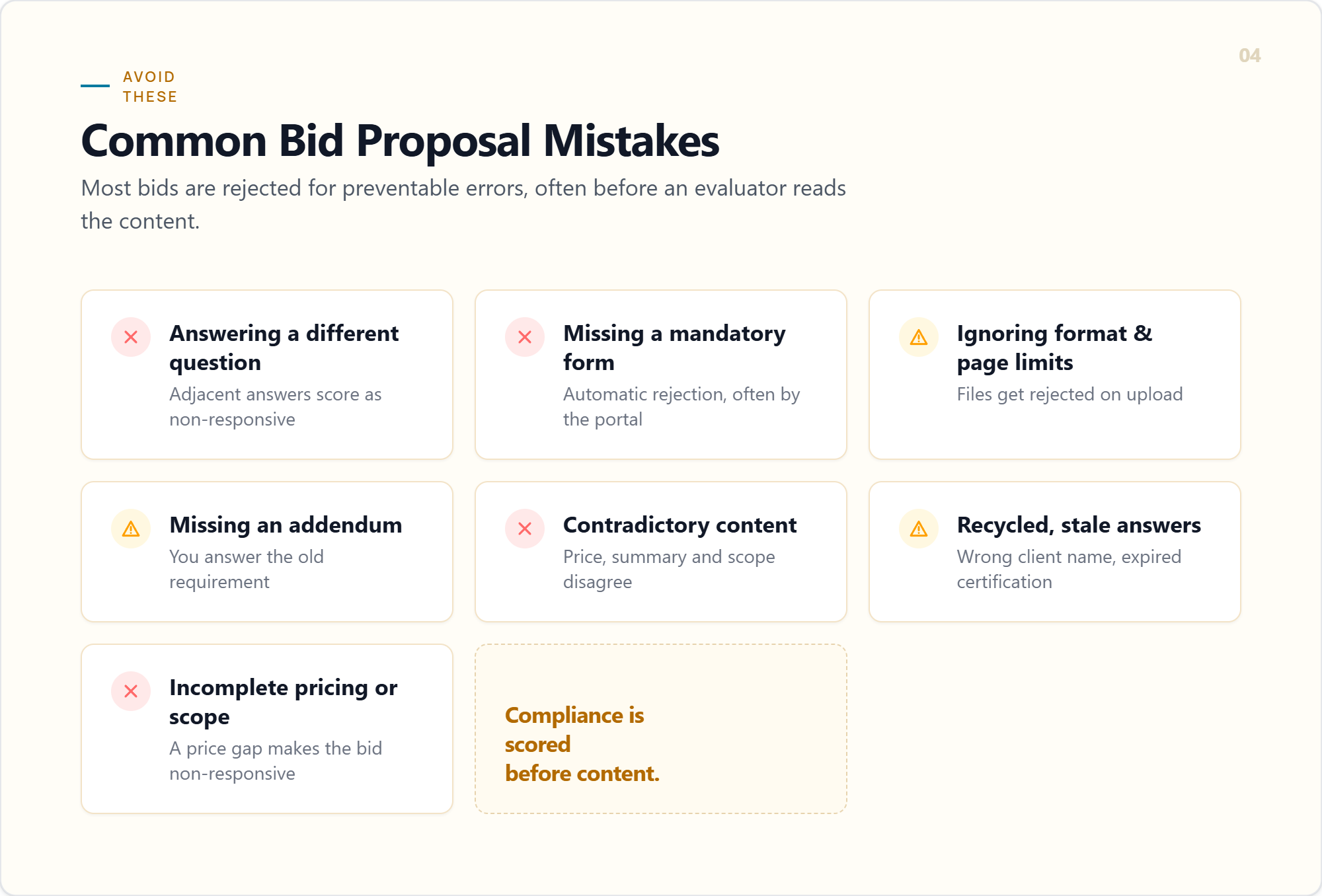
Most bids are not rejected for weak ideas or high prices. They are rejected for preventable errors. A number of proposals are disqualified for non-compliance before an evaluator assesses the actual content. These are the mistakes that do the damage.
- Not answering the exact question asked. Evaluators score your response against each specific requirement. If you give a general or adjacent answer, you lose points or are marked non-responsive, even when your capability is strong.
- Missing a mandatory requirement or form. A skipped form, an unsigned page, or an unmet eligibility criterion can trigger automatic rejection, often by the procurement system, before a human sees your bid.
- Ignoring format rules and page limits. Many buyers specify exact file types, naming conventions, and page counts. Breaking these rules can get your file rejected on upload, so follow every instruction precisely.
- Failing to acknowledge an addendum. Buyers frequently amend requirements after the RFP is released. If you miss an amendment, you answer the wrong question and can be disqualified for it.
- Submitting inconsistent or contradictory content. When several people contribute, your pricing table, executive summary, and scope can end up disagreeing with each other. Evaluators lose confidence fast when the numbers or claims don't match across sections.
- Reusing old content without checking it. Recycled answers often carry the wrong client name, an outdated metric, or an expired certification. Every reused section must be reviewed against this specific opportunity.
- Leaving pricing or scope incomplete. A price discrepancy or a missing detail that affects evaluation renders a bid non-responsive. State the full price, the assumptions behind it, and exactly what is in and out of scope.
How Inventive AI Helps Bid and Proposal Teams
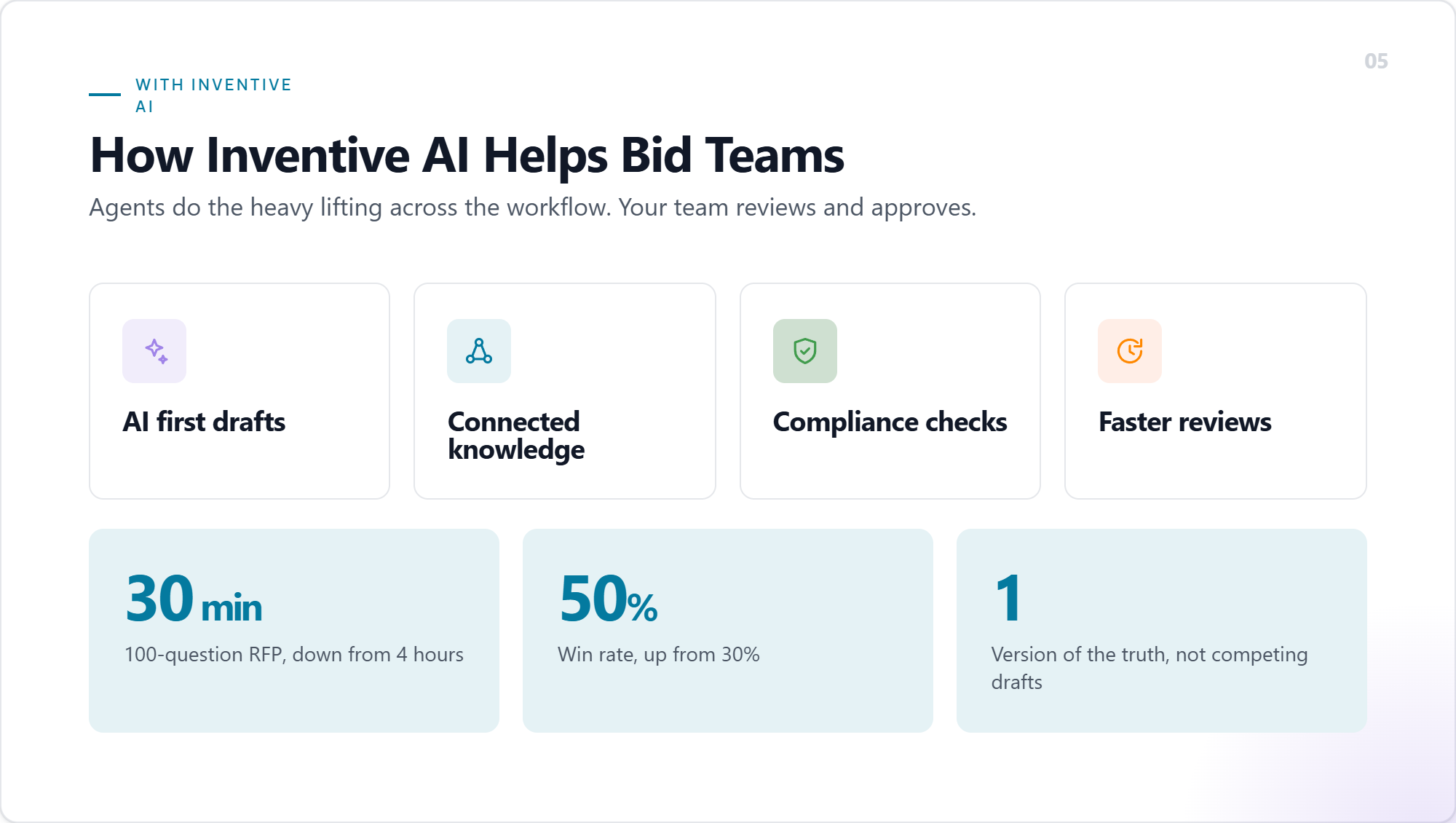
Everything in this guide is doable manually, but it gets harder to control as requirements pile up and more people contribute.
Inventive AI is an autonomous AI agent platform built for exactly this work: responding to RFPs and RFQs with winning bid proposals. The same platform handles RFIs, DDQs, and security questionnaires. Its agents handle the heavy lifting, reading the request and drafting responses, while your team reviews and approves what goes out.
- Go/no-go: The Go/No-Go Agent evaluates each opportunity against fit and requirements, so bid managers pass on weak deals before investing time.
- Reading the request: An agent reads the RFP and tags every question, section, and requirement from PDF, Word, Excel, or PowerPoint, so nothing is missed at intake.
- Win themes and competitors: The Competitive Intelligence Agent compares your positioning against named competitors, so your differentiators are sharper.
- Context-aware responses: The Context Engine drafts from your connected company knowledge and deal context. Every answer carries source citations and a confidence score, and flags "information unavailable" instead of guessing.
- Avoiding stale content: Content Governance Agent detects outdated, duplicate, and conflicting information across your sources automatically, so recycled answers never reach the buyer.
- Compliance and consistency checks: The Full Response Analyzer reviews the whole document for compliance, missing requirements, and contradictions across sections before you submit.
- Structured review: Assign sections, track progress, and approve in one place, so the team works from one version instead of competing drafts.
The results are measurable. Insider cut a 100-question RFP from four hours to under 30 minutes and lifted its win rate from 30% to 50%.
See how Inventive AI helps your team turn this process into faster, higher-quality bid proposals.
Book a demoAlso Read: Best AI for Proposal Writing in 2026: 10 Platforms Built for Winning Business Proposals
Frequently Asked Questions
What is the difference between a bid and a proposal?
People often use the terms together, but there is a slight difference. A bid usually emphasizes price and terms for clearly defined work. A proposal puts more weight on your approach, solution, and value. Most business documents are really bid proposals, combining both: a priced offer with a persuasive case behind it.
How do you write a bid proposal letter?
A bid proposal letter is the short cover letter that introduces your full proposal. Address it to the decision-maker, reference the specific project, and summarize in a few sentences why you are a strong fit. Keep it to one page, stay focused on the buyer, and point them to the detailed proposal.
Should you follow up after submitting a bid?
Yes, but do it professionally. Wait until any question deadline has passed, then send a brief, polite message confirming receipt and offering to answer questions. Avoid pressuring the buyer on their decision. A single, well-timed follow-up shows genuine interest without appearing pushy.
Who is responsible for writing a bid proposal?
It depends on the size of the organization. In smaller companies, a salesperson or owner often writes the whole bid. Larger teams use a proposal manager who coordinates input from sales, technical experts, finance, and legal. Either way, one person should own the final version to keep it consistent.
Can you change your bid after submitting it?
Usually only before the deadline. Most buyers allow you to withdraw and resubmit a revised bid until submissions close, but after that, your bid is typically locked. Some processes include a later clarification or negotiation stage, but you should never rely on fixing mistakes after you submit.

.avif)

%20Industry%20Examples.png)