AutogenAI vs AutoRFP (2026): Which AI Bid Tool Fits Your Team?
AutogenAI vs AutoRFP: the short answer
- Choose AutogenAI: if most of your work is long-form narrative bids, public sector tenders, or grants, and writing quality against evaluation criteria matters most.
- Choose AutoRFP: if most of your work is question-and-answer RFPs, security questionnaires, and DDQs, and you want predictable project-based pricing with unlimited users.
- Need both in one platform? Inventive AI is an AI-native RFP platform that drafts cited answers from your connected company knowledge and flags conflicting or outdated content before it reaches a buyer. It handles narrative proposals and questionnaires in the same workflow.
How do AutogenAI and AutoRFP compare side by side?
AutogenAI leads on narrative writing, compliance review, and government-grade security. AutoRFP leads on questionnaire throughput, price transparency, and G2 satisfaction.
Ratings from G2 reviews and the G2 RFP category, and pricing as reported in November 2026. Confirm with each vendor before you buy.
Where do AutogenAI and AutoRFP fit in the bid workflow?
AutogenAI covers more of a long bid end to end, from qualification to a scored review. AutoRFP is strongest in the middle of the workflow, where a team turns a long list of questions into approved answers fast.
How do AutogenAI and AutoRFP qualify a bid?
- AutogenAI: a Go/No-Go agent and automated gap analysis read the tender, and Extract pulls every requirement into a compliance matrix.
- AutoRFP: Go/No-Go analysis scores each RFP against deal-breaker criteria you set, such as certifications or hosting, with a confidence score per result.
How do AutogenAI and AutoRFP produce a first draft?
- AutogenAI: writes new narrative section by section from your library, chosen documents, or the web, then lets writers expand, cut, translate, or add evidence in one click. Its language engines are tuned to each customer's voice.
- AutoRFP: matches each question to approved content and drafts an answer with citations, so a 300-question security questionnaire comes back mostly filled.
How do AutogenAI and AutoRFP review drafts before submission?
- AutogenAI: Gamma Review scores each draft against the buyer's evaluation criteria and traces evidence back to its source.
- AutoRFP: reviewers check citations and Trust Scores, and assign low-confidence answers to the right expert.
How do AutogenAI and AutoRFP handle submission?
- AutogenAI: exports to Word and PowerPoint, and its own comparison confirms it has no portal submission extension.
- AutoRFP: returns answers into the buyer's Excel or Word file and offers a Coupa plug-in.
Where does Inventive AI fit? Most teams don't get to choose between narrative bids and questionnaires; they get both, often in the same week. Inventive AI drafts long PDF proposals into the customer's Word template and writes Excel answers straight back into the original file, all from the same Knowledge Hub, at $830/month, billed annually, with unlimited users.
How do AutogenAI and AutoRFP compare on features?
AutogenAI wins on writing depth, compliance scoring, and federal security. AutoRFP wins on questionnaire speed, ease of use, and pricing clarity.
Which writes better long-form narrative, AutogenAI or AutoRFP?
AutogenAI does, because it generates original narrative instead of reusing stored answers.
- AutogenAI: storyboarding, tone tuning, and one-click edits (expand, cut, translate, add evidence) are built for scored written questions. G2 reviewers note some drafts still read generic and need a writer's pass.
- AutoRFP: can draft longer answers, but its strength is reusing approved content across many short questions.
Which handles security questionnaires and DDQs better, AutogenAI or AutoRFP?
AutoRFP does, because its answer engine is built for repetitive question grids.
- AutoRFP: Trust Scores, citations, and an Excel round-trip, with G2 reviewers describing hours of security questionnaire work cut to minutes.
- AutogenAI: supports Excel questionnaires through Q&A Workbooks, but its product centers on narrative proposals, so spreadsheet-heavy teams should test it on a real questionnaire first.
Is AutogenAI or AutoRFP better for government and public sector bids?
AutogenAI is the stronger fit for public sector work.
- AutogenAI Federal: launched in February 2025, with FedRAMP authorization through Palantir FedStart, DoD IL5 deployment support, and CMMC 2.0 coverage.
- Tender features: compliance matrices and scoring against evaluation criteria, shaped by its UK public sector roots.
- AutoRFP: ISO 27001 and SOC 2 Type II, which covers most commercial security reviews but not federal authorization.
How do AutogenAI and AutoRFP pricing models compare?
AutoRFP prices by projects with unlimited users, while AutogenAI is reported to price per seat. AutoRFP pricing is published: Scale costs $899/month for 24 projects a year and Accelerate $1,299/month for 50, billed annually. AutogenAI pricing is quote only, set in each customer's order form, with no public benchmark on Vendr.
The model matters more than the headline number:
- Seat pricing (AutogenAI): cost grows with every writer, subject matter expert (SME), and reviewer who needs access, but not with how many bids you submit.
- Project pricing (AutoRFP): cost grows with how many RFPs you run, but not with headcount, so occasional SMEs join free.
Is AutogenAI or AutoRFP easier to learn?
AutoRFP is easier for most teams to pick up.
- AutoRFP: its most-mentioned G2 complaint is navigation, raised in a handful of reviews.
- AutogenAI: a steep learning curve and complex interface are its top G2 complaints, mentioned in more than 50 reviews combined, and some users say frequent platform changes mean retraining.
Do AutogenAI and AutoRFP fit your existing tools?
AutogenAI fits Microsoft-heavy teams, and AutoRFP fits teams that need identity controls and portal support.
- AutogenAI: works inside Microsoft 365 and connects to SharePoint libraries.
- AutoRFP: integrations with SharePoint, Google Drive, Confluence, Notion, Salesforce, Slack, and Teams, plus SSO and SCIM provisioning, and a Coupa plug-in for portal RFPs.
AutogenAI vs AutoRFP: pros and cons from G2 reviews
Reviewers of both tools praise the time they save. AutogenAI's complaints center on learning curve and complexity, while AutoRFP's center on navigation, and AutoRFP holds the higher score (4.9 vs 4.3).
What do G2 reviewers say about AutogenAI?
Strengths
- Time saved: the most-mentioned strength, in 56 reviews, with writers getting from a blank page to a tender-quality draft in seconds.
- Purpose-built for bids: reviewers say it understands bid structure, compliance, and tone better than general AI tools.
- Customer support: praised in 38 reviews for fast fixes and acting on feedback.
Limitations
- Learning curve: the top complaint, with reviewers describing a complex interface and many features to learn.
- Generic drafts: some output reads generic or repetitive and needs a writer's pass.
- Frequent changes: some users say the platform changes often enough to need retraining, and sources must be reloaded before each run.
What do G2 reviewers say about AutoRFP?
Strengths
- Time saved: the most-mentioned strength, in 34 reviews, across RFPs, DDQs, and security assessments.
- Team collaboration: 19 reviews credit easy question assignment across the business.
- Handles large RFPs: reviewers describe working through RFPs with hundreds of questions.
Limitations
- Navigation: reviewers find some screens hard to navigate and the interface not especially intuitive.
- Library ramp-up: an outdated library means weeks of SME cleanup before drafts improve.
- Web only: there's no desktop app, and one reviewer found the browser plug-in temperamental.
Is there an alternative to AutogenAI and AutoRFP that handles both bids and questionnaires?
Yes. Inventive AI is an AI-native RFP platform that drafts cited answers from your connected company knowledge and flags conflicting or outdated content before it reaches a buyer. Teams that would otherwise run AutogenAI for tenders and AutoRFP for questionnaires can run both in one workflow.
Best features
- Both document types: builds the outline and drafts every section of a PDF proposal into the customer's Word template, and writes Excel questionnaire answers back into the original file.
- Governed answers: every AI-drafted response carries a citation and confidence score, and missing information is flagged for an SME instead of guessed.
- Knowledge that stays current: the AI Content Manager flags stale, duplicate, and conflicting content across SharePoint, Google Drive, Confluence, and Notion, so nobody maintains a separate library.
Limitations
- No FedRAMP authorization: federal teams that need FedRAMP or IL5 should look at AutogenAI Federal.
- Analytics: G2 reviewers want deeper reporting and dashboards.
Pricing: $830/month, billed annually, with unlimited users.
G2 rating: 4.9 out of 5 from 88 reviews.
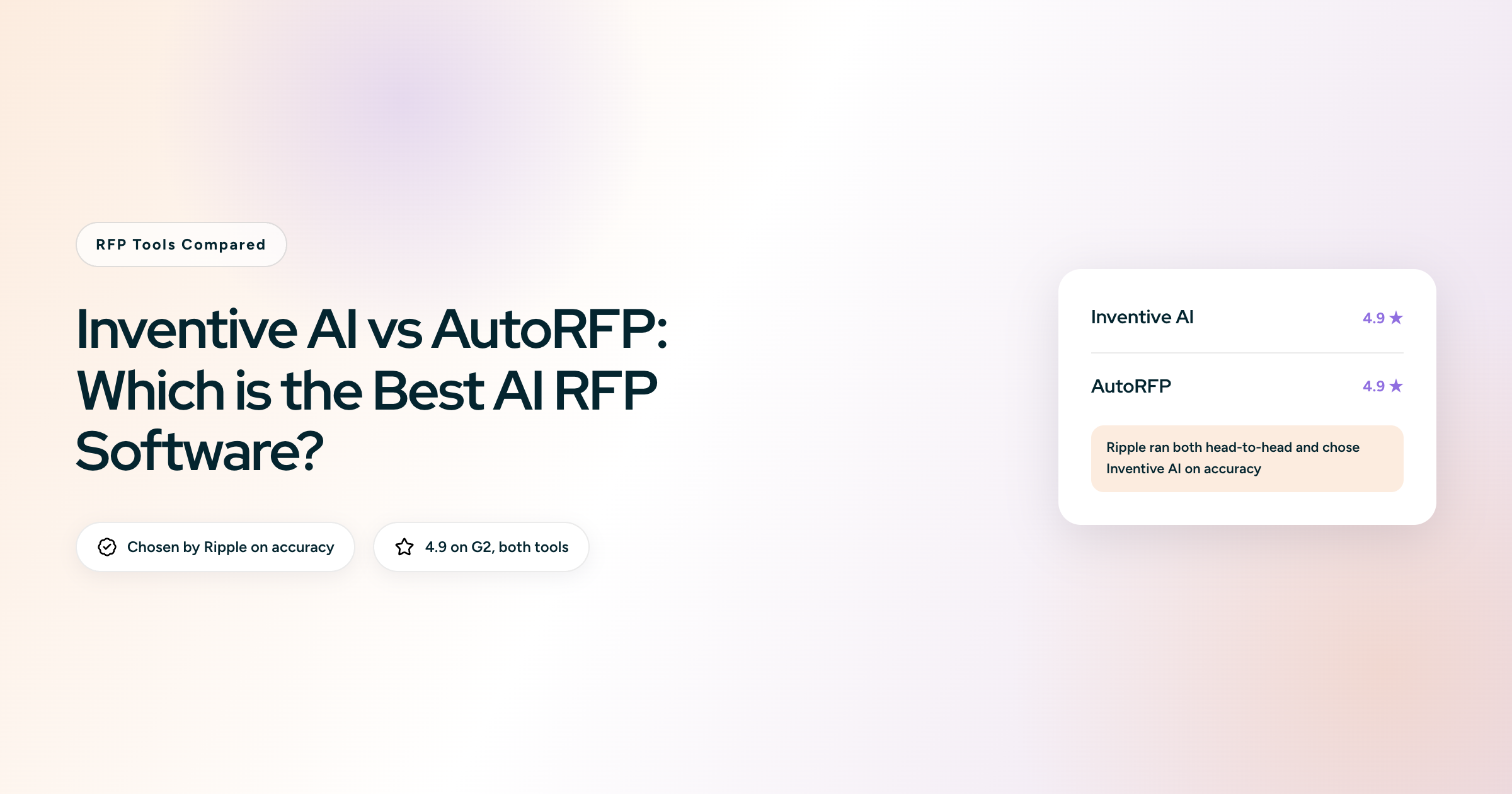
Proof: Ripple ran a head-to-head pilot against AutoRFP and chose Inventive AI on accuracy, then rolled it out to 150 users.
Which should a bid team choose: AutogenAI or AutoRFP?
Pick by the documents that fill your calendar.
- AutogenAI: best for teams writing long, scored tenders, public sector bids, and grants, especially US federal work that requires FedRAMP. Trade-off: a steeper learning curve and seat-based pricing that grows with every contributor.
- AutoRFP: best for sales and SE teams answering high volumes of questionnaires and Q&A-style RFPs. Trade-off: project caps per plan and less depth for long narrative writing.
Teams weighing other options can compare AutoRFP alternatives side by side.