HeyIris vs AutoRFP (2026): Which AI RFP Tool Fits Your Team?
HeyIris vs AutoRFP compared on AI drafting, pricing, integrations and reviews — plus where AI-native platforms like Inventive fit for RFP teams.
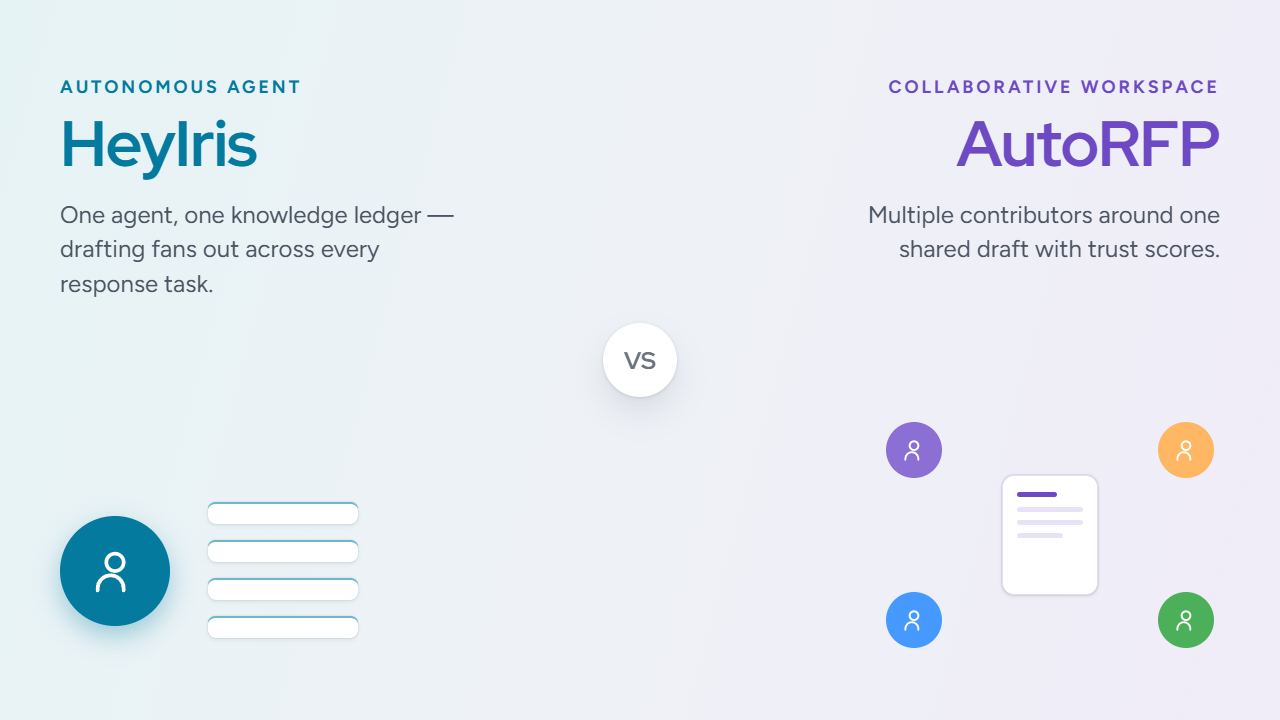
Both HeyIris and AutoRFP arrived in the same wave of AI-native RFP tools — neither is a legacy content-library platform retrofitted with AI. They overlap heavily on the pitch (fast AI first drafts, security questionnaires, browser extensions) but split on architecture: HeyIris leans into an autonomous "agent plus knowledge ledger" model, while AutoRFP leans into a "library-less" drafting engine wrapped in a collaborative bid workspace. This guide compares them on the dimensions buyers actually weigh, using published ratings, sourced pricing signals and verified reviews.
Last reviewed: January 2026. This comparison draws on vendor-published pages, verified G2 and Capterra reviews (plus Gartner Peer Insights where available), and independent third-party write-ups. Both vendors are early-stage, so review counts are thin and pricing is largely quote-based. Features and prices change often — confirm the current specifics with each vendor before you buy.
TL;DR: HeyIris vs AutoRFP in three sentences
HeyIris fits teams that want an easy-to-train autonomous agent with granular tone control and per-user seat pricing that bundles unlimited questionnaire credits. AutoRFP fits teams that want a library-less drafting engine with transparent per-response Trust Scores and unlimited-user, project-volume pricing. There is no universal winner — it depends on what your team needs, so weigh pricing model, learning curve and integration depth against how you actually run RFPs. If you're also scanning the wider AI-native category, this RFP software comparison guide maps the landscape.
HeyIris vs AutoRFP at a Glance

| HeyIris (Iris) | AutoRFP.ai | |
|---|---|---|
| Best for | Teams wanting an easy-to-train autonomous agent + one "knowledge ledger" | Teams wanting a library-less draft engine + collaborative bid workspace |
| G2 rating | 4.9 (67 reviews; some pages show 66) | 4.9 (56 reviews; pages vary 55–60) |
| Pricing model | Per-user seat; unlimited collaborators + unlimited RFx/DDQ/security credits; quote-based | Enterprise by projects/year; unlimited users, no per-seat fee; quote-based |
| Standout trait | Adjustable tone at document/section/answer level; confidence scores | Transparent per-response "Trust Scores"; AI Reviewer |
| Format handling | RFPs, RFIs, SOWs, DDQs, security questionnaires | Excel/Word/PDF/portals via browser extension |
| Access | Web + Chrome/browser extension | Web-only reported |
Figures are reported at time of writing; confirm ratings, counts and pricing with each vendor.
What Should You Consider When Choosing Between HeyIris and AutoRFP?
Start with the decisions that are hard to reverse — pricing model and data architecture — then work down to workflow fit. Use these criteria as demo questions:
• AI drafting model: Does the tool draft answer-by-answer or reason across the whole document? Ask each vendor to run a live 20-question set.
• Hallucination control: Does it flag "not enough information" or invent an answer? HeyIris reviewers note it declines to fabricate; AutoRFP surfaces Trust Scores. Verify both on edge-case questions.
• Content governance: How does approved content stay current, and who owns updates?
• Conflict detection: Will the tool catch two library entries that contradict each other?
• Tone and narrative control: Can you tune voice at the section level, or only globally?
• Content management: Library-based, library-less, or connected to systems you already use?
• Collaboration: How are questions assigned, reviewed and tracked across a bid team?
• Integrations: Does it connect to your CRM, docs and Slack/Teams out of the box?
• Security and compliance: SOC 2 status, SSO, data-training policy — get it in writing.
• Analytics: Can you see win rates, cycle time and reviewer bottlenecks?
• Pricing model fit: Per-seat vs per-project changes total cost sharply by team shape — compare both against your headcount using this pricing and review breakdown of AutoRFP.
• Ease of implementation: Days or weeks to first usable draft?
• Enterprise scalability: How does it behave on large, complex, multi-section documents?
• Support model: Hands-on onboarding or self-serve only?
HeyIris vs AutoRFP: Feature-by-Feature Comparison
This table is the centerpiece. Each cell reflects sourced values at time of writing; confirm with vendors.
| Dimension | HeyIris (Iris) | AutoRFP.ai |
|---|---|---|
| Best for | Autonomous drafting agent + centralized "knowledge ledger" | Library-less draft engine + collaborative bid workspace |
| Core positioning | AI-native "Deal Desk" agent for RFPs, RFIs, SOWs, DDQs, security questionnaires | AI-first, library-less platform generating complete drafts "in seconds" |
| G2 rating | 4.9 (67 reviews) | 4.9 (56 reviews) |
| Capterra | Listed; rating not published at review | 5.0 reported (1 review — confirm) |
| TrustRadius / Gartner | Listed in RFP category; thin history | Listed on Gartner Peer Insights; thin history |
| AI capabilities | Learns institutional knowledge; quick first-pass answers with confidence scores; won't fabricate when data is missing | Generates full drafts fast; AI Reviewer; learns from each approved response |
| Response transparency | Confidence scores per answer | "Trust Scores" showing confidence per response |
| Tone / narrative control | Adjustable at document, section or individual-answer level | Reviewers report limited template flexibility |
| Content model | Centralized knowledge ledger from company docs | Library-less; learns from approved responses |
| Format handling | RFPs, RFIs, SOWs, DDQs, security questionnaires | Excel/Word/PDF/portals via extension |
| Integrations | Salesforce, HubSpot, Slack, Teams, Google Workspace/Drive, Confluence, SharePoint, Chrome extension | Salesforce (AppExchange), Slack, Teams, Confluence, SharePoint, Google Drive, Seismic, Zendesk, Notion, SSO, browser extension |
| Access | Web + browser extension | Web-only reported |
| Pricing model | Per-user seat; unlimited collaborators + unlimited credits; quote-based | Enterprise by projects/year; unlimited users; quote-based (third-party tiers reported ~$899–$1,299/mo) |
| Support | Praised as proactive and hands-on | Praised as responsive and hands-on |
| Noted limitation | Missing project-management features; limited mobile; output tied to documentation depth | Steeper learning curve; web-only; challenges on large/complex docs (reported) |
Figures reported at time of writing — confirm ratings, integrations and pricing with each vendor before purchasing.
Inventive AI ships every response with a citation and a confidence score and flags "information unavailable" rather than guessing — see how that hallucination control works in a live demo.
HeyIris Deep Dive
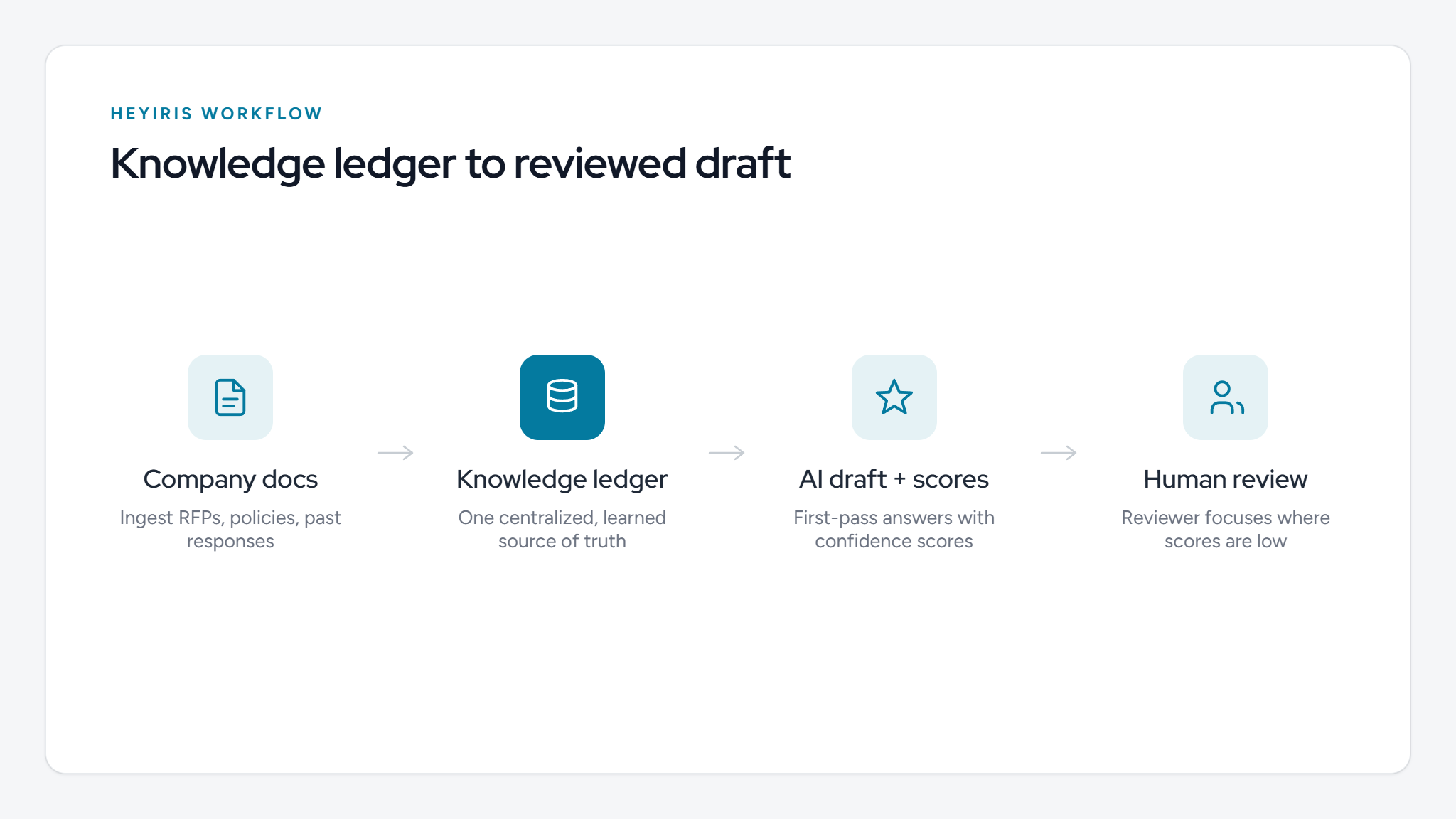
HeyIris (the product is called Iris) positions itself as an autonomous AI agent — a "Deal Desk" that drafts and manages responses across RFPs, RFIs, SOWs, DDQs and security questionnaires while learning your institutional knowledge and holding it in a centralized "knowledge ledger." The pitch is less "help me write" and more "draft it, then let me review."
HeyIris best features
• Fast completion of RFPs and security questionnaires, cited by reviewers as a primary time saver.
• Ease of use with minimal training — one G2 reviewer reported being up and running in a day.
• Granular tone control — adjust response voice at the document, section or individual-answer level.
• Confidence scores on quick first-pass answers so reviewers know where to focus.
• Proactive customer support, called out repeatedly in reviews.
• Won't fabricate — it declines to invent answers when source data is missing, which reduces silent errors.
HeyIris limitations
• Reviewers report missing or limited features, including project-management capabilities (G2 pros and cons).
• Limited mobile access and a narrower integration set than broader platforms; teams weighing that gap can compare it against HeyIris alternatives and competitors.
• Occasional inaccurate responses tied to incomplete or outdated source data — the flip side of not fabricating is that thin documentation yields thin answers (G2).
• A third-party review notes output quality depends on documentation depth, with occasional slow processing (SiftHub).
• The same review flags gaps in tone control edge cases and visual handling.
• Because it won't invent answers, teams with sparse knowledge bases must invest in content before drafts get strong.
HeyIris pricing
HeyIris uses per-user seat pricing that includes unlimited collaborators and unlimited RFx / DDQ / security-questionnaire credits — no pay-per-use or token model. No specific public price is verified; pricing is effectively quote/custom-based, and scaling seat counts means contacting sales (HeyIris pricing). For a fuller feature-and-limitations breakdown as you evaluate, see this HeyIris pricing and features review. For teams with many occasional contributors, unlimited collaborators can be attractive; confirm the per-seat rate during your evaluation.
HeyIris ratings and reviews
HeyIris holds a 4.9 on G2 across 67 reviews (some pages show 66) (G2). It is also listed on Capterra, though a published star rating was not visible at review time.
"Iris is incredibly easy to use and to train. It's adaptive to our needs and works without bugs or challenges, even on complicated questionnaires. The initial setup was very easy, and we had it up and running in a day." — G2 reviewer
"I don't like that Iris can't invent answers on its own and will say 'not enough…'" (quote truncated in G2's pros-and-cons summary — confirm the full text on the live listing) — G2 reviewer
AutoRFP Deep Dive
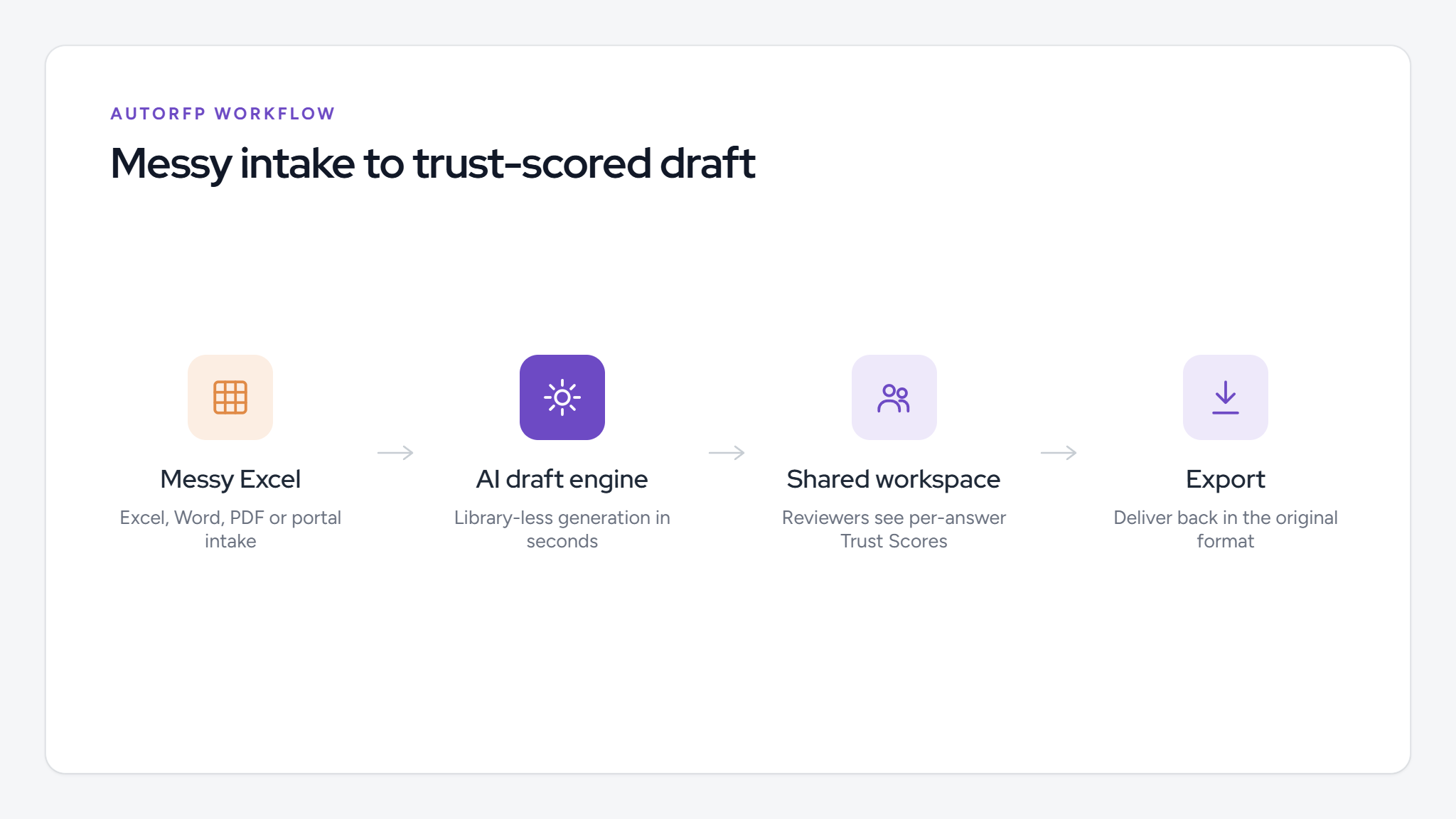
AutoRFP.ai positions itself as an AI-first, "library-less" RFP and security-questionnaire platform that generates complete draft responses in seconds, then layers an AI Reviewer and transparent Trust Scores on top. Around the drafting engine sits a collaborative bid-team workspace and a browser extension that handles Excel, Word, PDF and web portals.
AutoRFP best features
• Significant time savings on RFPs, DDQs and security assessments, per reviewers.
• Context-aware accuracy, praised as better than systems that "regurgitate" old answers.
• Easy, painless onboarding reported by multiple users.
• Transparent Trust Scores showing confidence per response.
• Library-less approach that learns from each approved response instead of a maintained repository.
• Responsive, hands-on support team.
AutoRFP limitations
• A steeper learning curve, especially without formal training (G2 pros and cons).
• Limited template flexibility and some unintuitive navigation feedback; teams that need more format range can review AutoRFP alternatives and how they compare.
• Web-only access reported as somewhat limiting (G2).
• A third party reports challenges with large or complex documents and some enterprise integrations (Inventive analysis).
• Like HeyIris, it relies on up-to-date content — stale source material weakens drafts.
• Review history remains thin (56 G2 reviews; a single reported Capterra review), so validate claims against your own pilot.
AutoRFP pricing
AutoRFP states enterprise pricing is based on the number of projects per year, with all plans including unlimited users and no per-seat fees (AutoRFP pricing). No fixed self-serve tiers are published. Third-party sources report a Scale plan around $899/mo and a higher tier around $1,299/mo (billed annually, ~24 projects/year) — not vendor-confirmed (Inventive breakdown). Capterra's listing shows a starting point "from $199/Per Month, Usage Based" (Capterra), and Gartner references startup pricing "from ~$499/mo" (Gartner). These figures conflict — treat all as reported and confirm directly.
AutoRFP ratings and reviews
AutoRFP holds a 4.9 on G2 across 56 reviews (pages vary 55–60) (G2). Capterra shows a reported 5.0 from a single review (Capterra), and it is listed on Gartner Peer Insights.
"I love how it takes a dirty Excel and magically converts it highly accurate answers." — G2 reviewer
"The learning curve is a little steep, but had I bothered to do any training at all instead of just diving in it might have been a little easier." — G2 reviewer
Weighing per-seat against per-project pricing? Inventive customer AssetWorks Facilities reported a 422% ROI and roughly $105K in net savings on RFP automation — read the case study.
AI Capabilities: How the Two Draft Differ
Both tools draft with AI first and put a human in the reviewer's seat — but the underlying model differs.
HeyIris
• Learns your institutional knowledge into a centralized ledger and drafts from it.
• Attaches confidence scores to first-pass answers.
• Declines to fabricate when data is missing — a deliberate accuracy trade-off.
AutoRFP
• Library-less generation that learns from each approved response.
• AI Reviewer plus per-answer Trust Scores for transparency.
• Praised for context-aware answers over "regurgitated" library entries.
Note: For both tools, answer quality is only as strong as your source content — reviewers of each flag stale or thin documentation as a drag on accuracy. If content freshness is a recurring pain, look at platforms with an automated content-governance layer; RAD AI, an Inventive customer, reported 2× more accurate responses than other RFP AI tools.
Integrations Compared
| Category | HeyIris | AutoRFP |
|---|---|---|
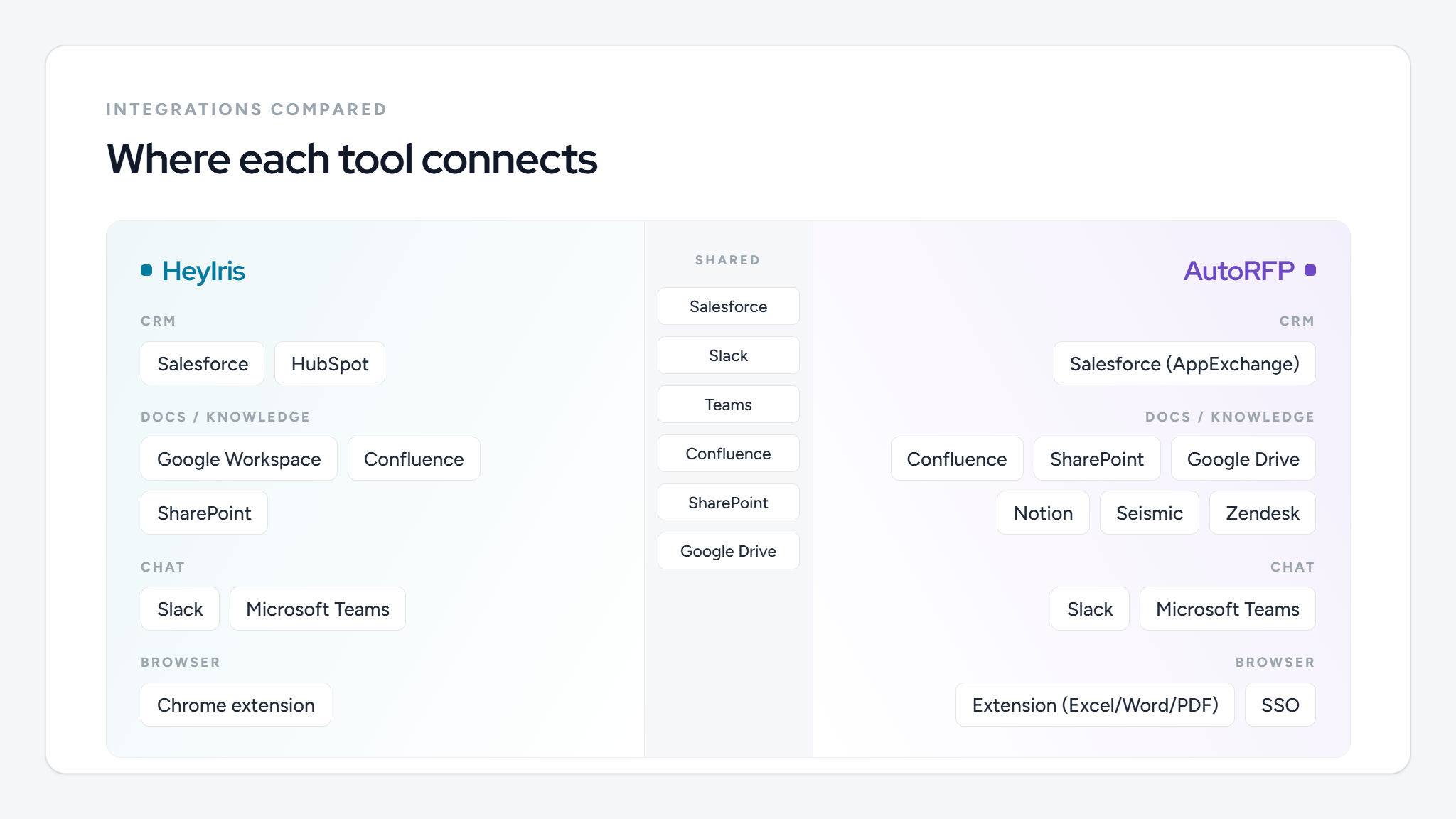
| CRM | Salesforce, HubSpot | Salesforce (AppExchange) |
| Docs / knowledge | Google Workspace/Drive, Confluence, SharePoint | Confluence, SharePoint, Google Drive, Notion, Seismic, Zendesk |
| Chat | Slack, Microsoft Teams | Slack, Microsoft Teams |
| Access | Chrome / browser extension | Browser extension (Excel/Word/PDF/portals), SSO |
AutoRFP lists a broader connector set (Seismic, Zendesk, Notion, SSO); HeyIris adds native HubSpot. Confirm which connectors are live versus roadmap during a demo.
Security and Compliance
Both platforms handle security questionnaires, so their own security posture matters. Neither vendor's SOC 2 status is stated in the sourced material here — request current SOC 2 / ISO documentation, SSO details and data-training policies directly. AutoRFP lists SSO among its features; verify HeyIris's SSO and admin controls in your evaluation.
Note: Ask each vendor in writing whether your data trains shared or public models. For reference on how an AI-native platform frames this, see the best AI agent for security questionnaires roundup.
Is HeyIris Better Than AutoRFP?
Neither is categorically better — they optimize for different teams. HeyIris is the stronger fit if you want fast onboarding, granular tone control, per-seat pricing with unlimited collaborators and credits, and an agent that won't invent answers. AutoRFP is the stronger fit if you want a library-less engine, transparent per-response Trust Scores, unlimited-user project-based pricing, and a collaborative bid workspace — and you can absorb a steeper learning curve. Both carry thin review histories and quote-based pricing, so a hands-on pilot matters more than star ratings here. For a broader shortlist, this enterprise RFP software comparison is a useful cross-check.
See how an agent that runs the full RFP workflow — not just drafting — handles your questionnaires: book an Inventive demo.
Also Worth Considering: Inventive AI
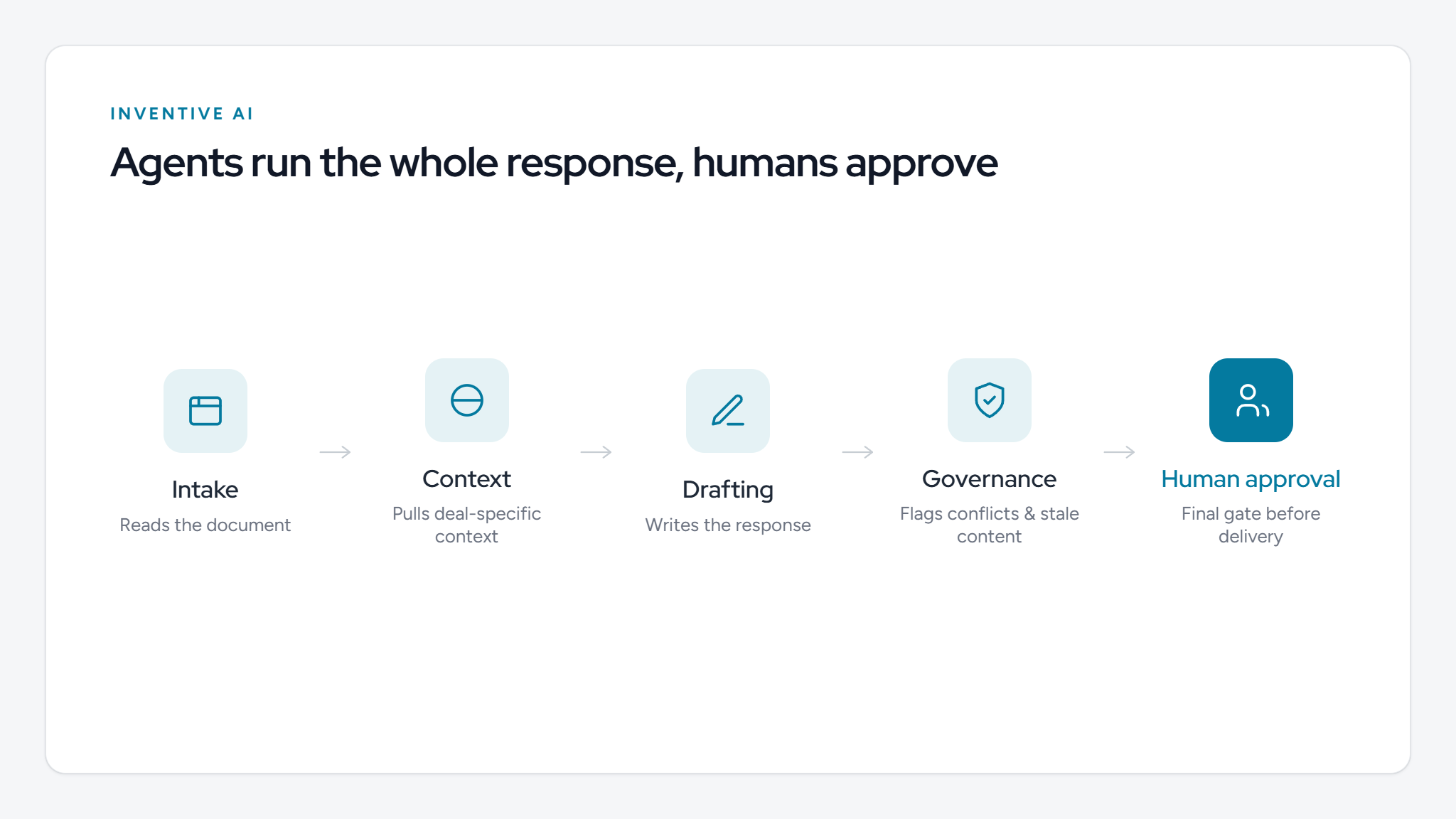
If you're comparing HeyIris and AutoRFP, it's worth knowing a newer category is taking a different architectural swing: AI-agentic proposal platforms that run the whole response process rather than accelerating one step of it. Inventive AI is one example in that category.
Inventive AI is an autonomous, AI-agentic platform for RFPs, RFIs, DDQs and security questionnaires, with humans in the loop for approvals (inventive.ai). Rather than asking a team to maintain a library or write drafts from scratch, its agents understand the document, pull context, draft, and flag what needs judgment.
Key capabilities of Inventive AI
• AI first drafts cited at up to 10× faster with ~95% accuracy, per vendor materials.
• Unified Knowledge Hub that connects SharePoint, Google Drive, Salesforce, Confluence, Notion and Zendesk and live-syncs when a source doc changes.
• Content Governance Agent that detects conflicting info, flags outdated content and surfaces duplicates automatically.
• Context Engine for deal-specific personalization using customer priorities, CRM data and sales notes.
• Competitive Intelligence Agent that compares positioning against named competitors inside the response.
• Format flexibility across Excel and narrative proposals, plus intake from PDF/Word/PPT.
• Collaborative review with assignments, ownership and approved answers feeding back into the Knowledge Hub.
• Response quality reported at 2× more client-ready answers than the next-best tool tested, per a named customer benchmark.
Best for: mid-market and enterprise proposal, presales, InfoSec and sales-enablement teams that want agents to run the RFP process end-to-end, not just draft answers.
Why buyers comparing HeyIris and AutoRFP might look at Inventive as an alternative
The shared pain in both tools is content dependency — reviewers of HeyIris and AutoRFP alike note that stale or thin source material weakens drafts. Inventive is positioned to address that with an automated Content Governance Agent and a Context Engine that tailors each response per deal. Insider, an Inventive customer, reported its win rate rising from 30% to 50% and RFP responses running 90% faster (case study). If that architecture is relevant, you can compare the AI-native approach directly.
MaxVal answered 80 RFP questions in 3 hours — work that used to take nearly a week, with zero weekend hours lost. See how.
Frequently Asked Questions
How much does HeyIris cost?
HeyIris uses per-user seat pricing that bundles unlimited collaborators and unlimited RFx/DDQ/security-questionnaire credits, with no pay-per-use model. No public per-seat price is verified — pricing is effectively quote-based, and scaling seats requires contacting sales (HeyIris pricing). Confirm the current rate directly.
How much does AutoRFP cost?
AutoRFP states enterprise pricing is based on projects per year with unlimited users and no per-seat fees (AutoRFP pricing). Third-party sources report figures ranging from ~$199/mo (Capterra) and ~$499/mo (Gartner) up to ~$899–$1,299/mo (Inventive breakdown) — all reported, none vendor-confirmed. Treat these as directional and verify.
Is HeyIris better than AutoRFP?
Neither is universally better. HeyIris suits teams wanting easy training, granular tone control and unlimited-collaborator seat pricing; AutoRFP suits teams wanting library-less drafting, Trust Scores and unlimited-user project pricing. Both hold 4.9 on G2 with thin review counts, so a pilot on your real documents decides it.
What do HeyIris and AutoRFP reviews say on G2?
Both sit at 4.9 on G2 — HeyIris across 67 reviews, AutoRFP across 56. HeyIris reviewers praise ease of setup and support but note missing features and mobile gaps; AutoRFP reviewers praise accuracy and onboarding but flag a steeper learning curve and web-only access.
What is an alternative to HeyIris and AutoRFP?
Beyond each other, alternatives include legacy library platforms and newer AI-native ones. Start with these curated lists of HeyIris alternatives and AutoRFP alternatives to build a shortlist.
Is there an AI-native alternative to HeyIris and AutoRFP?
Yes — a newer category of AI-agentic platforms, including Inventive AI, runs the full RFP workflow (intake, drafting, governance, review) rather than accelerating a single step. See HeyIris vs Inventive AI for a side-by-side of that approach.
Related Comparisons and Resources
For deeper research as you narrow your shortlist:
• Best RFP software (2026 roundup) — the broader field beyond these two tools.
• Best AI agent for security questionnaires — if InfoSec questionnaires are your primary use case.
• HeyIris vs Inventive AI — the agentic-architecture comparison.
• AutoRFP vs Arphie vs Inventive AI — how AutoRFP stacks up against another AI-native rival.
• AutoRFP vs SiftHub — a comparison focused on rework and response quality.
Sources
• HeyIris G2 reviews: https://www.g2.com/products/heyiris-ai-iris/reviews
• HeyIris pros and cons: https://www.g2.com/products/heyiris-ai-iris/reviews?qs=pros-and-cons
• HeyIris Capterra: https://www.capterra.com/p/10034662/Iris/
• HeyIris pricing: https://heyiris.ai/pricing
• HeyIris third-party review: https://www.sifthub.io/blog/heyiris-ai-pricing-features-reviews
• AutoRFP G2 reviews: https://www.g2.com/products/autorfp-ai/reviews
• AutoRFP pricing: https://autorfp.ai/pricing
• AutoRFP Capterra: https://www.capterra.com/p/10011500/AutoRFP-ai/
• AutoRFP Gartner Peer Insights: https://www.gartner.com/reviews/product/autorfp-ai
• AutoRFP pricing/review breakdown: https://www.inventive.ai/blog-posts/autorfp-ai-pricing-review-and-features
Figures, ratings and pricing are reported at time of writing (January 2026) and change frequently — confirm current specifics with each vendor before purchasing.

.avif)