Qvidian vs AutoRFP (2026): A Buyer's Comparison of Two Different RFP Software
Qvidian's governed content library vs AutoRFP's AI-generated drafts, compared on pricing, security questionnaires, integrations and verified reviews.

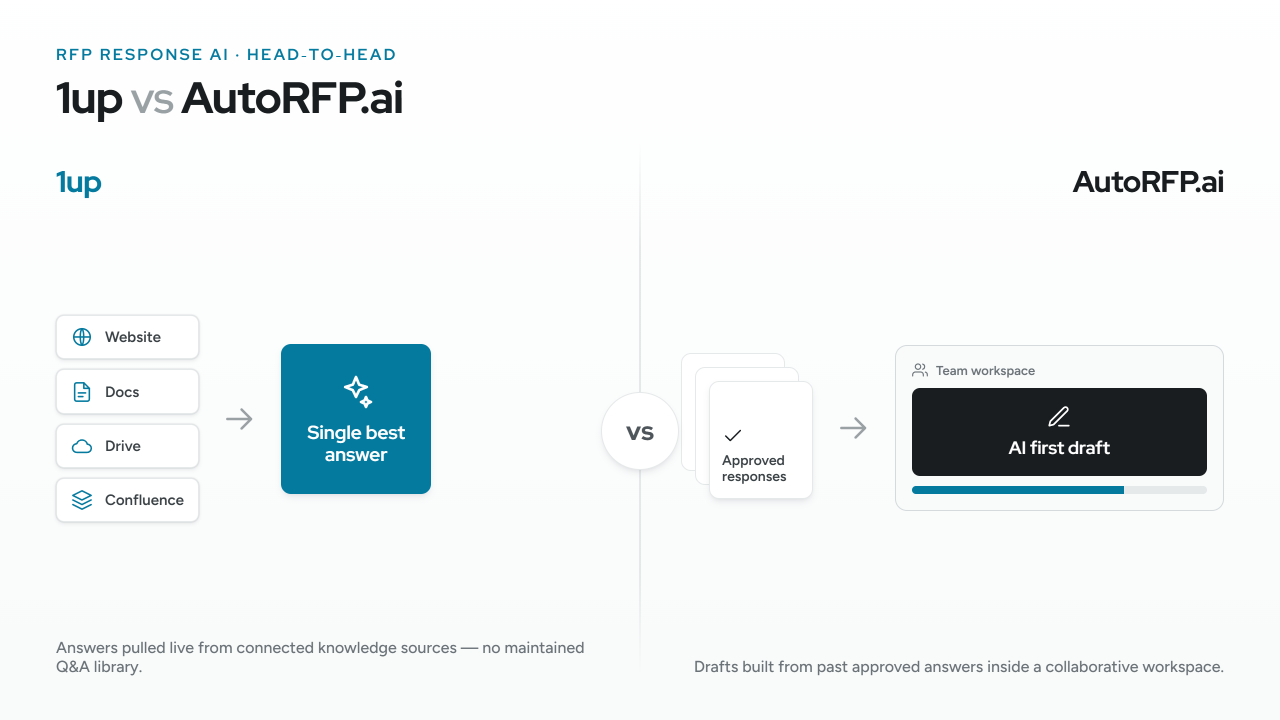
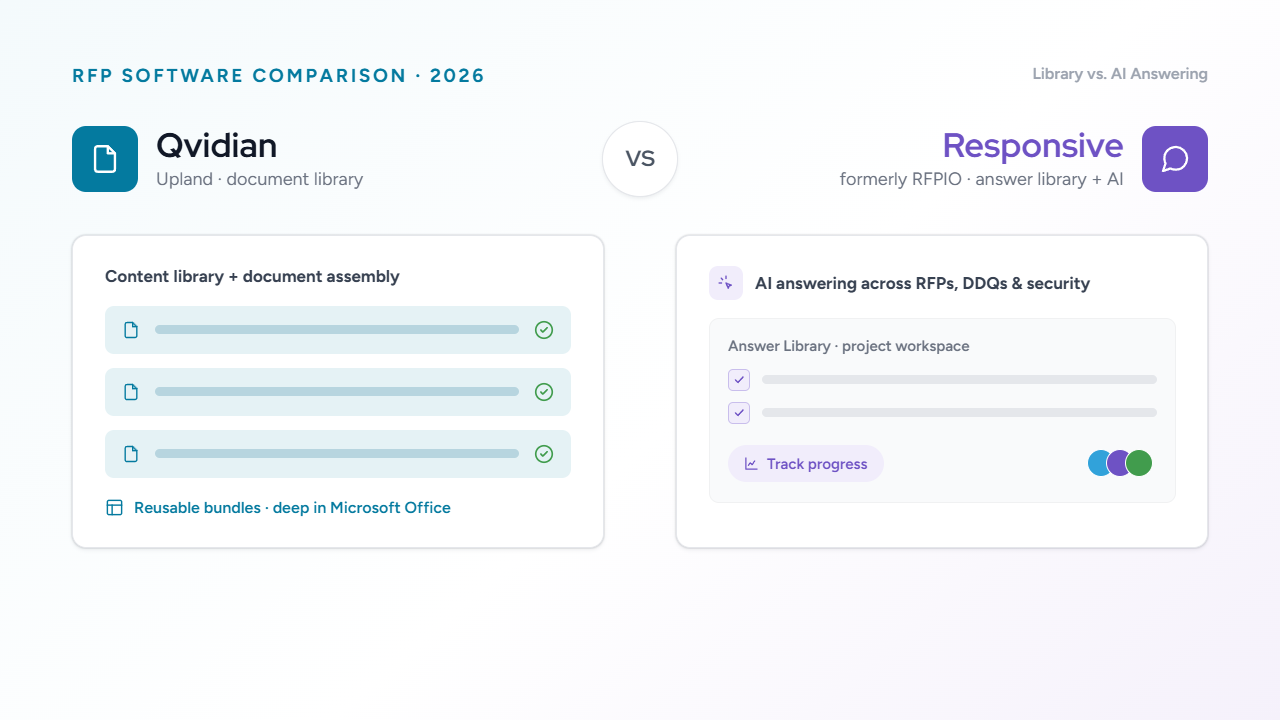
Qvidian and AutoRFP both help teams answer RFPs, RFIs, and security questionnaires faster — but they take opposite architectural routes. Qvidian is an established enterprise platform built around a governed, reusable content library. AutoRFP is a newer, AI-native tool built around instant AI-generated first drafts. This guide compares them on features, AI capability, pricing, integrations, security, and verified reviews so you can decide which fits your team.
Last reviewed: January 2026. This comparison draws on vendor-published materials, verified G2 and Capterra reviews (plus TrustRadius and Gartner Peer Insights where listings exist), and independent third-party analyses such as Vendr and Realm. Ratings, review counts, features, and pricing all move over time, so confirm the current specifics with each vendor before you buy.
TL;DR: Qvidian vs AutoRFP in Three Sentences
Qvidian fits medium-to-large enterprises that want a mature, governed content library, document automation, and deep approval workflows, and can budget for a quote-based enterprise contract. AutoRFP fits teams that prioritize fast AI-generated first drafts, strong handling of security questionnaires (CAIQ, SIG, VSA), and transparent published pricing, and are comfortable with a web-only, newer platform. The honest verdict is that it depends on what your team needs — library governance and enterprise maturity, or AI-first speed — and if you want the wider market context first, this RFP software comparison guide maps where both models sit.
Qvidian vs AutoRFP at a Glance
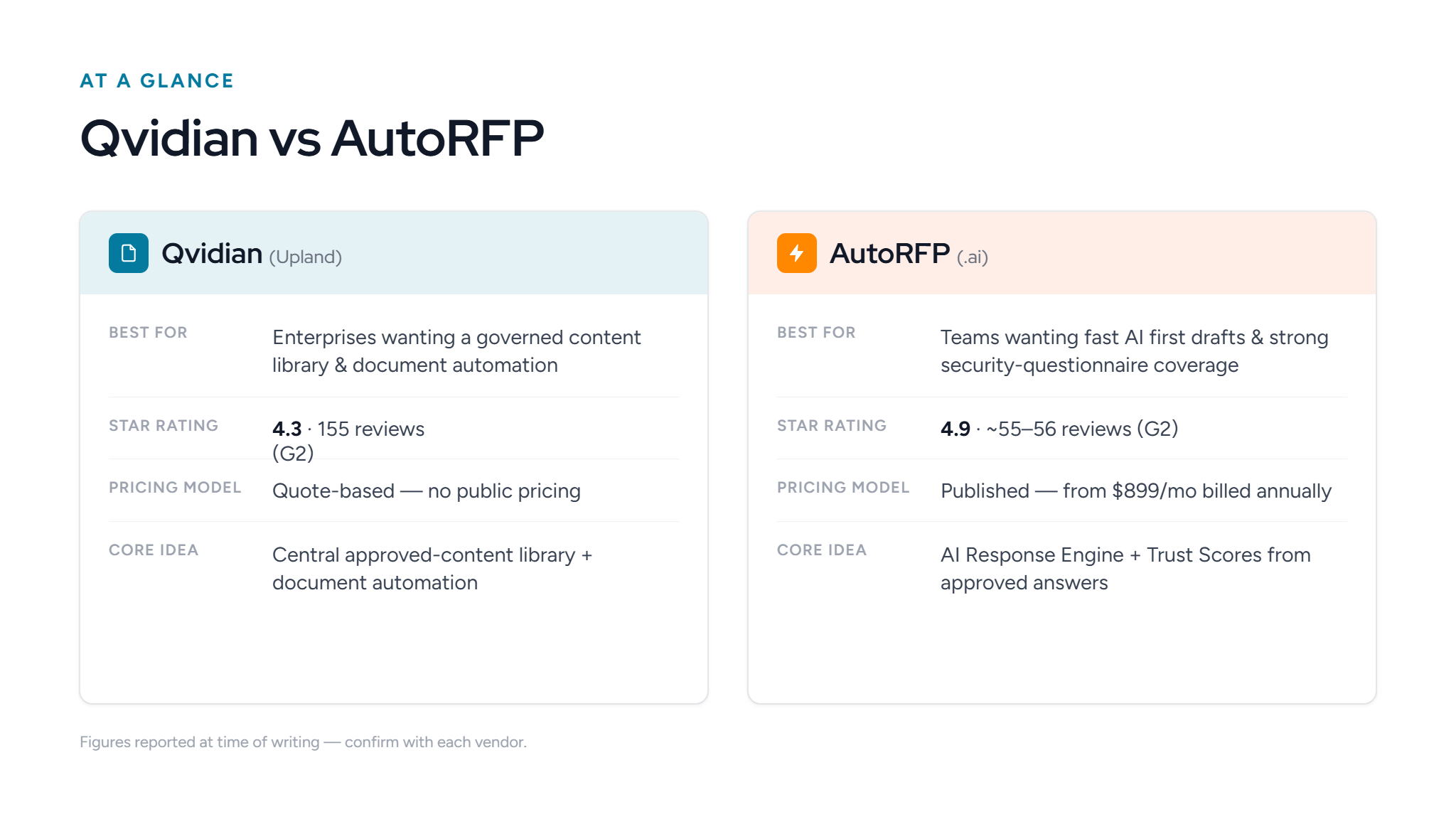
| Qvidian (Upland Qvidian) | AutoRFP (AutoRFP.ai) | |
|---|---|---|
| Best for | Enterprises wanting a governed content library and document automation | Teams wanting fast AI first drafts and strong security-questionnaire coverage |
| Category | Established enterprise RFP/proposal automation | AI-native RFP, DDQ and security-questionnaire responses |
| G2 rating | 4.3 (155 reviews; a filter header cites 166 — confirm on the live listing) | 4.9 (~55–56 reviews — confirm on the live listing) |
| Pricing | Quote-based; no public pricing (Upland) | Published: from $899/mo billed annually (AutoRFP) |
| Core idea | Central approved-content library + document automation | AI Response Engine + Trust Scores learning from approved answers |
Figures are reported at the time of writing; confirm with each vendor.
What Should You Consider When Choosing Between Qvidian and AutoRFP?
Start with the questions that actually change the decision, not a feature checklist. Answer these before you sit through a demo.
• AI drafting depth: Does the tool generate a full first draft, or mostly index and retrieve existing library answers? This is the sharpest difference between these two.
• Content governance: Who keeps answers current, and how does the system flag outdated or conflicting content?
• Conflict detection: Will the platform surface contradictory answers across your library before you submit?
• Hallucination control: Does AI output ship with citations and a confidence signal, or unattributed text you must fact-check manually?
• Security questionnaires: Do you regularly answer CAIQ, SIG, VSA, or DDQs from the same content source?
• Narrative vs. grid: Do you write long-form narrative proposals, fill Excel/portal grids, or both?
• Content management: Does the library support expiration dates, usage tracking, and ownership?
• Workflow and collaboration: Are reviewer assignments, approvals, and progress tracking built in — and do all contributors need paid seats?
• Integrations: Does it connect to your CRM, storage, and procurement portals?
• Security and compliance: ISO 27001, SOC 2, SSO — what does your InfoSec team require?
• Analytics: Can you measure turnaround time, win rate, and content usage?
• Pricing model: Per-seat vs. project-based, and quote-only vs. published?
• Implementation effort: How long until the library is loaded and the team is productive?
• Scalability: Will it hold up across concurrent RFPs and a growing team?
Weighing the AI-native category too? Insider reports its win rate climbed from 30% to 50% with 90% faster responses after switching to an agentic platform — read the Insider case study.
The Detailed Feature-by-Feature Comparison
This is the core of the comparison. Each row is a dimension that matters for these two tools specifically.
| Dimension | Qvidian (Upland Qvidian) | AutoRFP (AutoRFP.ai) |
|---|---|---|
| Best for | Enterprises needing governed content + document automation | Teams needing fast AI drafts and security-questionnaire coverage |
| G2 rating | 4.3 (155 reviews; header cites 166 — confirm) | 4.9 (~55–56 reviews — confirm) |
| Capterra rating | 4.4 (42 reviews — confirm) | Listed; numeric rating not verified in search — confirm |
| Other listings | TrustRadius (~40 ratings; trScore not verified — confirm) | Gartner Peer Insights listing exists — confirm |
| Pricing | Quote-based; no public pricing (Upland) | From $899/mo (Scale) / $1,299/mo (Accelerate), billed annually (AutoRFP) |
| AI capabilities | Search, autosearch, autofill from library; AI auto-population reported as limited vs. simple index search | AI Response Engine generates first drafts; converts "dirty" Excel questionnaires into answers |
| Response approach | Reuse approved library content | Learns from each approved response; Trust Scores on generated answers |
| Security questionnaires | Supported via content library | Strong focus: CAIQ, SIG, VSA, DDQs from one content source |
| Content governance | Expiration dates, usage tracking, approval workflows | Learns from approved answers; freshness depends on responses staying current |
| Collaboration | Real-time collaboration/approval; strongest tier needs a license per contributor | Collaborative workspace; unlimited users on paid plans |
| Format flexibility | Word, Excel, PowerPoint document automation; Excel reported as needing improvement | Web-based workspace; limited template flexibility reported |
| Integrations | Salesforce, Microsoft 365, Google Docs/Sheets/Slides, Open API | Salesforce, Slack, Teams, SharePoint, Confluence, Google/OneDrive, Notion, Seismic, Zendesk, portal Chrome extension |
| Access | Web + Microsoft 365 apps | Web-only (reported as somewhat limiting) |
| Security/compliance | Enterprise controls (confirm current certifications with vendor) | ISO 27001:2022, SSO (Google & Microsoft) on Scale plan |
Values reflect listings and vendor pages observed during research; confirm current details with each vendor.
Qvidian: Overview, Strengths, and Limitations
Qvidian (Upland Qvidian) is an established enterprise RFP and proposal automation platform built around a central, approved-content library. It emphasizes strategic response management, document automation, and content governance for medium-to-large organizations that run high volumes of RFPs and need control over who owns, updates, and approves answers.
Best features
• Well-organized, reusable central content library with content management controls including expiration dates and usage tracking.
• Document automation that builds shell and response documents, which reviewers credit for faster turnaround and greater consistency.
• Search, autosearch, and autofill when responding to RFPs.
• Highest-rated features per reviewers include proposal templates, content library updates, and collaboration/approval workflows.
• Native Microsoft 365 support (Word, Excel, PowerPoint, Teams) plus Google Docs, Sheets, and Slides.
• Open API for custom connections into existing enterprise systems.
Limitations (sourced)
• Search functionality could be improved; reviewers want semantic search and less repetition, and describe AI auto-population of questionnaires as limited versus a simple index search (G2).
• Uploading and updating data is described as difficult and time-consuming, with a lot of manual work that can hinder adoption (G2). Teams weighing that maintenance load often review Qvidian competitors and alternatives to compare content models.
• The strongest real-time collaboration requires procuring a license for every contributor (TrustRadius).
• Excel functionality is cited as needing improvement (TrustRadius).
• A TrustRadius reviewer documented feature regression (multi-edit removed in v9.1, later restored in v10) (checkthat.ai).
• Pricing is quote-only, and one third party reported the Upland pricing page returning a 404 with quote-only CTAs (checkthat.ai).
Ratings and reviews
• G2: 4.3 across 155 reviews (a filter header on the same listing cites 166 — confirm on the live listing).
• Capterra: 4.4 across 42 reviews (confirm on the live listing).
• TrustRadius: based on ~40 ratings; overall trScore not verified in search (confirm on the live listing).
Positive: "Using Qvidian as an RFP tool has made a difference in our RFP process, turn-around time, and content development." (TrustRadius)
Mixed: "I find the process of uploading and updating data to be quite difficult and time-consuming, which involves a lot of manual work." (G2)
AutoRFP: Overview, Strengths, and Limitations
AutoRFP (AutoRFP.ai) is an AI-native platform for RFPs, DDQs, and security questionnaires. Its positioning centers on instant AI-generated first drafts via an "AI Response Engine," "Trust Scores" that indicate confidence in generated answers, and a collaborative response workspace. Rather than maintaining a static library as the primary asset, it positions itself as learning from each approved response.
Best features
• Large time savings via AI-generated draft responses; users cite roughly a 50% reduction in response time.
• AI that understands context and converts messy or "dirty" Excel questionnaires into accurate answers.
• Built-in Q&A for one-off questions without launching a full project.
• Strong coverage of security questionnaires and vendor assessments (CAIQ, SIG, VSA) and DDQs from the same content source.
• Trust Scores on generated answers to signal confidence.
• Responsive support and straightforward onboarding, per reviewers.
Limitations (sourced)
• The learning curve can be steep without training, and some interface issues are reported (G2).
• Web-only access is seen as somewhat limiting, and template flexibility is reported as limited (G2). Teams that need more format range often scan AutoRFP alternatives alongside it.
• The Chrome browser extension/tab can be memory-heavy and degrade browser performance if left open (Gartner Peer Insights).
• Output quality depends on responses staying current; a reviewer noted AutoRFP relied on out-of-date responses when their product changed frequently (G2).
• The review base is thinner and more recent than Qvidian's, so there is less long-run enterprise track record to weigh.
• Feature depth for long-form narrative proposals is less established than its security-questionnaire and grid strengths (verify against your own document types in a trial).
Ratings and reviews
• G2: 4.9 across ~55–56 reviews (the product page shows 55, the seller page shows 56 — confirm on the live listing).
• Capterra: listed; numeric rating not verified in search (confirm on the live listing).
• Gartner Peer Insights: listing exists (confirm on the live listing). No verified TrustRadius listing was found in search.
Positive: "Since we started using AutoRFP six months ago, we've seen a +50% reduction in the time spent compiling RFP responses." (G2)
Mixed: "It takes up a lot of memory as an open tab in Chrome. If I leave it open for awhile, I notice that the whole browser performance is negatively impacted." (Gartner Peer Insights)
Comparing AI drafting quality? RAD AI reports 2× better response quality than the RFP AI tools it tested — see how the AI-native approach works in a demo.
AI Capabilities: Library Retrieval vs. Generative Drafting
The clearest split between these tools is how AI participates in answering.
Qvidian leans on search, autosearch, and autofill against an approved library. Reviewers value the governed library but describe AI auto-population as limited compared with a simple index search, and ask for semantic search improvements (G2). AI is added onto an established content-management foundation.
AutoRFP generates first drafts with its AI Response Engine and attaches Trust Scores to signal confidence. It converts unstructured Excel questionnaires into answers and positions itself as learning from each approved response rather than only reusing static content. The trade-off, per a reviewer, is that draft quality depends on responses staying current (G2).
Note: Both approaches still require human review before submission. Whether AI retrieves or generates, someone has to verify accuracy — and neither vendor claims otherwise. A separate category of agentic tools shifts more of that validation onto AI, as this Qvidian vs. Inventive AI comparison details.
Integrations: How Each Connects to Your Stack
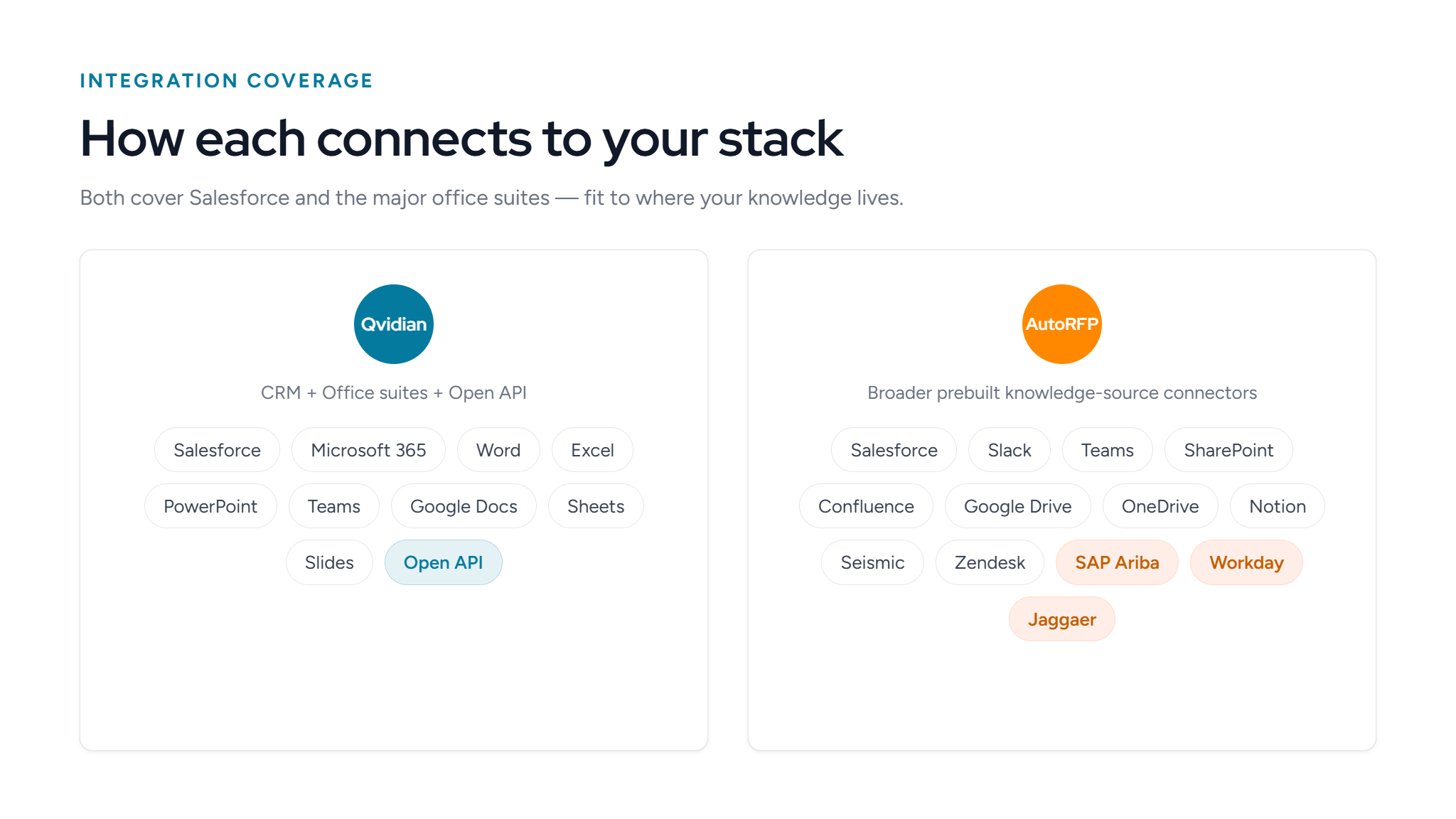
| Integration area | Qvidian | AutoRFP |
|---|---|---|
| CRM | Salesforce | Salesforce |
| Productivity | Microsoft 365 (Word, Excel, PowerPoint, Teams), Google Docs/Sheets/Slides | Google Workspace, OneDrive |
| Storage / knowledge | Open API for custom connections | SharePoint, Confluence, Google Drive, Notion, Seismic, Zendesk |
| Collaboration | Teams | Slack, Microsoft Teams |
| Procurement portals | Qvidian for Web (Chrome, Firefox, Edge) | Chrome extension for SAP Ariba, Workday Strategic Sourcing, Jaggaer |
| Extensibility | Open API | 18+ integrations (per vendor plan details) |
Both cover Salesforce and the major office suites. AutoRFP lists more prebuilt knowledge-source connectors; Qvidian offers an Open API for custom builds. Confirm current connector lists with each vendor.
Security and Compliance
For InfoSec-driven buyers, verify certifications directly. AutoRFP lists ISO 27001:2022 and SSO for Google and Microsoft on its Scale plan (AutoRFP), and focuses heavily on security-questionnaire workflows (CAIQ, SIG, VSA). Qvidian provides enterprise controls as part of Upland's platform; confirm current certifications with the vendor, since specifics were not verified in search.
Note: If security questionnaires are your primary use case, evaluate both against your actual CAIQ/SIG/VSA templates in a trial. Teams focused here also compare purpose-built options in this roundup of AI agents for security questionnaires.
Qvidian Pricing
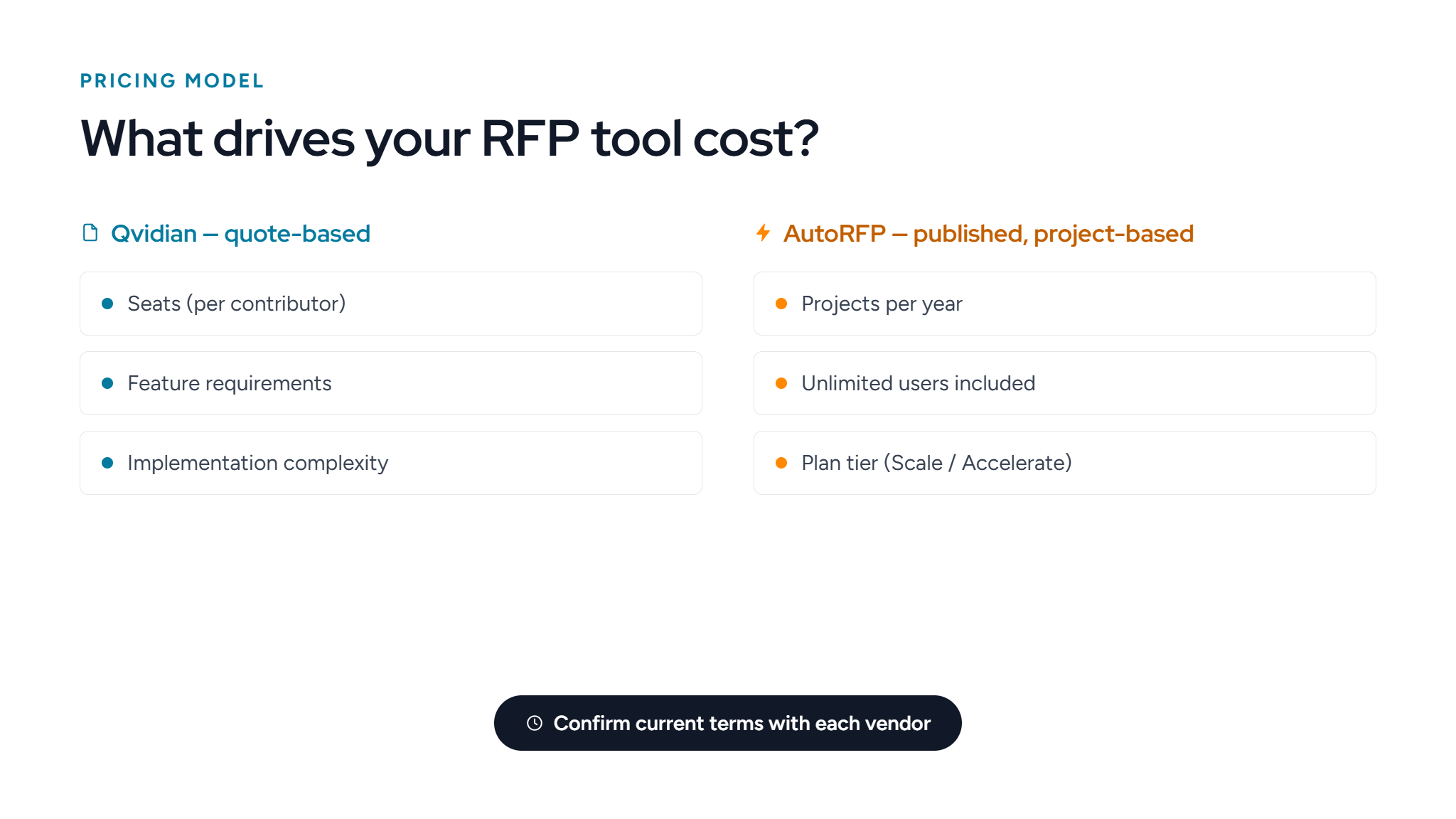
Qvidian is quote-based with no public pricing; Upland uses a "get a quote" / demo model (Upland), and our full Qvidian pricing and features breakdown tracks the tiers in more detail. Third-party benchmark data from Vendr, cited via checkthat.ai, reported a median of roughly $70,200/year across 42 Upland deals, ranging from about $22,800 to $201,296 — reported by a third party, so confirm directly with the vendor (checkthat.ai). Independent commentary from Realm confirms there is no public pricing and that cost is driven by user count, feature requirements, and implementation complexity (Realm). Because the strongest collaboration tier requires a license per contributor, seat count is a material cost driver.
AutoRFP Pricing
AutoRFP publishes plans, which is unusual in this category; for the wider feature and review picture, see our AutoRFP pricing, features, and reviews breakdown. The Scale plan is $899/month billed annually (24 projects/year, unlimited users, all features, SSO for Google and Microsoft, 18+ integrations, ISO 27001:2022, unlimited support). The Accelerate plan is $1,299/month billed annually (50 projects/year, unlimited users, all features). An Enterprise/custom tier offers bespoke implementation with custom terms and SLAs; the pricing model is project-based with unlimited users (AutoRFP).
The two models differ fundamentally: Qvidian tends to price per user and per implementation, while AutoRFP prices per project with unlimited users. Map both against your team size and annual RFP volume, and for a broader market view see how enterprise RFP tools compare on pricing.
Cost vs. return? AssetWorks Facilities reported 422% ROI and roughly $105K in net savings after automating RFP responses — read the ROI breakdown.
Is Qvidian Better Than AutoRFP?
Neither is universally better — they solve for different priorities. Choose Qvidian if you need a mature, governed content library, document automation for narrative and Office-format proposals, deep approval workflows, and enterprise procurement, and can budget for a quote-based contract. Choose AutoRFP if you want AI-generated first drafts, strong security-questionnaire coverage, transparent published pricing, and unlimited users, and are comfortable with a newer, web-only platform. The verdict genuinely depends on what your team needs: library governance and enterprise maturity, or AI-first drafting speed.
Curious how fast agentic drafting can get? MaxVal reported answering 80 questions in 3 hours — work that used to take close to a week — read the case study
| Qvidian (Upland Qvidian) | AutoRFP (AutoRFP.ai) | |
|---|---|---|
| Best for | Enterprises wanting a governed content library and document automation | Teams wanting fast AI first drafts and strong security-questionnaire coverage |
| Category | Established enterprise RFP/proposal automation | AI-native RFP, DDQ and security-questionnaire responses |
| G2 rating | 4.3 (155 reviews; a filter header cites 166 — confirm on the live listing) | 4.9 (~55–56 reviews — confirm on the live listing) |
| Pricing | Quote-based; no public pricing (Upland) | Published: from $899/mo billed annually (AutoRFP) |
| Core idea | Central approved-content library + document automation | AI Response Engine + Trust Scores learning from approved answers |
Also Worth Considering: Inventive AI
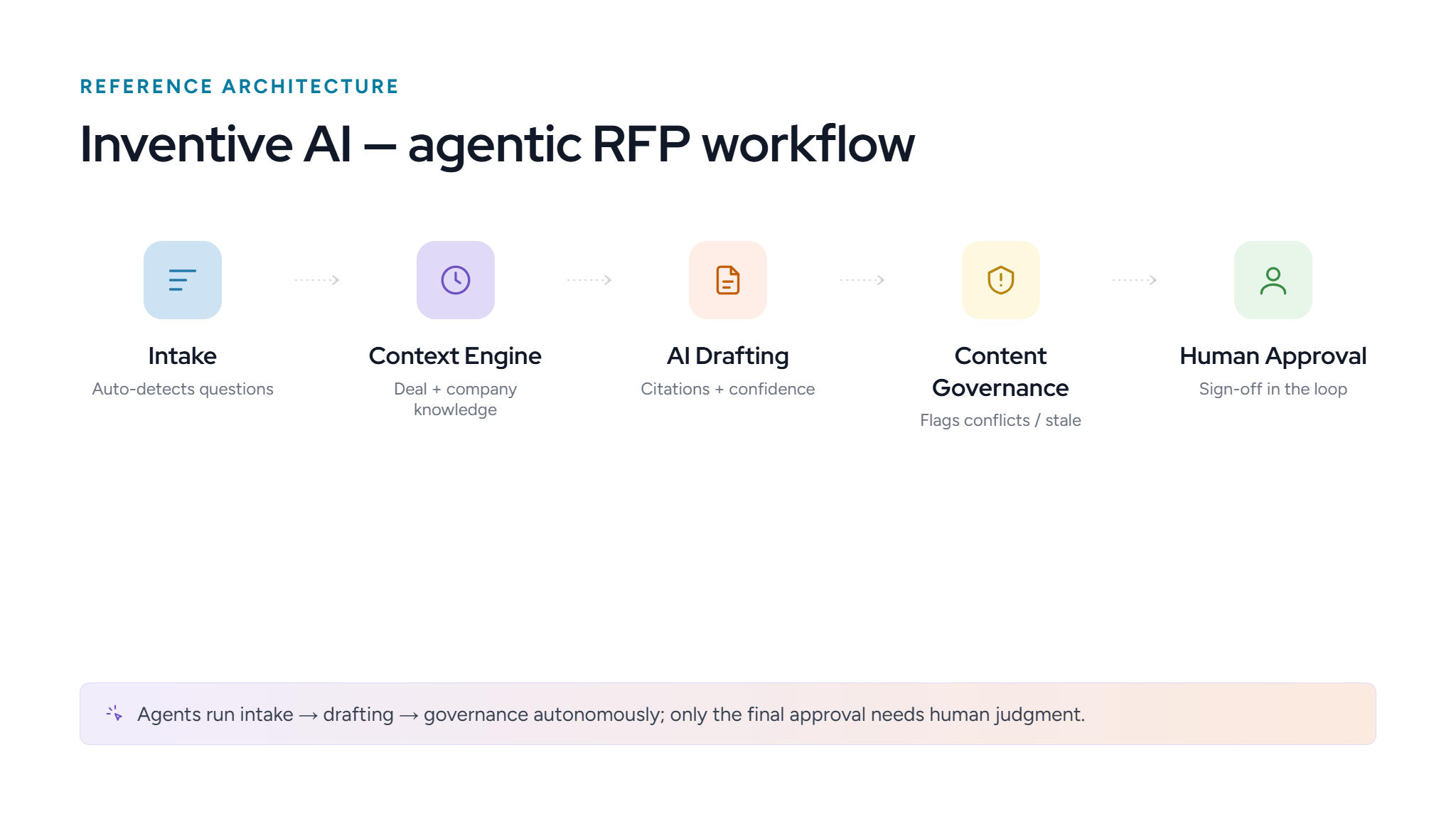
If you're weighing Qvidian's library-first model against AutoRFP's AI-draft model, it helps to know a third route exists: a newer wave of AI-native, agentic proposal platforms that restructure the workflow instead of layering AI onto an older one. Inventive AI is one example worth putting on the evaluation list, and this three-way Qvidian vs. AutoRFP vs. Inventive AI comparison lays out the differences side by side.
Inventive AI is positioned as an autonomous, AI-agentic platform for RFPs, RFIs, DDQs, and security questionnaires, built for proposal teams, presales, solution engineering, sales ops, InfoSec, and legal, with humans in the loop for approvals. Rather than asking teams to maintain a repository or draft from scratch, its agents run the workflow — understanding the RFP, drafting, and validating — and surface only what needs human judgment.
Key capabilities of Inventive AI
• AI-generated first drafts produced by autonomous agents, each answer shipping with source references and a confidence score.
• A Knowledge Hub that connects existing systems — SharePoint, Google Drive, Salesforce, Confluence, Notion, Zendesk — and live-syncs when a source doc changes, so there's no separate library to maintain.
• A Content Governance Agent that detects conflicting information, flags outdated content, and surfaces duplicates.
• A Context Engine that tailors responses per deal using customer priorities, sales notes, and CRM data.
• Competitive Intelligence agents that compare positioning against named competitors within a response.
• Format flexibility across Excel grids and narrative documents.
• Collaborative review and approval workflows, with approved answers feeding back into the Knowledge Hub.
• Response quality benchmarked at 2× more client-ready answers than the next-best tool tested, with SOC 2 Type II compliance.
Best for: mid-market and enterprise teams that want agents to run the RFP process end to end — intake, drafting, governance — with humans approving the output rather than managing each step.
Why buyers comparing Qvidian and AutoRFP might look at Inventive as an alternative
The shared pain point across both tools is content freshness and maintenance: Qvidian reviewers cite difficult, manual data updates, and an AutoRFP reviewer noted reliance on out-of-date responses when their product changed frequently. Inventive AI is positioned to address that with a Content Governance Agent that flags conflicts and stale content automatically, and a Context Engine that tailors each answer to the deal. If that model fits your workflow, you can compare the AI-native approach in a demo.
Frequently Asked Questions
Is Qvidian or AutoRFP better for security questionnaires?
AutoRFP places explicit focus on security questionnaires and vendor assessments — CAIQ, SIG, VSA — and DDQs from the same content source, and lists ISO 27001:2022 (AutoRFP). Qvidian supports questionnaires through its content library but is positioned more broadly around proposal automation. Test both against your actual templates before deciding.
How much does Qvidian cost compared with AutoRFP?
Qvidian is quote-based with no public pricing; third-party Vendr data cited a median near $70,200/year with wide variance (checkthat.ai). AutoRFP publishes plans from $899/month (Scale) and $1,299/month (Accelerate), billed annually with unlimited users (AutoRFP). Confirm current terms directly with each vendor.
Which has better reviews, Qvidian or AutoRFP?
On G2, AutoRFP shows a higher star rating (4.9 across ~55–56 reviews) than Qvidian (4.3 across 155 reviews), but Qvidian has a larger, longer-run review base across G2, Capterra, and TrustRadius (G2 Qvidian; G2 AutoRFP). A newer tool's high average often reflects a smaller, more recent sample — weigh volume and recency together.
What is an alternative to Qvidian and AutoRFP?
Alternatives span established platforms such as Loopio, Responsive (formerly RFPIO), and Proposify, plus a newer wave of AI-native, agentic tools. If library-heavy maintenance is your concern, prioritize how each option keeps content current; if drafting speed is, focus on generative depth and hallucination controls. Shortlist two or three and test them against the same real RFP.
Is there an AI-native alternative to Qvidian and AutoRFP?
Yes. A newer category of AI-native platforms, including Inventive AI, uses autonomous agents to run intake, drafting, and content governance, with humans approving output. It's one option to evaluate alongside — not automatically above — Qvidian and AutoRFP. See the AutoRFP vs. Inventive comparison for a direct look.
Related Comparisons and Resources
For research beyond this head-to-head, these guides and case studies cover adjacent decisions:
• MaxVal: 90% faster RFPs with zero weekend hours lost
• Insider: 50% higher win rate, 90% faster responses
Sources
• Upland Qvidian — G2, Capterra, TrustRadius, Upland product page
• AutoRFP.ai — G2, Capterra, Gartner Peer Insights, AutoRFP pricing
• Pricing benchmarks — checkthat.ai (Vendr data), Realm
Figures, ratings, review counts, and pricing are reported at the time of writing and change over time — confirm current specifics with each vendor before purchasing.