How to Build an RFP Agent: Architecture, Components, and the Parts Nobody Demos

Most teams start in the same place. Someone pastes an RFP question into a chat window, gets a passable answer, pastes it into the issuer's template, and does that eighty more times. It works, in the sense that a bicycle works for a cross-country move. The question that follows, usually from someone who has done this for a week, is different: could we build something that reads the whole RFP, figures out what it needs, drafts every answer from our own material, checks its own work, and only interrupts a human when it should? That thing is an agent, and it is a different animal from a chatbot with your documents attached.
This guide is about building that animal: what separates an agent from a retrieval script, the components an RFP agent needs, the orchestration pattern that holds them together, and the parts of the build that never show up in a Friday demo. We make RFP response software at Inventive AI, so we have both opinions and a product, and we will say where the line is. Most of this is useful whether you build or buy.
The prize is real. Proposal teams answered an average of 166 RFPs last year at about 25 hours each, according to Loopio's RFP Trends and Benchmarks research, and 68% used generative AI somewhere in the process. The gap between "used AI" and "trusts AI to run the response" is what this guide is about.
What’s the difference between an RFP agent and an RFP chatbot?
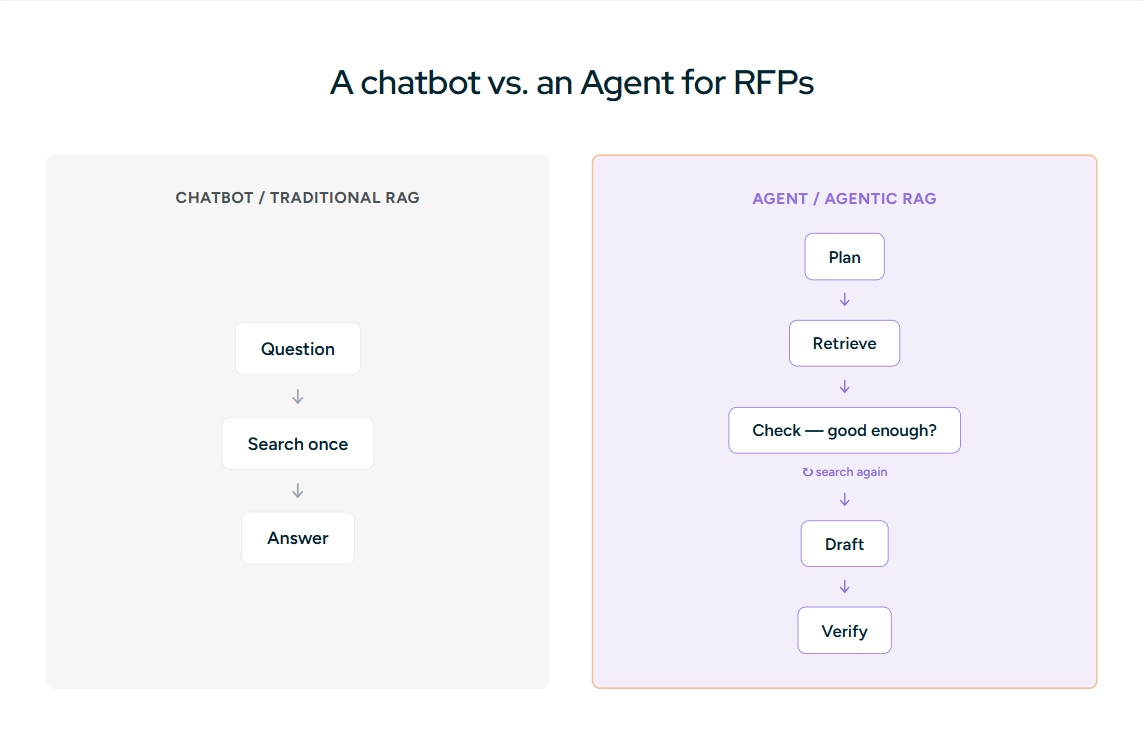
The word "agent" gets stretched to mean anything with an API call in it, so start with a working definition. A chatbot answers the question in front of it. An agent decides what to do next. Anthropic's own framing is the clean one: workflows follow predefined code paths, while an agent directs its own process and tool use, keeping control over how it accomplishes a task. An RFP agent, given a 200-page package, plans the work, chooses when to search, when to draft, when to ask for help, and when it is done.
The retrieval side shows the difference plainly. Traditional RAG is a straight line: take the question, search once, generate an answer. That is fine when the question is clean and the answer sits in one place. RFP questions are neither. "Describe your data residency posture for EU public-sector customers, including subprocessors" is three questions wearing a trench coat, and a single vector search returns a blurry average of everything vaguely related. Agentic RAG treats retrieval as a tool the model uses on purpose. It can rewrite the query, search again with tighter terms, notice that it found the policy but not the subprocessor list, and go back for the second thing. NVIDIA describes the loop as identify what you need, generate queries, retrieve, check relevance with reasoning, and repeat until the answer holds up. That iteration is most of what makes an agent worth building.
The practical test: if your system always answers in one pass and never decides to look again, you have built a fast RAG pipeline, not an agent. Nothing wrong with that, but name it correctly, because the two fail in different ways and cost different amounts to maintain.
The Anatomy of an RFP Agent
An RFP agent is not one model with a long prompt. It is a small set of specialized workers, each good at one job, coordinated by something that knows the plan. Build these six pieces and you have covered the real workflow.
The orchestrator. This is the piece that reads the intake, breaks the RFP into work, and decides the order. It does not write answers. It routes: this batch is security, that batch is legal, these forty questions are boilerplate the drafting worker can clear without help. The orchestrator also owns state, which questions are drafted, approved, blocked, and waiting, so the whole run is inspectable rather than a black box that returns 200 answers at once.
The intake and requirement worker. RFPs arrive as two-column PDFs, Word files with nested tables, and Excel workbooks with merged cells and hidden rows. This worker parses them with layout intact and turns them into records: an ID, the requirement quoted verbatim, its source location, whether it is mandatory, the deadline, and the evidence it needs. "Shall" and "must" are mandatory, always. Submission rules, page limits, and required forms are requirements too, and they are the ones a hurried human misses.
The retrieval worker. This is agentic RAG in one box. Given a requirement, it pulls candidate evidence from your governed knowledge, combining keyword search for exact identifiers (SOC 2 Type II, control numbers, SKUs, version strings) with dense retrieval for meaning, then reranks and hands the model a tight, cited set. When the first pass comes back thin, it reformulates and tries again rather than shrugging and letting the drafter guess.
The drafting worker. It writes the answer strictly from retrieved evidence, in your voice, at the right length. Every material claim carries a source ID that maps back to a chunk. When the evidence does not support an answer, it does not invent one. It returns "not found in approved sources" and marks the requirement for a subject-matter expert. An agent that always produces an answer is an agent that sometimes lies confidently, and confident lies are how you lose a bid on a clause you never actually meet.
The verification worker. This is the critic, and it is the piece most builds skip. A second, often cheaper, pass reads each drafted answer against its own citations and asks whether the cited text actually supports the sentence. It scans for unsupported numbers, invented certifications, contradictory product names, and pricing that drifts between questions. In agent terms this is the evaluator-optimizer pattern: one worker produces, another judges, and weak answers loop back with feedback instead of shipping. It is the difference between a draft and a draft you would sign.
The human-in-the-loop layer. The agent does not approve its own work. Low-confidence answers, mandatory requirements, and anything touching legal or pricing route to a named person with the context attached. This is not a fallback for when the AI fails; it is the design. The most reliable production agents in 2026 are explicit about where a human has to say yes, and they escalate on a rule, not a vibe.
The Orchestration Pattern That Holds It Together
Those six pieces map cleanly onto two well-worn agent patterns, and you do not need to invent anything exotic.
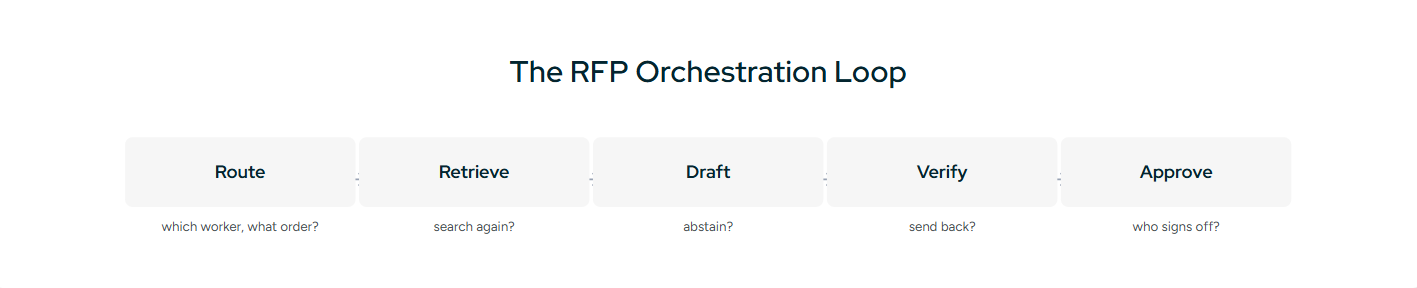
The backbone is orchestrator-workers. A lead component decomposes the RFP and dispatches self-contained jobs to specialized workers running in parallel where the work is independent, which most requirement drafting is. The verification step is evaluator-optimizer: the critic scores an answer, and anything below the bar goes back to the drafter with specific notes rather than a blanket "try again." Around both sits the thing that makes it an agent rather than a pipeline, a loop that keeps going until every requirement is either approved or parked with a human.
Resist the urge to make it more autonomous than the task needs. A fully open-ended agent that can do anything is harder to test, harder to trust, and harder to debug at 2 a.m. before a deadline. Give each worker a narrow job and a clear handoff, and let autonomy live in the loops that genuinely benefit from it, retrieval and verification, not in a single model improvising the whole bid.
Choosing Your Building Blocks
You have three decisions: the framework, the models, and the tools the agent can reach.
On frameworks, the field settled into a few honest choices. LangGraph fits when you want explicit state and resumable loops, which an RFP run needs, because you will want to inspect and restart the graph mid-bid. CrewAI is faster if you think in roles, an extractor, a drafter, a reviewer as named crew members. The OpenAI Agents SDK is lean for tightly scoped delegation, and LlamaIndex Workflows is built for document-centric, event-driven systems, which describes RFP work well. Pick for how much control you want over state, not for the logo.
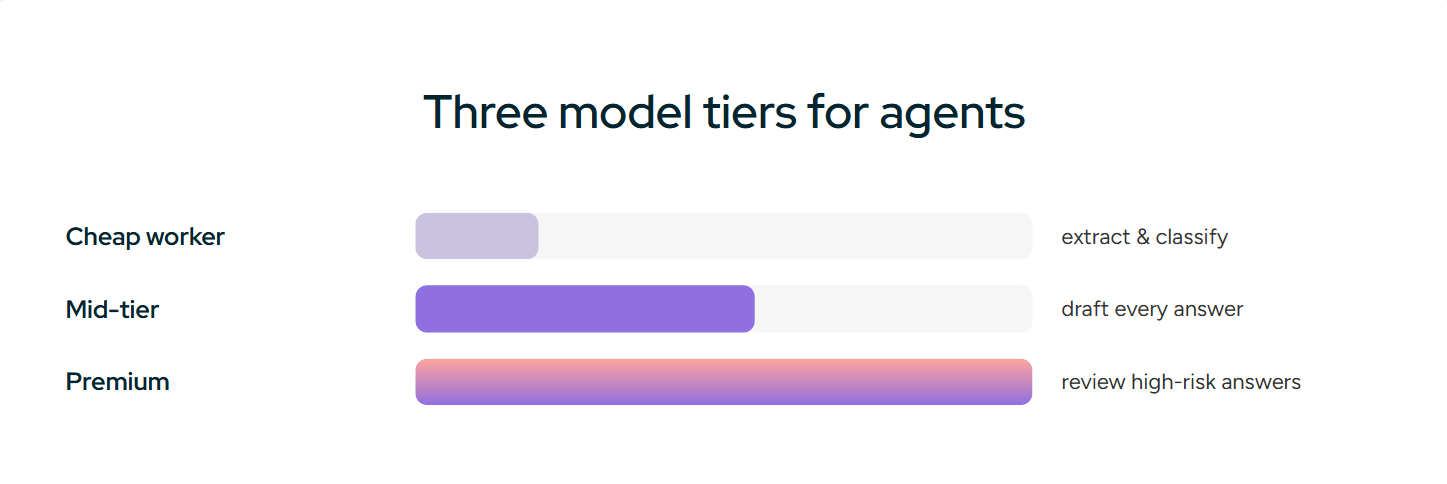
On models, use more than one. A cheap worker extracts requirements and classifies pages, a mid-tier model drafts, and a premium model reviews the high-risk answers. Designing this cascade from the start keeps the bill sane, because drafting a year of RFPs costs less in model fees than the engineers cost in a week. The expensive part was never the tokens.
On tools, the agent is only as useful as what it can reach. Connectors into where your approved content already lives, SharePoint, Google Drive, Salesforce, Confluence, let it retrieve from the source of truth instead of a second copy that goes stale the day you build it.
The Parts Nobody Demos
A weekend prototype answers clean questions from clean PDFs. Then reality arrives.
Governance is the actual product. No model knows which of two similar documents is the approved one. Last year's data-residency answer and this year's sit in the index with equal authority, and semantic similarity, not correctness, decides which one your prospect reads. You have to build the metadata model: every source gets an owner, an approval status, an effective date, an expiry date, and product and region tags, and the retrieval worker filters on them. Skip this and your agent will cite deprecated facts with total confidence.
Memory is not the same as governance. An agent that remembers what it approved on the last three security questionnaires answers the fourth faster and more consistently, but memory that never expires is just another way to serve a stale answer with conviction. Treat the answer library as a governed store, not a scratchpad the agent writes to freely.
Evaluation has to test the path, not just the answer. Because an agent takes multiple steps, a right answer reached by a lucky retrieval is not a system you can trust. Build a golden set of 100 to 500 real questions with verified answers and the documents that should have been retrieved, then measure retrieval recall, citation coverage, the unsupported-answer rate, and the trajectory, whether the agent took a sane path to get there. Run it after every change to prompts, chunking, models, or tools. Teams that skip this make decisions on demo vibes and reverse them in production.
Export is a product of its own. Writing 200 answers back into the issuer's rigid Excel template without breaking merged cells, dropdowns, or validation is document automation, and it has nothing to do with AI. It is also where a lot of the time you saved on drafting quietly comes back.
Model churn is scheduled, not surprising. Models retire on a cadence now. Every migration means re-running your full evaluation set and sometimes rewriting prompts and parsers. Pin your versions, keep the golden set current, and budget for one migration a year as a normal project rather than a fire.
Build or Buy
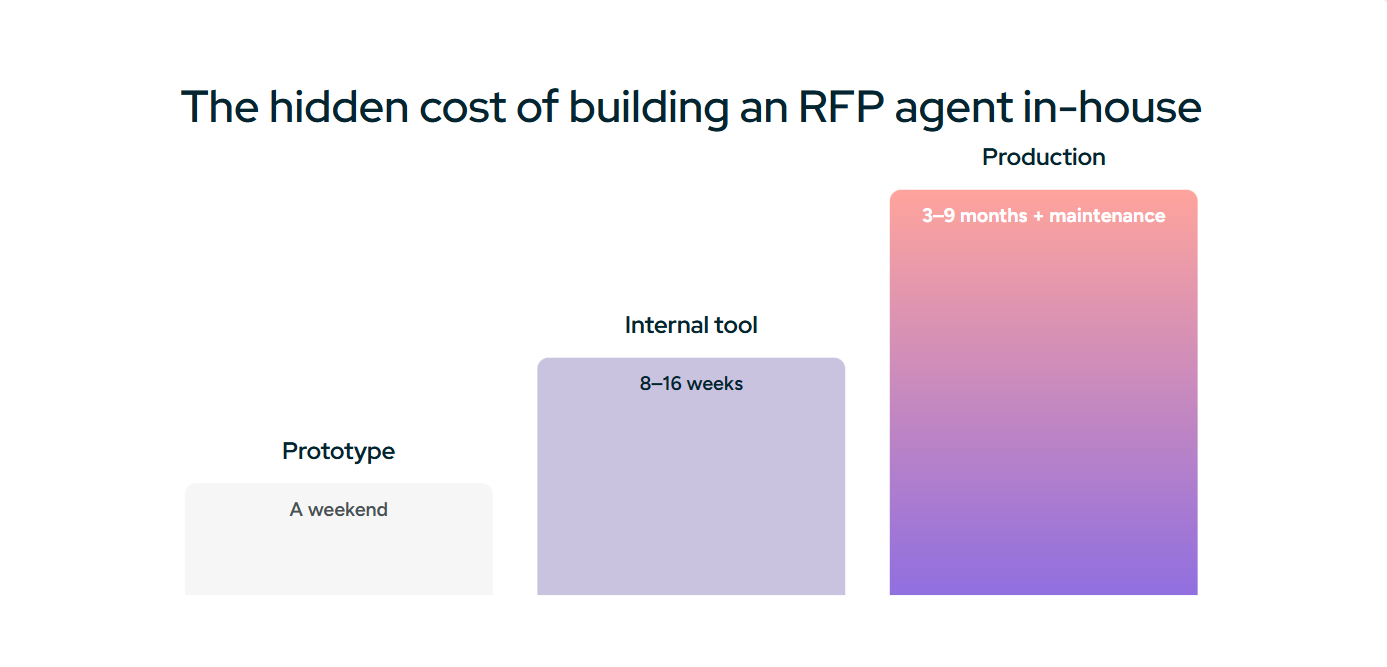
Build the prototype whenever you want; it is a good way to learn where the walls are. Build the internal tool if one proposal manager owns the process, reviews everything, and the drafting savings alone justify it. Think hard before the production system, the one with connectors, governance, approvals, evaluation, and formatted export, because that is three to nine months and a permanent maintenance line, and none of it is your company's product unless RFP software is. The old rule holds: build where you differentiate, buy where you operate.
How Inventive AI Handles It
Inventive AI is an agentic RFP platform that runs this architecture so your engineers do not have to rebuild it. Upload the full RFP in PDF, Word, Excel, or PowerPoint. Agents extract every requirement, retrieve the right evidence per question from a Knowledge Hub that syncs live with SharePoint, Google Drive, Salesforce, Confluence, and Notion, and draft each answer with citations and a confidence score. A Content Governance Agent flags conflicting, outdated, and duplicate sources before they reach an answer. When the evidence is not there, you get "Information unavailable," not a guess. Your team reviews and approves in one shared workspace, with assignments, reviewer routing, and an audit trail, and exports back into the issuer's original template in one pass.
The results are measured, not promised. RAD AI found Inventive AI's answers 2x more accurate than other RFP AI tools. Insider cut response time by 90% and moved its win rate from 30% to 50%. AssetWorks Facilities reported a 422% ROI with $105K in net savings.
If you have sketched the architecture above and the governance and export sections gave you pause, book a 20-minute demo and bring the RFP that broke your prototype.
.avif)


.jpg)