RFP AI Agents Explained: Meaning, Types, How They Work, and How to Evaluate One
TL;DR
- An RFP AI agent is a workflow-driven system that ingests RFPs, retrieves approved content, drafts sourced responses, and routes exceptions, not just a text generator.
- Agentic means multi-step orchestration: planning, retrieval, classification, routing, exception handling, and auditability, not merely drafting answers with an LLM.
- A mature platform is typically built from several specialized agents (intake, extraction, retrieval, drafting, conflict detection, SME routing, go/no-go scoring, outcome learning) rather than one model handling every step.
- Quality depends on governed data sources, retrieval accuracy, confidence controls, and human-in-the-loop checkpoints, not just model capability.
- Buyers should evaluate response quality, source grounding, hallucination controls, workflow orchestration, security, and audit trails, not just the AI agent label.
- Best outcomes come from human + AI workflows where AI handles repeatable work and humans own strategy, judgment, and high-risk commitments.
What is an RFP AI agent?
An RFP AI agent is a governed, workflow-driven system that ingests RFP documents, extracts requirements, retrieves approved content from internal sources, drafts sourced responses, flags uncertainty, and routes exceptions to subject matter experts for review. The category overlaps with what buyers also search for as AI RFP response software or agentic RFP automation software, though those terms are not always used precisely.
In practice, proposal and revenue teams use the term RFP AI agent to describe systems that go beyond single-step text generation. Instead of only producing draft answers, an agent can execute a connected sequence of tasks: parsing the RFP, classifying questions, searching knowledge bases, generating responses with citations, identifying gaps, and preparing the final response package.
This is also the distinction that shows up in how some AI-native RFP platforms describe their own architecture: rather than a single model producing a draft, the work is split across specialized agents, one to research and draft, one to manage and reconcile the knowledge base, one to scope whether an opportunity is worth pursuing at all. The agent label is best evaluated by identifying distinct, planned, executed steps rather than a single, longer prompt.
Gartner tracks this space as a distinct category, RFP Response Management Applications, and notes that vendors are moving beyond simple content storage toward tools that apply machine learning to RFP responses. According to Fortune Business Insights, the global proposal management software market size was estimated at USD 3.26 billion in 2025 and is projected to reach USD 3.66 billion in 2026 to USD 9.19 billion by 2034, growing at a CAGR of 12.20% from 2026 to 2034. North America dominated the market with a 33.79% share in 2025.
What problem does it solve?
RFP processes are repetitive, time-intensive, and coordination-heavy. Teams spend significant effort locating information, reusing past answers, chasing SMEs, and ensuring compliance with buyer instructions. Industry survey data on proposal management puts the average RFP response at roughly 24 hours of work, with teams reporting the highest win rates spending slightly more time per response than average. An RFP AI agent aims to reduce this friction by automating repeatable work while preserving human judgment for strategy, differentiation, and high-risk decisions.
Common pain points include:
- Manual extraction of questions and requirements from long PDFs, Word docs, Excel questionnaires, and portals.
- Time-consuming searches across scattered documentation and past proposals.
- Inconsistent answers when different people describe the same capability differently, usually because there's no single, well-maintained answer library everyone is drafting from.
- Coordination overhead routing questions to the right reviewers and tracking progress.
What does agentic mean in an RFP context?
Agentic refers to a system's ability to plan, sequence, and execute multi-step workflows with some autonomy, rather than simply generating text on demand.
In RFP work, agentic behavior may include:
- Parsing and structuring the RFP into a requirements matrix.
- Classifying questions by topic (security, legal, product, pricing, implementation).
- Retrieving relevant, approved content from connected sources using semantic search and RAG.
- Drafting responses grounded in retrieved content with source citations.
- Identifying gaps, low-confidence answers, or conflicting information and flagging them for review.
- Routing questions to appropriate SMEs or reviewers based on classification and confidence.
- Performing compliance checks (word limits, mandatory sections, attachments, formatting).
- Maintaining workflow state and audit logs of actions taken and sources used.
- Improving future retrieval and drafting based on which answers reviewers approved, edited, or rejected.
This is distinct from a chatbot or a simple AI assistant that answers one question at a time without orchestrating a broader process.
Conflicting information is one of the harder retrieval problems to solve. Two documents in a knowledge base rarely describe a security control or a pricing tier identically, and a system that retrieves the closest keyword match and drafts from it can reproduce the contradiction without detecting it. Some platforms address this with a dedicated conflict-detection layer that compares sources before drafting and surfaces the disagreement rather than resolving it silently. This is treated as a distinct step from response generation because comparing sources for agreement is a narrower, more mechanical task than producing a well-written answer.
A more advanced form of agentic behavior is outcome learning: using reviewer edits and win/loss data to improve future answers rather than treating every RFP as an isolated task. If a particular answer to a recurring question consistently gets rewritten by reviewers, or correlates with lost deals, that signal can feed back into which content the retrieval step favors next time. This capability is less universally implemented than core drafting and retrieval, and is worth asking about directly rather than assuming it exists just because a vendor uses the word learns.
See the difference between AI drafting and true agentic orchestration
Watch how Inventive AI's specialized agents handle extraction, retrieval, and routing end to end.
Book a Demo
How is an RFP AI agent different from basic generative AI?
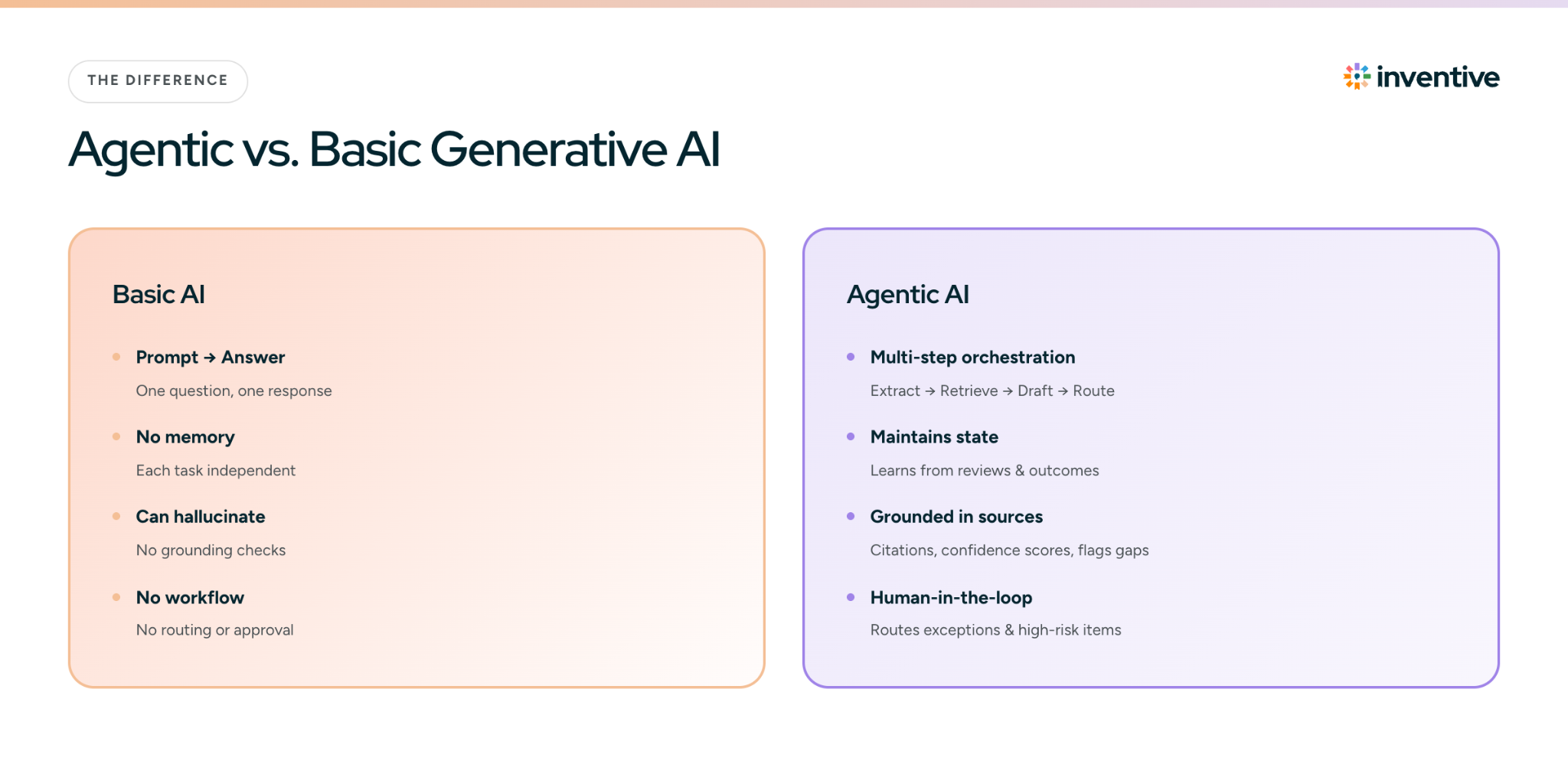
Generating an RFP answer with a general-purpose LLM does not, by itself, make a system an AI agent.
Key differences:
- Text-generation-only AI: Takes a prompt and produces text based on model training data, without connecting to your internal knowledge, governance controls, or workflow orchestration. Risk: hallucinations and unsupported claims.
- AI layered onto existing RFP software: Adds AI features like answer suggestions and drafting assistance to a traditionally manual platform. The core workflow remains human-coordinated. AI only handles drafting.
- AI-first RFP platforms: Built from the ground up with AI orchestration at the center. Multiple specialized agents work together on extraction, retrieval, drafting, conflict detection, and routing. Human approval gates protect high-risk checkpoints. Every action is auditable, and the system knows what it doesn't know.
Why the difference matters: AI-first architecture assumes AI should handle orchestration, retrieval, and routing. Layered AI means AI was added to a manual workflow after the fact. The former gives you speed and consistency across your entire RFP cycle. The latter gives you faster drafting, but not faster turnaround times.
Inventive AI is built as an AI-first platform, not AI bolted onto an RFP tool. It runs dedicated agents for extraction, retrieval, drafting, knowledge governance, and go/no-go scoring. Each agent owns a specific job, which is what enables speed without sacrificing auditability or control.
Note: Not every product marketed as an AI agent has all these capabilities. The label is used inconsistently, so buyers should evaluate actual behavior rather than relying on marketing terminology.
One practical way to test this is to ask a vendor to describe the exact sequence of steps their system runs for a single question, from extraction to the point it lands in a reviewer's queue, and whether the system retains anything from that interaction (an edit, an approval, a loss reason) that changes how it handles the next similar question.
If the described sequence is limited to the model reading a question and writing an answer with no memory of past outcomes, that behavior is generation, not orchestration.
Where do humans remain involved?
Even in an agentic RFP workflow, where AI handles extraction, retrieval, drafting, and routing, humans retain critical roles:
- Deciding whether to pursue an opportunity (go/no-go).
- Defining and governing approved content, answer libraries, and knowledge sources.
- Reviewing and approving responses, especially for high-risk areas (pricing, legal, security, compliance).
- Resolving exceptions, conflicting information, and strategic positioning.
- Owning accountability for what is submitted to the buyer.
A practical progression looks like:
- Manual RFP response: Humans read the RFP, extract questions, search for content, draft answers, coordinate reviews, and assemble the response.
- AI-assisted response: AI suggests answers or summaries; humans still perform most extraction, retrieval, and coordination.
- Agentic RFP workflow: AI agent executes much of the repeatable workflow (intake, extraction, retrieval, drafting, routing, compliance checks); humans focus on strategy, exceptions, and final approval.
Go/no-go determines whether an opportunity is pursued before any retrieval or drafting work begins. Some agentic platforms run a scoring pass at intake that checks a new opportunity against past win patterns and fit criteria, which reduces the time SMEs spend on bids that were unlikely to be won.
Types of RFP AI agents
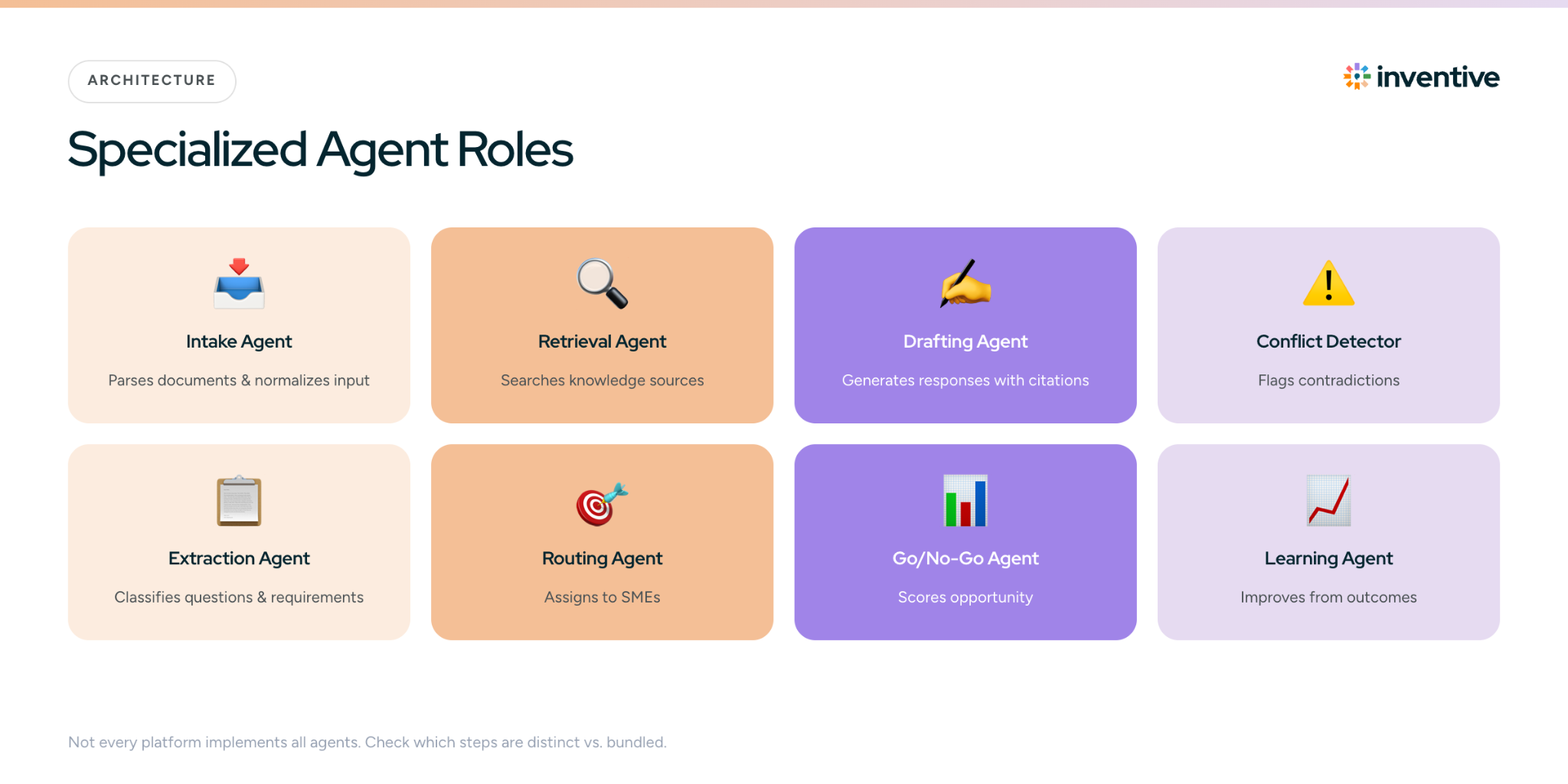
True AI-first RFP platforms use specialized agents for different workflow stages, not a single model trying to handle everything. This separation is what enables reliability, auditability, and human control. Naming conventions vary by vendor, but the following categories cover what a mature platform typically needs:
- Intake and ingestion agent: Parses incoming RFP files (Word, Excel, PDF, portal exports, scanned documents) into a structured, machine-readable task.
- Extraction and classification agent: Identifies individual questions, requirements, deadlines, and dependencies, then categorizes them by topic so they route to the right knowledge sources and reviewers.
- Knowledge retrieval agent: Searches connected, approved sources using semantic search and RAG rather than exact keyword matching, and surfaces the most current, relevant passage for each question.
- Drafting agent: Generates the response text itself, grounded in retrieved content, with a citation and confidence score attached to each answer.
- Conflict-detection agent: Compares sources for agreement before drafting, flagging contradictions between documents rather than silently resolving them.
- SME-routing agent: Sends unsupported or high-risk items to the correct subject-matter expert based on classification, with context and a deadline attached.
- Go/no-go agent: Scores a new opportunity against past win patterns and fit criteria before any retrieval or drafting work begins.
- Outcome-learning agent: Uses reviewer edits and win/loss data to refine which content the retrieval agent favors for similar questions in future RFPs.
Few platforms implement all eight as fully separate, independently testable agents; many bundle several functions into a single model call and describe the result as agentic regardless. When evaluating a platform, it is worth asking whether each function above can be demonstrated as a distinct, inspectable step rather than taking the label at face value, since separability is a stronger signal of real orchestration than the word agent itself.
How does an RFP AI agent work?
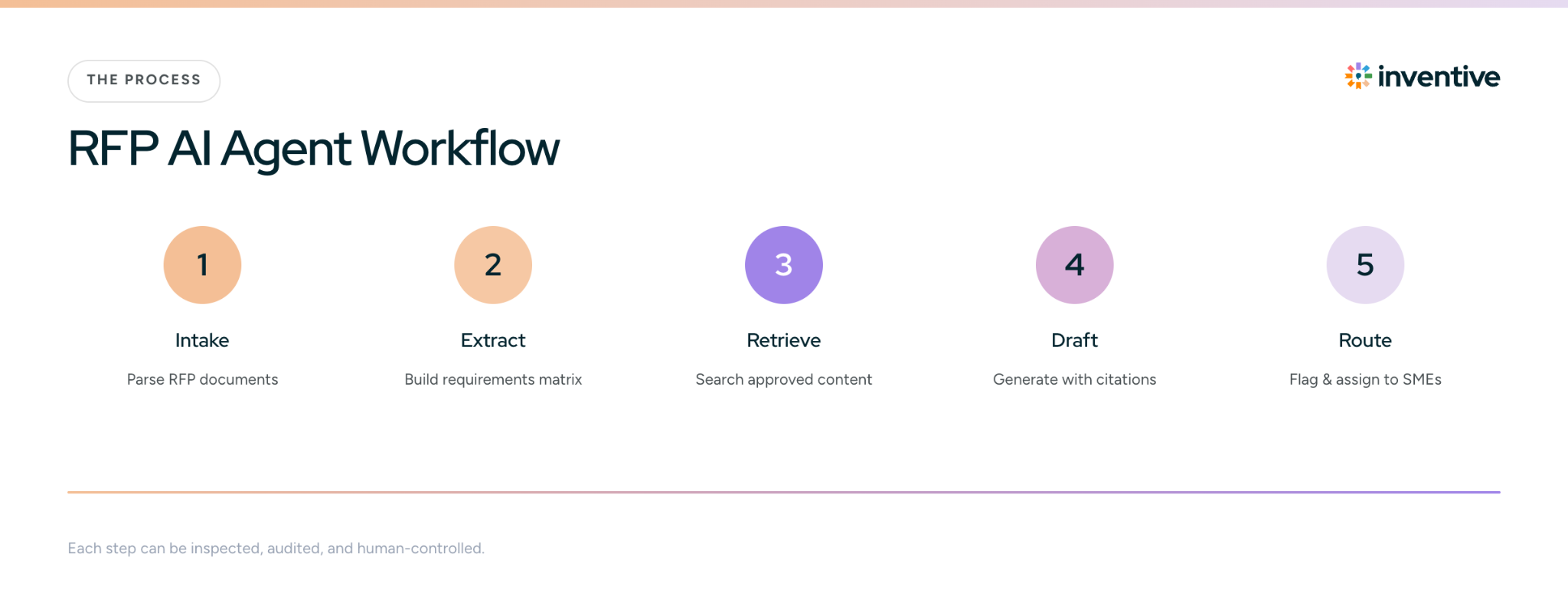
An agentic RFP response workflow typically follows a sequence of stages from intake to final preparation. Below is a common pattern observed across current tools and implementations.
1. RFP intake
The agent receives RFP materials in various formats:
- PDFs, Word documents, Excel questionnaires
- Portal exports or copied question sets
- Scanned documents (using OCR where needed)
It ingests and normalizes the content into a structured representation for downstream processing.
2. Requirement extraction
The agent identifies and extracts:
- Individual questions and requirements
- Instructions, deadlines, and submission requirements
- Evaluation criteria and weighting (if provided)
- Mandatory vs. optional items
- Required attachments and formats
This step often produces a compliance matrix or requirements register that tracks each item and its source location in the original document.
3. Question classification
Questions are categorized by topic to enable targeted retrieval and routing. Common categories include:
- Product and technical capabilities
- Security and compliance
- Legal and contractual terms
- Implementation and services
- Pricing and commercial terms
- Company information and references
Classification helps the agent select the right knowledge sources and route exceptions to the appropriate SMEs.
4. Knowledge retrieval
For each question, the agent searches connected internal sources to find relevant, approved content. This may involve:
- Semantic search: Matching meaning rather than exact keywords.
- RAG (Retrieval-Augmented Generation): Retrieving passages from a knowledge base and grounding the response in that context.
- Knowledge bases and answer libraries: Curated repositories of past responses, product docs, security policies, and legal-approved language.
- Metadata and version control: Using document metadata (product version, region, date) to select the most current and relevant content.
- Source attribution: Linking each claim back to its origin document for auditability.
Quality retrieval is critical; poor search or outdated sources directly degrade response quality. Knowledge base quality also degrades over time by default: documents get updated, certifications expire, and product names change, so retrieval accuracy declines unless something is actively monitoring the connected sources for staleness or duplication. Knowledge management is therefore treated as an ongoing operational function separate from drafting, not a one-time setup step.
5. Response generation
Using retrieved content, the agent drafts responses grounded in your approved sources:
- Align with the buyer's wording and requirements
- Reflect the organization's approved messaging and tone
- Each answer includes citations and a confidence score, so reviewers can verify it in one click.
- The result is consistent, auditable, buyer-ready responses.
The goal is to ground answers in known, approved information rather than relying solely on the model's general knowledge. Citation specificity affects how quickly a reviewer can verify a claim: a citation linking to the exact passage an answer came from allows one-click verification, while a citation that only names the source document requires the reviewer to search within it.
Inventive AI surfaces exact passages with confidence scores attached. This means your reviewers don't hunt through documents to verify an answer. They see the source, the claim, and the confidence level side by side. One click confirms it's right, or flags it for review.
6. Confidence and exception handling
A key agentic capability is recognizing uncertainty. The agent should flag situations such as:
- No relevant approved answer exists
- Sources conflict or are outdated
- The question requires expert judgment (e.g., custom pricing, legal interpretation)
- Confidence scores fall below a defined threshold
Instead of confidently inventing an answer, the system routes these items for human review. This abstention behavior is a key signal of whether an RFP AI agent is safe to use on buyer-facing content, since a system that answers every question regardless of source support carries a higher risk of introducing unsupported claims into a submission.
7. SME routing and human review
Questions that cannot be confidently answered, or that touch high-risk areas, are routed to:
- Product or solutions engineers
- Security and compliance teams
- Legal and privacy reviewers
- Pricing or commercial teams
- Proposal managers for final review
Routing may be based on classification, confidence scores, or predefined rules. Effective routing depends on a clearly defined SME role for each content category, so a flagged question is assigned to the person who owns that answer rather than a general reviewer queue.
8. Compliance and quality checks
Before finalization, the workflow can perform checks for:
- Missing answers or incomplete sections
- Unsupported or ungrounded claims
- Contradictions between sections
- Required formats, word/character limits
- Buyer-specific instructions (headings, appendices, attachments)
These checks reduce the risk of non-compliant submissions.
9. Final response preparation
The agent can help:
- Assemble responses into the buyer's required structure
- Generate executive summaries or compliance matrices
- Export to Word, PDF, or portal-specific formats
- Track internal milestones and submission deadlines
Human reviewers still own final approval, especially for high-stakes content.
Insider saw measurable results after implementing Inventive AI: 50% higher win rates and 90% faster RFP turnaround. The difference: governance, retrieval accuracy, and AI that knows when to ask for human help.
Agentic RFP response workflow
A simplified end-to-end flow:
RFP received → Requirements extracted → Questions classified → Knowledge retrieved → Responses drafted → Gaps identified → SMEs routed → Responses reviewed → Compliance checked → Final response prepared
| Workflow stage | What the AI agent can do | Where humans may be needed |
|---|---|---|
| RFP intake | Ingest PDFs, Word, Excel, portals; normalize text | Decide go/no-go; clarify ambiguous RFPs |
| Requirement extraction | Build compliance matrix; identify mandatory items | Validate critical requirements; interpret vague clauses |
| Question classification | Categorize by topic (security, legal, product, etc.) | Adjust classification rules; handle edge cases |
| Knowledge retrieval | Search approved sources using semantic/RAG methods | Curate and govern knowledge sources; resolve conflicts |
| Response generation | Draft answers grounded in retrieved content with citations | Refine positioning; add differentiation and strategy |
| Confidence & exceptions | Flag low-confidence, missing, or conflicting information | Provide expert judgment; approve exceptions |
| SME routing | Route questions to appropriate reviewers based on rules | Act as SMEs; resolve cross-functional dependencies |
| Compliance checks | Verify formats, word limits, mandatory sections | Final compliance sign-off; interpret buyer intent |
| Final preparation | Assemble document; export in required format | Final approval; submit to buyer |
Not every RFP AI agent performs all these steps autonomously. Capabilities vary by product and configuration.
How should teams evaluate RFP AI agent software?
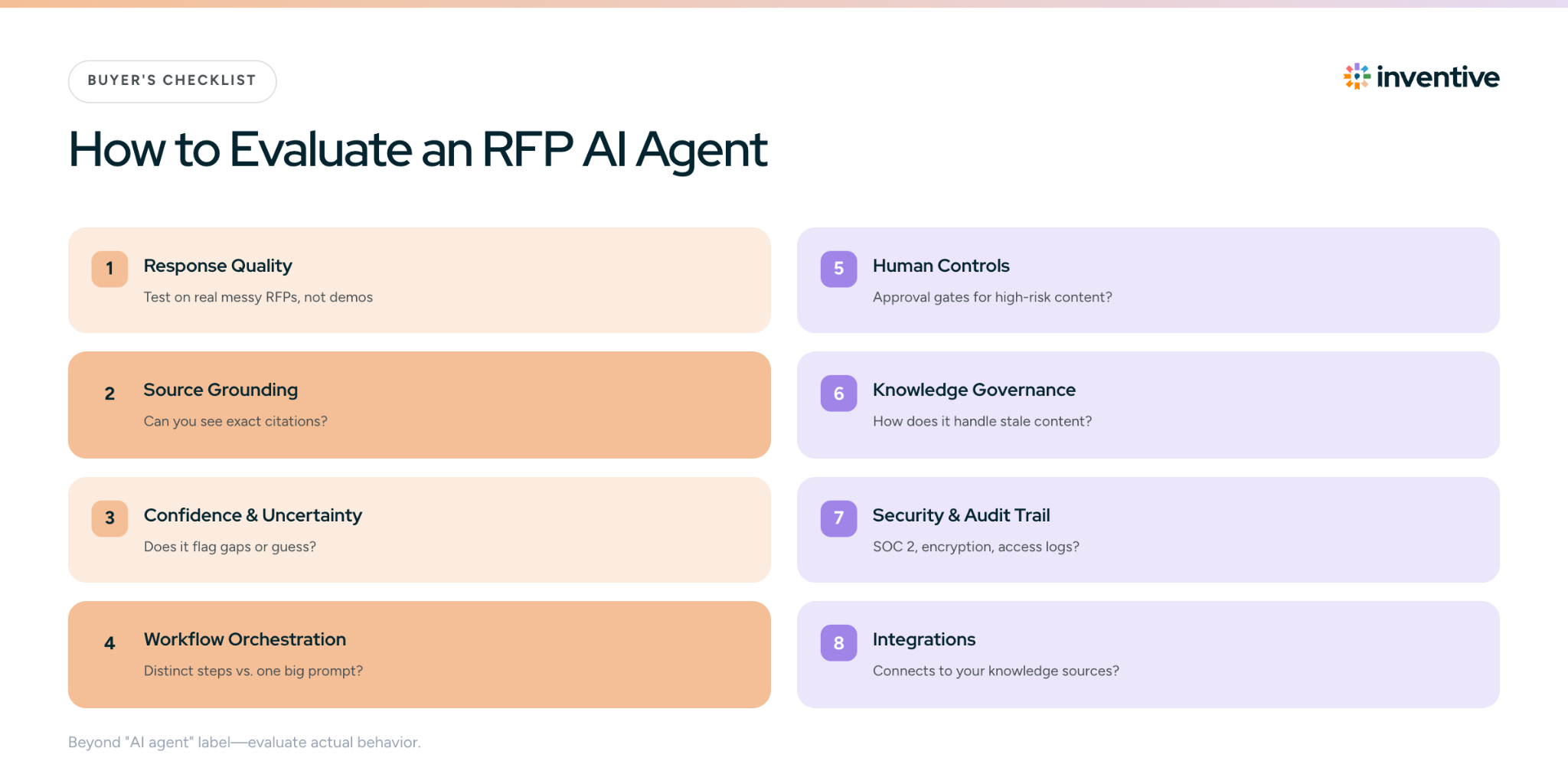
Evaluating an RFP AI agent is not just a feature checklist. Teams should assess whether a product is genuinely agentic and aligned with their workflow, risk tolerance, and governance requirements.
Response quality
- Can it produce accurate, relevant responses that match the buyer's wording?
- How much editing do draft answers require before they are usable?
- Does it maintain consistent tone and messaging across responses?
Practical test: run finalists on a real, messy RFP and rank by the share of answers usable with only light edits. Vendor demos are usually built on a curated sample RFP, which tends to overstate how clean the output will be on a team's actual, messier content, so this test is more informative than a scripted walkthrough. G2's RFP software category is a useful starting point for identifying which vendors to shortlist for that test.
Retrieval quality
- Can it find the correct information when RFP wording differs from internal documentation?
- Does it support semantic search and RAG over your actual content?
- How does it handle synonyms, acronyms, and product name variations?
Poor retrieval leads to irrelevant or incorrect answers, regardless of model quality.
Source grounding
- Can users see exactly where an answer came from?
- Are citations specific (document, section, paragraph) or vague?
- Can you restrict the agent to approved sources only?
Source transparency is essential for trust, auditability, and risk management.
Confidence and uncertainty handling
- Does it flag uncertainty instead of guessing?
- Are confidence scores visible and actionable (e.g., needs SME review below a threshold)?
- What happens when no reliable source exists, does it abstain or hallucinate?
Systems that say I don't know and route for review are safer than those that confidently invent answers.
Hallucination controls
- What guardrails prevent unsupported claims?
- Are there checks for groundedness (does every claim trace to provided context)?
- Is there anomaly detection or continuous evaluation of agent outputs?
Look for evidence-based checks, confidence scoring, and escalation paths for low-confidence outputs. These controls are best verified directly rather than taken on the vendor's description. Buyers can ask vendors to explain how their tooling prevents hallucinations, then test the claim by running a question the demo knowledge base does not have a supported answer for and checking whether the system abstains or guesses.
Workflow orchestration
- Can it execute multiple connected steps (intake → extraction → retrieval → drafting → routing → compliance)?
- Does it maintain workflow state and context across steps?
- Can it trigger subsequent actions (e.g., notify SMEs, update CRM, log decisions)?
True agentic behavior involves orchestration, not just isolated text generation.
Human-in-the-loop controls
- Can questions be routed to specific SMEs or reviewer groups?
- Are there explicit approval gates for high-risk content (pricing, legal, security)?
- Can you configure which actions require human approval vs. which can be automated?
Human checkpoints are critical for accuracy, accountability, and risk management.
Knowledge management
- How are answers approved, updated, versioned, and retired?
- Can you distinguish approved vs. unapproved, current vs. outdated content?
- Is there support for different product versions, regions, or customer segments?
Strong knowledge governance directly affects response quality and compliance. Ask specifically how the tool handles duplicate or contradictory entries that inevitably build up as multiple people add content over time. Some RFP automation platforms like Inventive AI run this as a standing background process, continuously scanning the connected knowledge sources for stale, duplicate, or conflicting entries and surfacing them to the content owner rather than waiting for a bad answer to surface the problem downstream.
Integrations
- Can it connect with your existing tools (CRM, document repositories, collaboration platforms, trust centers)?
- Are there native connectors for Microsoft 365, Google Drive, Confluence, SharePoint, Salesforce, etc.?
- How does it handle permissions and access controls from integrated systems?
Integrations reduce manual work and ensure the agent works where your team already operates. Most AI-native RFP platforms now list native integrations with Google Drive, SharePoint, Notion, Confluence, Slack, and Salesforce, since content that already lives in those systems does not need to be migrated into a separate library before the agent can use it.
Security and permissions
Evaluate:
- Access controls and role-based permissions: Who can see or edit what?
- Data isolation: Is your data logically separated from other customers?
- Encryption: At rest and in transit?
- Audit logs: Detailed, tamper-evident logs of agent actions and human reviews?
- SSO/MFA: Support for your identity provider?
- Data retention and residency: Where is data stored? Can you control retention periods?
- Model training policies: Is your data used to train shared models, or is it isolated?
- Compliance certifications: SOC 2 Type II, ISO 27001, and other relevant certifications?
Security and governance are non-negotiable for enterprise deployments, especially when handling confidential RFP data. This matters even more for regulated buyers, where the proposal itself might contain the same categories of sensitive information (security architecture, data handling practices) that the RFP is asking about. A vendor's published security documentation is a useful reference point for what this typically covers: SOC 2 compliance, encryption in transit and at rest, role-based access controls, and data handling practices aligned with GDPR and CCPA.
Auditability
- Can users understand what information was used and what actions the agent took?
- Are decision logs available (timestamp, user, agent version, inputs, outputs, sources)?
- Can you reconstruct how a specific answer was generated for compliance or legal review?
Audit trails support internal controls, external audits, and accountability. What counts as an audit log varies significantly between products, so it is worth reviewing a vendor's actual audit trail and version history implementation directly rather than relying on the feature name alone.
Performance measurement
Track metrics such as:
- RFP cycle time (from receipt to submission)
- Response time per question or section
- SME hours saved or reallocated
- Answer reuse rate (percentage of questions answered from approved content)
- Accuracy (percentage of answers requiring minimal edits)
- Compliance errors (missed requirements, formatting issues)
- Review effort (hours spent reviewing vs. writing)
- Human intervention rate (percentage of questions routed to SMEs)
These metrics help quantify ROI and identify improvement areas. Some vendors offer tools to model this before purchase, such as an ROI calculator that estimates the impact of cycle-time and SME-hour reductions based on a team's current RFP volume.
Questions to ask vendors during a demo
- What does the system do when it cannot find an approved answer?
- Can I see the exact source used for a response?
- How does it handle conflicting versions of information?
- Can I control which sources the agent can access?
- Which actions can the agent perform without human approval?
- What actions always require human approval?
- How are confidence scores calculated and displayed?
- What security certifications and audit logs do you provide?
Test agentic RFP software on your own messy RFPs
See how Inventive AI grounds every answer with citations and confidence scores you can verify in one click.
Book a Demo
What data sources should an RFP AI agent connect to?
Most teams don't migrate content into a new system before using an RFP AI agent. Instead, AI-first platforms connect directly to where content already lives, reducing setup time but increasing the need for active source governance.
Common source categories
- Previous RFP responses: Proven answers and language that worked in past bids
- Product documentation and specifications: Features, capabilities, and limitations
- Security and compliance documentation: Policies, certifications, controls, and attestations
- Legal-approved language: Contractual terms, privacy clauses, liability statements
- Case studies and customer references: Evidence of past success
- Implementation and services documentation: Onboarding, support, SLAs
- Pricing information: Standard pricing and discount policies
- Internal wikis and knowledge bases: Confluence, Notion, SharePoint
- Document repositories: Google Drive, OneDrive, Box
- Collaboration platforms: Slack, Teams channels with historical decisions
- CRM data: Account context, past engagements, opportunity details
The governance challenge: When sources aren't originally curated for RFP use, quality degrades over time. Outdated certifications, conflicting product specs, duplicate answers, stale case studies. This is why source governance and conflict detection aren't add-ons, they're core requirements.
Why source governance matters
An RFP AI agent should distinguish between:
- Approved vs. unapproved content: Only approved content should be used for buyer-facing answers.
- Current vs. outdated content: Versioned documentation and time-bound policies must be respected.
- Public vs. confidential information: Access controls must prevent leakage of sensitive data.
- Different product versions, markets, or segments: Answers must match the relevant context.
Connecting more data is not automatically better. An agent needs relevant, governed, permission-aware information to produce reliable responses.
Poor governance can lead to:
- Hallucinated or unsupported claims
- Outdated or conflicting information
- Compliance and legal risks
- Loss of trust from buyers and internal stakeholders
RFP AI agent vs. RFP automation vs. conventional RFP software
The market uses these terms inconsistently, but a practical distinction focuses on automation depth, retrieval, decision-making, and human involvement.
| Aspect | Manual RFP response | Rules-based RFP automation (templates, compliance matrices) | AI-supplemented RFP software (AI assists, humans orchestrate) | AI-first agentic RFP workflow (AI orchestrates, humans approve) |
|---|---|---|---|---|
| Automation | Minimal; mostly manual | Rule-based assembly, templates, compliance matrices | AI suggestions, drafting assistance | Multi-step orchestration (intake → extraction → retrieval → drafting → routing → compliance) |
| Retrieval | Manual search | Limited; often template-driven | May search knowledge base | Semantic/RAG retrieval from governed sources |
| Decision-making | Human-only | Deterministic rules | Human owns decisions; AI drafts and flags uncertainty | Agent makes workflow decisions within guardrails; humans own high-risk decisions |
| Workflow orchestration | Human-coordinated | Partial (e.g., task assignments) | AI handles intake, retrieval, routing; humans handle strategy | End-to-end workflow with state, routing, and audit trails |
| Human involvement | High throughout | High; automation assists | High; AI assists drafting | Humans focus on strategy, exceptions, and approval; AI handles repeatable work |
| Exception handling | Manual | Limited; often fails on edge cases | Human resolves | Agent flags and routes exceptions; humans resolve |
| Ability to take actions | Human executes | Limited automated actions | Mostly drafting | Can trigger notifications, updates, exports, and compliance checks |
Agentic systems do not completely replace RFP managers or SMEs. They shift human effort from repetitive tasks to higher-value activities.
Benefits of an RFP AI agent
When implemented with proper governance and human-in-the-loop controls, RFP AI agents can deliver practical benefits:
- Reducing repetitive work: Automates extraction, retrieval, and drafting of standard content.
- Faster first drafts: Generates initial responses in minutes rather than hours.
- Faster information retrieval: Finds relevant content across scattered sources quickly.
- Better reuse of approved content: Encourages consistent use of governed answer libraries.
- Less manual coordination: Routes questions to the right SMEs automatically.
- Identifying unanswered questions: Flags gaps and low-confidence items for review.
- More consistent responses: Reduces variation in how capabilities are described.
- Better workflow visibility: Provides audit trails and status tracking.
- Supporting higher RFP volumes: Enables teams to handle more concurrent bids without proportional headcount increases.
These benefits are contingent on quality data, retrieval, and governance, not just model capability.
Limitations and risks
RFP AI agents are powerful but not infallible. Teams should be aware of key limitations and risks:
- Hallucinations: Confident but unsupported claims when sources are missing or retrieval fails.
- Outdated source content: Answers based on stale documentation or expired certifications.
- Conflicting information: Different sources provide contradictory answers.
- Poor retrieval: Irrelevant or incomplete search results lead to weak answers.
- Incorrect assumptions: Agent misinterprets requirements or buyer intent.
- Over-automation: Automating high-risk decisions (pricing, legal, security) without human review.
- Data security: Risk of exposing confidential information if permissions are misconfigured.
- Incorrect permissions: Agent accesses or exposes content it should not.
- Model limitations: LLMs may struggle with nuanced legal or technical language.
- Overreliance on historical responses: Reusing past answers without validating current relevance.
- Poor knowledge-base governance: Ungoverned content propagates errors at scale.
- Lack of human review: Submitting AI-generated content without adequate human oversight.
AI agents should not be automatically trusted with high-risk commitments involving pricing, legal terms, security, compliance, contractual obligations, or other sensitive information. Human judgment and approval remain essential in these areas.
What does a good human + AI RFP workflow look like?
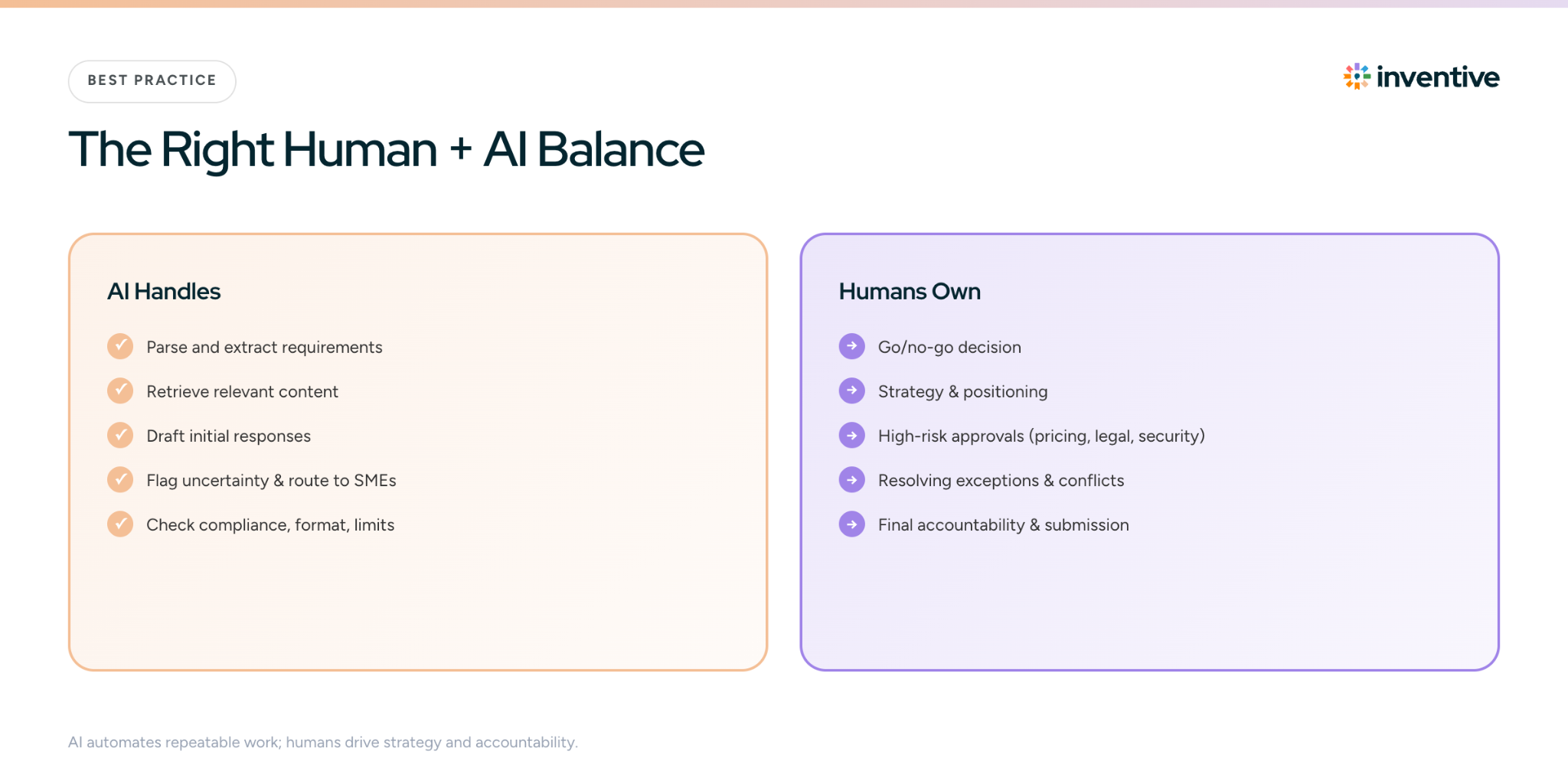
The best workflow is not AI does everything, human approves at the end. Instead, humans participate at meaningful checkpoints to ensure accuracy, accountability, and risk management.
A practical human + AI workflow:
- AI extracts requirements and builds a compliance matrix.
- AI retrieves relevant content from approved sources.
- AI drafts responses grounded in retrieved content with citations.
- AI flags uncertainty (low confidence, missing sources, conflicts).
- SMEs review exceptions and provide expert input where needed.
- Proposal manager reviews overall coherence, positioning, and strategy.
- Compliance check verifies formatting, mandatory sections, and buyer instructions.
- Final approval by an accountable human before submission.
These checkpoints matter because:
- They prevent hallucinated or unsupported claims from reaching the buyer.
- They ensure strategic differentiation and positioning are human-owned.
- They maintain accountability for high-risk commitments.
- They provide auditability for internal and external reviews.
Practical examples
Example 1: Security question
RFP question: Describe your encryption standards for data at rest and in transit.
This type of question also appears in standalone security questionnaires and vendor risk reviews outside the RFP process, which is one reason security-related content is often governed as a shared category rather than maintained separately for each use case.
Agent workflow:
- Retrieves current security documentation and policies from approved sources.
- Drafts a response citing the relevant security whitepaper and policy documents.
- If the RFP asks for information not covered (e.g., a specific certification not held), the agent flags this gap and routes the question to the security team for review.
Example 2: Product question
RFP question: Does your platform support SSO with Azure AD?
Agent workflow:
- Finds relevant product documentation and approved responses about authentication methods.
- Drafts an answer based on the buyer's wording, citing the product spec and past response.
- If documentation is outdated or conflicting, the agent flags it for product team review.
Example 3: Unknown question
RFP question: Provide your roadmap for AI-powered anomaly detection in Q4 2026.
Agent workflow:
- Searches approved sources and finds no reliable, approved answer.
- Instead of inventing a response, the agent flags the question as needs SME review and routes it to the product or strategy team.
These examples illustrate how an agent can handle routine questions efficiently while deferring uncertain or high-risk items to humans.
What this means for RFP teams
Don't just evaluate platforms on the AI agent label. Test them on your actual RFPs. Ask vendors how they handle stale content and conflicting information. Verify security certifications if you're in regulated industries. Check that humans own high-risk decisions.
The best agentic workflows shift your team from doing repetitive extraction and drafting to owning strategy, judgment, and final accountability.
Where Inventive AI fits into this
Inventive AI is built as an AI-first platform, not AI layered onto RFP software. It runs dedicated agents for extraction, retrieval, drafting, knowledge governance, and go/no-go scoring. Each agent does one job well.
It connects natively to Google Drive, SharePoint, Notion, Confluence, Slack, and Salesforce, so you don't migrate content into a separate system first. Your team works with sources that already exist.
Every answer gets a citation and confidence score attached. Reviewers verify claims in one click instead of hunting through documents. For regulated industries like healthcare, government, and financial services, it's SOC 2 compliant with role-based access, encryption, and audit trails built in.
Ready to see AI-first RFP orchestration in action?
Test Inventive AI's agents on one of your real RFPs.
Book a Demo
Frequently Asked Questions
Can an RFP AI agent work without an existing answer library?
Yes. AI-first platforms like Inventive connect directly to your existing sources Google Drive, SharePoint, Notion, Confluence so you don't need to build a separate answer library first. Response quality improves once you govern those sources, but deployment doesn't have to wait for a curated library.
Can an RFP AI agent process Excel questionnaires?
Most RFP AI agents can ingest Excel-based questionnaires, extracting questions and required answer formats such as yes/no, free text, or multi-select. Capability varies by product: merged cells, hidden tabs, and inconsistent column headers trip up many otherwise capable tools, so Excel handling is worth verifying during a demo.
How long does implementation typically take?
Most teams reach production deployment in 3–6 months, including content consolidation, integration, and workflow configuration. Simpler deployments with clean data and few integrations can go live faster; complex, multi-source knowledge bases take longer.
Do small RFP teams need an AI agent?
Not necessarily. Small teams with low RFP volume may benefit from simple drafting assistance first. As volume grows and coordination overhead increases, AI-first orchestration saves more time.
How much does RFP AI agent software cost?
Pricing varies widely by vendor and plan tier. AI-native tools range from free starter tiers to roughly $1,300 per month for mid-market plans, while established enterprise platforms often start at $15,000–$25,000 per year before add-ons.
What happens when an agent cannot answer a question?
A well-designed agent flags the question as low-confidence or needs SME review and routes it to the appropriate subject matter expert rather than inventing an answer. This behavior depends on the agent's confidence thresholds and retrieval quality.
Does every AI-generated RFP response require human review?
Not every individual answer, but every buyer-facing response should get human review before submission, especially for pricing, legal, security, and compliance content. Human review is what protects accuracy, strategic positioning, and accountability on the final submission.
How does an RFP AI agent handle confidential information?
Through access controls, permissions, and data isolation, so the agent only surfaces content a given user is authorized to see. Confidential data should not be used to train shared models; verify SOC 2 or ISO 27001 certification and data handling policies during evaluation.