Inventive AI vs Loopio vs Responsive (2026): Accuracy, Upkeep, Cost
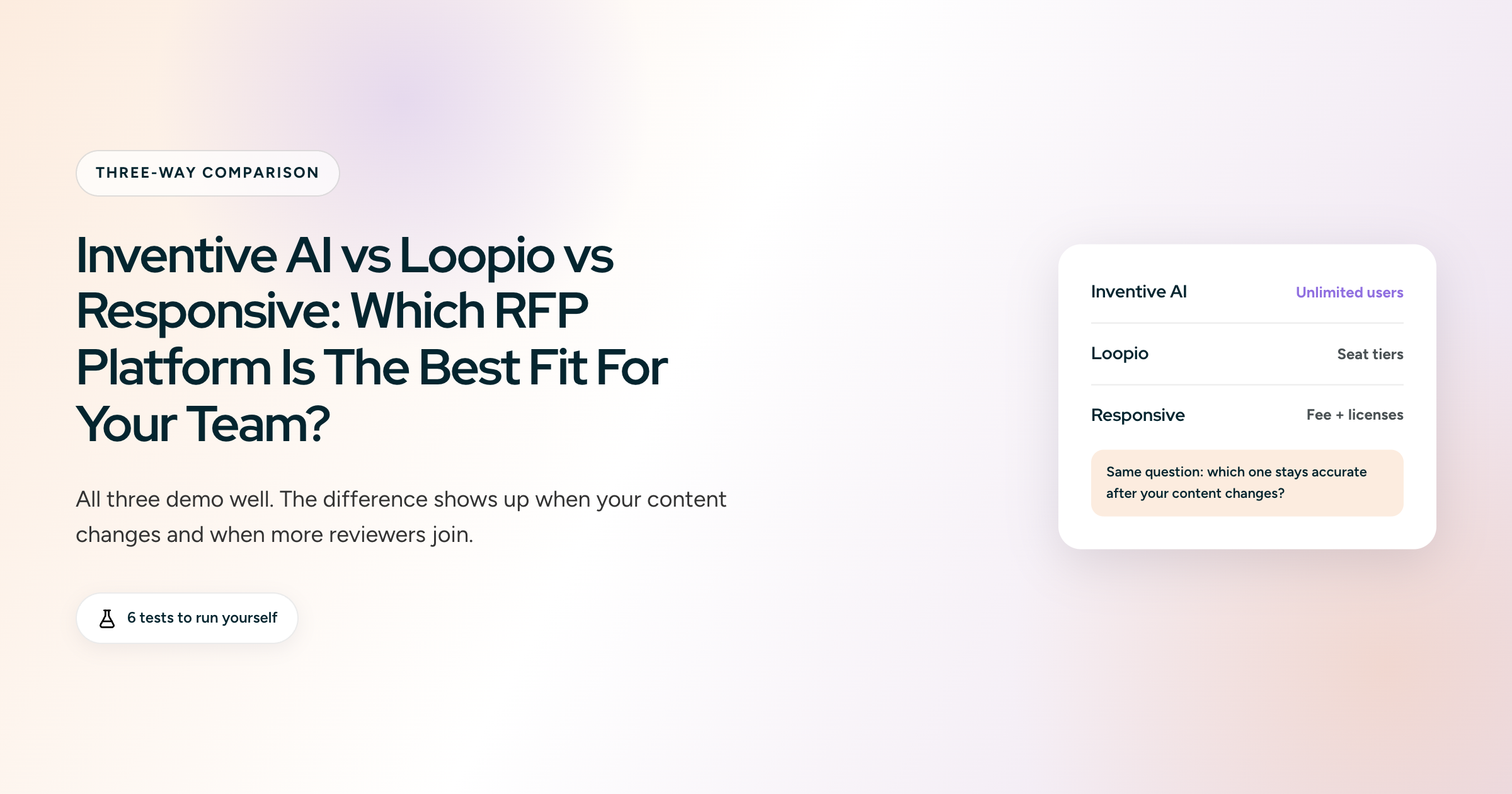
Every RFP platform on your shortlist will show AI drafting in a demo, even the library-based ones that added it later, so "does it have AI?" won't decide Inventive AI vs Loopio vs Responsive. Two harder questions will: what keeps your answers correct after your pricing, product, or certifications change, and what happens to your bill when 20 subject matter experts (SMEs) need to review a response. Loopio and Responsive answer both through a content library and per-user licenses. Inventive AI is an AI-native RFP platform that drafts cited answers from your connected company knowledge and flags conflicting or outdated content before it reaches a buyer.
Key takeaways
- Loopio is the library-first option: G2 reviewers most often praise its ease of use, but they also report answers that need heavy review when nobody keeps the Library current.
- Responsive is the broadest suite: intake, permissions, reporting, and the longest list of certifications, built for multi-region programs.
- Inventive AI removes the library as a separate job: it drafts from the documents you already keep current, catches contradictions between them, and charges $830/month, billed annually, with unlimited users.
- The cost gap shows up in seats: Loopio's Foundations plan starts with 10 seats and Responsive charges per user license, so every extra reviewer changes the quote.
Inventive AI vs Loopio vs Responsive at a glance
Checked against each vendor's pricing and security pages and G2 in November 2026.
What should you test when comparing Inventive AI, Loopio, and Responsive?
Run the same real work through each platform, and test the moments that cause problems after go-live. Keep these six tests in mind as you read the rest of this comparison.
- Same RFP, same sources: load one recent RFP and the same content into each tool, then score every draft as usable as-is, light edit, heavy edit, full rewrite, or wrong.
- Your messiest file: use a multi-tab Excel workbook with merged cells, a Word document with tables, and one portal questionnaire, not the vendor's demo file.
- The change test: update one fact, such as a pricing tier, in your source content, then check which tool reflects it in the next draft and which still cites the old version.
- The gap test: include five questions your content doesn't cover, and see which tool flags them and which writes something plausible.
- The reviewer test: invite real SMEs, time how long an occasional contributor takes to answer three questions, and count how many need a paid seat.
- The three-year cost: add platform fees, seats, usage, implementation, onboarding, and add-ons, since a cheaper first-year quote can cost more once adoption grows.
Are Loopio and Responsive AI-native like Inventive AI?
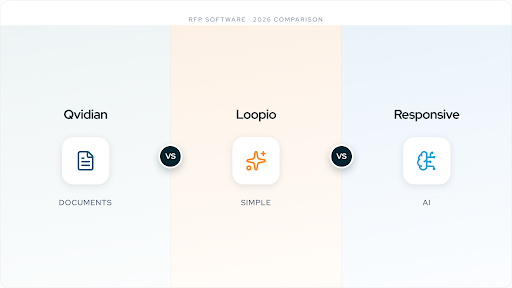
No. Loopio (founded 2014) and Responsive (founded 2015 as RFPIO) are library-based platforms that added generative AI on top of their content libraries later. Inventive AI was built AI-native, so drafting from live company knowledge is the core of the product, not a layer added to an older one.
- Loopio: a library-based platform with AI added later. Its AI drafts from the Loopio Library, a set of approved Q&A entries your team curates.
- Responsive: a library-based response suite with AI added later. Its AI agents draft from the Content Library and past responses.
- Inventive AI: drafts from the documents your teams already maintain, brought together in one Knowledge Hub, with no separate library to keep in sync.
On a demo call, all three look like AI tools. The difference shows up every time something in your business changes.
What happens to your answers when your facts change?
Picture a common quarter: your SOC 2 report renews and your pricing tiers change. Here's what each platform asks of your team before the next RFP goes out.
- In Loopio: a Library owner finds and edits every entry that mentions the old report or old tiers. A Freshness Indicator and review cycles help surface stale entries, but until someone updates them, drafts can pull the outdated wording.
- In Responsive: content owners update the affected entries through review workflows, and content stays locked while it's under review.
- In Inventive AI: your security and pricing teams update their own source documents, as they would anyway. The next draft uses the new versions, and the AI Content Manager flags any older document that still states the old tier, so you resolve the conflict once instead of finding it in a buyer's hands.
What do Inventive AI, Loopio, and Responsive do when your content can't answer a question?
They all signal uncertainty, but in different ways.
- Loopio: shows a confidence score with the cited answer, and the reviewer decides whether it's good enough.
- Responsive: shows a TRACE Score and source citations, and runs a Quality Check before submission.
- Inventive AI: marks the question as information unavailable and routes it to an SME, rather than stretching the closest match into an answer.
For buyers, this is the moment that matters most. A confident-sounding answer built from the wrong source is harder to catch than a blank.
How do Inventive AI, Loopio, and Responsive differ in daily use?
What is Inventive AI like to use?
Strengths
- Easy to adopt: ease of use is its most-mentioned strength on G2, in 58 reviews, and it's rated #1 Easiest to Use in G2's RFP category.
- Long RFPs and portals: reads 200-page PDFs and multi-tab Excel files in full, writes answers back into the original file or your Word template, and fills Coupa, Ariba, and Jaggaer through Portal Answers.
- Strategy built in: strategic agents support go/no-go decisions and competitive analysis.
Limitations
- Analytics: reporting and dashboards are the most common G2 request.
- Permissions: some reviewers want finer role controls by stage or team. Multi-tab Excel exports sometimes need a formatting pass, and PowerPoint decks are built outside the tool.
- Track record: a younger vendor with fewer reviews than Loopio or Responsive.
What is Loopio like to use?
Strengths
- Clean and quick to learn: ease of use is the most-mentioned G2 strength, in 142 reviews.
- Mature Library tools: tags, categories, a Freshness Indicator, and automated review cycles keep a curated Library organized.
- Wide adoption: more than 1,700 companies use it, and it now connects to Claude and ChatGPT through MCP.
Limitations
- Library dependence: G2 reviewers report inaccurate answers that need extensive review (25 mentions), and outdated duplicate entries pile up.
- Formatting fixes: exported documents often need manual cleanup.
- Seat-based plans: Foundations includes 10 seats, so larger contributor groups move you up a tier or a quote.
What is Responsive like to use?
Strengths
- Breadth: intake requests, LookUp, Trust Center, Requirements Analysis, and an AI and automation studio in one suite.
- Governance: advanced access controls, reporting, and flexible hosting on higher editions.
- Enterprise proof: Microsoft's proposal team reports 21,100 hours saved in response time.
Limitations
- Library upkeep: the AI runs on a question-and-answer library, which needs ongoing administration, per a G2 reviewer.
- Licensed reviewers: user licenses apply to the people who review and approve, too.
- Learning curve: 34 G2 reviews mention a steep learning curve, and 33 say the interface isn't always intuitive.
Which has the strongest AI: Inventive AI, Loopio, or Responsive?
Judge the AI by how much editing its drafts need. On that test, Inventive AI has the strongest published evidence of the three.
- Inventive AI: in Rad AI's evaluation, Inventive AI produced twice as many ready-to-submit answers as the other vendors tested, from the same 100 RFP questions and the same source material. Every draft carries a citation and a confidence score, and unanswerable questions are flagged.
- Loopio: Automated Answers drafts from approved Library content with citations and a Confidence Pulse score, and writers refine answers with prompts inside the project.
- Responsive: AI agents draft from the Content Library with citations, TRACE Score rates each answer across five dimensions, and Agent Studio lets teams build custom agents.
Inventive AI vs Loopio vs Responsive: how do they compare head to head?
Inventive AI vs Loopio: which is better?
Inventive AI is the better fit if you want answers drafted from live documents without maintaining a library. Loopio fits teams that want a curated Library with a named owner.
- Knowledge: Loopio pairs its Library with Content Connectors to SharePoint, Google Drive, and Confluence. Inventive AI syncs those sources directly and checks them against each other for conflicts.
- Portals: Loopio covers more portals, with SmartFill supporting 170+ providers. Inventive AI covers Coupa, Ariba, and Jaggaer, plus a browser extension for other vendor portals.
- Cost: Loopio's Foundations plan includes 10 seats. Inventive AI includes unlimited users.
Inventive AI vs Responsive: which is better?
Inventive AI is the better fit for teams that want governed AI drafts and broad SME participation. Responsive fits global programs that need intake workflows, a buyer-facing Trust Center, and the longest list of certifications.
- Switching evidence: Druva moved its 60-person SE team off Responsive in under a month, and Harte Hanks replaced Responsive across six lines of business.
- Adoption: Inventive AI is rated #1 Easiest to Use in G2's RFP category, while 34 Responsive reviews on G2 mention a steep learning curve.
- Where Responsive leads: its Trust Center, ISO 27701 and ISO 42001 certifications, and a larger integration catalog.
Loopio vs Responsive: which keeps library answers more current?
Both rely on people to keep the library current. They give those people different tools.
- Loopio: a Freshness Indicator flags stale entries, usage insights show which answers recur most, and automated review cycles route content to its owner.
- Responsive: review cycles and optional moderation hold edits for approval, and content in review stays locked for edits until the owner signs off.
- What neither advertises: a check for contradictions between library entries and the source documents they came from.
Which handles procurement portals and integrations best?
Loopio covers the most portals, Responsive the widest integration catalog, and Inventive AI the deepest connection to where your knowledge already lives.
- Loopio: Salesforce, HubSpot, Seismic, Highspot, Slack, Teams, a Copilot Agent in Microsoft 365, and an MCP connection to Claude and ChatGPT.
- Responsive: Salesforce, Microsoft Office, SharePoint, Slack, Teams, Google Drive, Seismic, and open APIs.
- Inventive AI: SharePoint, Google Drive, Confluence, Notion, Salesforce, HubSpot, Slack, and Teams. At Color, Salesforce launches RFP projects automatically and a Slack bot answers sales reps' follow-up questions.
Counting logos won't settle this. Ask each vendor whether an integration syncs continuously or imports once, and whether it respects the permissions set in the source system.
What does each platform cost once SMEs join the response?
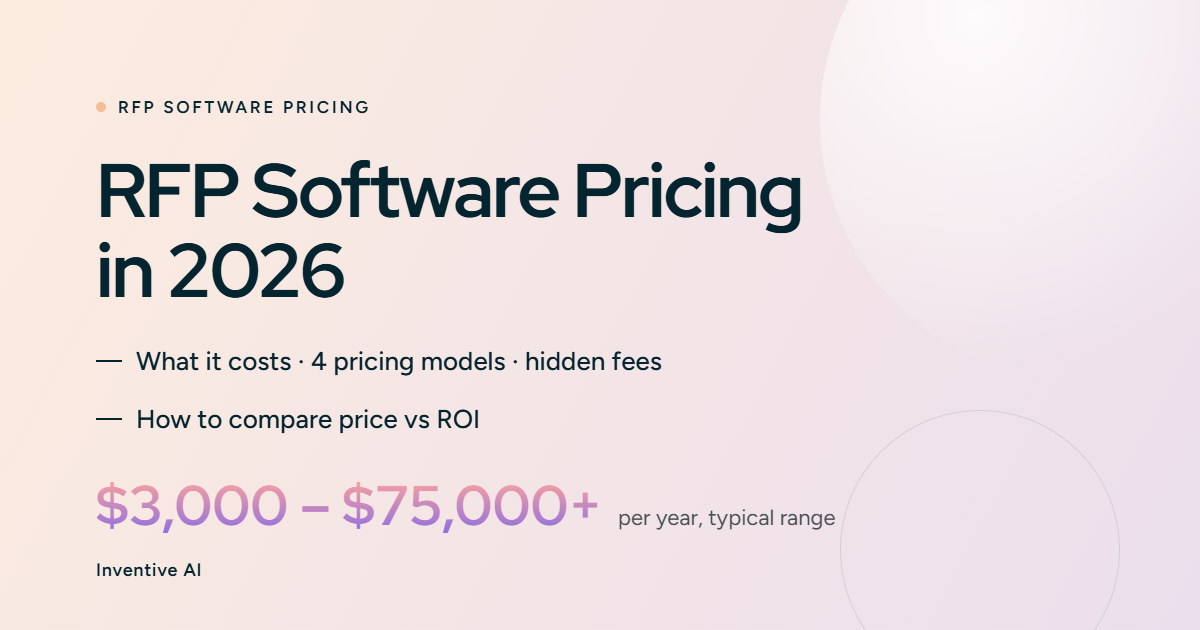
Of Inventive AI, Loopio, and Responsive, Inventive AI is the only one with a published price that doesn't change with headcount. Loopio and Responsive both tie part of the cost to the number of people with access.
- Inventive AI: $830/month, billed annually, with unlimited users and every feature in one plan.
- Loopio: custom quotes across three plans. Foundations includes 10 seats, Enhanced adds a multi-language Library, confidential projects, and multi-step reviews, and Enterprise adds business units, sandboxes, and a custom number of seats. Project translations, onboarding packages, and industry integrations are add-ons. Vendr data puts Loopio pricing at a median of $24,318 a year across 144 purchases.
- Responsive: a platform fee plus user licenses plus add-ons and services. The Emerging edition starts from $10,000, and Growth and Enterprise are quoted.
Here's how that plays out for a team with 5 proposal managers and 20 SMEs who each review a few answers a month:
- Inventive AI: all 25 people are included at $9,960 a year.
- Loopio: 25 people exceeds the 10 seats in Foundations, so the quote moves to more seats or a higher plan.
- Responsive: the platform fee plus 25 user licenses, before any add-ons.
How do Inventive AI, Loopio, and Responsive compare on security?
Inventive AI, Loopio, and Responsive all meet the bar most enterprise security reviews set. Responsive and Loopio list more third-party certifications, and Inventive AI adds strict controls on how AI models handle your data.
Inventive AI's full list of controls is on its security page.
What results do Inventive AI, Loopio, and Responsive customers report?
Each vendor publishes strong customer numbers, but every figure comes from a different team, process, and starting point, so treat them as signals rather than a ranking.
- Inventive AI: Druva moved its 60-person SE team off Responsive in under a month and runs about 600 RFPs a year. Harte Hanks replaced Responsive and ChatGPT across six lines of business, and AssetWorks reports a 422% ROI.
- Loopio: Allied Universal reports 50% faster RFP turnaround and 90% faster questionnaire turnaround, and Zendesk reports efficiency gains of up to 70%.
- Responsive: Microsoft's proposal team reports 21,100 hours saved in response time, and JAGGAER cut content library maintenance time by 50%.
Is a newer AI-native platform like Inventive AI riskier than Responsive?
It's a fair question when one vendor has been around since 2015. For most teams, the evidence points to no.
- Scale in production: Druva runs about 600 RFPs a year on Inventive AI, Ripple rolled it out to 150 people, and Harte Hanks uses it across six lines of business.
- Third-party ratings: G2 lists Inventive.AI as the Highest Performer and Easiest to Use in its RFP category, with a 4.9 rating against Responsive's 4.5.
- Security: SOC 2 Type II, zero data retention with OpenAI and Anthropic, and no training of generalized models on customer data.
- Where Responsive's scale does help: more than 2,000 customer organizations, global professional services, and ISO 27701 and ISO 42001 certifications, which matter most for multi-region programs with strict vendor requirements.
Inventive AI vs Loopio vs Responsive: which should you choose?
Choose by the job your team struggles with most.
- Answers keep going stale, or reviewers keep catching contradictions: Inventive AI, because it checks your sources against each other before drafting.
- You want a well-run library with a dedicated owner: Loopio. Teams outgrowing that model often compare Loopio alternatives.
- You run response operations across regions, business units, and request types: Responsive, for its intake, governance, and certification depth. Teams weighing a move can compare Responsive alternatives.
- Seat costs are keeping SMEs out of the tool: Inventive AI, with unlimited users.