RFP Software Pricing in 2026: What It Costs and How to Compare
What RFP software actually costs in 2026, the four pricing models, hidden fees to budget for, and how to compare price against ROI before you buy.
Most RFP software vendors don't publish a price. You book a demo, sit through a call, and get a quote built around your seat count. That makes RFP software pricing hard to compare and easy to overpay for.
This guide breaks down what RFP software actually costs in 2026, the four pricing models you'll run into, the fees that don't show up on the quote, and how to weigh price against the time and win-rate gains that justify it.
TL;DR
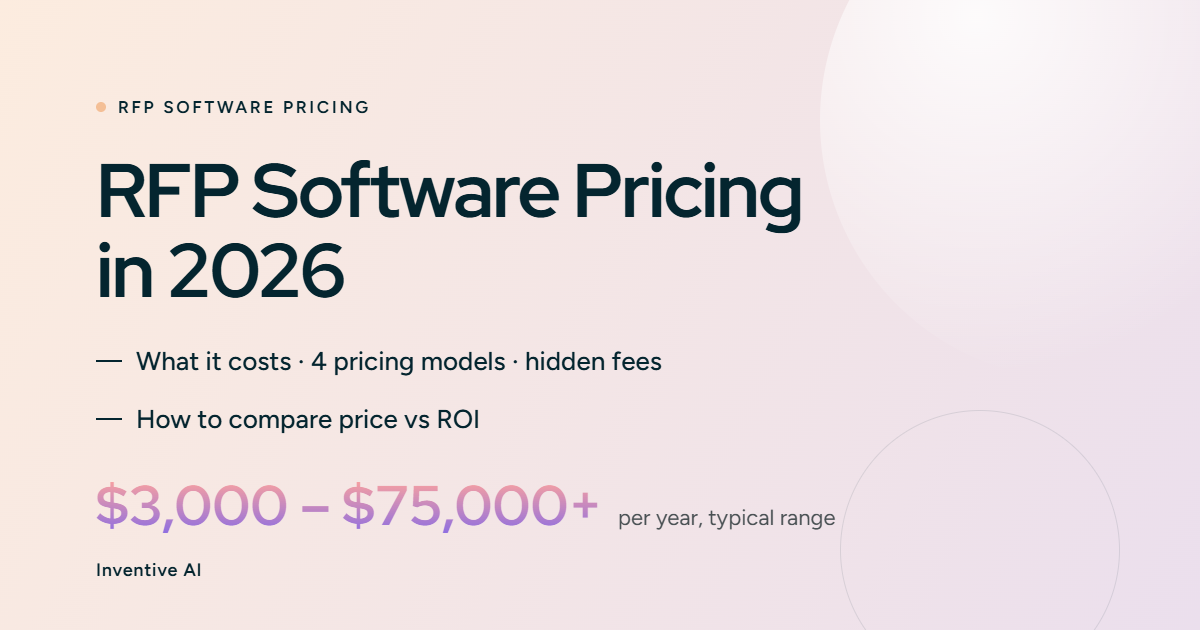
- Typical RFP software cost per year runs from about $3,000 to $75,000+. Self-serve tools publish rates in the low thousands; enterprise response platforms are quote-based and reportedly land around $15,000 to $25,000+ per year, climbing past $75,000 at scale.
- Four pricing models dominate: per-seat, flat-rate self-serve, usage-based, and credit or project-based. The model matters more than the sticker price, because it decides how your cost grows.
- Per-seat pricing ties your bill to headcount, not output. Usage-based ties it to the work you actually do.
- The quote is not the cost. Add implementation, integrations, premium support, and annual price increases before you compare.
- Judge price against ROI, not in isolation. A tool that costs more but cuts response time 70% and lifts win rate can pay back faster than a cheaper one. Run the math with an ROI calculator before you decide.
How much does RFP software cost?

There's no single number, because pricing scales with team size, RFP volume, and how much AI and automation you turn on. Here's the range by segment.
Two things to keep in mind. First, the quote-based tools don't publish list prices, so their figures here are medians from real buyer contracts, not official rates. Second, the self-serve and AI-native tiers overlap: a usage-based AI platform can start lower than a legacy per-seat tool while covering the same work.
RFP software pricing comparison (2026)
The table below groups tools by pricing model. Published figures come from each vendor's own pricing page. For quote-only tools, we show the median annual price real buyers pay, from Vendr's procurement data, so you have a grounded number instead of a guess.
Only a minority of vendors put a number on the page. Inventive AI, Conveyor, AutoRFP.ai, Proposify, and PandaDoc publish rates you can compare directly. Loopio, Responsive, Qvidian, QorusDocs, and Arphie quote by sales call, so the figures above reflect what buyers actually pay, not a list price.
Enterprise RFP software pricing by tool
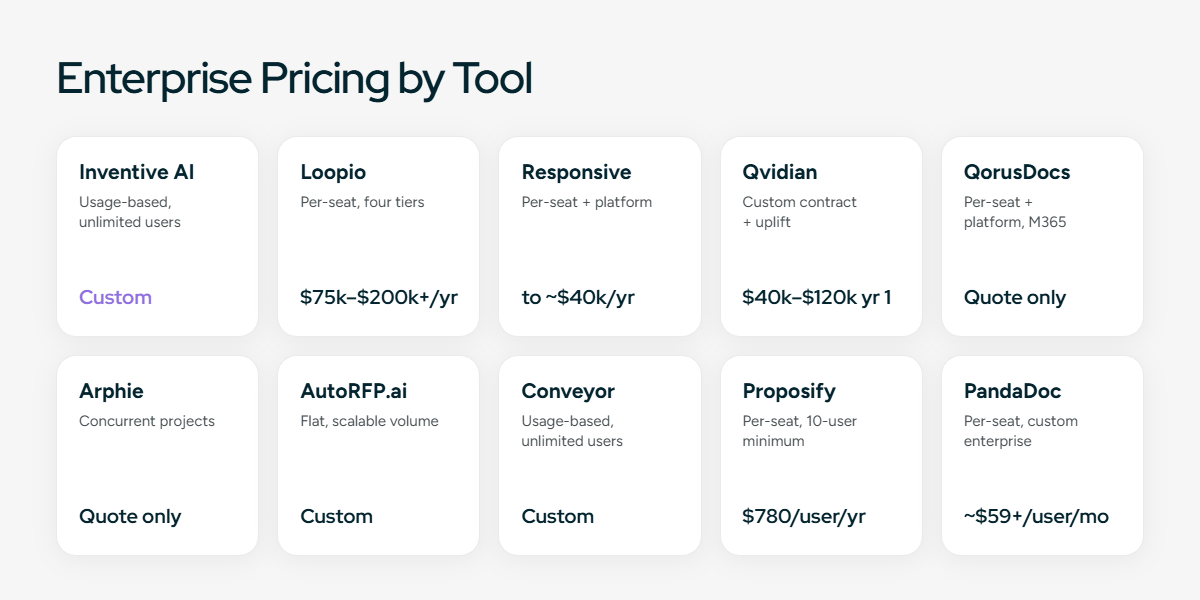
Most of these tools reserve their full feature set, integrations, and security controls for an enterprise tier. Here's what each one includes at that level, and what it costs where a real number exists.
- Inventive AI. Custom enterprise pricing on the same usage-based model, with unlimited users included, tailored volume, SSO, and dedicated support. Unused volume rolls over, so enterprise buyers don't forfeit what they prepaid.
- Loopio. Enterprise is the top of a four-tier per-seat structure (Essentials, Plus, Enhanced, Enterprise) and adds advanced workflow, integrations, and SSO. Vendr data puts enterprise contracts in the $75,000–$200,000+ per year range, with a $24,100 median across all tiers.
- Responsive (RFPIO). Enterprise adds broader workflow, integrations, and volume discounts that begin around 10–15 users. Buyers pay a $10000, with larger deals reaching about $40,000/yr; budget 20–40% of the first-year subscription for implementation.
- Qvidian (Upland). Sold as a custom enterprise contract with an annual uplift. Upland buyers commonly see first-year totals of $40,000–$120,000 for mid-market, and $150,000–$500,000+ for large or multi-product deals.
- QorusDocs. Enterprise, quote-only, built around Microsoft 365. Pricing is not published; expect a per-seat plus platform structure sized to your team.
- Arphie. Enterprise, sales-led, on a concurrent-project model. No public price; figures depend on how many proposals you run at once.
- AutoRFP.ai. The Enterprise plan is custom, with scalable project volume, unlimited users, and every feature included, on top of the published $899–$1,299/month self-serve plans.
- Conveyor. Enterprise is custom and usage-based, with unlimited users, SSO and SCIM, public API, role-based access, and dedicated support. The published Business plan is $9,600/yr; there is also a free trust-center tier.
- Proposify. The Business plan runs $780/user/year (10-user minimum, billed annually) and adds custom branding, approval workflows, and Salesforce integration above the $19 and $49/user plans.
- PandaDoc. Enterprise is custom, reported around $59+/user/month, adding SSO, advanced reporting, and API access above the $19 Essentials and $49 Business per-user plans.
Two patterns stand out. The legacy per-seat platforms concentrate their real cost at the enterprise tier, where seat counts and add-ons compound. The usage-based tools keep users unlimited at every tier, so moving to enterprise buys more volume and controls, not a bigger headcount bill.
The four RFP software pricing models
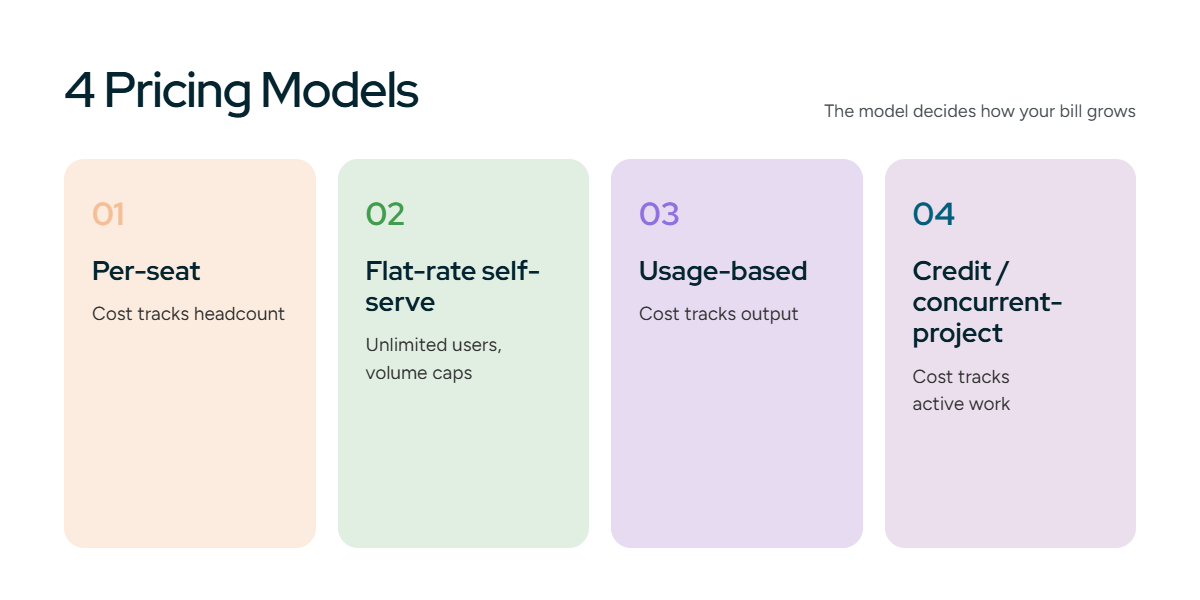
The pricing model shapes your cost more than the headline rate, because it decides how the bill grows as your team and volume change. Here's how each one works and where the cost adds up.
1. Per-seat (subscription)
You pay per user, usually with a platform fee on top. Loopio, Responsive, and Qvidian use versions of this.
It's predictable when your team is stable, since the bill maps to headcount. The catch is that it charges for access, not output. A proposal team averages about eight people, and occasional contributors, reviewers, and SMEs each add cost even if they log in twice a quarter. Many vendors also set seat minimums that inflate the entry price.
2. Flat-rate self-serve
You pay a fixed monthly fee for a plan, often with unlimited users. Tools like AutoRFP.ai and newer self-serve platforms use this.
Pricing is published and easy to compare, and adding people costs nothing. The limit usually moves to volume: plans cap the number of proposals or projects per year, and heavy quarters can push you into a higher tier.
3. Usage-based (platform fee + consumption)
You pay a base platform fee plus a charge for the work you run through the tool, with users included. Inventive AI uses this model.
Cost tracks output instead of headcount, so a large team that answers a moderate volume isn't penalized for its size. The thing to confirm is what "usage" means and whether unused volume expires. Some usage models fluctuate month to month; others let volume roll over so you don't lose what you paid for.
4. Credit or concurrent-project
You buy credits or pay for a set number of concurrent projects. Some agentic and AI-native tools price this way.
It aligns cost with active work, but it takes forecasting. If you underestimate a busy stretch, you top up mid-cycle at a worse rate.
What drives RFP software cost
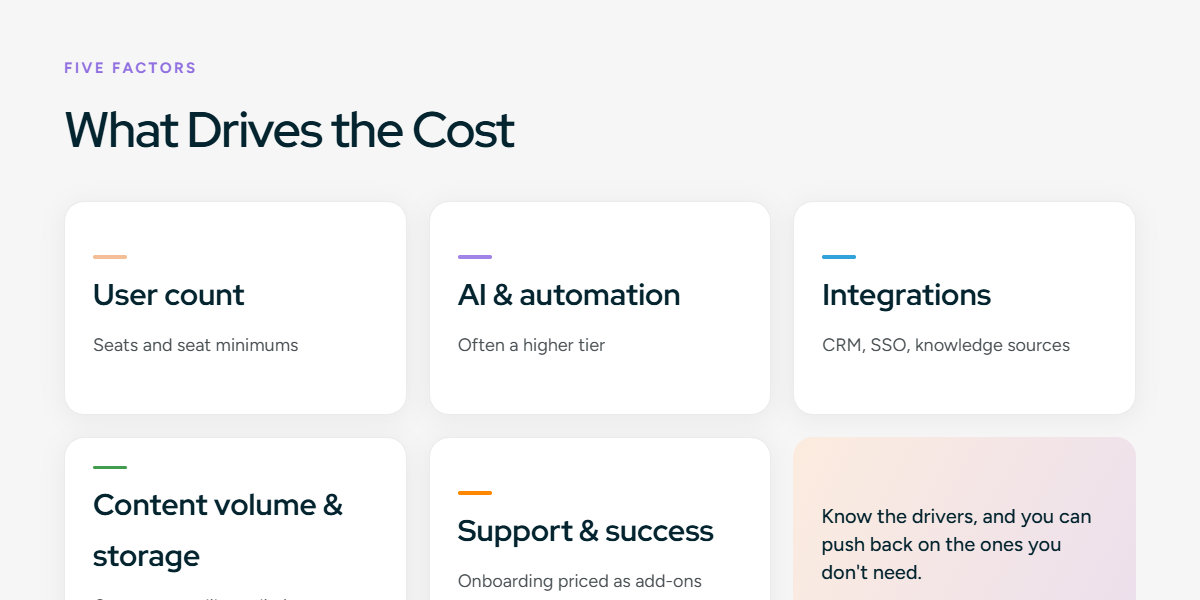
Five factors move a quote up or down. Knowing them helps you push back on the ones you don't need.
- User count. The primary driver for per-seat tools. Seat minimums and per-user tiers are where legacy platforms get expensive.
- AI and automation. AI drafting, content governance, and accuracy features often sit in higher tiers and can add a meaningful premium over the base plan.
- Integrations. A standard set is usually included. Extra CRM, SSO, or knowledge-source connectors may require a premium tier.
- Content volume and storage. Some platforms charge overage fees once your library passes a limit.
- Support and success. Dedicated onboarding and premium support are frequently priced as add-ons, not baked in.
Hidden RFP software costs to budget for
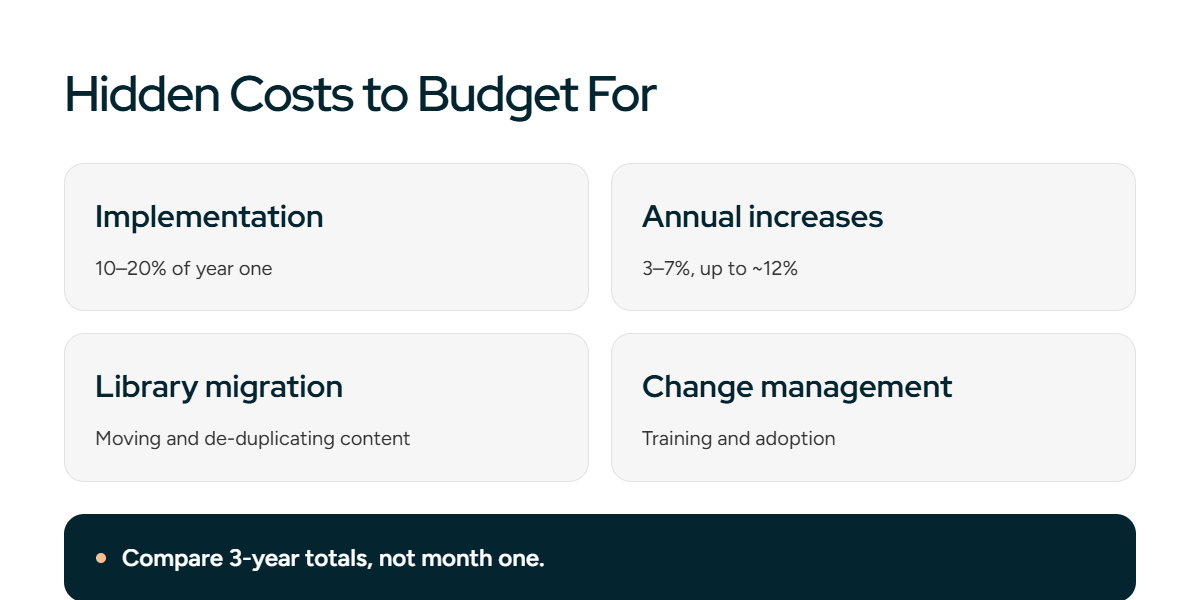
Budget for these before you compare two numbers, because they change the real total.
- Implementation and onboarding. Often 10–20% of the first-year subscription for enterprise tools.
- Annual price increases. Expect 3–7% as an industry norm; some contracts, like Qvidian's reported terms, carry uplifts closer to 12%.
- Library migration and cleanup. Moving and de-duplicating existing content takes time, whether you pay the vendor or spend internal hours.
- Change management. Training and adoption are real costs, especially on tools with a steep learning curve.
A cheaper subscription with a heavy implementation fee and a 12% annual uplift can cost more over three years than a higher subscription that includes onboarding and holds its price.
How to compare RFP software cost against ROI
The lowest quote rarely wins on total value. RFP software earns back its price by saving hours and winning more deals, so compare price against return, not price alone.
Here's the shape of the math. A team answering 40 RFPs a year at 30 hours each spends 1,200 hours on responses. At a $75 loaded hourly rate, that's $90,000 in labor. Cut response time by 60% and you free roughly $54,000 in capacity, before counting the deals you win because you responded to more RFPs, faster, and with better answers.
Reported time savings back this up: buyers cite 60–80% reductions in response time after moving to AI-assisted tools, and roughly 60% of teams report ROI within twelve months. The gain compounds when faster, higher-quality responses lift win rate, since a single extra win often exceeds the annual software cost.
To pressure-test a specific quote against your own volume, hours, and win rate, run it through an ROI calculator before you sign. A tool that costs $10,000 more but pays back in four months is cheaper than a bargain that never moves your numbers.
How to evaluate RFP software pricing for your team
Work through these before you commit.
- Match the model to your shape. Big team, moderate volume: usage-based avoids paying per seat. Small team, high volume: watch project caps on flat-rate plans.
- Get the all-in number. Ask for subscription, implementation, integrations, support, and the annual uplift in writing. Compare three-year totals, not month one.
- Price the AI you'll actually use. Confirm whether drafting, accuracy, and governance features sit in your tier or cost extra.
- Count every contributor. On per-seat tools, list reviewers and SMEs, not just full-time responders. That's the real seat count.
- Tie it to a return. Put your volume, hours per RFP, and win rate into an ROI model and require the quote to clear it.
Where Inventive AI fits on RFP software price
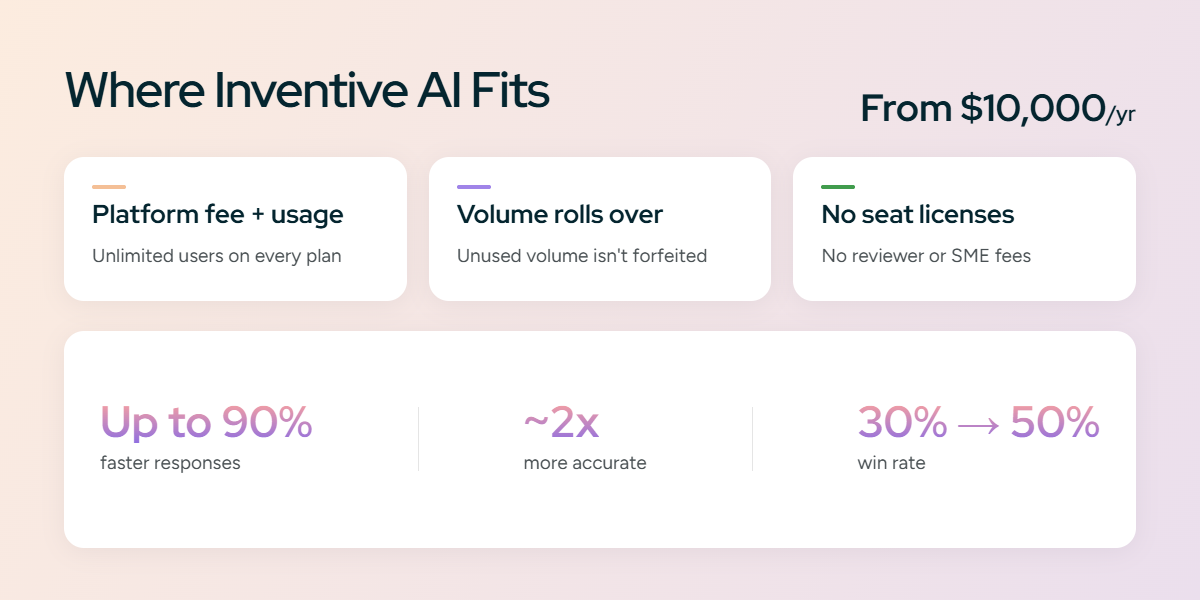
Inventive AI is an autonomous AI agent platform for RFPs, RFIs, DDQs, and security questionnaires. Its pricing model is the main way it differs from legacy tools on cost.
Instead of charging per seat, Inventive AI uses a platform fee plus usage, and every plan includes unlimited users. Pricing starts at $830 per month, billed annually, and unused volume rolls over month to month and into the next year, so you don't lose what you paid for. There are no seat licenses and no separate charge to add reviewers or SMEs.
The practical effect: your cost scales with the RFPs and questionnaires you work on, not with how many people touch them. Customers report responses up to 90% faster, RAD-AI found answers about 2x more accurate than other AI tools, and Insider raised its win rate from 30% to 50%.