RFI Scoring Template: A Practical Guide for Buyers and Vendors
TL;DR
- An RFI scoring template is a structured evaluation sheet buyers use to score vendor responses against weighted criteria rather than judging them subjectively.
- Most templates score six areas: capability fit, technical compatibility, security and risk, implementation approach, vendor experience, and pricing transparency.
- Scoring usually combines a rating scale, commonly one to five, with category weights that sum to 100%, producing a weighted total that ranks vendors.
- Mandatory requirements are handled as pass or fail before weighted scoring begins, since a vendor failing one is disqualified regardless of total score.
- Buyers typically shortlist three to six vendors from RFI to RFP, so the practical target is clearing the shortlist threshold rather than scoring highest.
- Vendors raise scores by structuring responses around the evaluation criteria and supplying verifiable evidence, because evaluators can only score what they can find and confirm.
Have you ever submitted an RFI response and wondered why a competitor reached the RFP stage instead of you? The answer usually lies in how buyers scored the response, not in what it said.
The frustration starts when evaluation criteria are unclear. Teams invest hours coordinating technical input, security documentation, and product detail, and the shortlist still looks unpredictable.
This guide covers how RFI scoring actually works, including the weighting mechanics, who scores what, and how vendors can structure responses to score well against a template they will never see.
What is an RFI scoring template?
An RFI scoring template is a structured evaluation sheet buyers use to compare vendor responses across predefined criteria. Evaluators assign a numerical score to each category rather than forming an overall impression, and category weights reflect what matters most for the project.
The output is a weighted total per vendor, which is what determines the shortlist. The template exists to make the decision defensible as much as to make it accurate, since procurement teams frequently need to explain why one vendor advanced and another did not.
How RFI scoring actually works
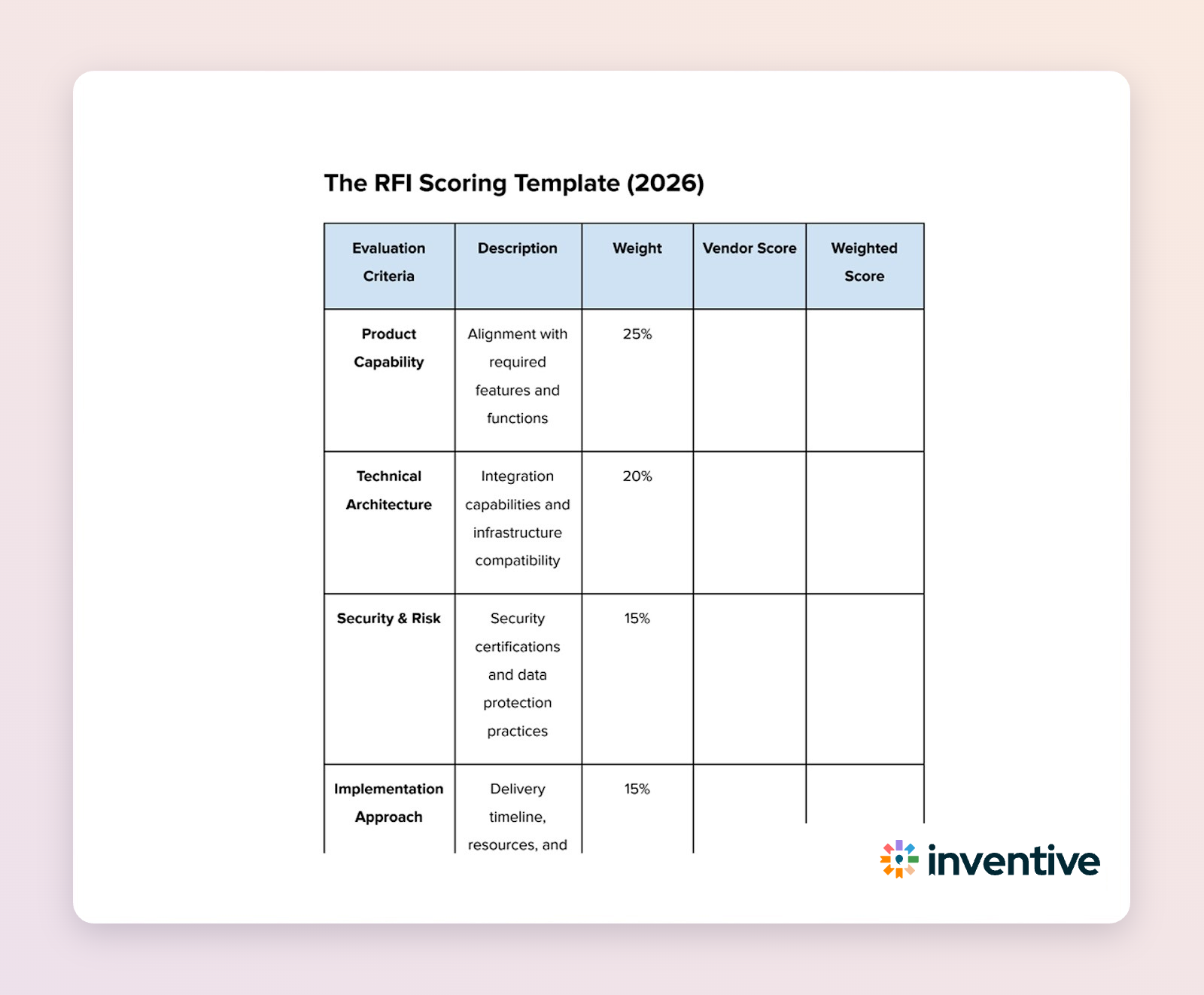
RFI scoring combines a rating scale with category weights. Each criterion is rated, the rating is multiplied by the category weight, and the weighted scores sum to a total out of 100.
The rating scale
Most buyers use a one to five scale, with defined anchors so different reviewers score consistently. Without written anchors, two evaluators reading the same answer routinely differ by two points.
Weighting the categories
Weights are set before the RFI is issued and should sum to 100%. A typical enterprise software RFI might weight as follows, though the distribution shifts heavily by industry and risk profile.
In regulated sectors, security frequently rises to 30% or more and capability fit drops accordingly. When it does, a strong product answer no longer compensates for a weak security section.
A worked example
Two vendors, scored against the weights above:
Vendor A has the better product and the stronger customer base, and loses. A single weak category carrying 20% weight cost more than two strong categories at 10% each gained. This is the pattern most vendors underestimate: an unanswered or thin section does more damage than an excellent section does good.
Mandatory requirements and pass or fail gates
Some criteria are not scored at all. Mandatory requirements such as a required certification, data residency, or a minimum insurance level are assessed as pass or fail before weighted scoring begins, and a failure eliminates the vendor regardless of total score.
Vendors should identify these first in any RFI. A weighted criterion you score poorly on costs points, while a mandatory requirement you miss costs the opportunity.
What buyers score in an RFI
.png)
Buyers typically score six areas, and understanding the emphasis helps vendors prioritize where to invest response effort.
- Product and capability fit: Whether your product directly addresses the problem described. Responses should map capabilities to the buyer's stated requirements in their own terminology rather than your product naming.
- Technical compatibility: Architecture, APIs, integration options, and scalability. Vendors who name the specific systems in the buyer's environment score higher than those describing general extensibility.
- Security and risk readiness: Certifications, policies, and controls, weighted heavily in regulated industries. Attach or reference evidence rather than asserting compliance.
- Implementation strategy: Whether your team can realistically deliver within the buyer's timeline and constraints. Specific phasing scores better than a stated methodology.
- Vendor experience and proof points: Comparable customers, references, and measurable outcomes. Comparable matters more than impressive, since a similar-sized customer in the same sector is stronger evidence than a larger one elsewhere.
- Pricing transparency: Even where an RFI requests no firm pricing, buyers assess how clearly the commercial model is explained. Evasiveness here reads as a negotiation posture and scores down.
Who scores an RFI
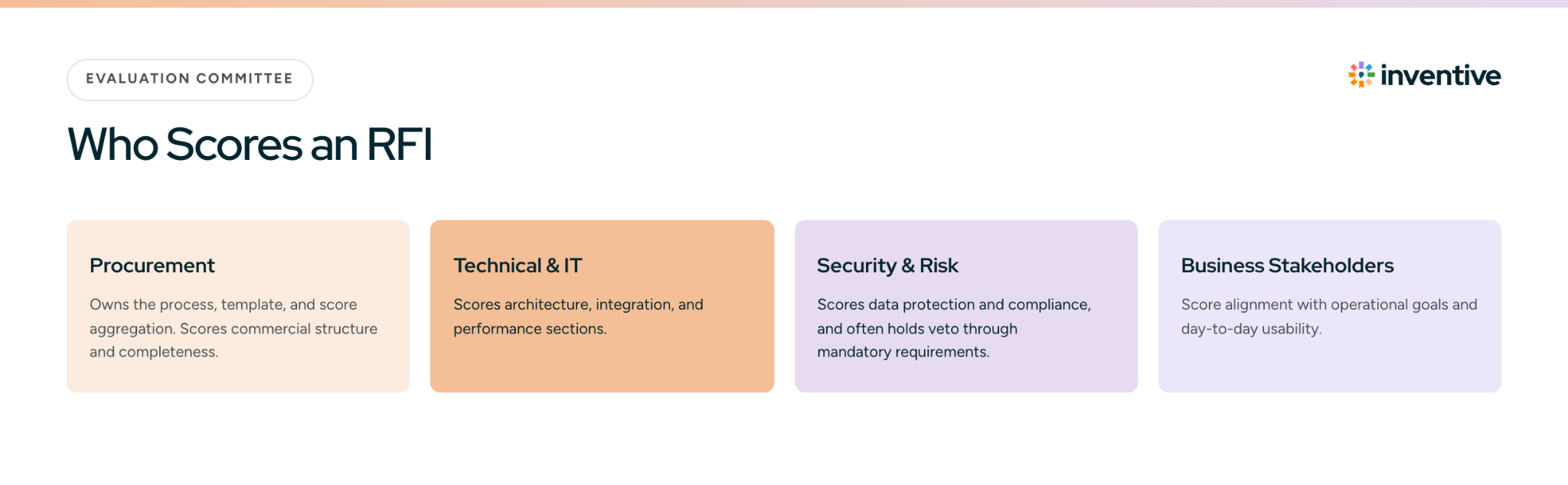
An RFI is scored by an evaluation committee rather than a single reviewer, with each function scoring the sections within its expertise.
- Procurement: Owns the process, the template, and score aggregation. Scores commercial structure and completeness.
- Technical and IT: Scores architecture, integration, and performance sections.
- Security and risk: Scores data protection, compliance, and controls, and frequently holds a veto through mandatory requirements.
- Business stakeholders: Score alignment with operational goals and usability for the teams who will run the system.
The practical consequence for vendors is that no single reader sees your whole response. Each section is read in isolation by someone who did not read the others, which is why a section that depends on context established elsewhere scores poorly.
How analysts score vendor RFIs
Analyst firm RFIs work differently from procurement RFIs, and vendors treating them the same way underperform. Firms running evaluations such as the Gartner Magic Quadrant or Forrester Wave use their own published criteria and score against a market definition rather than a single buyer's requirement.
Four differences that change how you should respond:
- Criteria are published in advance: Inclusion criteria and evaluation dimensions are usually documented before the cycle opens, so the weighting is knowable rather than inferred.
- Claims are verified through customer references: Analysts check capability claims against reference customers they select, so an overstated answer surfaces later in the process rather than passing unnoticed.
- Roadmap carries real weight: Procurement RFIs score what exists today. Analyst evaluations score strategy and trajectory alongside current capability.
- Market definition governs relevance: Capability outside the defined market scope earns nothing, however strong. Answering the market definition is the first requirement.
For a first-time submission, the practical advice is to start with the inclusion criteria and confirm you clear them before investing in the response itself, since most first-time failures are eligibility failures rather than scoring failures.
The 5-step RFI evaluation process
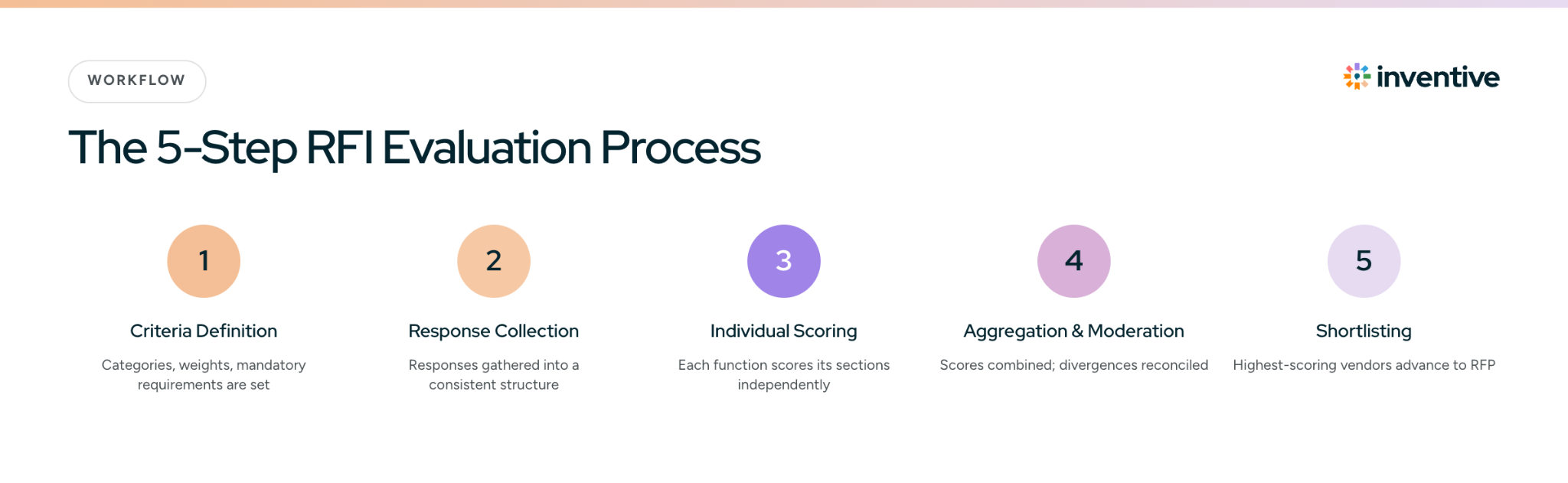
Understanding the workflow helps vendors align responses with how decisions are actually made.
- Step 1, criteria definition: Before the RFI is released, procurement defines scoring categories, weights, and any mandatory requirements. This is where the outcome is largely shaped.
- Step 2, response collection: Responses are gathered and organized so evaluators review them in a consistent structure.
- Step 3, individual scoring: Each function scores its own sections independently, usually without seeing other reviewers' scores.
- Step 4, score aggregation and moderation: Scores are combined using the weightings. Many buyers hold a moderation session where large divergences between reviewers are discussed and reconciled.
- Step 5, shortlisting: Highest-scoring vendors advance to RFP, demonstration, or deeper technical review.
The moderation step in stage four is worth knowing about as a vendor. Where two reviewers score the same answer very differently, the usual cause is ambiguity in the response rather than disagreement about your product.
How vendors can score higher
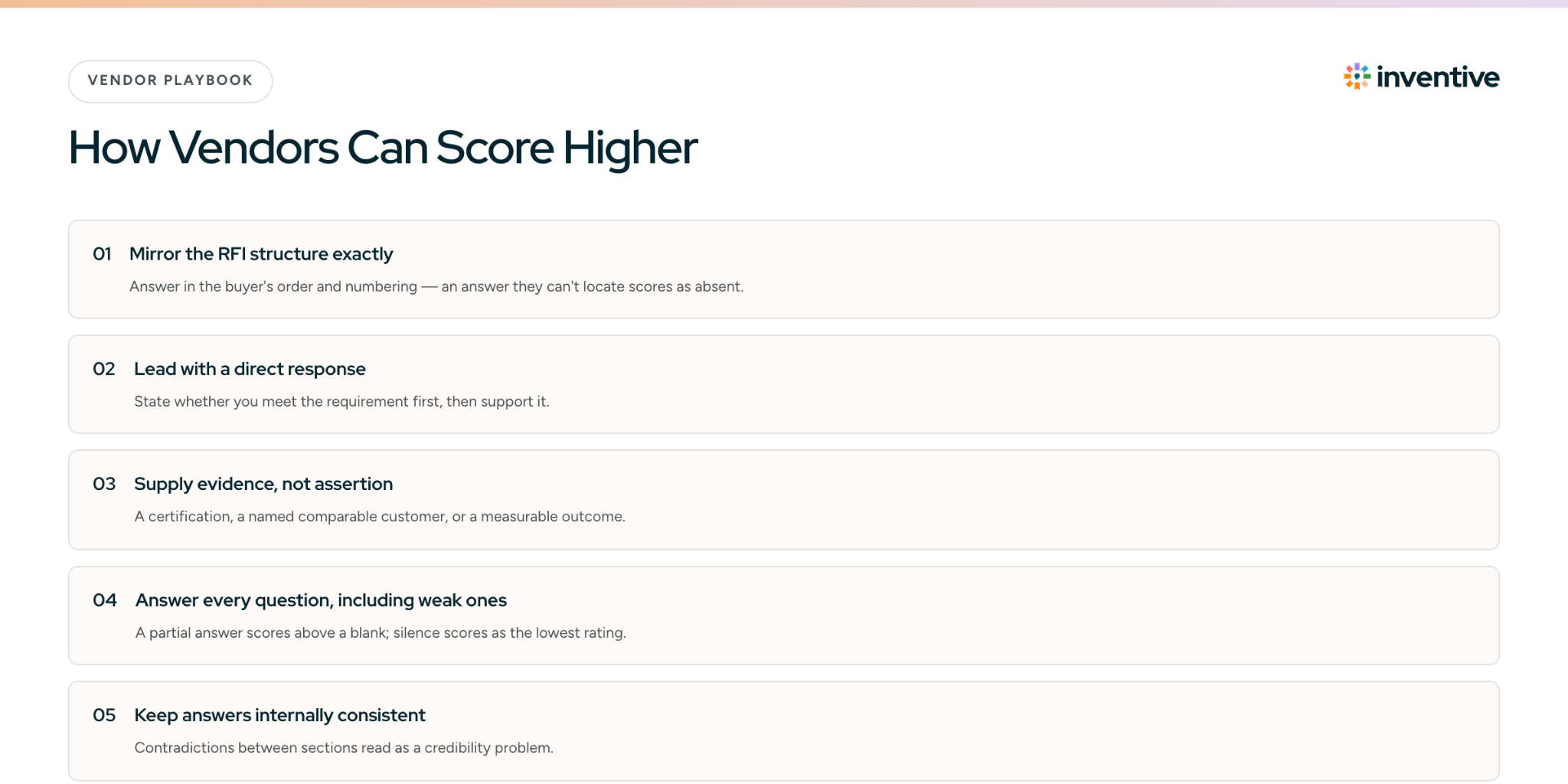
Vendors cannot see the scoring template, but they can respond as though they can. Five practices have the most effect on score.
- Mirror the RFI structure exactly: Answer in the buyer's order and their numbering. Evaluators score with the question list open, and an answer they cannot locate scores as absent.
- Lead each answer with a direct response: State whether you meet the requirement in the first line, then support it. Evaluators reading forty responses do not hunt for the answer inside a paragraph.
- Supply evidence, not assertion: A certification name with its audit period, a named comparable customer, or a measurable outcome moves a four to a five. Unsupported superlatives do not.
- Answer every question, including weak ones: A partial answer scores above a blank. Silence is scored as one, and reads as a capability gap the evaluator will assume is worse than it is.
- Keep answers internally consistent: Contradictions between sections are treated as a credibility problem rather than an error, particularly between technical and security answers.
Teams building a repeatable source for these answers will find the structure in the guide to RFI templates by industry, and sector-specific handling in the walkthrough on responding to insurance RFIs.
RFI scoring compared with RFP scoring
RFI scoring screens vendors on general capability and fit, while RFP scoring evaluates a detailed proposal on solution design, pricing, and delivery commitment.
The criteria established during RFI screening often carry into the RFP stage, with the same priorities shaping how buyers evaluate final proposals. For more detail on building the later-stage framework, see our guides to RFP evaluation criteria, RFP scoring templates, and vendor selection criteria.
Move from RFI screening to RFP selection with Inventive AI
RFI responses often require input from sales, presales, solutions, and other subject-matter experts. Teams have to find relevant information, verify that it is still accurate, and make sure responses are consistent before submission. The writing itself is often the easy part.
Inventive AI's RFP agent brings that knowledge together, drafts responses from verified sources, and helps teams maintain consistency across submissions.
- 2x higher quality responses: Generates structured drafts from verified knowledge sources, helping teams produce clearer answers. See the response accuracy case study.
- Context engine: Pulls from past responses, documentation, and product information to ground answers in your existing content.
- Conflict detection: Identifies contradictions across knowledge sources before they make it into a submission.
- Outdated content detection: Flags references to superseded capabilities, expired certifications, and retired policies.
- Collaborative interface: Gives sales, presales, solutions, and proposal teams a shared workspace instead of coordinating responses across email threads.
Insider used Inventive AI to achieve a 50% higher win rate and 90% faster RFP responses. See the full results in their case study.




%2010%20Free%20Response%20Templates%20By%20Industry%20%26%20Service.jpg)


.avif)