RFP Examples: 7 Real Structures, Industry Samples, and How to Read One
See what real RFPs look like section by section, with RFP examples across seven industries, a sample outline to adapt, and reading tips for vendor teams.
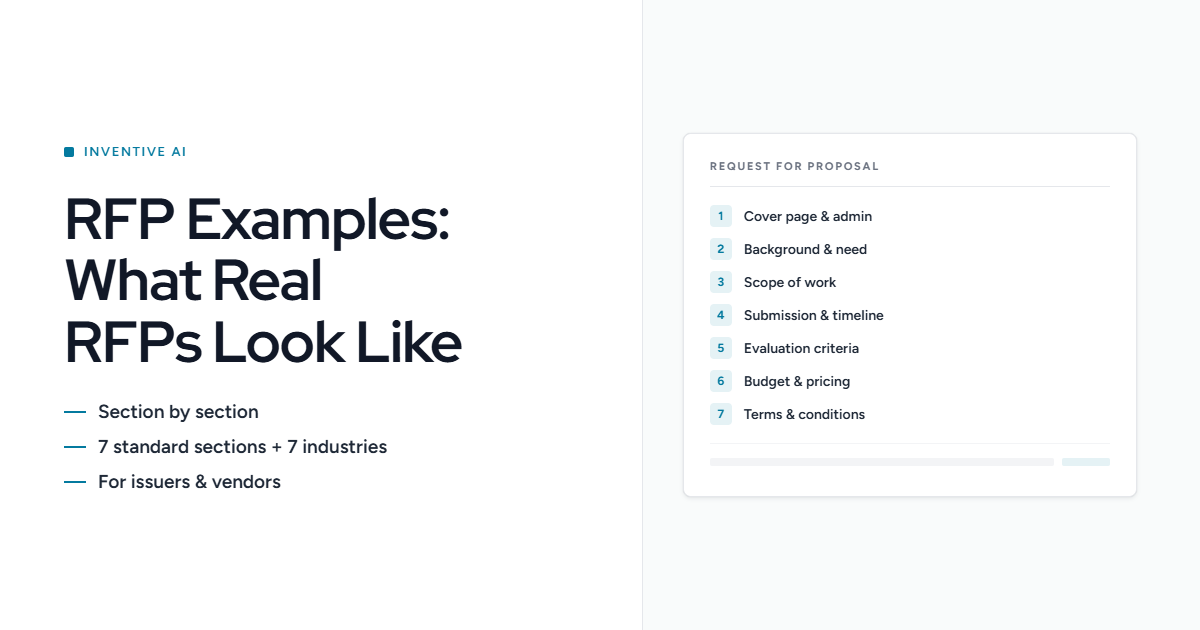
Most people searching for RFP examples want the same thing: to see a real one before they write one, or before they answer one. The second group is larger than most example roundups acknowledge. For every procurement manager drafting a request for proposal, there are a dozen vendor teams on the receiving end working to understand it, judge their chances, and decide whether the next 30 hours of response work is worth it.
This guide serves both readers. It covers the anatomy of a standard RFP, a sample outline you can adapt, examples of what RFPs look like across seven US industries, and one thing most examples posts leave out: how to read an RFP the way experienced proposal teams do, so the document tells you whether to bid before you write a word.
Key Takeaways
- An RFP is the document a buyer issues when the purchasing decision depends on capability and fit, not price alone. It differs from an RFQ (a price on a fixed spec) and an RFI (early market research).
- Nearly every RFP shares seven sections: cover page, background, scope of work, submission requirements, evaluation criteria, pricing instructions, and terms and conditions.
- The structure holds across industries, but the emphasis shifts. Software RFPs are requirement-heavy, healthcare RFPs are compliance-gated, and consulting RFPs focus on named individuals.
- Before responding, spend twenty minutes reading the RFP for its evaluation weights, mandatory pass/fail gates, timeline fairness, and any deal-breaking terms.
- The best RFPs publish their scoring weights, write an unambiguous scope, and consolidate their Q&A. Each is a signal vendors can use to judge how mature and winnable an opportunity is.
What Is an RFP? A Sixty-Second Refresher
A request for proposal (RFP) is a formal document a buyer issues to solicit detailed proposals from vendors when the purchasing decision depends on more than price. The buyer describes a problem, sets requirements, and asks vendors to respond with an approach, a team, a timeline, and a cost. Those proposals are then scored against published or unpublished criteria, and a winner is selected.
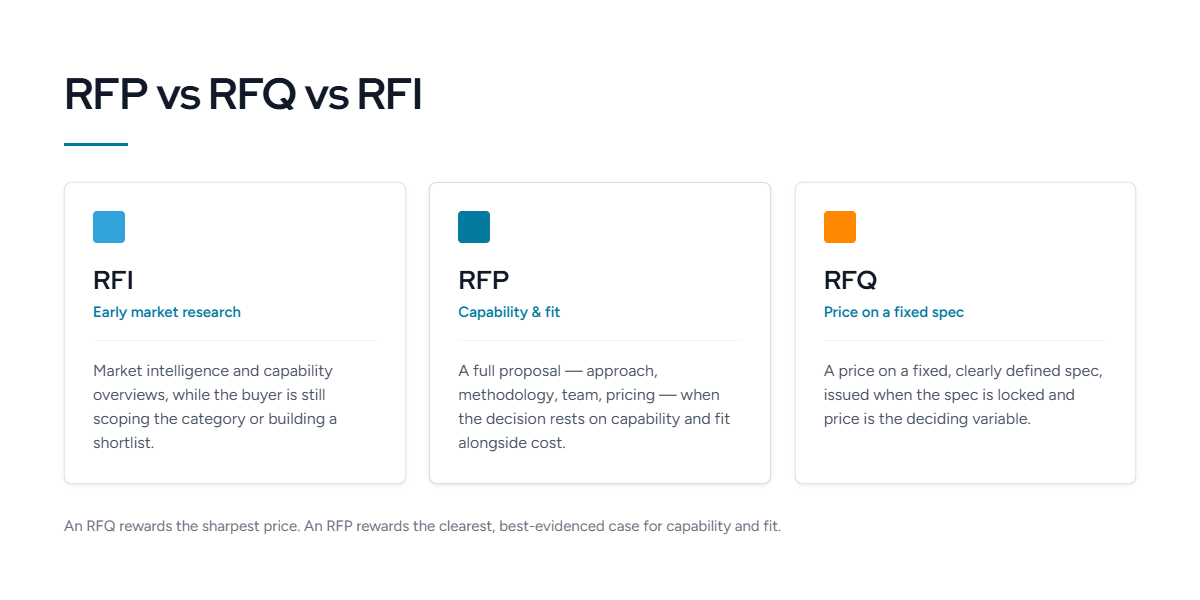
An RFP is one of three related documents that buyers often confuse:
For vendors who respond to RFPs regularly, the difference between these documents is practical, not academic. An RFQ rewards the sharpest price on a fixed spec. An RFP rewards a response that mirrors the buyer's evaluation structure. Treat the two the same way, and you will lose both.
Also Read: Your Ultimate Guide to RFPs (Request for Proposals)
RFP Structure: The 7 RFP Sections in Nearly Every Example
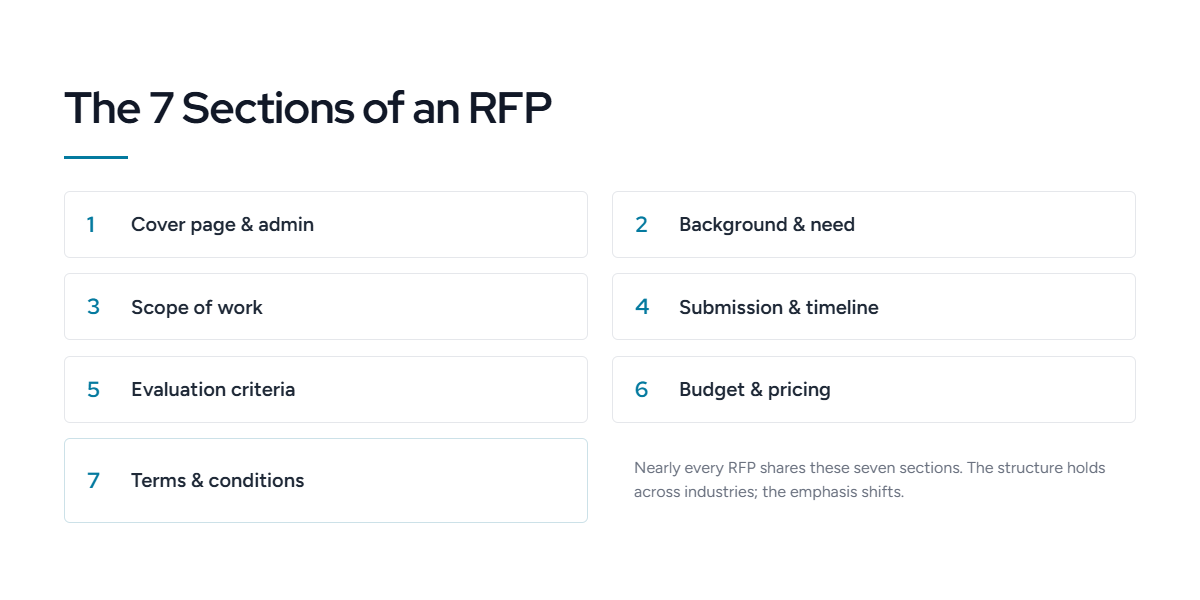
Read enough RFPs and a clear pattern emerges. Whether the issuer is a county government, a hospital system, or a SaaS company sourcing a new vendor, the same seven sections appear in some order. Here is what each one does, and what a vendor should look for inside it.
1. Cover page and administrative summary
This section lists the RFP title, reference number, issuing organization, issue date, and submission deadline. It looks routine, but it is also the first place deals are lost. Vendor teams that skim past the reference number or the required submission method get disqualified on technicalities that have nothing to do with the quality of their solution.
2. Background and statement of need
This section explains who the buyer is and why they are going to market now. Strong examples keep it to a few paragraphs. For vendors, it is where you find the real problem behind the procurement, which is rarely stated as directly anywhere else in the document.
3. Scope of work
The scope of work is the heart of the RFP: deliverables, timelines, volumes, service levels, what is included, and what is explicitly excluded. A vague scope produces proposals that cannot be compared against one another. If you are responding and the scope can be read three different ways, submit clarifying questions early. Guessing at scope is how a bid priced for 200 users loses to one priced for 2,000, or the reverse.
4. Submission requirements and timeline
This section covers format, page limits, required forms, the question-and-answer window, and the full procurement calendar from issue date to award. Federal and state response windows in the US commonly run 30 to 60 days, while commercial RFPs often allow two to four weeks.
5. Evaluation criteria
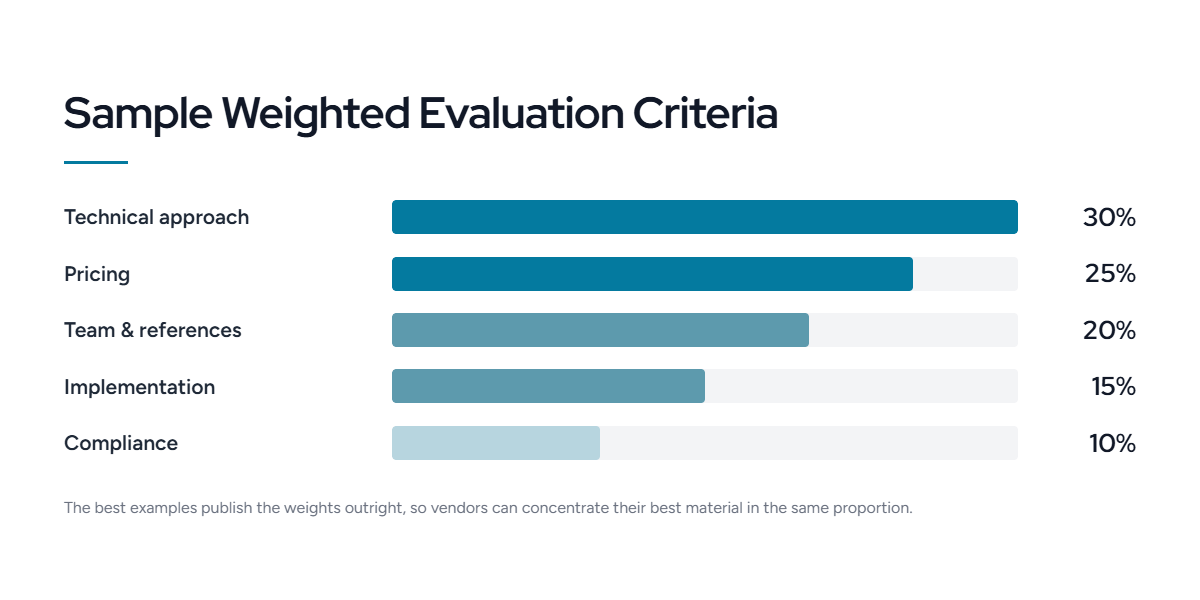
This section explains how proposals will be scored. The best examples publish the weights outright, for example technical approach 30%, pricing 25%, team and references 20%, implementation plan 15%, and compliance 10%. When the weights are published, your response outline should follow them almost mechanically. We break down real scoring frameworks in our guide to RFP evaluation criteria examples.
6. Budget and pricing instructions
Some issuers disclose a budget range or ceiling. Most provide a pricing template instead and ask for a specific cost breakdown. Follow the template exactly, because pricing presented in your own format reads as evasive.
7. Terms and conditions
This section covers contract terms, insurance minimums, confidentiality, payment terms, and compliance standards. Vendors should read it before writing anything else. A net-90 payment term or an uncapped liability clause you cannot accept is a reason to walk away on day one, not a surprise to discover in week three.
A Sample RFP Template Outline You Can Adapt
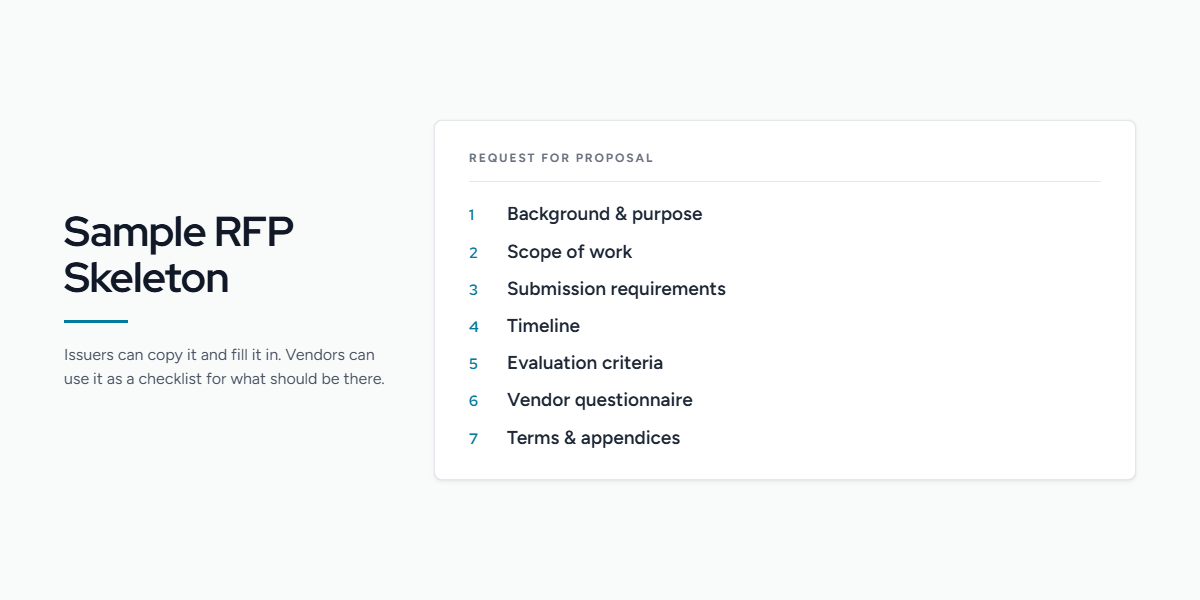
A Sample RFP Template Outline You Can Adapt
Here is an example that reflects how well-constructed US RFPs are organized. Issuers can copy it and fill it in. Vendors can use it as a checklist for what a complete RFP should include, and for what to ask about when something is missing.
REQUEST FOR PROPOSAL
Issued by: [Organization]
RFP Title: [Category or project name]
Reference No: [Number] | Issue Date: [Date]
Questions Due: [Date] | Proposals Due: [Date, time, time zone]
1. BACKGROUND AND PURPOSE
Who we are, the problem we are solving, why now,
and approximate scale or contract value if disclosable.
2. SCOPE OF WORK
Deliverables, timelines, volumes, SLAs.
In scope. Explicitly out of scope.
3. SUBMISSION REQUIREMENTS
Response format and method. Page limit.
Pricing template. Late submissions policy.
Pre-proposal conference details, if any.
4. TIMELINE
Issue date, Q&A window, answers published,
proposals due, evaluation period, award date.
5. EVALUATION CRITERIA
Published scoring weights by category.
Any mandatory pass/fail requirements.
6. VENDOR QUESTIONNAIRE
Structured questions, each mapped to a criterion.
7. TERMS AND CONDITIONS
Contract terms, insurance, confidentiality, compliance.
8. APPENDICES
Required forms, pricing sheets, technical specs.
RFP Examples by Industry: 7 Real Sample RFPs
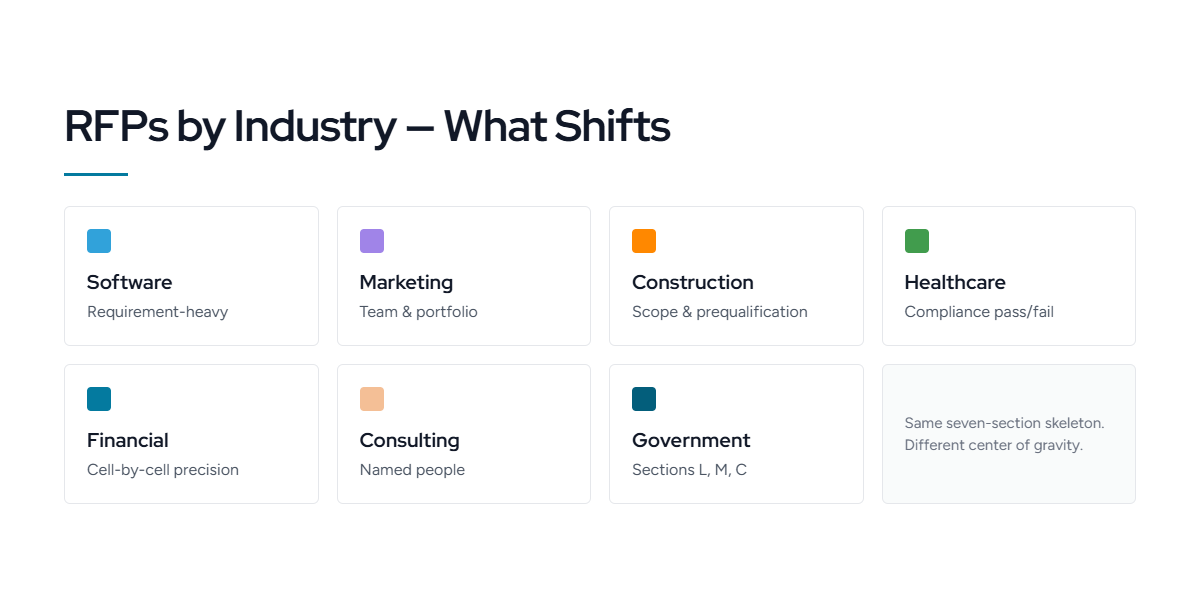
The seven-section example holds across industries, but the emphasis shifts from one sector to the next. Here is what RFPs actually look like in seven US sectors, and what vendor teams should notice in each.
Technology and software RFPs
Software RFPs contain a high volume of detailed requirements. Expect functional requirement matrices, integration requirements, data migration questions, security questionnaires attached as appendices, and user counts that drive pricing.
Real documents you can open right now:
City of Duluth, MN: case management software RFP. A municipal software procurement with required forms and both paper and digital submission, typical of how local governments buy systems.
Institute of International Education: web design and hosting services RFP. Issued in 2026 with a five-year performance period, it shows how a long-term service relationship gets scoped and priced.
COAST transit authority (NH): website redesign and maintenance RFP. A compact 2026 example of a small public agency structuring a web project without overcomplicating it.
Vendor takeaway: the security and compliance sections are usually pass/fail gates. Answer them completely and literally. A vague line such as "we take security seriously" reads as a non-answer and can get you disqualified.
Marketing and creative services RFPs
Marketing and creative RFPs combine a defined structure with room for the agency's creative judgment. The strongest ones hand agencies the raw materials, brand guidelines, audience data, and campaign objectives, then evaluate responses on strategic thinking and past campaign results rather than feature checklists.
Two worth studying:
Monterey County CVB: agency of record RFP. It provides rich background on the destination's business plan, target market, and team structure, exactly the raw material an agency needs to respond well.
Silicon Valley Clean Energy: marketing and advertising services RFP. A clear multi-channel scope from a public agency, with submission requirements agencies can follow without guesswork.
Vendor takeaway: in practice, marketing and creative buyers often give heavy weight to team rapport and portfolio strength, even when the published criteria emphasize other factors. Named team members and relevant case work carry the response.
Construction RFPs
In construction RFPs, the scope of work section is often longer and more decisive than the rest of the document combined. Expect bills of quantities, technical drawings attached as appendices, prequalification gates, milestone payment structures, and non-negotiable safety standards.
Real documents to study:
NYC Health + Hospitals: construction management services RFP. A 2026 solicitation from one of the largest US public health systems, seeking up to seven construction management firms for as-needed infrastructure and modernization work.
Hesperia Recreation and Park District: public works construction RFP. A 2026 posting covering facility restoration, roofing, HVAC, electrical, and plumbing across multiple sites.
Incourage Community Foundation: construction manager RFP. Seven pages, with the issuer's vendor priorities stated on page one, proof that a good RFP does not need to be long.
Vendor takeaway: prequalification requirements come first. If you cannot clear them, the quality of the rest of your proposal will not matter. Our construction RFP template shows the full structure.
Healthcare RFPs
In healthcare RFPs, compliance is a pass/fail gate rather than a scored criterion, which means it can eliminate you before your proposal is ever evaluated. HIPAA obligations, data residency, and interoperability requirements sit at the front of hospital and payer RFPs, and vendors who cannot attest to them are removed before scoring begins.
Open these:
Puerto Rico Health Insurance Administration: State Funded Health Plan RFP. A 2026 payer-side procurement soliciting managed care organizations, dense with the compliance and reporting requirements that define healthcare RFPs.
University of New Mexico Hospital: strategic healthcare consultant RFP. Note how the evaluation criteria weight technical approach, management approach, experience, and cost, a common pattern for consulting engagements.
Vendor takeaway: generic security language reads as a red flag to healthcare evaluators. Cite the specific certification, the audit date, and the scope it covers.
Financial services RFPs
Asset management, banking, and insurance RFPs are among the longest and most standardized you will encounter. Expect tables for assets under management, client base reporting, fee structure disclosures, and lengthy qualification sections.
Two real examples:
Office of the State Treasurer of Delaware: endowment manager RFP. It includes the assets-under-management and client-base reporting tables that define this category.
Town of Cutler Bay, FL: financial advisory services RFP. A compact 2026 municipal example showing the same qualification-heavy structure at smaller scale.
Vendor takeaway: these issuers compare responses cell by cell, so precision and completeness matter more than narrative, the opposite of the marketing RFP above. Reading the document type correctly is half the response strategy.
Professional services and consulting RFPs
In consulting RFPs, the buyer is hiring the specific people who will do the work, not the firm's brand. These RFPs ask for named team members, individual CVs, time commitments, and a plan for what happens when a key person leaves mid-engagement.
Real documents to study:
Morrow County, OR: project management services RFP. It states three pass/fail criteria in plain language, on-time submission, proposal completeness, and copy count, small details that disqualify real vendors.
New Jersey City University: data analytics consultant RFP. A thorough question list plus a supplier diversity policy, showing how universities structure consulting procurements.
Vendor takeaway: answer the key-person question honestly and specifically. Evaluators use it to tell firms with real staffing depth from firms that only look strong on paper. See our consulting RFP template for the standard structure.
Government RFPs
Federal solicitations follow the Uniform Contract Format, a thirteen-section structure (Sections A through M) defined in the Federal Acquisition Regulation. Section C holds the statement of work, Section L tells you exactly what to submit, and Section M tells you exactly how it will be scored. FAR 15.203 requires solicitations to disclose evaluation factors and their relative importance. State and local RFPs are less rigid but follow a recognizably similar logic.
To read live federal RFPs in full, browse SAM.gov's contract opportunities, the government's official portal for open solicitations. For how public-sector issuers think about structuring these documents, the Harvard Government Performance Lab's RFP guidebook is a strong, permanent public reference.
Vendor takeaway: experienced government proposal teams read Section L first, Section M second, and Section C third. Compliance with Section L and alignment to Section M decide awards more often than the quality of the writing does.
How Vendors Should Read an RFP Before Writing a Word
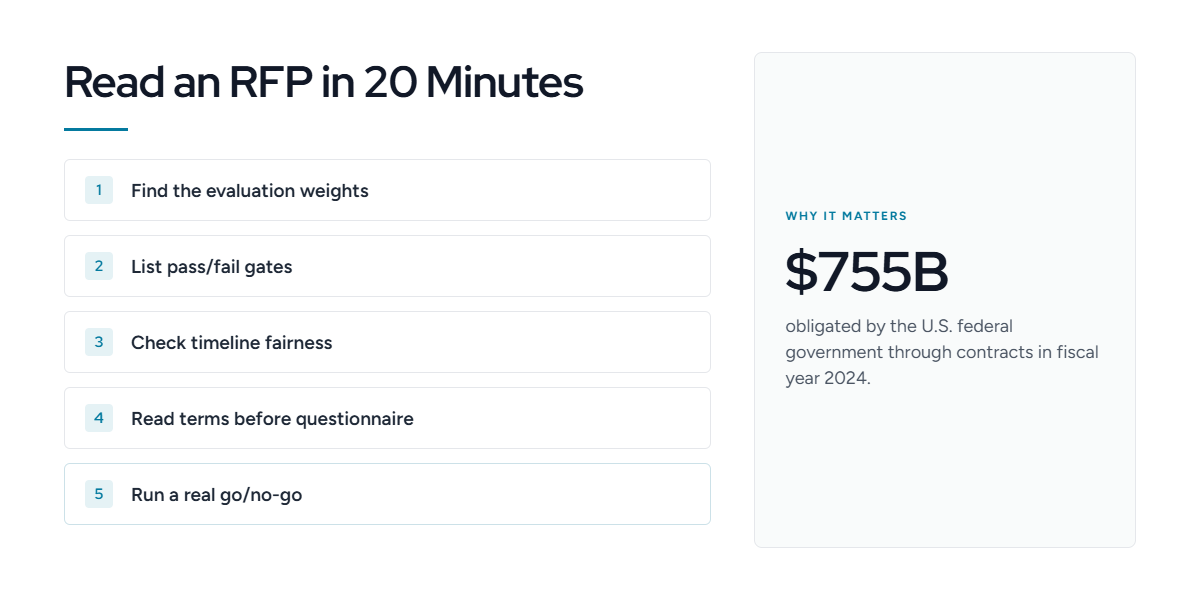
RFPs decide how enormous sums are spent. In fiscal year 2024, the U.S. federal government alone obligated about $755 billion through contracts, much of it via competitive solicitations, according to the U.S. Government Accountability Office. A single response can absorb dozens of hours, and you win only a share of what you bid, so before committing that time, spend the first twenty minutes on a structured read:
- Find the evaluation weights. If technical approach carries 30% and price carries 25%, concentrate your best material in that same proportion. If no weights are published, treat that as information too: it often signals a less mature procurement, or one where the buyer already has a preferred vendor in mind.
- List every mandatory requirement and pass/fail gate. Certifications, insurance minimums, reference counts, and submission formats are each binary. Miss one and the other 114 answers never get read.
- Check the timeline for fairness. A complex RFP issued on a Monday with a deadline that Friday usually means an incumbent is already favored and the process is largely a formality. You can still bid if the relationship is worth building, but do it knowing the odds.
- Read the terms before the questionnaire. Deal-breaking payment or liability terms surface within minutes and can save you the entire response effort.
- Run a real go/no-go decision. Weigh strategic fit, competitive position, resource cost, and win probability. Teams that skip this step respond to everything and win less. The RFP questions vendors should ask before committing are worth building into a standing checklist.
RFP Best Practices: What Strong Examples Do Differently
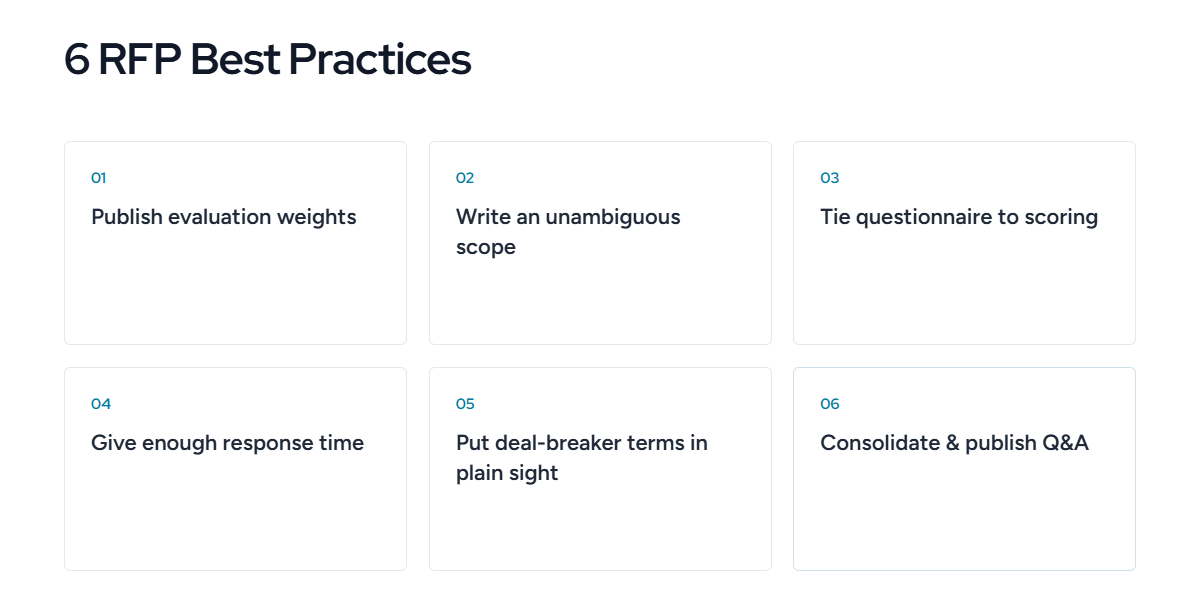
Every example above, from the county construction RFP to the federal solicitation, is ultimately judged by the proposals it produces. These six practices separate RFPs that attract strong, comparable proposals from those that produce weak or mismatched ones, and each carries a lesson for the vendors responding, too.
1. Publish the evaluation weights
Some buyers hide their scoring weights, assuming disclosure gives away their strategy. In practice, publishing the weights helps them: vendors who know that implementation carries 15% write focused implementation sections instead of guessing.
For vendors: when weights are published, mirror them in your structure. Evaluators score responses organized around their own criteria more easily, and they notice when you have done it.
2. Write a scope that can only be read one way
Specify volumes, user counts, locations, and boundaries. An ambiguous scope produces bids ranging from $50K to $500K for the same work, none of which can be compared.
For vendors: ambiguity is your cue to use the Q&A window actively. Every clarifying question you ask is answered for all bidders, which levels the field and sharpens your own estimate.
3. Keep the questionnaire tied to scoring
Twenty questions, each mapped to an evaluation criterion, beat forty-five questions that serve curiosity rather than scoring. Vendors juggling eight RFPs a month will deprioritize the bloated one.
For vendors: when you do face a 100-question RFP, answer placement matters. Put the substance in the answer itself rather than pointing evaluators to an appendix they are unlikely to open.
4. Give vendors enough time to be thoughtful
Two weeks is the floor for commercial RFPs of any complexity, and public-sector windows of 30 to 60 days exist for a reason: response quality drops sharply when timelines compress.
For vendors: treat a short window as a factor to weigh in your go/no-go decision, not just a frustration. Teams with automated first drafts can handle compressed timelines that manual teams cannot.
5. Put deal-breaker terms in plain sight
Net-90 payment, uncapped liability, and mandatory on-site presence are all terms that can end a deal. Burying them in an appendix wastes three weeks of everyone's evaluation effort.
For vendors: look for these terms in your first read, precisely because many issuers do bury them.
6. Consolidate and publish the Q&A
Answering each vendor privately creates unequal information and duplicate work, while a single published Q&A document keeps the process clean.
For vendors: read the full consolidated Q&A even for questions you did not ask. Competitor questions reveal how the field is interpreting the scope, and sometimes reveal who your competitors are.
Also Read: RFP Response Best Practices: 10 Tips to Win More Bids in 2026
How Inventive AI Helps Vendor Teams Answer Any of These RFPs
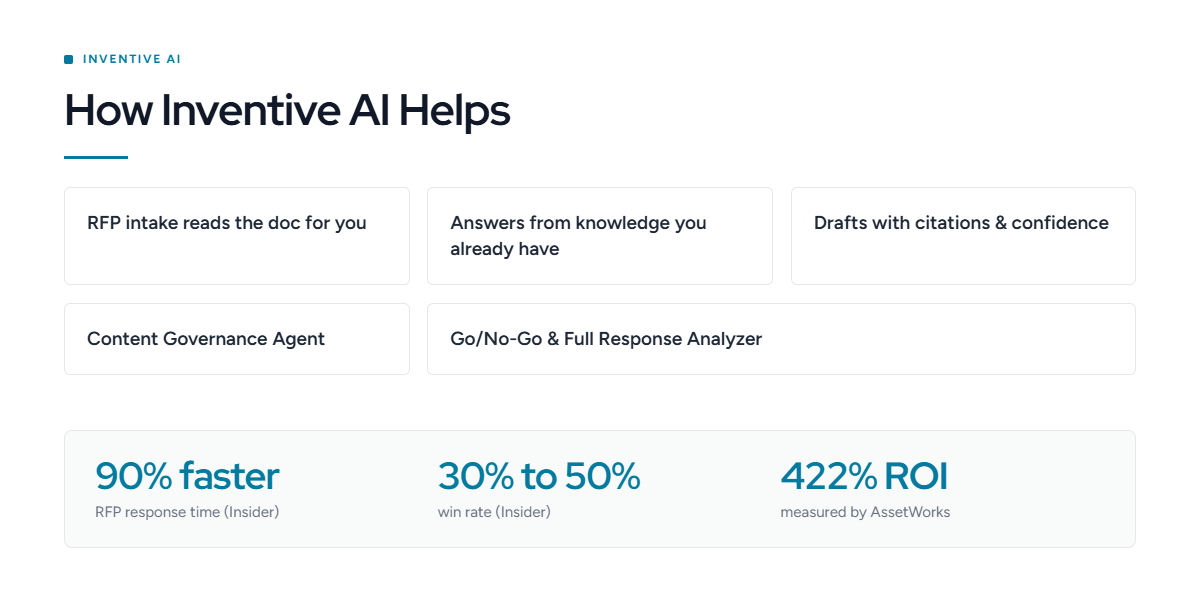
Every example in this guide ends the same way for a vendor: a deadline, a long questionnaire, and answers scattered across your company's documents, wikis, and past proposals. Inventive AI is an autonomous AI agent platform built for exactly that moment. Its agents run the response process end to end, with your team staying in the loop for approvals.
Here is what that looks like in practice:
- RFP intake that reads the document for you. Upload the RFP in PDF, Word, Excel, or PowerPoint, and an agent semantically extracts every question, section, and requirement for your team to validate.
- Answers drawn from knowledge you already have. The Knowledge Hub connects to SharePoint, Google Drive, Salesforce, Confluence, Notion, and more, so there is no new content repository to build or maintain.
- Drafts with citations and confidence scores. Every generated answer shows its source, and when the information does not exist, the agent flags it as unavailable instead of guessing.
- A Content Governance Agent that keeps knowledge current. Conflicting, outdated, and duplicate content is flagged automatically, so the answer library stays trustworthy between RFPs.
- Strategic agents for the hard parts. A Go/No-Go Agent scores the opportunity early, and a Full Response Analyzer checks the finished response for compliance gaps and contradictions before submission.
Also Read: Best AI RFP Software 2026: Ranked & Compared
Frequently Asked Questions
How many questions does a typical RFP include?
There is no standard length. Commercial software RFPs range from a few dozen questions to well over a hundred, while government solicitations often pair a shorter questionnaire with heavy compliance documentation. Size your response effort to the questionnaire in front of you, not to any industry average.
How long do vendors usually get to respond to an RFP?
Vendors usually get 30 to 60 days to respond to US public-sector RFPs, with complex procurements allowing 90 days or more. Commercial RFPs move faster, often two to four weeks. Anything under two weeks for complex work is a signal worth weighing in your go/no-go decision.
What should a vendor do when an RFP is vague or missing details?
When an RFP is vague, use the question period, and use it early. Submit specific clarifying questions about scope boundaries, volumes, and evaluation weights. Answers are typically published to all bidders, so asking costs you no competitive ground. If the issuer declines to clarify anything material, document your assumptions explicitly in the proposal.
What are pass/fail criteria in an RFP?
Pass/fail criteria are requirements evaluated as binary gates before scoring begins, such as mandatory certifications, insurance minimums, on-time submission, required reference counts, or specific compliance attestations. A proposal that misses even one is typically eliminated regardless of how well it scores elsewhere, which is why experienced teams extract every mandatory requirement into a checklist before drafting.
Do government RFPs follow a standard format?
Federal government RFPs follow the Uniform Contract Format, thirteen sections labeled A through M, with proposal instructions in Section L and evaluation factors in Section M. State and local formats vary by jurisdiction but usually mirror the same logic: scope, submission rules, evaluation criteria, and terms in a predictable order.
Should an RFP disclose the budget?
Practice is split on whether an RFP should disclose the budget. Disclosing a range or ceiling produces proposals scoped to reality and saves both sides from a $50K-versus-$500K spread. Issuers who withhold the budget usually do so to avoid anchoring prices. For vendors, an undisclosed budget makes the Q&A window and your own discovery questions more important, not less.

.avif)