What Is an EOI? Meaning, Types, Process and How to Write One
TL;DR
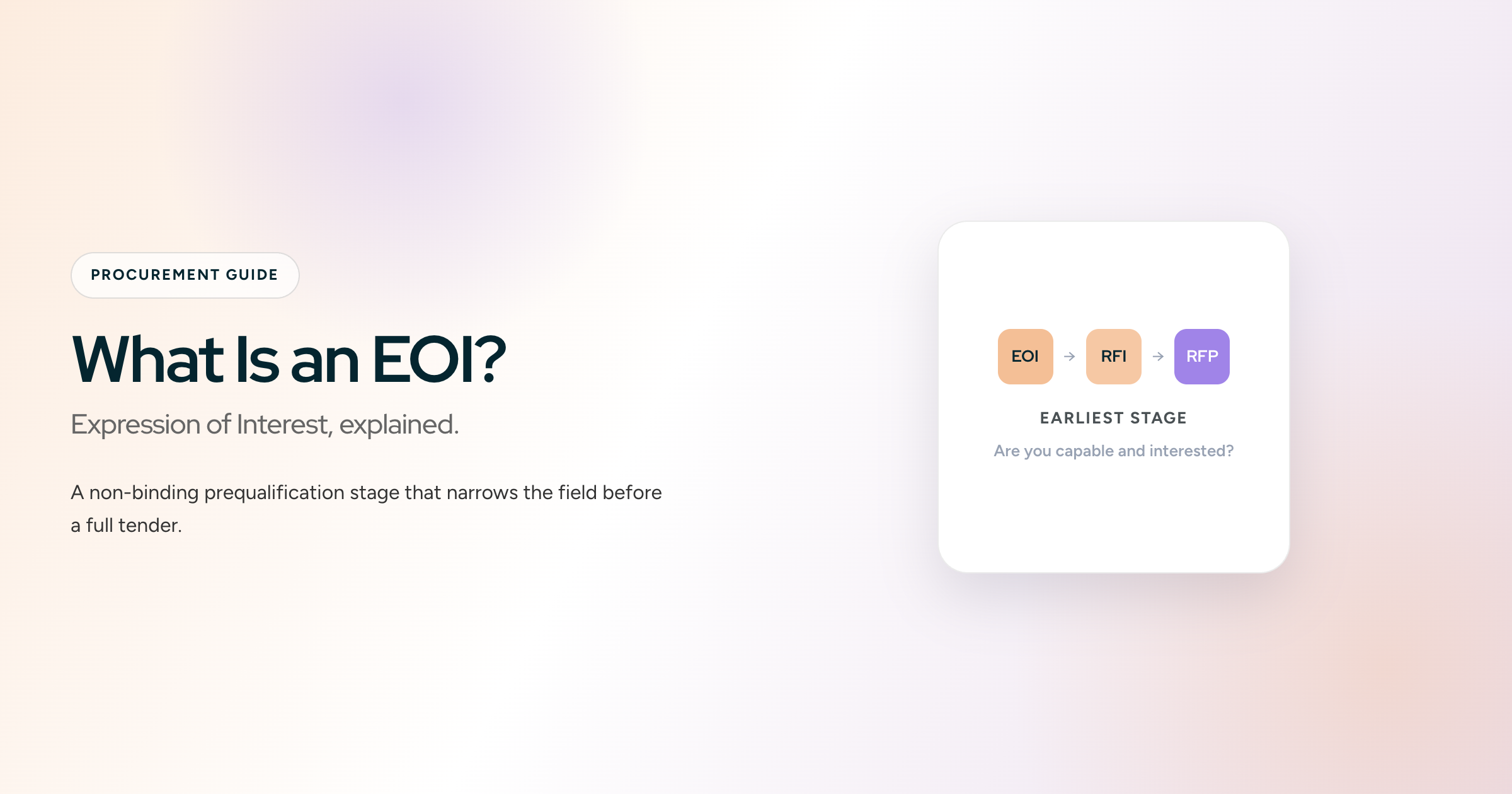
- EOI stands for Expression of Interest. It is a preliminary document used to register interest in an opportunity before any formal proposal or pricing is requested.
- In procurement, buyers issue an EOI to identify capable suppliers before running a full tender, and suppliers respond to get onto the shortlist.
- An EOI is non-binding on both sides. Responding creates no obligation to bid, and issuing one creates no obligation to award.
- A procurement EOI response covers organizational capability, relevant experience, accreditations, and capacity, but not detailed pricing or solution design.
- The term also appears in employment, where an EOI or letter of interest registers interest with an employer who has not advertised a role.
- EOI, RFI, RFP and RFQ sit at different stages. The EOI comes earliest and asks the narrowest question: are you capable and interested?
What Is an expression of interest (EOI)?
EOI stands for Expression of Interest. It is a short, formal document one party submits to register interest in an opportunity before committing to a detailed proposal.
The abbreviation appears in two distinct contexts. In procurement and tendering, an EOI is a prequalification document issued by a buyer and answered by suppliers. In employment, an EOI is an unsolicited approach to an employer, closer to what is usually called a letter of interest.
This guide covers the procurement sense in detail, with a section on the employment usage further down.
What Is an expression of interest in Procurement?
In procurement, an EOI is a prequalification document a buyer issues to identify which suppliers are capable and interested before running a full tender process. Suppliers respond with capability evidence rather than a priced solution.
The purpose is filtering. Running a full tender with twenty bidders wastes the buyer's evaluation capacity and the suppliers' bid effort, most of which is spent by firms who were never going to win. An EOI narrows the field before that cost is incurred on either side.
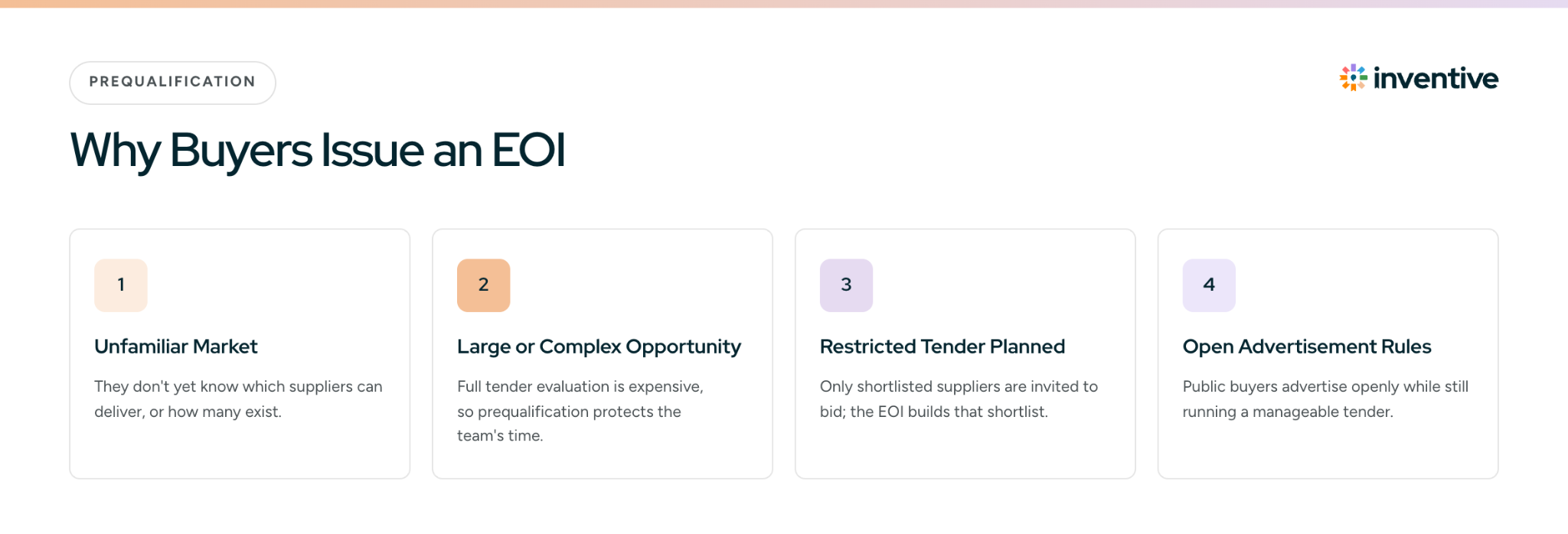
Buyers commonly issue one when:
- The market is unfamiliar: They do not yet know which suppliers can deliver the requirement or how many exist.
- The opportunity is large or complex: Full tender evaluation is expensive, so prequalification protects the evaluation team's time.
- A restricted tender is planned: Only shortlisted suppliers will be invited to bid, and the EOI is how that shortlist is built.
- Procurement rules require open advertisement: Public-sector buyers often must advertise openly, and an EOI stage lets them do that while still running a manageable tender.
An EOI is non-binding. Submitting one does not commit you to bidding later, and issuing one does not commit the buyer to proceeding at all. Opportunities are withdrawn at this stage regularly, which is worth factoring into how much effort a response deserves.
What to include in an expression of interest
An EOI response demonstrates capability and interest concisely. It is not a proposal, and treating it like one wastes effort on detail the buyer has not asked for and will not evaluate.
Two things to get right. Answer in the buyer's structure and numbering, since EOI evaluation is usually a compliance check rather than a nuanced read, and a missing item reads as a gap rather than an oversight. And keep experience genuinely comparable, because a large project in an unrelated sector is weaker evidence than a smaller one matching the buyer's scope and context.
How to write an expression of interest
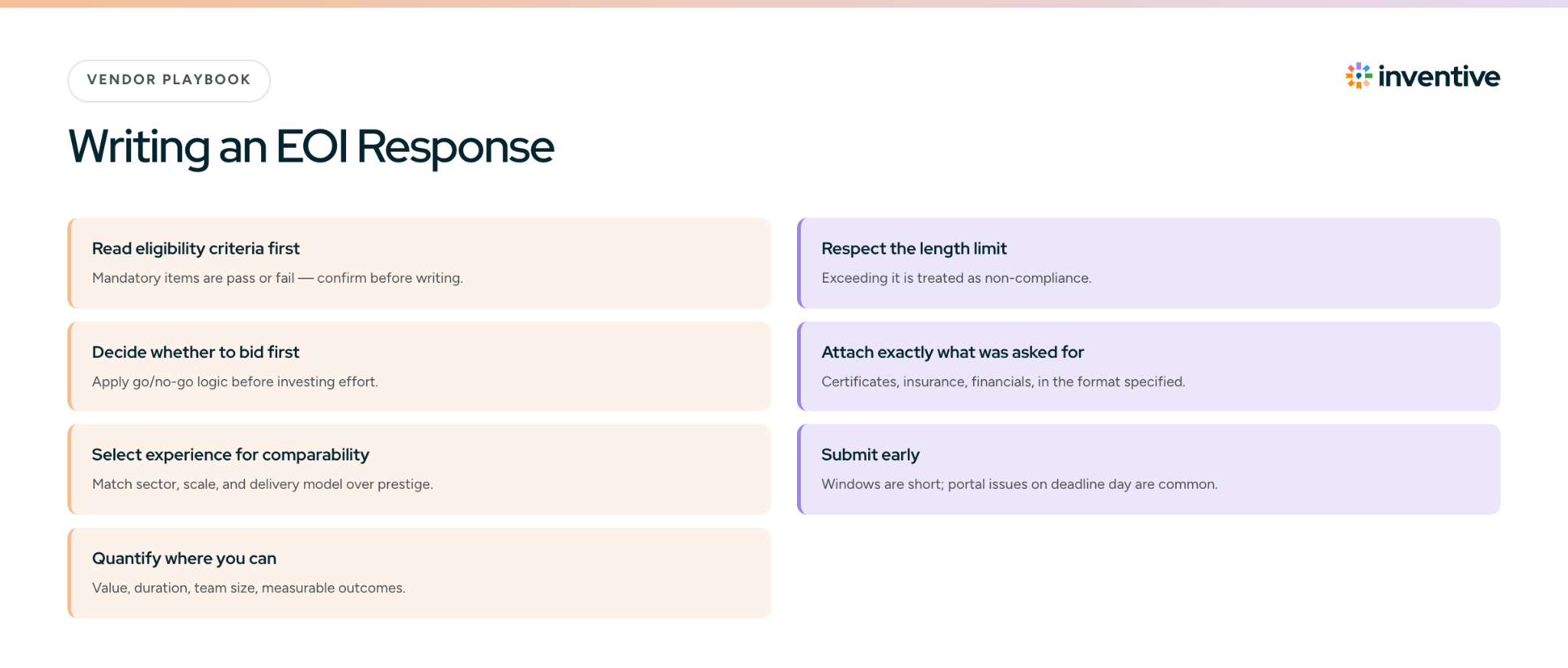
Write an EOI response by answering the buyer's stated questions in order, evidencing capability with comparable work, and keeping it within whatever length the document specifies.
- Read the eligibility criteria first: Most EOIs set mandatory requirements such as accreditations, insurance levels, or turnover thresholds. These are pass or fail, so confirm you clear them before writing anything.
- Decide whether to bid before you write: An EOI is cheap relative to a full tender, but not free. Apply the same go/no-go logic you would to any opportunity, since registering interest in work you cannot resource wastes a shortlist place you may want later.
- Select experience for comparability: Choose three or four projects matching the buyer's sector, scale, and delivery model rather than your most prestigious work.
- Quantify where you can: Contract value, duration, team size, and a measurable outcome carry more weight than descriptive capability language.
- Respect the length limit: EOIs frequently cap responses at a page count or word count, and exceeding it is treated as non-compliance in public-sector processes.
- Attach exactly what was asked for: Certificates, insurance evidence, and financial statements in the format specified. Administrative omissions are the most common cause of EOI rejection.
- Submit early: EOI windows are short, often two to three weeks, and portal submission problems on deadline day are common enough to plan around.
EOI vs RFI vs RFP vs RFQ
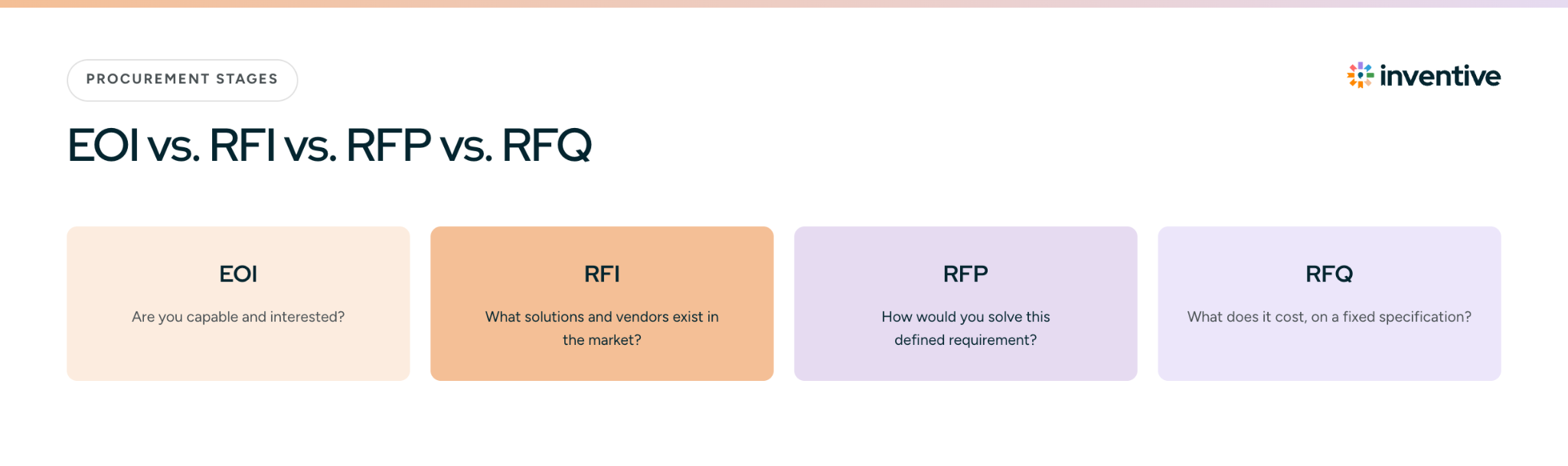
These four documents sit at different stages of a procurement process and ask progressively more of the supplier.
The distinction between an EOI and an RFI is the one most often blurred, and the two are sometimes used interchangeably. The practical difference is direction of interest. An RFI gathers market information to help the buyer define their requirement, while an EOI filters suppliers against a requirement the buyer has largely defined already.
Not every process runs all four stages. A common sequence is EOI to shortlist, then RFP to select, with the full comparison covered in the guide to the differences between RFI, RFQ and RFP.
What happens after an expression of interest?
After the EOI closes, the buyer assesses responses against the stated criteria and shortlists suppliers for the next stage, which is usually an RFP or an invitation to tender.
Three outcomes are normal:
- You are shortlisted: You receive the full tender documentation and move into a proper bid, where the tender writing work begins in earnest. Teams that reach this stage often find the bottleneck is content rather than writing, which is what the features worth paying for in RFP software are built to address.
- You are not shortlisted: Request feedback. EOI rejections are usually specific, often a missing accreditation or insufficient comparable experience, and that is actionable for next time.
- The process is withdrawn: Funding changes, requirements shift, or the buyer decides to procure differently. This is common at EOI stage and is not a reflection on your submission.
Shortlists are typically five to eight suppliers, though this varies by contract value and procurement rules. Being shortlisted is the point of the exercise, so an EOI response that clears the bar comfortably is a better use of effort than one optimized to rank first at a stage that awards nothing.
Expression of interest for employment and job searching
Outside procurement, an EOI is an unsolicited approach to an employer expressing interest in working for them when no suitable role is advertised. It is more commonly called a letter of interest, and the two terms describe the same document.
The structure is short and specific:
- Named recipient: Address a specific person found through the company site or LinkedIn rather than a generic salutation.
- Opening hook: One or two sentences naming the organization and referencing something specific you know about their work or direction.
- Relevant achievements: Two or three quantified outcomes mapped to what the organization appears to need, rather than a duty list.
- Clear ask: Request a short conversation rather than a job. A fifteen-minute call is a realistic first step, and asking for employment outright rarely is.
- Professional close: Contact details and a resume attached.
Keep it to roughly 250 to 350 words as an attachment, or 120 to 180 words in an email body. The employment usage and the procurement usage share a name and very little else, so guidance written for one does not transfer cleanly to the other.
Common expression of interest mistakes
Most rejected EOI responses fail on administration rather than capability.
- Missing a mandatory accreditation: Eligibility requirements are pass or fail, and no amount of relevant experience compensates for a certification you do not hold.
- Submitting a full proposal: Detailed solution design and pricing at EOI stage is wasted effort and occasionally signals you have misread the document.
- Using non-comparable experience: Impressive work in an unrelated sector does not evidence capability for this requirement.
- Exceeding the length limit: Treated as non-compliance in most formal processes, regardless of content quality.
- Generic capability statements: Language any competitor could submit unchanged does not differentiate and does not score.
- Missing the deadline: EOI windows are short, and late submissions are rejected without discretion in public procurement.
- Registering interest in everything: Suppliers who submit EOIs indiscriminately end up shortlisted for work they cannot resource, then decline the tender, which damages the relationship for future opportunities.
How Inventive AI helps teams respond to expressions of interest and tenders
Teams responding to frequent EOIs, RFPs and tenders reuse the same capability statements, accreditations, and project references across every submission. Maintaining that content manually is where most of the time goes.
Inventive AI generates responses from your existing approved content rather than requiring each submission to be assembled by hand, and the same RFP automation carries from the EOI stage through to the full tender.
- Centralized knowledge hub: Connects to Google Drive, SharePoint, and Notion so capability content, certifications, and project references live in one maintained place.
- Context-aware drafting: Reads the full request document and generates responses aligned to what was actually asked, rather than retrieving on keyword match.
- Conflict detection: Flags contradictions across a submission, such as capacity claims that do not reconcile with stated current workload.
- Outdated content detection: Surfaces expired certifications and superseded project references before they reach a buyer, which matters most in EOIs where accreditation evidence is pass or fail.
- Collaborative workflow: Section ownership and version control across bid, delivery, and commercial teams.