Tendering Meaning: Definition, Types, Process and How to Respond
Tendering meaning explained: what a tender is, how the process works, the types, scoring, and what it takes for suppliers to win.
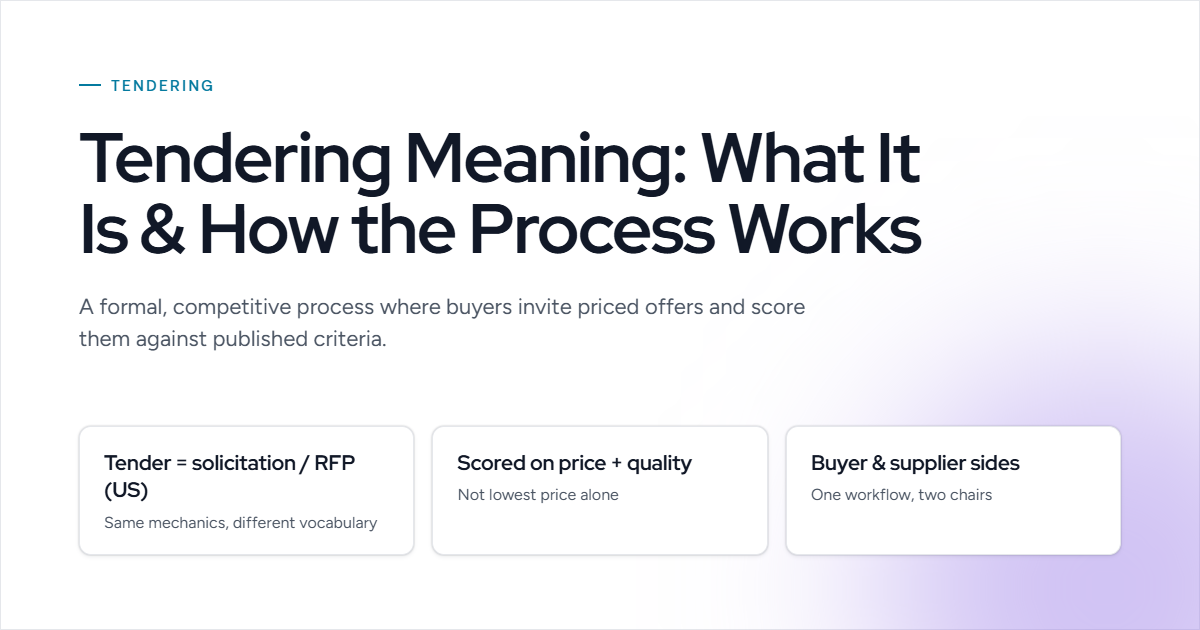
Tendering is how organizations buy large or complex goods and services through formal, competitive offers. If you have seen the words "tender," "ITT," or "invitation to tender" and were not sure what they meant, this guide gives the tendering meaning in plain terms, walks through the process step by step, and explains what it takes to win as a supplier.
One translation to set upfront. Tendering is the term used across the UK, Europe, Australia, India, and most of the Commonwealth. In the United States, the same process is usually called competitive bidding, a solicitation, or an RFP. Throughout this guide, the US equivalent is given alongside each term. The words differ by country, but the mechanics are nearly identical.
TL;DR
- A tender is a formal, competitive offer process. The UK and Commonwealth say "tender," the US says "solicitation," "competitive bid," or "RFP." Same mechanics.
- Most tenders are won or lost in two moments: deciding whether to bid, and answering the buyer's exact criteria.
- Tenders are scored on price and quality together, not lowest price alone. In the US this is called best value.
- One missed mandatory requirement can disqualify an otherwise strong bid.
- Public procurement runs to about $11 trillion a year worldwide, most of it awarded through tenders.
What is tendering?
Tendering is a structured process where a buyer invites suppliers to submit priced, written proposals for a defined piece of work, then selects a winner against published criteria. The buyer sets the rules, the scope, and the deadline. Suppliers respond with how they would deliver and at what price.
The process exists to make large purchases fair, transparent, and documented. It is most common in government and public sector buying, but large enterprises use it too. In the US, the same activity is governed for federal buyers by the Federal Acquisition Regulation (FAR) and carried out through solicitations. The winner is chosen against criteria the buyer publishes in advance, which is what separates a tender from an informal quote.
Tendering meaning: key terms.
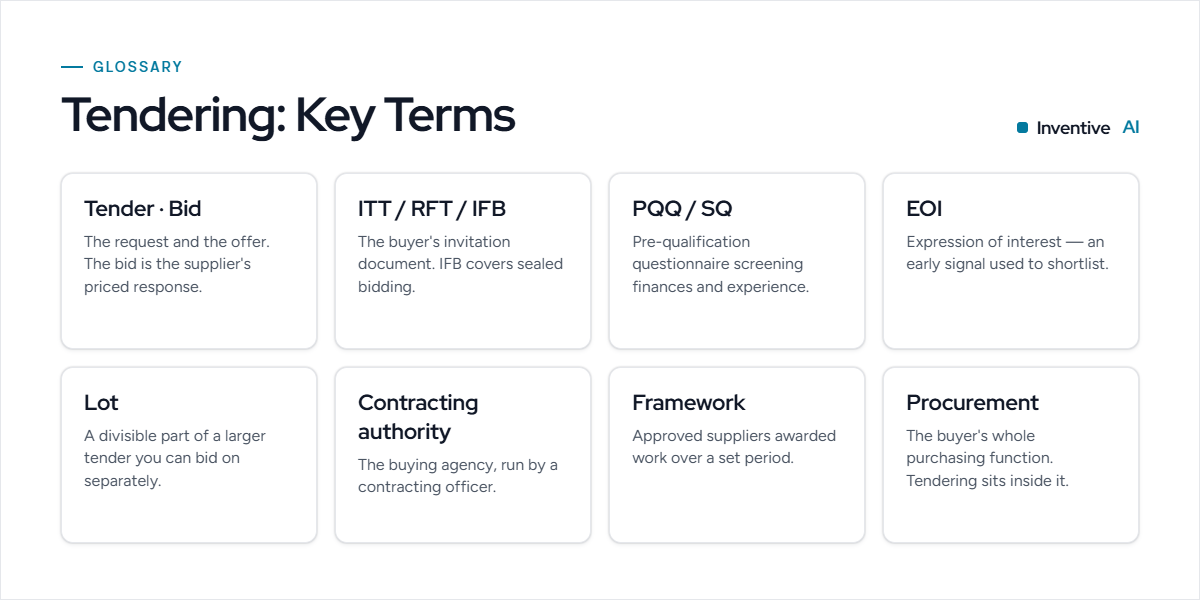
A few words get used interchangeably, which is where confusion starts. Here is the plain-language version, which doubles as a quick glossary:
- Tender. Both the buyer's request and the supplier's response are called a tender. US equivalent: solicitation (buyer side) and bid or proposal (supplier side).
- Bid. The supplier's actual offer, including price. "Bidding" and "tendering" often mean the same activity.
- ITT (Invitation to Tender). The document the buyer issues to invite offers. Also called an RFT. IFB (Invitation for Bid) for sealed bidding, or an RFP for negotiated buys.
- PQQ / SQ. The pre-qualification or selection questionnaire that screens suppliers on suitability, such as finances and experience. In restricted tenders it also shortlists who is invited to bid.
- EOI (Expression of Interest). An early signal of interest, before a full tender, used to shortlist.
- Lot. A divisible part of a larger tender you can bid on separately.
- Contracting authority. The contracting agency, run by a contracting officer.
- Framework. An agreement that approves suppliers to be awarded work over a set period, through mini-competitions or direct award.
- Procurement. The buyer's whole purchasing function. Tendering is one method within it.
Tender vs RFP vs RFQ vs RFI
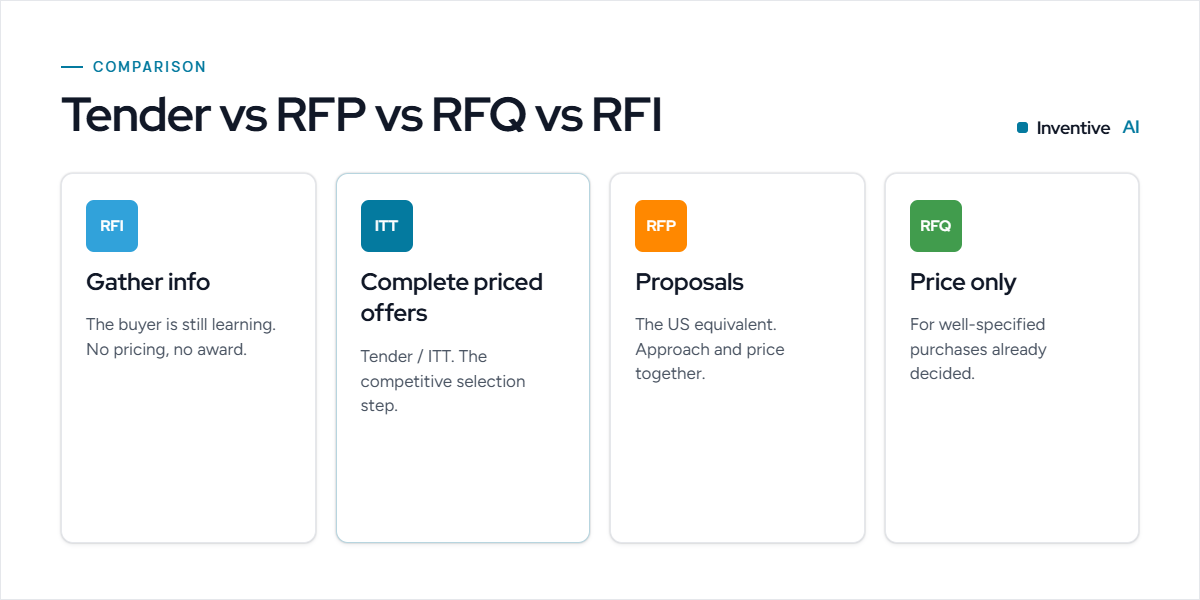
These four are different requests, each suited to a different stage of buying. The simplest way to tell them apart is by what the buyer is ready to decide. These terms are used in both global and US procurement.
- RFI (Request for Information). The buyer is still learning. An RFI gathers information about what suppliers and solutions exist. There is no pricing and no award. It is market research.
- Tender / ITT (Invitation to Tender). The buyer knows what they need and wants complete, priced offers to deliver it. This is the competitive selection step.
- RFP (Request for Proposal). The same intent as a tender, and the standard term in the US and corporate buying. The buyer wants proposals covering both approach and price.
- RFQ (Request for Quotation). The buyer has already decided exactly what they want and only needs a price. It is used for straightforward, well-specified purchases.
Also Read: RFI vs RFP vs RFQ: Key Differences
What documents are in a tender?
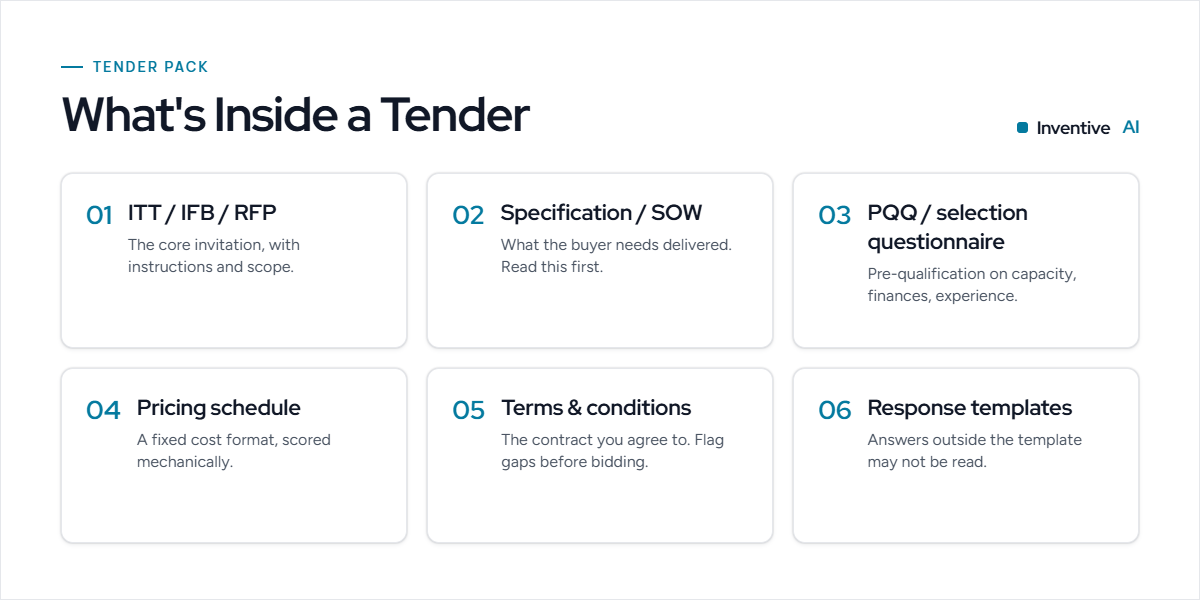
A tender is rarely one file. Knowing the parts tells you where the marks are:
- ITT, IFB, or RFP. The core invitation with instructions and scope.
- Specification or statement of work (SOW). What the buyer actually needs delivered. Read this first.
- PQQ or selection questionnaire. Pre-qualification on capacity, finances, and experience.
- Pricing schedule. The fixed format for your costs. Buyers score price mechanically, so follow it exactly.
- Terms and conditions. The contract you are agreeing to. Flag anything you cannot meet before you bid.
- Response templates. Many tenders only score answers submitted in their template. Answers placed anywhere else may not be read.
The 5 Types of tenders
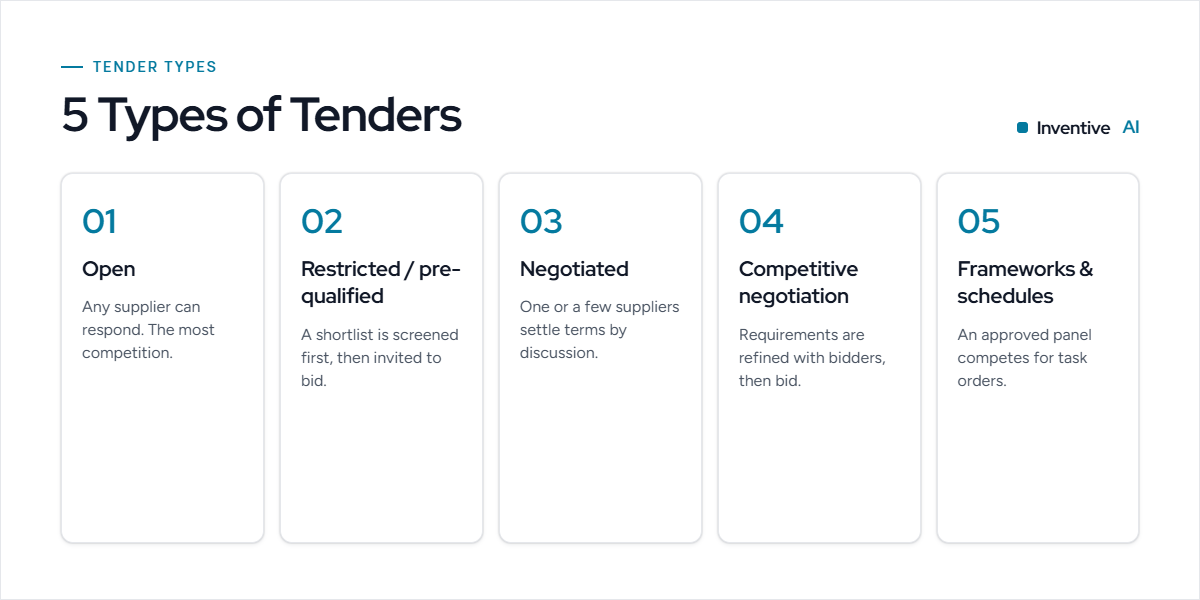
Tenders differ by how open they are and how many stages they run. Knowing the type tells you how much competition to expect and how much work is involved.
Open tender
Any supplier can respond. The buyer posts the solicitation publicly and evaluates every compliant submission. This is full and open competition, often run as sealed bidding under an Invitation for Bid (IFB). It is the most transparent route and the most common in the public sector, but it draws the most competitors, so your response has to stand out on quality, not just clear the minimum.
Restricted or pre-qualified tender
The buyer runs a shortlisting stage first, screening suppliers on capacity, finances, and past performance, then invites only the strongest to submit a full bid. Sometimes called a two-step competition. There is competition to get shortlisted, but far less once you make the invited list, so qualifying is where the effort pays off.
Negotiated procurement
The buyer works directly with one or a few suppliers and settles terms through discussion. It is used for specialist, urgent, or continuation work, and becomes a sole-source award when only one supplier can meet the need. Track record matters more here than a polished document.
Competitive negotiation
For large or complex contracts the buyer cannot fully define upfront, the buyer holds structured discussions with shortlisted suppliers to refine the requirement before final proposals. It rewards suppliers who can shape the buyer's thinking early.
Frameworks and schedules
Suppliers are approved onto a pre-vetted list, then compete for individual jobs, called task orders, over the life of the contract. GSA Schedules and IDIQ (Indefinite Delivery, Indefinite Quantity) contracts work this way. Getting on is a great effort once, and it opens a steady stream of lower-effort opportunities afterward.
How the tendering process works, on both sides
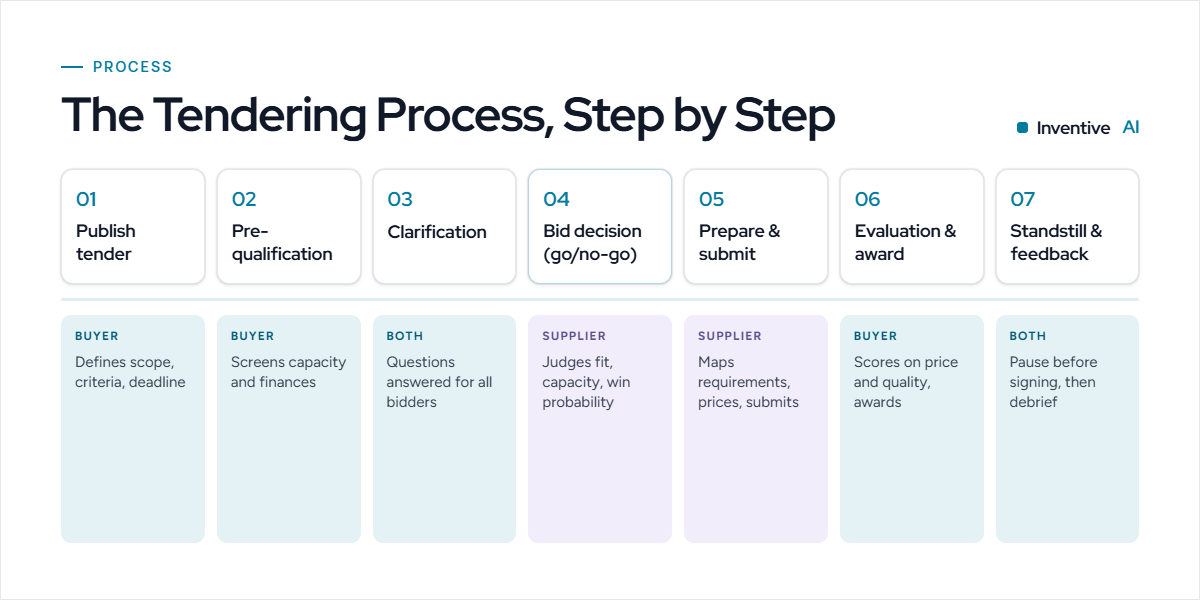
The tendering process is one workflow seen from two chairs. The buyer runs a fair competition. The supplier tries to win it. Here is each stage from both sides.
- Publishing the tender. The buyer defines the scope, evaluation criteria, and deadline, then publishes the ITT or, in the US, the solicitation on a portal such as SAM.gov. The supplier's job is to find it early, because time is the resource that decides most bids.
- Pre-qualification. In restricted tenders, the buyer screens suppliers on capacity, finances, and experience through a PQQ. The supplier completes it accurately, because a weak submission ends the opportunity before the real bid begins.
- Clarification. The buyer opens a window for written questions and shares the answers with all bidders. The supplier reads every clarification, not just their own, since one competitor's question often reveals something the whole field needs.
- The bid decision. There is no buyer action here, and that is the point. This is the supplier's go or no-go call on fit, capacity, and win probability. A disciplined "no" protects the time you need for winnable work.
- Preparing and submitting. The buyer waits. The supplier maps every requirement to a direct answer, supports claims with evidence, completes the pricing schedule exactly as required, and submits in the buyer's template before the deadline.
- Evaluation and award. The buyer scores submissions against the published criteria, usually on price and quality together, and awards the contract. The supplier can only wait, which is why the earlier work matters so much.
- Standstill and feedback. Public buyers hold a short pause before signing and offer losing bidders a debrief. In the US, this maps to the debrief and the protest window under the FAR. Smart suppliers use the scoring feedback to raise their next bid.
The pattern is clear: the buyer controls the frame, but the supplier's outcome is decided by two things they fully own, which opportunities they choose and how precisely they answer.
Why tenders are important for both buyers and vendors
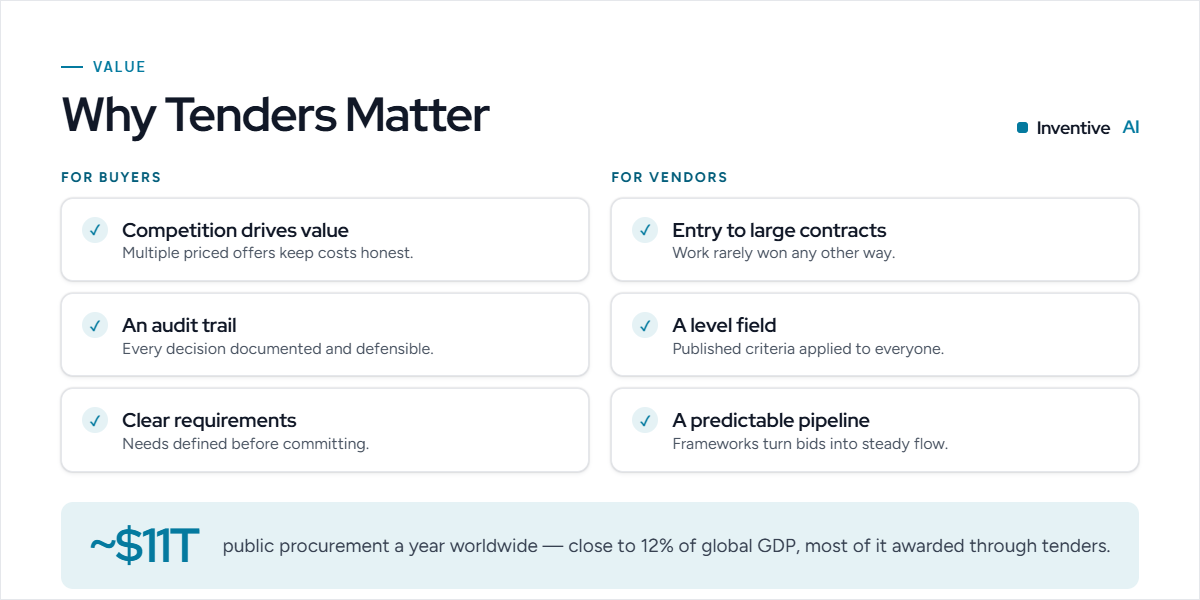
Tendering matters because it is how a large share of serious money changes hands. Public procurement alone is worth about $11 trillion a year, close to 12% of global GDP, according to the World Bank, and most of it is awarded through tenders. In the US, the federal government is one of the largest buyers in the world, and that spending flows through solicitations. That scale is why both sides invest in doing it well.
For buyers, tendering turns a high-stakes purchase into a fair, defensible decision. The specific gains:
- Competition that drives value. Multiple priced offers keep costs honest.
- An audit trail that holds up. Every decision is documented, which is essential in the public sector.
- Clear requirements upfront. The buyer defines exactly what they need before committing.
For vendors, tendering is access. It opens doors that are otherwise closed to newcomers:
- Entry to large contracts. Government and enterprise work that is rarely won any other way.
- A level field. Because criteria are published and applied to everyone, a smaller supplier with a strong, well-evidenced response can beat a bigger incumbent.
- A predictable pipeline. A place on a framework or GSA Schedule turns tendering into a steady stream of opportunities rather than one-off gambles.
How tenders are scored
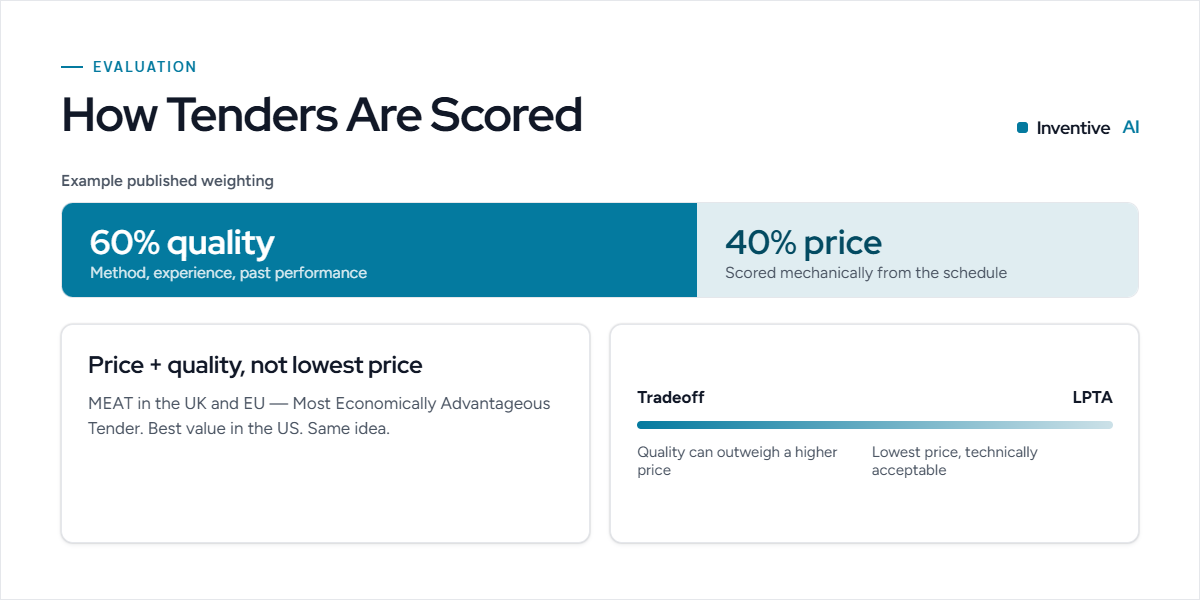
Most tenders are not awarded to the cheapest bid. They are scored on a mix of price and quality. In the UK and EU, this is called the Most Economically Advantageous Tender, or MEAT. In the US, the same idea is called best value, and it runs on a spectrum from a tradeoff process, which weighs quality against price, to LPTA (Lowest Price Technically Acceptable), which picks the cheapest bid that clears the quality bar.
The buyer publishes a weighting in advance, for example 60% quality and 40% price. Quality is scored against defined criteria such as method, experience, and past performance. Price is usually scored by formula.
Two things follow for suppliers. First, a higher price can still win under a tradeoff or MEAT approach if the quality score is strong enough, so competing on value often beats competing on cost. Second, because the weighting is published, you can see where the marks are before you write a word. Put your effort where the points are.
Where suppliers find tenders
You cannot win a tender you never see. Suppliers find opportunities through:
- Government portals. Most public buyers post notices on official portals. In the US, federal opportunities are on SAM.gov, with separate portals for most states and cities.
- Aggregator and alert services. Paid tools scan multiple portals and email matches to your criteria.
- Frameworks and schedules. A place on an approved panel, or a GSA Schedule in the US, gives you access to a stream of task orders.
- Buyer relationships. Early contact, before a tender is published, helps you shape your response and judge fit faster.
The practical takeaway: set up alerts so opportunities reach you early, because a tender you find late is one you rarely have time to win.
When is tendering required?
For private buyers, tendering is a choice. For public bodies, it is often a legal duty. Government organizations usually must run an open competition once a contract passes a set value threshold, so that public money is spent transparently.
In the US, the FAR sets named thresholds, such as the micro-purchase threshold for small buys and the simplified acquisition threshold above it, that determine how formal the process must be. Below the lowest threshold, buyers can use quick methods like requesting a few quotes. The principle is consistent worldwide: the larger the public contract, the more formal the tender.
Tendering best practices for suppliers
Winning tenders is a repeatable discipline, not luck. The practices that matter most:
- Qualify before you commit. Run a go or no-go check on fit, deadline, and win probability. A focused "no" protects the time you spend on winnable work.
- Answer the question that was asked. Evaluators score against their criteria, not your standard pitch. Map every requirement to a direct response.
- Support claims with evidence. Case studies, certifications, and past performance outscore adjectives every time.
- Build a compliance matrix. Track every mandatory requirement so nothing is missed. A single missed mandatory item can disqualify a strong bid.
- Reuse approved content, then tailor. Keep past answers in one place so you start from proven material and spend your time on the deal-specific parts.
Common tendering mistakes to avoid
Most losing bids fail for avoidable reasons:
- Chasing every tender, so effort is wasted on unwinnable work.
- Answering your pitch instead of the buyer's published criteria.
- Missing a mandatory requirement and being disqualified on a technicality.
- Leaving it too late, which shows in rushed pricing and thin evidence.
- Skipping the debrief and repeating the same mistakes next time.
Also Read: Tender Writing: Examples, Tips and Success
How to improve tendering with new-age AI software
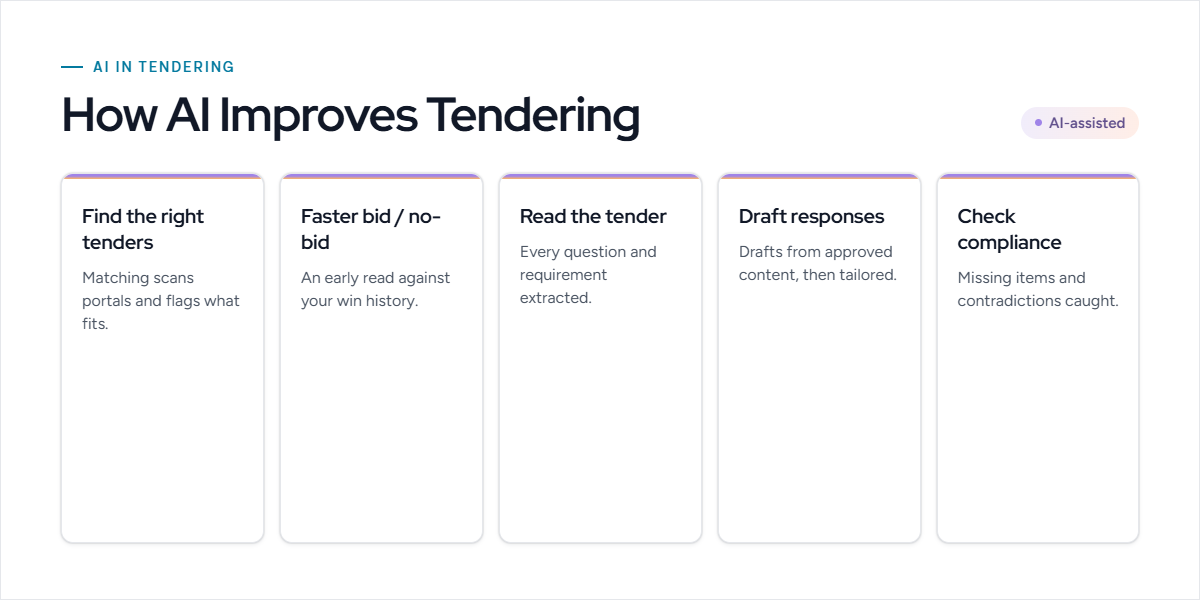
AI is changing tendering by removing the manual work that used to swallow a bid team's time, so people can focus on strategy and quality. Modern AI tools help across the whole cycle:
- Finding the right tenders. AI matching scans portals and flags the opportunities that fit your capabilities, so relevant tenders reach you early instead of being missed.
- Faster bid or no-bid decisions. AI can assess a tender against your win history and fit, giving you an early read on whether it is worth pursuing.
- Reading the tender. Instead of manually sorting a long ITT, AI extracts and tags every question and requirement, so nothing is overlooked.
- Drafting responses. AI drafts answers from your approved content and past tenders, then tailors them to the specific requirement.
- Checking compliance. AI reviews the full response for missing mandatory items and contradictions before submission, catching the errors that quietly disqualify bids.
The goal is not to remove human judgment. It is to spend that judgment where it counts, on strategy, evidence, and the deal-specific message, while the software handles the repetitive parts.
Also Read: Best Tender Response Software
How Inventive AI helps teams respond to tenders
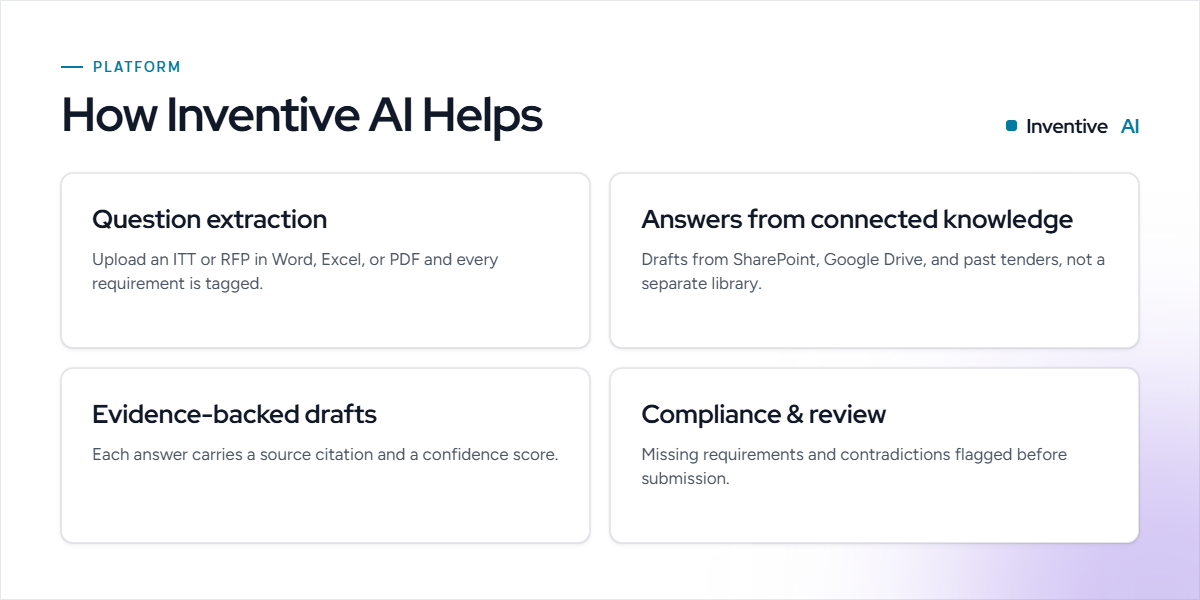
Tenders are long, repetitive, and deadline-driven, and the same questions return in slightly different wording for every opportunity. Inventive AI is an autonomous AI agent platform that responds to tenders, RFPs, RFIs, DDQs, and security questionnaires, with humans in the loop for approvals.
Here is how that helps a bid team:
- Question extraction. Upload the ITT or RFP in Word, Excel, or PDF, and an agent reads it and tags every requirement, so you skip manual sorting.
- Answers from connected knowledge. The platform drafts from systems you already use, such as SharePoint, Google Drive, and past tenders, instead of a separate library you have to maintain.
- Evidence-backed drafts. Each answer ships with a source citation and a confidence score, and the agent flags "information unavailable" rather than guessing.
- Compliance and review. The platform checks the full response for missing requirements and contradictions before submission, and routes only unsupported answers to experts.
Frequently asked questions
What does tendering mean in business?
In business, tendering means responding to a formal, competitive request to supply goods or services at a stated price. A buyer invites offers, suppliers submit bids, and the buyer awards the contract against published criteria. In the US, the same process is called a solicitation or an RFP.
What is the difference between a tender and a bid?
A tender is the overall process and the documents involved. A bid is the specific offer a supplier submits within that process. The words are often used interchangeably.
Is a tender the same as an RFP?
Largely yes. A tender is the UK and Commonwealth term. An RFP, or request for proposal, is the US and corporate equivalent. Both invite priced proposals against defined requirements.
What are the main stages of tendering?
The buyer publishes the tender, suppliers pre-qualify if required, questions are clarified, suppliers decide whether to bid and submit their offer, the buyer evaluates against set criteria, and the contract is awarded.
What does ITT stand for?
ITT stands for Invitation to Tender, the document a buyer issues to invite offers. The closest US equivalents are an IFB (Invitation for Bid) and an RFP.

.avif)



%20Definition%20and%20Process.avif)
.avif)