SiftHub pricing in 2026: plans, usage-based costs, and what to know before you buy
How SiftHub pricing works in 2026, why its usage-based model can be unpredictable, what you get, and the doubts to settle before you buy.
SiftHub pricing is custom and usage-based. It does not publish a flat public rate. You get a tailored quote built around two options, an RFP Agent point solution and the full SiftHub platform, and you are charged by usage rather than a simple per-seat fee. One third-party directory lists a starting point of about $35 per user per month, but SiftHub's own pricing page shows custom, usage-based plans instead.
SiftHub is an AI assistant for presales and sales teams that answers RFPs and security questionnaires and helps draft responses inside the browser, Slack, and Teams.
Because the price only comes through a sales call, it helps to know how the model works before you book one. This guide breaks down SiftHub's pricing model, what drives the cost up, what you get, the doubts to settle before you buy, and how it compares if predictable pricing matters to you.
Key takeaways
- SiftHub pricing is quote-based and usage-based. You are charged per transaction, not a flat per-seat fee, so cost moves with how much your team uses it.
- A third-party directory lists a starting point near $35 per user per month, but SiftHub's own pricing page does not confirm a flat rate.
- SiftHub sells in two ways: an RFP Agent point solution and the full platform. Confirm which transactions each plan includes.
- On G2, SiftHub holds 4.5/5 across 69 reviews. Reviewers praise autofill and speed, and flag accuracy, single-document limits, and thin analytics.
- If cost predictability matters, compare SiftHub's per-transaction pricing with Inventive AI's per-RFP pricing, which includes unlimited users on one plan from $830/month, billed annually.
SiftHub pricing: How much does it cost?
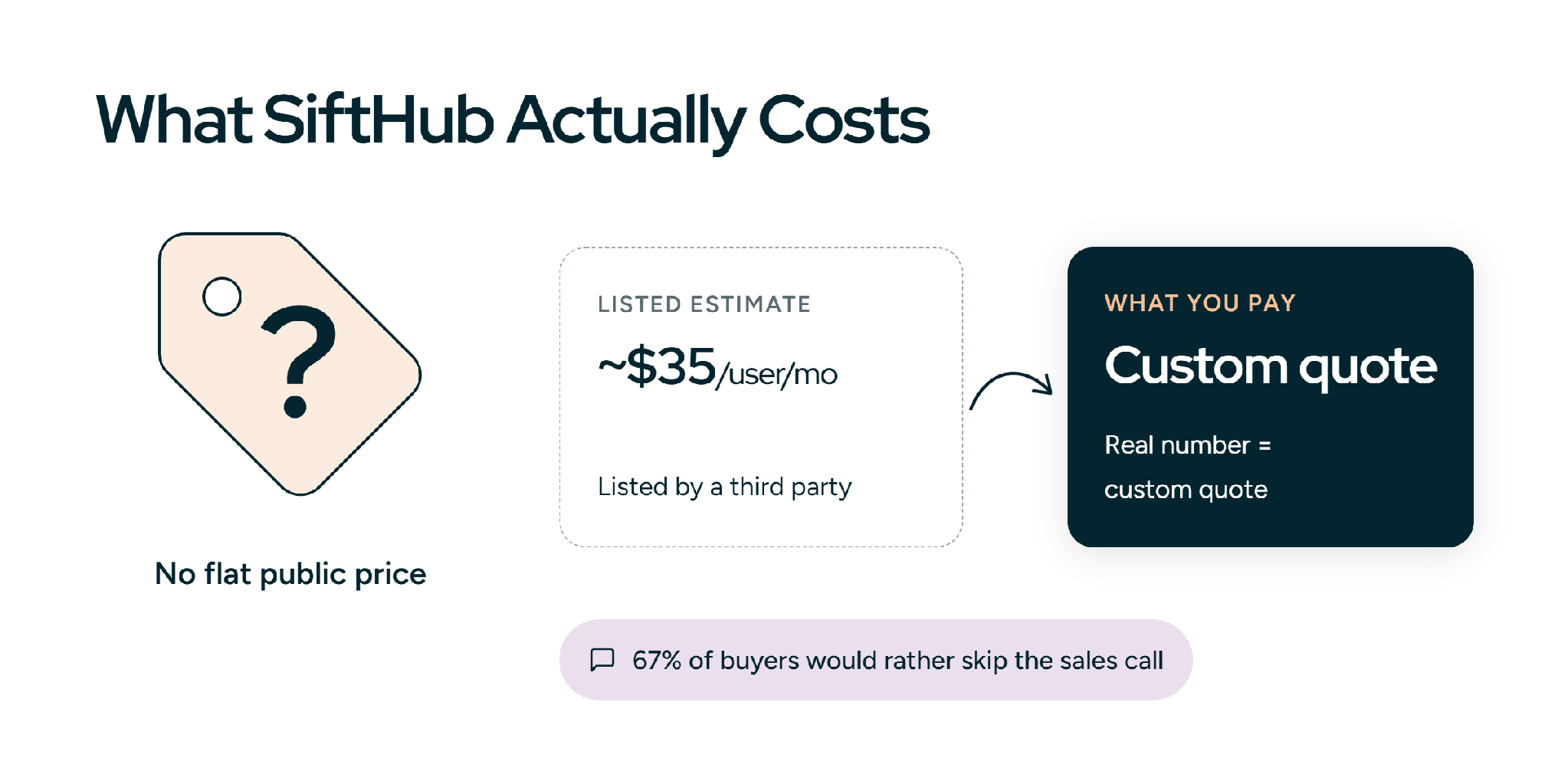
SiftHub does not list flat prices publicly. Its pricing page describes custom plans built around your team size and usage, and you get an exact figure only after a demo and a quote. A third-party directory, SoftwareFinder, lists a starting point of about $35 per user per month.
Keeping the number behind a sales call is common, but it is friction for buyers: 67% of B2B buyers now prefer a rep-free buying experience.
The more important thing to understand before that call is how SiftHub charges, because the model, not the headline rate, decides what you actually pay.
How SiftHub's pricing model works: transaction-based consumption
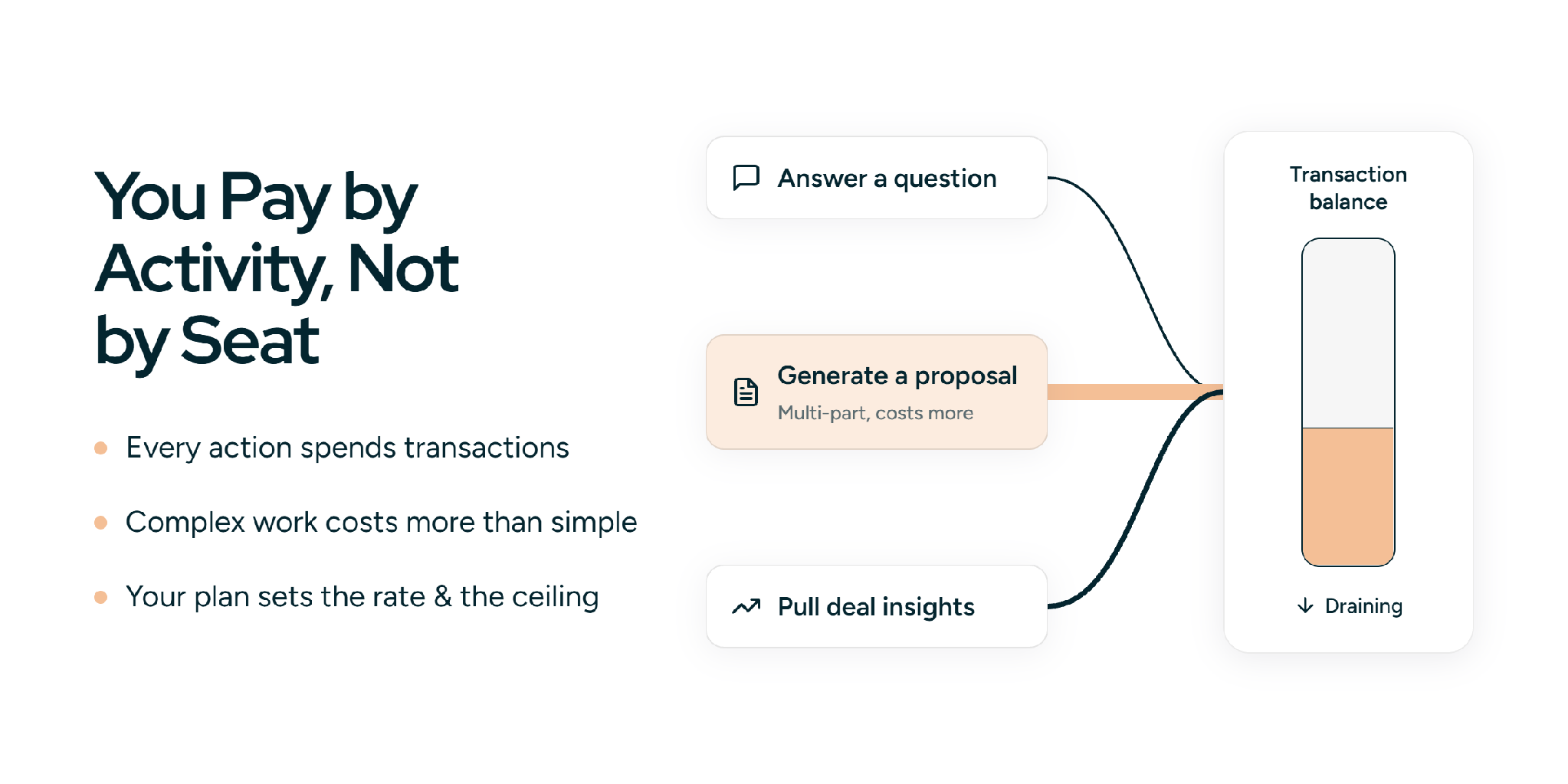
SiftHub does not charge per seat or publish fixed tiers. It runs on a transaction-based model, so you pay for activity rather than for users. In SiftHub's words, "every action you take in SiftHub, from answering a question and generating a proposal to building collateral or retrieving deal insights, consumes transactions."
Three things define how the model behaves:
- Every action consumes transactions. Responding to a question, generating a proposal, building collateral, and pulling deal insights all draw down your transaction balance. The more work your team runs through SiftHub, the more you consume.
- Complex work costs more than simple work. SiftHub states that the transactions consumed depend on "the complexity, size, and number of processing steps required to generate the final response." A long, multi-part proposal uses more than a single quick question.
- Your plan sets the rates and the ceiling. Consumption rates and total transaction limits vary by plan or contract, and pricing is tailored to your team size and use case rather than sold off a public price list.
SiftHub features: what's included in your plan
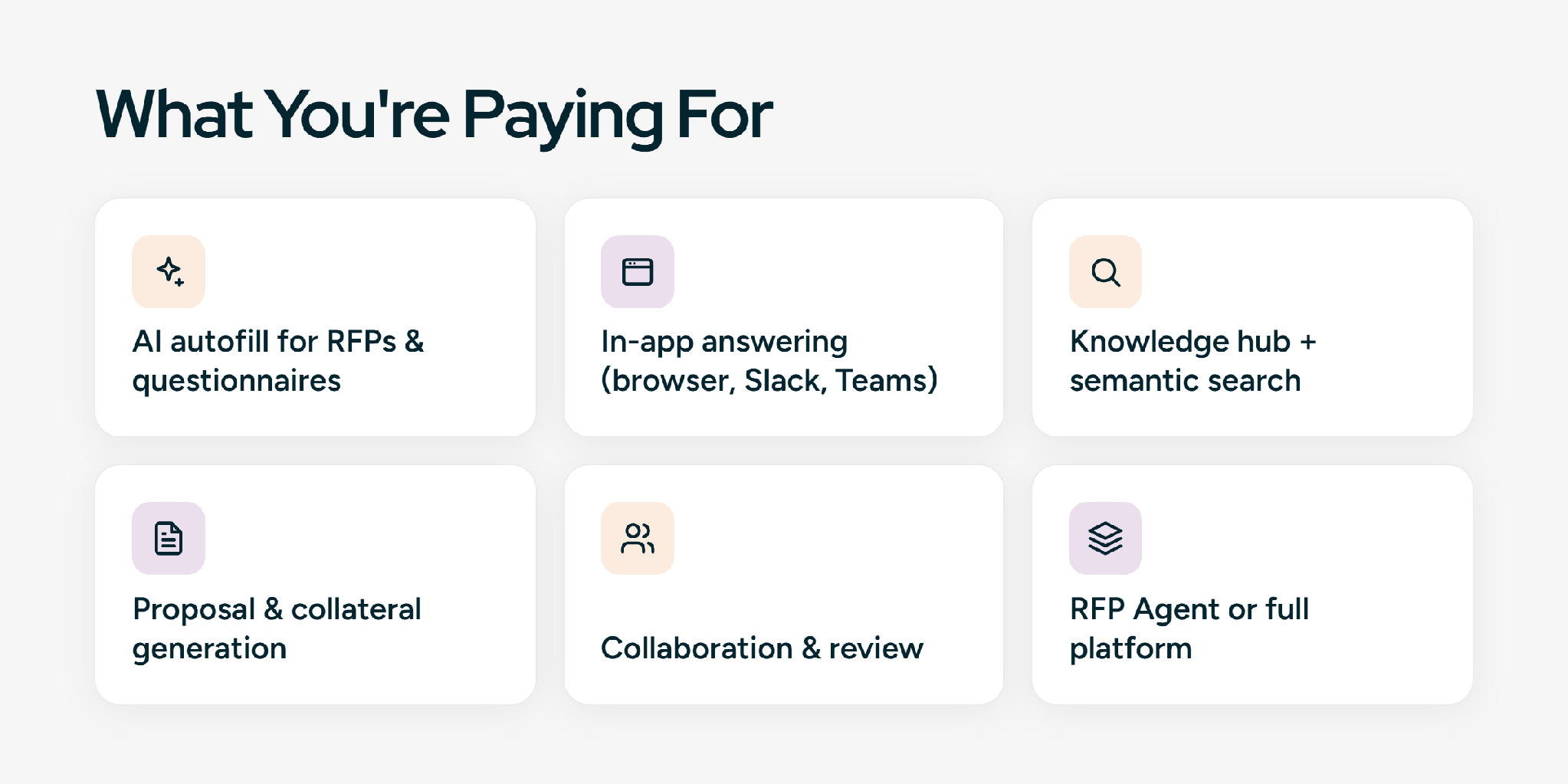
SiftHub is built to help presales and sales teams respond to RFPs and security questionnaires faster. Whichever plan you buy, these are the core features you are paying for.
- AI autofill for RFPs and questionnaires. Upload an RFP or questionnaire and SiftHub drafts responses automatically. Reviewers say it handles roughly 90% of questions, so your team starts from a filled draft instead of a blank sheet and edits from there.
- In-app answering across your tools. SiftHub surfaces responses inside the browser, Slack, and Teams, so a rep can pull an approved answer mid-deal without switching tabs. This is where SiftHub leans into its "deal orchestration" positioning, helping reps answer buyer questions in the flow of the conversation.
- Knowledge hub with semantic search. A central place for your approved content, past responses, and product information. Semantic search means the assistant finds the right answer by meaning, not just keyword match, so older content surfaces faster.
- Proposal and collateral generation. Beyond question-and-answer autofill, SiftHub can draft proposals and supporting sales material from the same content library, so one source feeds both RFP responses and deal collateral.
- Collaboration and review. Multiple people can work on a response together, with the assistant drafting and the team reviewing before it goes out.
- RFP Agent or the full platform. SiftHub is sold two ways. The RFP Agent is a point solution focused on RFP responses. The full platform adds wider presales and deal support. Before you sign, confirm exactly which features and how many transactions each tier includes, since that is what sets your real cost.
SiftHub reviews, ratings, strengths, and limitations
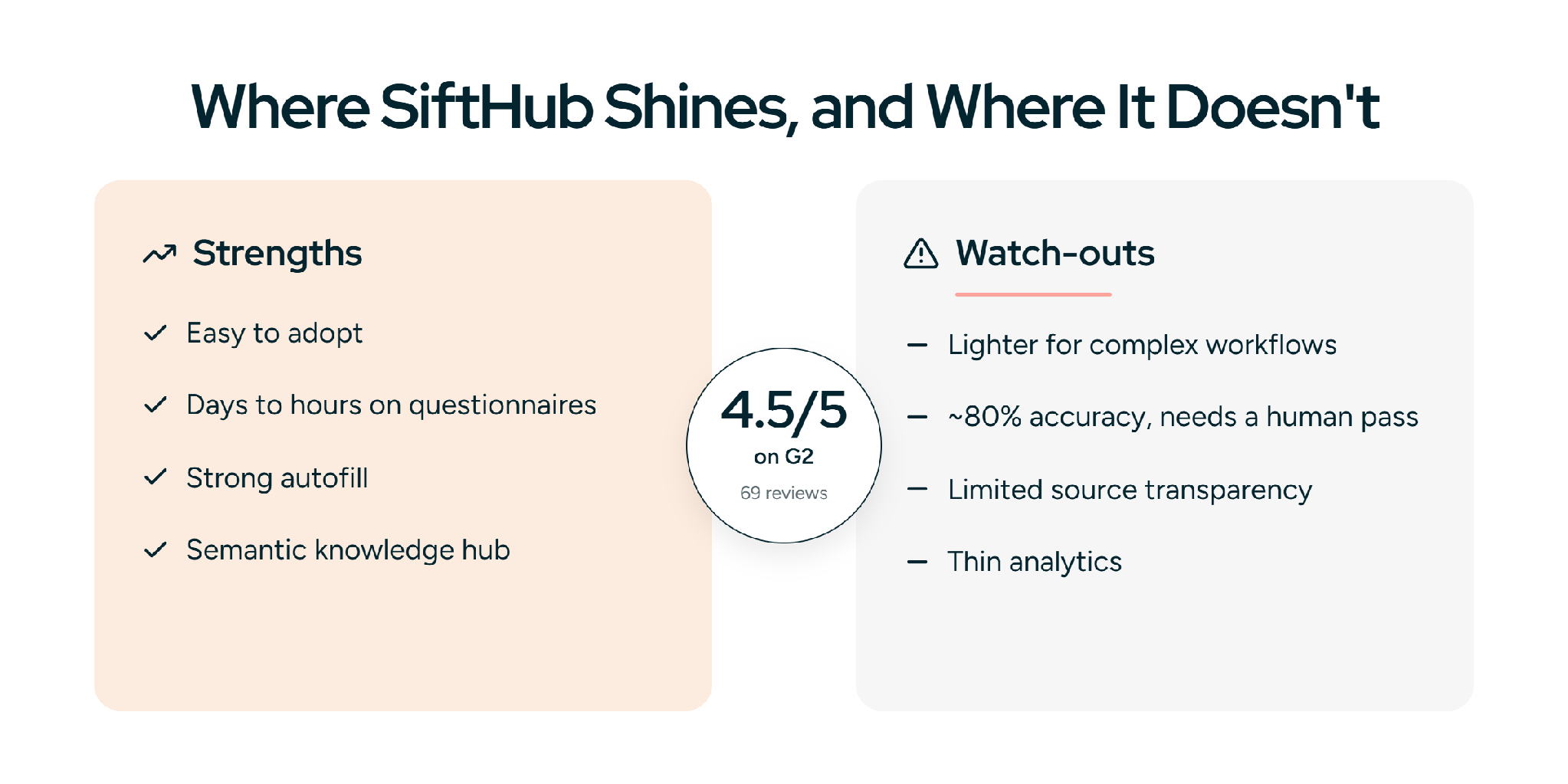
Like most modern RFP automation tools, SiftHub has features that make managing responses easier for small and mid-sized teams. Where needs get more complex, reviewers say it has less depth and room to scale.
Strengths
- Teams find it easy to adopt, thanks to an intuitive interface and quick setup.
- RFP and RFI workflows save real time. Reviewers say a response can go from days to hours, especially on questionnaires.
- Strong automation of repetitive work, such as autofilling questionnaire fields, gives presales and proposal teams bandwidth back.
- A single knowledge hub with semantic search across your repositories makes it easier to find past content and speeds up the response.
G2 rating: 4.5/5 across 69 reviews. Reviewers most often credit SiftHub with saving time by automating RFP responses.
Weaknesses
- The feature set is lighter for large-scale or highly customized workflows. Reviewers say working with very large, complex documents or enterprise systems can be difficult.
- Accuracy and formatting need a human pass. Reviewers report that AI-generated responses often need manual refinement on nuanced questions, and that exports can lose formatting, especially tables.
- Source transparency is limited. Reviewers want clearer traceability of which content fed each response, plus a flag when a source is outdated.
- For teams with high RFP volume, complex questionnaires, or multi-department coordination, reviewers report bottlenecks or heavy customization.
Is SiftHub worth it? The five doubts that decide the deal
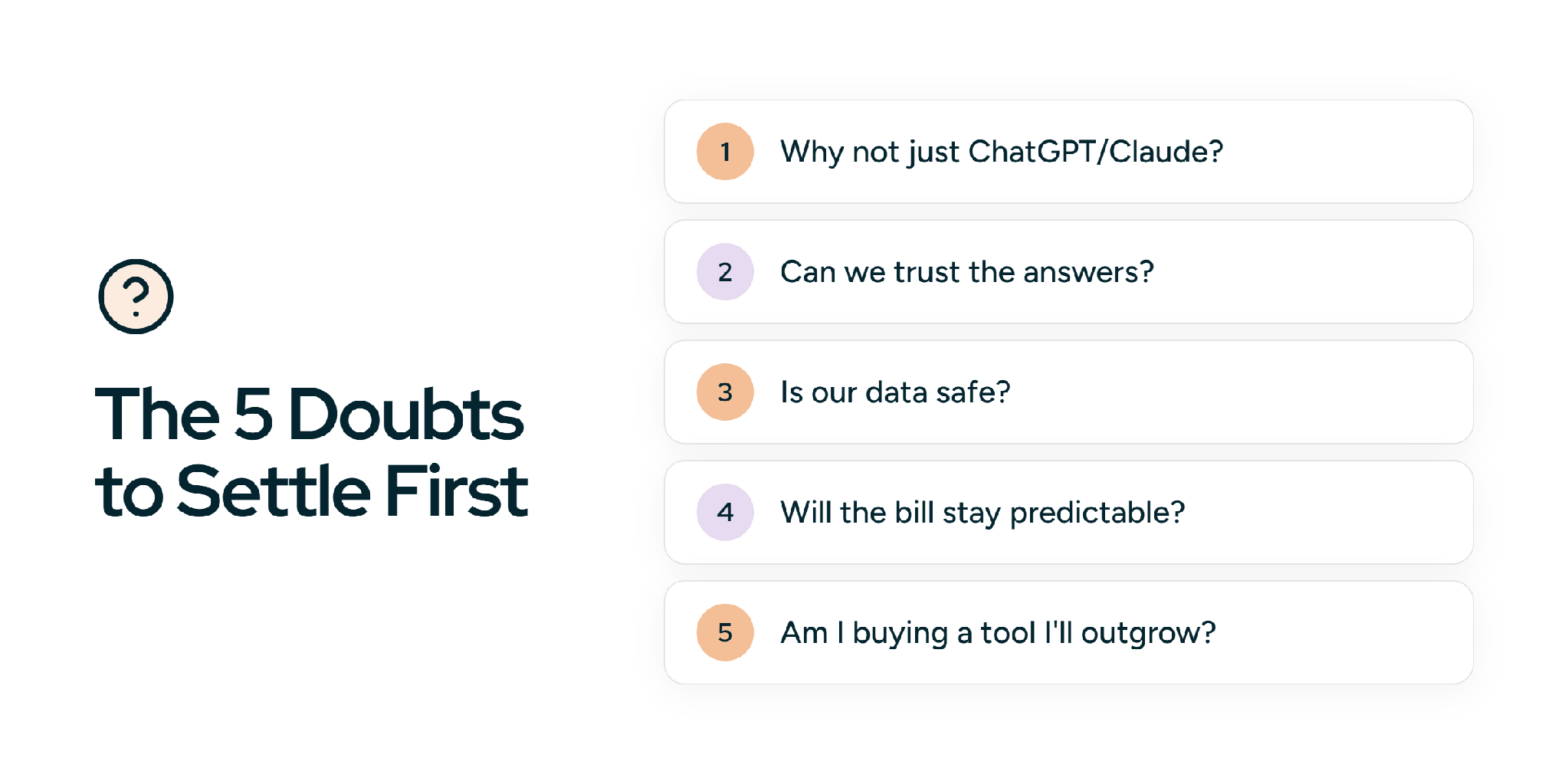
Most teams do not hesitate on SiftHub's price. They hesitate on five doubts underneath it. Settle these before the sales call.
Why not just use ChatGPT or Claude?
A general chatbot writes a decent first draft. But it cannot pull from your approved content, it does not cite sources, and pasting confidential details into it can break a client NDA. Dedicated tools like SiftHub and Inventive AI exist to fix those gaps. The real question is which tool gives you the most for the price.
Can we trust the responses?
There is a gap between how much SiftHub fills and how much is correct. It fills most questions, but reviewers put accuracy near 80%, so about one in five responses needs an edit. On a security questionnaire, one wrong answer can fail the review. So ask for a source and a confidence score on every response, and a clear flag when the tool does not know the answer.
Is our data safe with SiftHub?
RFPs and security questionnaires hold your pricing, architecture, and customer names. Whatever tool you put them into becomes a security risk you have to answer for. Ask the vendor three things: are you SOC 2 Type II, do you control who can access what, and do you promise not to train public AI models on our data? If they cannot answer all three clearly, walk away.
Will the bill stay predictable?
SiftHub charges by usage, so your cost rises when your team is busiest. A single large RFP can eat a big share of your monthly limit. Plan for your busiest quarter, not an average one. Pricing that is billed per RFP, with unlimited users, is easier to predict.
Am I buying a point tool I will outgrow?
SiftHub sells a standalone RFP Agent and a separate full platform. Most teams do not stop at RFPs. RFIs, DDQs, and security questionnaires come next, and the smaller tool may not cover them. Decide now whether you need the point tool or the full platform, so you are not buying twice in a year.
All five doubts point to one fix. Inventive AI covers them in a single platform: agents that draft from your connected content, a source and confidence score on every response, SOC 2 Type II with no training on your data, and per-RFP pricing with unlimited users, from $830/month, billed annually. One tool for RFPs, RFIs, DDQs, and security questionnaires, so you never pay to upgrade later.
SiftHub vs Inventive AI: how they compare
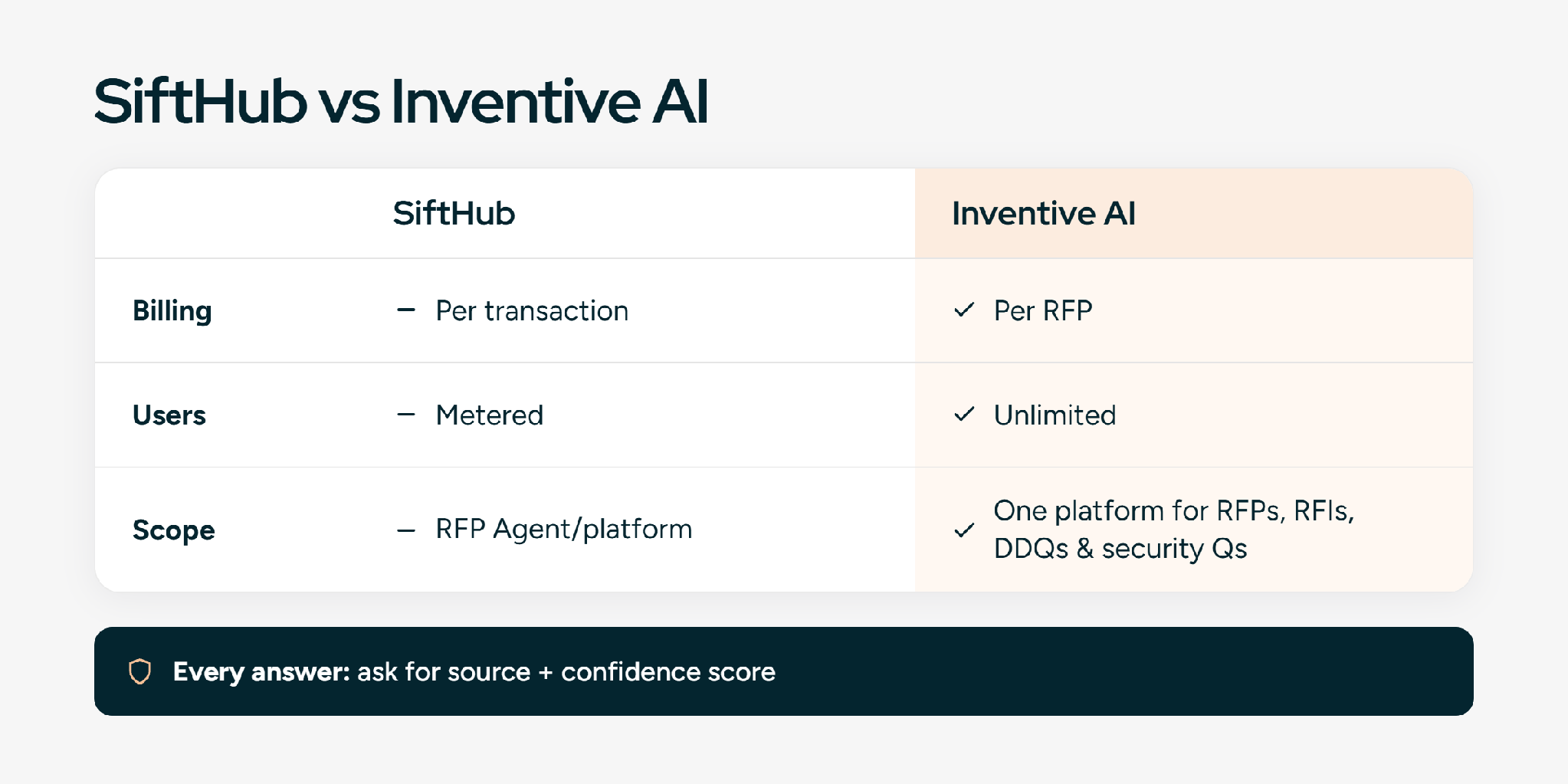
If you are weighing SiftHub for RFP and questionnaire responses, the closest platform to compare is Inventive AI. Both use usage-based pricing, but they differ in how they bill, how the AI works, and how far the platform reaches. Here is the side-by-side.

.avif)


.png)