Arphie vs SiftHub (2026): AI Response Agents vs a Unified Knowledge Hub
Compare Arphie and SiftHub on AI drafting, source transparency, integrations, pricing and reviews, plus where AI-native platforms like Inventive AI fit.
.png)
Last reviewed: July 2026. This head-to-head draws on each vendor's published pages, verified G2, Capterra, TrustRadius and Gartner Peer Insights reviews, and independent third-party write-ups. Both products are recent AI-native entrants, so their review samples are small and recent, and both quote pricing privately rather than listing it. Because features and prices shift often, treat every figure here as a starting point and confirm the current details with each vendor before you commit.
TL;DR: Arphie vs SiftHub
Arphie fits teams that want AI agents to draft first-pass RFP, DDQ and security-questionnaire answers from a managed knowledge base, with every draft shown alongside its source and an AI confidence level. SiftHub fits presales and sales teams that want a unified knowledge hub sitting across scattered repositories — Drive, SharePoint, CRM, Gong, Slack — feeding answers inside the tools reps already use.
Neither is universally "better." It depends on what your team needs: Arphie leans toward source-transparent response drafting; SiftHub leans toward centralizing knowledge and working inside your existing stack. Both are worth trialing on the same real questionnaire before you decide.
Arphie vs SiftHub at a Glance
Arphie is an AI-native platform built specifically for RFP, DDQ and security-questionnaire responses, where knowledge agents draft answers and expose their sources. SiftHub is positioned as an "AI Sales Engineer" — a knowledge hub that sifts across your content stores to power presales and questionnaire responses.
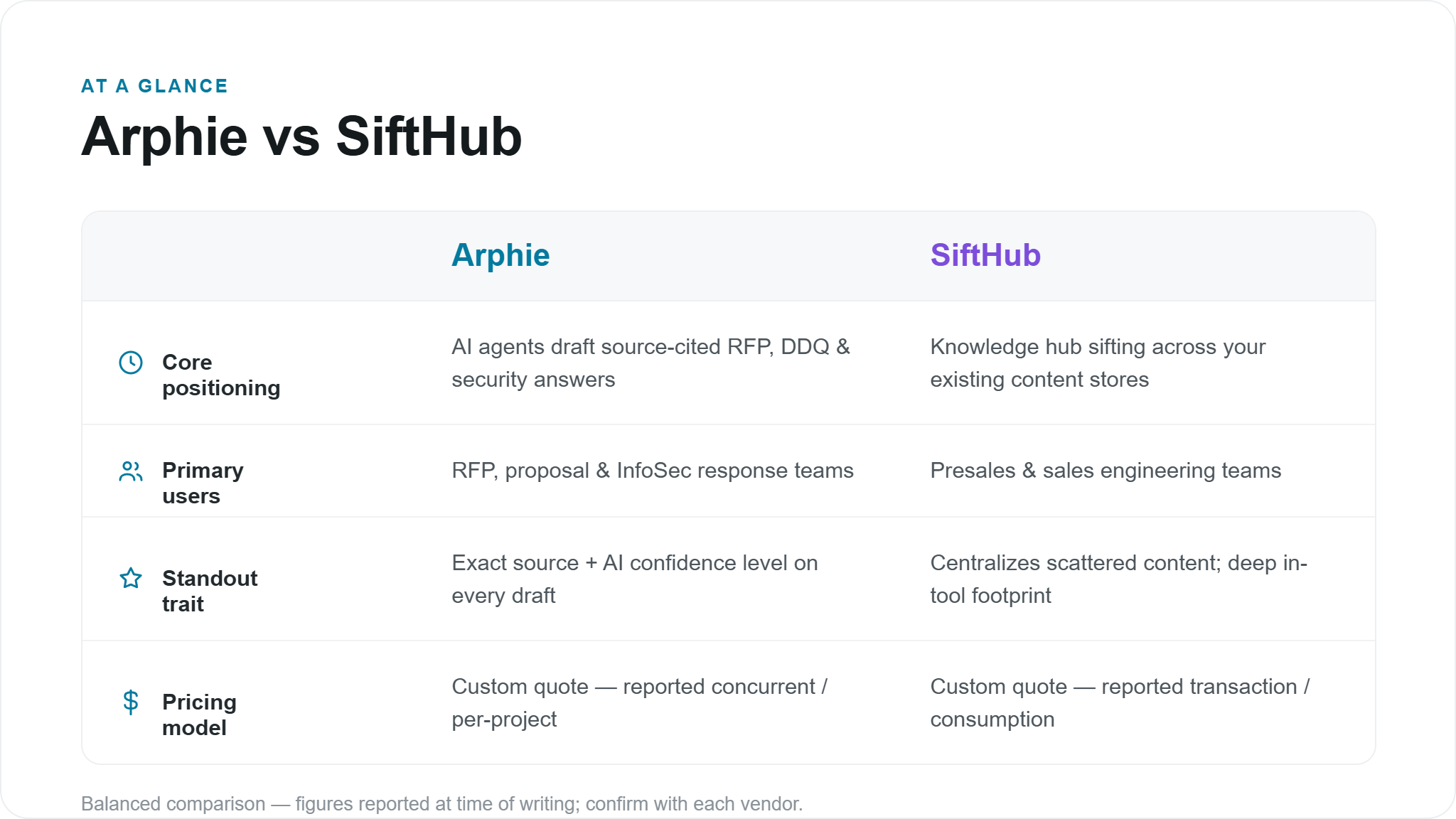
| Arphie | SiftHub | |
|---|---|---|
| Best for | Teams wanting source-cited AI drafts for RFPs, DDQs and security questionnaires | Presales/sales teams wanting a unified knowledge hub inside existing tools |
| G2 rating | 4.9 / 5 (~16–19 reviews, reported — confirm on live listing) | 4.6 / 5 (22 reviews, reported — confirm on live listing) |
| Other ratings | Capterra 5.0 (1 review); Gartner Peer Insights 5★ (5 reviews) | TrustRadius 8.7 / 10 (5 reviews); Gartner listing exists, no aggregate verified |
| Pricing | Custom quote; reported concurrent/per-project model | Custom quote; reported transaction/consumption-based model |
| Standout trait | Shows exact source + AI confidence level per draft | Centralizes scattered content; deep in-tool footprint |
| Security | SOC 2 Type 2; Zero Data Retention with model providers | SOC 2 Type II; ISO 27001 |
Figures are reported at time of writing (February 2026) and change frequently — confirm with each vendor and on the live review listings.
What Should You Consider When Choosing Between Arphie and SiftHub?
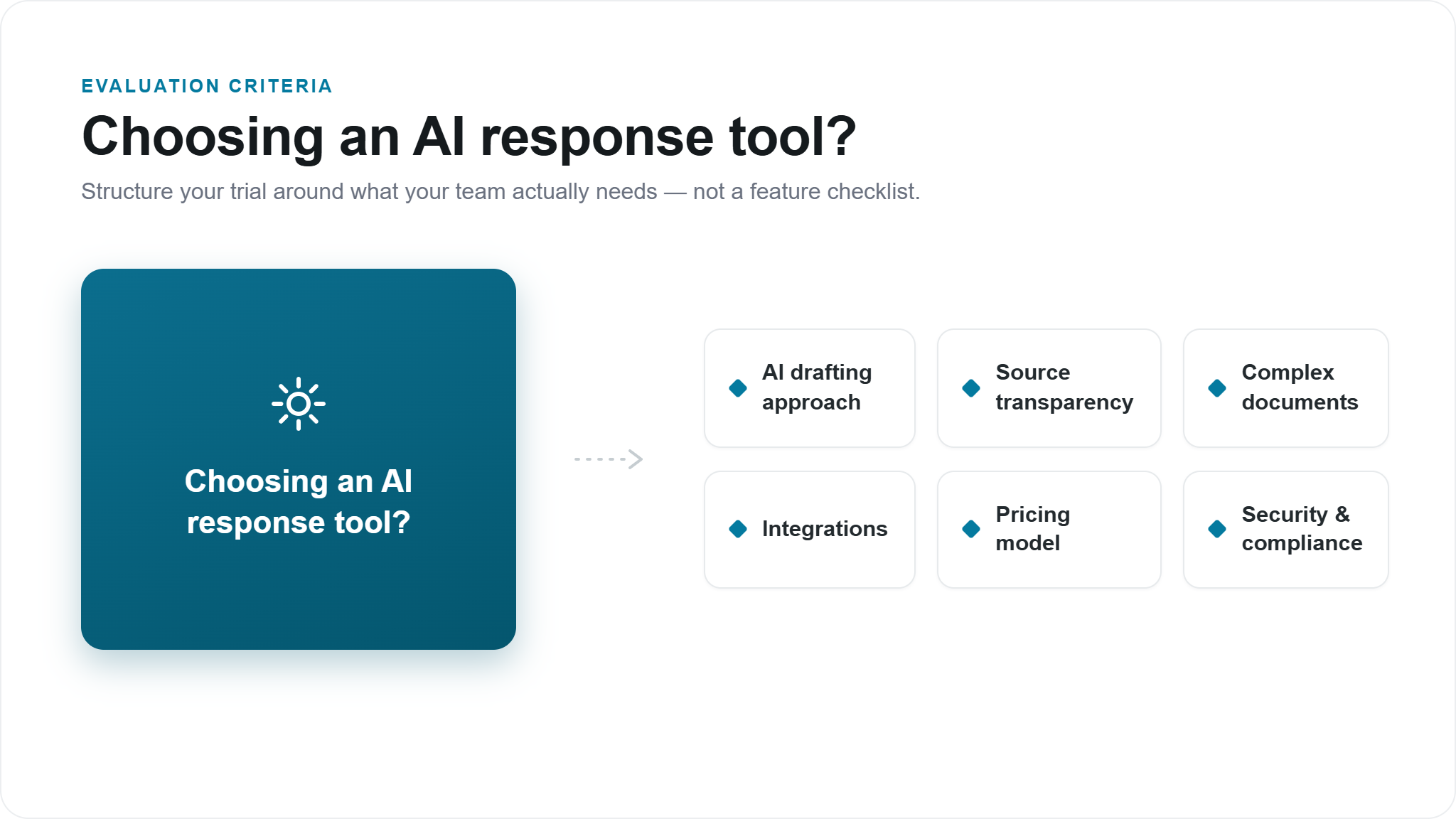
Start from your workflow, not the feature list. Both tools automate response drafting; they diverge on architecture, transparency and where the work happens. Use these criteria to structure a trial.
• AI drafting approach: Do you want agents that generate first-pass answers, or a hub that retrieves and assembles content? Test both on a real questionnaire.
• Source transparency: Does every answer show where it came from? Arphie surfaces sources plus a confidence level; some SiftHub reviewers ask for clearer source transparency.
• Hallucination control: When information is missing, does the tool flag the gap or guess? Confirm behavior on edge-case questions during a demo.
• Complex-document handling: How do they cope with long, multi-section RFPs and mixed formats? Some SiftHub reviewers cite limits on larger, more complex documents.
• Content governance: Who keeps answers current, and how are conflicting or outdated entries caught?
• Where the work happens: In-app only, or inside Slack, Teams, Excel and the browser? SiftHub emphasizes in-tool autofill; verify Arphie's surface areas.
• Integrations: Do the connectors match your stack today? Cross-check the integration table below.
• Collaboration and review: Assignments, reviewer workflows and progress tracking for multi-SME bids.
• Security and compliance: SOC 2, ISO 27001, data-retention terms with model providers.
• Analytics: Visibility into turnaround, reuse and win rates.
• Pricing model: Both are quote-based; understand what drives cost — seats, projects, or consumption. A broad RFP software comparison guide helps you benchmark quotes and structure a like-for-like request.
• Ease of implementation: How fast to first useful draft? Ask for a timeline in the demo.
• Enterprise scalability: Will it hold up across many concurrent bids and teams?
Arphie vs SiftHub: Feature-by-Feature Comparison
This is the core of the comparison. Values are drawn from vendor pages and verified reviews; confirm current specifics with each vendor.
| Dimension | Arphie | SiftHub |
|---|---|---|
| Best for | Source-cited AI drafts for RFPs, DDQs, security questionnaires | Unified knowledge hub for presales, RFP/RFI and security questionnaires |
| AI drafting | Knowledge agents draft first-pass answers from a managed knowledge base | Sifts across scattered repositories to retrieve and assemble answers |
| Source transparency | Shows exact sources + AI confidence level per draft | Answers attributed to source doc/owner/last-modified; some reviewers want clearer transparency |
| Complex documents | Handles RFPs/DDQs; some reviewers cite export/format flexibility gaps | Some reviewers report limited features on larger, more complex documents |
| In-tool footprint | App-based; Slack quick-ask agent + notifications; not mobile-native yet | Slack/Teams bots, browser extension, Excel/Word/Google Sheets autofill, browser procurement portals |
| Collaboration | Project workflows; Salesforce-opportunity project creation | Collaboration tools praised for streamlining review cycles |
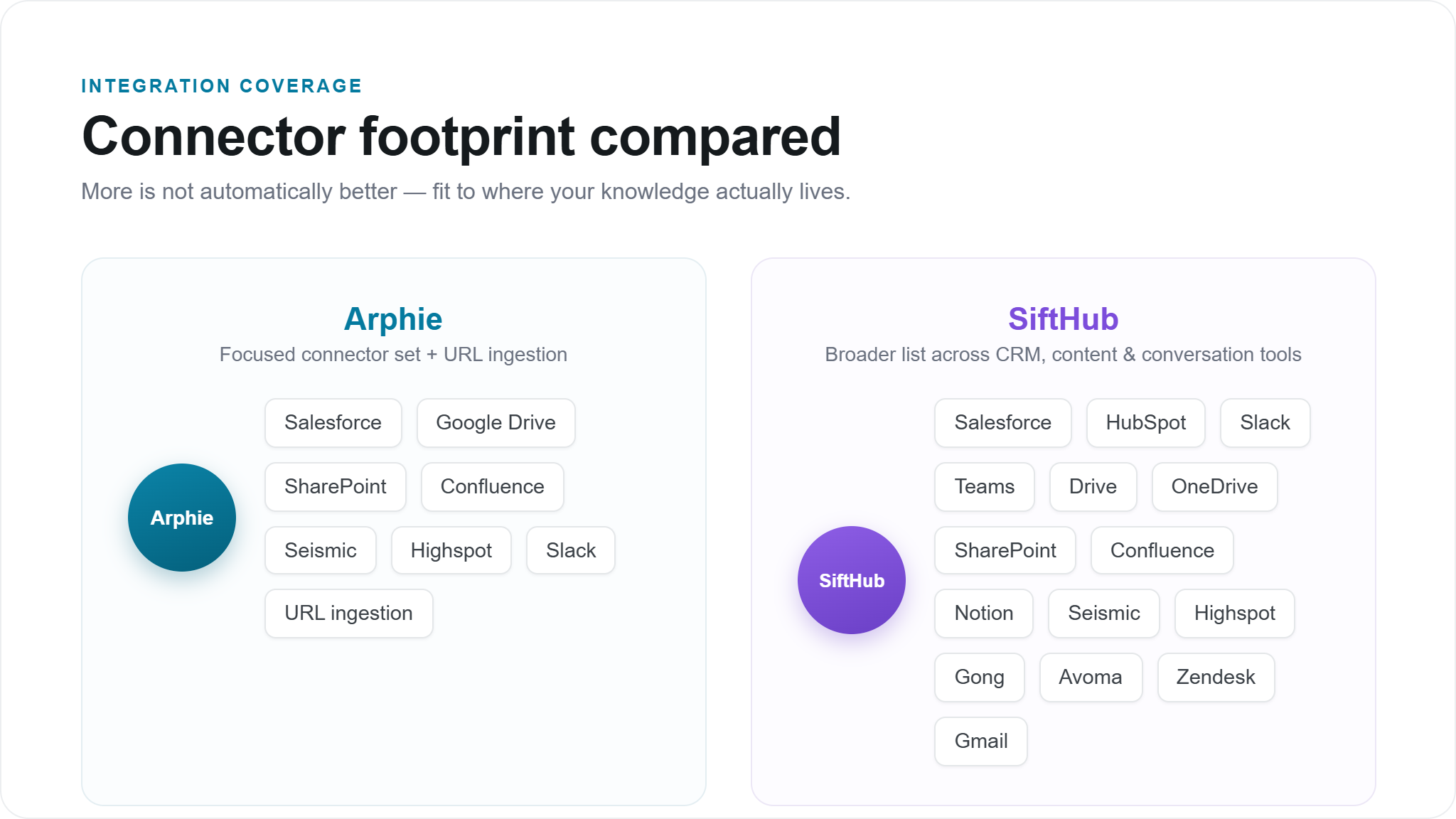
| Integrations | Google Drive, SharePoint, Confluence, Seismic, Highspot, Salesforce, Slack, Front, URL ingestion | Salesforce, HubSpot, Slack, Teams, Drive, OneDrive, SharePoint, Confluence, Notion, Seismic, Highspot, Gong, Avoma, Zendesk, Gmail |
| G2 rating | 4.9 / 5 (~16–19 reviews, reported) | 4.6 / 5 (22 reviews, reported) |
| Other ratings | Capterra 5.0 (1 review); Gartner 5★ (5 reviews) | TrustRadius 8.7 / 10 (5 reviews) |
| Pricing model | Custom quote; reported concurrent/per-project structure | Custom quote; reported transaction/consumption model |
| Security/compliance | SOC 2 Type 2; Zero Data Retention with model providers | SOC 2 Type II; ISO 27001 |
| Agentic depth | Positioned around AI knowledge agents | Some reviewers want more AI agentic capabilities |
| Review base | Thin, recent across directories (small samples) | Thin, recent across directories (small samples) |
All figures reported at time of writing; confirm with vendors and on live listings.
See it run end to end: Teams weighing agent-driven drafting often add one autonomous option to the shortlist. Watch how Inventive AI takes a live questionnaire from intake to cited draft in a hands-on demo.
AI Capabilities: How Arphie and SiftHub Draft Answers
Both use AI to reduce manual response effort, but their emphasis differs. Arphie centers on agents that draft from a managed knowledge base and expose the reasoning; SiftHub centers on retrieving the right content from wherever it already lives.
Arphie
• AI knowledge agents produce first-pass drafts for RFPs, DDQs and security questionnaires — for example, taking a security-questionnaire row and returning a paragraph answer with the underlying policy document cited beside it.
• Each draft shows its exact sources plus an AI confidence level, which per vendor materials is meant to flag lower-certainty answers for a reviewer's attention rather than burying them.
• A Slack quick-ask agent lets a rep query the knowledge base mid-conversation — useful when a prospect asks a one-off security or compliance question outside a formal RFP.
SiftHub
• Sifts across scattered repositories (Drive, SharePoint, CRM, Gong, Slack) to assemble an answer from whatever content already exists, rather than requiring you to pre-load a curated library.
• Attributes each answer to the source document, owner and last-modified date, so a reviewer can see whether the underlying content is stale before shipping it.
• Some reviewers explicitly ask for more AI agentic capabilities, per G2 — a signal that its current strength is retrieval and assembly more than multi-step autonomous workflows.
Practically, the difference shows up in how much curation each tool expects up front. Arphie leans on a managed knowledge base you keep in good shape; SiftHub leans on connecting to existing stores and letting search do more of the work. Neither removes the need for human review — both are drafting aids, and the reviewer still owns the final answer.
Note: Both are young platforms with small, recent review bases, so real-world AI reliability at scale is still being established for each. Test hallucination behavior on your own edge-case questions before deciding. For how a fully agent-run approach compares on answer quality, RAD AI reported 2× more accurate responses than other RFP AI tools tested with Inventive AI.

Integrations Compared
Integration fit often decides the trial. SiftHub advertises a broader connector list, including CRM, conversation-intelligence and support tools; Arphie covers the common content and CRM sources plus URL ingestion. Confirm which connectors are GA versus roadmap for your stack.
| Integration | Arphie | SiftHub |
|---|---|---|
| Salesforce | Yes (create projects from opportunity) | Yes |
| HubSpot | Not listed | Yes |
| Google Drive | Yes | Yes |
| SharePoint / OneDrive | SharePoint | SharePoint + OneDrive |
| Confluence | Yes | Yes |
| Notion | Not listed | Yes |
| Seismic / Highspot | Yes | Yes |
| Slack | Yes (quick-ask + notifications) | Yes |
| Microsoft Teams | Not listed | Yes |
| Gong / Avoma | Not listed | Yes |
| Zendesk | Not listed | Yes |
| Excel/Word autofill | Export flexibility cited as a gap by some reviewers | Yes (Excel/Word/Google Sheets autofill) |
| URL / website ingestion | Yes | Browser-based procurement portals |
The takeaway is not "more is better." SiftHub's wider list matters if your knowledge genuinely lives across Gong calls, Zendesk articles and Notion pages; Arphie's tighter list may be sufficient if your content sits mostly in Drive, SharePoint and Salesforce. Ask each vendor which connectors are read-only versus bidirectional, and how often synced content refreshes.
Arphie Pricing
How much does Arphie cost? Arphie does not publish plan prices. Pricing is quote-based; third-party analysis reports a custom model structured around concurrent/per-project usage rather than per-seat, per a SiftHub-published breakdown of Arphie pricing. Treat any vendor-published competitor analysis with appropriate caution and confirm figures directly with Arphie. Our independent Arphie pricing, features and reviews breakdown offers a neutral read on the same model.
• Custom quote only — no public tiers on arphie.ai.
• Reported concurrent/per-project structure (reported — confirm with vendor).
• Ask what drives cost as you scale bids and add users, so a growth quarter doesn't reprice you unexpectedly.
SiftHub Pricing
SiftHub also keeps pricing off the public site. Per its pricing page, cost is "tailored to your team's size and use cases," described as a transaction/consumption-based model with a "Get custom quote" CTA. Our SiftHub pricing, features and reviews breakdown unpacks how that reported consumption model works in practice.
• Custom quote only — no fixed tiers published.
• Reported transaction/consumption-based model.
• Clarify how consumption is metered — per question, per project, per user — so a busy quarter doesn't surprise you.
Note: Because both vendors quote privately, a real side-by-side price comparison requires two live quotes for the same scope and question volume. Give each vendor an identical trial scenario, then compare not just the number but what the number scales with.
Pressure-test the quotes you get: Inventive AI publishes attributed customer ROI you can hold your own numbers up against — AssetWorks reported a 422% ROI on RFP automation, reclaiming 1.5–2 FTEs. See how those figures are built in a demo.
Arphie: Deep Dive
Arphie is an AI-native platform focused on RFP, DDQ and security-questionnaire responses. Its knowledge agents draft first-pass answers from a managed knowledge base and show the exact sources plus an AI confidence level for each draft, which the vendor frames as a hallucination-reduction mechanism. Reviewers most often cite time savings and ease of use, and the setup experience gets consistent praise for being quick to a first useful draft.
Best features
• AI knowledge agents that draft first-pass RFP, DDQ and security-questionnaire answers.
• Source display plus AI confidence level on every generated draft.
• Ease of use and quick setup, a repeated G2 theme.
• Salesforce integration that creates projects directly from an opportunity, keeping bid work tied to the deal record.
• Slack quick-ask agent and notifications for in-chat answers.
• SOC 2 Type 2 compliance and Zero Data Retention agreements with model providers.
Limitations (per reviews and vendor docs)
• Not mobile-native yet, per G2 pros-and-cons.
• Export issues and a desire for more file-format flexibility (reported ~3 mentions). Teams that hit format walls often scan the Arphie alternatives and competitors landscape before committing.
• Occasional minor software bugs, usually resolved quickly by support, per G2 feedback.
• Some users want more integrations than the current connector list.
• Thin, recent review base across directories (small sample sizes) — confirm on live listings.
• No public pricing; custom quote only, which lengthens evaluation.
• Capterra rating rests on a single review at time of writing, so weight it lightly.
Pricing: Custom quote only; reported concurrent/per-project structure per third-party analysis. No prices on the vendor site.
Ratings and reviews: G2 4.9 / 5 (~16–19 reviews, reported — G2); Capterra 5.0 / 5 (1 review — Capterra); Gartner Peer Insights 5★ (5 reviews — Gartner). No TrustRadius listing with a rating was found during research.
"Saves me 100s of hours a week in response writing." — G2 reviewer
"I'd like to see more integrations in the future, but I am really satisfied now." — G2 reviewer
SiftHub: Deep Dive
SiftHub is positioned as an "AI Sales Engineer" built around a unified knowledge hub that sifts across scattered repositories to power presales, RFP/RFI and security-questionnaire responses. Its emphasis is on centralizing content and working inside the tools reps already use — Slack, Teams, the browser and spreadsheets — with answers attributed to their source document, owner and last-modified date.
Best features
• Centralized knowledge hub that unifies scattered content for consistent answers.
• Autofill inside Excel, Word and Google Sheets plus a browser extension for procurement portals.
• Slack and Teams bots that surface answers in-flow, so reps don't switch context to answer a one-off question.
• Attribution of each answer to source document, owner and last-modified date.
• Collaboration tools that reviewers say streamline review cycles.
• SOC 2 Type II and ISO 27001 certification.
Limitations (per reviews and vendor docs)
• Limited features when handling larger, more complex documents, per G2 pros-and-cons. Teams with long, multi-section RFPs sometimes compare the wider SiftHub competitors and alternatives set before buying.
• Some users want clearer source transparency and better formatting handling, per G2 pros-and-cons.
• Desire for more AI agentic capabilities, per G2.
• For complex enterprise stacks, some reviewers note integrations can take time to set up and maintain (reported — confirm on the live G2 listing).
• Thin, recent review base across directories (small sample sizes) — confirm on live listings.
• No public pricing; consumption-based quote model requires scoping to compare.
Pricing: Custom quote, described as "tailored to your team's size and use cases" with a transaction/consumption model, per the SiftHub pricing page.
Ratings and reviews: G2 4.6 / 5 (22 reviews, reported — G2); TrustRadius 8.7 / 10 (5 reviews — TrustRadius). No Capterra rating was found; a Gartner listing exists without a verified aggregate.
What users say:
"SiftHub's seamless collaboration tools streamline review cycles, preventing delays and fostering better teamwork." — G2 reviewer
"I'd also like clearer source transparency." — G2 reviewer
Weighing source transparency and complex-doc handling? These are exactly the gaps buyers probe in demos. See how one AI-native alternative treats them, with citations and a confidence score on every answer — compare the AI-native approach.
Arphie vs SiftHub: What Do Reviewers Say?
Across G2, Capterra, TrustRadius and Gartner Peer Insights, the two tools attract praise for the same core promise — less manual response work — but the recurring themes differ.
For Arphie, the dominant threads are time savings ("saves me 100s of hours a week"), ease of use and quick setup, and appreciation for the source-and-confidence display on drafts. The most common asks are more integrations, more file-format and export flexibility, a mobile experience, and occasional bug fixes. Its scores are high (G2 4.9, Capterra 5.0, Gartner 5★) but rest on small samples — the Capterra rating is a single review — so read them as early signal, not settled consensus.
For SiftHub, reviewers highlight the centralized knowledge hub, in-tool autofill and collaboration during review cycles. The recurring asks are clearer source transparency, better handling of large and complex documents, more agentic AI behavior, and smoother integration maintenance for bigger stacks. A G2 4.6 across 22 reviews and TrustRadius 8.7/10 across 5 reviews give a slightly larger base than Arphie's, but still a young one.
One SERP-adjacent note: buyers frequently search for "Arphie vs SiftHub reddit" hoping for unfiltered community sentiment. As of this review, public Reddit discussion of either tool is sparse — a byproduct of both being recent entrants. Until threads mature, weight the verified directory reviews above, and lean on your own parallel trial rather than anecdotes.
Two young platforms, one real test: The fastest way past thin review data is your own questionnaire. See how an agent-run platform performs on it — Insider reported a 50% higher win rate and 90% faster responses with Inventive AI; book a walkthrough.
Is Arphie Better Than SiftHub?
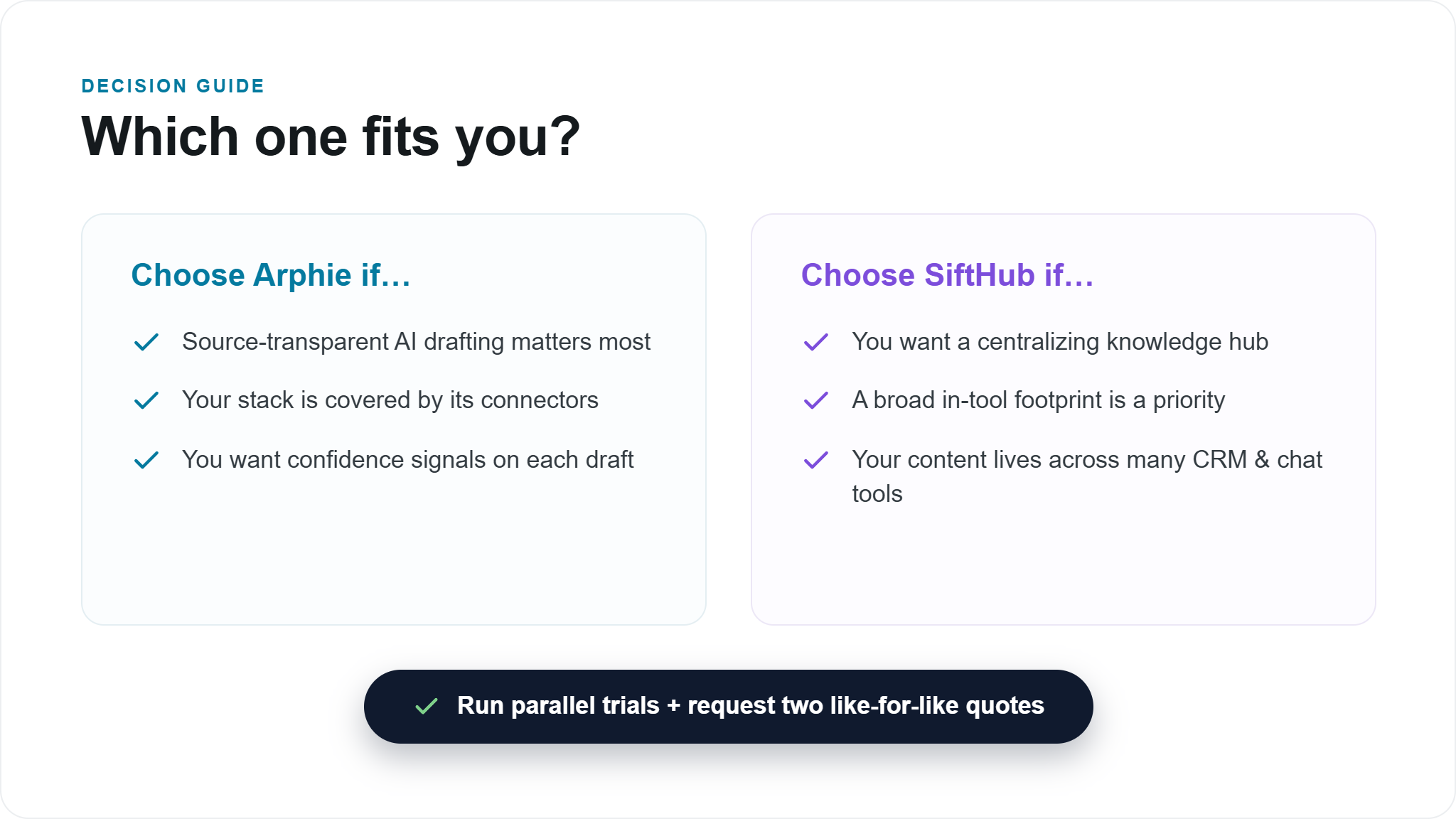
Neither wins outright — it depends on what your team needs. Choose Arphie if source-transparent AI drafting matters most and your stack is covered by its connectors; you'll trade off a not-yet-mobile experience and some export flexibility. Choose SiftHub if you want a centralizing knowledge hub with a broad in-tool footprint (Slack, Teams, browser, spreadsheets) and CRM/conversation-intelligence connectors; you'll want to test complex-document handling and source transparency, which some reviewers flag.
Because both carry thin, recent review bases and quote-based pricing, run parallel trials on the same real questionnaire and request two like-for-like quotes before deciding.
Also Worth Considering: Inventive AI
If you're weighing Arphie and SiftHub, it helps to know a newer category is forming alongside them: autonomous, AI-agentic proposal platforms that take a different architectural approach to the same problem. Inventive AI is one example of that category, and worth understanding as a reference point even if you ultimately pick one of the two above.
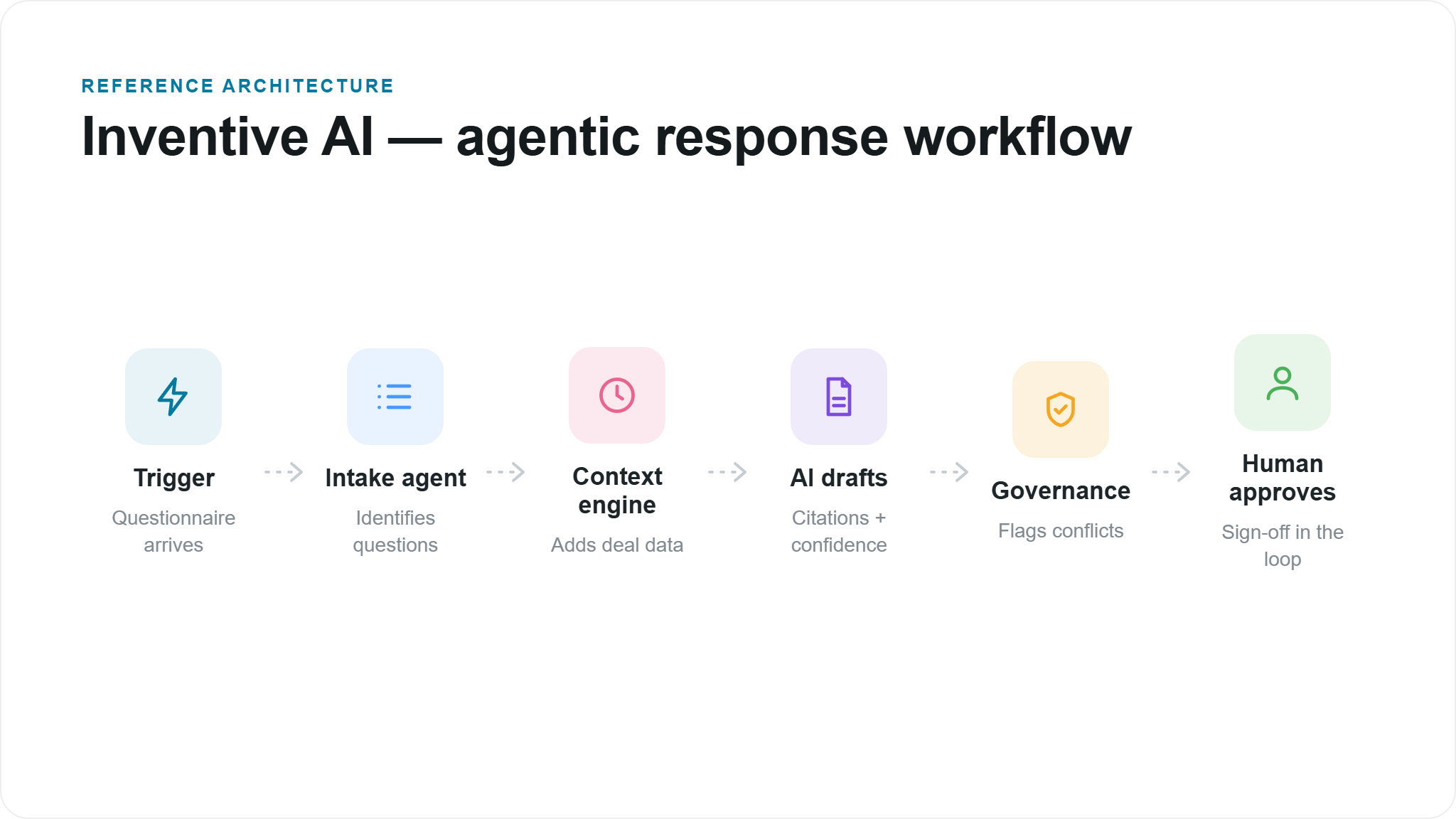
Rather than centering on a content library you maintain or drafts you assemble, Inventive AI is positioned as an autonomous, AI-agentic platform for RFPs, RFIs, DDQs and security questionnaires, with humans kept in the loop for approvals. Per vendor materials, once triggered, its agents run the workflow — understanding the document, drafting, validating and flagging gaps — for teams in sales, solution engineering and presales.
Key capabilities of Inventive AI (per vendor materials)
• AI first drafts the vendor reports at up to 10× faster generation with ~95% accuracy — for context, MaxVal described turning roughly a week of RFP work into 80 questions answered in 3 hours (vendor-reported; verify in a demo).
• Knowledge Hub that connects SharePoint, Google Drive, Salesforce, Confluence, Notion, Zendesk and websites, with live sync when a source doc changes.
• Content Governance Agent that detects conflicting info, flags outdated content and surfaces duplicates automatically.
• Context Engine that tailors responses per deal using customer priorities, CRM data and sales notes.
• Competitive Intelligence Agent that compares positioning against named competitors within a response.
• Format flexibility across Excel autofill and narrative-style proposals.
• Review and approval workflows with assignments, ownership and progress tracking; approved answers feed back into the Knowledge Hub.
• Response quality: RAD AI reported 2× more client-ready answers than the next-best RFP AI tool tested, with citations and confidence scores on every answer.
Best for: mid-market and enterprise proposal, presales, sales-ops and InfoSec teams that want agents to run the full response process, not just assist with drafting.
Why buyers comparing Arphie and SiftHub might look at Inventive as an alternative
Both Arphie and SiftHub draw feedback around source transparency, complex-document handling and how much agentic depth the AI provides. Inventive AI is positioned to address that shared gap with agents that run intake, drafting, governance and validation end to end, shipping every answer with a citation and confidence score and flagging "information unavailable" rather than guessing. As one attributed data point, AssetWorks reported a 422% ROI on RFP automation after adopting it. If that architecture fits your workflow, book a demo and test it on a live questionnaire alongside the other two.
Frequently Asked Questions
Is Arphie better than SiftHub?
Neither is better across the board. Arphie emphasizes source-cited AI drafting with confidence levels; SiftHub emphasizes a unified knowledge hub with a broad in-tool footprint. Arphie holds a higher reported G2 score (4.9 vs 4.6), but on a smaller sample, so weight both cautiously and trial them on your own questionnaires.
How much does Arphie cost?
Arphie does not publish prices. It uses a custom-quote model, reported by third-party analysis as a concurrent/per-project structure rather than per-seat. Confirm the current quote directly with Arphie for your team size and volume.
How much does SiftHub cost?
SiftHub also quotes privately, describing pricing as tailored to team size and use cases with a transaction/consumption-based model. Request a quote scoped to your expected question volume so the metering is clear.
Which has better integrations, Arphie or SiftHub?
SiftHub advertises a broader connector list, including HubSpot, Teams, Notion, Gong, Avoma and Zendesk, alongside the common content sources. Arphie covers Salesforce (with opportunity-to-project creation), SharePoint, Drive, Confluence, Seismic, Highspot, Slack and URL ingestion. Confirm which connectors are GA for your stack.
Do Arphie and SiftHub show where answers come from?
Both provide attribution. Arphie displays exact sources plus an AI confidence level on each draft. SiftHub attributes answers to the source document, owner and last-modified date, though some reviewers ask for clearer source transparency.
Is there an AI-native alternative to Arphie and SiftHub?
Yes. A newer category of autonomous, agent-run platforms — Inventive AI among them — takes a different approach, with agents handling intake, drafting, governance and validation while humans approve. It's one option to evaluate alongside Arphie and SiftHub; see how it stacks up in this SiftHub vs Inventive AI comparison.
Related Comparisons and Resources
• Best RFP software: an overview roundup
• Best enterprise RFP software compared
• Best AI agent for security questionnaires
• AutoRFP vs SiftHub comparison
• Loopio vs SiftHub comparison
• Arphie vs Inventive AI, head to head
Sources
• Arphie reviews — G2, Capterra, Gartner Peer Insights
• SiftHub reviews — G2, TrustRadius
• Pricing — Arphie site, SiftHub pricing, third-party Arphie pricing analysis
Figures are reported at time of writing (February 2026) and change frequently. Confirm current pricing, features and review counts with each vendor and on the live listings before purchasing.

.avif)


.png)