AutogenAI vs Loopio vs Responsive (2026): Which RFP Tool Fits Your Team?
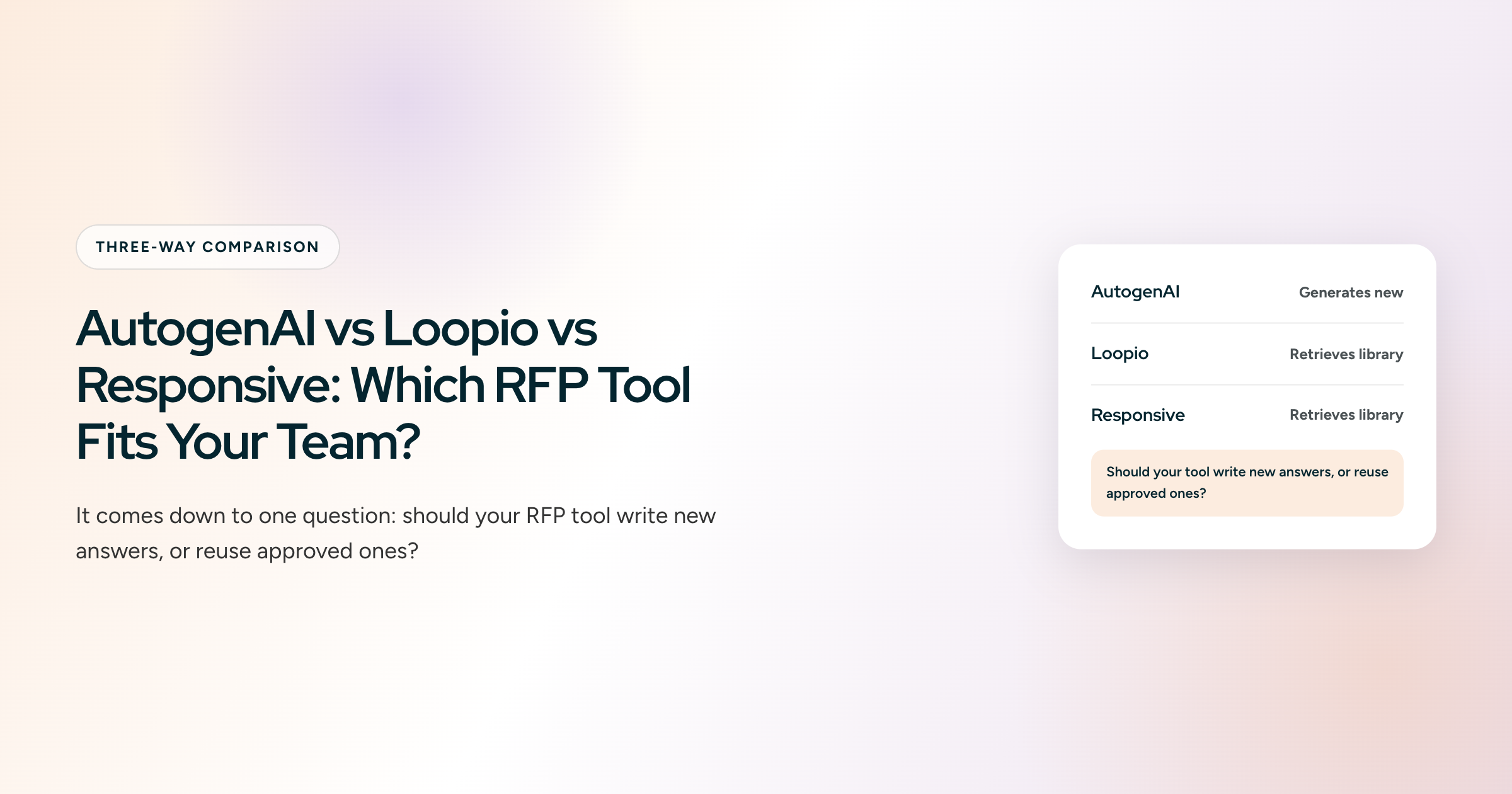
AutogenAI vs Loopio vs Responsive comes down to one question: should your request for proposal (RFP) tool write new answers or reuse approved ones? AutogenAI generates fresh, cited narrative for each section. Loopio and Responsive start from a library of answers your team has already approved, then use AI to draft from it. Inventive AI is an AI-native RFP platform that drafts cited answers from your connected company knowledge and flags conflicting or outdated content before it reaches a buyer.
Key takeaways
- AutogenAI is built for scored, long-form proposals: it drafts new narrative against evaluation criteria and holds FedRAMP High authorization through Palantir FedStart, which matters most for US federal work.
- Loopio is library-first: G2 reviewers most often praise its ease of use, and its value grows with how well someone keeps the Library current.
- Responsive is the broadest response suite: intake, governance, a Trust Center, and the longest commercial certification list, built for multi-team programs.
- Inventive AI covers the gap between them: it drafts narrative sections and questionnaire answers from live company knowledge, catches contradictions automatically, and costs $830/month, billed annually, with unlimited users.
AutogenAI vs Loopio vs Responsive at a glance
Checked against each vendor's own pricing, security, and comparison pages and G2 in November 2026.
What should you test when comparing AutogenAI, Loopio, and Responsive?
Test each tool on the work you actually do, because each one is strongest on a different kind of document. Keep these six tests in mind as you read on.
- The scored-section test: give each tool one evaluated narrative section with a word limit, and judge how close the draft is to submission-ready.
- The questionnaire test: load a 200-row security questionnaire in Excel and time how long it takes to get answers back into the original file.
- The federal check: if you bid on US government work, confirm FedRAMP, CMMC 2.0, and data hosting requirements before any demo.
- The source test: pick ten answers and check whether each claim traces back to an approved source you'd stand behind.
- The upkeep test: ask each vendor how many hours a week current customers spend maintaining content.
- The seat test: count every writer, subject matter expert (SME), and approver who needs access, and price that number, not the core team.
Are AutogenAI, Loopio, and Responsive AI-native?
Only AutogenAI. Loopio (founded 2014) and Responsive (founded 2015 as RFPIO) are library-based platforms that added generative AI later, while AutogenAI was founded in 2021 to build proposals with AI from the start.
- AutogenAI: AI-first proposal software that orchestrates multiple large language models, including GPT, Claude, Gemini, Mistral, and Cohere, and picks one per task.
- Loopio: a response management platform built around its Library, with Response Intelligence and Automated Answers added on top.
- Responsive: a Strategic Response Management suite built around its Content Library, now with AI agents for drafting, document import, and bid analysis.
AI-native doesn't automatically mean more accurate. What matters is where each draft's facts come from. Inventive AI is AI-native too, and it drafts only from your connected, approved company knowledge, flagging conflicting or outdated content before it reaches a draft. The next section shows how AutogenAI, Loopio, and Responsive source their answers.
How do AutogenAI, Loopio, and Responsive create an answer?
AutogenAI writes a new answer for each requirement, while Loopio and Responsive start from an answer your team already approved.
- AutogenAI generates: it shreds the RFP into requirements, builds a compliance matrix, then drafts new narrative from your approved knowledge, chosen documents, or the web, with Source Finder tracing claims to their source. Drafting happens inside Microsoft Word.
- Loopio retrieves: Automated Answers drafts from approved Library content, with a citation and Confidence Pulse score, and writers refine the wording with prompts.
- Responsive retrieves: AI agents draft from the Content Library and past responses, with source citations and a TRACE Score for reviewers.
Each approach has a cost. Generated narrative fits scored sections a library can't hold in advance, but G2 reviewers say AutogenAI drafts can read generic and still need a writer's pass. Retrieved answers keep approved wording intact, but they're only as current as the library behind them.
What do AutogenAI, Loopio, and Responsive need from your team to stay accurate?
All three depend on someone keeping content current. The job just looks different in each.
- AutogenAI: a curated knowledge library of past bids and evidence. Some G2 reviewers mention reloading source documents before each run, and AutogenAI can also pull from the web, so regulated teams should set rules on which sources each draft may use.
- Loopio: a named Library owner who acts on Freshness Indicator flags and runs review cycles. G2 reviewers report answers that need extensive review when the Library falls behind.
- Responsive: content owners working through approvals and version tracking, with content locked while it's under review.
Where does Inventive AI fit? Inventive AI drafts from the documents your teams already keep current in SharePoint, Google Drive, Confluence, and Notion, brought together in one Knowledge Hub. Its AI Content Manager flags stale, duplicate, and conflicting content across those sources before it reaches a draft, so there's no separate library to maintain. It handles narrative proposal sections and questionnaire answers in the same workspace, at $830/month, billed annually, with unlimited users.
How does AutogenAI compare with Loopio and Responsive head to head?
AutogenAI vs Loopio: which is better?
AutogenAI fits teams writing long, scored proposals. Loopio fits teams answering repeat RFPs, security questionnaires, and due diligence questionnaires (DDQs) from an approved library.
- Writing vs reuse: AutogenAI drafts new narrative against evaluation criteria, with storyboarding and win themes. Loopio drafts by combining approved Library entries.
- Portals: Loopio's SmartFill covers 170+ portal providers. AutogenAI's own comparison confirms it has no portal submission extension.
- Reported results: AutogenAI customers report 70% less drafting time, while a Loopio-commissioned Forrester study found about 50% time savings on questionnaire response.
AutogenAI vs Responsive: which is better?
AutogenAI fits narrative-heavy and federal bids. Responsive fits organizations running many response types across teams and regions.
- Scope: Responsive covers RFPs, DDQs, security questionnaires, RFQs, and buy-side requests, with intake and reporting. AutogenAI centers on proposal development, from qualification to review.
- Buyer self-service: Responsive's Trust Center lets buyers pull security documents themselves.
- Security: AutogenAI holds FedRAMP High authorization. Responsive holds more commercial certifications, including ISO 27701 and ISO 42001.
Which is best for federal and public sector bids: AutogenAI, Loopio, or Responsive?
AutogenAI is, and for US federal work that requires FedRAMP-authorized cloud services, it's the only one of the three that qualifies.
- AutogenAI: FedRAMP High authorization through Palantir FedStart, hosted in AWS GovCloud (US), plus DoD IL5, CMMC 2.0, and TX-RAMP. Compliance matrices and Gamma Review check drafts against Section L and M requirements.
- Loopio and Responsive: neither lists FedRAMP or CMMC 2.0 on its security page, which limits both for federal contracts that require them.
- Inventive AI: SOC 2 Type II without FedRAMP, so federal teams with FedRAMP requirements should shortlist AutogenAI.
Which handles security questionnaires, DDQs, and portals best: AutogenAI, Loopio, or Responsive?
Loopio and Responsive are the stronger fits for high-volume questionnaires, and Loopio covers the most portals.
- Loopio: answers security questionnaires and DDQs from the same Library, and SmartFill pushes approved answers into 170+ procurement portals.
- Responsive: widely used for security questionnaires, with a Trust Center and a browser extension for portal questionnaires.
- AutogenAI: supports Excel questionnaires through Q&A Workbooks, but its product centers on narrative proposals rather than questionnaire volume.
- Inventive AI: writes answers back into the original Excel file and fills Coupa, Ariba, and Jaggaer through Portal Answers, plus a browser extension for other vendor portals.
What do AutogenAI, Loopio, and Responsive cost?
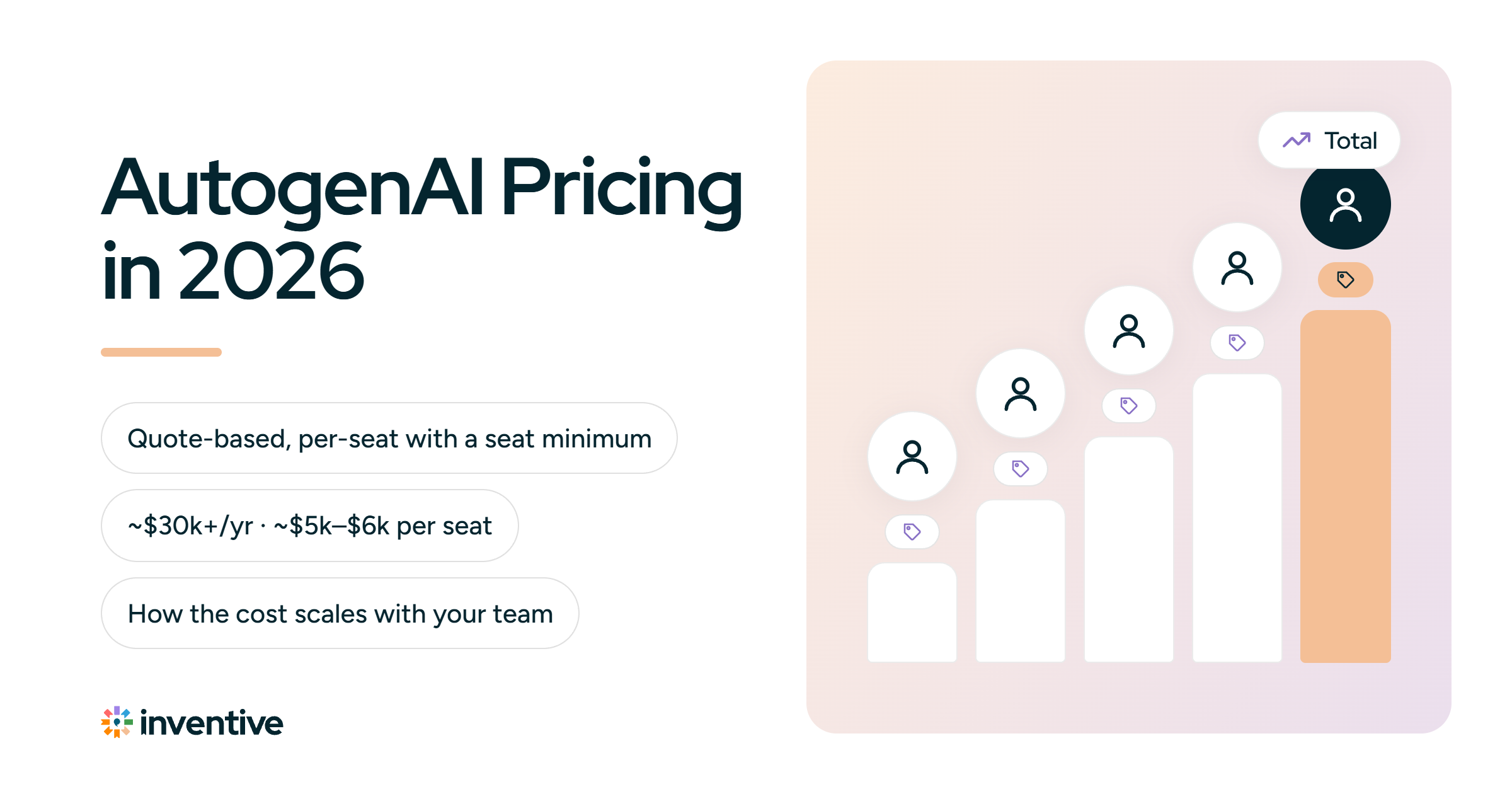
None of the three publishes a full price list. Each one ties cost to something different, so price the thing your team will grow.
- AutogenAI: quote only, set in each customer's order form. There's no public benchmark for AutogenAI pricing, even on Vendr.
- Loopio: custom quotes across Foundations, Enhanced, and Enterprise. Foundations includes 10 seats, and onboarding packages and project translations are add-ons. More detail on Loopio pricing.
- Responsive: a platform fee plus user licenses plus add-ons. The Emerging edition starts from $10,000, and Vendr reports a median contract of $14,750 a year across 133 purchases.
- Inventive AI: $830/month, billed annually, with unlimited users, so SMEs and approvers join without seat costs.
What do G2 reviewers say about AutogenAI, Loopio, and Responsive?
Reviewers of all three credit time saved. Their complaints split between learning curve (AutogenAI, Responsive) and answer accuracy when content falls behind (Loopio, Responsive).
Is there an AI-native alternative that handles both proposals and questionnaires?
Yes. Inventive AI is an AI-native RFP platform that drafts cited answers from your connected company knowledge and flags conflicting or outdated content before it reaches a buyer. It writes narrative sections like AutogenAI and answers questionnaires at volume like Loopio and Responsive, without a separate library to maintain.
Best features
- Both document types: an AI writer drafts narrative sections in the document editor, builds long proposals into your Word template, and writes Excel answers back into the original file.
- Answers you can verify: every draft cites its source and carries a confidence score, and unanswerable questions go to an SME instead of being guessed.
- Conflict detection: the AI Content Manager catches contradictions between your own documents before they reach a buyer.
Limitations
- No FedRAMP: federal teams with FedRAMP requirements should look at AutogenAI.
- Analytics: reporting and dashboards are the most common G2 request.
- Designed layouts: highly designed proposals are still finished outside the tool.
Pricing: $830/month, billed annually, with unlimited users.
G2 rating: 4.9 out of 5 from 88 reviews, and rated #1 Easiest to Use in G2's RFP category.
Proof:
- Rad AI: got twice as many ready-to-submit answers as the other vendors it tested, from the same 100 RFP questions.
- Druva: moved its 60-person SE team off Responsive in under a month.
- Harte Hanks: replaced Responsive and ChatGPT across six lines of business.
AutogenAI vs Loopio vs Responsive: which should you choose?
Match the tool to the documents your team writes most.
- Long, scored proposals or US federal bids: AutogenAI, especially when FedRAMP or CMMC 2.0 is required.
- Repeat questionnaires and portal submissions with a dedicated Library owner: Loopio. Teams outgrowing library upkeep often compare Loopio alternatives.
- Many teams, regions, and request types under one program: Responsive. Teams weighing a move can compare Responsive alternatives.
- A mix of narrative proposals and questionnaires, with no library to maintain: Inventive AI.