AutoRFP vs Qvidian vs Arphie (2026): Legacy vs AI-Native RFP Tools
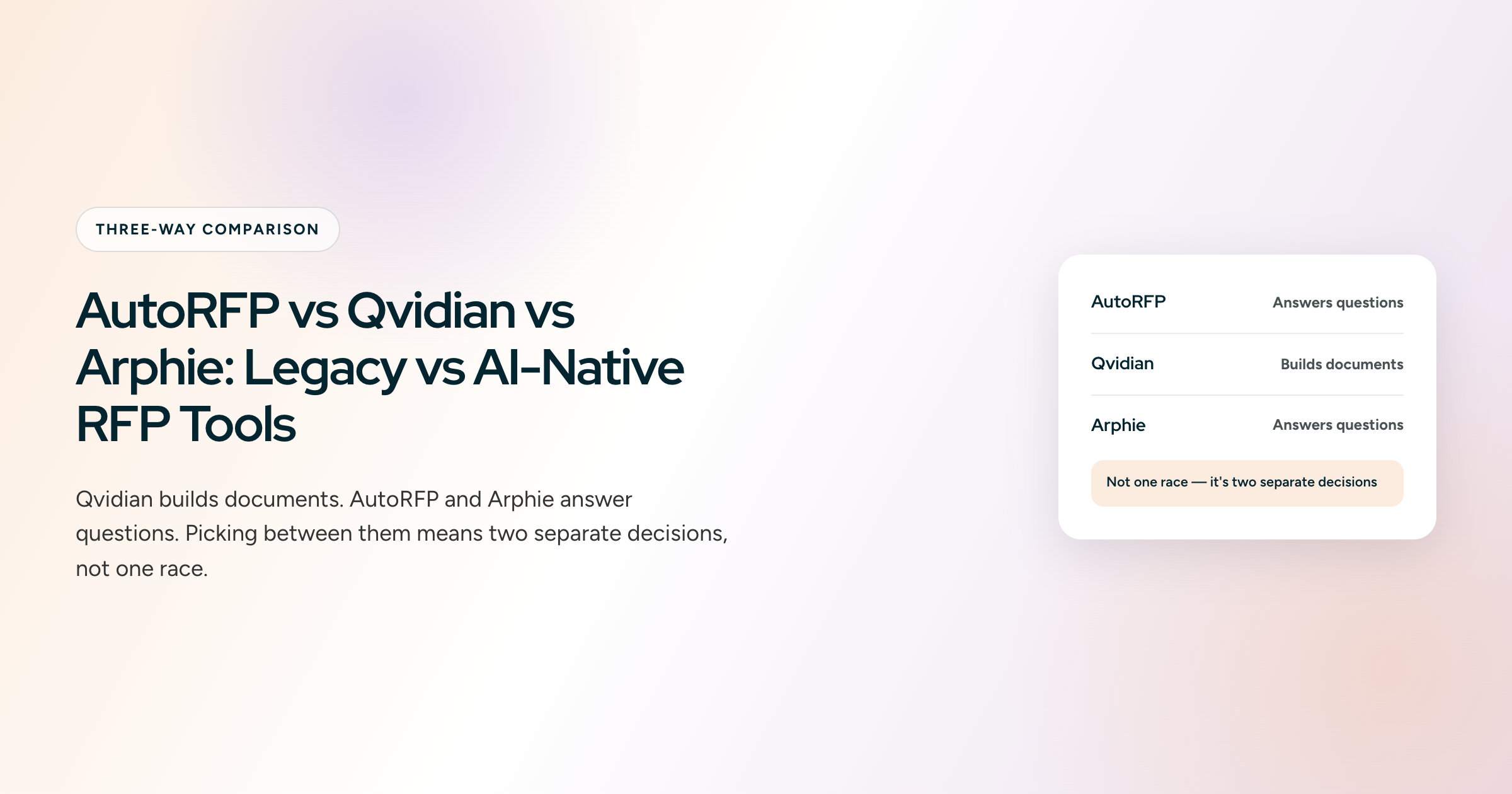
Most AutoRFP vs Qvidian vs Arphie comparisons treat this as a three-way race. It isn't: Qvidian builds documents, while AutoRFP and Arphie answer questions.
Key takeaways
- Qvidian is still the best document factory: nothing here matches its Word templates and 70+ reports, but you pay in manual upkeep and a named seat per contributor.
- AutoRFP is the fastest way off Qvidian for questionnaire-heavy teams: it's the only one with published prices, and every user is included.
- Arphie is the most transparent AI of the three: it shows the source, confidence, and reasoning behind every answer, on a custom quote.
- Inventive AI closes the gap all three leave: it's an AI-native RFP platform that drafts cited answers from your connected company knowledge and flags conflicting or outdated content before it reaches a buyer, with formatted proposal output included.
AutoRFP vs Qvidian vs Arphie at a glance
Ratings from G2 and pricing as reported in November 2026.
Do AutoRFP, Qvidian, and Arphie really compete with each other?
Only partly. Choosing between them means making two separate decisions.
- Decision 1, legacy or AI-native: Qvidian (owned by Upland Software) assembles approved content into branded Word proposals. AutoRFP (founded 2022) and Arphie (founded 2023) draft answers to hundreds of questions with AI.
- When Qvidian still makes sense: your output is mostly long narrative proposals, not questionnaires.
- When it doesn't: your week is security questionnaires, due diligence questionnaires (DDQs), and Q&A-style request for proposal (RFP) grids.
- Decision 2, AutoRFP or Arphie: both draft with citations. They split on pricing (published per-project plans vs a custom quote) and on how much of the AI's reasoning reviewers see.
What gap do AutoRFP, Qvidian, and Arphie all leave open?
None of the three gives you AI-native drafting and finished proposal formatting in one tool, and none checks your source documents against each other.
- Formatting vs AI: Qvidian formats well but doesn't draft from live knowledge. AutoRFP and Arphie draft well but return answers into the buyer's file instead of building a designed proposal.
- Contradictions between sources: AutoRFP checks conflicts inside its own library, and Arphie's Smart Merge flags duplicates. Neither checks whether two of your documents disagree, which is how outdated certifications and wrong pricing tiers end up in submissions.
Is there an RFP tool that closes the gaps AutoRFP, Qvidian, and Arphie leave?
Yes. Inventive AI covers both: AI-native drafting from live sources and finished proposal output, with conflict checks across your documents.
Inventive AI is an AI-native RFP platform that drafts cited answers from your connected company knowledge and flags conflicting or outdated content before it reaches a buyer.
- Both output types: builds long proposals into your Word template and writes questionnaire answers back into the original Excel file, all from one Knowledge Hub.
- Proof: AssetWorks reports a 422% ROI.
- Pricing: $830/month, billed annually, with unlimited users.
Where do AutoRFP, Qvidian, and Arphie each win, and what do they cost you?
AutoRFP: the fastest path off Qvidian, if your work is mostly questions
Where it wins
- Questionnaire speed: one G2 reviewer handling healthcare security questionnaires says work that took hours now takes minutes.
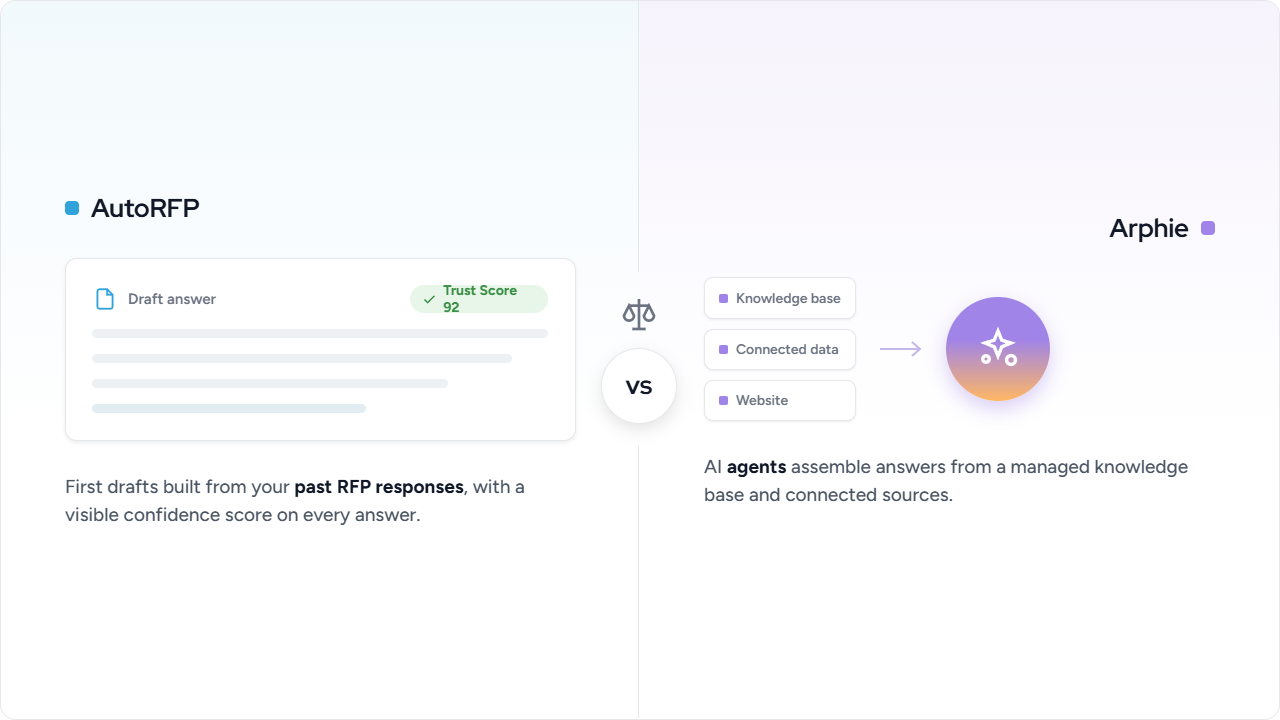
- Answers you can check: each draft carries a citation and a Trust Score, and answers go back into the buyer's Excel or Word file.
- Bid screening: Go/No-Go analysis scores each RFP against deal-breakers you set.
What you give up
- Document craft: it won't build a designed, 60-page proposal, and it doesn't publish a report builder like Qvidian's.
- A clean start: reviewers warn of a ramp-up period if your library is patchy, because the AI flags every inconsistency.
Pick AutoRFP if: questionnaires are most of your volume and you want a price before the first call. AutoRFP pricing runs $899/month for 24 projects a year or $1,299/month for 50, billed annually.
Qvidian: still the best document factory, at a cost in upkeep
Where it wins
- Formatted proposals: templates and Office plug-ins turn approved content into polished, on-brand Word documents.
- Reporting: 70+ prebuilt reports and a report builder, which leadership in regulated industries often requires.
- AI on top: AI Assist adds generative drafting and go/no-go screening of incoming RFPs.
What you give up
- Time: reviewers describe content uploads and updates as slow and manual.
- Ease: the interface feels dated, and setup is heavy.
- Budget flexibility: every contributor needs a named seat, so bringing in 20 subject matter experts (SMEs) gets expensive fast.
Pick Qvidian if: you produce long, formatted proposals, leadership relies on reporting, and you have a content owner. Qvidian pricing is quote only, per named user, plus a year-one implementation fee.
Arphie: the most honest AI, with the least predictable bill
Where it wins
- Visible reasoning: every answer shows the exact source, a confidence score, and why the AI answered that way, and it says so when sources can't support an answer.
- Live sources: drafts from Google Drive, SharePoint, Confluence, Notion, Seismic, and Highspot, so answers change when your documents do.
- Cleanup help: Smart Merge surfaces duplicate entries.
What you give up
- Track record: founded in 2023, it has 26 G2 reviews, against Qvidian's 156.
- Coverage: a few G2 reviewers mention export issues, bugs, and no mobile app.
- Predictable cost: Arphie pricing is a custom quote. Arphie earlier priced by concurrent projects at $36,000 to $60,000+ a year, which is hard to forecast if RFPs arrive in bursts, so confirm the current model.
Pick Arphie if: your reviewers won't sign off on AI answers they can't trace, and your volume is steady.
Which pricing model costs more as you grow: AutoRFP, Qvidian, or Arphie?
Each model penalizes a different kind of growth, so work out which number in your business grows fastest before you compare quotes.
- AutoRFP: cost rises with how many RFPs you run.
- Qvidian: cost rises with how many people are involved.
- Arphie: cost has historically risen with how many RFPs overlap at once, since Arphie priced by concurrent projects; confirm its current model.
For a team running 40 RFPs a year with 25 contributors:
- On AutoRFP: 40 projects pushes you past Scale to Accelerate, at $15,588 a year, and the 25 people cost nothing extra.
- On Qvidian: all 25 contributors need named seats, plus implementation.
- On Arphie: the quote is custom, and under Arphie's earlier concurrent-project model, ten RFPs landing in one quarter would set the price.
Infographic 2 brief: Takeaway headline: Which number grows fastest? Three bars showing what raises each bill: AutoRFP (RFPs per year), Qvidian (named users), Arphie (custom quote; earlier concurrent projects). 1200 x 675, WebP. Alt text: AutoRFP vs Qvidian vs Arphie pricing models.
Which should you choose: AutoRFP, Qvidian, or Arphie?
- Mostly formatted proposals: staying on Qvidian is defensible, as long as you budget for upkeep and seats.
- Mostly questionnaires: AutoRFP is the cleanest move, being faster, easier to forecast, and easier to adopt.
- Reviewers need to see the AI's reasoning: Arphie, if a custom-quoted price works for your budget.
- Need formatted proposals and AI-native drafting together: none of the three is built for it, and that's the gap teams usually bring to us.