Best AI Sales Agents for AEs and RevOps in 2026
The best AI sales agents for AEs and RevOps in 2026, compared by agent capability, pricing, and verified G2 ratings, with how to choose for your role.
Most sales platforms now advertise an AI agent, and most of them are outbound SDR bots built to send more email. The agents that actually move a deal forward, for the AE managing the opportunity and the RevOps leader overseeing the sales process, are a smaller, more useful set.
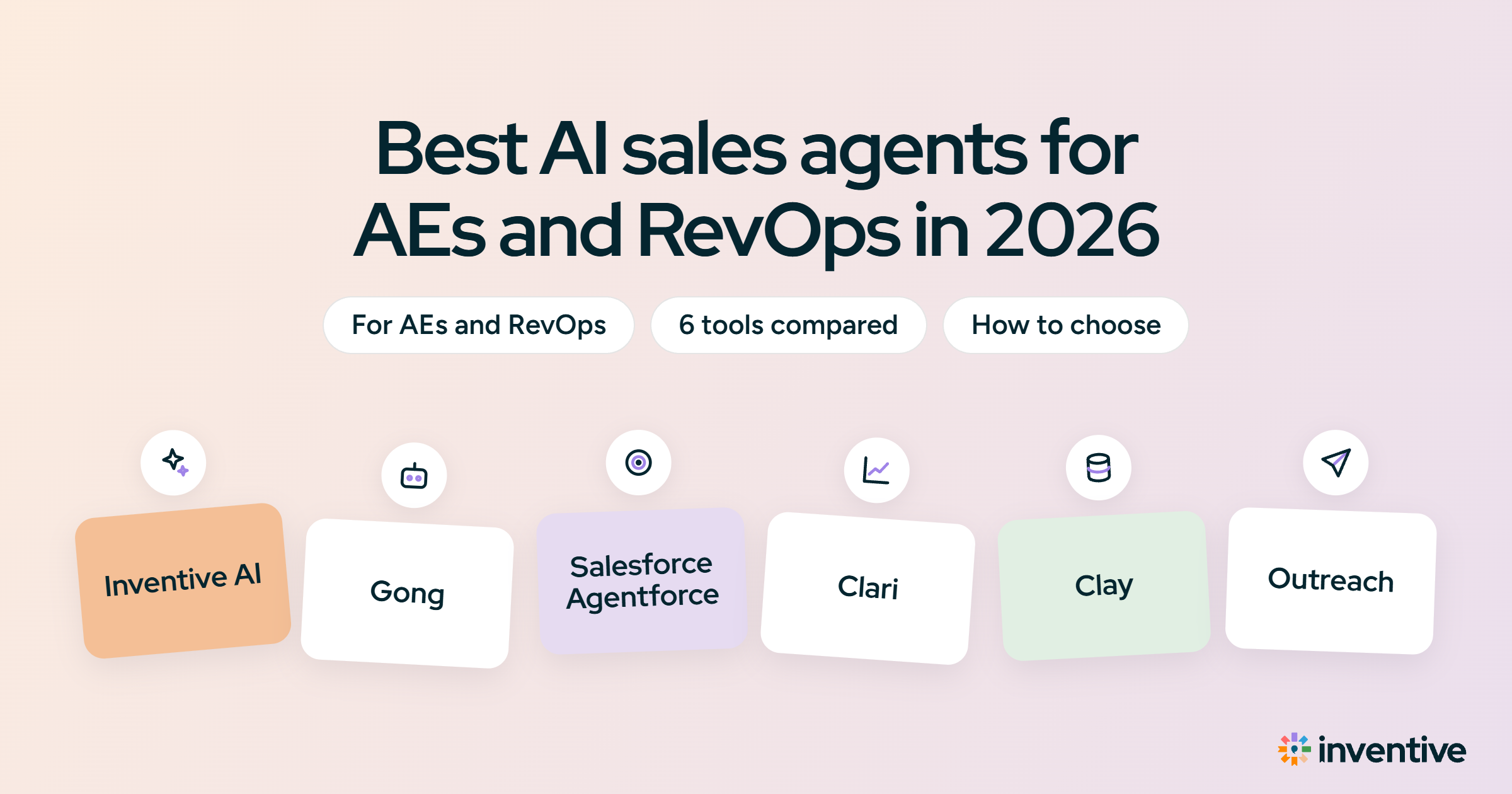
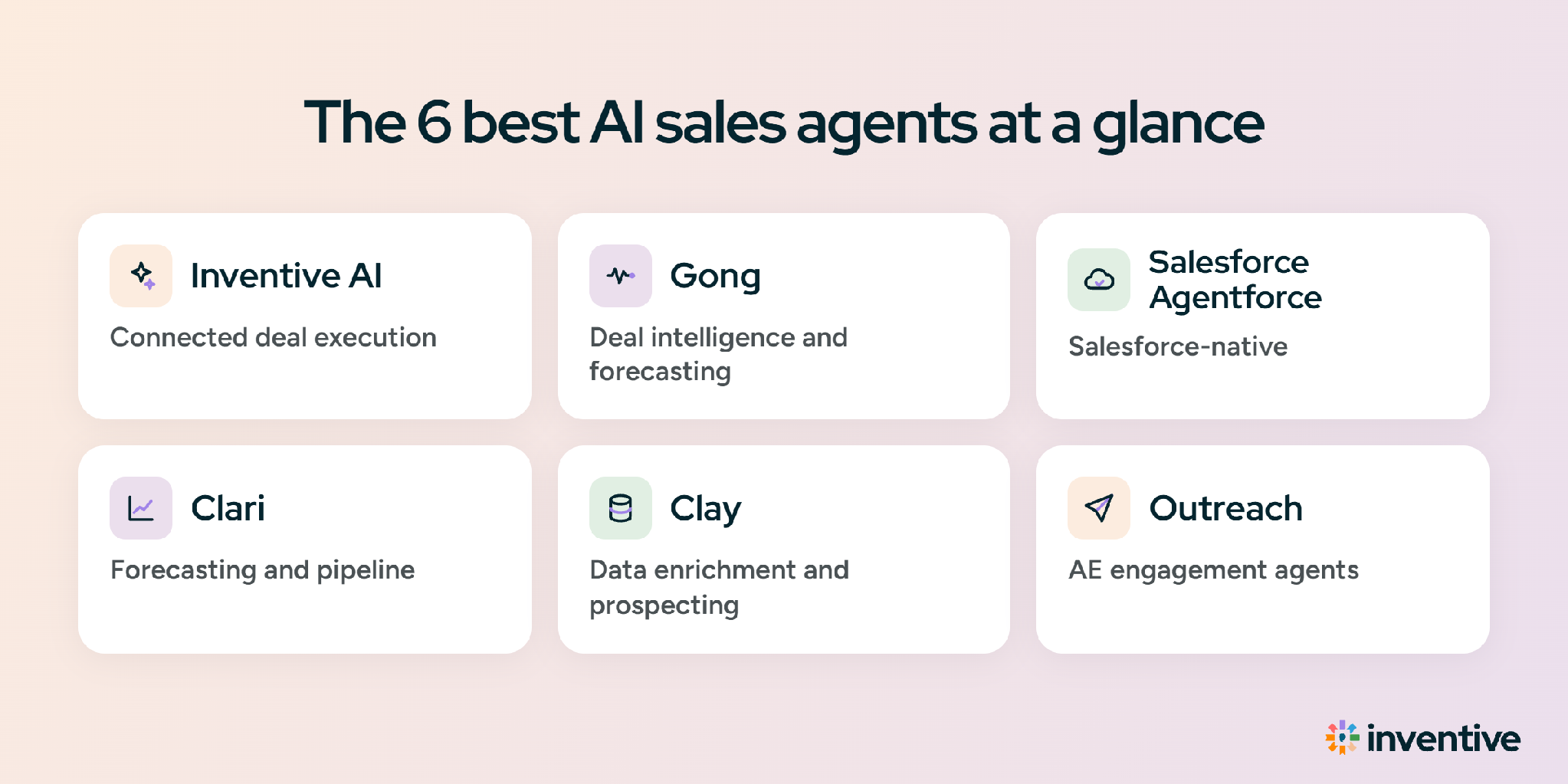
In 2026, that shortlist is Inventive AI, Gong, Salesforce Agentforce, Clari, Clay, and Outreach. This guide scores each on what its agents do for those two roles, with pricing and verified G2 or Gartner ratings you can check.
TL;DR
The right agent depends on which problem costs your team the most.
- AEs losing hours to post-call admin: Inventive AI, Gong, and Outreach write the recap, update the CRM, and draft the follow-up, so reps spend less time on paperwork.
- Deals slipping late in the quarter: Inventive AI and Clari flag deal risk and show when a deal is likely to close later than expected.
- A forecast nobody trusts: Clari and Gong build forecast from real deal activity, like emails and meetings, instead of each rep’s guess about what will close.
- One tool or several: Gong and Inventive AI cover both AE and RevOps workflows, while the other tools in this list are more focused on specific sales functions.
How we chose these AI sales agents
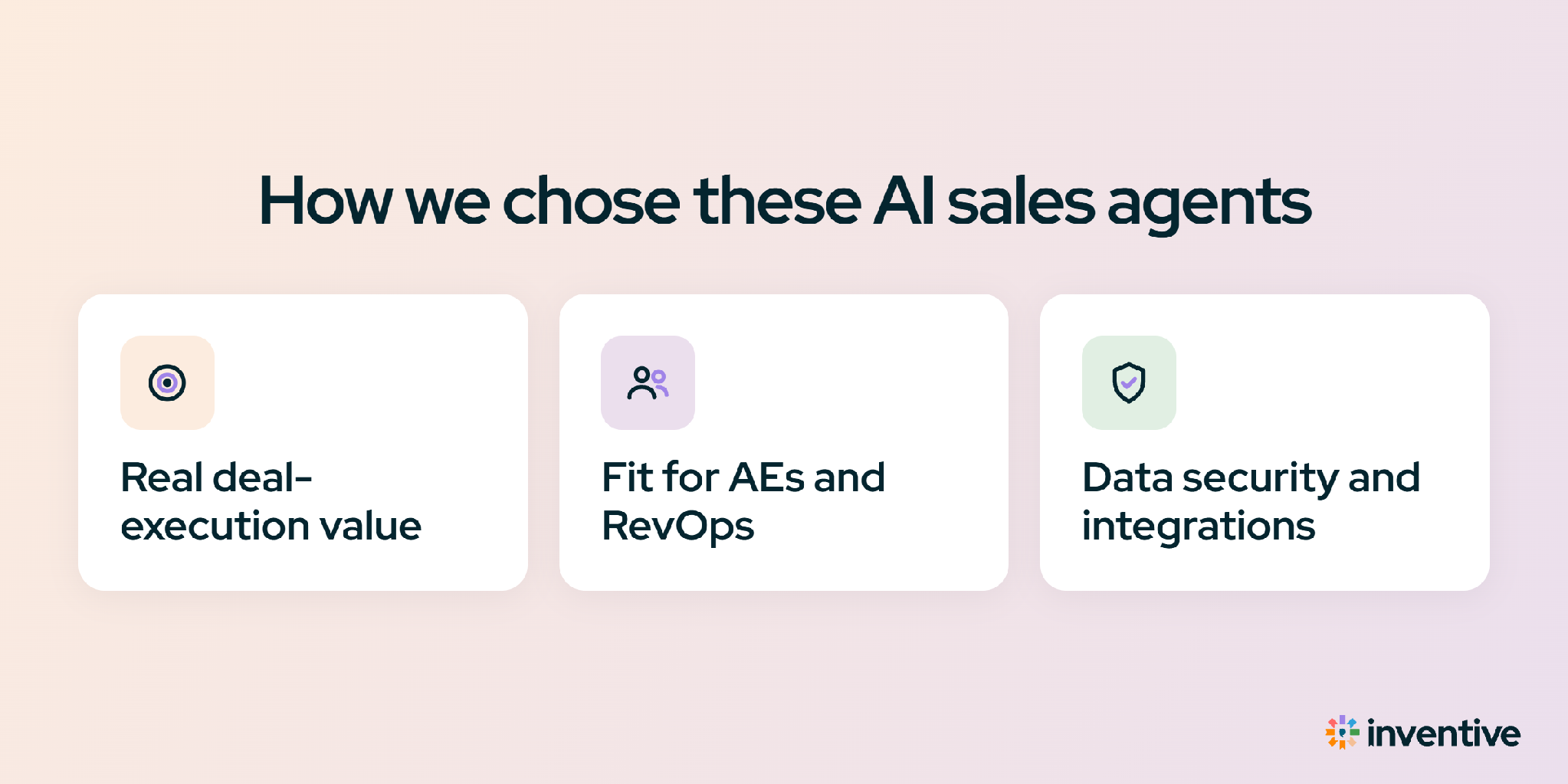
We scored each tool on five things that matter to AEs and RevOps: what its agents actually do in practice, how deeply it reads CRM and deal data, how it governs accuracy on buyer-facing work, pricing clarity, and verified ratings from G2 or Gartner Peer Insights.
Everything below is sourced from each vendor's own pages and third-party review sites, so you can check every claim rather than take our word for it.
To get a complete understanding of how AI works in sales, see our guide on How to Use AI in Sales.
Best AI sales agents at a glance
1. Inventive AI: best for connected deal execution across AEs and RevOps
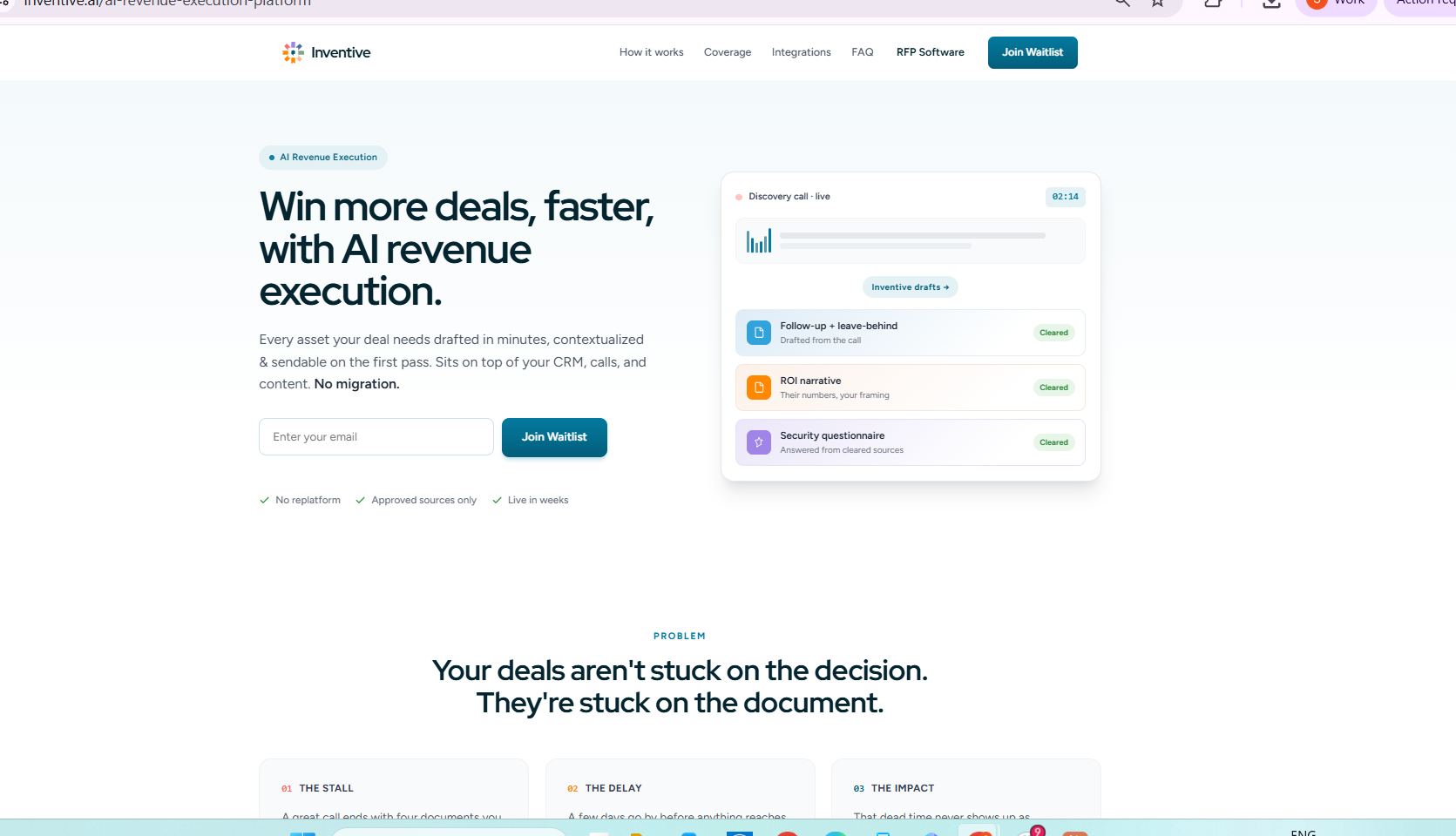
Inventive AI is an AI revenue execution platform that runs agents across the whole deal from one connected view of the CRM, email, calendar, and calls, built to reduce deal slippage.
What its agents do:
- Deal slippage: shows what is holding a deal up, such as a pending pricing approval or legal review, and flags when the modelled close date is later than the rep's called date.
- CRM automation: proposes CRM updates after meetings, including next step, description, and stage, and applies them automatically or after approval based on user settings.
- Call prep and recap: Opens on the day’s calendar with deal context, then turns each call into a sales intelligence report covering the executive summary, pain points, buyer requests, seller commitments, risks, and next actions.
- Sales collateral: From the deal chat, drafts one-pagers, ROI case studies, and sales decks as interactive HTML, Word, or slides, built from the Knowledge Hub.
- Governed content: Sales assets cite their sources, including Knowledge Hub, CRM, and web content. Customer-facing actions can require approval before sending.
- Custom agents: Build recurring or event-triggered workflows in plain language, without waiting for a new product feature.
Limitations:
- Current integrations include Salesforce, HubSpot, Fathom, Gmail, Google Calendar, Slack, and SSO. Dynamics, Gong, Zoom, Fireflies, and several other integrations are in progress.
- Forecasting works deal by deal, but the full team-level pipeline forecast is still being built, so RevOps leaders won’t get a complete quarter roll-up yet.
Pricing: Custom for the platform; the RFP response product starts at $830/month billed annually, with unlimited users and usage-based pricing.
Rating: G2 4.9/5 (87 reviews)
Best for: AEs and RevOps that want one governed, connected workflow instead of stitching together separate agents for calls, CRM, and content.
Skip it if: you only need a high-volume outbound SDR, or you require a large catalog of prebuilt integrations today.
2. Gong: best for AE deal intelligence and RevOps forecasting
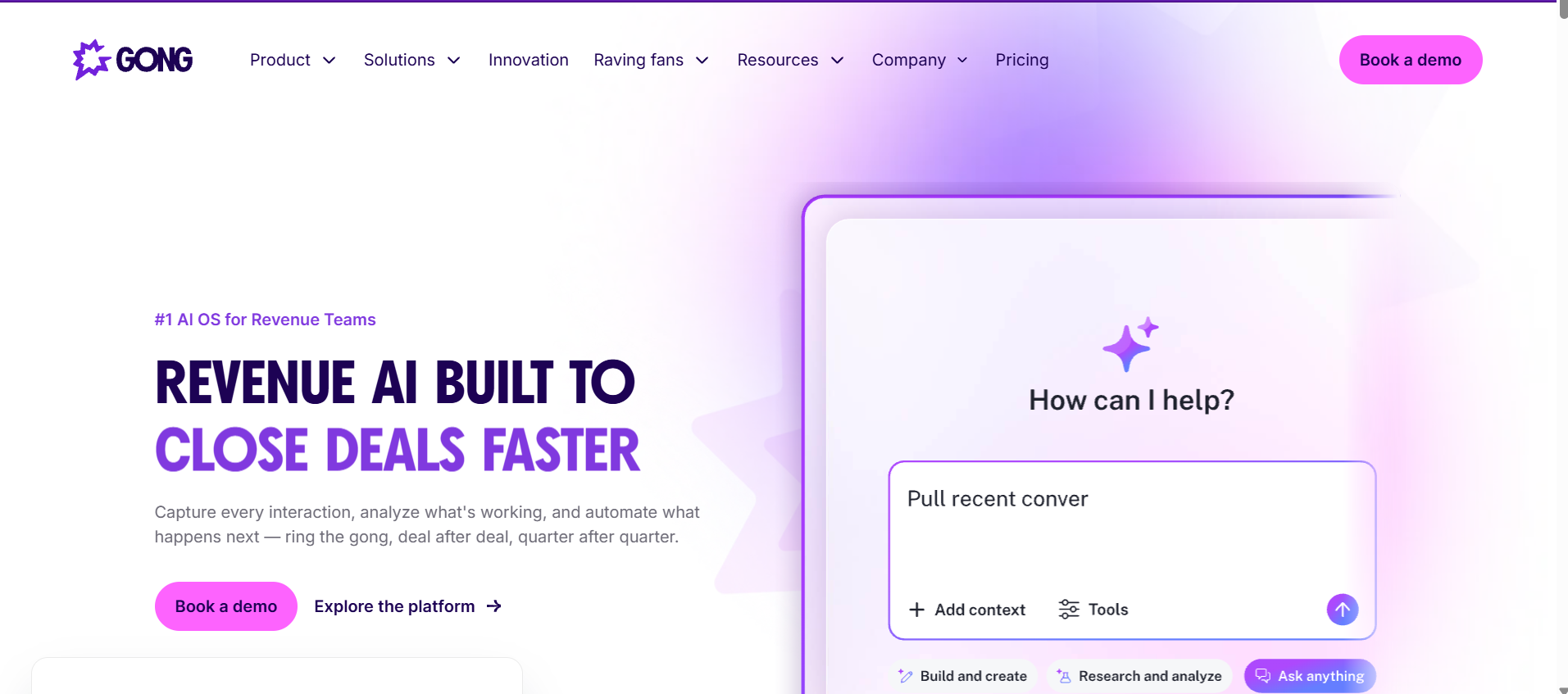
Gong is the revenue-intelligence incumbent, and in 2025 it packaged its AI into named Gong Agents that read your calls and emails.
What its agents do:
- AI Deal Predictor: scores each deal’s health and likelihood to close.
- AI Revenue Predictor: rolls call and email signals into a forecast.
- AI Ask Anything: answers plain-language questions about any deal, account, or call.
- Included with Gong licenses rather than charged separately.
Limitations:
- Reviewers consistently flag Gong as expensive and hard to justify against its platform fee.
- Some report AI summaries and transcripts can be inaccurate and need checking, with recurring call-capture and recording issues.
Pricing: Custom; per user plus a platform fee that scales with team size, with no public self-serve plan.
Rating: G2 4.7/5 (about 6,780 reviews)
Best for: mid-market and enterprise teams that want AE deal intelligence and RevOps forecasting from the same call data.
Skip it if: you are a small or budget-conscious team, or you only need outbound prospecting.
3. Salesforce Agentforce: best for teams standardized on Salesforce
Agentforce is Salesforce’s layer of prebuilt agents that run inside Sales Cloud on live CRM data.
What its agents do:
- SDR Agent: detects a buying signal, sends personalized outreach across email, SMS, and WhatsApp, qualifies the lead, and books the meeting.
- Sales Coach: runs AI roleplay for discovery, pitch, and negotiation, with feedback tied to your methodology.
- For managers: tracks coaching and compares win rates for coached versus uncoached deals.
Limitations:
- Reviewers note setup takes significant configuration and strong Salesforce admin skills.
- Consumption-based pricing is hard to forecast and can get expensive, and output depends on clean CRM data.
Pricing: $2 per conversation, or a $125/user/month add-on; Flex Credits at $500 per 100,000; requires a Sales Cloud license.
Rating: G2 4.3/5 (1,698 reviews)
Best for: AEs and RevOps already standardized on Salesforce, with admin resources to tune the agents.
Skip it if: you work largely outside Salesforce, or you cannot cap consumption-based spend.
4. Clari: best for RevOps forecasting and pipeline inspection
Clari is a revenue platform built around forecasting and deal inspection, used mostly by RevOps and sales management. Clari and Salesloft merged in late 2025, so it now sits in the Salesloft portfolio.
What its agents do:
- Forecast: AI revenue forecasts with scenario and what-if planning.
- Inspect: scores deal health, flags risk, and recommends CRM changes, so managers review by exception.
- Copilot: records and summarizes calls and writes results back to the CRM.
- MCP server (2026): exposes pipeline and deal data to outside AI tools like Claude and Microsoft Copilot.
Limitations:
- Reviewers report occasional stability and performance lags and data-refresh delays.
- Limited day-to-day value for individual reps, and implementation is heavy enough to need a dedicated RevOps owner.
Pricing: Custom; Clari does not publish pricing, and its pricing page now redirects to Salesloft.
Rating: Gartner Peer Insights 4.7/ 5 (849 ratings)
Best for: RevOps leaders and sales management that need enterprise forecasting across a large pipeline.
Skip it if: you want daily value for individual AEs, or a light setup without a dedicated RevOps owner.
5. Clay: best for RevOps data enrichment and prospecting
Clay is a data enrichment and go-to-market automation engine, aimed at RevOps and growth teams rather than seller-facing AEs.
What its agents do:
- Claygent: an AI agent that scrapes the web to research and qualify accounts and people against custom criteria.
- Waterfall enrichment: chains 100-plus data providers, so coverage often passes 80 percent.
- Signals: watch for job changes, hiring, and intent, then trigger enrichment or outreach.
- Account and rep-prep agents: draft briefs and follow-ups, routable to Slack for approval.
Limitations:
- Reviewers cite a steep learning curve and real ramp-up time before building effective workflows.
- Costs climb quickly with enrichment volume, and misconfigured settings can burn credits.
Pricing: Free tier; paid from around $167/month (Launch) and $446/month (Growth); credit-based, so cost scales with volume.
Rating: G2 4.6/ 5 (234 reviews)
Best for: RevOps and growth teams that own enrichment, list building, and signal-based outbound.
Skip it if: you want a seller-facing AE assistant, or predictable costs rather than per-credit pricing.
6. Outreach: best for AE engagement with deal and research agents
Outreach is a sales engagement platform that added agents to its workflow in 2025.
What its agents do:
- Deal Agent: updates sales-methodology fields such as the economic buyer and decision criteria from recent conversations.
- Research Agent: builds real-time account views, handoff briefs, and tailored messaging.
- Plus AI personalization, smart data enrichment, and live call coaching.
Limitations:
- Reviewers describe support as slow and generic, and the interface as cluttered with a steep learning curve.
- Several report reliability problems with the browser extension, the dialer, and Salesforce sync.
Pricing: Custom; seat-based access plus consumption-based AI credits across four tiers, with no public figures.
Rating: G2 4.3/ 5 (3,676 reviews)
Best for: AEs wanting deal execution and account research in their engagement tool, and RevOps wanting pipeline accuracy at scale.
Skip it if: you want a simple setup and fast, hands-on support.
AI sales agents: which one fits your role
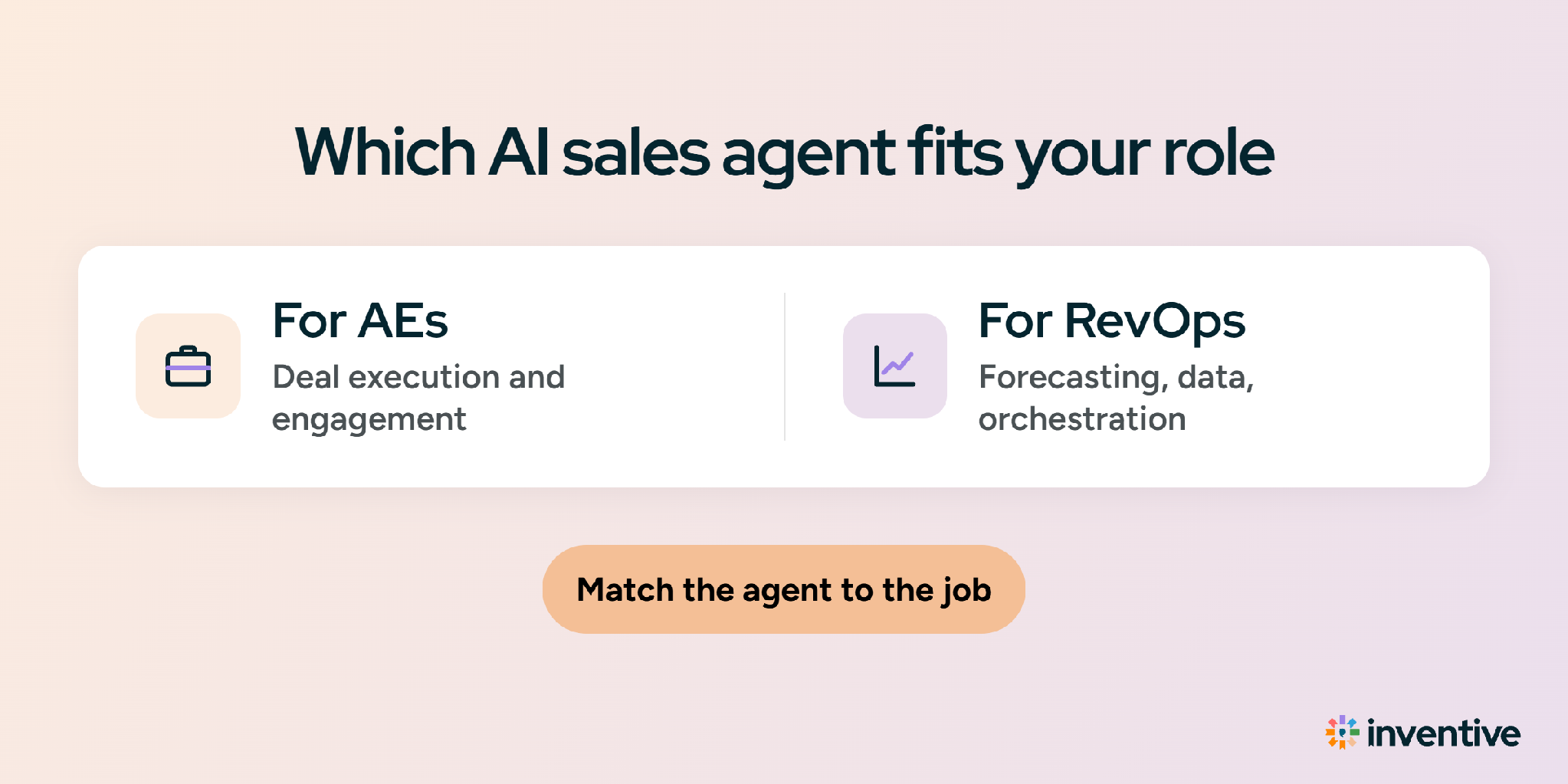
The same deal looks different depending on the role.
For AEs (deal execution):
- Inventive AI: to cut post-call admin and catch deals before they stall. It writes the recap, updates the CRM, drafts the follow-up, and builds the one-pager, so the AE edits a draft instead of starting from scratch.
- Gong: for the strongest call coaching and deal scoring, if the budget can absorb its platform fee.
- Outreach: if your AEs already send sequences in Outreach and want account research and CRM updates in the same tool.
- Salesforce Agentforce: only if you run on Salesforce. Its agents need Sales Cloud, and its value is more limited outside Salesforce.
For RevOps (data, orchestration):
- Clari: for the most accurate team forecast, if you have a RevOps owner to run it. Individual reps get little from it day to day.
- Clay: if your bottleneck is data, such as enrichment, list building, and CRM hygiene, and you can spend time building workflows.
- Inventive AI: to keep CRM updates moving and generate buyer-facing content from governed, approved sources.
- Gong: for forecasts built from what buyers actually said on calls, not what reps typed into the CRM.
Read more: Best Revenue Operations Software: AI Tools for RevOps Teams
How to choose AI agents for sales
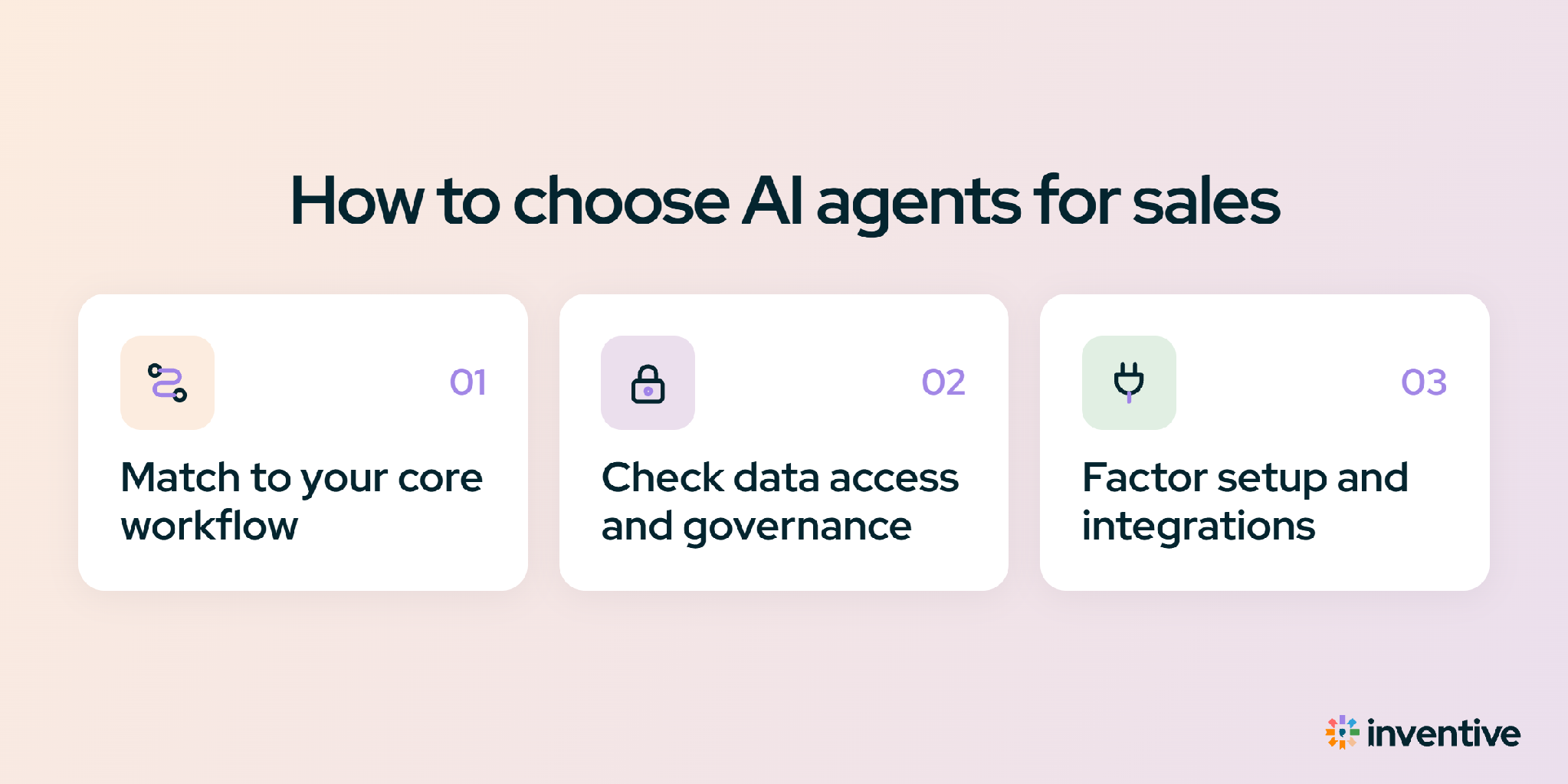
Pick an AI sales agent by matching it to your role, your stack, and the autonomy you are ready to give it. Work through these in order:
- Start by choosing: one agent, or one platform? Some tools do a single job well, like an AI SDR or a call note-taker. A platform runs agents across the whole deal, so the recap, CRM, forecast, and content all share the same data. One agent is quicker to set up. A platform saves you from juggling separate tools. Decide which you want before comparing vendors.
- Name the task to automate first. Within that choice, start where the pain is. AEs usually begin with call recaps and follow-ups; RevOps with forecasting or data enrichment. Pick one, and decide who owns it.
- Decide what it can do on its own. Let the agent update internal CRM fields automatically, but make it wait for sign-off before anything reaches a buyer. Check that the tool lets you set autonomy by task, rather than using one on/off setting.
- Check that agents read your actual stack. An agent that sees only one CRM field writes generic work. Confirm it connects to your CRM (Salesforce or HubSpot), your call recorder, email, and calendar before you commit.
- Test accuracy on buyer-facing content. For a one-pager or proposal, confirm the agent pulls from your approved content, cites its sources, and flags what it can’t verify instead of guessing. This matters most for pricing, security, and product claims.
- Work out the real monthly cost. Headline prices hide the bill. Add the platform fee, per-user cost, and per-conversation or per-credit charges at your actual usage, since consumption pricing (like $2 per conversation) climbs fast.
- Pilot on real deals first. Run the agent on a handful of live deals for a few weeks, and measure draft quality and time saved, before signing an annual contract.
Common mistakes when deploying AI sales agents
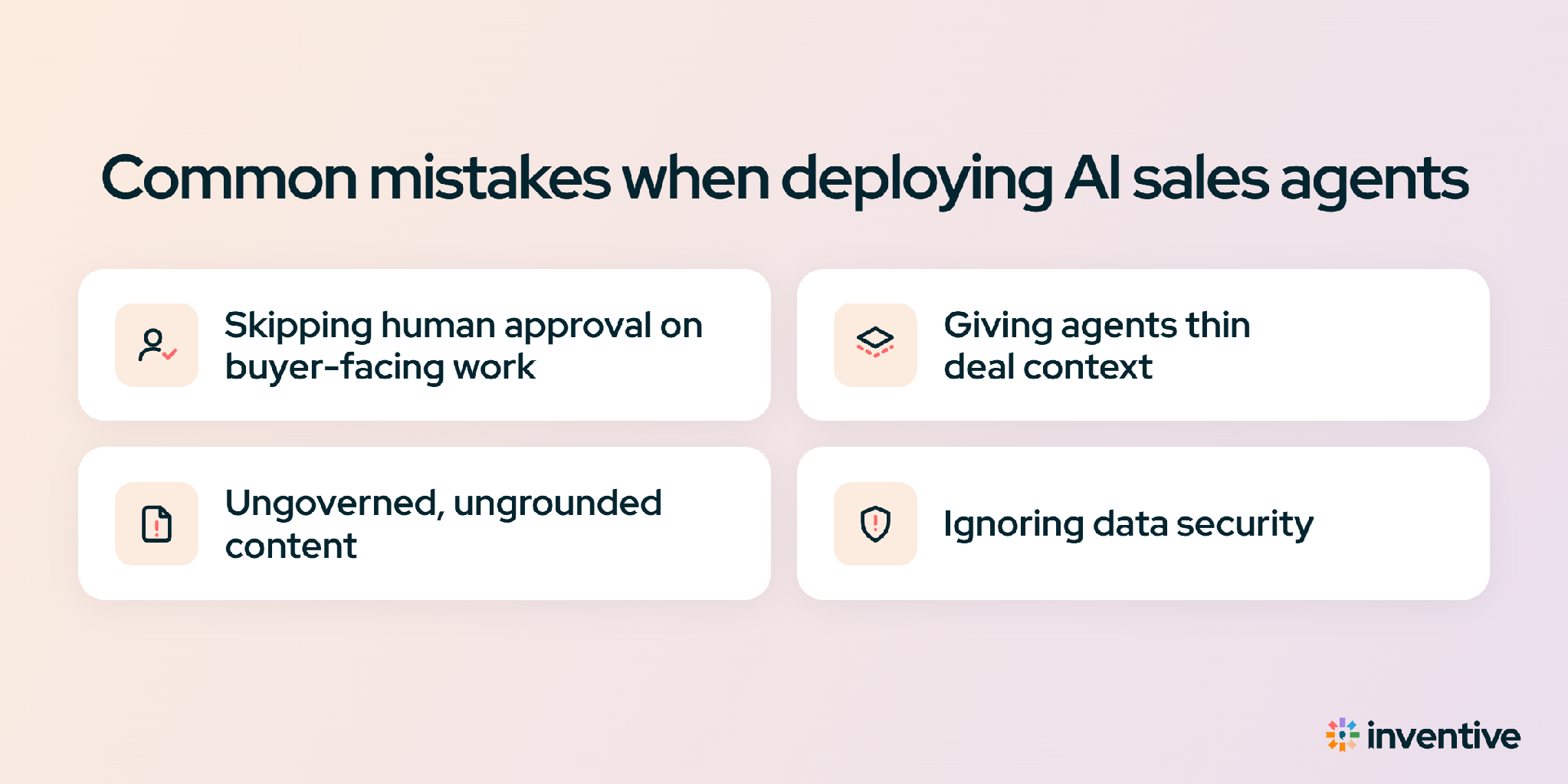
A few mistakes come up again and again. Each one is easy to avoid, and handling it early saves rework later.
- Review buyer-facing work before it sends. An agent can draft the email, one-pager, or proposal, but a person should check the tone and the claims before a buyer sees it.
- Clean the CRM before you rely on agents. Scoring and forecasting agents read the data underneath, so accurate data produces accurate output.
- Set up deliverability and consent first. Authenticate your domain, keep send volumes sensible, and get recording consent. These steps keep your email in the inbox and your team compliant.
- Compare the real cost, not the headline price. Consumption and platform fees drive the actual bill, so add up what you would spend at your own usage.
- Automate in stages. Start with internal, low-risk tasks, then expand as the team builds confidence in the output.
The bottom line: which to shortlist first
Shortlist by your role and your stack. For AEs buried in post-call admin, start with Inventive AI or Gong. For RevOps, start with Clari for forecasting or Clay for data. Then run one pilot: pick a high-pain, low-risk task like call recaps, test it on a few real deals, and check the draft quality before you commit. Whatever you choose, output quality depends heavily on the quality of your CRM data.
Inventive AI is the pick if you want the recap, CRM update, content, and slippage alerts working from one connected, governed view, with every agent on the same deal data and a human in the loop. AEs spend less time on post-call admin, while RevOps gets automated CRM updates from deal activity.