What is bid management software? Features, uses & how It Works
Bid management software helps teams find, write, and submit bids and tenders in one place. Learn what it does, its features, types, and who needs it.
What is bid management software? Features, uses & how It Works
Bid management software is a platform that helps a team manage the full process of responding to bids, tenders, and RFPs in one place, from deciding which opportunities to pursue through writing, reviewing, and submitting each response. It replaces the mix of spreadsheets, shared drives, and email threads that most teams use to track deadlines, gather answers, and coordinate the people who write a bid.
If your team responds to more than a few bids a month, that manual setup starts to cost you. Answers are hard to find, deadlines slip, and two people write different responses to the same question. Bid management software fixes that by giving the whole process one system. This guide explains what it is, how it works, what it does, the different types, and who needs it.
TL;DR
- Bid management software is a platform for running bid and tender responses end-to-end: finding opportunities, qualifying them, writing responses, reviewing, and submitting, all in one place.
- It is used by response teams. Bid, proposal, sales, and presales teams that respond to RFPs, tenders, and security questionnaires rely on it to stay organized and consistent.
- Core features include opportunity tracking, a content library, collaborative drafting, deadline and compliance tracking, approvals, and reporting.
- The main benefits are faster responses, more bids handled without adding people, higher win rates, and consistent answers.
- AI has changed the category. Modern tools draft responses from your own approved content, so teams review instead of writing, but the draft is only as accurate as the content behind it.
What is bid management software?
Bid management software is a platform that response teams use to manage competitive bids end-to-end. It brings your open opportunities, deadlines, reusable content, and in-progress responses into one system, instead of spreading them across spreadsheets, drives, and email.
Its purpose is control and repeatability. A manual process relies on people to remember which bids are due, where the approved answer lives, and which sections are still outstanding.
Bid management software standardizes that: every bid follows the same workflow, every question has an owner, and every answer comes from a single approved source. That is what shortens turnaround times and holds quality steady as bid volume grows.
It is used most by organizations that win business through formal procurement, including software and technology vendors, professional services firms, and construction and engineering suppliers, and by any team that regularly responds to RFPs, RFIs, tenders, or security questionnaires.
Bid management software vs proposal, RFP, and tender software
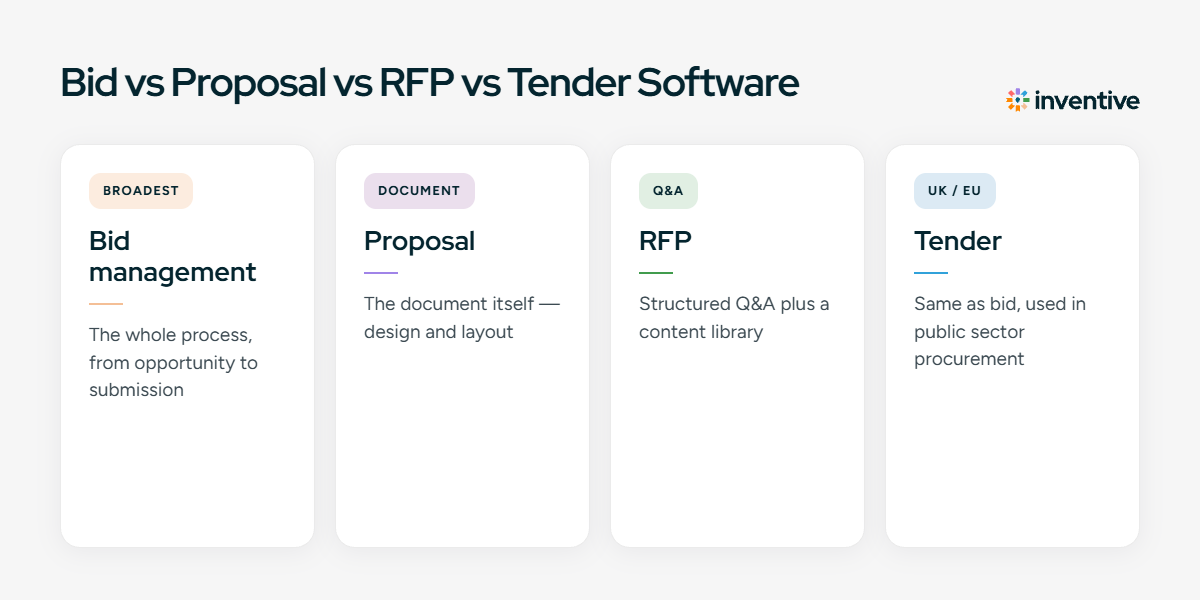
Bid management sits in a family of closely related tools, and the names overlap in marketing. The differences are real, though, and they affect what you buy.
- Bid management software is the broadest term. It covers the whole process of responding to competitive opportunities, including tracking which ones to pursue, not just writing the response.
- Proposal software focuses on creating the proposal document itself: layout, design, content, and sometimes e-signature. It is strongest on the writing and presentation, lighter on opportunity tracking.
- RFP software is built specifically for responding to requests for proposals, with a content library and question-by-question answering at its core. In practice, RFP software and bid management software overlap heavily.
- Tender management software is the same idea using the word common in the UK, Europe, and public-sector procurement. Tender and bid are largely interchangeable terms for the same work.
The practical takeaway: if your work is mostly answering structured RFPs and questionnaires, look at RFP or bid management software. If it is mostly building polished, custom proposal documents, look at proposal software. Many platforms now cover more than one of these, so match the tool to where most of your work sits.
How bid management software works
Bid management software works by running every bid through one system in set stages: it captures new opportunities, helps you qualify them, assigns sections and deadlines, drafts responses from your content library, routes them for review, and tracks the outcome after you submit.
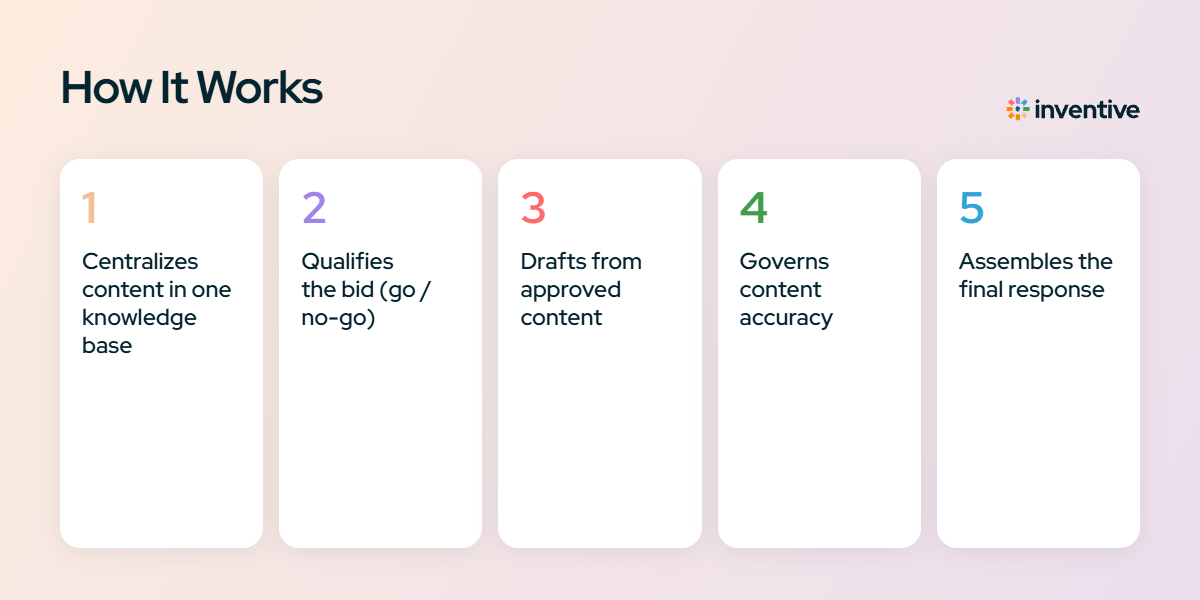
1. Centralizes your content in one knowledge base
The software connects to the systems where your answers already live, such as SharePoint, Google Drive, Notion, and Confluence, and brings your past responses and documents into one source it can draft from. Every answer depends on the content behind it, so this step is what makes the rest of the process reliable. For your team, it means no one has to search across drives to find the current, approved answer.
2. Qualifies the bid with a go/no-go recommendation
When a new bid arrives, the software reviews it and produces a go/no-go recommendation based on fit and win probability. Your team makes the final decision, but it starts from a clear signal rather than a guess. The outcome is that your team spends its time on the bids it can win, instead of stretching across opportunities it was never likely to close.
3. Generates a first draft from your approved content
This is the stage that saves the most time. The AI writes a first draft of every answer using only your approved knowledge, never the open web, which is what keeps the answers accurate. It can also research the competitor and strengthen your positioning, so the response is built to win rather than simply completed. Your team reviews and refines a strong first draft, which is far faster than writing each response from scratch, particularly on long questionnaires where the same questions recur.
4. Governs content accuracy before submission
Outdated answers cause more harm than missing ones, because your team trusts them and sends them out. The software identifies outdated and conflicting answers and removes them, so every draft pulls from current content. Before submission, it flags weak or missing answers for a person to review, and your team gives the final approval. The result is that errors are caught by your team, not by the buyer.
5. Assembles the final response for submission
Once your team approves the answers, the software compiles them into the format the buyer requires, whether that is a document or a completed questionnaire, so you submit a complete, consistent response on time. Nothing has to be reformatted or reassembled by hand at the deadline.
The value is that all of this happens in one system, so nothing depends on a spreadsheet someone forgot to update.
Key features of bid management software
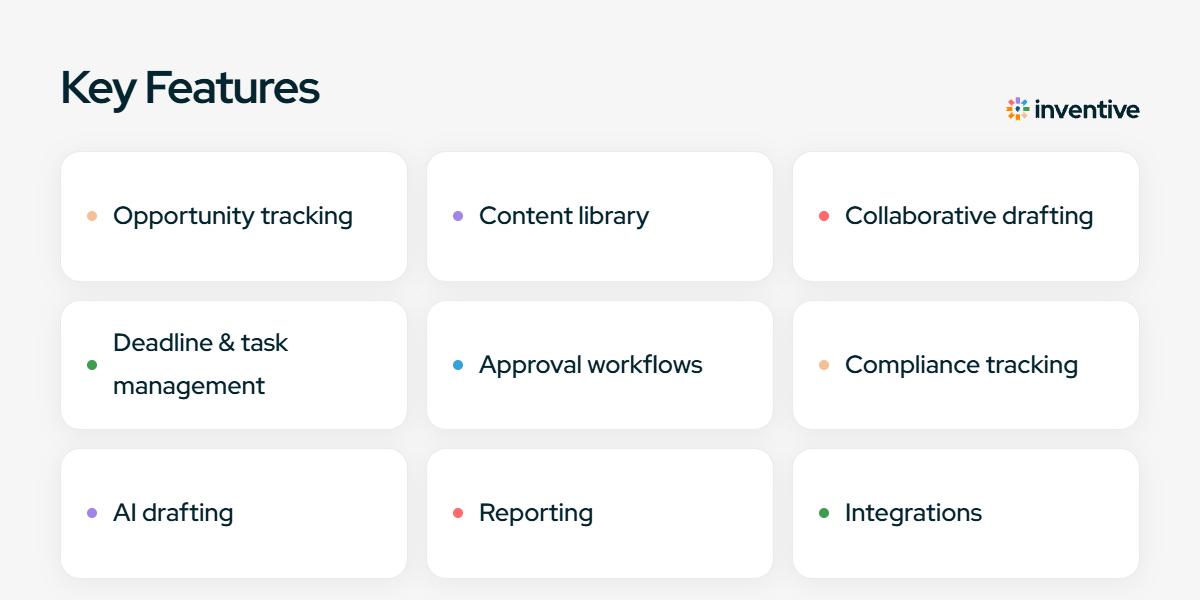
The key features of bid management software are opportunity tracking, a content library, collaborative drafting, deadline management, approval workflows, compliance tracking, AI drafting, reporting, and integrations. Together, they cover the full bid process, from opportunity to submission.
- Opportunity tracking: a single view of the bids you are pursuing, their stage, and their deadlines.
- Content library: a store of approved answers, company facts, and past responses that writers reuse instead of rewriting.
- Collaborative drafting: multiple people write and edit one response at the same time, with clear ownership of each section.
- Deadline and task management: due dates, reminders, and assignments so no section or bid is missed.
- Approval workflows: defined review steps and sign-offs, with an audit trail of every change.
- Compliance tracking: a way to map every requirement in the bid to an answer, so nothing is left unanswered.
- AI drafting: automatic first drafts generated from your existing content, covered in more detail below.
- Reporting: win rate, turnaround time, and workload, so you can see whether the process is improving.
- Integrations: connections to your CRM, storage, and communication tools, so data does not have to be re-entered.
Benefits of bid management software
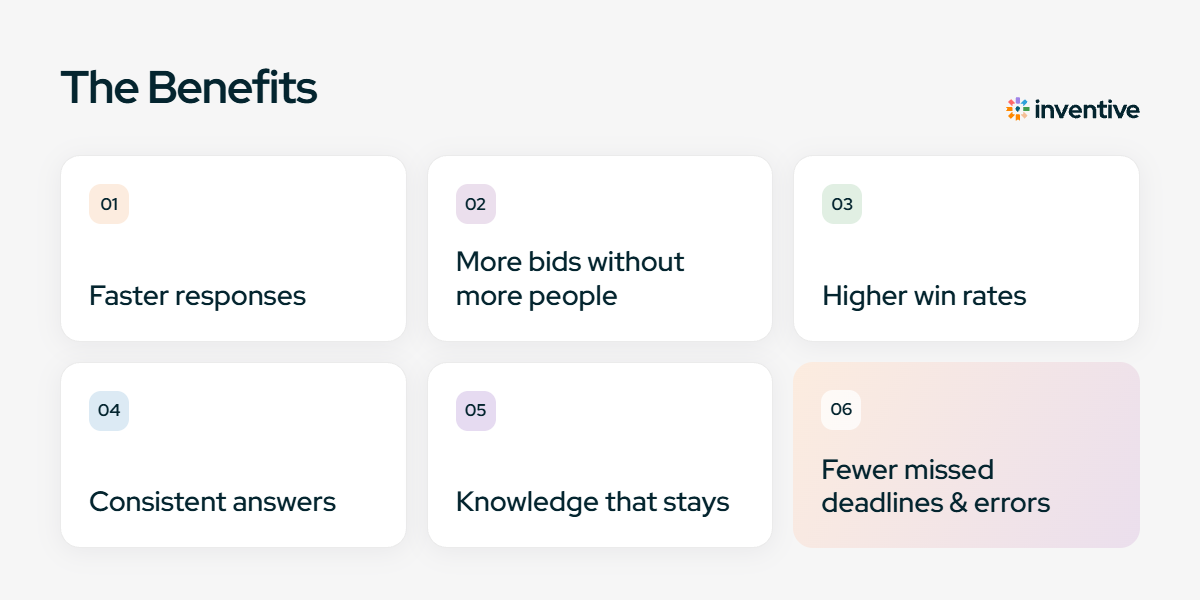
The main benefits of bid management software are faster responses, higher win rates, more bids handled without adding people, consistent answers, and fewer missed deadlines. Together they help your team win more of the bids worth pursuing.
- Faster responses. Reusing approved content and drafting from it cuts the time to a finished response from weeks to days.
- More bids without more people. A small team can handle higher bid volume when the repetitive work is systematized, so you stop turning down winnable opportunities for lack of capacity.
- Higher win rates. Better qualification means you spend effort on bids you can win, and consistent, complete responses score better.
- Consistent answers. Everyone works from one approved source, so the buyer gets the same accurate answer no matter who wrote the section.
- Knowledge that stays. Answers live in the platform, not in one person's head, so expertise survives when people leave.
- Fewer missed deadlines and errors. Tracking and review steps catch the missed requirement or late submission that loses a bid.
Who uses bid management software?
Any team that regularly responds to competitive bids is a candidate. The people who own it usually sit in one of these roles: bid managers, proposal managers, sales and presales teams, revenue operations, and the subject-matter experts in security, legal, and product who contribute answers.
By industry, it is common in software and technology companies answering RFPs and security questionnaires, professional services and consulting firms, construction and engineering suppliers bidding on projects, and any company that sells into government or enterprise procurement, where formal bids are the norm. A simple signal that you need it: if your team responds to more bids than a spreadsheet can comfortably track, the manual process is already costing you deals.
How AI is changing bid management software, and how to trust it
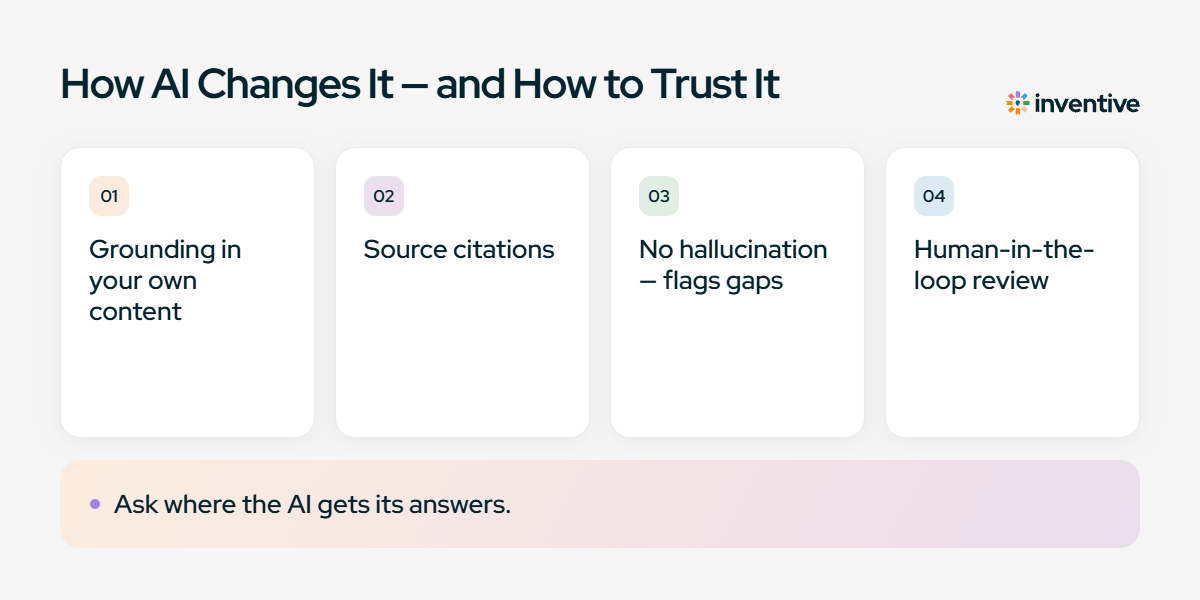
AI is the biggest shift in this category, and it is worth understanding clearly, because it also introduces a risk the older tools did not have.
Traditional bid management software stored your content and made it easier to find. You still wrote every answer by hand. AI-powered software goes further: it drafts each answer for you, pulling from your approved content, so your team reviews and edits instead of writing from scratch. On a large questionnaire, that is the difference between days of writing and an afternoon of review.
The risk is accuracy. An AI draft is only as good as the content it draws from. If it generates answers from the open internet or from thin, outdated content, it can produce confident answers that are wrong, which is worse than a blank space in a bid. This is the gap most buyers do not think to ask about, so ask it directly. The safe approach, and the one serious platforms use, works like this:
- Grounding in your own content. The AI drafts only from your approved sources, your past responses, and documents, not the open web, so answers reflect what your company says. This is what prevents hallucination.
- Source citations. It shows which answer or document each draft came from, so your team can verify every response before it goes out.
- No hallucination. It marks the questions it cannot answer well, rather than guessing, so your team can fill the gaps.
- Human-in-the-loop review. The AI drafts and your team approves, so final accuracy stays a human decision.
Used this way, AI removes the slow part of bidding, the first draft, without putting inaccurate answers in front of a buyer. When you evaluate AI bid management software, the question is not whether it uses AI. It is where the AI gets its answers, and whether you can check them.
Cut bid response time with Inventive AI
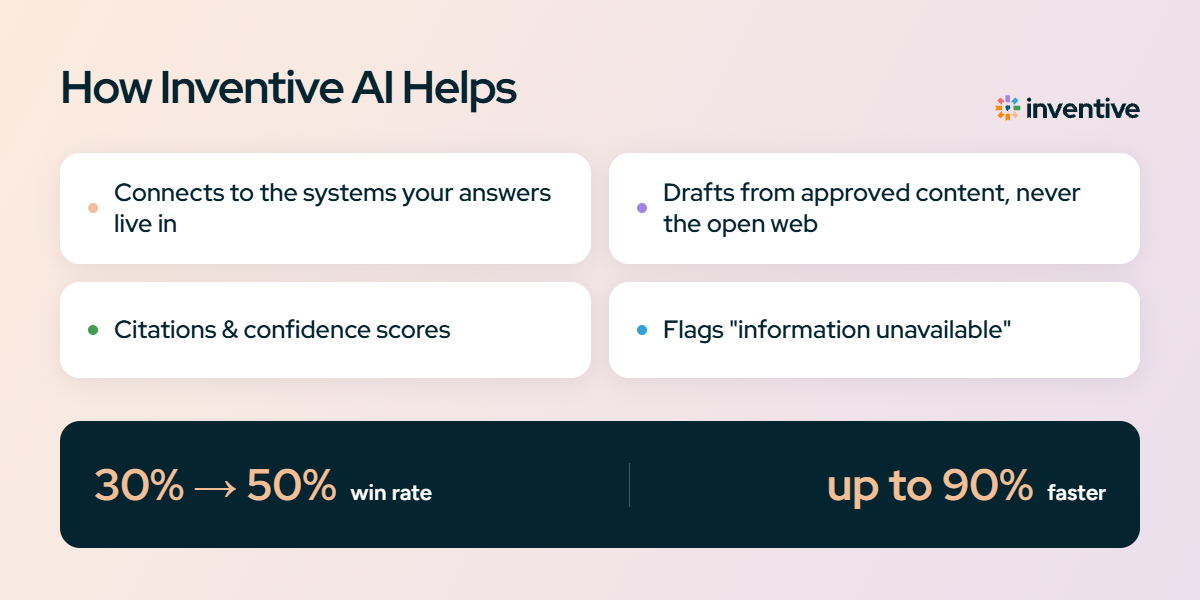
Inventive AI is built for exactly this: responding to RFPs, RFIs, DDQs, and security questionnaires. Rather than a content library you maintain manually, it connects to the systems your answers already live in and drafts each response from that approved content, never the open web.
Every draft ships with source citations and a confidence score, and flags "information unavailable" instead of guessing, so your team verifies accuracy before a bid reaches the buyer. Your team reviews and approves rather than writing from scratch, which is what lets a small team respond to more bids without adding headcount.

.avif)


%20(5).avif)