1Up vs AutoRFP (2026): A Buyer's Comparison of Two AI-Native RFP Tools
1Up answers from connected sources; AutoRFP drafts from approved responses. Compare pricing, AI, reviews, and one AI-native alternative for 2026.
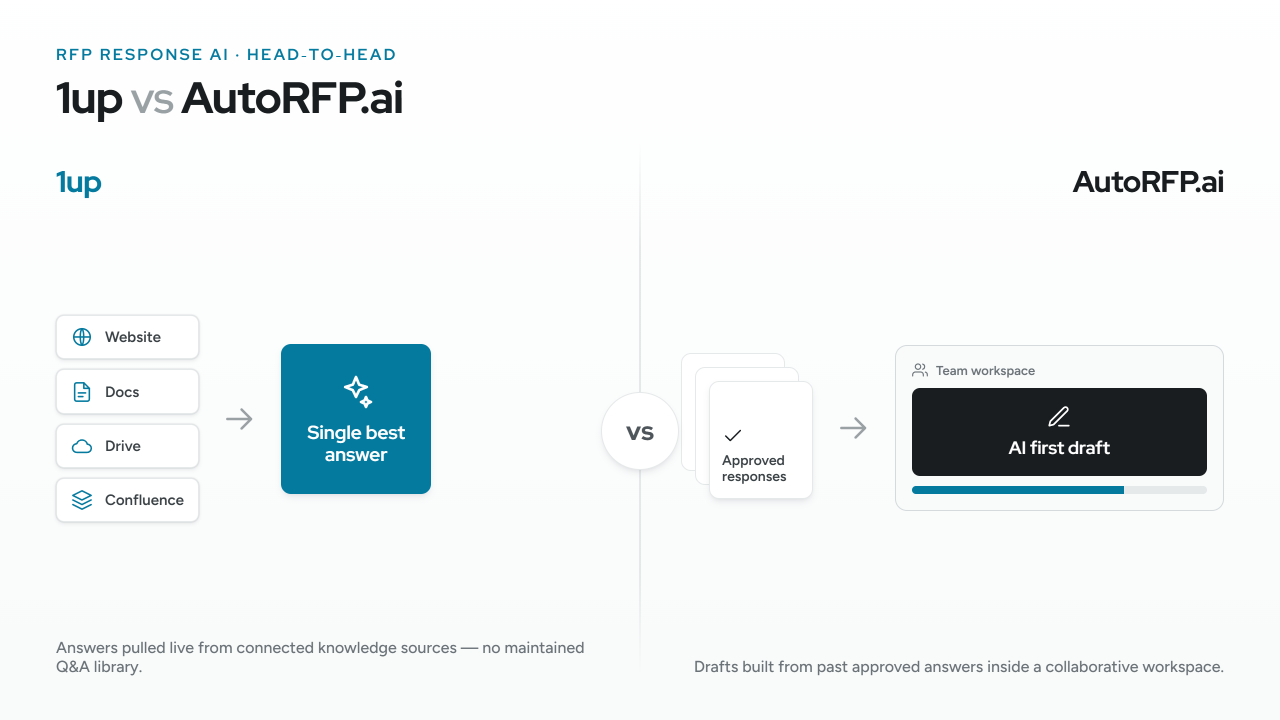
Both tools promise to kill the copy-paste RFP grind. They take different routes to get there. 1up answers questions by pulling from the knowledge sources you already run — your website, Drive, Confluence, SharePoint — without a maintained Q&A library. AutoRFP.ai generates a large share of the first draft from your past approved responses inside a purpose-built collaboration workspace. This guide compares them feature by feature, with sourced pricing, ratings, and user quotes, so you can decide which fits your team.
Last reviewed: February 2026. This comparison draws on vendor-published pages, verified G2 and Capterra reviews, Gartner Peer Insights listings, and independent third-party breakdowns. Both products are recent AI-native entrants, so review counts are thinner and more recent than legacy platforms. Pricing and features change often — confirm current numbers with each vendor before you buy.
TL;DR: Which Should You Choose?
1up fits teams that want answers generated straight from existing knowledge systems, with fast setup and no separate library to maintain — a good match for lean sales and presales teams answering RFPs, security questionnaires, and ad-hoc sales questions. AutoRFP.ai fits teams that want a dedicated response workspace with structured collaboration, reviewer workflows, and drafts built from a growing set of approved answers.
There is no universal winner. The right choice depends on what your team needs: source-driven answering and quick onboarding (1up) versus a purpose-built collaborative bid workspace (AutoRFP). If you are early in evaluation, it is also worth understanding the newer AI-native RFP software category before committing.
1Up vs AutoRFP at a Glance
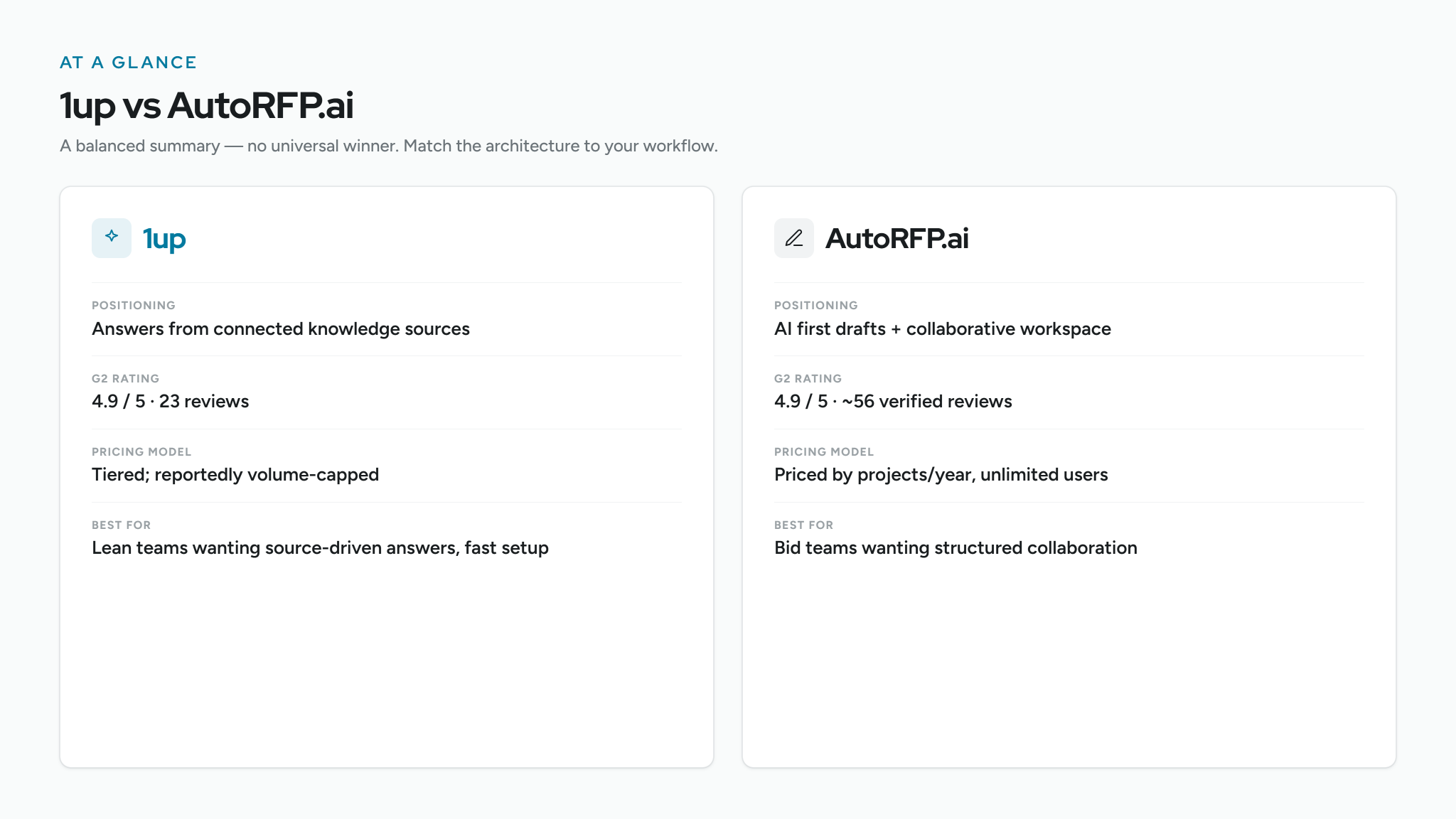
Here is the quick read before the detail. Both hold a 4.9/5 average on G2, both connect to the same core content systems, and both lean AI-first rather than library-first.
| 1up | AutoRFP.ai | |
|---|---|---|
| Positioning | Answers from connected knowledge sources | AI first drafts + collaborative workspace |
| G2 rating | 4.9/5 (23 reviews) | 4.8/5 (~56 verified reviews) |
| Entry pricing | From ~$250/mo (free trial) | Scale $899/mo billed annually; Capterra lists from $199/mo |
| Pricing model | Tiered; reportedly capped by annual question/questionnaire volume | Priced by projects per year, unlimited users |
| Best for | Lean teams wanting source-driven answers, fast setup | Bid teams wanting structured collaboration |
The Detailed Feature-by-Feature Comparison
This table is the core of the comparison. Values are sourced at time of writing; confirm each with the vendor during a demo.
| Dimension | 1up | AutoRFP.ai |
|---|---|---|
| Best for | Lean sales/presales teams answering RFPs, security questionnaires, and sales questions | Bid teams needing a collaborative response workspace |
| Core architecture | Generates a single best answer from connected trusted sources; no maintained Q&A library | "Library-less" drafts that learn via reinforcement from approved answers |
| G2 rating | 4.9/5 (23 reviews) | 4.9/5 (~56 reviews) |
| Other ratings | Gartner Peer Insights (13 reviews) | Capterra 5.0 (1 review); Gartner listing present |
| AI first draft | Answers assembled from connected knowledge sources | Claims ~90%+ of first draft automated from past RFPs |
| Pricing entry | From ~$250/mo, free trial | Scale $899/mo (annual); Capterra lists $199/mo |
| Pricing model | Tiered (Free/Starter/Plus/Pro/Enterprise), reportedly volume-capped | 4 editions by projects/year, unlimited users |
| Content/knowledge model | Website, docs, past RFPs, Drive/Confluence/Notion/SharePoint as live sources | Approved-answer store that improves per submission |
| Collaboration | Works inside Slack, Teams, Salesforce | Purpose-built workflows for bid teams, SMEs, reviewers with progress tracking |
| Format support | File caps per plan (25 files Starter, 75 Pro); users want more upload formats | Excel/Word/PDF/portal support |
| Web-portal capture | Chrome & Edge extension for web questionnaires | Chrome extension for SAP Ariba, Workday, Jaggaer |
| Security/compliance | Vendor-stated; confirm during procurement | ISO 27001:2022, SSO on Accelerate tier |
| Ease of implementation | Praised as easy and fast to implement (11 G2 mentions) | Fast setup, but a steeper learning curve reported |
| Noted limitation | Struggles with complex questions; volume/approval-chain limits reported | Learning curve; high Chrome memory use; template flexibility |
Figures are reported at time of writing and may have changed. Verify current ratings, pricing, and integrations directly with each vendor.
What Should You Consider When Choosing Between 1Up and AutoRFP?
Score both against the criteria that map to your actual workflow, not a feature-count race.
- AI answer architecture: Do you want answers pulled live from source systems (1up) or drafted from a growing approved-answer set (AutoRFP)?
- First-draft coverage: How much of a questionnaire can each realistically complete before human editing? Test on your own documents.
- Complex-question handling: Some 1up reviewers cite limits on complex questions. Bring hard edge-case questions to each demo.
- Content governance: Who keeps answers current, and how are outdated or conflicting entries caught?
- Conflict detection: Does the tool flag contradictions across a long response, or answer question-by-question?
- Hallucination control: Does each answer ship with citations and a confidence signal, or does it guess?
- Collaboration and review: Do you need assignments, reviewer workflows, and progress tracking for a multi-person bid team?
- Format flexibility: Excel, Word, PDF, and web-portal questionnaires — confirm coverage for your formats.
- Integrations: Match each tool's connectors to your content stack and CRM.
- Security and compliance: SSO, ISO 27001, SOC 2 — verify what each provides at your tier.
- Analytics: Can you see cycle time, reuse, and win-rate signals?
- Pricing model fit: 1up is reportedly volume-capped; AutoRFP prices by projects/year. Model your real annual volume — this pricing and reviews breakdown is a useful reference for 1up tiers.
- Ease of implementation: How fast can a non-technical team be productive?
- Enterprise scalability: Can it handle concurrent projects and larger teams without degrading?
1up: Overview, Features, Pricing, and Reviews
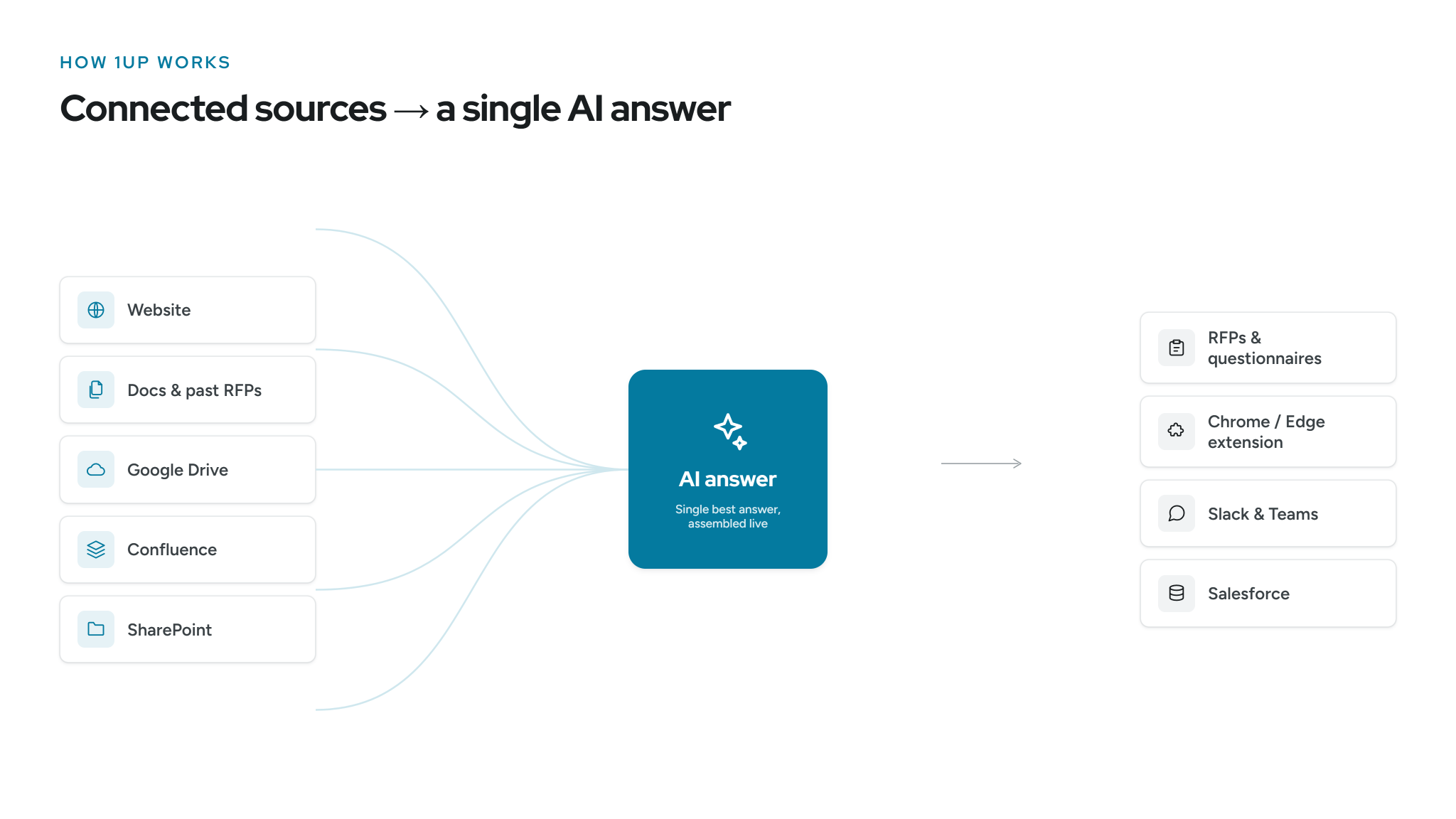
1up is an AI-native knowledge-automation platform. Instead of maintaining a legacy Q&A library, it connects to the knowledge sources your team already uses — your website, documents, past RFPs, and tools like Google Drive, Confluence, Notion, and SharePoint — then generates a single best answer for RFPs, security questionnaires, and inbound sales questions. It works where reps already work, including Slack, Teams, and Salesforce.
1up best features
- Generates answers directly from connected sources, so there is no separate Q&A library to build or maintain.
- Centralizes knowledge scattered across SharePoint, Confluence, and Slack into one trusted answer source — a top theme in G2 pros.
- Time-saving automation of RFI/RFP responses (12 mentions in G2 pros).
- Fast to implement and easy to use (11 mentions).
- Chrome and Edge browser extension for completing web-based questionnaires in the portal.
- Responsive support with quick turnaround on feedback (10 mentions).
1up limitations
- Some users feel limited features hinder answering complex questions (2 mentions).
- Access limits reported around prompt engineering and an imposed question-length restriction.
- Users want more upload file formats and higher word-count limits in the knowledge base.
- Plan file caps are tight (25 files on Starter, up to 75 on Pro).
- Reported to fall short for complex multi-team approval chains, strict verbatim requirements, or high concurrent volume — teams hitting this ceiling often review 1up alternatives and competitors.
- The ~$250/month entry point may be a barrier for smaller teams and startups.
1up pricing
The vendor states pricing starts as low as $250/month with a free trial; higher tiers are not fully detailed on the page. A third-party breakdown reports tiers of Free, Starter ~$250/mo, Plus ~$500/mo, Pro ~$850/mo, and Enterprise custom, reportedly capped by annual questionnaire volume. Confirm the current structure and any volume caps directly with 1up.
1up ratings and reviews
1up holds 4.9/5 on G2 across 23 reviews and appears on Gartner Peer Insights with 13 reviews. No verified 1up listing was found on Capterra or TrustRadius at time of research.
Positive: "Before using 1up, the process of responding to RFPs was very inefficient, and we had information scattered all over the place. It typically involved an endless back-and-forth between SharePoint, Confluence, and asking questions in various Slack channels." — G2 reviewer
Mixed: "The only thing I had to get used to was the interface for responding to and editing questions on the web. I was normally used to working on RFPs in Excel, so it took me a little while to adjust to the slightly different process." — G2 reviewer
AutoRFP.ai: Overview, Features, Pricing, and Reviews
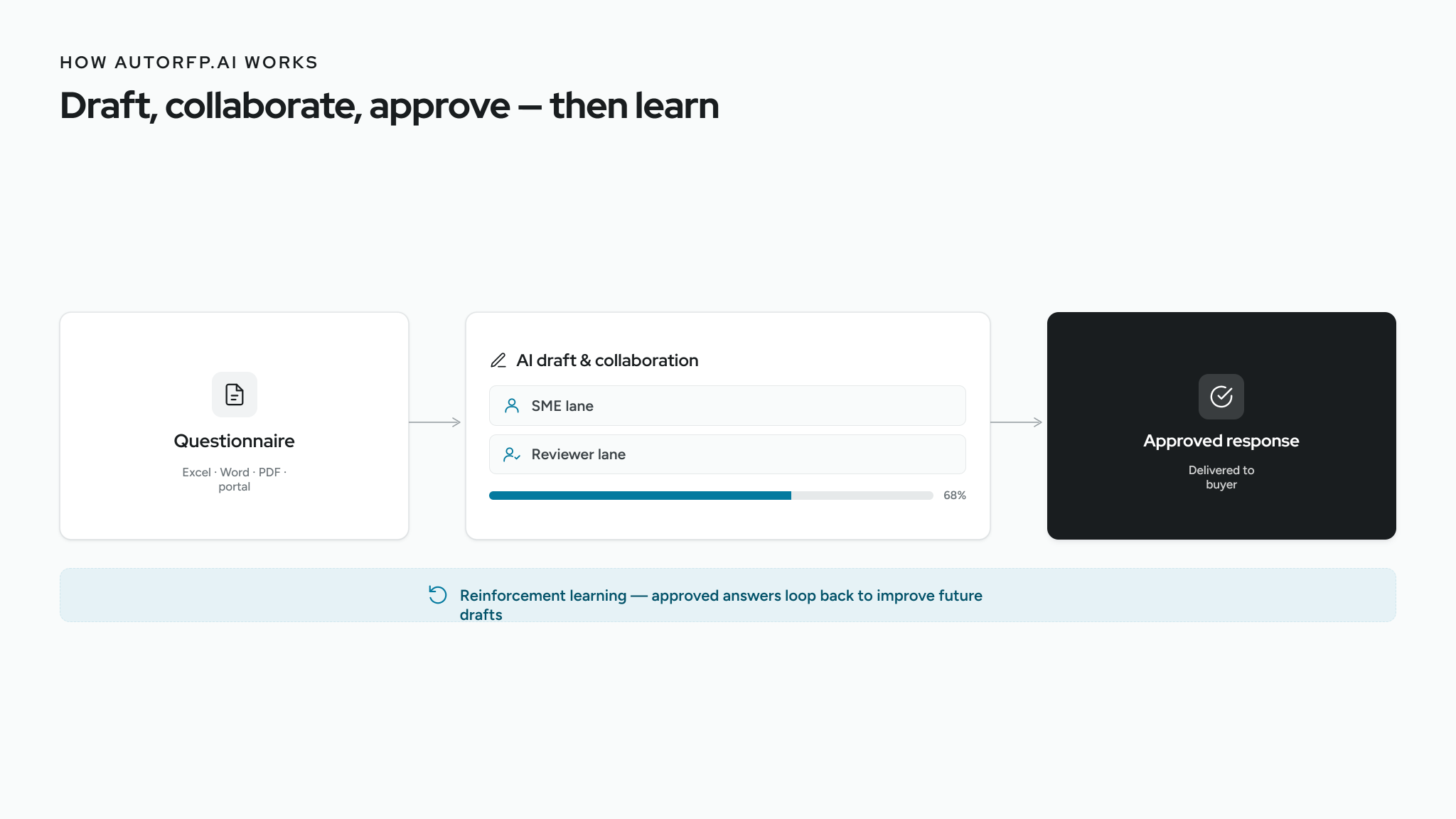
AutoRFP.ai is an AI-native, "library-less" platform for RFPs, security questionnaires, and due diligence questionnaires (DDQs). Its pitch centers on fast AI-generated first drafts — the vendor and reviewers cite roughly 90%+ of the first draft — inside a purpose-built collaborative workspace. Rather than maintaining a static library, it applies reinforcement learning from your approved answers so drafts improve over time.
AutoRFP.ai best features
- Automates the majority of the first draft from historical responses — a consistent theme in reviews.
- "Library-less" model that learns from each approved response, reducing library upkeep.
- Purpose-built collaboration uniting bid teams, SMEs, and reviewers with real-time progress tracking.
- Multi-format support across Excel, Word, PDF, and procurement portals.
- Chrome extension for portals like SAP Ariba, Workday Strategic Sourcing, and Jaggaer.
- A Capterra reviewer notes it understands context better than systems that resurface irrelevant past answers.
AutoRFP.ai limitations
- A steep learning curve is reported, especially without training (2 mentions).
- Some users find navigation not intuitive — e.g., reordering Requirement/Response/Compliance/Trust information.
- Limited template flexibility is reported as restrictive for rapidly changing needs.
- A Gartner reviewer notes high Chrome memory usage that degrades browser performance over time.
- Reported to lack the scalability larger teams need — a common trigger for reviewing AutoRFP alternatives.
- Pricing starts higher than 1up's stated entry, which may matter for smaller teams.
AutoRFP.ai pricing
AutoRFP prices by number of projects per year with unlimited users, across four editions. Published tiers include Scale at $899/month billed annually (24 projects/year), Accelerate at $1,299/month annually (50 projects/year, SSO, 18+ integrations, ISO 27001:2022), and Enterprise custom pricing. A Capterra listing shows a $199/month usage-based entry; confirm the current entry price with the vendor.
AutoRFP.ai ratings and reviews
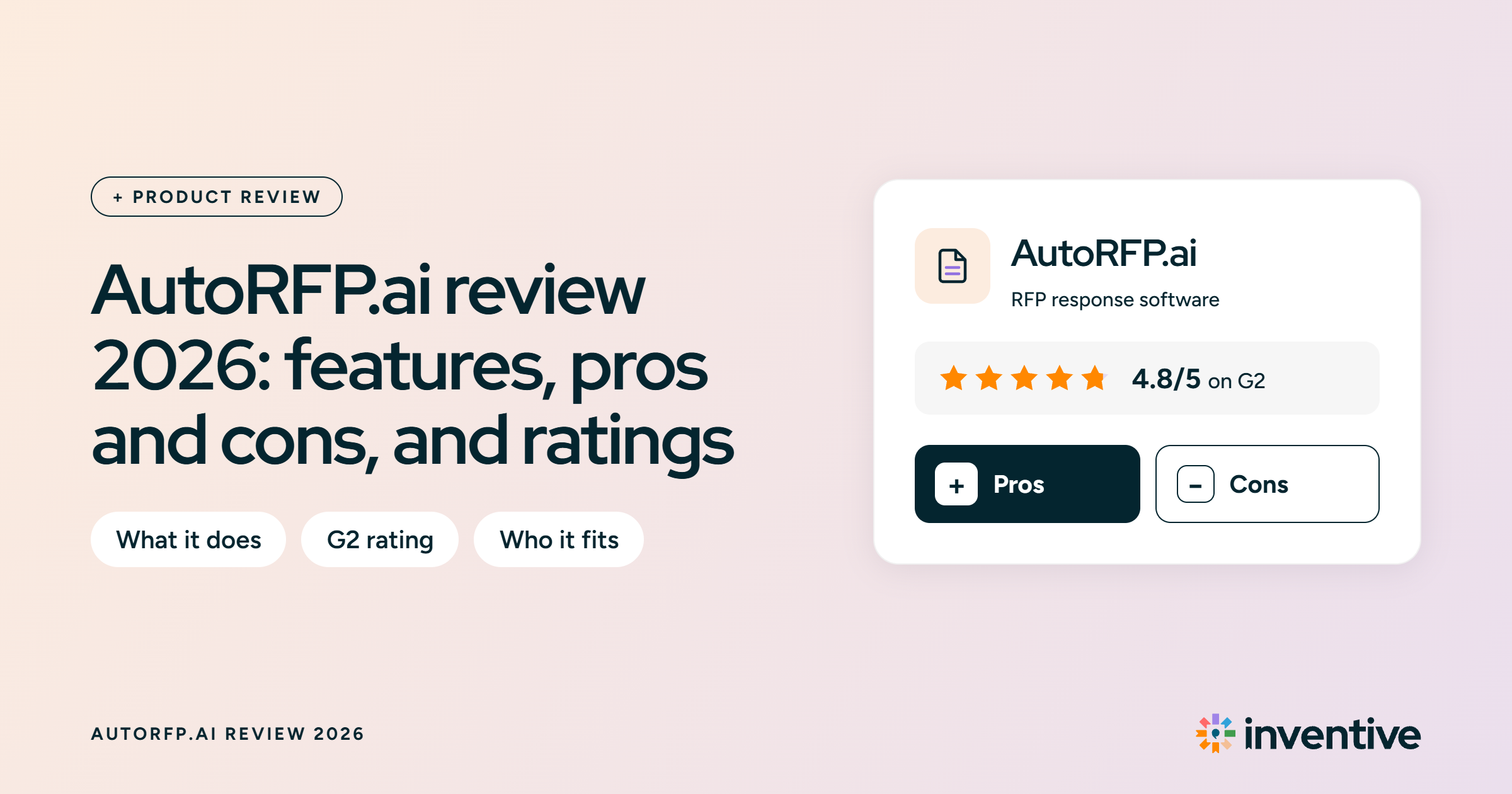
AutoRFP holds 4.8/5 on G2 across ~56 verified reviews, 5.0 on Capterra (1 review), and has a Gartner Peer Insights listing. No TrustRadius listing was found at time of research.
Positive: "By automating 90% of the first draft using responses from past RFPs, AutoRFP.ai has significantly streamlined our workflow." — G2 reviewer
Mixed: "The learning curve is a little steep, but had I bothered to do any training at all instead of just diving in it might have been a little easier." — G2 reviewer
See it in practice: MaxVal reports answering 80 RFP questions in 3 hours — work that once took nearly a week — after moving to an agentic platform. Read how in the demo.
AI Capabilities Compared
Both are AI-first, but their generation model differs. 1up assembles a single best answer live from connected sources, which keeps answers tied to source content but can strain on complex or highly specific questions per some reviewers. AutoRFP drafts from your approved-answer history with reinforcement learning, which strengthens over time but depends on the quality of past answers.
- 1up: source-grounded answers; strong on centralizing scattered knowledge; reported limits on complex questions.
- AutoRFP: high first-draft coverage (~90%+ cited); improves per approval; learning curve to reach that output.
Note: Neither tool's public materials detail a document-wide conflict-detection or confidence-scoring step in the way agentic platforms describe. If contradiction-catching across a long response matters to you, probe it in each demo — and compare against the AI-native benchmark approach.
Integrations Compared
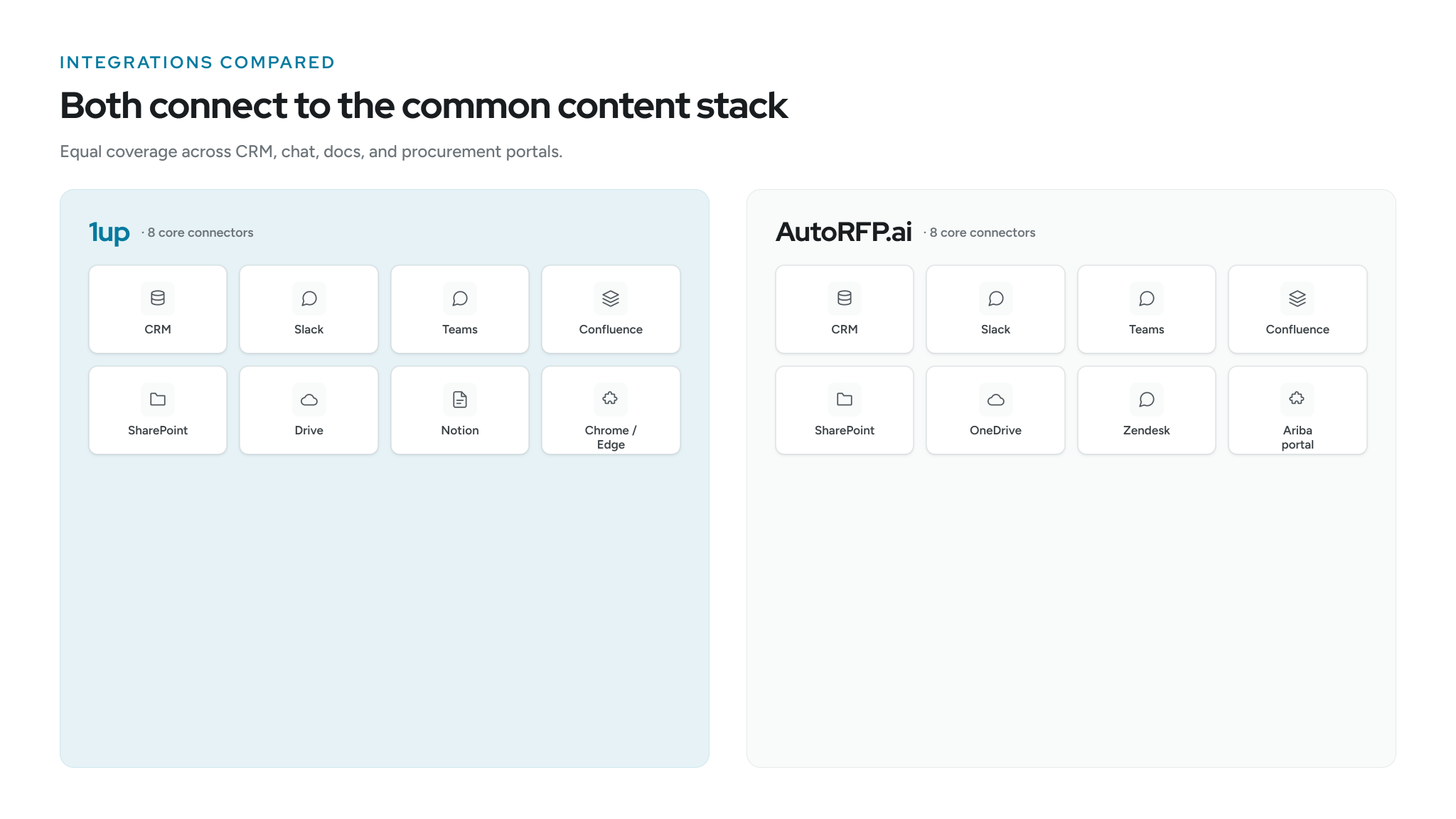
Both connect to the common content stack. AutoRFP publishes a broader named portal-connector list; 1up leans on its browser extension plus source connectors.
| Integration | 1up | AutoRFP.ai |
|---|---|---|
| Salesforce | Reported | Yes |
| Slack | Yes | Yes |
| Microsoft Teams | Yes | Yes |
| Confluence | Yes | Yes |
| SharePoint | Yes | Yes |
| Google Drive / Workspace | Yes | Yes |
| Notion | Yes | Yes |
| Dropbox / OneDrive | Dropbox | OneDrive |
| Zendesk / Intercom | — | Yes |
| Portal extension | Chrome & Edge (web questionnaires) | Chrome (Ariba, Workday, Jaggaer) |
Security, Support, and Ease of Use
Security and compliance. AutoRFP publishes ISO 27001:2022 and SSO on its Accelerate tier. 1up's security posture is vendor-stated; request current documentation during procurement.
Customer support. 1up reviewers repeatedly praise responsive support and fast feedback implementation (10 G2 mentions). AutoRFP offers unlimited support on higher tiers.
Ease of use. 1up is often described as fast and easy to implement. AutoRFP is quick to set up but carries a steeper learning curve per multiple reviewers.
Note: For both tools, review histories are thin and recent because they are new entrants. Weight hands-on trials over review counts, and test with your own questionnaires. For broader context, see this enterprise RFP software comparison.
Also Worth Considering: Inventive AI
If you are weighing 1up against AutoRFP, it is worth knowing that a newer class of AI-native proposal platforms takes a different architectural approach — running the response process with autonomous agents rather than assisting a single drafting step. Inventive AI is one example of that category.
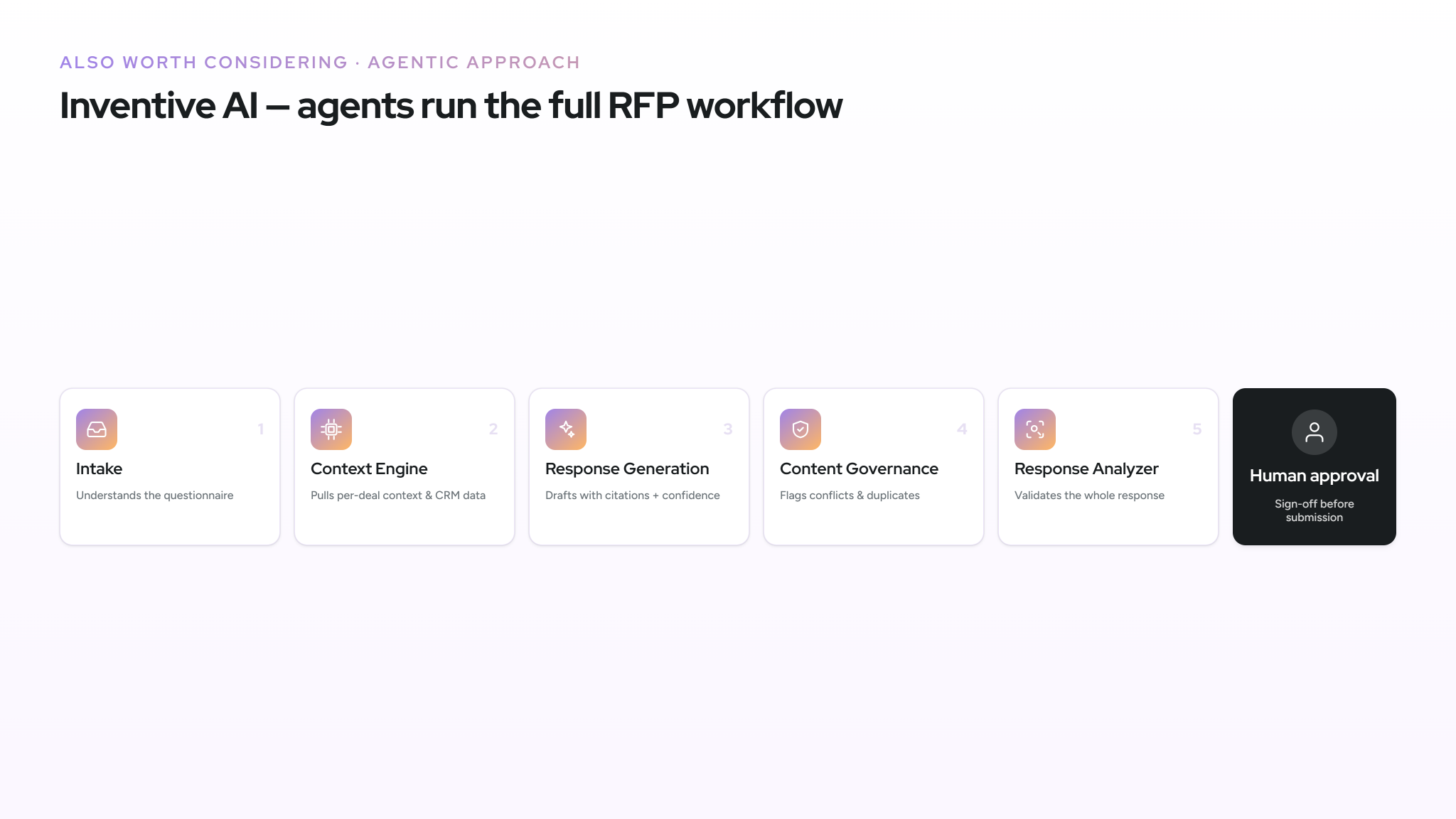
Inventive AI is positioned as an autonomous, AI-agentic platform for RFPs, RFIs, DDQs, and security questionnaires, with humans in the loop for approvals. Rather than maintaining a library or drafting one answer at a time, agents understand the questionnaire, pull context, draft, and flag gaps.
Key capabilities of Inventive AI
- AI first drafts the vendor cites at up to 10x faster with ~95% accuracy on connected knowledge.
- A unified Knowledge Hub connecting SharePoint, Google Drive, Salesforce, Confluence, Notion, and Zendesk, with live sync when source docs change.
- A Content Governance Agent that flags conflicting, outdated, or duplicate content automatically.
- A Context Engine that tailors responses per deal using customer priorities and CRM data.
- Competitive Intelligence agents that compare positioning against named competitors within a response.
- Format flexibility across Excel, Word, PDF, and PPT, plus narrative-style output.
- Collaborative review with assignments, reviewer workflows, and progress tracking.
- Response quality benchmarked at 2x more client-ready answers than the next-best tool tested, per a named customer.
Best for: mid-market and enterprise proposal, presales, and InfoSec teams that want agents to run the full RFP process, not just draft answers.
Why buyers comparing 1Up and AutoRFP might look at Inventive as an alternative
The shared gap for both 1up and AutoRFP is document-wide governance and scale: reviewers note 1up strains on complex questions and high concurrent volume, and AutoRFP reviewers cite a learning curve and scalability limits. Inventive AI is positioned to address that gap with agents that validate the whole response for contradictions and missing requirements before submission. AssetWorks Facilities reports a 422% ROI on RFP automation after moving to this approach. If that fits your evaluation, compare the AI-native approach in a demo.
Frequently Asked Questions
Is 1Up better than AutoRFP?
Neither is universally better. 1up suits teams that want answers generated from existing knowledge sources with fast setup and no separate library. AutoRFP suits teams that want a dedicated collaborative workspace and high first-draft coverage from past approved answers. Match the architecture to your workflow and volume.
How much does 1Up cost?
1up states pricing starts as low as $250/month with a free trial. A third party reports tiers of Free, Starter ~$250/mo, Plus ~$500/mo, Pro ~$850/mo, and Enterprise custom, reportedly capped by annual questionnaire volume. Confirm current pricing and caps with the vendor.
How much does AutoRFP cost?
AutoRFP prices by projects per year with unlimited users. Published tiers include Scale at $899/month and Accelerate at $1,299/month billed annually, plus custom Enterprise. A Capterra listing shows a $199/month entry; verify with the vendor.
Which handles security questionnaires better?
Both target security questionnaires. 1up uses a browser extension to complete web-based questionnaires from connected sources; AutoRFP supports portals like Ariba and Workday and publishes ISO 27001:2022. Test each with a real questionnaire and compare the best AI agents for security questionnaires.
Is there an AI-native alternative to 1Up and AutoRFP?
Yes. A newer category of agentic platforms — Inventive AI among them — runs the full response workflow with autonomous agents and human approval, rather than assisting a single drafting step. It is one option worth evaluating alongside 1up and AutoRFP.
Related Comparisons and Resources
For deeper research as you shortlist, these guides cover pricing, alternatives, and head-to-head detail:
• 1up vs Inventive AI — direct head-to-head on architecture and capabilities.
• AutoRFP vs Inventive AI — how the collaborative-workspace model compares with an agentic approach.
• Best RFP software — a broader market roundup.
• Insider: 50% higher win rate, 90% faster RFP responses — a named customer case study.
• 90% faster RFPs, zero weekend hours lost — outcomes on cycle time.