HeyIris vs 1Up (2026): Which AI Response Tool Fits Your Team?
Compare HeyIris and 1Up on pricing, AI architecture, integrations and G2 reviews for RFP and security-questionnaire work plus one AI-native alternative to weigh.
Both HeyIris (Iris) and 1up are AI-native tools built for RFPs, security questionnaires and proposal work. Neither is a legacy content-library platform. The practical split comes down to two things: HeyIris positions itself as an autonomous "AI-Native Deal Desk" that drafts and manages the whole response, while 1up positions itself as a connected "answer engine" with self-serve, published pricing. This guide compares them on architecture, features, pricing, integrations and reviews so you can decide which suits your workflow.
Last reviewed: February 2026. This comparison draws on vendor-published pages, verified G2 and Capterra listings, and independent third-party write-ups. Both tools are recent entrants, so review histories are thin and change often. Pricing and features shift quickly, confirm current rates, plan limits and capabilities directly with each vendor before you buy.
TL;DR: HeyIris vs 1Up
HeyIris (Iris) fits teams that want an autonomous agent to own the RFP, DDQ and security-questionnaire drafting cycle in one place, with answers grounded in approved internal docs and audit trails. 1up fits teams that want fast, no-migration setup, real-time Slack answers for customer-facing reps, and transparent published pricing they can evaluate before a sales call.
Which is "better" depends on what your team needs: HeyIris leans toward a managed, deal-desk workflow; 1up leans toward a lightweight, knowledge-connected answer engine. If you're also weighing autonomous, agent-run alternatives, it's worth scanning a broader RFP software comparison guide before committing.
What Should You Consider When Choosing Between HeyIris and 1Up?
Answer-first: match the tool to how your team actually responds today — who drafts, where your knowledge lives, and how much project management you need around the answers. Use these criteria as a demo checklist.
• AI architecture: Is drafting a single agent that runs the workflow, or an answer engine you query? Confirm which model the demo shows.
• Response quality: How grounded are drafts in your approved content, and what happens when the source data is thin?
• Hallucination control: Does the tool cite sources and flag uncertainty, or fill gaps confidently? Test edge-case questions.
• Content management and governance: Who keeps answers current, and how are outdated or conflicting entries surfaced? Strong RFP content management practices matter here.
• Conflict detection: Does the tool catch contradictions across a long response before submission?
• Workflow and project management: Do you need multi-stage RFP tracking, assignments and progress views, or just drafts?
• Collaboration: How do reviewers, SMEs and approvers work together in the tool?
• Integrations: Do the connectors match where your knowledge and CRM already live?
• Security and compliance: What certifications and data-handling policies apply? Ask about model-training use of your data.
• Analytics: Can you see cycle times, win data or content usage?
• Pricing and value: Published or quote-only? Model your annual questionnaire volume before choosing a tier — a pricing and reviews breakdown helps benchmark what's fair.
• Ease of implementation: How fast from connecting sources to first usable draft?
• Enterprise scalability: Seat counts, volume caps and admin controls as usage grows.
HeyIris vs 1Up at a Glance
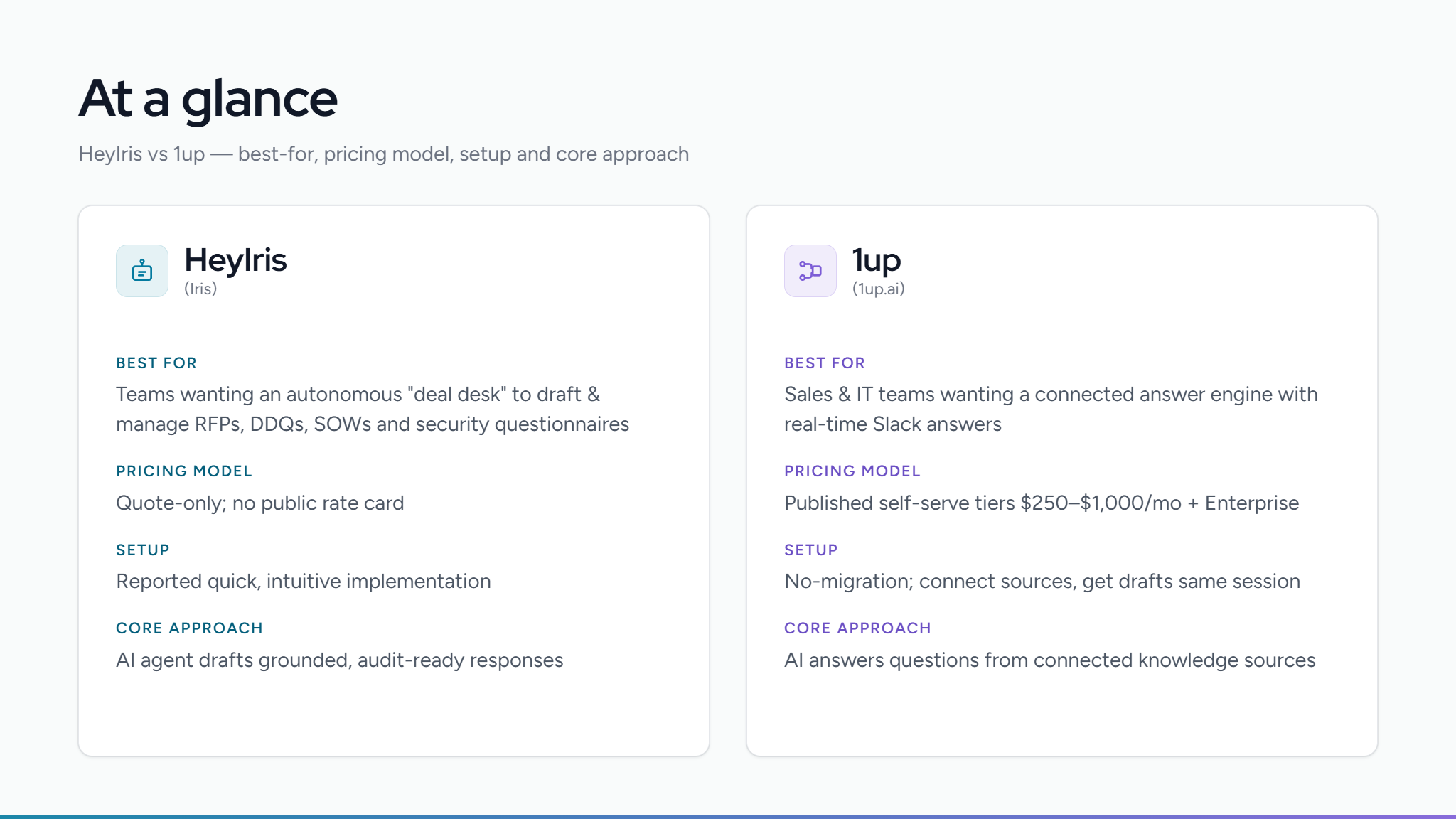
Answer-first: HeyIris is the more workflow-and-deal-desk-oriented option with quote-based pricing; 1up is the more lightweight, self-serve answer engine with published tiers. Both carry a 4.9/5 G2 rating on thin review counts.
| Dimension | HeyIris (Iris) | 1up |
|---|---|---|
| Best for | Teams wanting an autonomous "deal desk" to draft and manage RFPs, DDQs, SOWs and security questionnaires | Sales & IT teams wanting a connected answer engine with real-time Slack answers |
| Pricing model | Quote-only; no public rate card | Published, self-serve tiers from $250–$1,000/mo + Enterprise |
| Setup | Reported quick, intuitive implementation | No-migration; connect sources, get drafts same session |
| Core approach | AI agent drafts grounded, audit-ready responses | AI answers questions from connected knowledge sources |
Figures reported at time of writing; confirm current details with each vendor.
HeyIris vs 1Up: Feature-by-Feature Comparison
This is the core side-by-side. Values are drawn from vendor pages and verified reviews; reconfirm on the live listings.
| Feature / dimension | HeyIris (Iris) | 1up |
|---|---|---|
| Best for | Autonomous deal-desk drafting + managing RFx, DDQ, SOW, security questionnaires | Answer engine for sales, RFP and security questions from connected sources |
| G2 rating | 4.9/5 (66–67 reviews, 95% five-star) G2 | 4.9/5 (23 reviews, 95% five-star) G2 |
| Capterra | Listed; no visible star rating/count found (confirm) Capterra | No Capterra listing verified |
| Pricing | Quote-only; per-seat with unlimited collaborators + unlimited RFx credits per seat (confirm) | Starter $250/mo–Pro $850/mo (annual) + Enterprise; Trust Hub add-on $800/mo |
| AI approach | Autonomous agent that drafts grounded, audit-ready responses | Knowledge-automation answer engine querying connected sources |
| Response quality | Grounds answers in approved docs with provenance/audit trails | Vendor-cited "no real hallucinations"; reliable on well-connected KBs |
| Content governance | Product/tag-based filtering of answers | Depends on quality of connected knowledge base |
| Project management | Reported gaps in PM capabilities (some reviewers) | Reported: does not manage multi-stage RFP workflows |
| Integrations | Salesforce, HubSpot, Slack, Google Workspace, Confluence, Chrome extension, Jira (via Zapier/webhook) | Google Drive, Confluence, Slack, Salesforce, SharePoint, Microsoft Teams, Google Chat |
| Real-time Slack answers | Slack integration available | Slack answer engine is a headline strength |
| Volume limits | Unlimited RFx/DDQ/security-questionnaire credits per paid seat (confirm) | Tiered annual questionnaire caps (12/30/60/100+) |
| Mobile support | Reported: no mobile functionality yet G2 | Not specified; confirm |
| Free trial | Not published; contact sales | 14-day free trial, no credit card 1up |
| Founded / HQ | 2023, NYC | NYC; reported $8M+ raised, cites WalkMe, Gladly |
Figures are reported at time of writing; confirm with each vendor before purchasing.
HeyIris (Iris) Deep Dive
HeyIris markets Iris as an "AI-Native Deal Desk" — an autonomous agent that learns a company's institutional knowledge and drafts grounded, audit-ready responses across RFPs, RFIs, DDQs, SOWs, proposals and security questionnaires. Founded in 2023 and based in New York, it targets teams that want the drafting and the surrounding workflow handled in one location rather than across trackers and DMs.
Best features
• Reported quick, intuitive implementation — ease of use is the single most-cited pro on G2 (44 mentions in the pros-and-cons view).
• Time savings on RFP responses and review cycles (36 mentions), per aggregated G2 feedback.
• Response quality grounded in approved internal documentation, with provenance and audit trails.
• Product/tag-based filtering of answers, useful for multi-product organizations managing distinct answer sets.
• Single-workspace model that consolidates drafting, review and tracking rather than spreading them across tools.
• High overall satisfaction: 4.9/5 with 95% five-star reviews on G2.
Limitations (sourced)
• Missing features that limit some functionality, including project-management capabilities (5 mentions in G2 aggregated cons). If deal-desk PM depth matters, weigh HeyIris alternatives and competitors alongside it.
• Inaccurate responses when the underlying data is incomplete or outdated, output quality depends on documentation depth.
• No mobile functionality reported, and requests for additional integrations.
• Reported occasional slow processing at times.
• Reported gaps in tone control and nuanced/visual writing.
• Some connectors (e.g. Jira) run through a Zapier/webhook handoff rather than a native connector, confirm this fits your stack during a demo.
• Pricing not publicly available, making early budgeting harder without a sales conversation.
Pricing. HeyIris does not publish a rate card. Its pricing page describes per-user seat pricing with unlimited collaborator users and unlimited RFx/DDQ/security-questionnaire credits per paid seat (reported; confirm with the vendor).
Ratings and reviews. G2: 4.9/5 across 66–67 reviews. G2 Capterra lists Iris but no visible star rating or review count was found at time of research — confirm on the live listing. Capterra No TrustRadius listing was verified.
Positive: "I love how easy Iris makes the process by allowing us to do everything in one location rather than using a bespoke tracker or messaging coworkers for assistance." — G2
Mixed: "Can encounter technical glitches, but they're addressed promptly. Lacks certain integrations. No support for mobile functionality." — G2
See it in context: Insider reports a jump from a 30% to 50% win rate and 90% faster RFP responses after moving to an agent-run workflow — read how in a short demo.
1up Deep Dive
1up (1up.ai) positions itself as an AI-native "answer engine" for Sales and IT teams. It answers sales questions, RFPs and security questionnaires from connected knowledge sources, and ships a separate Trust Hub product for security content. It's NYC-based, reported to have raised $8M+, and cites customers such as WalkMe and Gladly.
Best features
• Automates answers to complex technical, compliance and security questions — reviewers report work that took hours or days dropping to hours.
• Slack integration that gives customer-facing teams real-time answers pulled from the knowledge center.
• Vendor-cited reliability with "no real hallucinations" per a user quote — verify against your own edge cases in a trial.
• Fast, no-migration setup: connect knowledge sources and get drafts in the same session.
• Responsive team and strong customer support reported across reviews; secure and multi-platform.
• Transparent, self-serve published pricing — rare among RFP tools and useful for early budgeting.
Limitations (sourced)
• Limited features can hinder answering the most complex questions (2 mentions in G2 aggregated cons). If complex, multi-stage RFPs are your norm, it's worth scanning 1up alternatives and competitors.
• Access limitations, prompt-engineering effort and an imposed question-length restriction (1 mention).
• Requests for more upload file formats and higher knowledge-base word-count limits (1 mention).
• Output success depends directly on the quality of the connected knowledge base and assets.
• Reported: does not manage multi-stage RFP project workflows, pre-call briefs or live deal signals.
• Plans are capped by annual questionnaire volume, so teams should model their volume before choosing a tier.
• As a reviewer notes, it's still an earlier-stage company — some features are missing, though the team is receptive to feedback.
Pricing. 1up publishes tiers (annual billing): Starter $250/mo (2 admins, 12 questionnaires/year, 50 files), Plus $500/mo (5 admins, 30 questionnaires/year, 75 files), Pro $850/mo (10 admins, 60 questionnaires/year, 100 files), and custom Enterprise (25+ admins, 100+ questionnaires/year). A Trust Hub add-on is $800/month, and there's a 14-day free trial with no credit card.
Ratings and reviews. G2: 4.9/5 across 23 reviews (95% five-star). G2 No Capterra or TrustRadius listing was verified at time of research.
Positive: "1up has made our workflow much smoother by automatically answering common questions and filling out forms like RFPs." — G2
Mixed: "They are still an earlier-stage company so some features are missing. However, they have been very receptive to feedback and their support…" — G2
AI Capabilities: HeyIris vs 1Up
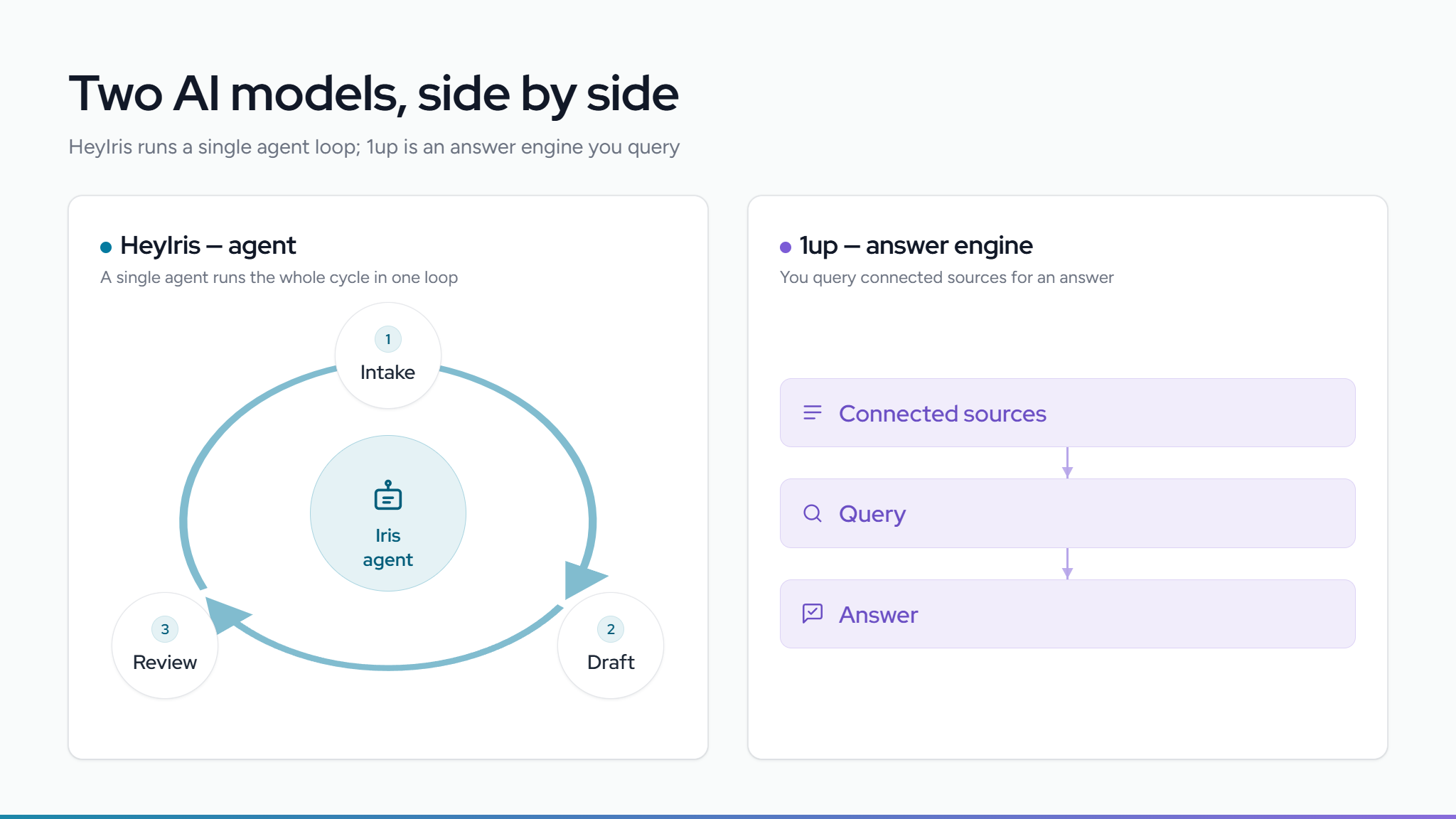
Answer-first: HeyIris frames its AI as an autonomous agent that drafts and manages responses end to end; 1up frames its AI as an answer engine you query against connected sources. Both are AI-native, not AI bolted onto a legacy library.
HeyIris
• Drafts grounded, audit-ready responses tied to approved internal documentation.
• Product/tag filtering to keep multi-product answer sets separate.
• Reported accuracy drops when source documentation is incomplete or outdated.
1up
• Answers pulled from connected sources with a vendor-cited "no real hallucinations" claim.
• Real-time answers surfaced in Slack for reps mid-conversation.
• Answer quality tracks directly to the quality of the connected knowledge base.
Note: Both tools depend on the depth and freshness of your source content — neither is a substitute for good knowledge hygiene. Platforms that add a governance layer to flag stale or conflicting content take a different approach; you can see how that model works in a benchmark of AI response accuracy.
Integrations: HeyIris vs 1Up
Answer-first: the connector lists overlap on Salesforce, Slack and Confluence, but 1up leans Microsoft-friendly (SharePoint, Teams) while HeyIris adds HubSpot and a Chrome extension.
| Integration | HeyIris (Iris) | 1up |
|---|---|---|
| Salesforce | Yes | Yes |
| HubSpot | Yes | Not listed |
| Slack | Yes | Yes (answer engine) |
| Google Workspace / Drive | Yes | Yes (Drive) |
| Confluence | Yes | Yes |
| SharePoint | Not listed | Yes |
| Microsoft Teams | Not listed | Yes |
| Google Chat | Not listed | Yes |
| Chrome extension | Yes | Not listed |
| Jira | Via Zapier/webhook | Not listed |
Confirm current connectors with each vendor; integration lists change often.
Security, Governance and Response Trust
Answer-first: HeyIris emphasizes provenance and audit trails on grounded answers; 1up ships a dedicated Trust Hub add-on for security content. Neither vendor's certifications were verified in this research — ask directly.
HeyIris
• Provenance/audit trails on drafted answers, grounded in approved docs.
• Tag/product filtering to control which content answers which questionnaire.
1up
• Trust Hub add-on ($800/mo) focused on security-questionnaire content.
• Answers scoped to connected, approved sources.
Note: Confirm SOC 2 (Type I/II) status and data-training policies for both tools before signing — these weren't verifiable at time of writing. If InfoSec ownership is central to your use case, a guide to AI agents for security questionnaires is a useful cross-reference.
HeyIris Pricing vs 1Up Pricing
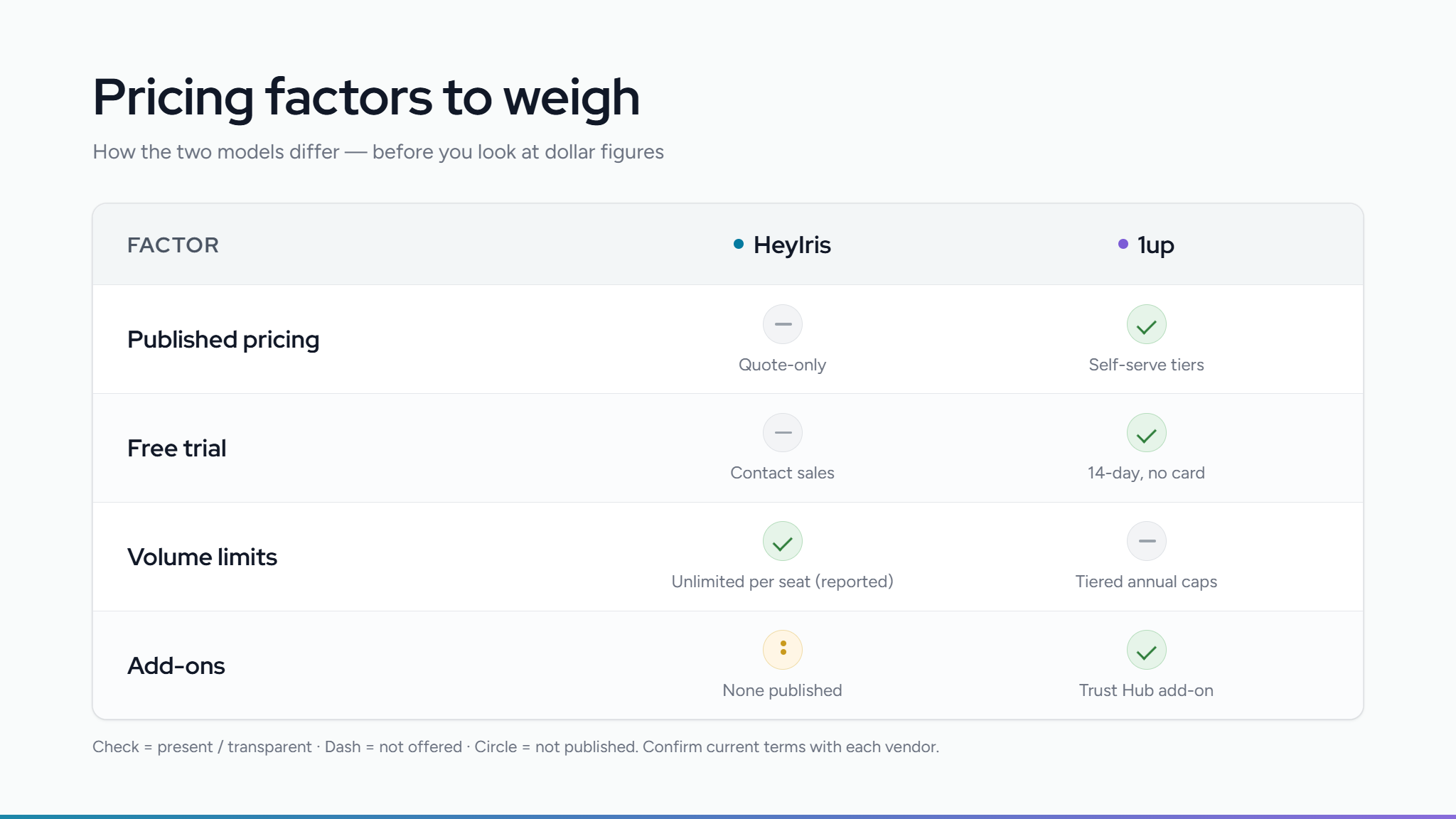
Answer-first: this is one of the sharpest differences. 1up publishes self-serve tiers and a free trial; HeyIris is quote-only. If early, transparent budgeting matters, 1up's model is easier to evaluate; if you want unlimited response volume per seat, HeyIris's reported model may suit high-volume teams better.
• HeyIris: Quote-only. Reported per-seat pricing with unlimited collaborators and unlimited RFx/DDQ/security-questionnaire credits per paid seat. No public rate card.
• 1up: Starter $250/mo, Plus $500/mo, Pro $850/mo (all annual), plus custom Enterprise; Trust Hub add-on $800/mo; 14-day free trial. Note the annual questionnaire caps by tier.
Model your volume first: Insider cut a 100-question RFP from 4–5 hours to 20–30 minutes with agent-run drafting — see the workflow in a demo before you size any tier.
Is HeyIris Better Than 1Up?
Answer-first: neither is universally better — it depends on what your team needs. Choose HeyIris if you want an autonomous agent to draft and consolidate RFx, DDQ and security-questionnaire work in a single workspace, and quote-based per-seat pricing is acceptable. Choose 1up if you want fast, no-migration setup, real-time Slack answers for reps, and published pricing with a free trial you can test before talking to sales.
Both share the same underlying dependency: answer quality follows content quality, and both reportedly stop short of deep multi-stage RFP project management. Weigh those gaps against your actual process before deciding. For a wider field of options, the best RFP software roundup puts both in broader context.
Also Worth Considering: Inventive AI
If you're comparing HeyIris and 1up, it's worth knowing a newer category of AI-native proposal platforms is taking a different architectural approach, one where autonomous agents run the whole response process rather than only drafting or answering. Inventive AI is one example of that category.
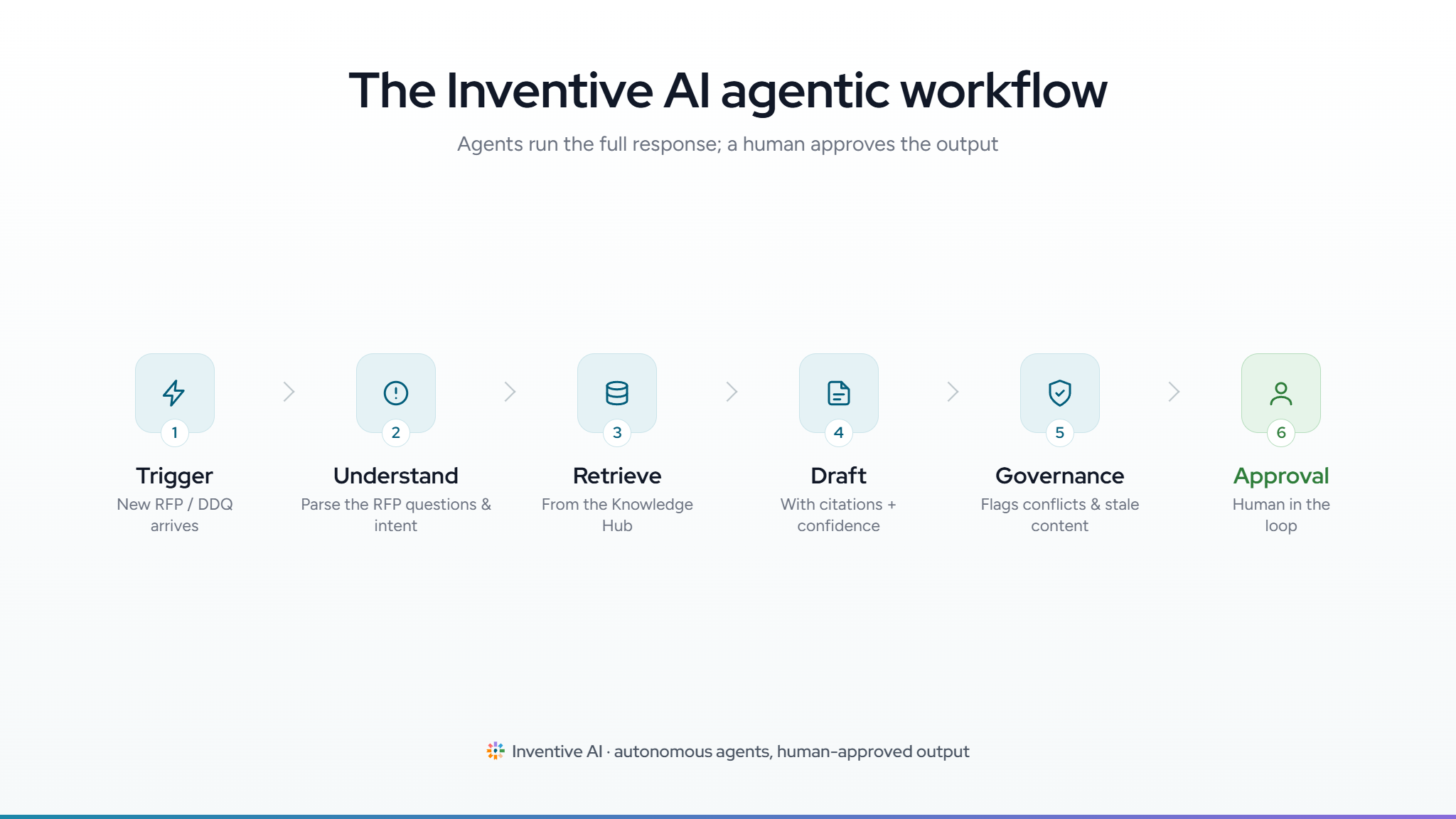
Inventive AI is an autonomous, AI-agentic platform for RFPs, RFIs, DDQs and security questionnaires, with humans in the loop for approvals. Rather than maintaining a separate content library, it connects to systems teams already use and triggers agents to understand, draft, validate and flag gaps.
Key capabilities of Inventive AI
• AI first drafts generated with source references and a confidence score, cited by the vendor at up to 10x faster drafting with 95% accuracy (confirm current figures with the vendor).
• Unified Knowledge Hub connecting SharePoint, Google Drive, Salesforce, Confluence, Notion, Zendesk, Okta and websites, with live sync when a source doc changes.
• Content Governance Agent that detects conflicting info, flags outdated content and surfaces duplicates.
• Context Engine that tailors responses per deal using customer priorities, sales notes and CRM data.
• Competitive Intelligence Agent that compares positioning against named competitors within the response.
• Format flexibility across Excel spreadsheets and narrative-style proposals.
• Collaborative review with assignments, reviewer workflows and progress tracking.
• Response quality benchmarked at 2x more client-ready answers than the next-best tool tested, per RAD AI's account.
Best for: mid-market and enterprise proposal, presales, sales ops and InfoSec teams that want agents to run the full RFP process, not just help draft.
Why Buyers Comparing HeyIris and 1Up Might Look at Inventive as an Alternative
Both HeyIris and 1up depend heavily on the quality of connected content, and reviewers of each note limits around complex, multi-stage RFP workflows. Inventive AI is positioned to address that shared gap with a Content Governance Agent that keeps knowledge current automatically and agents that manage the process end to end. AssetWorks Facilities reports a 422% ROI and roughly $105K in net savings after adopting agent-run RFP automation. If that model fits your process, you can compare the AI-native approach in a demo.
Frequently Asked Questions
Is HeyIris better than 1Up?
Neither is definitively better. HeyIris suits teams wanting an autonomous deal-desk agent that drafts and manages RFx, DDQ and security-questionnaire responses in one workspace. 1up suits teams wanting a connected answer engine with real-time Slack answers and published, self-serve pricing. Both hold a 4.9/5 G2 rating on relatively thin review counts.
How much does HeyIris cost?
HeyIris does not publish a rate card. Its pricing is quote-based, reported as per-seat with unlimited collaborators and unlimited RFx/DDQ/security-questionnaire credits per paid seat — confirm current terms directly with the vendor.
How much does 1up cost?
1up publishes annual tiers: Starter $250/mo, Plus $500/mo, Pro $850/mo, plus custom Enterprise. A Trust Hub add-on is $800/mo, and a 14-day free trial is available with no credit card. Note that plans are capped by annual questionnaire volume.
Do HeyIris and 1Up handle security questionnaires?
Yes — both target security questionnaires. HeyIris drafts grounded, audit-ready security responses; 1up handles them through its answer engine and offers a dedicated Trust Hub add-on for security content. Verify certification and data-handling specifics with each vendor.
What is an alternative to HeyIris and 1Up?
Alternatives include a range of AI-native and legacy RFP tools. Autonomous, agent-run platforms such as Inventive AI take a different architectural approach; you can also review HeyIris alternatives and 1up alternatives for a fuller field.
Is there an AI-native alternative to HeyIris and 1Up?
Yes. A newer category of AI-agentic platforms runs the full RFP process, understanding, drafting, validating and flagging gaps, with humans approving the output. Inventive AI is one example; RAD AI reports 2x more accurate responses than other RFP AI tools after switching to that model.
Related Comparisons and Resources
For deeper head-to-heads and buyer context beyond this comparison:
• HeyIris vs Inventive AI comparison
• 1up vs Inventive AI comparison
• Best enterprise RFP software comparison
• Insider: 50% higher win rate, 90% faster RFP responses
• 90% faster RFPs with zero weekend hours lost

.avif)