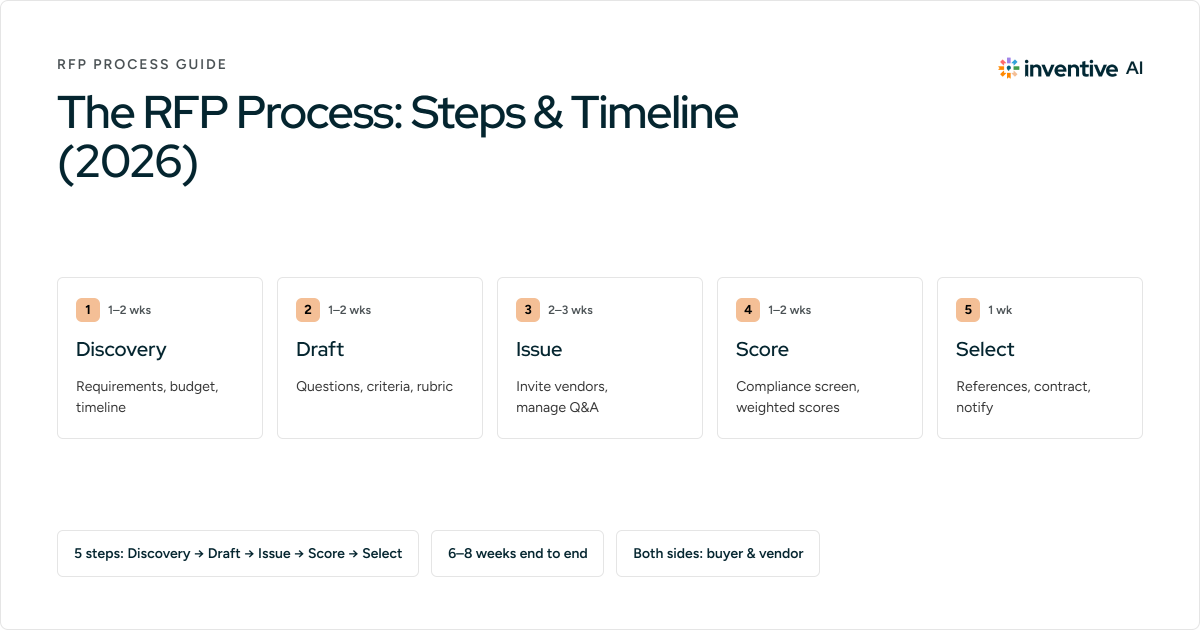
How to Improve Your RFP Process: A Step-by-Step Guide to Winning More Bids
Learn how to improve your RFP process by fixing the bottlenecks that slow responses and lose deals, from qualification to content to turnaround.

Two vendors get the same RFP. One responds in four days with clear, consistent answers and wins. The other takes three weeks, misses a question, and loses. Talent rarely decides this. The process behind the response does.
Improving your RFP process means fixing the steps where responses slow down or lose quality, one at a time. Most teams share the same weak steps: they chase RFPs they can't win, hunt for content spread across five places, wait on subject-matter experts, and write every answer from scratch. Each step costs time, and time loses deals.
This guide shows you how to spot each problem and how to fix it. It is written for the teams that respond to RFPs: proposal, bid, sales, presales, and RevOps. The goal is a process you can repeat and measure.
TL;DR
- To improve your RFP process, fix one bottleneck at a time: qualify before you bid, keep answers in one library, cut SME wait time, draft from proven content, review before you submit, and measure results. Start with the step that costs you most.
- The bottlenecks repeat across teams: weak qualification, scattered content, slow SME input, from-scratch writing, and no final quality check.
- Qualify every RFP before you bid. Declining bad-fit RFPs gives your team the time to win the ones they can.
- Keep one content library your team trusts, so writers reuse approved answers instead of rewriting them.
- RFP process best practices: Track win rate, turnaround time, and content reuse, and review every bid after it closes.
- Use software for speed and consistency. AI drafts from your approved content, so responses go out faster and answers stay uniform.
Signs your RFP process needs improvement
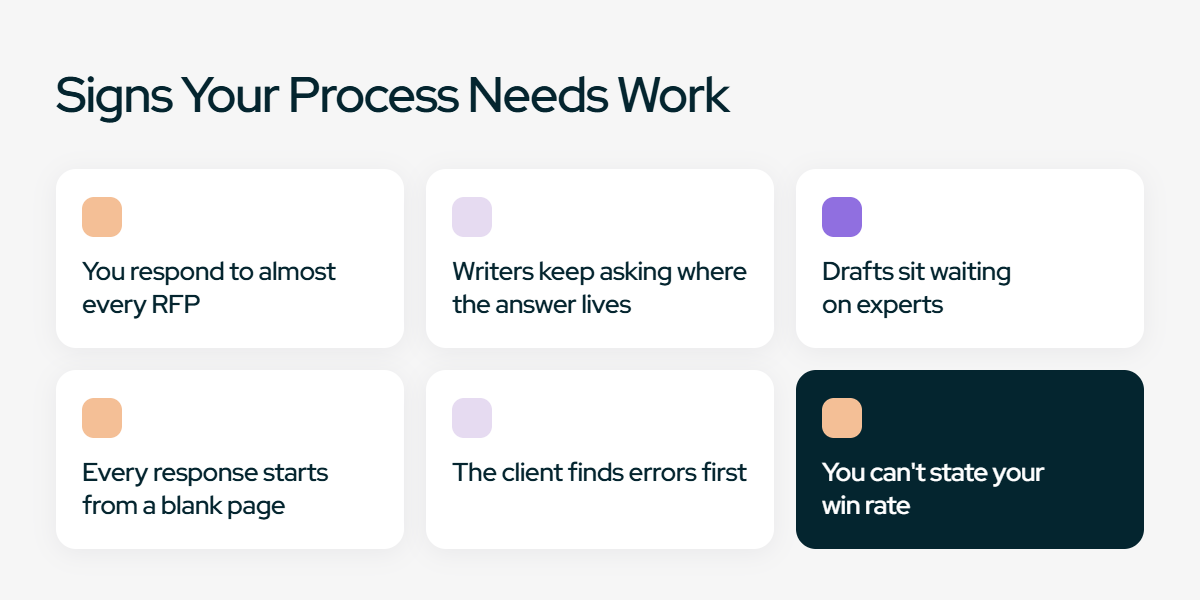
Before you change anything, find the real problem. Most teams feel that responses take too long, but the cause sits in one or two specific steps. Match the signs below to the step that is failing.
- You respond to almost every RFP that arrives. This is a qualification gap. You spend your team's hours on deals you were never likely to win, which leaves less time for the ones you can.
- Writers keep asking where the latest answer lives. Your content is scattered across old proposals, drives, and inboxes. People lose time searching or rewriting, and two writers often send the buyer different responses to the same question.
- Drafts sit for days waiting on an expert. The delay is in subject-matter expert input, not the writing. Your experts in security, legal, and product are occupied, so their answers come back late, and the whole response misses its deadline.
- Every response starts from a blank page. Your team is not reusing past work. It writes answers from scratch that it has already written and won with before, and rewriting the same content every time keeps each response slow.
- The client finds errors before your team does. You have no review step before submission. Missed requirements and out-of-date answers go out to the buyer, which lowers your evaluation score and can remove you from the shortlist.
- You cannot state your current win rate. You are not measuring the process. Without the numbers, you cannot tell whether a change worked, so the same problems return.
9 ways to improve RFP response process
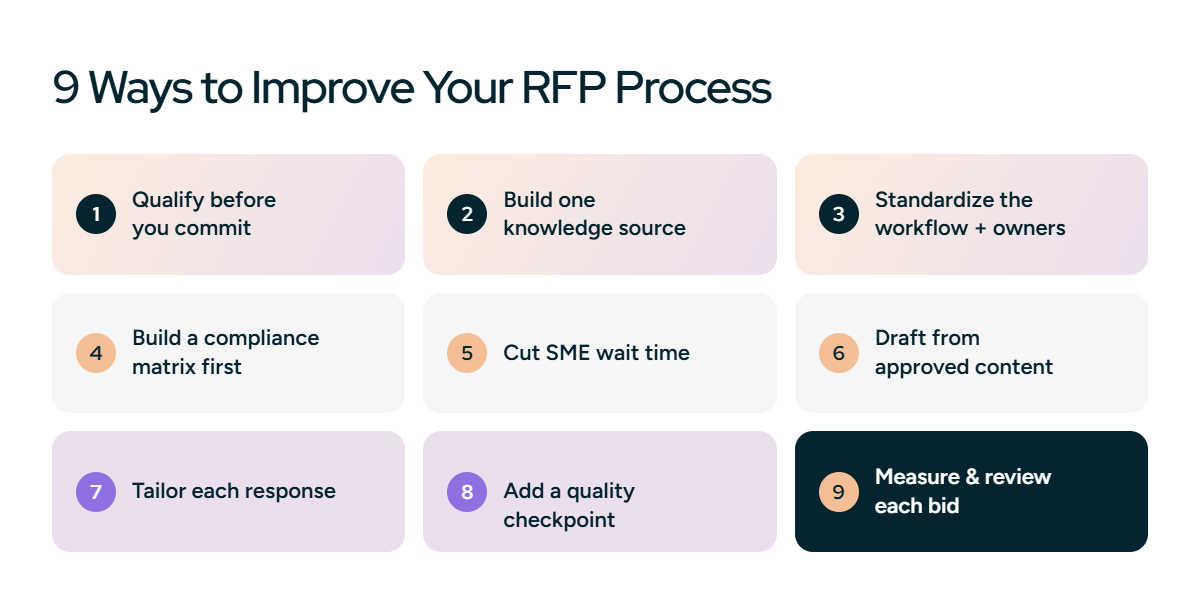
Work through these in order. Each one fixes a specific step where responses slow down or lose quality.
1. Qualify every RFP before you commit
To raise your win rate, respond to fewer, better-fit RFPs. Teams that answer everything spread thin and win a small share, because most of their effort goes to deals they were never positioned to win.
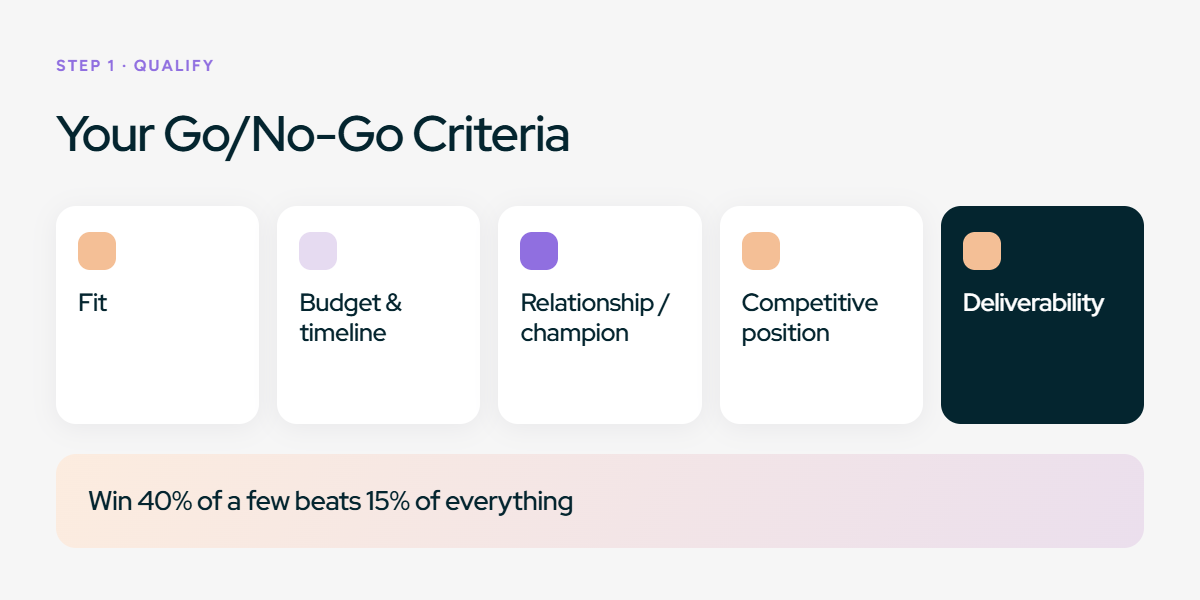
Set a go/no-go rule and apply it to every RFP before any writing starts. Score each one on a few factors, and decline the ones that fall below your threshold:
- Fit: how closely your product matches the requirements.
- Budget and timeline: whether the deal size and close date justify the effort.
- Relationship: whether you have a champion inside the account, or you are just a name on the list.
- Competitive position: whether the RFP is open or written around an incumbent.
- Deliverability: whether you can meet the must-have requirements without heavy custom work.
Give one person, usually the proposal or sales lead, the authority to make the call, and treat a no-bid as a normal outcome, not a failure. It is better to win 40% of a few good-fit deals than 15% of every deal you chase.
2. Build one knowledge source your team trusts
Most delays come down to content that is hard to find. When approved answers live in old proposals, shared drives, and a few people's heads, writers either hunt for the latest version or write a new one, and the buyer ends up with two different answers to the same question.
Give your team one trusted place to pull answers from, and keep it accurate. That source should:
- Hold the right content: company and legal facts, product and technical details, security and compliance answers, case studies, and current pricing.
- Have a clear owner: a named person who keeps the security, legal, and product answers correct.
- Stay current: flag answers for review before they go stale, so no one reuses an outdated one.
- Capture your wins: after each win, keep the answers that scored well so your strongest material is ready to reuse.
Keeping that source accurate is where the work goes, and there are two ways to handle it. The manual way is a curated library your team updates by hand. The faster way is AI that drafts from the content you already have, your past proposals and approved documents, so you get one reliable source without maintaining a separate library.
3. Standardize the workflow and give each step an owner
Responses often stall at a handoff nobody owned. A draft gets finished, then sits, because no one knows who reviews it next or by when. The deadline slips on confusion, not on effort.
Write your process down once, from intake to submission, and give every stage an owner and a due date. Set those dates by working backward from the submission deadline, so no stage is left open-ended. Two things matter most here: a single intake point, so no RFP gets buried in someone's inbox, and a named owner on each review step, so nothing waits on an unnamed "someone." Keep it to one page. A short process people actually follow beats a detailed one that sits in a folder unopened.
4. Break down the RFP and build a compliance matrix before you write
Before anyone drafts, pull every requirement, question, and evaluation criterion out of the RFP and list them in a compliance matrix: one row per requirement, with the owner, the response, and the status. This does three things for you:
- Nothing gets missed. Every requirement has a row, so no question is left unanswered at submission.
- Work is assigned early. Each row has an owner from the start, instead of scrambling near the deadline.
- You see the shape of the win. The evaluation criteria tell you what the buyer weights most, so you know where to put your best effort.
The matrix becomes the backbone of the response and the checklist you verify against later, which makes your final review far faster.
5. Cut the time you wait on subject-matter experts
Your experts in security, legal, and product are the hardest people to book and the ones your responses depend on most. When drafts sit in their queue, the whole response waits. The goal is not to demand more of their time. It is to need them less often.
- Deflect the routine questions. Answer everything you can from the content library first, so experts only see questions that genuinely need them.
- Ask precisely. Send a specific question with context, not a whole document, so an expert can answer in minutes.
- Capture every answer. Save each expert response back to the library, so you ask once and reuse it next time.
- Set a standing slot. A short weekly window for RFP questions beats chasing experts deal by deal.
Done consistently, this shortens your waits now and shrinks them over time, because each expert answer you save is one you never have to ask for again.
6. Draft from approved content instead of a blank page
A blank page is the slowest way to start a response, and it makes quality depend on whoever is writing that day. Your strongest answers already exist, so the job is to draft from them rather than write each answer new.
This is where AI response software changes the economics of the work. Inventive AI drafts each response end to end from content you already have, so your team reviews and tailors instead of writing from scratch. It drafts with competitive intelligence built in, so responses stand out against other vendors rather than just read as complete, and its governance and compliance checks keep every answer accurate. It also keeps answers consistent on large questionnaires, where several people write at once and the response still needs to sound like one voice.
7. Tailor each response to the buyer
Tailor every response before it goes out:
- Lead with an executive summary that states the buyer's problem and your answer to it, not your company background.
- Answer their priorities in their order. Follow the evaluation criteria, and put the questions they weight most first.
- Work in your win themes. Name why buyers choose you, such as faster implementation, a security certification, or a key integration, and tie each to what this buyer asked for.
- Use proof that fits. Pick the case study from their industry, not your most impressive one.
8. Add a quality checkpoint before you submit
Most errors reach the buyer because no one checked for them. A missed requirement, a vague security answer, or last year's pricing gets through when the response goes straight from draft to send. One review step before submission catches these.
Check every response against the compliance matrix from Step 4:
- Completeness: every required question is answered, with no "TBD" left in.
- Compliance: every answer meets the buyer's requirement, in their terms.
- Consistency: pricing, product claims, and dates match across the document.
- Currency: no old product name, policy, or price appears anywhere.
A short checklist covers most of this, and software that flags gaps and weak answers before you submit catches the rest. Do this review every time. One missed requirement or one outdated answer can lower your score and drop you from the shortlist, after your team has already done the work to win.
9. Measure the process and review each bid
Without numbers, you cannot tell whether a change helped, and the process quietly drifts back to old habits. Measuring turns improvement from a one-time effort into something that holds.
Track a small set of metrics (covered in the next section) and hold a short debrief after each bid closes, win or lose. Keep it to a few questions: What slowed this response down? Which answers were weak? What will we change next time? Write the answers on one page and act on them before the next RFP. The value is in the loop: measure, change, and measure again, so each response teaches the next one.
Metrics that show your RFP process is improving

Track a small set of numbers so you can prove a change worked. Start with these:
- Win rate. The share of decided bids you win. This is the number every other fix should move.
- Turnaround time. How long it takes from intake to submission. It shows whether your process is getting faster.
- First-draft time. How long to a complete first draft. It isolates the writing step from review.
- Content reuse rate. The share of answers pulled from your library versus written new. Higher reuse means less duplicated work.
- SME response time. How long experts take to answer. It tells you if the expert bottleneck is shrinking.
- RFP response rate. How many qualified RFPs you actually respond to. It shows whether qualification freed up capacity.
How RFP software improves the RFP process
A manual process works at low volume. As volume rises, it does not scale: search, drafting, and review consume more time than the deadlines allow, and answer quality becomes inconsistent. At that stage, RFP response software becomes the practical way to maintain both speed and quality, which is where Inventive AI applies.
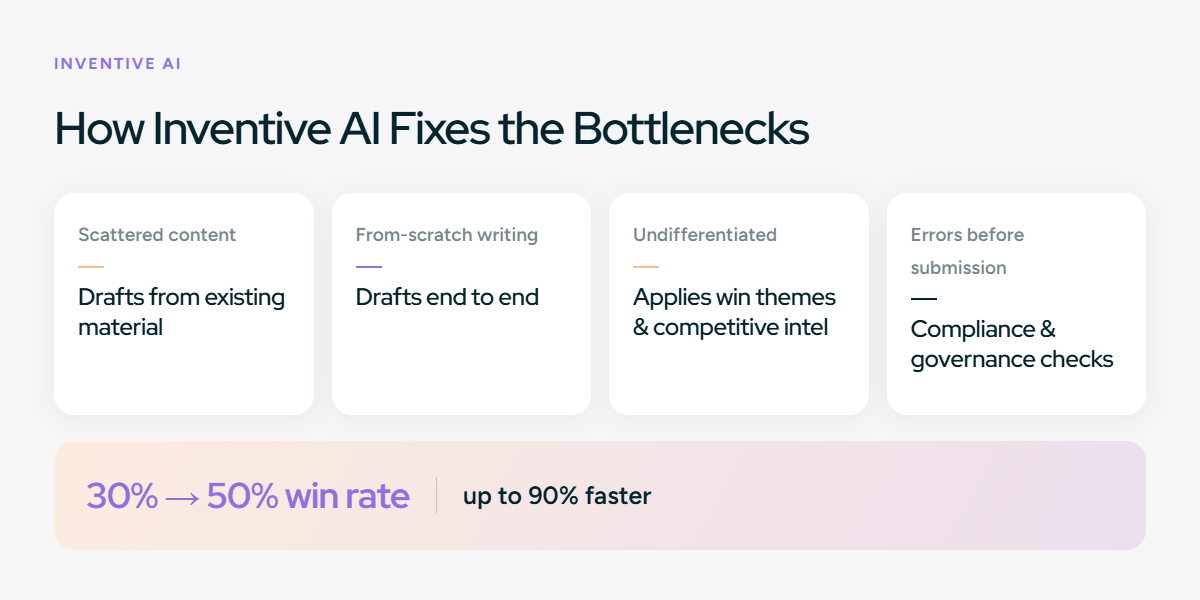
Inventive AI is an autonomous AI agent platform for RFPs, RFIs, DDQs, and security questionnaires. It addresses the bottlenecks covered in this guide:
- Scattered content: it drafts from your existing material, past proposals and approved documents, so your team reuses proven answers rather than rewriting them.
- From-scratch writing: it drafts each response end to end, so your team reviews and tailors rather than authoring from a blank page.
- Undifferentiated responses: it applies competitive intelligence and your win themes as it drafts, so each response is positioned against competing vendors rather than merely compliant.
- Errors before submission: its compliance and governance agents identify gaps, weak answers, and off-policy content before the response is sent.

.avif)