LMS RFI Template: Turn Buyer Insights into Winning Responses

Choosing the right Learning Management System (LMS) is a big decision for enterprises. They need a platform that supports learning goals, ensures compliance, and scales with their organization. For vendors, this is where the real challenge and opportunity lie.
Submitting an RFI response that clearly demonstrates your platform’s strengths can be the difference between being shortlisted and being passed over. Enterprises use structured RFI processes to evaluate features, so you can customize responses, showcase strengths, and provide evidence that makes your solution stand out.
In this blog, you’ll see how buyers use LMS RFI templates and learn how you can craft responses that make your solution stand out.
LMS RFI Template: How Buyers Evaluate Learning Platforms
Enterprise buyers rely on LMS RFI templates to compare platforms systematically across technical, functional, and operational dimensions. This structured approach ensures decisions are aligned with corporate learning objectives, regulatory requirements, and budget constraints.
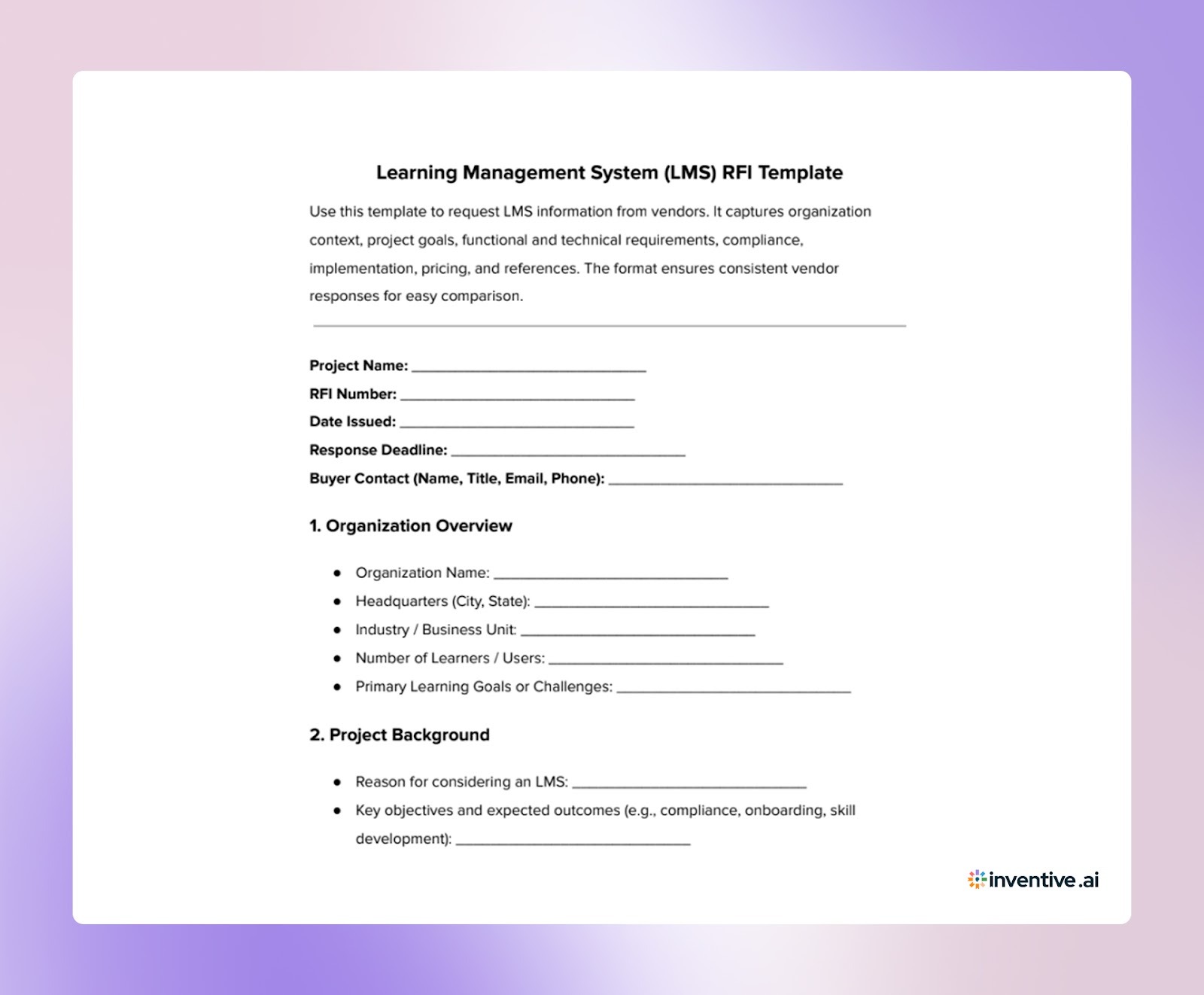

- Organization Overview: This section captures your organization’s basic details, learner population, and learning objectives. It helps vendors understand your context and tailor responses accordingly.
- Project Background: Provide the purpose of this LMS evaluation and key outcomes expected. Vendors can see why the platform is needed and align their solution accordingly.
- Vendor Company Information: Collect essential vendor details, including company name, contact info, and experience. This ensures accountability and allows comparison across potential suppliers.
- Functional Requirements: List the core features your LMS must support, including content management, assessments, and user experience. It helps buyers quickly assess capability fit.
- Technical & Integration Requirements: Specify deployment, integrations, APIs, and customization needs. This ensures the LMS can work within existing enterprise systems and infrastructure.
- Compliance & Security: Document required certifications, privacy compliance, encryption, and access controls. This protects organizational data and ensures regulatory adherence.
- Implementation & Support: Outline expected implementation timelines, training, and ongoing support. It allows buyers to evaluate vendor readiness and service capabilities.
- Pricing & Licensing: Request clear pricing for licenses, modules, implementation, and support. This enables fair cost comparison and budgeting for decision-making.
- References & Case Studies: Ask vendors for client references and success stories. This provides evidence of past performance and suitability for similar use cases.
- Optional Attachments: Include supporting documents such as demos, screenshots, and certificates. These help buyers validate claims and better understand vendor offerings.
- Buyer Evaluation Criteria: Define how responses will be scored based on functionality, technical fit, pricing, and support. This guides structured comparison and final vendor selection.
With the buyer’s perspective in mind, it’s time to craft responses that highlight your strengths.
LMS RFI Response Template: How Vendors Should Prepare Submissions
Vendors play a critical role in clarifying their solution capabilities, contextualizing performance, and responding to buyer evaluation criteria. A structured response improves the chances of being shortlisted and demonstrates readiness for enterprise-level engagements.
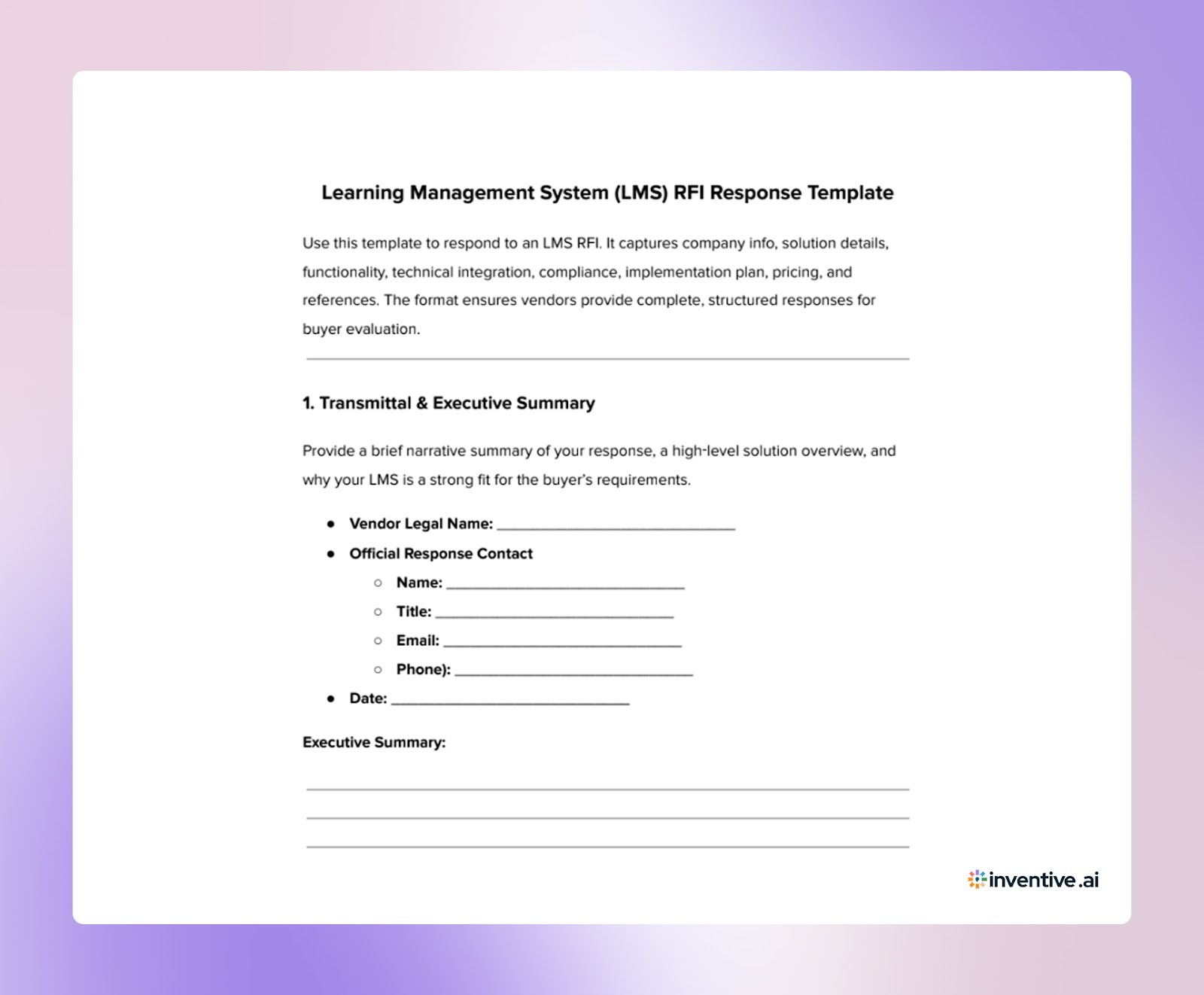

- Transmittal & Executive Summary: Provide a concise overview of your LMS solution and why it’s a strong fit. This sets the stage for buyers and highlights your platform’s key differentiators.
- About Your Organization: Share your company background, size, location, and experience. Buyers use this to assess credibility, stability, and relevant industry expertise.
- Proposed LMS Solution Overview: Describe your LMS product, version, deployment model, and high-level capabilities. Focus on aligning features with the buyer’s stated objectives.
- Functional Capabilities & Compliance: Respond clearly to each functional requirement with yes/no answers and brief details. Include measurable evidence or examples to show how your LMS meets their needs.
- Technical & Integration Response: Provide specifics on integration support, APIs, data formats, and customization. Buyers use this to confirm your LMS can work seamlessly in their environment.
- Security & Compliance Evidence: Document certifications, privacy compliance, and data protection measures. Demonstrating compliance builds trust and reduces buyers' risk concerns.
- Implementation Approach & Support: Outline timelines, training plans, and post-go-live support. Clear execution and support plans demonstrate to buyers that you can deliver a smooth, reliable rollout.
- Pricing & Licensing Response: Provide transparent pricing for licenses, modules, implementation, and support. Structured pricing helps buyers compare solutions and evaluate total cost.
- Case Studies & References: Include relevant client references and success stories. This allows buyers to validate your experience and results in similar environments.
- Optional Supporting Documents: Attach demos, screenshots, compliance certificates, or sample reports. These documents strengthen your responses and provide evidence for your claims.
Also Read: RFI, RFP, and RFQ: Understanding the Key Differences
To ensure your LMS RFI stands out, let’s review common mistakes vendors should avoid.
5 Common Pitfalls Vendors Must Avoid in LMS RFI Responses
Even experienced vendors can lose points if their LMS RFI responses are incomplete, inconsistent, or unclear. Avoiding these errors ensures your submission reflects professionalism, reliability, and alignment with buyer expectations.
1. Failing to Link Features to Buyer Needs
Simply listing LMS capabilities without explaining how they address the buyer’s specific requirements weakens your response.
Fix: For each feature, explicitly describe how it solves the buyer’s stated challenges or meets their objectives.
2. Submitting Outdated Integration or API Details
Providing old or unsupported integration information can make buyers doubt technical compatibility.
Fix: Verify all integration capabilities, APIs, and supported formats are up-to-date and compatible with the buyer’s systems.
3. Omitting Compliance Evidence
Claiming GDPR, CCPA, HIPAA, or SOC 2 compliance without documentation undermines credibility.
Fix: Attach certifications, audit reports, and privacy policies, and reference them clearly in your responses.
4. Making Unsupported Performance Claims
Statements about platform uptime, scalability, or engagement without evidence are unconvincing.
Fix: Include metrics, benchmark results, or real-world case studies to substantiate performance claims.
5. Providing Ambiguous Pricing or Licensing Information
Unclear license types, module costs, or renewal terms can confuse buyers and reduce confidence
Fix: Present a detailed pricing table that clearly specifies base licenses, optional modules, implementation fees, and renewal terms.
Also Read: Top 10 Best RFI Software and Tools for 2026: Features, Pricing & more
However, even with careful preparation, keeping multiple RFI responses accurate and consistent can be challenging. This is where technology can help streamline the process and reduce errors.
Accelerate Your LMS RFI Responses with Inventive AI
Responding to LMS RFIs manually is slow, scattered, and error-prone, which can delay your chances of getting shortlisted. Inventive AI centralizes all content and automatically drafts accurate responses, ensuring every submission is complete, clear, and up-to-date. It delivers 95% accurate drafts and speeds up response cycles by up to 90%.
Here are Inventive AI’s key capabilities that strengthen LMS RFI responses:
Context Engine
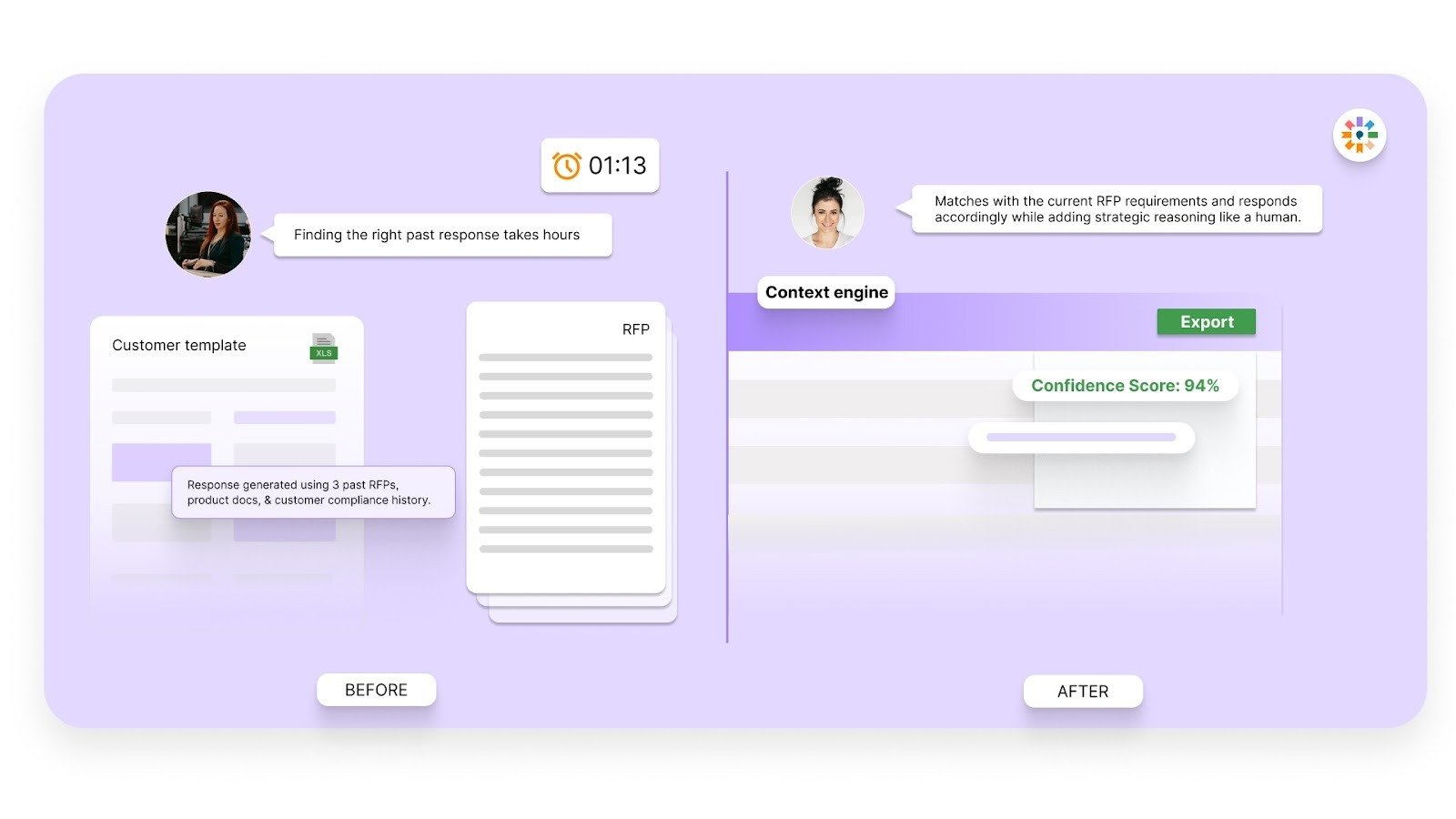
Most tools rely on basic retrieval methods that produce generic answers. Inventive AI uses multi-layer reasoning to understand the full LMS RFI context, including industry, learning goals, and technical depth. This results in tailored responses that read as if written by a learning solutions expert.
Conflict Detection
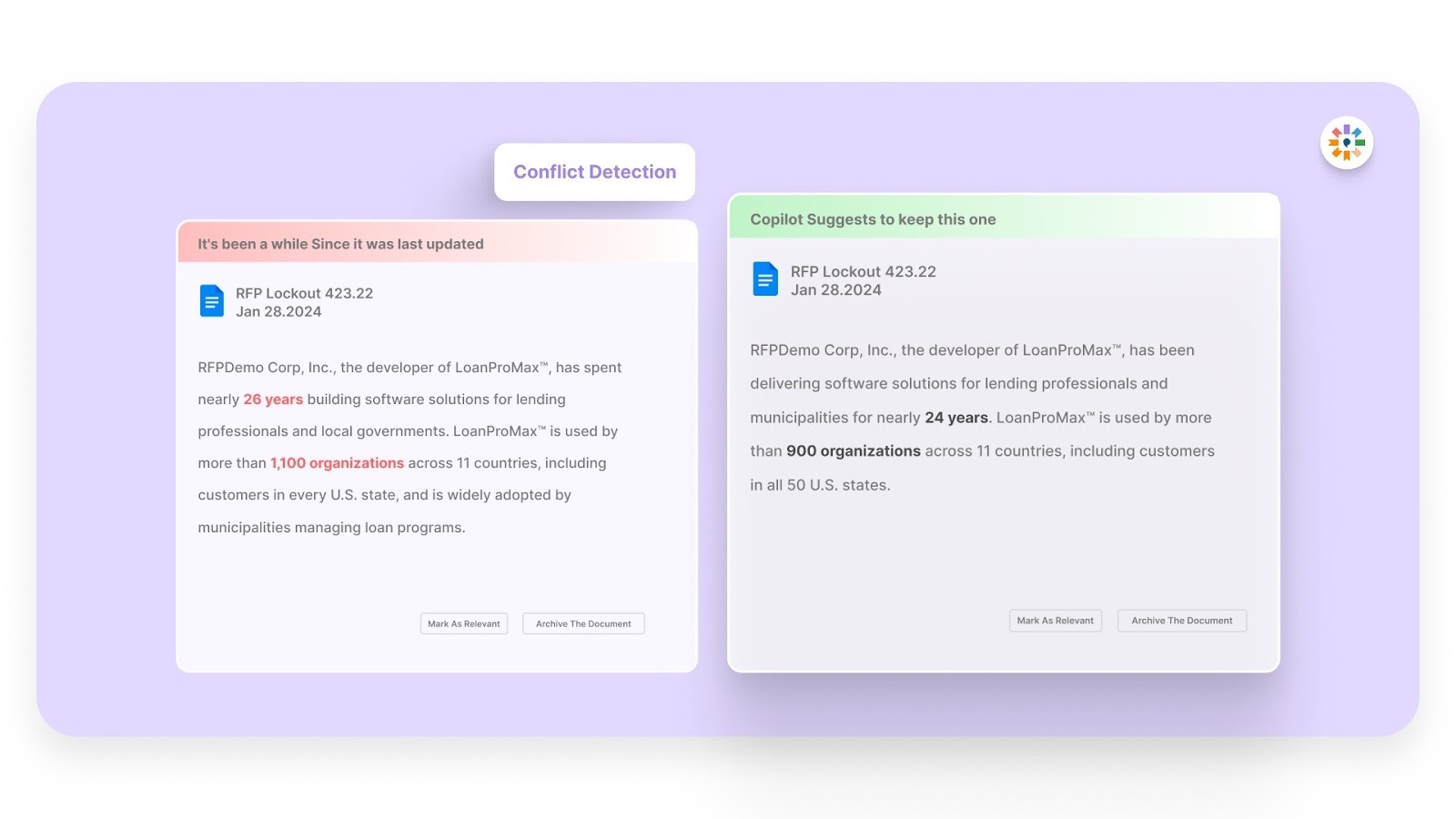
LMS RFIs often include overlapping functional, technical, and integration requirements. Inventive AI flags contradictory statements across sections before submission, reducing the risk of credibility issues during evaluation.
Outdated Content Detection
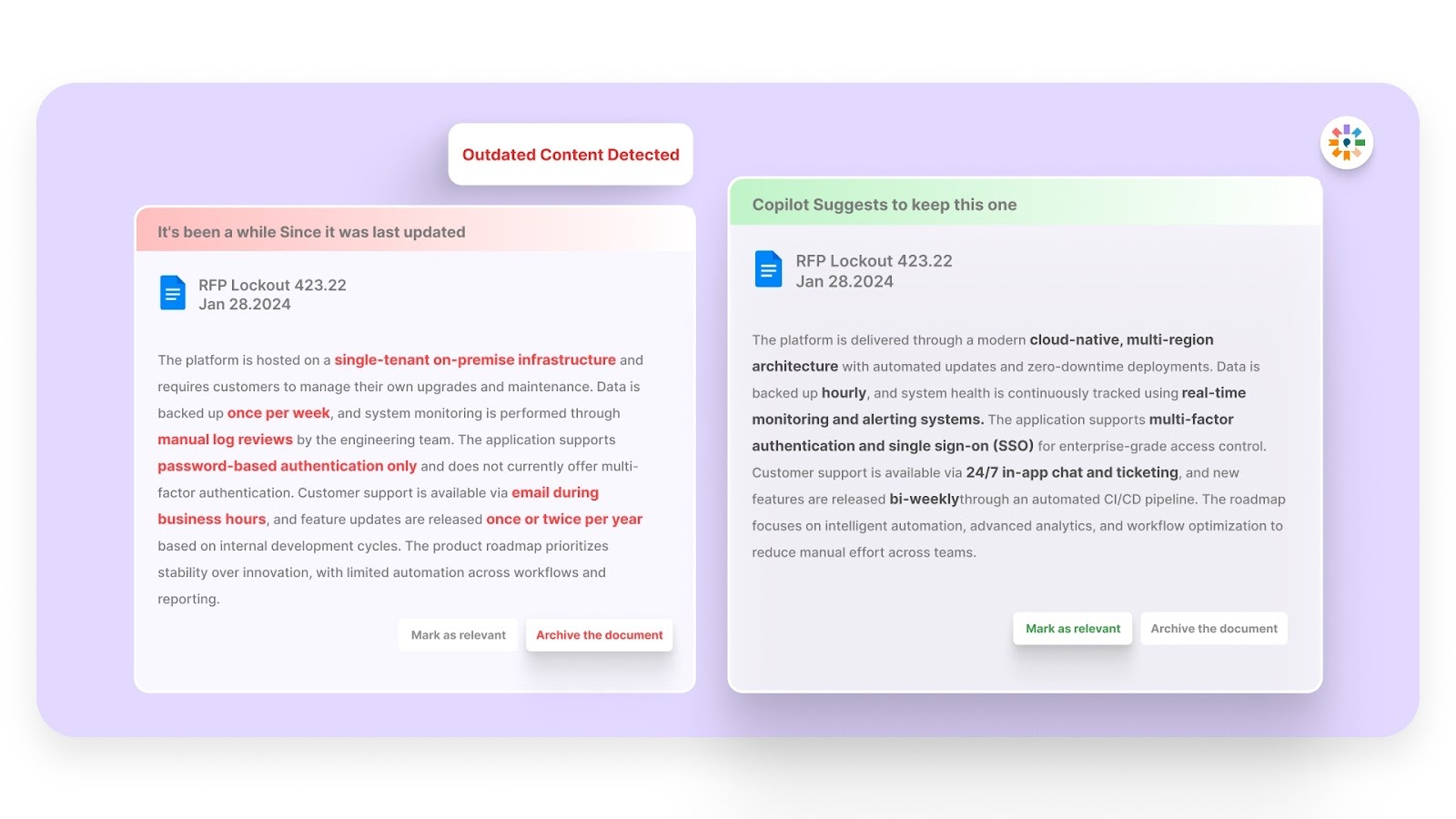
Large knowledge bases often contain deprecated product or feature information. Inventive AI automatically identifies stale or non-compliant content before it appears in your response, cutting manual review time and eliminating version confusion.
2X Quality Response
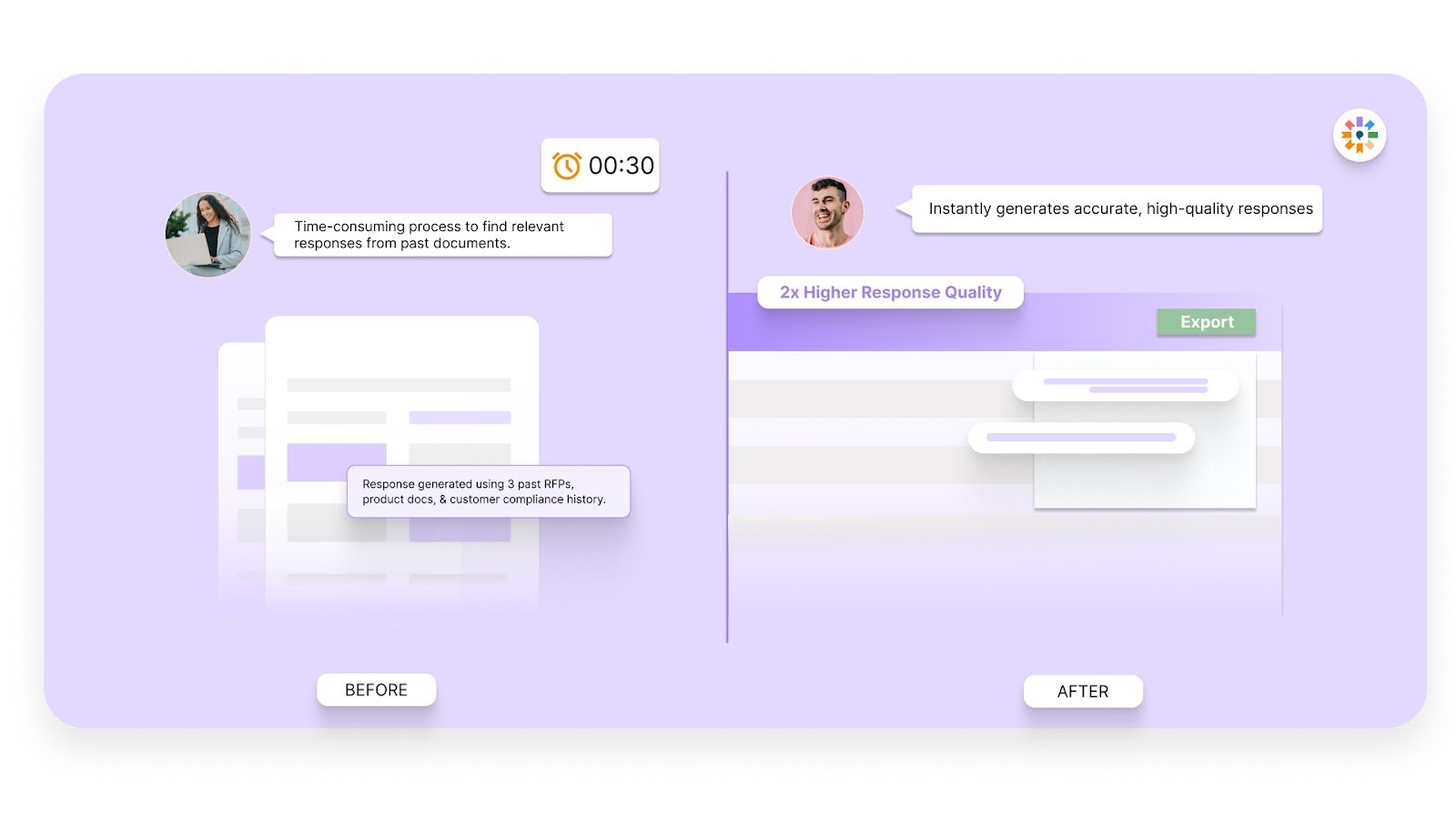
Inventive AI’s multi-agent system produces responses with higher clarity, accuracy, and completeness. Answers address buyer intent directly, improving perceived LMS readiness and solution fit during evaluation.
Simple And Easy To Use UI/UX
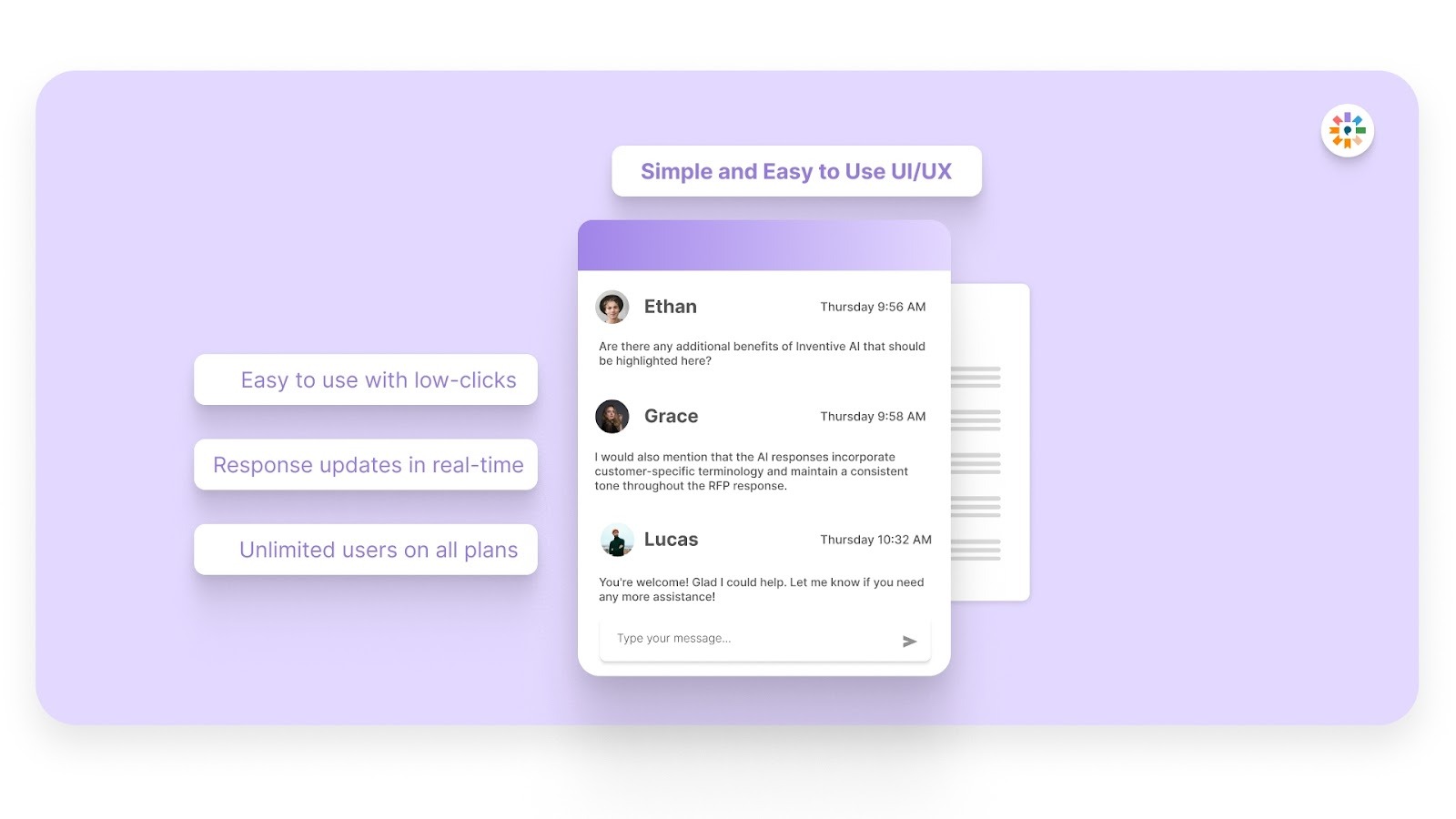
Adoption matters under tight deadlines. Inventive AI enables teams to generate systematic LMS RFI responses quickly without operational friction.
Narrative-Style Proposals
Beyond structured Q&A, Inventive AI generates long-form narrative responses, including executive summaries, technical overviews, and solution highlights. This strengthens your LMS positioning when buyers request consolidated documentation.
FAQs
1. How can vendors ensure their LMS RFI responses address buyer-specific learning goals?
Vendors should analyze the buyer’s stated objectives, map each LMS feature to those goals, and provide concrete examples or metrics. Highlighting alignment with compliance, skill development, or onboarding needs increases credibility and response effectiveness.
2. What is the best way to handle optional features in an LMS RFI response?
Clearly separate core and optional functionalities in your response. Provide details, benefits, and associated costs for optional modules, and explain how they enhance learning outcomes, so buyers can make informed comparisons without confusion.
3. How can vendors demonstrate LMS scalability in an RFI?
Use concrete metrics such as maximum concurrent users, course volume capacity, and system load testing results. Include real-world case studies or benchmarks to illustrate that the LMS can grow with enterprise needs.
4. What role do integration details play in strengthening an LMS RFI response?
Integration capabilities signal how well the LMS fits into existing enterprise systems. Vendors should clearly list supported APIs, single sign-on options, and third-party system compatibility to reduce buyers' perceived risk and demonstrate readiness.
5. How can vendors make RFI responses more persuasive without adding fluff?
Focus on structured, evidence-backed answers. Include metrics, compliance proof, and success stories. Avoid generic marketing claims; instead, show how your LMS directly addresses the buyer’s challenges with clear, actionable information.



%2010%20Free%20Response%20Templates%20By%20Industry%20%26%20Service.jpg)