Qvidian vs Loopio (2026): Features, Reviews, Limitations, and Alternatives
Qvidian vs Loopio compared: features, real G2 reviews, limitations, pricing, and the AI-native alternative that replaces both. See which legacy RFP tool fits your team.
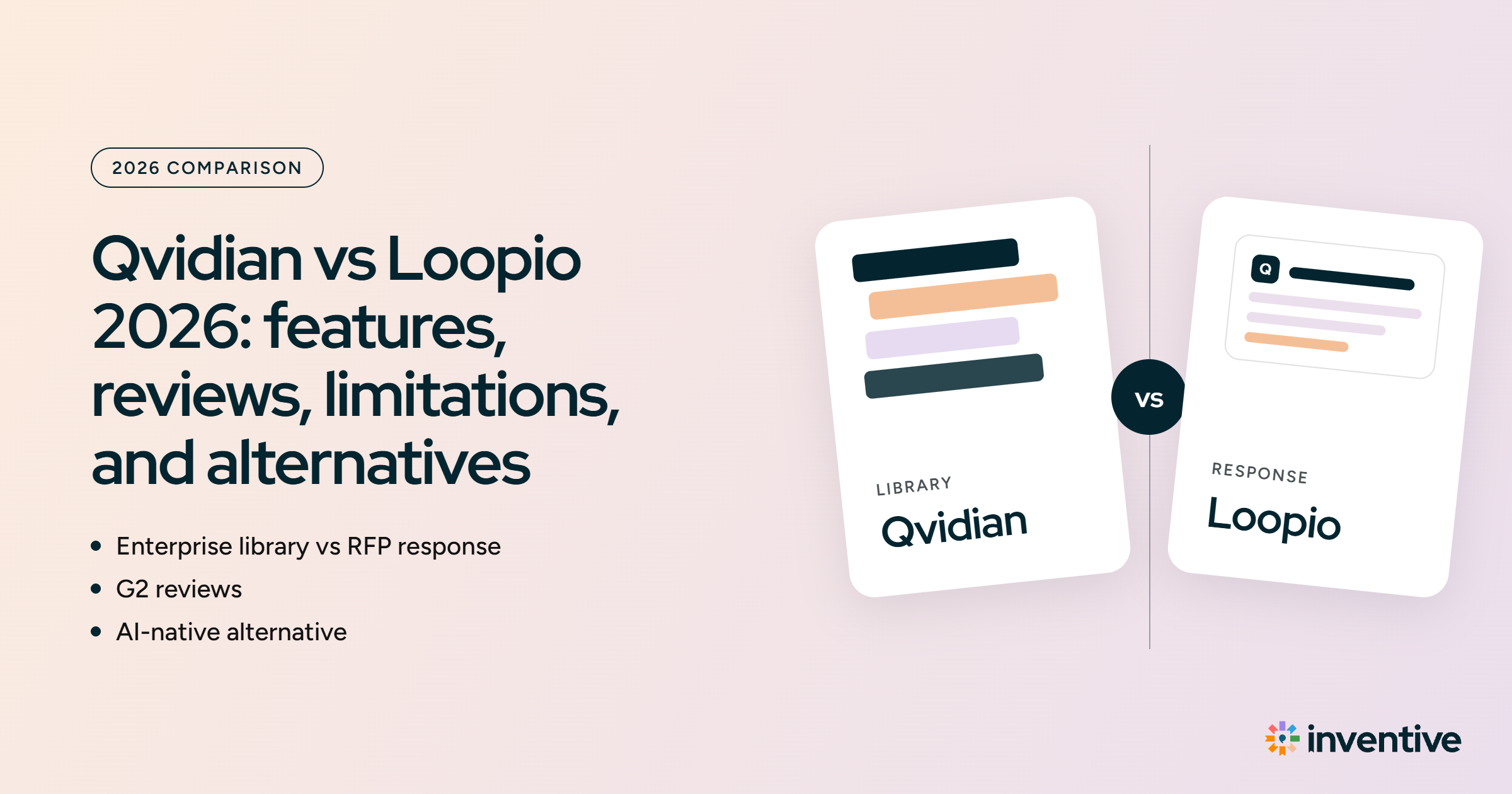
Qvidian and Loopio are two of the most established RFP response tools, and they share the same foundation: a content library your team builds and maintains, with AI added on top later. When you compare Qvidian and Loopio, the real question is which library-based platform fits your team, and whether a newer, AI-native tool would serve you better than either. This comprehensive Loopio vs Qvidian review evaluates features, real G2 reviews, limitations, and pricing, then highlights where both leave critical gaps.
This guide compares Loopio and Qvidian features, real G2 reviews, limitations, and pricing, then shows where both leave gaps.
At a glance: Loopio vs Qvidian comparison
- Qvidian suits established enterprise teams that need first AI drafts, version control, and heavy reporting, and can absorb a longer, hands-on setup.
- Loopio suits teams that want a cleaner, more approachable library and faster onboarding than Qvidian, with strong collaboration.
- Both are library-first by design. The AI drafts from the content you maintain, so answers are only as current as your library, and someone has to keep it clean.
- If you want AI that drafts from your live sources with citations and keeps content current on its own, an AI-native tool like Inventive AI (4.9 out of 5 on G2) is worth testing alongside both.
Qvidian and Loopio compared at a glance
What is Qvidian? Enterprise RFP and proposal software
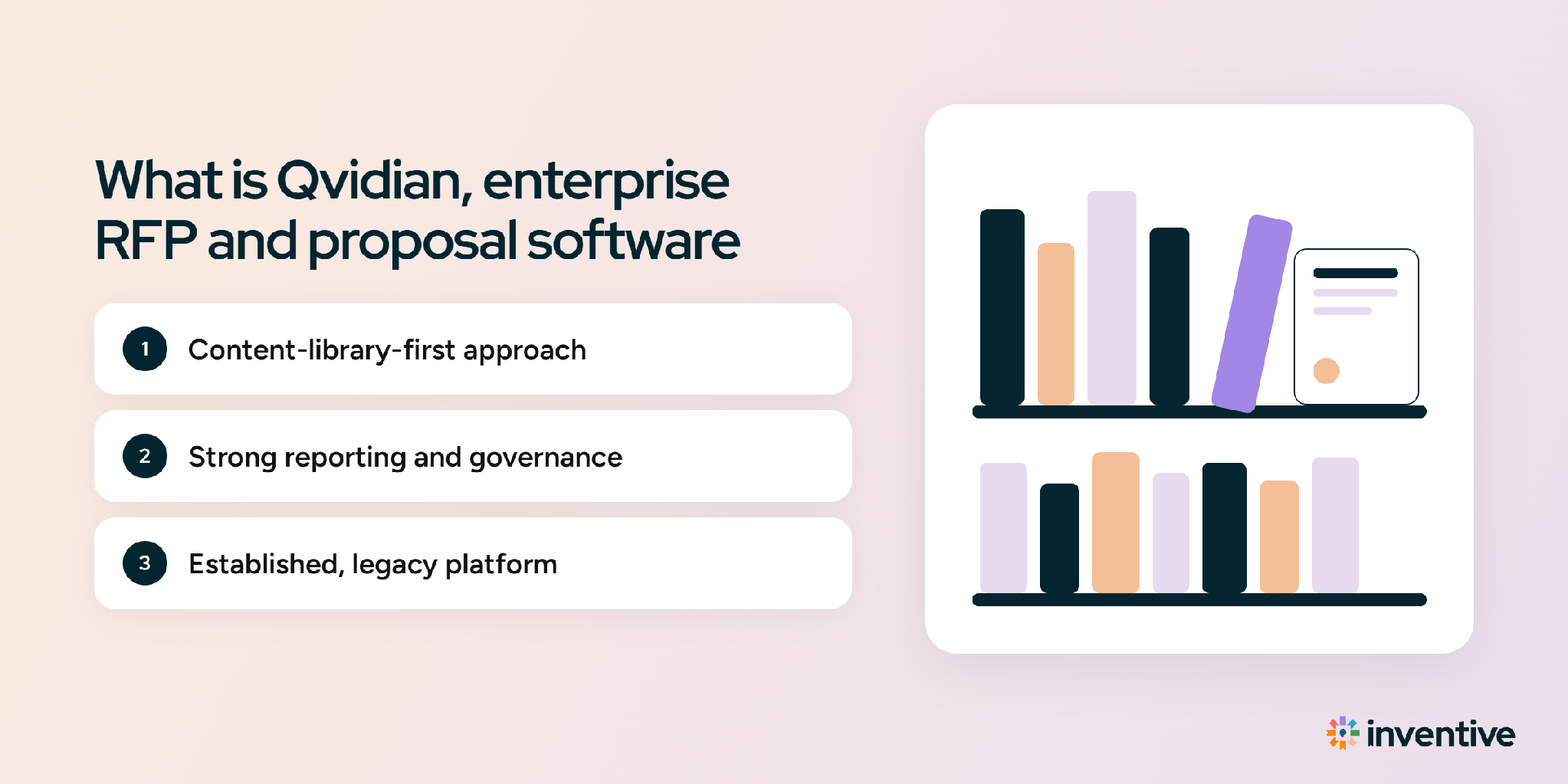
Qvidian, sold today as Upland Qvidian after Upland acquired it in 2017, is an enterprise platform for RFP, DDQ, and proposal responses. It is built around a governed content library with version control, deep reporting, and a Microsoft Word add-in. Upland added Qvidian AI Assist on top in the last couple of years to draft and revise responses. It is a strong fit for large, established teams, and reviewers most often fault its dated interface and setup effort.
What is Loopio? RFP response and content library software
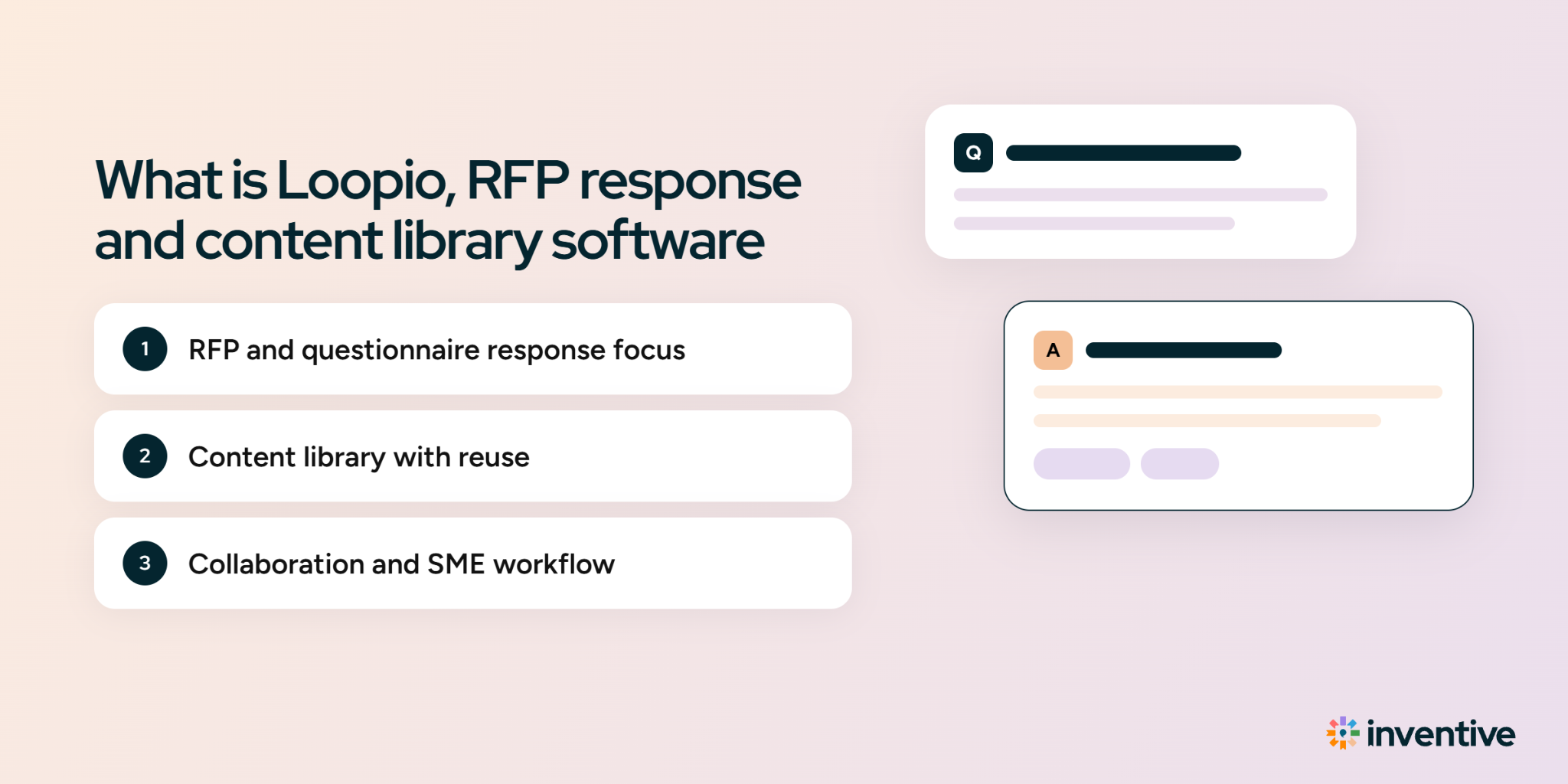
Loopio is a library-first RFP and questionnaire platform built around a central content library and strong collaboration. Teams store approved content in that library, organize it with tags and categories, and assign questions to subject-matter experts through review cycles. Loopio added AI drafting on top of that library. It tends to onboard faster than Qvidian, and reviewers most often ask for better search and less manual library upkeep.
Both Qvidian and Loopio ask your team to build and maintain a content library, then layer AI over it. Inventive AI works the other way around. It generates every answer from your approved knowledge, so responses stay grounded and don’t hallucinate, and it flags conflicting or outdated content on its own to keep that knowledge fresh without manual upkeep. It holds a 4.9 out of 5 on G2 across 80 reviews.
Qvidian vs Loopio: features, limitations, and reviews
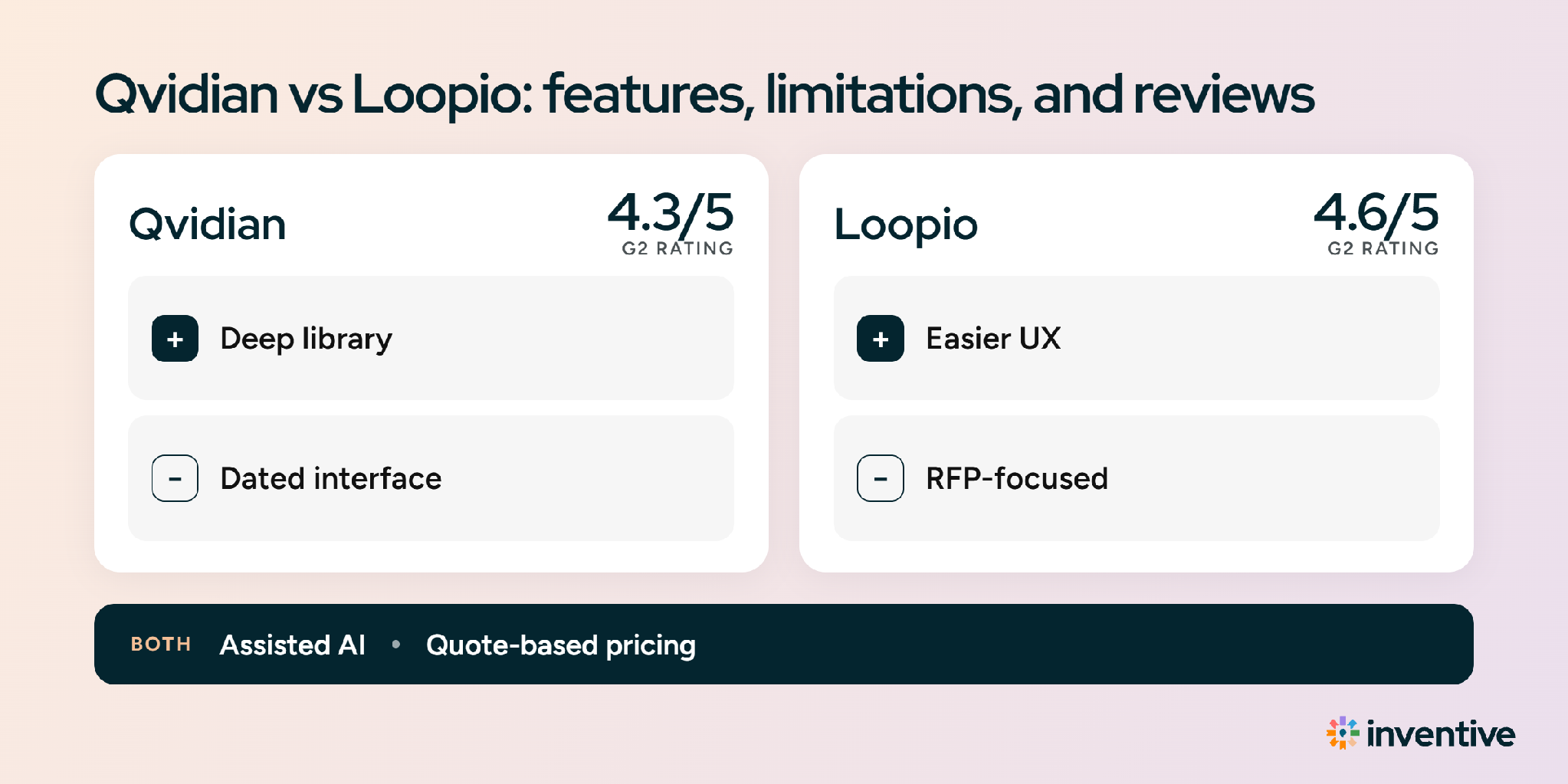
Here is each tool in depth, with the real strengths, the limitations reviewers raise most on G2, pricing, and ratings.
Qvidian
Key features
- Governed content library with version control, expiration dates, and review jobs
- Deep reporting: 70-plus prebuilt reports, a drag-and-drop builder, and dashboards
- Qvidian AI Assist for generative drafting, tone and length edits, and RFP analysis
- Microsoft Word, Excel, and PowerPoint add-ins, plus Salesforce and Teams
- Granular permissions and audit trails for enterprise sign-off
Limitations (from G2 reviews)
- The interface feels dated, and routine tasks take more clicks than they should.
- Adding and uploading content is slow, and the library often opens in a second window.
- Search misses the right phrase, and the filters are weak.
- AI Assist is newer and, reviewers say, still maturing.
- Content maintenance is entirely manual, with no live sync or automated governance to catch stale answers. See our Qvidian alternatives guide for how modern platforms handle content hygiene automatically.
Pricing
- Quote-only, licensed per named user
- A separate, one-time implementation fee in year one
- Annual, often multi-year contracts (see our Qvidian pricing guide)
Also read: Qvidian vs Inventive AI.
What do reviewers say about Qvidian?
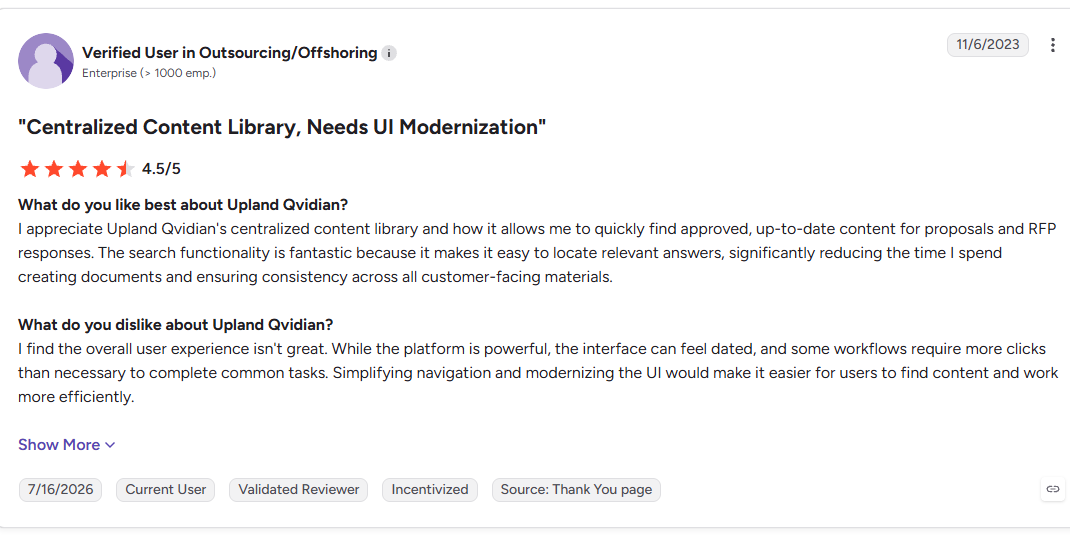
Verified User in Outsourcing/Offshoring, enterprise, 4.5/5: The centralized library makes it easy to find approved, up-to-date content and keep materials consistent. The platform is powerful, but the interface feels dated, and some workflows take more clicks than they should.
Loopio
Key features
- Central content library with tags, categories, and structured review cycles
- Clean collaboration: assign questions to subject-matter experts and track status
- AI drafting that surfaces and responds from the library
- Integrations with Salesforce, HubSpot, Slack, Teams, and 80-plus content sources
- SOC 2 Type II and ISO 27001, with SSO
Limitations (from G2 reviews)
- Search is the top request: reviewers say it could be more accurate and easier to use.
- Imports do not always work, especially complex multi-column Excel files.
- Exports need better sorting and filtering by subcategory.
- Formatting is fiddly, from bullet points to finding completed questions.
- Keeping the library current is manual, and AI output still needs real review.
If you want to switch or need a better platform, see our Loopio alternatives guide.
Pricing
- Quote-only, tier plus per-user
- Third-party procurement data (Vendr) puts contracts near a $24,000 median
See our Loopio pricing guide for the full breakdown.
What do reviewers say about Loopio?
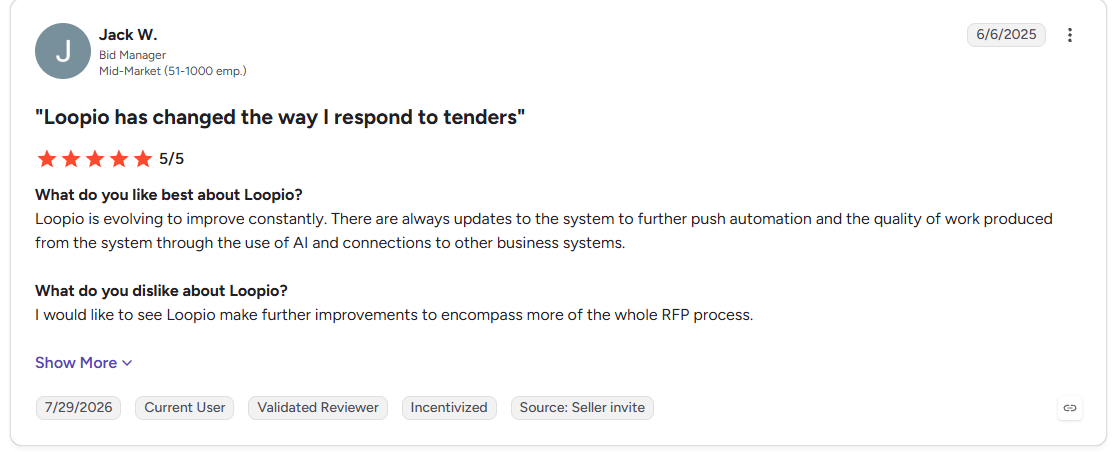
"Loopio has changed the way I respond to tenders." (Jack W., mid-market, 5/5). On the other side:
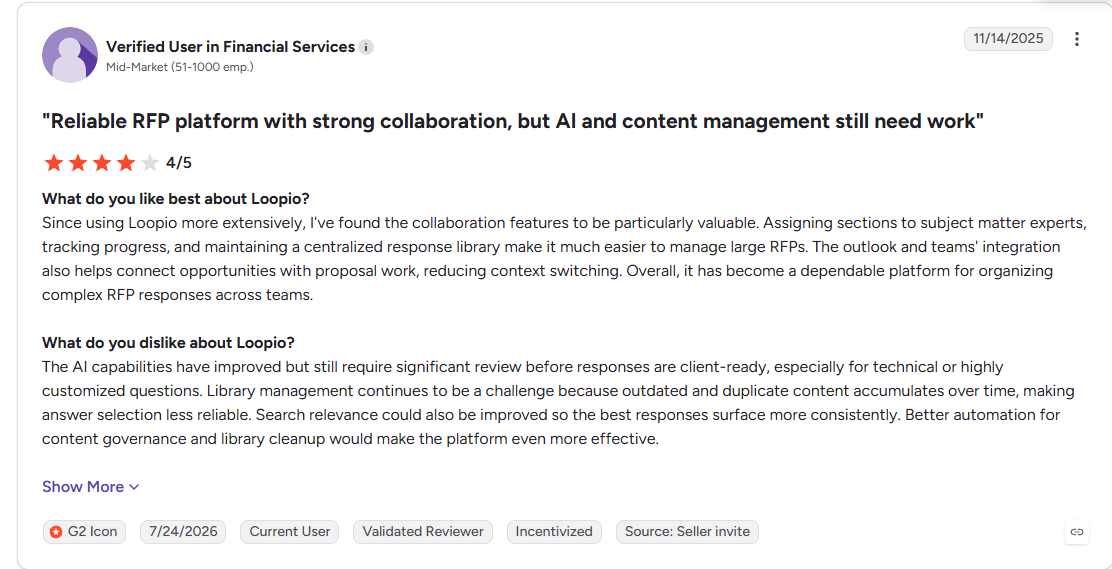
Verified User in Financial Services, mid-market, 4/5: A reliable platform with strong collaboration; assigning sections to experts and tracking progress makes large RFPs easier to manage. But the AI still needs heavy review before responses are client-ready; outdated and duplicate content builds up in the library over time, and search relevance could be better.
Qvidian vs Loopio: the AI-native feature gap
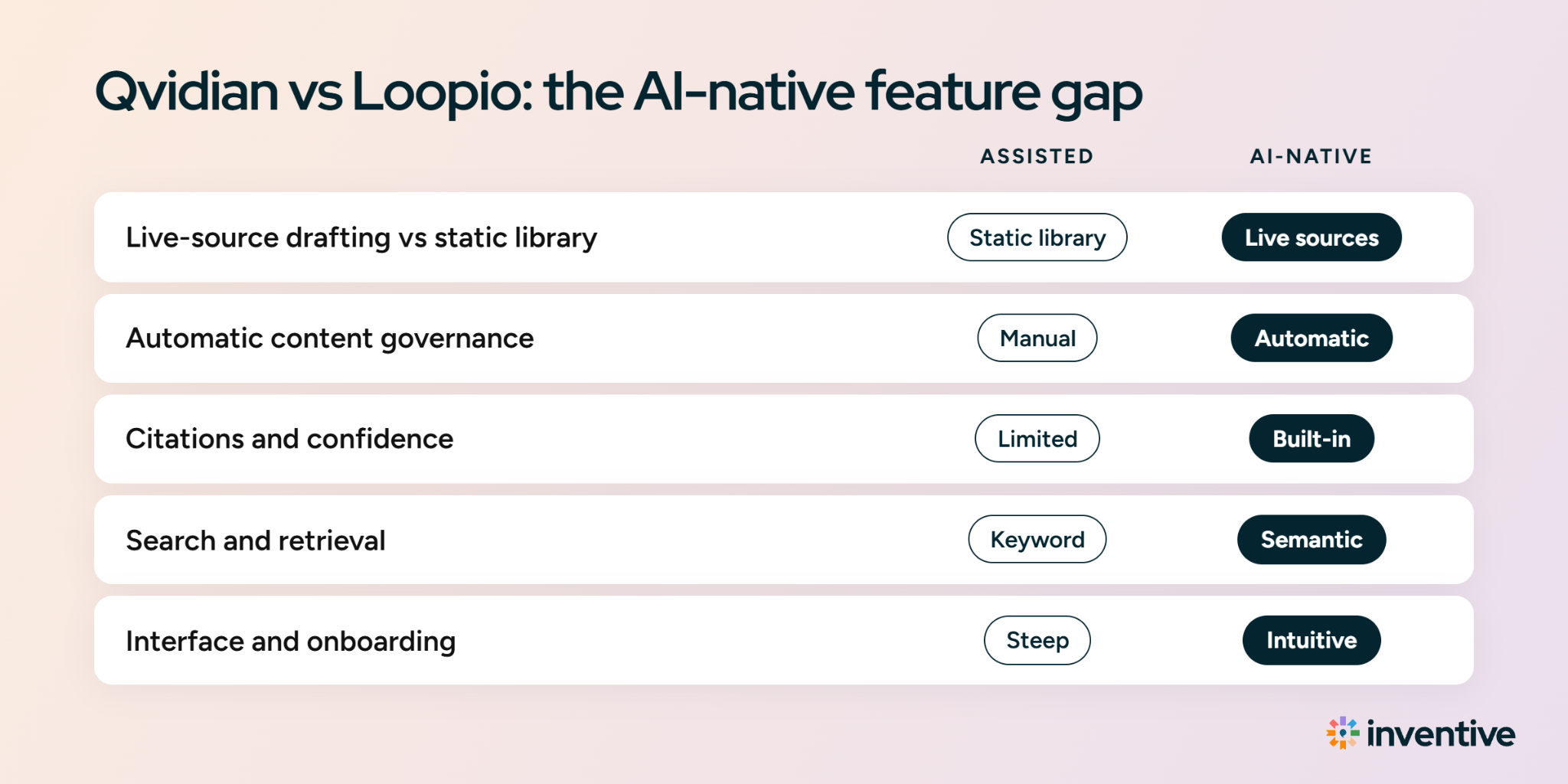
Both tools added AI to a library you maintain by hand. That design shapes what their AI can and cannot do. Gartner predicts that by 2026, sales teams using generative AI for proposal and bid responses will cut time per RFP by about 40%, to roughly 16 hours, so the gap below is worth weighing.
Drafting from live sources vs. a static library
Qvidian and Loopio both draft from the library your team curates, so answers are only as fresh as your last update. An AI-native tool drafts from your connected knowledge sources directly, so it pulls current content without a separate upkeep cycle.
Automatic content governance
In both tools, keeping content accurate is a manual job: review cycles, expiration dates, and duplicate checks that people run. Neither flags conflicting or outdated answers automatically. An AI-native platform does this on its own, so stale answers surface before they reach a buyer.
Citations and confidence
Reviewers of both tools say the AI output needs real review before it is client-ready. Answers that carry a source citation and a confidence score, and that flag anything the tool cannot ground, make that review faster and safer.
Search and retrieval
Search is a named weakness for both: Qvidian's filters are weak, and Loopio reviewers ask for more accurate search. AI-native retrieval reads the whole question in context rather than matching keywords to stored Q&A pairs.
Interface and onboarding
Loopio is generally easier to learn than Qvidian, whose interface reviewers call dated. Usability is not a minor detail: Gartner found 60% of workers were frustrated by software in the past two years, and many then used it less. A modern, AI-native interface narrows the learning curve, so the whole team actually uses the tool.
Why AI-first RFP software is the future, and where Qvidian and Loopio fit
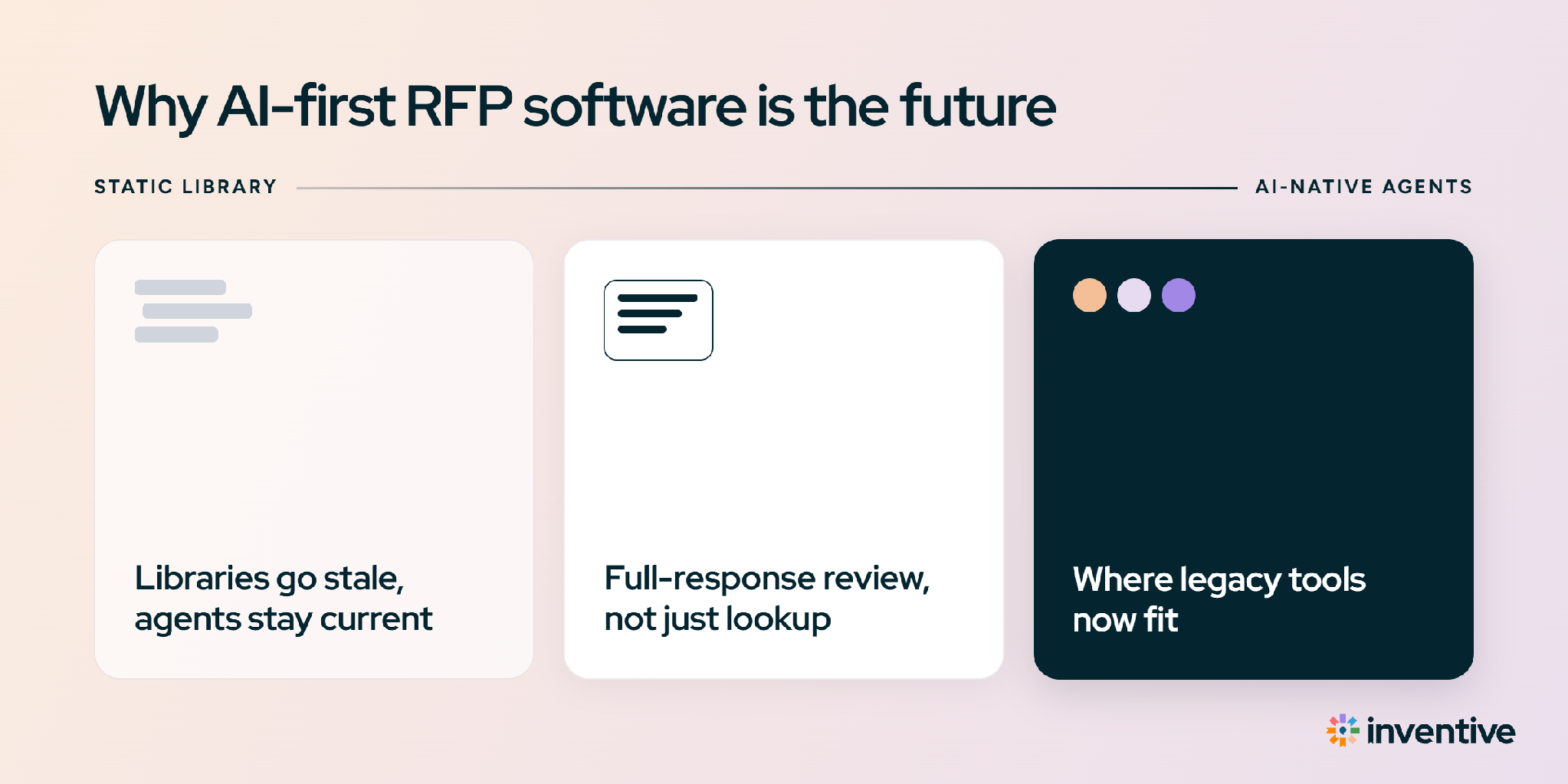
AI-first RFP software wins because it drafts answers from your approved sources and keeps them current on its own, with no separate content store to maintain. Qvidian and Loopio are proven, but both added AI to an older architecture instead of building around it. The table shows what changes when the AI comes first.