Qvidian vs Responsive (2026): A Buyer's Comparison of Two Enterprise RFP Platforms
Compare Qvidian and Responsive on pricing, AI answering, integrations, and reviews plus a look at the AI-native alternative reshaping RFP response.
Last reviewed: January 2026. This comparison draws on vendor-published materials, verified reviews across G2, Capterra, and TrustRadius, and independent third-party analyses. Both vendors price by quote and ship feature updates frequently, so read every figure here as a point-in-time snapshot — verify current pricing, editions, and capabilities with each vendor before you commit.
TL;DR: Qvidian vs Responsive
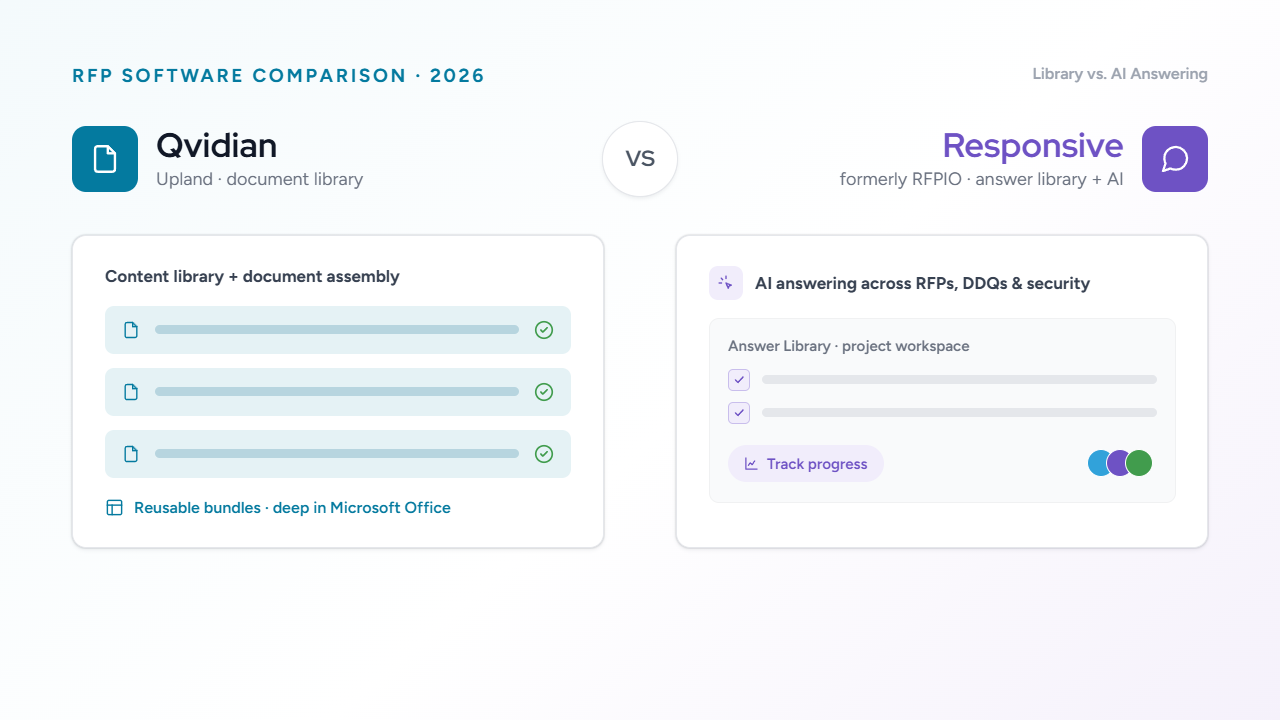
Qvidian fits teams that want a mature, content-library-centric proposal engine with deep Microsoft Office integration — common in large financial services, technology, and healthcare organizations. Responsive fits teams that want a broad answer library plus AI-driven answering across RFPs, RFIs, DDQs, and security questionnaires, with strong project collaboration. Which is better? It depends on what your team needs: Qvidian leans toward document assembly and library governance; Responsive leans toward AI answering, breadth of integrations, and multi-format response management. If you're shortlisting at the enterprise level, it's also worth scanning how a newer wave of AI-native enterprise RFP platforms tackles the same job with a different architecture.
What Should You Consider When Choosing Between Qvidian and Responsive?
Before the feature tables, map these criteria to how your team actually responds to RFPs. Answer each question during your demos.
• AI capabilities: Does the tool draft answers, or just retrieve stored ones? How much editing do drafts need?
• Response quality: Test edge-case questions. How often are top-ranked answers actually usable as-is?
• Content management and governance: How do you keep the library current, and who owns that maintenance?
• Conflict and duplicate detection: Does the platform flag contradictory or outdated answers, or is that a manual review job?
• Hallucination control: Does AI cite sources and admit when it doesn't know, or does it fill gaps with guesses?
• Narrative-style proposals: Can it produce prose proposals, not just Q&A grids?
• Content format flexibility: How well does it handle Excel, Word, PDF, and PowerPoint imports and exports?
• Workflow automation: Can you assign questions, route reviews, and track progress without spreadsheets on the side?
• Collaboration: How do occasional reviewers (legal, InfoSec, execs) participate — and are they licensed?
• Integrations: Does it connect to your CRM, content stores, and messaging tools? (See the integration table below.)
• Security and compliance: SOC 2 status, data handling, and whether your data trains external models.
• Analytics: Can you see win rates, cycle times, and content usage?
• Pricing: Both vendors quote privately. Model total cost across seats, editions, and add-ons — cross-check vendor quotes against our RFP software pricing and comparison guide.
• Ease of implementation: How long to first live RFP, and how much configuration is required?
• Enterprise scalability: Does the licensing model hold up as your team and volume grow?
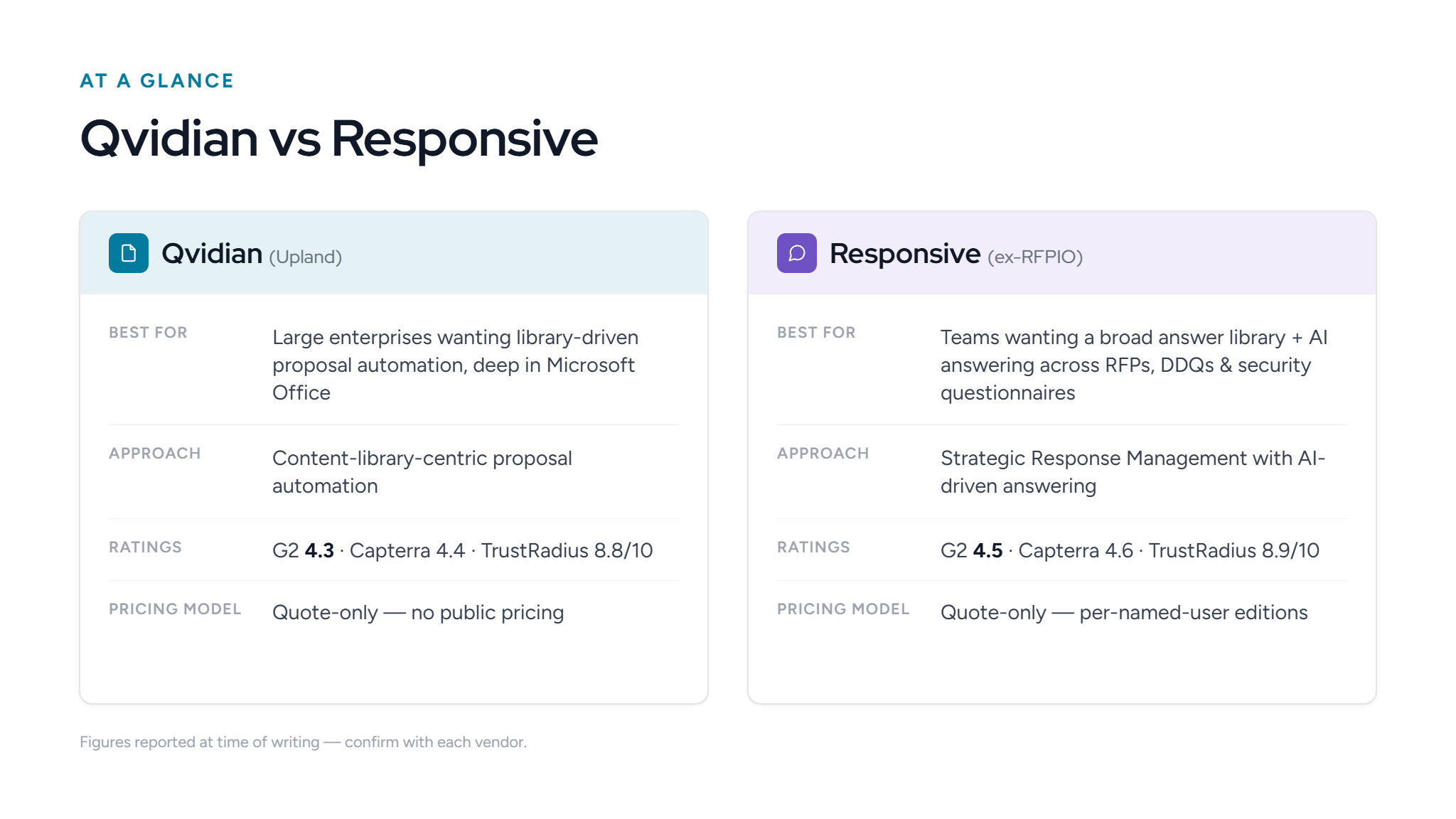
Qvidian vs Responsive at a Glance
| Qvidian (Upland) | Responsive (formerly RFPIO) | |
|---|---|---|
| Best for | Large enterprises wanting library-driven proposal automation, deep in Microsoft Office | Teams wanting a broad answer library plus AI answering across RFPs, DDQs, security questionnaires |
| Architecture | Content-library-centric proposal automation | Strategic Response Management with AI-driven answering |
| G2 rating | 4.3 (~155–166, confirm on live listing) | 4.5 (~1,300, confirm on live listing) |
| Pricing model | Quote-only; ~$15K–$25K/yr base estimated by a third party (not vendor-confirmed) | Quote-only; core subscriptions estimated ~$5K–$29K+ by a third party (not vendor-confirmed) |
Figures reported at time of writing; confirm with each vendor._
Feature-by-Feature Comparison: Qvidian vs Responsive
This is the core comparison. Each cell reflects sourced values at the time of writing.
| Dimension | Qvidian (Upland) | Responsive (formerly RFPIO) |
|---|---|---|
| Best for | Large enterprises (1,001+ employees) in financial services, tech, healthcare | Mid-market to enterprise response teams handling RFPs, RFIs, DDQs, security questionnaires |
| Core approach | Content library + document assembly ("bundles" / shell documents) | Answer Library + AI-driven answering + project collaboration |
| G2 rating | 4.3 (~155–166 reviews, confirm on live listing) | 4.5 (~1,300 reviews, confirm on live listing) |
| Capterra rating | 4.4 (~42 reviews, confirm on live listing) | 4.6 (~249 reviews, confirm on live listing) |
| TrustRadius rating | 8.8 / 10 (37 reviews, confirm on live listing) | 8.9 / 10 (52 reviews, confirm on live listing) |
| AI capabilities | Library retrieval; users request semantic search improvements | AI answering that suggests and imports reusable responses |
| Content search | Flagged by users as needing more precise, contextual results | Answer Library search praised for fast reuse |
| Microsoft Office | Deep — pull library content directly into Word/Excel/PowerPoint | Word/Excel/PowerPoint import-export plus SharePoint, OneDrive |
| Collaboration | Document automation, reusable bundles | Assign questions, track progress, reuse prior answers |
| Integrations | Salesforce, Microsoft 365, Word/Excel/PPT, Open API, browser extension | Salesforce, Slack, Teams, SharePoint, OneDrive, Google Drive, HubSpot, Box, Dropbox, Jira, Seismic |
| Reviewer licensing | Confirm seat model with vendor | No free reviewer-only access reported; can raise seat counts |
| Excel handling | Excel integration supported | Very complex spreadsheets reported harder to import |
| Pricing transparency | Quote-only; no public price | Quote-only; editions all "Contact sales" |
Values are reported at time of writing. Ratings, review counts, and pricing change — confirm each on the live listing and with the vendor._
Worth a look: One proposal team documented 90% faster RFP turnaround with zero weekend hours lost after moving to an agentic workflow. See how that turnaround works in a demo.
Qvidian: Overview, Features, and Limitations
Qvidian, now part of Upland Software, is an established RFP and proposal automation platform built around a central content library. It's most common in large enterprises — financial services, technology, and healthcare — where consistency across many proposals matters and Microsoft Office is the daily working environment.
Qvidian's best features
• Strong content management and library, cited by users for keeping proposals consistent.
• Deep Microsoft Office integration — pull approved library content directly into Word, Excel, and PowerPoint.
• Reusable content "bundles" that speed up assembling shell documents.
• Document automation for repeatable proposal structures.
• Salesforce and Microsoft 365 connectivity plus an Open API.
• Browser extension (Qvidian for Web) for working across tools.
Qvidian's limitations
• Search and indexing precision is the most-cited weakness — users want semantic search and more contextual ranking, and indexing/search is flagged as the main hitch by reviewers.
• Third-party summaries report an outdated UI, slow search, and complex implementation (confirm on live listings).
• AI answering is less prominent than in AI-first tools; drafting leans on stored content.
• Pricing is quote-only, which lengthens evaluation. Teams weighing options often review Qvidian alternatives and how they compare before committing.
• Best fit skews to large enterprises; smaller teams may find it heavier than needed.
• Conflict/duplicate detection relies largely on manual library upkeep.
Qvidian pricing: No public price is listed by Upland. A third party estimates roughly $15,000–$25,000/year for a base license — an estimate, not vendor-confirmed. Get a written quote for your seat count, and see our full Qvidian pricing, features, and reviews breakdown for more detail.
Ratings and reviews: G2 4.3 (~155–166 reviews), Capterra 4.4 (~42 reviews), TrustRadius 8.8/10 (37 reviews) — all reported; confirm on live listings.
Positive: "I have used Qvidian for almost two years now and couldn't see myself doing my job without it." — Capterra
Mixed: "I think the search functionality in Upland Qvidian could be improved with semantic search and a more contextualized approach to show more accurate responses at the top." — G2
Responsive (formerly RFPIO): Overview, Features, and Limitations
Responsive, formerly RFPIO and headquartered in Beaverton, positions itself as a Strategic Response Management platform. It pairs a large Answer Library with AI-driven answering across RFPs, RFIs, DDQs, and security questionnaires, and is known for project organization and collaboration.
Responsive's best features
• Answer Library plus AI answering, praised for fast, reusable responses.
• Project organization: assign questions, track progress, and reuse prior answers.
• Import/export flexibility across Word, Excel, and PDF.
• Broad integration set including Salesforce, Slack, Teams, SharePoint, and HubSpot.
• Coverage across multiple response types — not just RFPs, but DDQs and security questionnaires.
• Collaboration tooling suited to cross-functional response teams.
Responsive's limitations
• Licensing is reported as not scaling cost-effectively for larger teams.
• No free reviewer-only access, which can inflate license counts for occasional legal, security, or exec reviewers.
• Very complex Excel spreadsheets can be difficult to import due to field setup.
• AI still needs refinement to avoid altering library responses.
• Pricing is quote-only across all editions; total cost depends heavily on add-ons. Teams often scan Responsive alternatives and how pricing compares during evaluation.
• Breadth can mean a longer configuration and onboarding runway for smaller teams.
Responsive pricing: The vendor pricing page lists editions (Emerging, Growth, Enterprise) all marked "Contact sales" with no dollar figures. Vendr describes a per-named-user subscription with edition tiers and optional add-ons (AI content suggestions, advanced integrations), usually quoted annually and often multi-year. A third party estimates core subscriptions from ~$5,000 to $29,000+ depending on team size — an estimate, not vendor-confirmed. For a deeper look, see our Responsive software pricing and plans comparison.
Ratings and reviews: G2 4.5 (~1,300 reviews), Capterra 4.6 (~249 reviews), TrustRadius 8.9/10 (52 reviews) — all reported; confirm on live listings.
Positive: "Responsive is a total lifesaver for RFPs and security questionnaires!" — G2
Mixed: "The current licensing model doesn't support scaling without breaking the bank." — Capterra
AI Capabilities: How Qvidian and Responsive Compare
Direct answer: Responsive leads on visible AI answering; Qvidian leans on library retrieval and document assembly, with users still asking for smarter search.
Qvidian
• Retrieves and reuses approved library content; strong at consistent document assembly.
• Users request semantic search and more contextual ranking — a sign AI relevance can miss.
Responsive
• AI answering suggests and imports reusable responses across question types.
• Reviewers note the AI can still alter library responses and needs refinement.
Note: Both platforms grew from content-library foundations, so their AI is layered onto retrieval rather than built to draft and validate autonomously. If autonomous drafting with citations and confidence scores is your priority, see how AI-native RFP tools approach response quality.
Integrations: Qvidian vs Responsive
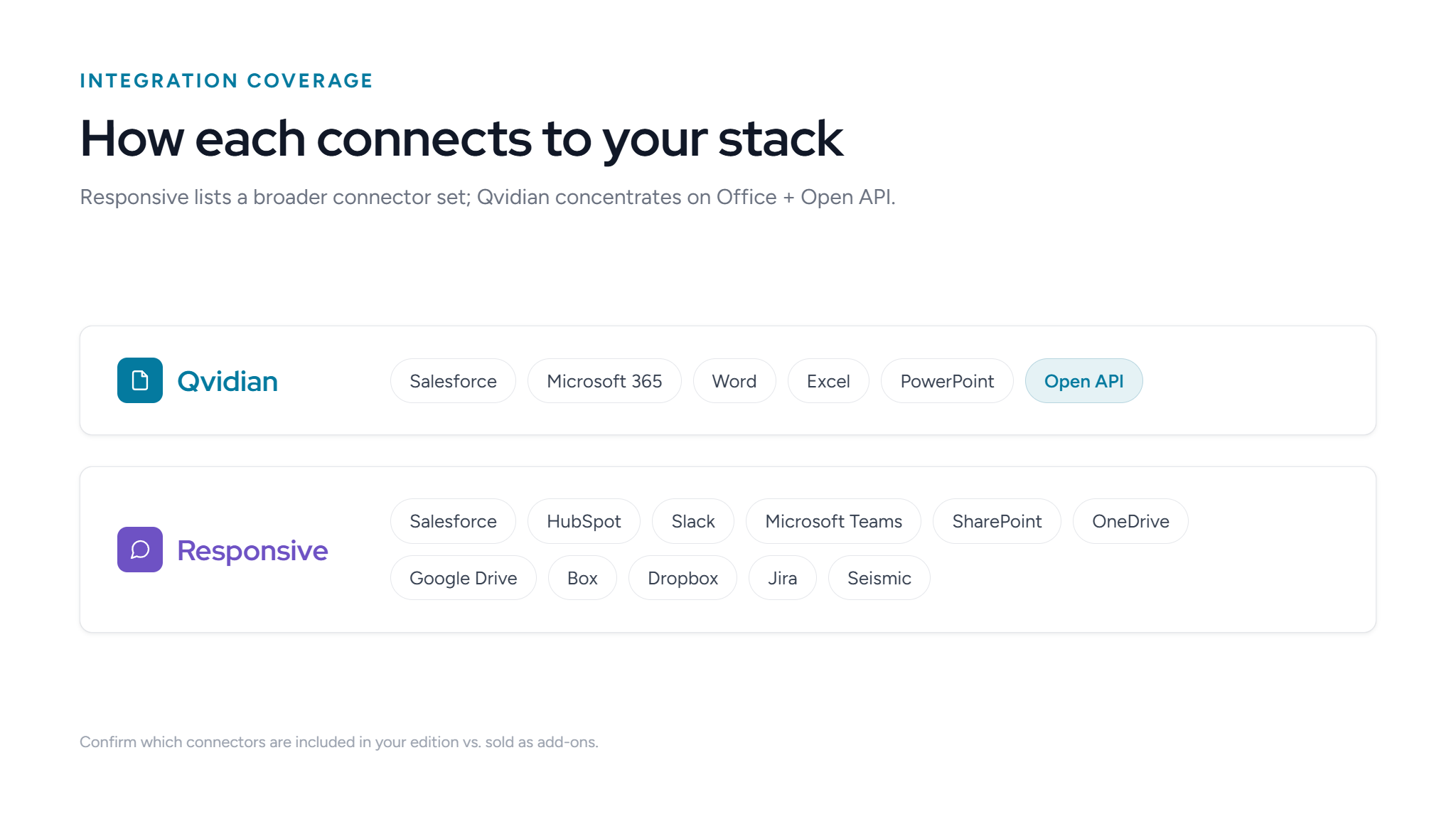
| Category | Qvidian | Responsive |
|---|---|---|
| CRM | Salesforce (Sales Cloud) | Salesforce (Sales Cloud), HubSpot CRM |
| Productivity | Microsoft 365, Word, Excel, PowerPoint | Word, Excel, PowerPoint, SharePoint, OneDrive |
| Content stores | Open API | Google Drive, Box, Dropbox Business |
| Messaging / PM | Browser extension (Qvidian for Web) | Slack, Microsoft Teams, Jira, Seismic |
Responsive lists a broader connector set, especially for messaging and content stores; Qvidian concentrates on Microsoft Office plus an Open API for custom work. Confirm which connectors are included in your edition versus sold as add-ons.
See it in practice: AssetWorks Facilities reported a 422% ROI and roughly $105K in net savings after automating RFPs on top of tools it already used, including SharePoint. Read the AssetWorks case study to see the setup.
Pricing: How Much Does Qvidian Cost vs Responsive?
Direct answer: Neither vendor publishes prices — both are quote-only, so exact cost depends on seats, editions, and add-ons.
• Qvidian: No official price. A third party estimates ~$15,000–$25,000/year for a base license (estimate, not confirmed).
• Responsive: Editions all show "Contact sales"; Vendr describes per-named-user pricing with add-ons; a third party estimates ~$5,000–$29,000+ (estimate, not confirmed).
Note: Reviewer licensing is the hidden cost on both sides. Responsive users flag no free reviewer-only seats; confirm Qvidian's seat model too. Occasional legal, InfoSec, and exec reviewers can quietly raise your license count, so model total cost of ownership — not just the sticker figure — before you sign.
Reviews: What Users Say About Qvidian and Responsive
Responsive carries a larger review base and marginally higher scores; Qvidian's smaller base still rates well but flags search and UI. Both are established, credible platforms.
• Qvidian: G2 4.3, Capterra 4.4, TrustRadius 8.8/10 — praised for library consistency, criticized for search precision and UI (all reported; confirm live).
• Responsive: G2 4.5, Capterra 4.6, TrustRadius 8.9/10 — praised for AI answering and collaboration, criticized for licensing cost at scale (all reported; confirm live).
If you're chasing the "Qvidian vs Responsive Reddit" style of candid feedback, cross-check these listings against practitioner threads before deciding.
Security and Compliance
Both vendors serve regulated enterprises and handle security questionnaires — a use case a wave of dedicated AI security-questionnaire tools also target — so verify each platform's current certifications, data-handling terms, and whether your content is used to train external models during your security review. Neither vendor's specific certifications are restated here — request current documentation directly.
Note: Data handling is table stakes in this category, but the details differ by vendor and edition. Ask each provider, in writing, how AI features process and store your response content — and whether reviewer access and audit logs meet your compliance team's bar.
Is Qvidian Better Than Responsive?
Direct answer: Neither is universally better — it depends on what your team needs.
Choose Qvidian if you want a mature, library-centric proposal engine, live deep inside Microsoft Office, and you're a large enterprise that values document-assembly consistency. Choose Responsive if you want broader AI answering across RFPs, DDQs, and security questionnaires, wider integrations, and stronger project collaboration — and you can model the seat-based licensing at your scale.
Weigh the recurring themes: Qvidian's search precision and UI, Responsive's licensing cost at scale. Both grew from content-library roots, so both share the same structural question — how much manual library upkeep and human editing your team is prepared to own.
Different architecture, worth comparing: Insider reported its win rate climbing from 30% to 50% and RFP response time dropping 90% in its case study. /Compare the AI-native approach in a demo.
Also Worth Considering: Inventive AI
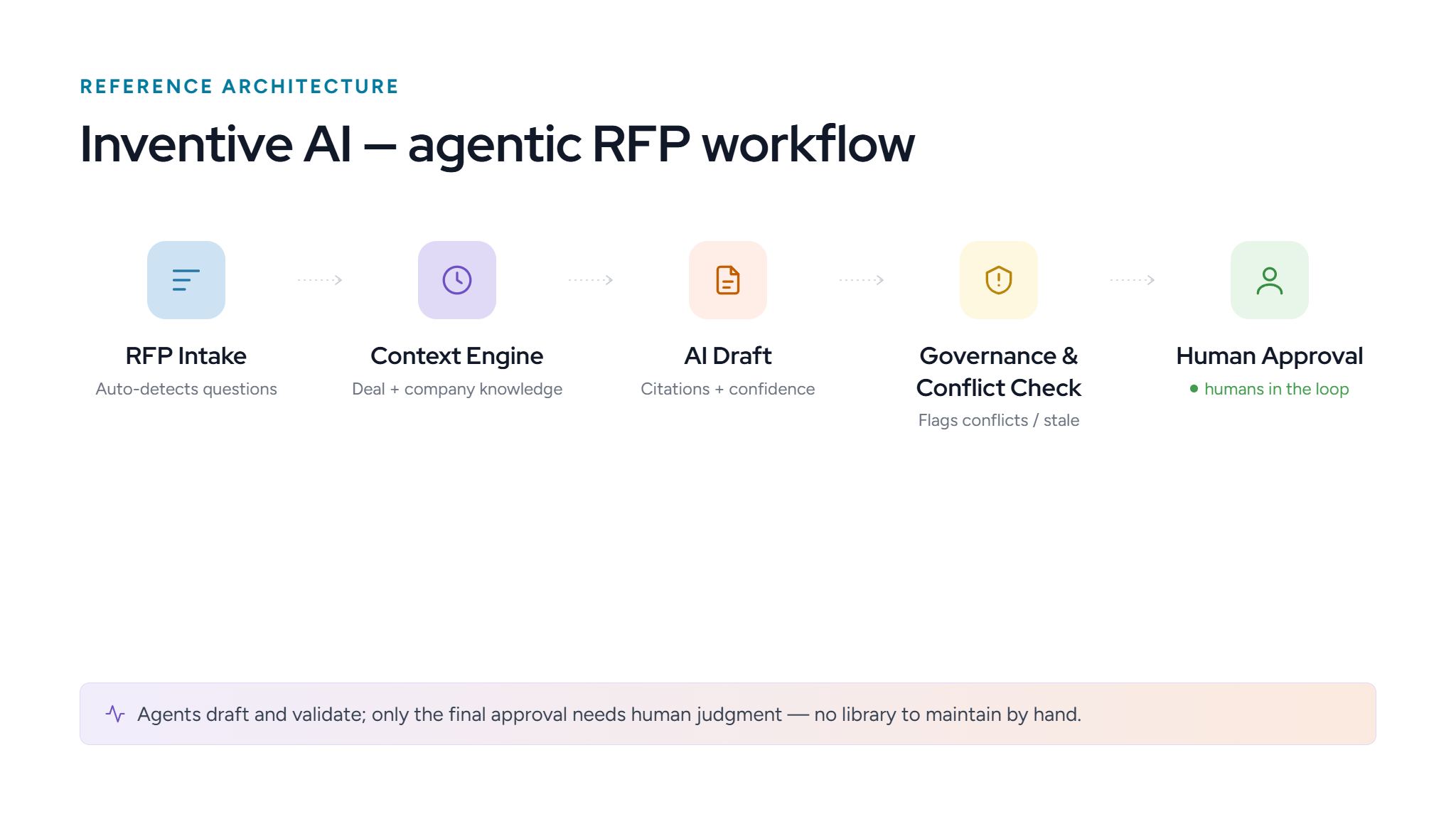
If you're weighing Qvidian against Responsive, it helps to know a different category has grown up beside them: AI-native, agentic proposal platforms that are replacing legacy tools, taking an alternative architectural route rather than building on a library teams maintain. Inventive AI is one example of that approach.
Inventive AI is positioned as an autonomous, AI-agentic platform for RFPs, RFIs, DDQs, and security questionnaires, built for proposal teams, presales, solution engineering, sales ops, InfoSec, and legal, with humans in the loop for approvals. Rather than centering on a repository teams maintain, Inventive AI connects to systems already in use and runs the response workflow with agents.
Key capabilities of Inventive AI
• AI first drafts generated with source references, supporting context, and a confidence score on each response.
• Knowledge Hub that connects SharePoint, Google Drive, Salesforce, Confluence, Notion, and more, live-syncing when a source doc changes.
• Content Governance Agent that detects conflicting info, flags outdated content, and surfaces duplicates automatically.
• Context Engine that tailors responses per deal using customer priorities, sales notes, and CRM data.
• Competitive Intelligence Agent that compares positioning against named competitors within a response.
• Format flexibility across Excel grids and narrative proposals.
• Collaborative review and approval workflows with progress tracking; approved answers feed back into the Knowledge Hub.
• Hallucination control — every answer ships with a citation and confidence score, flagging "unavailable" rather than guessing; RAD AI reported 2x more client-ready answers than the next-best tool tested.
Best for: mid-market and enterprise teams that want agents to run the RFP process end to end — rather than maintaining a library and editing retrieved answers by hand.
Why buyers comparing Qvidian and Responsive might look at Inventive as an alternative
The shared pain point across both incumbents is library upkeep and human editing of retrieved answers. Inventive AI is positioned to reduce that overhead by drafting with a governance agent and Context Engine instead of relying on a repository your team maintains. Insider, for instance, reported its win rate moving from 30% to 50% with 90% faster RFP responses in its case study. If that maps to your bottleneck, see how the agentic workflow handles your own questions in a demo.
Frequently Asked Questions
Is Qvidian better than Responsive?
Neither is universally better. Qvidian suits large enterprises wanting library-driven proposal automation deep in Microsoft Office; Responsive suits teams wanting broader AI answering and collaboration across RFPs, DDQs, and security questionnaires. Match each to your workflow during demos.
How much does Qvidian cost?
Qvidian doesn't publish pricing — it's quote-only. A third party estimates roughly $15,000–$25,000/year for a base license, but that's an estimate, not a vendor-confirmed figure. Request a written quote for your seat count.
How much does Responsive cost?
Responsive is also quote-only; its editions all read "Contact sales." Vendr describes per-named-user pricing with add-ons, and a third party estimates ~$5,000–$29,000+ depending on team size — again, an estimate, not confirmed.
Which has better AI, Qvidian or Responsive?
Responsive offers more visible AI answering; Qvidian leans on library retrieval and document assembly, with users requesting smarter, more contextual search. Both layer AI onto a content-library foundation, so test draft quality on your own edge-case questions.
What is an alternative to Qvidian and Responsive?
Alternatives include Loopio, Proposify, and a newer category of AI-native, agentic platforms. For a curated view, see our best RFP software roundup and the enterprise RFP software comparison.
Is there an AI-native alternative to Qvidian and Responsive?
Yes. AI-native platforms such as Inventive AI use autonomous agents to draft, validate, and govern responses rather than centering on a manually maintained library. See how it compares against each incumbent: Qvidian vs Inventive AI and Responsive vs Inventive AI.
Related Comparisons and Resources
For deeper research as you finalize your shortlist:
• Qvidian competitors and alternatives
• Responsive (RFPIO) competitors and alternatives
• RFP software comparison guide
• Enterprise RFP software comparison
• Case study: Insider — 50% higher win rate, 90% faster responses
• Case study: AssetWorks — 422% ROI on RFP automation
• Case study: 90% faster RFPs, zero weekend hours lost
Sources
• Qvidian reviews — G2, Capterra, TrustRadius
• Responsive reviews — G2, Capterra, TrustRadius
• Pricing — Qvidian pricing breakdown (third party), Responsive pricing page, Vendr Responsive marketplace, Responsive pricing guide (third party)
• Additional — Technology Evaluation: Qvidian, G2 Loopio vs Responsive comparison
_Ratings, review counts, and pricing are reported at time of writing (January 2026) and change frequently. Confirm current figures on the live listings and directly with each vendor before purchasing._

.avif)